
Alhambra · Granada · Independent guide
Alhambra audio guide,
five stops, free.
A walled palace city on a hilltop, about 700 to 740 metres long and begun in 1238: all five stops stream in this tab, and Chiaro narrates the rest of it from a photo.
Made by Chiaro. Not affiliated with the Alhambra.
The Gate of Justice, from the esplanade
Alhambra, Granada
That was the free part
Chiaro narrates anything at the Alhambra from a photo.
The five stops · 11 minutes of audio
Five places, one walk,
in the order you will walk them.
This self-guided Alhambra audio guide crosses the hill from west to east in five stops, and you can hear the first two before buying any ticket. It starts outside the walls, on the esplanade in front of the Gate of Justice at the top of the path up through the Alhambra Wood; then through the Puerta del Vino to the round courtyard of the Palace of Charles V, which is free to enter; then into the Nasrid Palaces at the time printed on your ticket, for the Court of the Myrtles and the Court of the Lions; and last across the ravine to the Generalife and its Court of the Main Canal, on the way out. Together the recordings run to about eleven minutes. The Patronato puts a general visit at around three hours, and the Nasrid Palaces time on your ticket decides the order of everything else, so plan the rest of the day around it.
Every name, date and measurement on this page was checked against the Patronato de la Alhambra y Generalife's own pages and a second source on 23 September 2026, and every visit fact is filed with the sentence it came from, so we hear about it when the Patronato changes something. Hours change with the season and itineraries can be modified at short notice, so check the Patronato's own homepage for the day you are going. The August 2026 earthquake showed how fast that can happen, so on the day the staff at the Access Pavilion outrank anything written here.
Martin Furtschegger, CC BY 3.0, via Wikimedia Commons, cropped. Photo: Martin Furtschegger
,_Alhambra_-_panoramio.jpg)
Stop 1 of 5 · Outside the walls, on the esplanade in front of the Gate of Justice at the top of the path up through the Alhambra Wood from the Puerta de las Granadas; no ticket needed
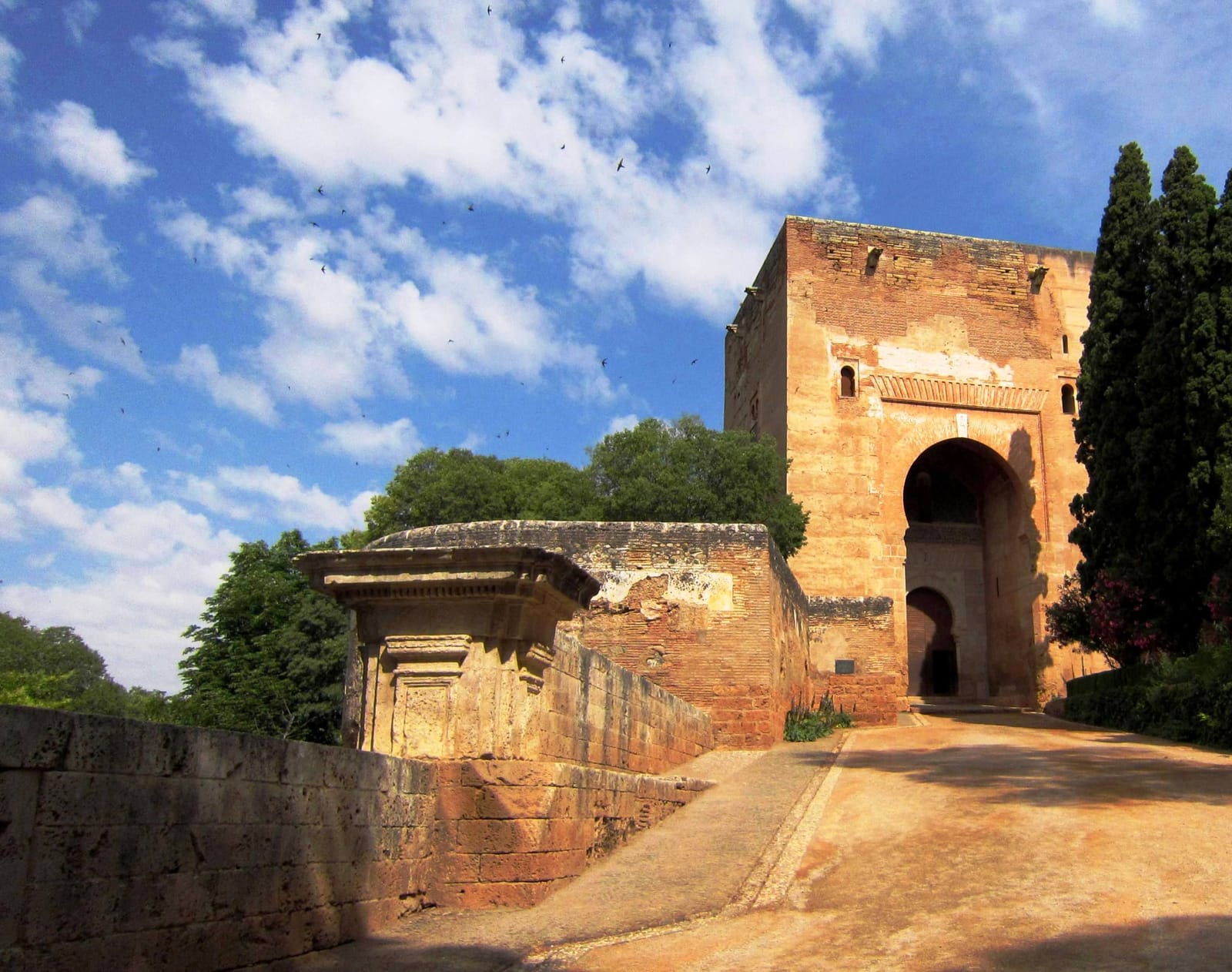
The Gate of Justice, from the esplanade
Nasrid builders under Sultan Yusuf I (reigned 1333–1354); the Gothic Virgin and Child by Roberto Alemán, set up on the order of the Catholic Monarchs · 1348; the foundation inscription gives 30 May to 28 June 1348 · Brick horseshoe arch in a stone and rammed-earth tower gate, the largest of the four outer gates of a walled site about 700 to 740 metres long; the passage inside turns 90 degrees twice
Look for
- The hand carved on the keystone of the great outer arch. Its five fingers are read as the Five Pillars of Islam.
- Deeper in, on the inner arch, the key, with the band of Arabic foundation inscription above it and a Gothic Virgin and Child set over that by order of the Catholic Monarchs.
- The door itself: iron-plated leaves and original ironwork, framed by four engaged columns whose capitals carry the Muslim profession of faith.
- Against the wall beside the gate, the Pilar de Carlos V, a Renaissance fountain of 1524 with three spouting masks the Patronato reads as Granada's rivers, the Darro, the Beiro and the Genil.
Transcript (2:08)
You have just walked up through the wood, and this is the way the Alhambra was meant to be entered. The square tower in front of you, with the tall brick horseshoe arch cut into it, is the Gate of Justice, built in 1348 under Sultan Yusuf the First. Of the four gates in the Alhambra's outer walls it is the largest, and the Patronato that runs the site today calls it the most monumental. Its Arabic name was Bab al-Shari'a, the Gate of the Law.
Look up at the keystone of the great arch. There is a hand carved on it, five fingers spread. The usual reading is that the fingers stand for the Five Pillars of Islam, and the hand itself is read as a sign of welcome, and a charm against the evil eye. Now look through the arch, into the shadow, at the smaller inner arch behind it. On that one there is a key.
Above the key runs a band of Arabic script. That is the foundation inscription, and it names the gate and gives the dates it was finished, between the thirtieth of May and the twenty-eighth of June 1348. And above the inscription, in a niche, sits something that was never meant to be there: a Gothic Virgin and Child by Roberto Alemán, placed there on the orders of the Catholic Monarchs, Ferdinand and Isabella, after they took Granada. You are looking at the conquest, in stone, in a single doorway.
The door still has its iron-plated leaves and its original ironwork, and the four columns framing it carry the Muslim profession of faith on their capitals. Go through, and the passage will not let you walk straight in. It turns ninety degrees to the left, then ninety degrees to the right, up a steep ramp, with an opening overhead from which defenders could drop things on anyone forcing the way. The vaults inside are painted with red imitation brickwork, a Nasrid habit you will see again.
For over three hundred years this tower was also somebody's house. From the conquest in 1492 until Napoleon's troops arrived in 1810 it was the official home of the Alhambra's gatekeeper.
Before you go in, turn left. Against the wall below the round artillery bastion is the Pilar de Carlos V, a Renaissance fountain of 1524 with three stone masks spouting water, which the Patronato reads as Granada's three rivers. And one more thing about the colour of everything around you. Alhambra comes from the Arabic al-Hamra, the red one, because these walls are rammed earth made from a local clay full of iron oxide. The red you are standing among is the name.
Roland Geider (Ogre), Public domain, via Wikimedia Commons. Photo: Roland Geider (Ogre)

Stop 2 of 5 · Inside the walls between the Puerta del Vino and the entrance to the Nasrid Palaces, in the round courtyard; free, no ticket needed
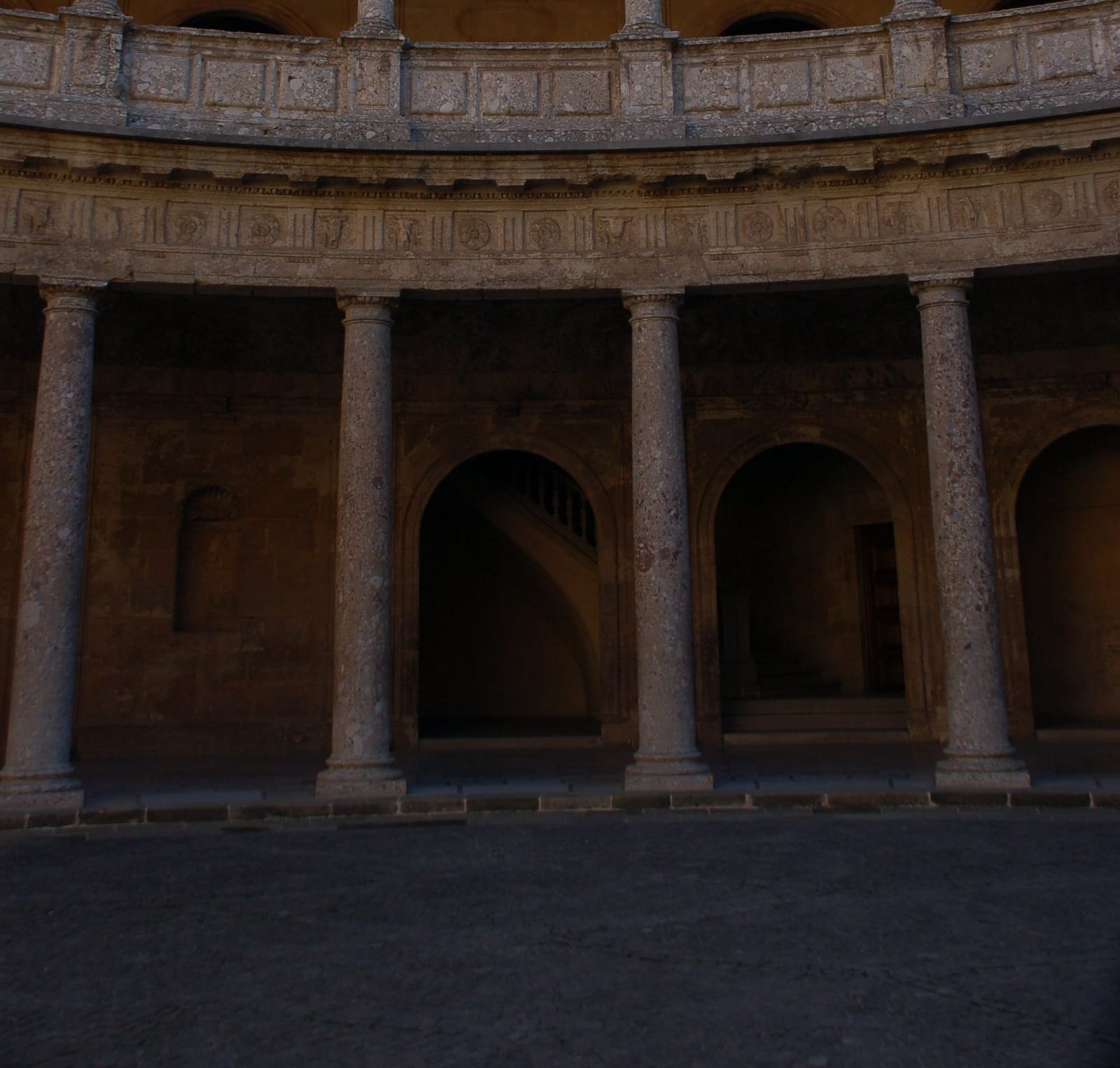
The Palace of Charles V, the round courtyard
Pedro Machuca (c. 1490–1550) for the Emperor Charles V; the round courtyard built by his son Luis Machuca · Begun 1527; upper colonnade finished 1619; abandoned unroofed in 1637 and completed as a museum between 1923 and 1958 · Stone; a square of 63 metres a side enclosing a circular courtyard of two storeys, Doric columns in pudding stone below and Ionic columns above
Look for
- The lower columns: pudding stone, a conglomerate, with the pebbles showing in every shaft.
- The frieze above them, triglyphs alternating with carved garlands and ox skulls, straight out of ancient Rome.
- The circle itself. Stand in the middle and the colonnade reads all the way round you, a perfect ring set inside a square building.
Transcript (2:09)
Stand in the middle of the courtyard and turn slowly on the spot. Everything around you is a circle, and it is a circle inside a square: the building is 63 metres a side, and this round courtyard is cut out of the middle of it. Nothing in Renaissance architecture had been built like that before.
It is here because of a honeymoon. In 1526 the Emperor Charles the Fifth came to the Alhambra with his new wife, Isabella of Portugal, after their wedding in Seville, and decided he wanted a palace of his own on the hill. Not a capital; he was an emperor who spent his life travelling across Europe. What he wanted was a residence with a message, inside the Muslim citadel his grandparents, Ferdinand and Isabella, had conquered. The Patronato puts it plainly: the decision to build here symbolised the triumph of Christianity over Islam.
The design is Pedro Machuca's, an architect trained in the Rome of Pope Leo the Tenth, and he ran the works from 1533 until he died in 1550. Look at the columns on the ground floor. They are Doric, and they are pudding stone, a conglomerate rock that shows its pebbles in every shaft. Above them runs a frieze of triglyphs and carved panels with garlands and ox skulls, the vocabulary of ancient Rome brought to a Nasrid hilltop. Machuca's son Luis built this courtyard after him. Then the Morisco rebellion of 1568 stopped work for fifteen years, the upper Ionic colonnade was only finished in 1619, and in 1637 the whole project was abandoned with no roof on it. When Philip the Fourth visited Granada in 1628 he could not even stay here: after ninety years of building it still was not habitable.
It got worse before it got better. During the Napoleonic war the French used the palace as an artillery store, and afterwards it served as a powder magazine full of gunpowder and shot, in the middle of the Alhambra, until it was finally emptied in 1832. The roof came in the twentieth century: Leopoldo Torres Balbás began turning the building into a museum in 1923, and Francisco Prieto Moreno finished it in 1958.
Here is the part that matters for your next stop. To make room for all this, part of the Nasrid Comares Palace next door was pulled down. When you reach the Court of the Myrtles, look at the facade at its south end; there is nothing behind it any more, because this building took its place. Across the square outside is the Alcazaba, the oldest part of the Alhambra, and it was on its watchtower that the flag of Ferdinand and Isabella was first raised, on the second of January 1492.
Jebulon, CC0, via Wikimedia Commons. Photo: Jebulon

Stop 3 of 5 · Nasrid Palaces, Comares Palace, the Court of the Myrtles, at the north end of the pool with the Comares Tower behind you
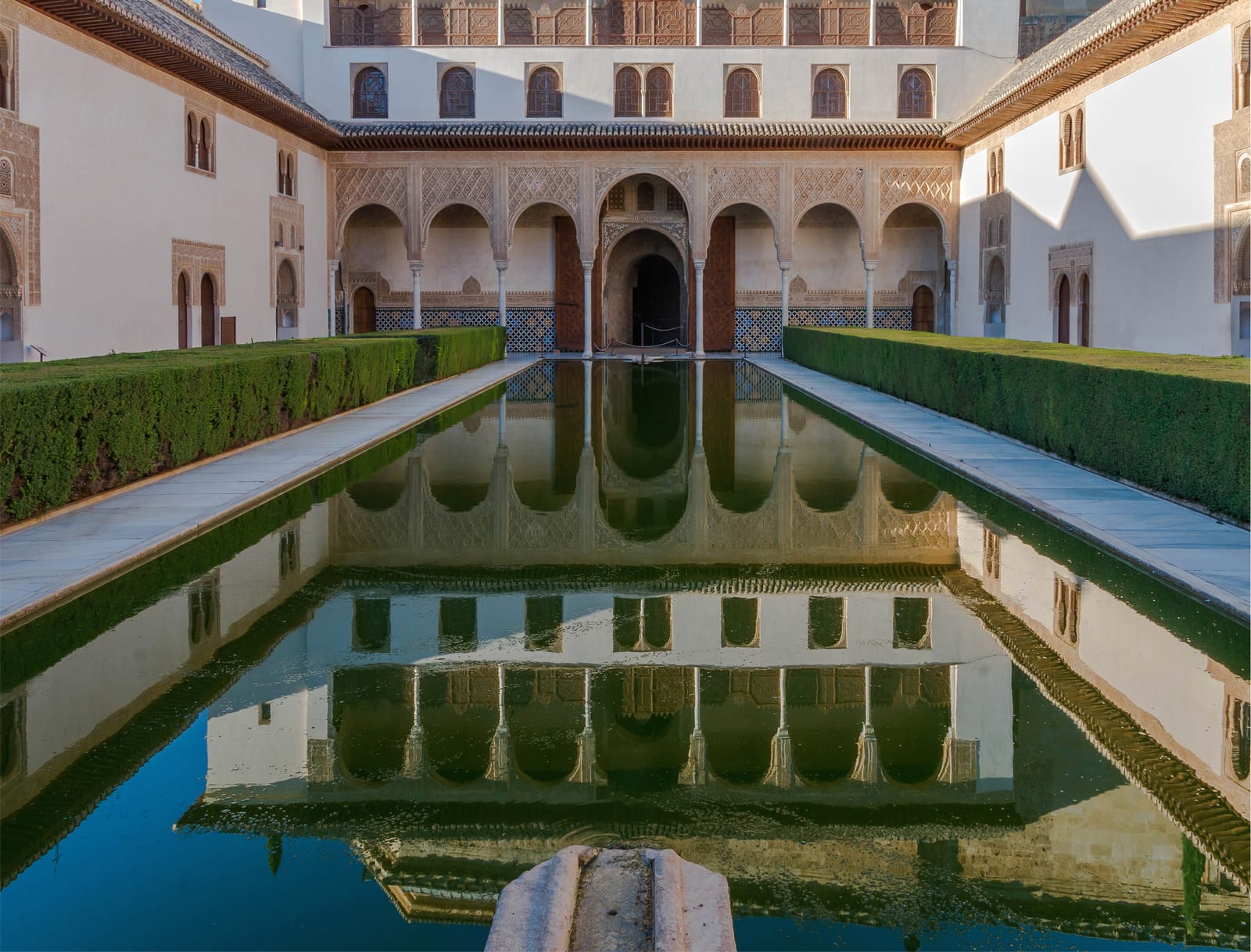
The Court of the Myrtles
Nasrid builders under Isma'il I, Yusuf I and Muhammad V; the Comares Tower and the Hall of the Ambassadors built for Yusuf I · Begun under Isma'il I (reigned 1314–1325); refurbished by Muhammad V between 1362 and 1367 · Stucco, tile and marble round a courtyard 36.6 metres long and 23 to 23.5 metres wide, with a pool 34 metres long; the Comares Tower rises 45 metres
Look for
- The reflection. From the end of the pool the whole south portico hangs upside down in the water.
- The short channel from the round fountain at your feet into the pool, designed so the water slows and pauses before it goes in and leaves no ripple.
- Across the court, the tall facade above the south portico with nothing behind it: all that is left of the pavilion demolished for the Palace of Charles V, whose stone wall shows over the roof.
Transcript (2:06)
Stand at the end of the pool and look down the length of it before you look at anything else. The water is doing a job. The whole south portico, seven arches and the wall above them, hangs upside down in it, and the Patronato describes the pool exactly that way: a mirror that breaks the flat horizontal lines of the court. The pool is 34 metres long in a courtyard 36.6 metres long, and the myrtle hedges along both sides give the place its name.
Now look at your feet. There is a small round fountain here, and a short channel from it into the pool. That channel is built so the water slows and pauses before it enters, so no ripple ever spoils the reflection. A whole courtyard designed around a still surface.
This was the heart of the Comares Palace, the official palace of the Nasrid sultans. Isma'il the First began it early in the fourteenth century, and Muhammad the Fifth gave it its final look in the 1360s. In a Hispano-Muslim house, the Patronato says, you could not tell a family's wealth from the outside; you found out in the courtyard. A palace was the same idea on a bigger scale.
Behind you is the Comares Tower, 45 metres high, the tallest in the Alhambra. Behind the portico at your back, filling the tower, lies the largest room in the whole complex, the Hall of the Ambassadors, the sultan's throne room. It is a square hall eleven point three metres square and eighteen point two metres high, and its ceiling is built from 8017 interlocking pieces of wood, a pattern read as the seven heavens. It was in that hall, in 1492, that Christopher Columbus put his plans for the Atlantic crossing to Ferdinand and Isabella. The contract itself was signed on the seventeenth of April, not here but at Santa Fe, outside Granada. When later Spanish kings came to stay, their flag flew from this tower rather than from the Alcazaba's watchtower.
Then turn back to the far end. The facade above the south portico is standing on its own. The halls behind it were demolished in the sixteenth century to make room for the Palace of Charles V, and the builders kept only this face, so the courtyard would still look complete from here. You can see the Emperor's stone wall showing above the roofline.
One last thing. The walls around you are carved stucco and the colours have gone, but they were painted in red, blue and gold, and among the carving are poems composed for the palace by the court poet and vizier Ibn Zamrak.
Jebulon, CC0, via Wikimedia Commons. Photo: Jebulon

Stop 4 of 5 · Nasrid Palaces, Palace of the Lions, in the courtyard gallery at the Hall of the Muqarnas end, looking at the fountain
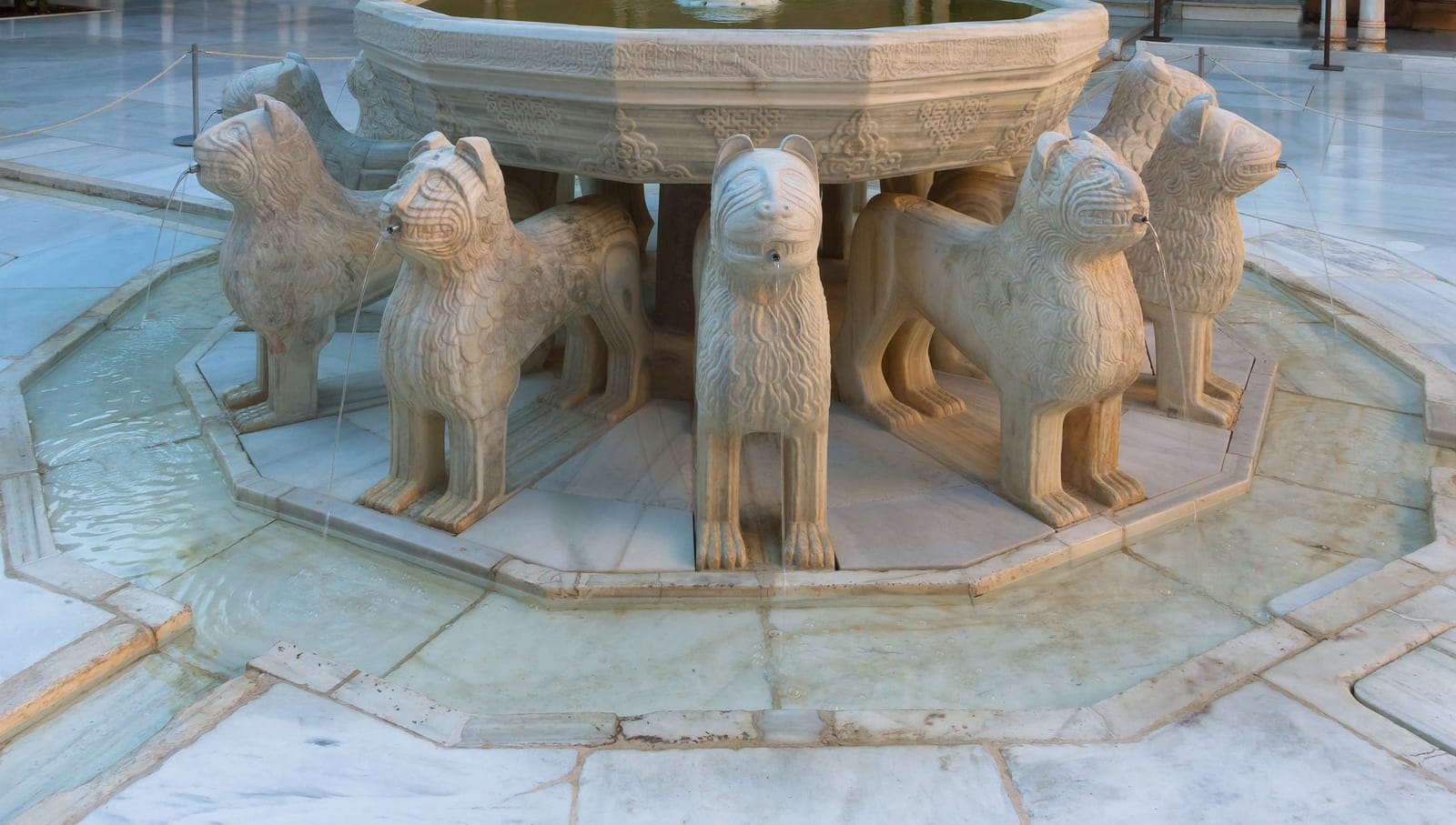
The Court of the Lions and its fountain
Nasrid builders for Sultan Muhammad V; the poem on the basin by his vizier Ibn Zamrak · Muhammad V's second reign, 1362–1391; the lions restored 2002–2011 and returned in December 2011 · Macael marble fountain of twelve lions round a basin carved from a single piece, in a courtyard about 28.7 metres long and 15.6 metres wide
Look for
- The inscription running round the rim of the basin: Ibn Zamrak's poem, describing the fountain you are looking at and how its water works.
- The columns: single ones alternating with pairs and threes all the way round, a rhythm found nowhere else in Islamic architecture.
- The four water channels in the marble floor, running from the halls to meet at the fountain.
- The two pavilions pushing out into the courtyard at the east and west ends on their slender columns.
Transcript (2:45)
Twelve marble lions, standing in a ring and facing outwards, with a twelve-sided basin on their backs and water running from their mouths. That is the fountain, and everything else in this courtyard is arranged around it.
Muhammad the Fifth built the Palace of the Lions in his second reign, between 1362 and 1391. His first reign had lasted five years before he was overthrown, and when he came back he built this. The Patronato calls it the architectural pinnacle of the Alhambra.
Start with the columns, because they are the courtyard's real trick. Walk your eye along any side: a single column, then a pair, then three together, then a single one again. Nothing else in Islamic architecture has that rhythm. The courtyard is about 28.7 metres long and 15.6 metres wide, and at the east and west ends two pavilions push out into it on the same slender columns.
Now look at the floor. Four water channels run across the marble from the four halls and meet at the fountain. The usual reading is the four rivers of Paradise.
Now look at the rim of the basin, because it carries an inscription. Carved around it is a poem by Ibn Zamrak, the sultan's vizier, and it describes the very fountain it is carved on: the lions, and the way the water works. The idea was for the water to lie in the basin as a still, solid-looking sheet. A cylinder in the middle fed it and drained it at the same time, so it never overflowed. The basin itself was cut from a single piece of marble, and it was once painted in soft colours that centuries of cleaning have taken off.
The fountain you see has come back from a lot. In the sixteenth century someone stacked extra tiers on top of it. The sculptor Alonso de Mena repaired it in 1624, another spout was added in 1837, and only in 1966 was it returned to its presumed original form. Then, in 2002, one lion was taken away for restoration, and in 2007 the other eleven followed. After two years on show in the Alhambra Museum they came back here in December 2011, and in 2012 a replica of the original pierced cylinder replaced the plain water jet. The gravel that used to cover this floor went too, replaced with Macael marble after studies showed the bedrock underneath left too little soil for any garden.
Four halls open off this courtyard. On the south side is the Hall of the Abencerrages, named after a sixteenth-century legend that members of that family were invited to a banquet there and murdered; there is no historical link between the family and the room. Opposite, on the north side, is the Hall of the Two Sisters, named after two big marble slabs in its floor, under a muqarnas dome of at least 5000 pieces. On the east side, the Hall of the Kings has painted leather ceilings, one showing ten seated dignitaries in conversation, restored in 2018. And behind you, on the west side, is the Hall of the Muqarnas, the room you came in through.
Look up at the pyramid roof of the east pavilion before you leave. In 1859 a restorer, Rafael Contreras, gave it a round tiled dome that he thought looked properly Arabic. Leopoldo Torres Balbás took the dome down in 1934 and replaced it with the pyramid you see, and that swap set off an international debate about the nature of restorations.
Jebulon, CC0, via Wikimedia Commons. Photo: Jebulon

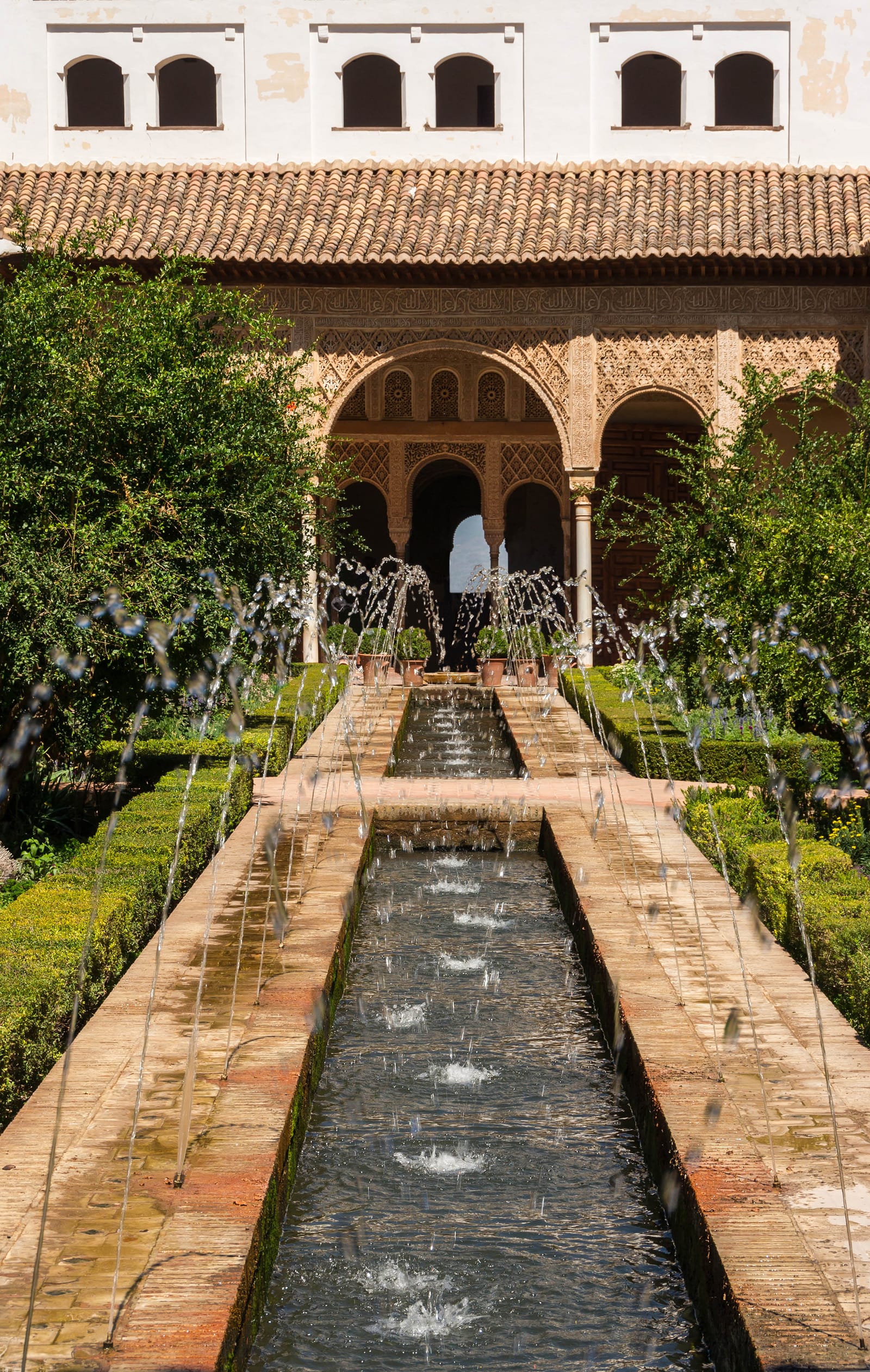
Stop 5 of 5 · Generalife, Palace of the Generalife, the Court of the Main Canal (Patio de la Acequia), at the south end looking north along the water
The Generalife: the Court of the Main Canal
Nasrid builders under Muhammad II or Muhammad III; its decoration redone for Isma'il I; the upper gallery of the north pavilion added by the Catholic Monarchs · Late 13th or early 14th century; redecorated 1319; upper gallery 1494; jets 19th century · A courtyard garden 48.7 metres long and 12.8 metres wide, fed by the Acequia Real, with a carved-stucco portico of five arches at its north end
Look for
- The jets arching over the channel. They are nineteenth-century, not Nasrid.
- The north portico of five arches with its bands of carved inscription, and through its centre the arch of the mirador on the far side.
- The arcaded gallery down the west side and, in the middle of it, the small projecting mirador with low windows facing the Alhambra.
- The Catholic Monarchs' yoke and arrows painted inside the arches of that gallery.
Transcript (2:07)
This is where the sultans came to get away from the Alhambra. The Generalife was their country estate, outside the walls and across the ravine, a retreat and a working farm at the same time. It was most likely built at the end of the thirteenth century or the very beginning of the fourteenth, and Isma'il the First had it redecorated in 1319.
The courtyard in front of you is long and narrow on purpose: 48.7 metres by 12.8, about four times as long as it is wide. Down the middle runs the water, and that water has come a long way. It is the Acequia Real, the Royal Canal, which takes its water from the river Darro about 6.1 kilometres to the east and feeds the whole monument, the fountains you have already seen included.
Now the surprise. Those arching jets crossing the channel, copied in gardens all over the world, are not Nasrid at all. They were put in during the nineteenth century. When archaeologists dug here after a fire in 1958, they found the channel had once had twelve spouts, and they found the original Moorish paths and garden soil about 70 centimetres below the flowerbeds you are looking at. Then they covered it all up again and replanted.
Look along the left-hand side, the west. It was once a high blank wall, and this was a closed, private garden looking only inwards. After the conquest the wall was lowered and an arcaded gallery built along it, and if you look inside those arches you can find the Catholic Monarchs' badges painted there, the yoke and the arrows, with their motto, Tanto Monta. In the middle of that side is a small projecting room, the mirador, probably the court's only original window on the world. Its windows sit low because people sat on the floor, an arm on the sill, looking out over the gardens to the Alhambra hill and the city below. The stucco inside is from Isma'il the First's reign, laid over older work.
At the far end, the north pavilion: five arches of carved stucco with bands of inscription, and through the middle one, if you line yourself up, the arch of another mirador beyond. The open gallery on the floor above it was added by Ferdinand and Isabella in 1494.
When the Venetian ambassador Andrea Navagero came here in 1526 he wrote about a fountain that threw water ten fathoms into the air. From here the way out is the Walk of the Oleanders and the Promenade of the Cypress Trees, and through the windows of the gallery on your left, across the valley, the red walls of the hill you have just walked the length of.
Independent guide · Chiaro
Point Chiaro at anything at the Alhambra.
Every wall on this hill carries an inscription, and five stops reach only a handful of them. Aim your phone at a line of carved Arabic, a tile pattern, a capital or a tower with no label, and Chiaro reads out what it says and whose work it is, and stays with you for the next question.
Before you go
Getting there
Calle Real de la Alhambra s/n, 18009 Granada. The ticket office, lockers, information desk and audio-guide point are at the Access Pavilion at the eastern end, beside the car park. On foot from the city the classic way up is the Cuesta de Gomérez from Plaza Nueva, through the Puerta de las Granadas and the Alhambra Wood to the Gate of Justice, where the first stop on this page is.
On foot: the Cuesta de Gomérez from Plaza Nueva, the Cuesta del Realejo from Plaza del Realejo, or the Cuesta del Rey Chico, also called the Cuesta de los Chinos, from Paseo de los Tristes. City buses C30 (Alhambra to Plaza Isabel la Católica), C32 (Alhambra to the Albaicín) and C35 stop at the monument. Private cars cannot come up from the city centre; the Alhambra car park, guarded 24 hours, is reached by the southern ring road.
Tickets and entry
- The Nasrid Palaces have their own entry time, printed on your ticket, and you can only go in at that time: the Patronato admits 300 people every half hour, and if you are not at the palace entrance at your time you lose the palaces. Everything else can be seen at any time the monument is open, so build the day around that one slot, and collect your tickets at least an hour before it.
- The General ticket, 22.27 euros for an adult, normally covers the Nasrid Palaces, the Partal, the Alcazaba and the Generalife. The Gardens ticket, 12.73 euros, covers everything on the public route except the Nasrid Palaces, so it reaches the first two stops and the last one on this page but not the Court of the Myrtles or the Court of the Lions. The Palace of Charles V and the Alhambra Museum are free. Tickets are in your name, must be carried with ID, and sell online until 23:59 the day before; the Patronato recommends buying in advance because demand is high.
- At present the Alcazaba is closed to the public for safety reasons and access to the Comares Tower is closed, after the earthquake of August 2026; the Nasrid Palaces and the Generalife are open on their usual route. No stop on this page needs either closed area. Check the Patronato's homepage for the latest before you go.
- The monument opens from 8:30 to 18:00 from 15 October to 31 March and from 8:30 to 20:00 from 1 April to 14 October, every day, and closes on 25 December and 1 January. Each space can be entered once, bags larger than 40 by 40 centimetres are not allowed, and photographs are fine without flash or tripod.
The official audio guide
The Patronato de la Alhambra y Generalife does not run guided tours itself. It does offer its own audio guide, which is currently free during a trial phase; the audio-guide point is at the Access Pavilion. Ours needs no trip to the Access Pavilion: it runs on the phone in your hand, prints every word of the script below each of its five players, and keeps the two Nasrid Palaces stops ready for whenever your timed slot comes round.
Official site →Questions
Is there a free Alhambra audio guide?
There are two, and both cost nothing. The Patronato's own audio guide is free for now, in a trial phase, from the audio-guide point at the Access Pavilion. This page is the other one, five stops you start on your own phone with the script for each printed right below it. Anything off both routes, a stray tile or a doorway, you can photograph for the Chiaro app to narrate.
Do I need a ticket to listen?
No ticket is needed for the first two stops. The Gate of Justice stands outside the walls at the top of the path through the Alhambra Wood, and the Palace of Charles V is free to enter. The Court of the Myrtles and the Court of the Lions are inside the Nasrid Palaces, which need the General ticket and your timed palace entry. The Generalife, the last stop, is on both the General and the cheaper Gardens ticket.
How does the Nasrid Palaces time slot work?
Your ticket carries a specific entry time for the Nasrid Palaces, and that is the only time you can go in: the Patronato lets in 300 people every half hour, and anyone not at the palace entrance at their time loses the visit to the palaces. The rest of the monument can be seen at any time it is open, so plan the day around the slot. Tickets have to be collected at least one hour before it.
How much is the official Alhambra audio guide?
Nothing at the moment. The Patronato's own page says it currently offers a free audio guide in a trial phase, and the audio-guide point is at the Access Pavilion. The Patronato does not run guided tours itself.
Where do I start?
At the Gate of Justice. On foot from the city, walk up the Cuesta de Gomérez from Plaza Nueva, through the Puerta de las Granadas and up the path through the Alhambra Wood; the gate is at the top, and the first stop plays from the esplanade in front of it, before any ticket check. The walk then runs east through the palaces and ends in the Generalife, on the way out.
Is the Alhambra closed on any day?
It closes on 25 December and 1 January and is open every other day. Hours are 8:30 to 18:00 from 15 October to 31 March and 8:30 to 20:00 from 1 April to 14 October. At present the Alcazaba and the Comares Tower are closed for safety after the August 2026 earthquake, so check the Patronato's homepage before you go.
More audio guides
Made by Chiaro. Not affiliated with the Alhambra.