Sagrada Família · Barcelona · Independent guide
Sagrada Família audio guide,
five stops, free.
All five stream in this tab, with nothing to install and three of them playable from the pavement before you have a ticket. The tower of Jesus Christ topped out in February 2026 at 172.5 metres, on a building site that has been running for 144 years; point Chiaro at any part of it and it talks about that instead.
Made by Chiaro. Not affiliated with the Sagrada Família.
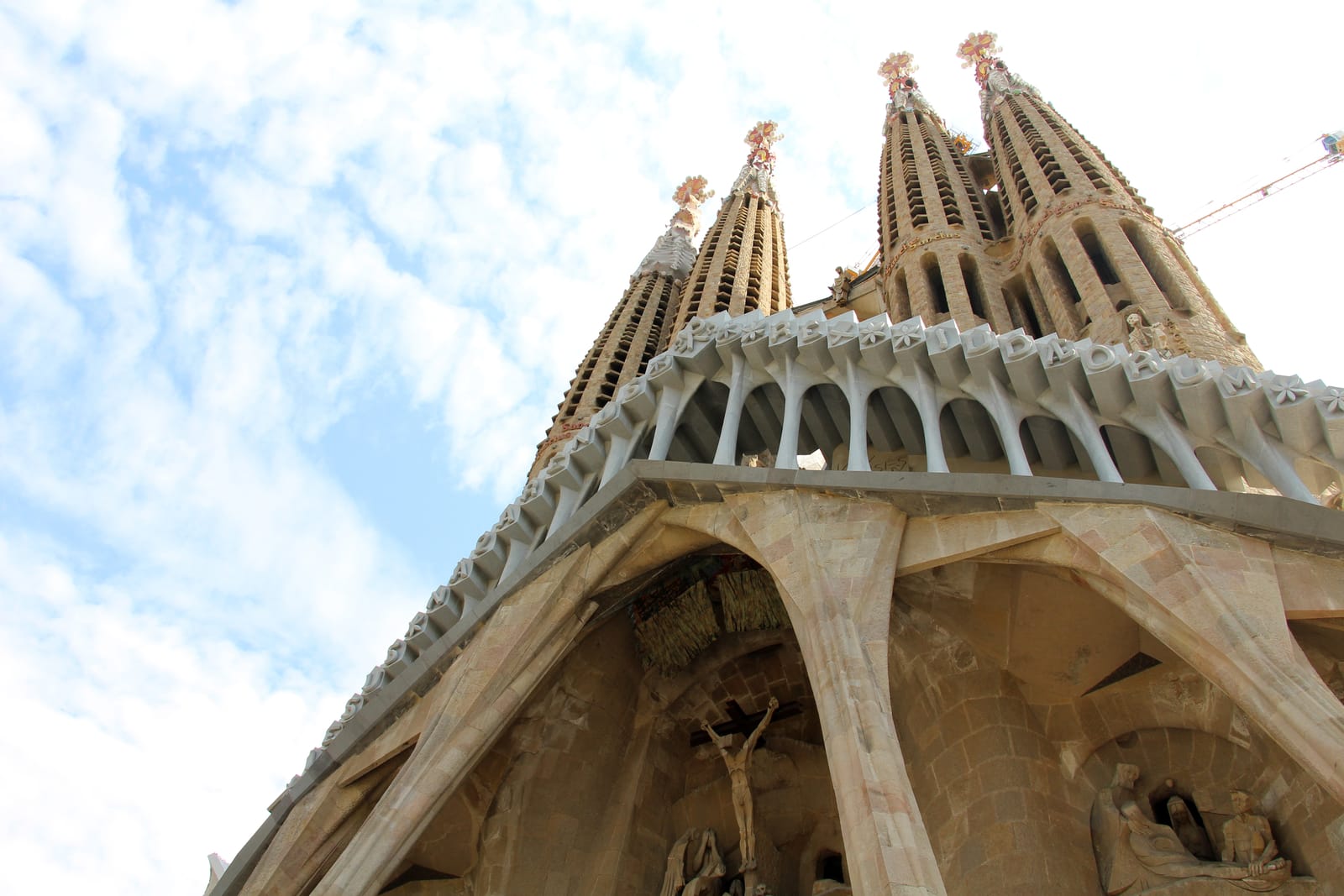
The Nativity façade, from the Plaça de Gaudí
Sagrada Família, Barcelona
That was the free part
Chiaro narrates anything at the Sagrada Família from a photo.
The five stops · 11 minutes of audio
Five places, one walk,
in the order you will walk them.
Three of the five stops in this Sagrada Família audio guide can be heard without a ticket, on a loop that circles the basilica and then passes through it. Start across Carrer de la Marina in the Plaça de Gaudí, where the pond holds the whole Nativity façade and its reflection. Walk one corner north-west onto Carrer de Provença for the apse wall, the only front Gaudí finished in his life. Come back to the general entrance on the Nativity side, stand in the transept under the columns, then go down to the museum at the Passion end. Finish outside on the Plaça de la Sagrada Família, looking back up at the Passion façade and the towers. About eleven minutes of listening, roughly 700 metres of walking end to end, and the basilica itself reckons the ticketed part of the visit at about an hour.
The opening times, ticket tiers, entrances and building dates here were taken from the Basílica de la Sagrada Família's website and its ten information booklets, which we read on 21 September 2026; we keep the exact line behind each one, so that when the basilica revises something we notice. Hours here are seasonal, and parts of the route close at short notice because this is still a working construction site. The signs at the basilica door have the final word over anything written here, and when they differ from us we want to hear about it.
Jesus Solana from Madrid, Spain, CC BY 2.0, via Wikimedia Commons. Photo: Jesus Solana from Madrid, Spain

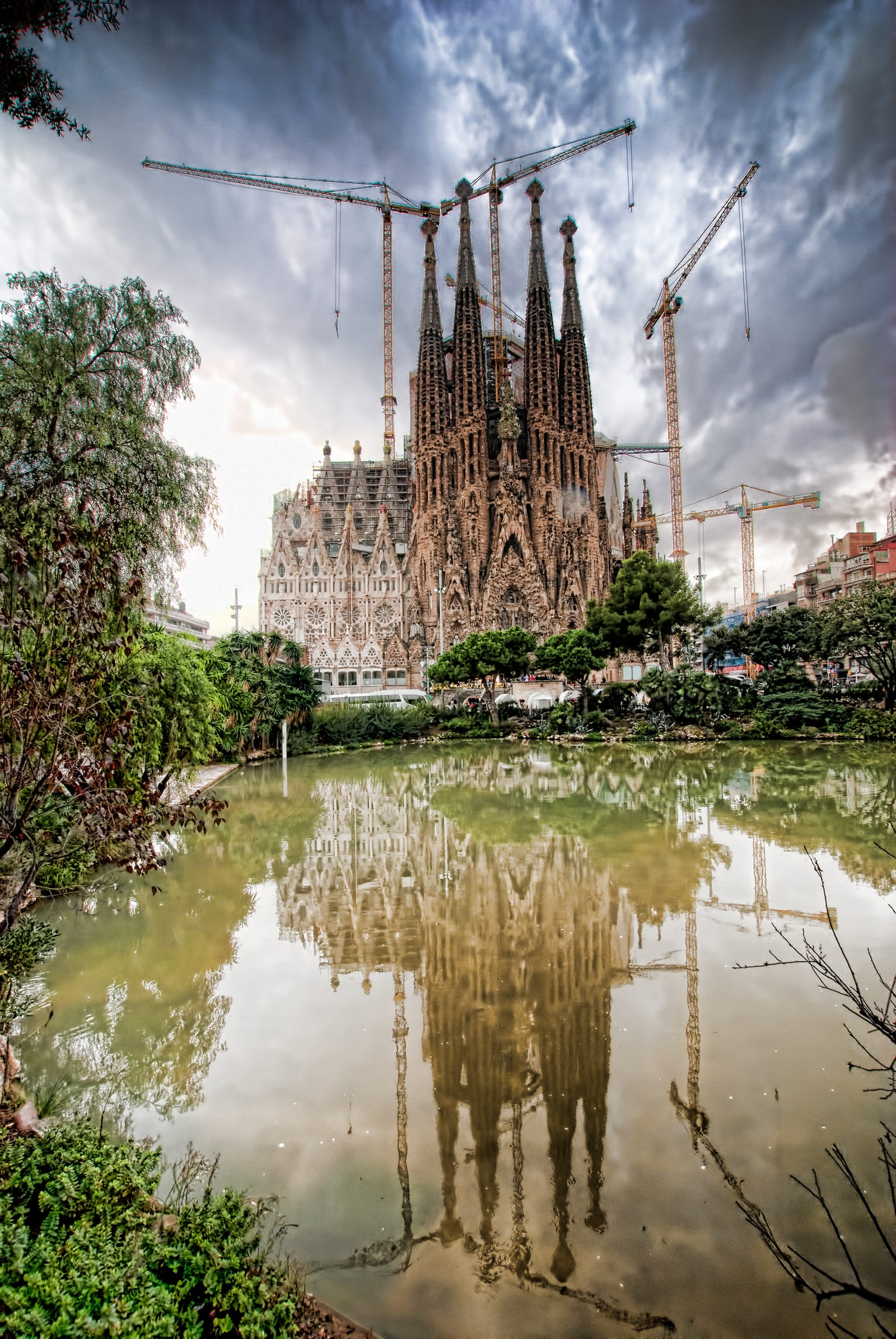
Stop 1 of 5 · Plaça de Gaudí, across Carrer de la Marina from the general entrance; the pond at the far end of the square gives the whole façade and its reflection
The Nativity façade, from the Plaça de Gaudí
Antoni Gaudí i Cornet (1852–1926); sculpture cut by his workshop under Llorenç Matamala i Piñol (1856–1925) and later by Jaume Busquets (1903–1968), with Civil War damage recarved from 1978 by Etsuro Sotoo · Begun 1891; the Saint Barnabas bell tower finished 1925, the other three in 1930 · Stone, with four bell towers, three portals and pinnacles of Venetian glass mosaic
Look for
- The cypress in stone over the central door, the tree of life, with white doves roosting in its branches and a cross shaped like a tau at the top.
- The turtles holding up the two columns between the portals: a sea turtle on the seaward side, a land tortoise on the mountain side, both of them symbols of time as something fixed. The chameleons at either end of the façade mean the opposite.
- The four bell towers, dedicated to the apostles Matthias, Barnabas, Jude and Simon. Barnabas is the one Gaudí lived to see finished, in 1925.
- The rosaries carved into the portal windows: ten beads in the centre, nine on the mountain side, seven on the sea side.
Transcript (1:57)
Turn your back on the trees and look across the water. From this side of the pond you get the whole Nativity façade, four bell towers and three doorways, and this is the front Gaudí worked on to the end of his life.
Work started on this side in 1891, and he chose to begin here deliberately. If he had started with the Passion front on the far side of the block, which he wanted harsh and bare, as if made of bones, he thought people would take one look and walk away. So he put the joyful one first, facing east into the sunrise, and let it sell the rest of the project.
One of those four towers is Saint Barnabas, finished in 1925. It is the only tower Gaudí ever saw completed. He died the following June. The other three, dedicated to the apostles Simon, Jude Thaddeus and Matthias, went up in 1930.
Now the doors. Hope on the left, Charity in the middle, Faith on the right, with the names Joseph, Jesus and Mary cut into the columns in between. Each of those two columns stands on a turtle, one from the sea and one from the land, both of them symbols of time as something fixed; the chameleons at either end of the façade mean the opposite.
Above the central door there is a cypress tree in stone, the tree of life, and if you follow its branches you will find white doves roosting all over it. They stand for the men and women saved by redemption.
Here is the surprise. None of this was supposed to be the colour it is. Gaudí meant the whole façade to be painted, every arch band in a wide array of colours, every statue and every figure, so that the human beings would look as alive as the plants and animals crawling over them. It never happened. You are looking at a literally unfinished picture.
The way the figures were made is stranger still. To get them lifelike, the workshop moulded them from real people and real animals. Gaudí would then have the plaster version hoisted up onto the façade to see how it read from down here, and only if he was happy with it was the final version cut in stone.
At the far end of this wall, tucked into the base of one tower, is the door to the portal of the Rosary. Gaudí left it finished in 1897 as a worked example, a piece of the inside done properly so that whoever came after him would know what he had meant. It is the only interior in the whole basilica he completed himself.
Craig Sunter from Manchester, UK, CC BY 2.0, via Wikimedia Commons. Photo: Craig Sunter from Manchester, UK
.jpg)
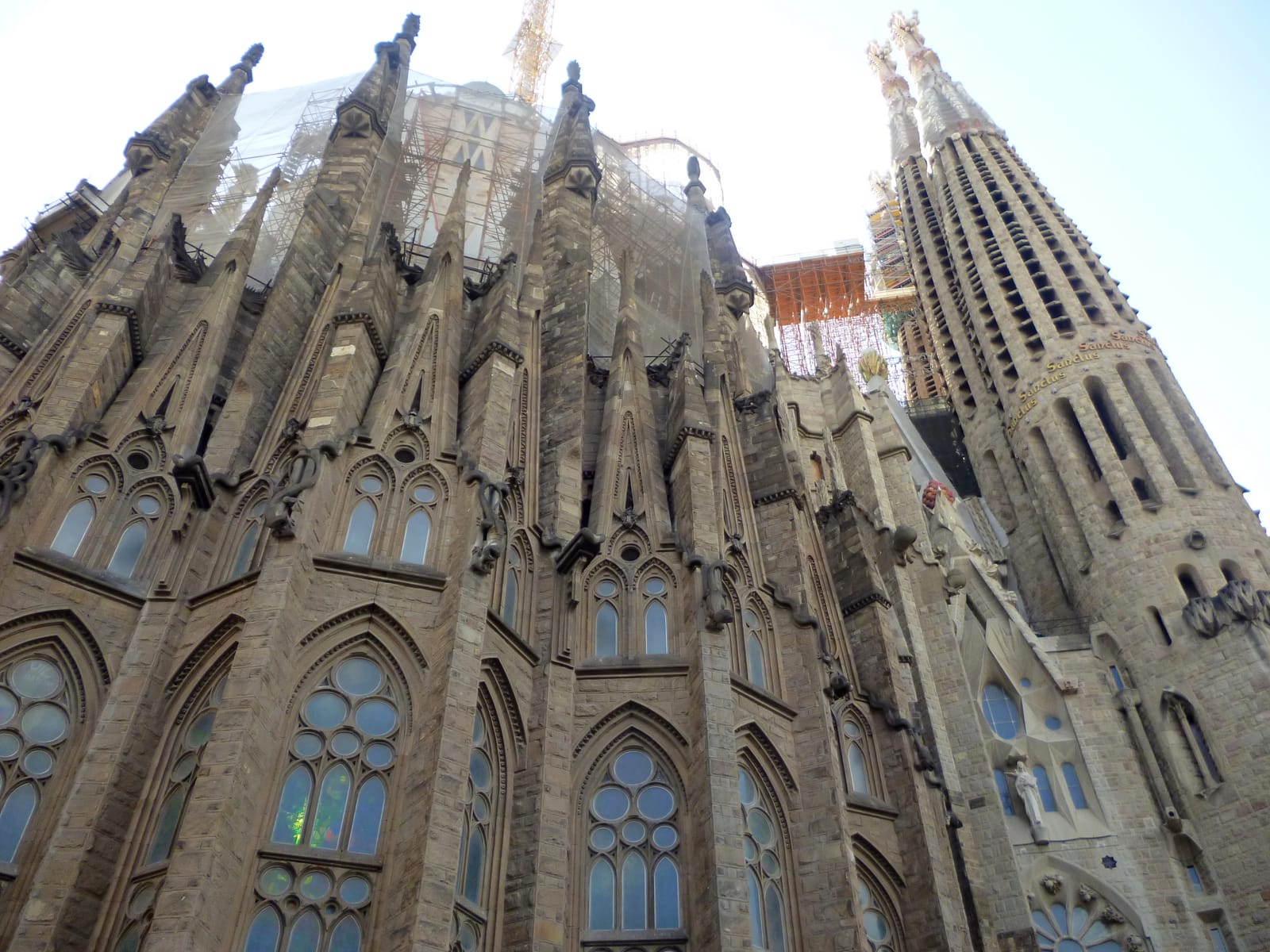
Stop 2 of 5 · Carrer de Provença, the north-west side of the block, one corner along from the Plaça de Gaudí; the crypt is directly underneath
The apse façade, from Carrer de Provença
Antoni Gaudí i Cornet (1852–1926), on the crypt foundations of the diocesan architect Francisco de Paula del Villar y Lozano (1828–1901); the only façade Gaudí completed · 1890–1893 · Stone, with six buttresses, seven chapels and pinnacles nearly 50 metres tall
Look for
- The gargoyles under the roofline: sea snails and land snails, lizards, frogs, toads and snakes, all of them working spouts that carry rainwater off the apse roof.
- The pinnacles, nearly 50 metres tall, crowned with plant motifs including the wild plants that grew on this ground before the church did.
- Three initials on the three windows of one chapel: a J, an M and another J, for Jesus, Mary and Joseph.
- The six buttresses dividing the seven chapels, and the way the plain lancets at the bottom give over to Gaudí's own shapes higher up.
Transcript (2:08)
One corner along from the pond, on the pavement of Carrer de Provença, you are standing in front of the only part of the outside of this church that Gaudí actually finished. The basilica says so itself, in its own visitor booklet: of the great fronts, the apse is the only one he was able to complete.
It went up between 1890 and 1893, which makes it the oldest thing above ground here. It is also the wall where you can watch him take the project over from somebody else. Francisco de Paula del Villar, the diocesan architect, designed a conventional neo-Gothic building and got as far as the crypt foundation before he resigned in 1883. Start at the bottom of this wall and the lancets and buttresses are still speaking Villar's language. Go up, and piece by piece it stops being his.
Gaudí built out of order, and that was a decision. Instead of laying foundations all the way round and then climbing storey by storey, he took one section of the church and drove it to the top, so the generations after him would have a finished thing to copy instead of drawings to argue about. Given what later happened to his drawings, that is the best decision anybody made on this site.
Now look for the animals. Run your eye along under the roofline and you will find the gargoyles, and they are not the usual monsters. They are snails, sea snails and land snails, along with lizards, frogs, toads and snakes, and they are doing a job: rainwater comes off the apse roof through them. Gaudí chose them because they were the creatures actually living on the waste ground he was building on.
The pinnacles above them climb to nearly fifty metres and are crowned with plants, including the wild ones that grew here before the church did. On the three windows of one chapel you can pick out three initials, a J, an M and another J, for Jesus, Mary and Joseph.
And under your feet, below this wall, is the crypt. The first Masses were said down there in 1885, in the chapel of Saint Joseph. Two men are buried in it. One is a bookseller, Josep Maria Bocabella, who set all this going in 1866: he founded a devotional society, published a magazine to collect donations, and bought this plot of land in 1881 with the proceeds. The other is Gaudí, who died in June 1926 leaving a church somewhere between fifteen and twenty-five percent built. Asked once why it was taking so long, he is supposed to have answered that his client was not in a hurry.
Julian Lupyan, CC0, via Wikimedia Commons. Photo: Julian Lupyan

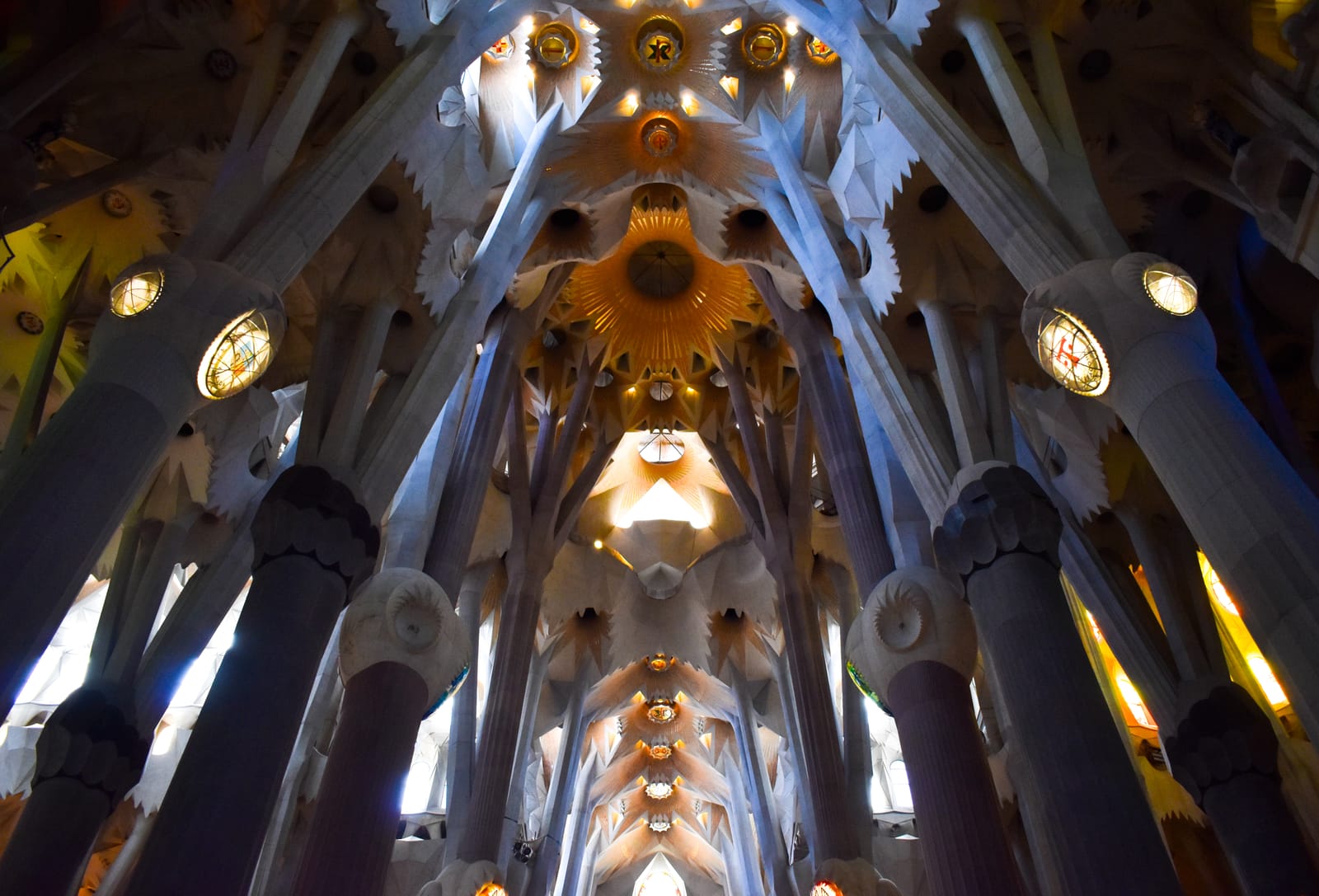
Stop 3 of 5 · Inside, standing in the transept: you come in through the Nativity doors with the Passion doors opposite, the nave running off to the left towards the Glory front and the apse rising to the right
The central nave, under the forest of columns
Designed by Antoni Gaudí i Cornet (1852–1926) and built to his plans from 1986 by the basilica's technical office under Jordi Bonet i Armengol (1925–2022) · Designed by 1926; the naves and vaults built from 1986, the central nave vaulting closed in 2000 · Red granite porphyry, black basalt, grey granite and sandstone cladding over reinforced concrete; central vaults 45 metres, the crossing 60, the apse 75
Look for
- The swelling at the top of each shaft, which does the job a capital would do and is meant to read as a knot in a trunk; above it the column branches at more than one height.
- The four twelve-pointed columns at the corners of the crossing: dark red granite porphyry, the thickest and strongest stone in the building, because they carry the central tower.
- Count the points of the star at the foot of the nearest column, then double the number. That is the column's height in metres.
- The hyperboloid openings punched between the columns, 289 of them, which is where the daylight coming down on you is getting in.
Transcript (2:37)
You are inside now, standing in the transept: the Nativity doors are behind you and the Passion doors are directly across. The long axis of the church crosses here, the nave running away to your left towards the unfinished Glory front, the apse rising to your right. Stop walking and look up.
Gaudí told his assistant Joan Bergós what he was after, and Bergós wrote it down: intimacy with the spaciousness of the forest, this will be the inside of the temple. That is the whole brief for this space. The shafts are trunks. The swelling at the top of each one, where a classical building would put a capital, is a knot. Above it the column branches, at more than one height, and the branches hold up the vault, which is the foliage.
The columns are his own invention. Each one begins as a star and ends as a circle: a star-shaped base twisting clockwise and anticlockwise at once, doubling its points every time it climbs half the height and turns half the rotation, until the polygon is so nearly a circle that he hid the last of it inside an egg-shaped knot, to keep the stonecutting possible. He took the idea of the rising twist from a eucalyptus tree growing outside his workshop next door.
Here is something you can check yourself. Go to the nearest column, count the points of the star at its foot, and double the number. That is its height in metres. Six points, twelve metres. Ten points, twenty.
The count is also a ranking: it tells you what that column carries, and each rank got its own stone. The four with twelve points, at the corners of the crossing in the middle of the building, are dark red granite porphyry, the strongest stone here, because they hold up the central tower. Ten points is black basalt, eight grey granite, six a yellowish sandstone for the lightest load.
And none of them is doing the work the way it looks. The stone is a skin. Solid columns thick enough to carry this roof would have closed the floor in, so Gaudí thought about iron for the four main ones, painted gold, and settled in the end on reinforced concrete inside the cladding, as his right-hand man Domènec Sugranyes explained to a meeting of Catalan architects in 1923.
Every height in here is a multiple of seven and a half metres, and they rise as you go inward: the side aisles thirty, the central nave forty-five, the crossing sixty, the apse seventy-five. That ladder is deliberate. Gaudí wanted somebody coming in at the main Glory door, away at the far end of the nave on your left, to see the nave vault, then the crossing vault, then the apse vault, each one appearing over the top of the last.
The daylight falling on you comes through openings he designed, two hundred and eighty-nine of them, punched between the columns to lighten the roof. The vaulting over your head was closed only in 2000 and the roof went on in 2010, the year an unfinished building could finally be used as a church. Pope Benedict the Sixteenth consecrated it that November in front of six thousand five hundred people, with another fifty thousand following from the streets outside.
Wmpearl, Public domain, via Wikimedia Commons. Photo: Wmpearl

Stop 4 of 5 · Museum, on the lower level under the Passion façade at the end of the visitor route
The museum and Gaudí's own workshop pieces
Antoni Gaudí i Cornet (1852–1926) for the objects; the museum set up in 1961 by the Junta Constructora del Temple Expiatori de la Sagrada Família · Museum created 1961; the workshop method in use since 1883 and resumed in 1939 after the fire · Plaster models, drawings, photographs, and Gaudí's own liturgical furniture in wood and wrought iron
Look for
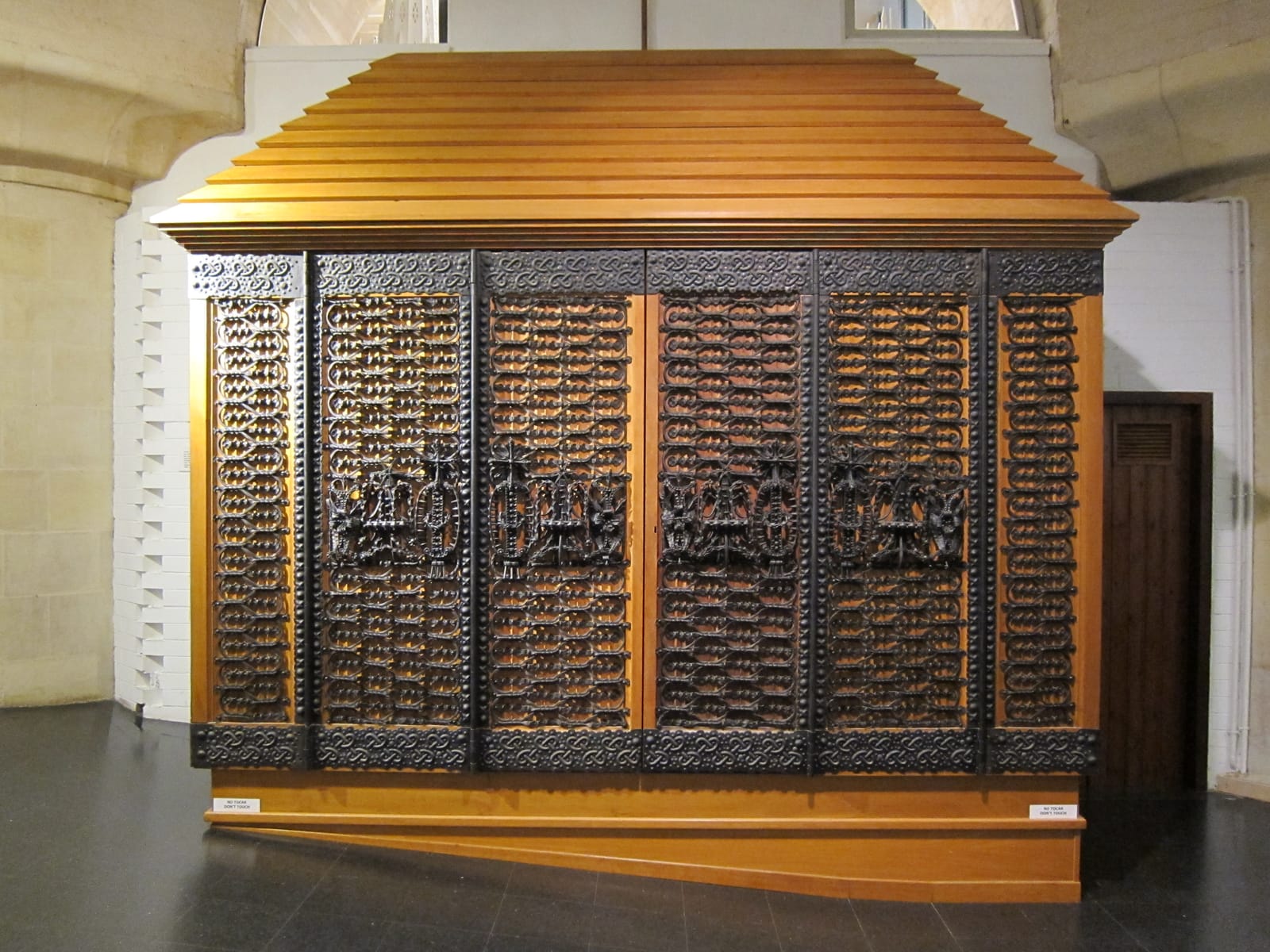
- Gaudí's vestment cabinet: pale wood with a wall of wrought-iron lattice set into it, and letters worked into the metal.
- The plaster models on the tables through the workshop window. That is not a display; the building is still designed that way.
- The three-dimensional printers standing next to the plaster, doing the same job.
- Gaudí's own model of a window pinnacle crowned with a basket of fruit, the pattern for the twelve baskets on the side walls outside.
Transcript (1:51)
Down here, under the Passion front, is where the building explains how it was ever possible.
Gaudí did not design this church on paper. He designed it in plaster. His first workshop stood on the corner of Carrer de Sardenya and Carrer de Provença, on the far side of the block from the door you came in by, and he rebuilt it as he went because it had to hold whatever he was testing that year. He made a model, looked at it, cut it about, made another. The basilica's own account of him puts it flatly: you cannot understand how any of his buildings were made without understanding the workshop.
Which is why July 1936 was nearly the end of the whole thing. Anarchists set fire to the crypt and broke into the workshop. The drawings burned. The photographs burned. The plaster models were smashed.
What happened next is the reason you are standing here at all. In 1939 Francesc de Paula Quintana took over the site, and the work went forward on two things only: the fragments that could be picked out of the wreckage, and whatever could be reconstructed from plans and photographs that had already been published elsewhere. Gaudí's old disciples then went looking for every scrap of paper about him they could find, and that salvage operation has grown into an archive of two thousand four hundred and fifty books and more than seventy-nine thousand press cuttings going back to 1871, including the obituaries printed in June 1926. It even holds books off Gaudí's own shelves, among them a dictionary of French architecture by Viollet-le-Duc, which he kept for professional reasons, and a Roman Missal, which he did not.
Find the models on the tables through the workshop window. That is not a display case. This building is still designed in plaster, by hand, next to the three-dimensional printers that now do the same job faster.
Then look for the cabinet for vestments that Gaudí designed himself, pale wood with a lattice of wrought iron set into it and letters worked into the metal. He drew the chalices and the candlesticks and the cupboards as well as the towers. It is the smallest scale he ever worked at, and the only one where you can stand close enough to see his handwriting.
Fred Romero, CC BY 2.0, via Wikimedia Commons. Photo: Fred Romero
.jpg)
Stop 5 of 5 · Plaça de la Sagrada Família, across Carrer de Sardenya from the Passion façade, where the visitor route comes out
The Passion façade and the towers, from the Plaça de la Sagrada Família
Antoni Gaudí i Cornet (1852–1926), who designed it in 1911 and published the porch drawing in 1917; built from 1954, the sculpture groups by Josep Maria Subirachs (1927–2014) from 1986, the central tower completed under Jordi Faulí i Oller · Foundation laid 1954; the four bell towers finished 1976; the cross set on the pediment in July 2018; the tower of Jesus Christ topped out 20 February 2026 · Stone on six inclined columns, under a pyramidal pediment of eighteen bone-shaped columns; the tower of Jesus Christ 172.5 metres, in post-tensioned stone panels
Look for
- The six columns holding the porch up. Not one of them is upright, and they are shaped like strained tendons rather than supports.
- The pediment above them, carried on eighteen more columns shaped like bones, with a gallery of hexagonal prisms along the top carrying the Latin sentence from the cross.
- The four bell towers, dedicated to the apostles James, Thomas, Philip and Bartholomew and finished in 1976, and the bridge slung between the middle two.
- Behind and above them, the tower of Jesus Christ: 172.5 metres, its cross closed on 20 February 2026, and one metre lower than the hill of Montjuïc.
Transcript (2:13)
Out through the doors, across into the square, then turn round and look back up. From directly underneath you get what Gaudí was actually after here, and it has little to do with the sculpture.
He designed this front in 1911, when he believed he was dying. He had fallen ill, gone up to Puigcerdà in the Pyrenees, drawn up his will, and spent the time reading Saint John of the Cross. What came back down the mountain was a set of small sketches; his drawing of this porch was printed in the temple's own magazine in 1917.
His instruction was one sentence: this façade should be harsh and cruel, as if made of bones. Isidre Puig i Boada took down the longer version. Some may find it too extravagant, Gaudí said, but I wanted it to inspire fear; I am willing to sacrifice the building itself, to break arches, cut down columns, to give people an idea of how bloody the sacrifice is.
So look at what is holding the porch up. Six columns, and not one of them upright. They lean, and they are cut to look like strained tendons rather than supports: a structurally honest thing dressed up as a horrible one. Above them the pediment rests on eighteen more, every one of them a bone.
None of this existed in his lifetime. The foundation went in in 1954, twenty-eight years after he died, and the four bell towers, dedicated to the apostles James, Thomas, Philip and Bartholomew, were finished in 1976. In 1986 the sculptor Josep Maria Subirachs was given the sculpture groups. He spent a year with Gaudí's drawings before he cut anything, then moved into a small bedroom at the basilica and worked on nothing else, exactly as Gaudí had at the end. The cross went up onto the pediment in July 2018.
Now the thing above all of it. That is the tower of Jesus Christ, and on the twentieth of February 2026 the upper arm of its cross was lifted into place, finishing the outside of it. It stands 172.5 metres, and that figure is a ceiling rather than an ambition: Gaudí fixed it one metre below the summit of Montjuïc, because nothing he made should rise higher than something God made. It also makes this the tallest church in the world, eleven metres above the spire at Ulm.
Fourteen of the eighteen planned spires are standing. Four to go, on a church that has never taken a coin of government or diocesan money: the bookseller's donations paid for the start, and the people who come to look at it pay for the rest.
Independent guide · Chiaro
Point Chiaro at anything at the Sagrada Família.
Five stops, and the building is not done with you: twelve baskets of fruit along the side walls, seven chapels round the apse, fourteen finished spires and a hundred and forty-four years of stonework nobody has narrated to you. Aim your phone at a gargoyle, a doorway or a star at the foot of a column; Chiaro names the thing and who made it, and your questions keep getting answers for as long as you stay beside it.
Before you go
Getting there
Carrer de Mallorca 401, 08013 Barcelona, but that is not the door you use. Individual visitors go to the general entrance on the Nativity façade, on Carrer de la Marina. Entrance B, also on Carrer de la Marina, is the one for visitors with disabilities or reduced mobility, and it is where the basilica lends out wheelchairs.
Metro lines L2 and L5 stop at Sagrada Família, which surfaces at the corner of Carrer de Provença and Carrer de la Marina, a few steps from the apse wall and a couple of minutes from the entrance. Buses 19, 33, 34, D50, H10 and B24 also serve the basilica.
Tickets and entry
- Entry is by timed slot and the slot is enforced. A ticket is valid only for the time you chose, and if you arrive late you do not get in. Tickets are nominative, so bring official photo identification to match the name on it.
- The 26-euro Sagrada Família ticket covers the basilica and the museum for as long as you like, and does not cover the towers or the crypt. A ticket with a tower is 36 euros and gets you up one tower only: the Nativity side for the eastern half of the city, the Passion side for the centre. You go up by lift and walk back down, and the towers are the one part of the building that is not accessible for visitors with reduced mobility.
- There is no weekly closing day, but hours are seasonal and shorten to 9am to 2pm on 25 and 26 December and on 1 and 6 January. Parts of the route can also close at short notice, with no refund, because the place is a construction site.
- The hour from 9am to 10am is a designated quiet hour, which is the first hour of the day from Monday to Saturday and falls before visiting hours begin at 10.30 on a Sunday, though the basilica's own 9am Mass is under way by then: earphones are required for anything with sound, and visitors are asked to keep quiet. That Mass is also the one way in without a ticket: the Archdiocese holds a free international Mass every Sunday and holy day of obligation at 9am and an evening one every Saturday at 8pm, in through the same Nativity façade door, but capacity is limited and it is a service rather than a visit, so it will not get you the museum or a wander with a phone.
The official audio guide
The basilica's own audio guide is included with every individual ticket at no extra charge, the 26-euro basilica ticket as much as the dearer tiers, but you have to fetch it yourself: it lives in the official Sagrada Família app, so download that before you arrive and bring earphones and a charged phone. It runs in nineteen languages plus sign-guides in Catalan, Spanish and International Sign, in a 45-minute standard version and a 25-minute express one, and it covers the basilica only, not the towers. It is not adapted for children under ten. Our five stops work differently: three can be heard from the pavement before you have paid for anything, no app is needed, and every player has its transcript beneath it.
Official site →Questions
Is there a free Sagrada Família audio guide?
Yes, and this is one. It runs as five stops inside your web browser, with every word of the narration printed below each player, no download and no handset to pick up. Three of the five stand on public ground outside the fence, so you can listen before you have bought anything. The hundreds of details the five stops leave out are what the Chiaro app is for: take a picture of one and it narrates it.
Do I need a ticket to listen?
Not for most of it. Three of the five stops are on public ground: the Nativity façade from the Plaça de Gaudí, the apse wall from the pavement of Carrer de Provença, and the Passion façade from the Plaça de la Sagrada Família. Only two are behind the barrier, the transept under the columns and the museum, and both are covered by the 26-euro basilica ticket.
Is the official Sagrada Família audio guide included in the ticket?
Yes. Every individual ticket tier is sold as including the audio-guide app, from the 26-euro basilica ticket up, so there is nothing extra to pay. You download it yourself through the official Sagrada Família app and listen on your own phone, so bring earphones and charge up first. It comes in nineteen languages plus sign-guides in Catalan, Spanish and International Sign, in a 45-minute version and a 25-minute express one, and it covers the basilica but not the towers.
Do I need a separate ticket for the towers?
Yes. The basic 26-euro ticket explicitly does not include the towers or the crypt. The ticket with a tower is 36 euros and takes you up one tower only, either on the Nativity side for the eastern half of Barcelona or on the Passion side for the city centre. You go up by lift and walk back down, and the towers are not accessible for visitors with reduced mobility, though everything else in the basilica is.
Do I have to book a time slot for the Sagrada Família?
Yes, and the basilica means it: to guarantee you get in you must come during your time slot, tickets are valid only for the time chosen, and arriving late means not entering at all. The basilica's own answer to whether you have to queue is that with an advance ticket you enter without waiting. Tickets are nominative and need official photo identification, and the hours page says they are sold online, though the basilica's own FAQ also allows direct-purchase QR codes around the building when there is space.
Is the Sagrada Família open every day?
Yes, there is no weekly closing day, but the hours move with the season. November to February it runs 9am to 6pm Monday to Saturday and opens at 10.30am on Sundays; March and October, 9am to 7pm on weekdays and 10.30am to 7pm on Sundays; April to September, 9am to 8pm on weekdays and 10.30am to 8pm on Sundays, with Saturdays closing at 6pm all year. On 25 and 26 December and 1 and 6 January it opens 9am to 2pm. The basilica reserves the right to change times and days for special events taking place inside the basilica, so check its own hours page before you book.
More audio guides
Made by Chiaro. Not affiliated with the Sagrada Família.