
Montserrat Monastery · Montserrat · Independent guide
Montserrat Monastery audio guide,
five stops, free.
A monastery founded in 1025 on a ledge at 720 metres, under a mountain of cemented pebbles that climbs to 1,236: five spots to stand, then photograph whatever they skip and Chiaro keeps going.
Made by Chiaro. Not affiliated with Montserrat Monastery.
The serrated mountain from the station walkway
Montserrat Monastery
That was the free part
Chiaro narrates anything at Montserrat Monastery from a photo.
The five stops · 10 minutes of audio
Five places, one walk,
in the order you will walk them.
Treat this self-guided Montserrat Monastery audio guide as the second half of a day trip from Barcelona; the first half is the train out to the mountain, 48 kilometres north-west of the city, and the rack railway or cable car up. Begin where those two arrive, on the walkway east of the sanctuary, with the peaks and the apse in one view. Walk west into Plaça de Santa Maria for the Gothic cloister. Those two stops are in the open. Then through the arches to the Atrium and the 1901 facade, into the nave, and up the stair behind the high altar to La Moreneta, leaving by the candle path. You will spend about ten minutes listening and less than that walking, in a visit that takes far longer.
Ticket rules, prices and opening times here come from the abbey's visitor site, montserratvisita.com, and its ticket shop, and the stories lean on the Catalan encyclopedia and on Wikipedia as well. The abbey's calendar shifts around the liturgy and the choir's school year, and the trains down shift with the season, so read those pages the morning you travel. Where a notice at Montserrat contradicts us, follow the notice, and send us a line about it afterwards.

Stop 1 of 5 · On the walkway between the rack railway and cable car stations and the Sanctuary, outside every ticket point
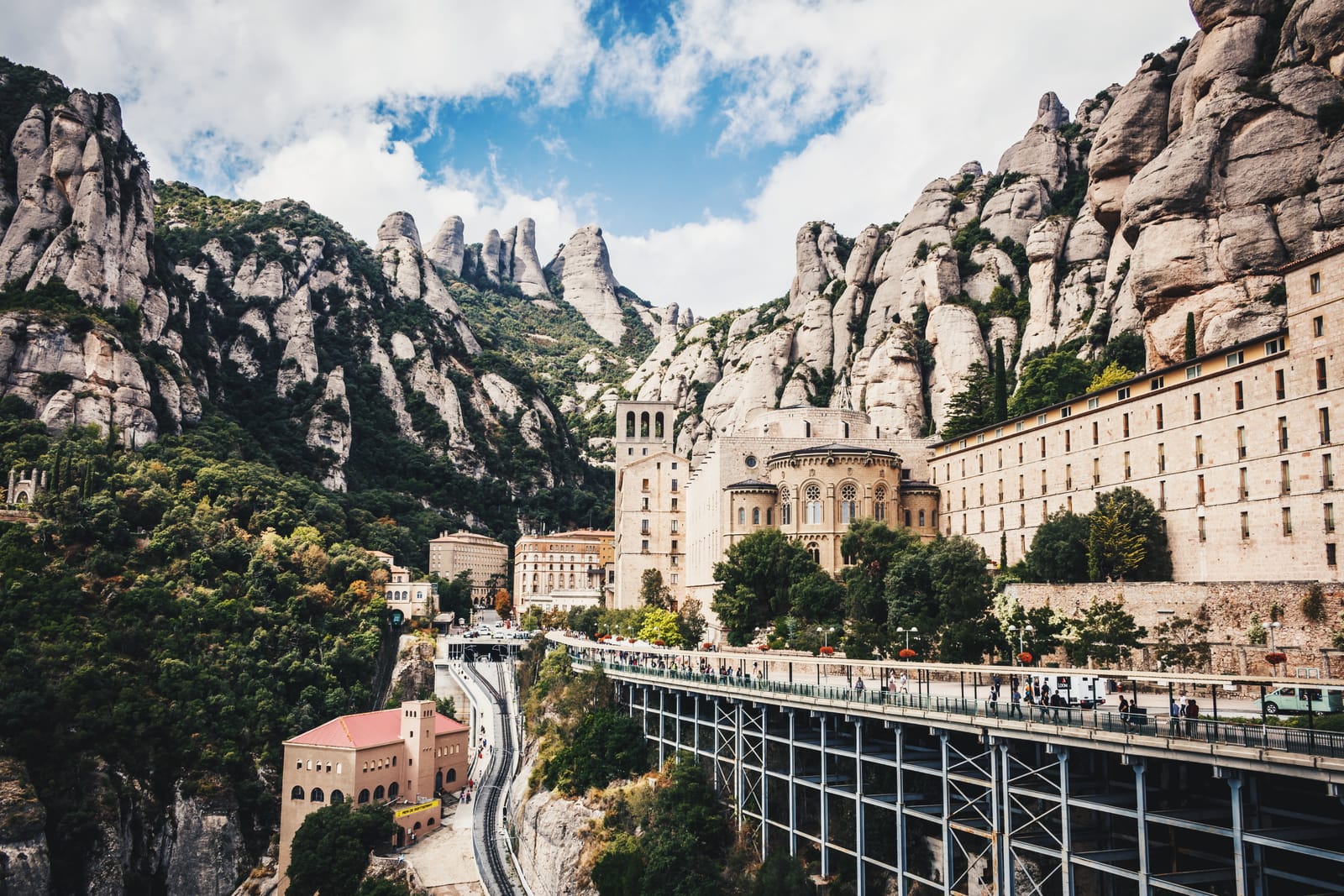
The serrated mountain from the station walkway
Francisco de Paula del Villar y Lozano (1828–1901), whose apse plans Antoni Gaudí helped draw as a student; the mountain itself is middle Eocene rock · Middle Eocene rock; apse project 1877, built by 1885 · Conglomerate rising to 1,236 m at Sant Jeroni, with the monastery at 720 m
Look for
- The rounded apse with its tiers of round-headed windows, beside the square tower. This is the part an architecture student named Gaudí helped draw up in 1876 and 1877.
- The surface of the rock closest to the path. Look for pebbles packed in a natural cement of sand and clay, which is why these needles wear the way they do.
- The rack railway tracks in the gap below the viaduct: the line that opened in 1892, closed in 1957 and came back in 2003.
Transcript (1:48)
Stop on the walkway and look up before you look at any building, because the rock got here first. Those pale towers are where the place gets its name. Montserrat means serrated mountain in Catalan, a mountain with teeth like a handsaw, and from here you can count them.
Find a rock face close to the path and the surface stops looking like stone and starts looking like badly mixed concrete. It is pebbles, a vast number of them, held in a natural cement of sand and clay. They were laid down as a fan delta at the edge of the Ebro Basin, in the middle Eocene. The rest of the basin's fill wore away faster, and wind and rain cut what stayed into needles. People have seen figures and animals in those needles for centuries, and invented legends to explain them. Give it a minute and you will find your own.
The summit, Sant Jeroni, reaches 1,236 metres. The monastery you are walking to stands at 720, on a shelf that looks too narrow for it.
Now find the curved end of the church, beside the square tower, with its tiers of round-headed windows. That apse has a small secret. Work on it restarted in 1877 to a project by the architect Francisco de Paula del Villar, and among those drawing the plans was a fourth-year architecture student working in his office: Antoni Gaudí. He kept a diary of the job, and it records that he and his boss did not always agree. That same year Villar was commissioned to build a new church in Barcelona, the Sagrada Família. He resigned from it in 1883, and the commission ended up with the young Gaudí. So a student who helped draw this wall went on to take over that one.
Getting up here used to be the whole ordeal, and for centuries the only way was on foot. The rack railway below you opened in 1892, closed on the twelfth of May 1957, and came back in its modern form on the sixth of June 2003. The cable car has been climbing gradients of up to 45 percent since 1930.
The name travelled further than any of them. In 1493 Christopher Columbus gave it to an island in the Caribbean, and the island still carries it.

Stop 2 of 5 · Plaça de Santa Maria, to the left of the monastery front, seen from the open square
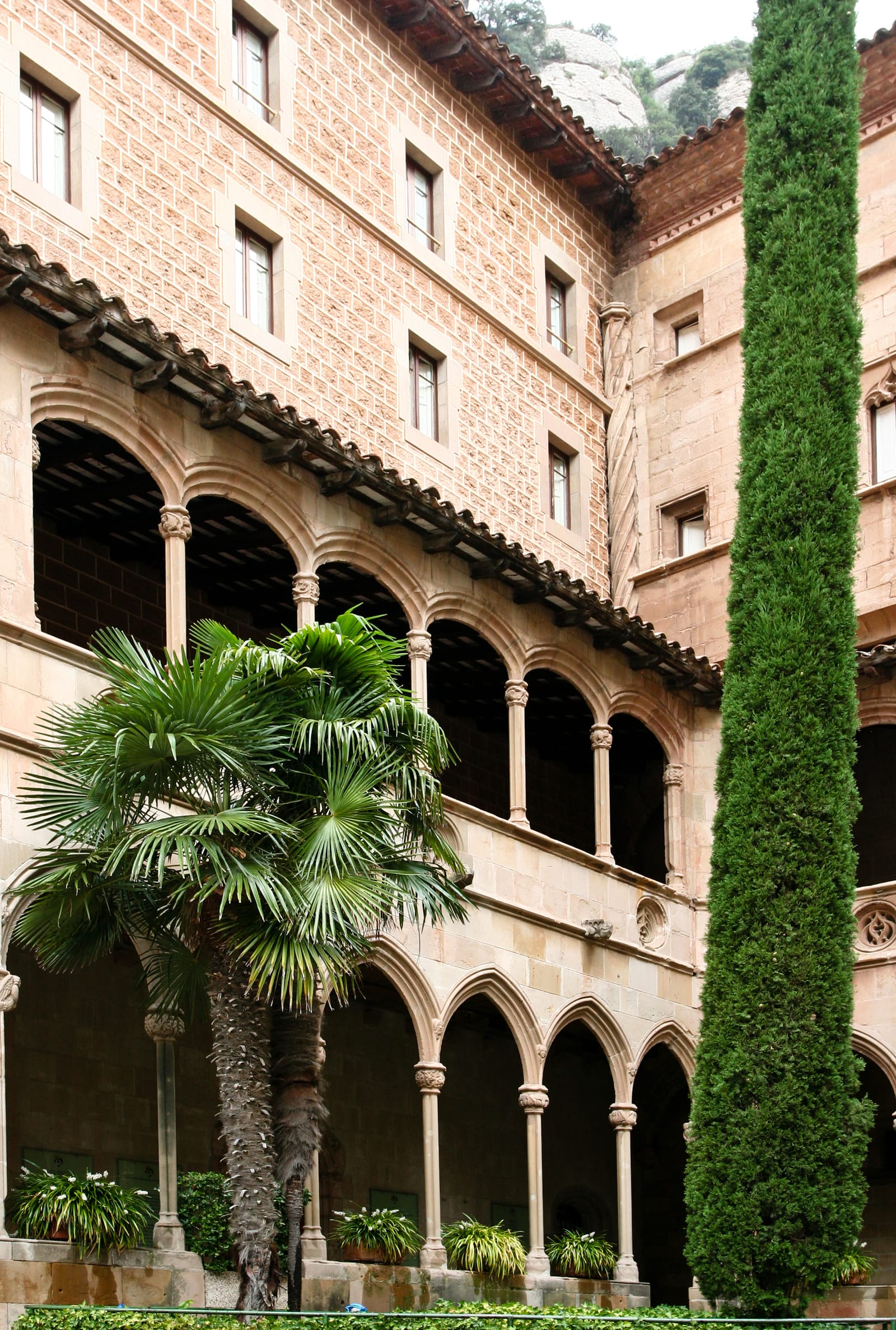
The two surviving wings of the Gothic cloister
Jaume Alfons and Pere Basset, for Giuliano della Rovere as commendatory abbot · 1476 · Stone, two surviving wings of two storeys; pointed arches on clustered columns below, low round arches above
Look for
- The arches change between floors: pointed on clustered columns below, low and round on thin columns above.
- The carved capitals in the lower gallery, which show secular scenes and the coats of arms of Montserrat and the builder abbot.
- The row of small rosettes in the stone band between the two galleries.
Transcript (1:59)
After the rock and the walkway, this square feels enormous and very open. Stand with the monastery front ahead of you and look to its left, past the tall cypress and the palm. Those two wings of stone arches, one storey stacked on another, are the oldest architecture you can walk up to here without going through a door.
They are the survivors of a Gothic cloister built in 1476 by Jaume Alfons and Pere Basset. It went up with the blessing of Giuliano della Rovere, a cardinal who held the title of abbot of Montserrat from 1472 to 1483 and did not live here. He is better known by the name he took later. As Pope Julius the Second he made Michelangelo paint the ceiling of the Sistine Chapel. This is a much quieter item in his record, and I like it more for that.
Look at how the arches change between floors. The lower ones are pointed, on slim columns bunched in fours. The upper ones are low and round, on thin single columns. In the band between them there are small rosettes, and the carved capitals below show scenes of ordinary secular life and the coats of arms of Montserrat and of the abbot who built it.
Two wings are all that survive, and the monastery around them has burned more than once. On the eleventh of October 1811 Napoleon's troops set fire to the church and the monastery as they left. Art, library and archive were almost all lost in the French war and the decades of looting after it, and when Abbot Muntadas began restoring the monastery in 1858 little more than walls was standing. The square around you is a twentieth-century answer, laid out by Josep Puig i Cadafalch, and the front ahead of you was built after 1939 by Francesc Folguera. Under your feet, though, the past is still there: the Hall of Walls, a fourteenth-century room, lies below this paving.
This has also been a political place. On the twenty-seventh of April 1947 more than 100,000 people came up for a Mass to enthrone the Virgin, and prayers were said aloud in Catalan, in open defiance of the government's language policy. In December 1970, 300 artists and academics held a sit-in at the abbey in protest at the Burgos military trial, and the police sealed the monastery off. Through all of it, these two wings of a cloister commissioned under a future pope went on standing.

Stop 3 of 5 · Atrium of the Basilica, facing the facade
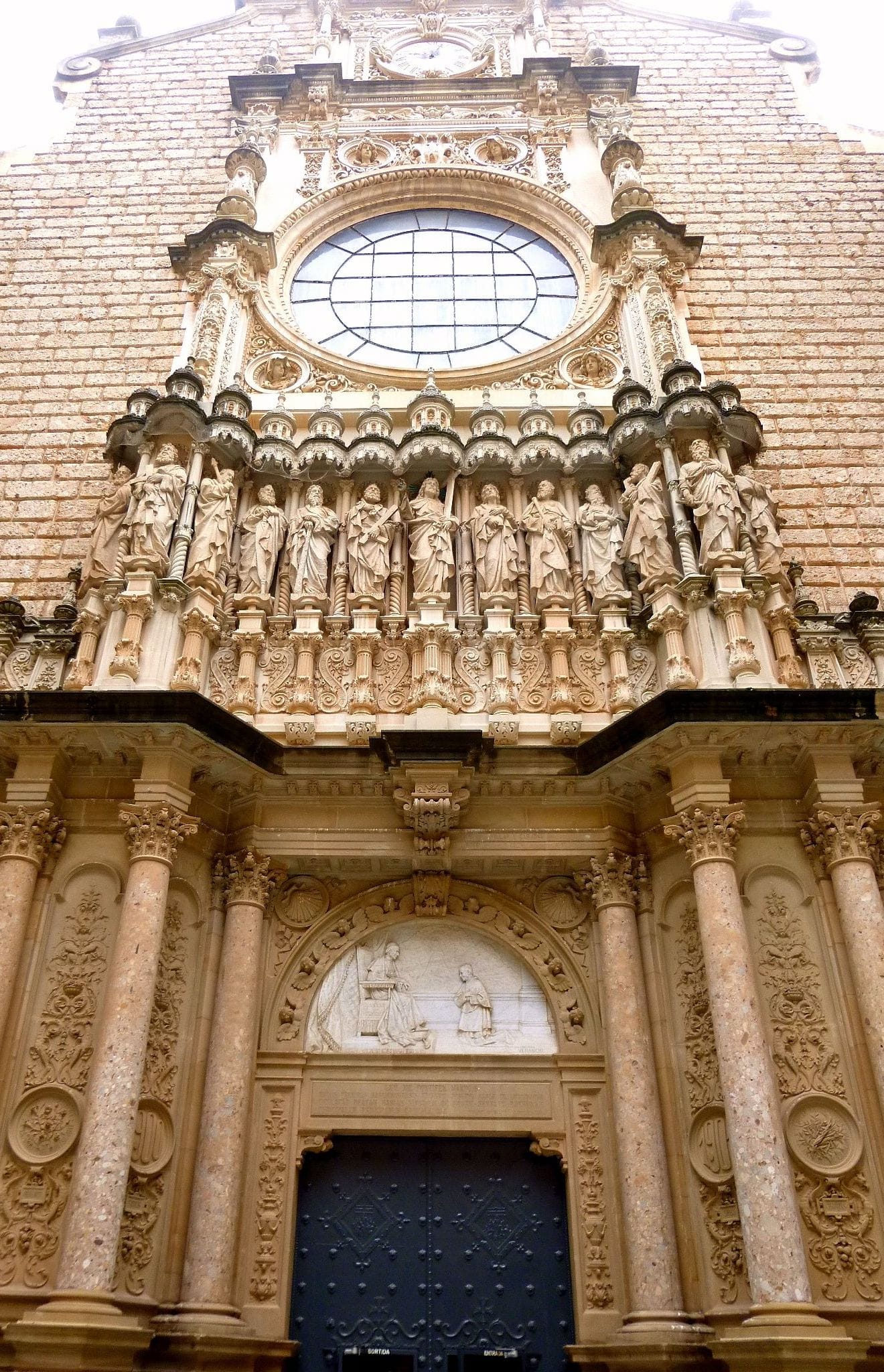
The basilica facade from the Atrium
Francesc de Paula del Villar i Carmona (1861–1926), with sculpture by the brothers Agapit and Venanci Vallmitjana · 1900–1901 · Carved stone over a coursed stone wall, three doors and a frieze of 13 figures, fronting a nave 21.5 m wide
Look for
- The thirteen figures in a row under separate canopies: Jesus at the centre with the twelve apostles.
- The bare coursed stone at the top corners. It shows that the ornament is a layer laid over a plain wall.
- On the right-hand wall as you face the church, the Romanesque portal: find Samson with the lions, and Adam and Eve.
Transcript (1:55)
You have come through the arches into a closed court, the old cloister of Abbot Argeric, and everything in it pushes your eyes at one wall. Stand back as far as you can and take in the front of the church from the doors to the cross.
Now look at the top corners, where the ornament stops. Behind it is a plain wall of coursed stone. That is the trick of this facade: the carving is laid over the masonry like a piece of lace, the way the old plateresque fronts were, the University of Salamanca being the famous one. It looks like the sixteenth century and it is dated 1900 to 1901. The architect was Francesc de Paula del Villar i Carmona, the son of the man who rebuilt the apse, and the sculpture is by two brothers, Agapit and Venanci Vallmitjana.
Read it from the bottom. Three doors, each with a carved panel above it, separated by Corinthian columns pushed forward from the wall, so the whole lower storey seems to ripple. Above them, thirteen figures stand in a row under little individual canopies: Jesus in the middle and the twelve apostles. Above those, the great rose window, then a clock, then the cross.
The church behind this front is far older, and it began with a boy's promise. Bartomeu Garriga was a chorister here in the sixteenth century, and he said that when he grew up he would build the Virgin a great temple. In 1560, by then abbot, he started it. It was consecrated in 1592, after thirty-two years of work. Pope Leo the Thirteenth made it a minor basilica in 1881, by which point it had been burned and was being put back together, which is how it came to need a new face.
Before you go in, turn to the side wall on your right as you face the church. Set into it is a Romanesque portal from the twelfth-century church, and it is the only thing left of that building. Five arches step back one inside another. Hunt among the carving for Samson with the lions and for Adam and Eve, set against scenes of the Virgin and Jesus, with animals and monsters filling the gaps. Walk from the apostles to that doorway and you cross seven hundred years in a few paces, from a confident imitation to the real thing, partly broken and still standing.

Stop 4 of 5 · Inside the Basilica, in the central aisle of the nave
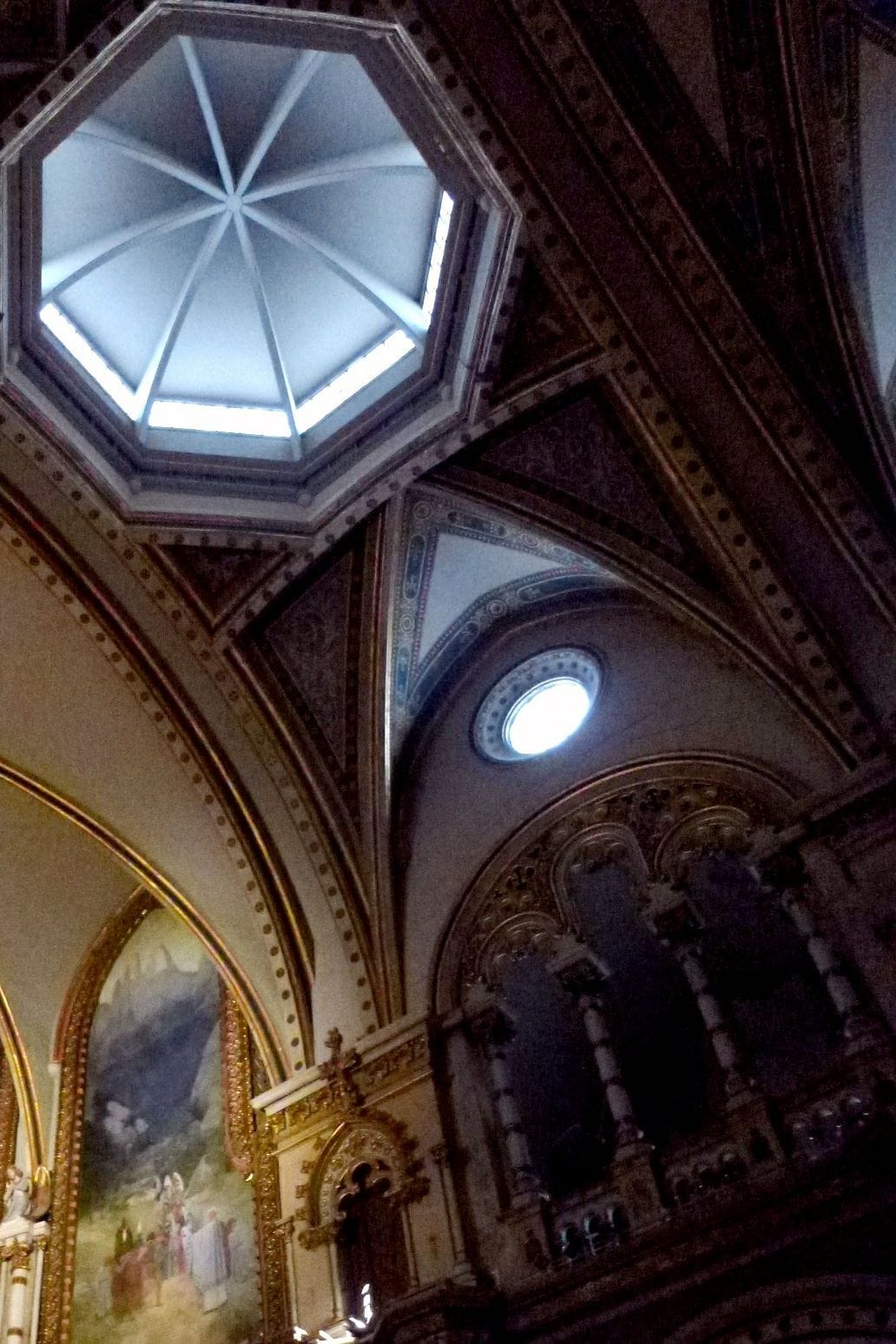
The nave of the Basilica
Church of Abbot Bartomeu Garriga, consecrated 1592; roofs and apse by Francisco de Paula del Villar y Lozano (1828–1901); paintings by Alexandre de Riquer and Joan Llimona, carved prophets by Josep Llimona · 1560–1592, rebuilt from 1877 · Single nave 68.32 m long, 21.5 m wide and 33.33 m high
Look for
- The octagonal lantern above the crossing, a shaft of daylight in a dark and gilded room.
- The large painted panels in gilded frames around the far end, where Alexandre de Riquer's work hangs with that of his colleagues.
- The wooden prophets by Josep Llimona: Isaiah, Jeremiah, Ezekiel and Daniel.
Transcript (2:05)
Give your eyes a moment. The nave is dark, and then, slowly, it is gold. Stand in the central aisle and look straight up, and you get the proportions first: 68.32 metres long, 21.5 wide, and 33.33 high. There is one single nave, with no side aisles to escape into, only side chapels down each flank.
The bones are Abbot Garriga's sixteenth-century church, Gothic in structure even as its pilasters and balustrades were turning Renaissance. Those bones are nearly all that survived. After the French war only the nave was left, with every piece of decoration and every work of art gone, and the country's politics stopped work on the basilica until 1877. What you see now is the answer to all that bare stone, and it holds nothing back. Walls and vault were covered in paint, stucco arches were added, and artists of the late nineteenth and early twentieth centuries filled the place with pictures and carvings. I find it a little too much, and I would not change a square metre of it.
Now find three things. High above the crossing, the octagonal lantern, a shaft of plain daylight in all that gilding. Ahead of you, around the far end, the big painted panels in gilded frames: the presbytery pictures, with Alexandre de Riquer's among them. And look out for the four great prophets, Isaiah, Jeremiah, Ezekiel and Daniel, carved in wood by Josep Llimona.
One object here has a puzzle attached. Over the high altar hangs a lamp with a crucifix, a Florentine piece of the early Renaissance that came from Rome in 1920. It has been attributed to Lorenzo Ghiberti, and a more recent study argues for a young Michelangelo.
This room is also the home of a choir. The Escolania, more than fifty boys aged nine to fourteen, is first documented in 1307, which makes it one of the oldest boys' choirs in Europe. The monks, some 80 of them, stop to pray together five times a day as well.
Music at Montserrat was not always so orderly. Pilgrims kept watch through the night at the older church, and they wanted to sing and dance while they did it. Around 1399, rather than forbid it, someone there wrote down songs that were at least chaste and pious, in a manuscript now called the Llibre Vermell, the Red Book. His instructions survive: use them modestly, and take care that no one keeping watch in prayer is disturbed.

Stop 5 of 5 · Throne of Our Lady, up the stair behind the high altar; the route ends on the Camí de l'Ave Maria
La Moreneta on the Throne route
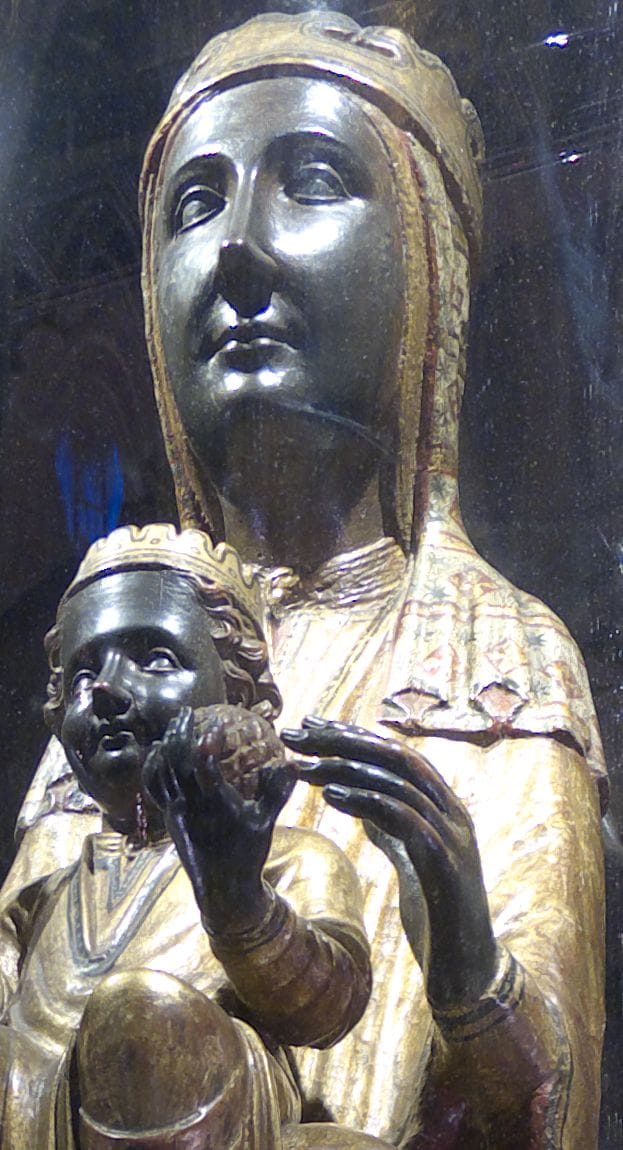
An anonymous Romanesque carver · Twelfth century · Polychrome wood, 95 cm high and 35 cm wide
Look for
- The faces and hands, nearly black, against gilded robes. The abbey puts it down to varnish changing with time; other accounts name oxidised paint and smoke.
- The Child's left hand with the pine cone, a sign of fertility and everlasting life.
- Her left hand, close to the Child's shoulder, and the crowns on both heads. The abbey reads that hand as showing that this king is her son.
Transcript (2:00)
You have climbed the stair behind the high altar and here she is, and the first surprise is the size. She is 95 centimetres high and 35 wide, carved in wood some time in the twelfth century. The basilica, the squares, the railway: all of it grew up around the devotion to this piece of wood.
Look at the colours. The robes are gilded, and the faces and hands of both mother and child are nearly black. That is why Catalans call her La Moreneta, the little dark one. The abbey's own explanation is the varnish on her face and hands, changed by the passing of time. The studies presented in 2001 named the original paint oxidising and the smoke of lamps and candles, and restorers have also repainted her black more than once. Accounts differ.
She is a Romanesque type, the Throne of Wisdom, staring straight ahead with the Child in the centre of her lap, and both wear crowns. The Child blesses with his right hand and holds a pine cone in his left, a sign of fertility and everlasting life. Her own right hand stretches out with a globe, the cosmos.
The legend is older on paper than you might think, with a first text from 1239. It says shepherds saw a light on the mountain in 880 and found her in a cave, and when a bishop tried to carry her down to Manresa she grew too heavy to move. So the chapel was built up here instead.
The true stories are better. On the twenty-fifth of March 1522 a soldier just recovered from battle wounds, Ignatius of Loyola, came to her and laid down his military gear before founding the Jesuits. When Napoleon's army came, the monks took her away again and again, and in 1811 a hermit, Maur Picanyol, hid her in the gap under a staircase while the monastery burned. In 1835 the abbot left her with a farmer from El Bruc, Pau Jorba, who kept her in his house for nine years, so well hidden that the bishop of Barcelona had to contact the exiled abbot in Palermo to ask where she was. Pope Leo the Thirteenth named her patron of Catalonia in 1881, and in 1947 she was enthroned here, where you are standing.
The way out is the Camí de l'Ave Maria. Rows and rows of candles burn there, each one left by somebody for a reason of their own. Some accounts blame smoke like this for her dark face, and it is still rising eight hundred years on.
Independent guide · Chiaro
Point Chiaro at anything at the Montserrat Monastery.
A mountain, an abbey and a thousand years do not fit in five stops. The tomb in the Atrium, a chapel off the nave, a peak with a name you can't place, the odd carved capital in the cloister: photograph it, and Chiaro names it and the people behind it, then keeps answering while the next rack train is still on its way up.
Before you go
Getting there
Monestir de Montserrat, s/n, 08199 Monestir de Montserrat, on the mountain above Monistrol de Montserrat. It is 48 kilometres north-west of Barcelona, and most visitors come as a day trip. Walk from either station to Plaça de Santa Maria; the ticketed part starts at the Atrium.
From Barcelona, take the FGC R5 towards Manresa from Plaça Espanya; trains run every hour from 08:26. There are two official ways up, each with its own stop. Get off at Montserrat-Aeri for the Aeri cable car, every 15 minutes and 5 minutes long (15 euros adult return on the operator's 2026 fares). Get off at Monistrol de Montserrat for the Cremallera rack railway, 15 minutes, on trains that connect with the R5; the departures every 20 minutes are from Monistrol Vila, one stop further up, where the car park is. Going home, rack trains leaving Montserrat at quarter past the hour connect with the R5. The last ones down change with the season, so check them for your date.
Tickets and entry
- Non-residents need the tourist ticket for the Atrium, the Basilica and the Cambril: the Basilica alone costs 9 euros online and 10 at the office, and the Throne of Our Lady with the Basilica, which is what the fifth stop needs, costs 12 and 14. Bookings open one month ahead, and a package with the Throne books a time for the Throne, with the rest of your visit before or after it. Whatever time your own booking shows, keep to it.
- Residents of Catalonia, the rest of Spain and European Union countries do not pay the tourist ticket, except in groups and organised trips; neither do people attending services or staying overnight at Montserrat. Residents still reserve through the abbey's own website for Mass, the Escolania or the Virgin.
- Every day the Basilica keeps the same hours, 07:00 to 20:00. The Throne opens in separate windows, 08:00 to 10:30 then 12:00 to 18:25, so it is shut between them. The abbey's timetable adds a short one from 19:20 to 19:40, but don't plan a booking around it.
- The Escolania sings Monday to Friday at 13:00 and takes part in the Conventual Mass on Sundays, and both need a reservation. Non-residents buy the choir as its own ticket in the shop, 12 euros online and 14 at the office, because the Basilica ticket does not list it. It is away after St John's Day until the end of August, after Christmas and in Easter Week, and times shift, so check escolania.cat first. The Santa Cova funicular is out of service until further notice.
The official audio guide
The abbey has its own guide: a downloadable audio guide in its app comes included with its tickets, and the Visit Montserrat tickets add an open-air museum audio guide for the Sanctuary route. No separate price for it appears in the shop. Ours asks for no ticket and no download, and its first two stops are for the open square and the walkway, before you have paid anyone anything.
Official site →Questions
Is there a free Montserrat Monastery audio guide?
Yes, and you need no app for it: spoken stops with their scripts printed below, ready on your phone at the monastery or on the train out of Barcelona, at no cost. The abbey's paid tickets include its own, through its app. For a tomb or a peak we skip, the Chiaro app works from your photo.
Can I listen to the Montserrat audio guide without a ticket?
Yes, it plays anywhere, and the first two stops are made for that: the station walkway and Plaça de Santa Maria are outside the ticketed part. The tourist ticket covers the Atrium, the Basilica and the Cambril. So stops three and four need a Basilica ticket or better if you are a non-resident, and stop five needs one that includes the Throne of Our Lady.
How much is the official Montserrat Monastery audio guide?
It has no price of its own in the abbey's ticket shop. A downloadable audio guide in the app is listed as included with the abbey's tickets, starting with the Basilica ticket: 9 euros bought online, 10 on the day at the office.
How do I get to Montserrat from Barcelona?
Take the FGC R5 from Plaça Espanya, hourly from 08:26. Change at Montserrat-Aeri for the cable car, a 5-minute ride, or at Monistrol de Montserrat for the Cremallera rack railway, 15 minutes. Check the last descent for your date, because those hours change with the season.
Do I need a separate ticket to see La Moreneta?
If you are a non-resident, yes: the Basilica ticket does not list the Throne of Our Lady, while the 12 euro online Throne ticket includes both it and the Basilica. Your booked time is the time for the Throne, so plan the rest around it. Its main windows run 08:00 to 10:30 then 12:00 to 18:25, the abbey's timetable adds 19:20 to 19:40, and the route ends on the Camí de l'Ave Maria.
Which Montserrat stop should I start with?
The first one, on the walkway outside the stations, as soon as you step off the train or the cable car. From there the mountain and the apse are in one view and you need nothing but your phone. The rest runs west through the square and into the church, ending at the statue.
More audio guides
Made by Chiaro. Not affiliated with Montserrat Monastery.