
Thyssen-Bornemisza · Madrid · Independent guide
Thyssen-Bornemisza audio guide,
five stops, free.
From a Florentine memorial to a Paris dressing mirror, told out loud on this page. For the rest of almost 1,000 paintings, photograph one and Chiaro takes over.
Made by Chiaro. Not affiliated with the Thyssen-Bornemisza.
Portrait of Giovanna degli Albizzi Tornabuoni
Thyssen-Bornemisza, Madrid
That was the free part
Chiaro narrates any work in the Thyssen-Bornemisza from a photo.
The five stops · 10 minutes of audio
Five stops, one walk,
in the order you will walk them.
Go up first. The museum numbers its rooms chronologically from the top of the building down, and our Thyssen-Bornemisza audio guide walks those numbers in order: Ghirlandaio in room 5, Carpaccio in room 7, Caravaggio in room 12 and Hals in room 23, all on level 2, then down a floor to Morisot in room 33 on level 1. Listening takes about ten minutes. The walking, by our own estimate, comes to about twenty minutes if you do not stop on the way, and you will stop on the way.
Each room number comes from the Museo Thyssen's own collection page for that painting. The museum also warns that its paintings are often out on loan, in which case a notice or a substitute takes their place on the wall. Trust the wall over this page, and write to us when they part ways.

Stop 1 of 5 · Level 2, Room 5, Permanent Collection
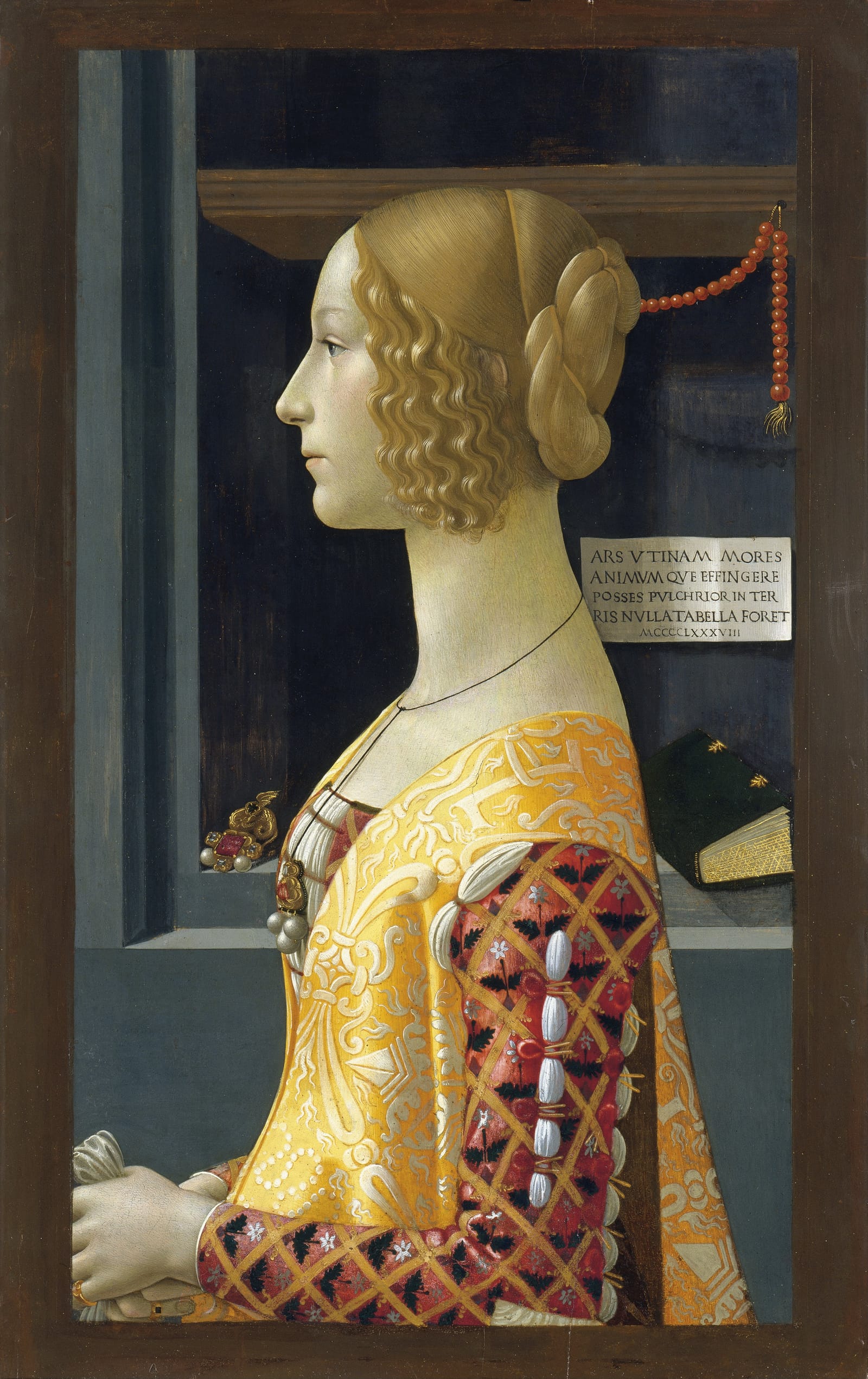
Portrait of Giovanna degli Albizzi Tornabuoni
Domenico Ghirlandaio (1449–1494) · 1489–1490 · Mixed media on panel, 77 × 49 cm
Look for
- The slip of paper behind her neck at the right. The Roman numerals at the bottom give 1488, the year she died, not the year of the painting.
- The gold cloth at her shoulder, with the Tornabuoni emblem and two letter Ls for her husband, Lorenzo.
- The coral beads hanging from the shelf and the book on the ledge below them, both at the right, both signs of her piety.
Transcript (2:11)
She will not look at you. The face is turned in strict profile, the neck long, the hands folded, and everything about her is so composed that it takes a moment to understand what kind of picture this is. It is a memorial. When Domenico Ghirlandaio painted this panel, around 1489 or 1490, the young woman in it was already dead.
Giovanna degli Albizzi was born in Florence in 1468. In June 1486 she married Lorenzo Tornabuoni. A son, Giovanni, came in October 1487. On the seventh of October 1488, pregnant with her second child, she died. She was nineteen.
Now find the slip of paper behind her neck, at the right. It is the key to the whole picture. It carries lines adapted from the Roman poet Martial and then a date in Roman numerals: 1488, the year she died, not the year of the painting. The Latin says, roughly: Art, if only you could portray character and mind, there would be no more beautiful painting on earth. Think about what that admits. A painter at the height of his trade tells you, inside his own picture, that he has only managed the outside of her.
He knew that outside well. He had already painted her full length in a fresco of the Visitation, in the Tornabuoni chapel of Santa Maria Novella, and a medallion by Niccolò Fiorentino with her likeness and her name is how we know who she is. The profile was the usual Florentine way of painting a woman and was starting to look old-fashioned. For someone who could no longer sit for a portrait, I find it hard to imagine a better choice.
Look at the gold cloth at her shoulder. It carries the Tornabuoni emblem and two letter Ls for Lorenzo, so she wears her husband's name on her clothes. From the shelf above the slip hangs a string of coral beads, probably a rosary. People at the time believed coral warded off evil and helped fertility, which is hard to read in the portrait of a woman who died pregnant. On the ledge below sits a book, possibly for prayer.
Under the paint, infrared shows a necklace of round beads hidden in the neck that never made the final design, and the hands were first placed higher, then lowered. Ghirlandaio kept moving her towards something quieter.
The panel first hung in Lorenzo's own rooms in the Tornabuoni palace. J. P. Morgan bought it in 1907, and in 1935 his son sold it to Heinrich Thyssen. It has travelled a long way from those rooms, and the slip of paper still says what it said there: the painter did not quite get her.

Stop 2 of 5 · Level 2, Room 7, Permanent Collection
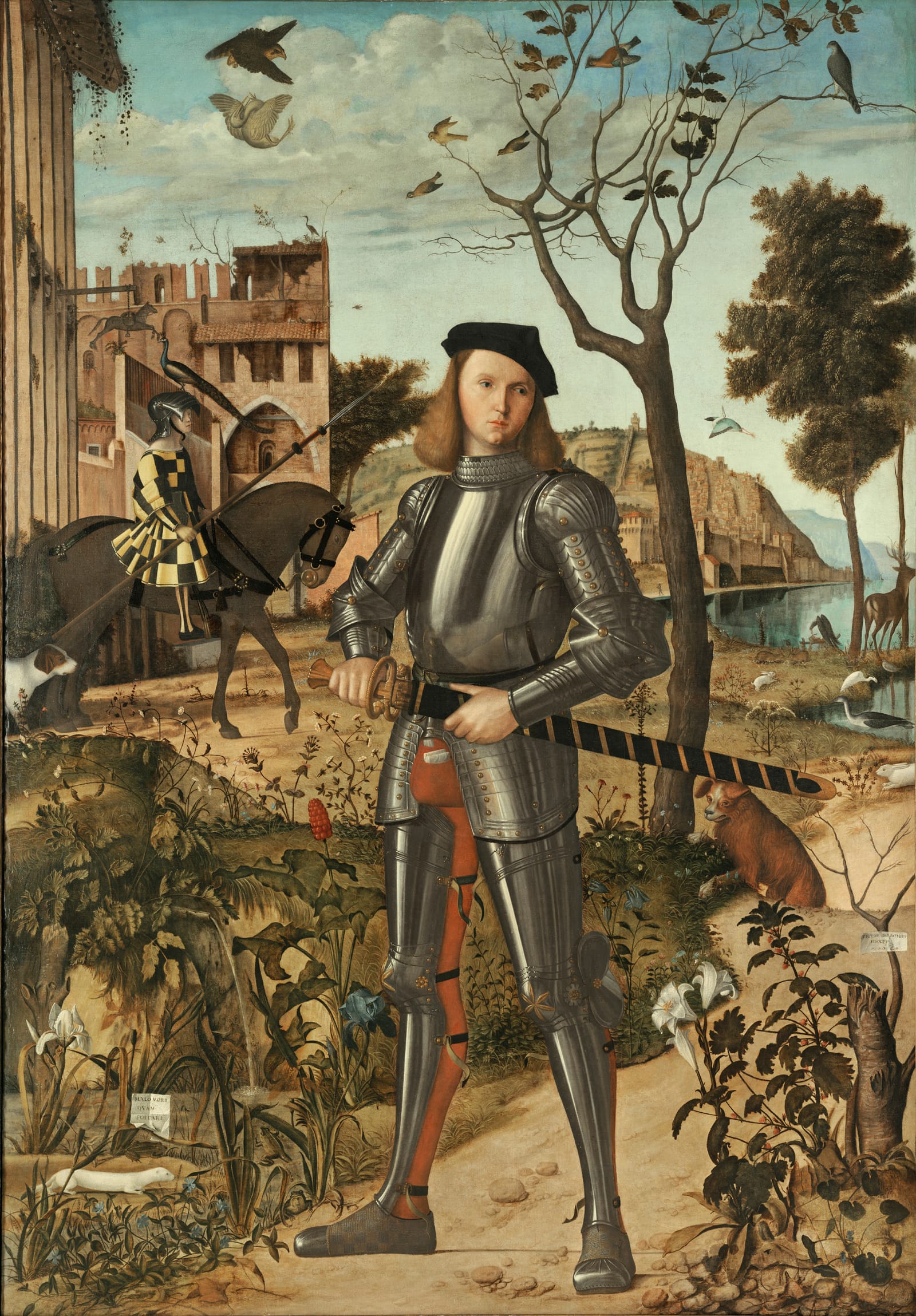
Young Knight in a Landscape
Vittore Carpaccio (c. 1465–1525/26) · c. 1505 · Oil on canvas, 218.5 × 151.5 cm
Look for
- The white ermine at the lower left, with the scroll beside it: Malo mori quam foedari, better to die than be defiled.
- The hawk bringing down a heron in the sky, which may hint at this man's death.
- The gleam on the armour. Carpaccio put stibnite in the paint, a mineral seldom used in pictures, to catch it.
Transcript (2:06)
Here is a young man who has stopped moving. The canvas is more than two metres high, and he stands in it in full armour, both hands on his sword, in a landscape so packed with birds, animals and plants that it reads less like scenery and more like a code nobody has finished breaking.
For a long time nobody even had the painter right. The canvas carried the monogram of Albrecht Dürer, and Carpaccio's own signature had been painted over. It was given to Dürer until 1919. When the museum's conservators studied it, they found a concealed inscription on the back that said A. Durer. Somebody wanted that name on it badly. Yet Vittore Carpaccio had signed it all along, on a slip of paper to the right of the figure, and that slip is still there for you to find.
Now look at the lower left corner. That small white animal is an ermine, and beside it runs a scroll with the Latin motto Malo mori quam foedari, better to die than be defiled. The motto and the animal suggest he may be a knight of the Order of the Ermine, but they raise the real question: who is he? If this is a portrait, and it probably is, then it is often called the earliest full-length portrait in Western painting, and we still do not know his name.
Art historians have been guessing for a century. One favourite is Francesco Maria the First della Rovere, Duke of Urbino. The candidate I find hardest to forget is more recent, proposed by the scholar Augusto Gentili: a Venetian named Marco Gabriel, who commanded the fortress of Methoni in Greece when the Ottomans besieged it in 1500. He was the only Venetian to survive, and he was accused of cowardice for it. Taken to Constantinople, he was beheaded on the fourth of November 1501. If that is the man, this painting is his family's answer to the accusation, and the motto about dying rather than being dishonoured stops being decoration.
Look up into the sky, where a hawk is bringing down a heron, and look again at how he stands, which recalls a statue on a tomb. The rider behind him may be his page, or the same man while he was still alive. The conservators found that Carpaccio first imagined more than one horse. They also found stibnite in the armour, a mineral rarely used in paint, chosen to give the metal its gleam. Heinrich Thyssen bought the canvas in 1935 from the heirs of the American collector Otto Kahn. He paid for a knight whose armour still shines and whose name is still missing.

Stop 3 of 5 · Level 2, Room 12, Permanent Collection
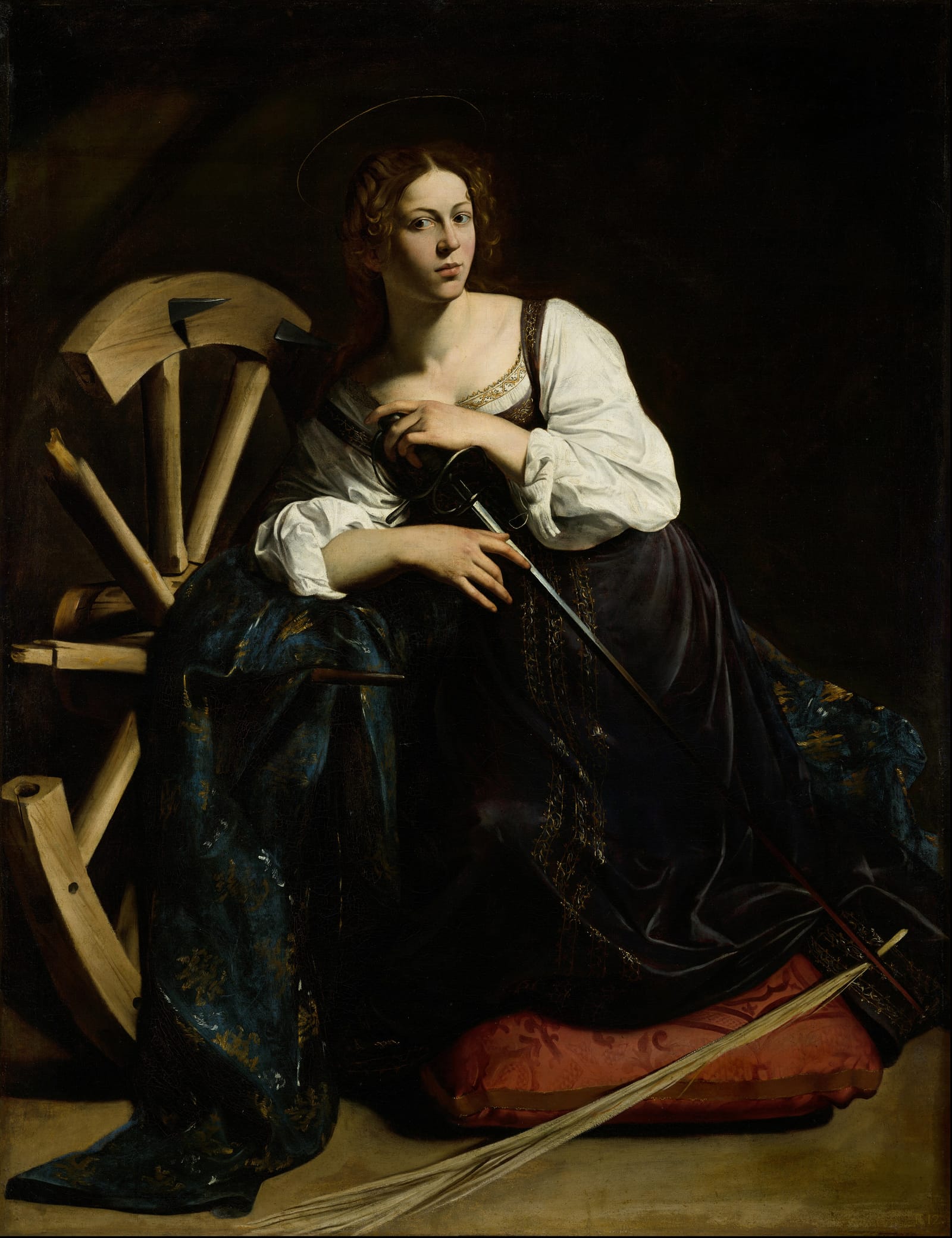
Saint Catherine of Alexandria
Caravaggio (Michelangelo Merisi, 1571–1610) · c. 1598–1599 · Oil on canvas, 173 × 133 cm
Look for
- The broken wheel with its iron blades at the left, which legend says shattered when she touched it.
- The sword under her hands and the palm branch on the floor, the other two signs of her martyrdom.
- Her eyes. A saint in a devotional picture, and she looks at you level, like someone you might recognise in the street.
Transcript (2:06)
She looks straight back at you, and she is in no hurry. Everything around her says martyr: the broken wheel, the sword, the palm branch on the floor. Her face says something else entirely. Caravaggio painted this around 1598 or 1599 in Rome, and almost certainly for his first patron, Cardinal Francesco Maria del Monte. It was listed in the cardinal's collection in 1627.
The saint first. Catherine of Alexandria was, according to her legend, a young noblewoman who argued with a Roman emperor and his philosophers and converted many of them. He condemned her to a spiked wheel, which shattered the moment she touched it, so he had her beheaded. That is why you see those three objects. She kneels on a cushion, in the robes of a princess, with both hands on the sword that finally killed her. The Catholic Church itself lost confidence in her: it took her off the calendar of saints in 1969, on the view that she had probably never existed, and put her back in 2002.
The woman you are actually looking at definitely existed. She has been identified as Fillide Melandroni, born in Siena in 1581 and one of the best-known courtesans in Rome. So when this was painted she was still in her teens. Caravaggio used her again as Judith in Judith Beheading Holofernes, and he painted a portrait of her that burned in Berlin during the Second World War. That is the shock of this picture and its power. A picture for a cardinal's collection, and the saint has the face of a woman half of Rome could recognise.
Look at how the light falls. It comes in hard from the upper left and leaves the rest in black, so she seems to lean out of the dark toward you. That handling of light and volume went on to have a huge effect on painters in Italy and across Europe.
The museum analysed the materials and found something you cannot see: red, part of a first version of her clothing. Today the strongest red left in the picture is the cushion under her knees.
Her life did not stay in the studio either. Fillide was involved with a young man from a noble family called Ranuccio Tomassoni, and in 1599 the pair were arrested together. In May 1606, Caravaggio killed Tomassoni and fled Rome under a death sentence. Rumour said the fight was over her, and nobody can settle that now. It came about seven years after he painted this calm, level look, with a sword in her hands.

Stop 4 of 5 · Level 2, Room 23, Permanent Collection
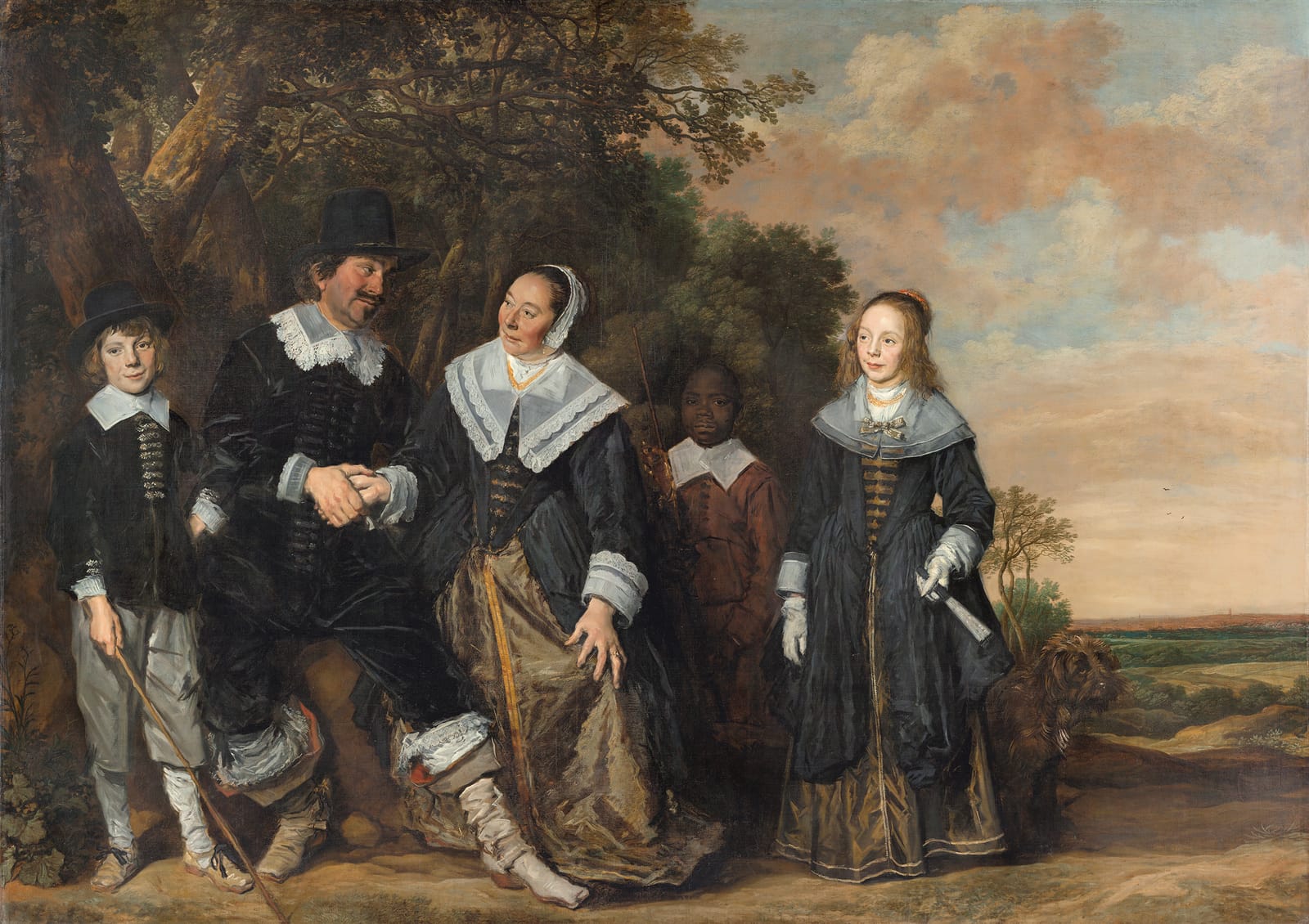
Family Group in a Landscape
Frans Hals (c. 1582–1666) · 1645–1648 · Oil on canvas, 202 × 285 cm
Look for
- The couple's joined hands, an allusion to faithfulness in marriage, and the dog at the girl's side for loyalty.
- The boy between the woman and the girl, looking out of the picture, a figure a 1910 catalogue gave one line.
- The lace and cuffs from close up, a few loose strokes that only become lace when you step back.
Transcript (1:52)
Stand back, because you need to. This canvas is almost three metres wide, one of the largest things Frans Hals ever painted, and the largest not devoted to the civic guards of Haarlem. It looks like the easiest afternoon in the Dutch seventeenth century. A couple sit outdoors holding hands, which alludes to faithfulness in marriage. A dog waits at the girl's side, for loyalty. Everyone is well dressed and pleased about it.
Go closer and look at how little of it is drawn. The lace and the cuffs are a few loose strokes of a broad brush that only turn into lace when you step back again. It seems very modern for the 1640s. The rich citizens of Holland wanted their good fortune recorded, and Hals made it look alive.
Now look past the couple, between the woman and the girl. A Black boy stands there in a brown coat and white collar, looking straight out, and he is the reason this canvas gets talked about today. It is the only one of Hals's open-air family pictures with such a figure in it. He has not always been noticed. In 1906 the Royal Academy in London showed the picture as the painter's own family. A catalogue of 1910 counts a family group of five and gives him one line, a little boy in a dark-brown costume, with no word that he is Black. That same year the American collector Otto Kahn outbid J. P. Morgan for the canvas, at 500,000 dollars.
In 2023 two researchers, Ineke Mok and Dineke Stam, argued that the family has a name after all: Jacob Ruychaver and his wife Maria Hendrixs, with their children Geertruid and Willem. Ruychaver was linked to the Gold Coast of West Africa, where former directors-general commonly had themselves painted with an African servant. If the researchers are right, this easy afternoon has a colonial story standing behind it. The museum itself invited them to speak about the painting, as part of an exhibition on colonial memory in its own collections.
In April 2017 the American painter Titus Kaphar painted over a copy of this canvas on stage for a TED talk, until only the boy was left. His point was that we know far more about the lace collars in pictures like this than about the people standing behind them. Look at the collars again, those few quick strokes. Then look at him.

Stop 5 of 5 · Level 1, Room 33, Permanent Collection
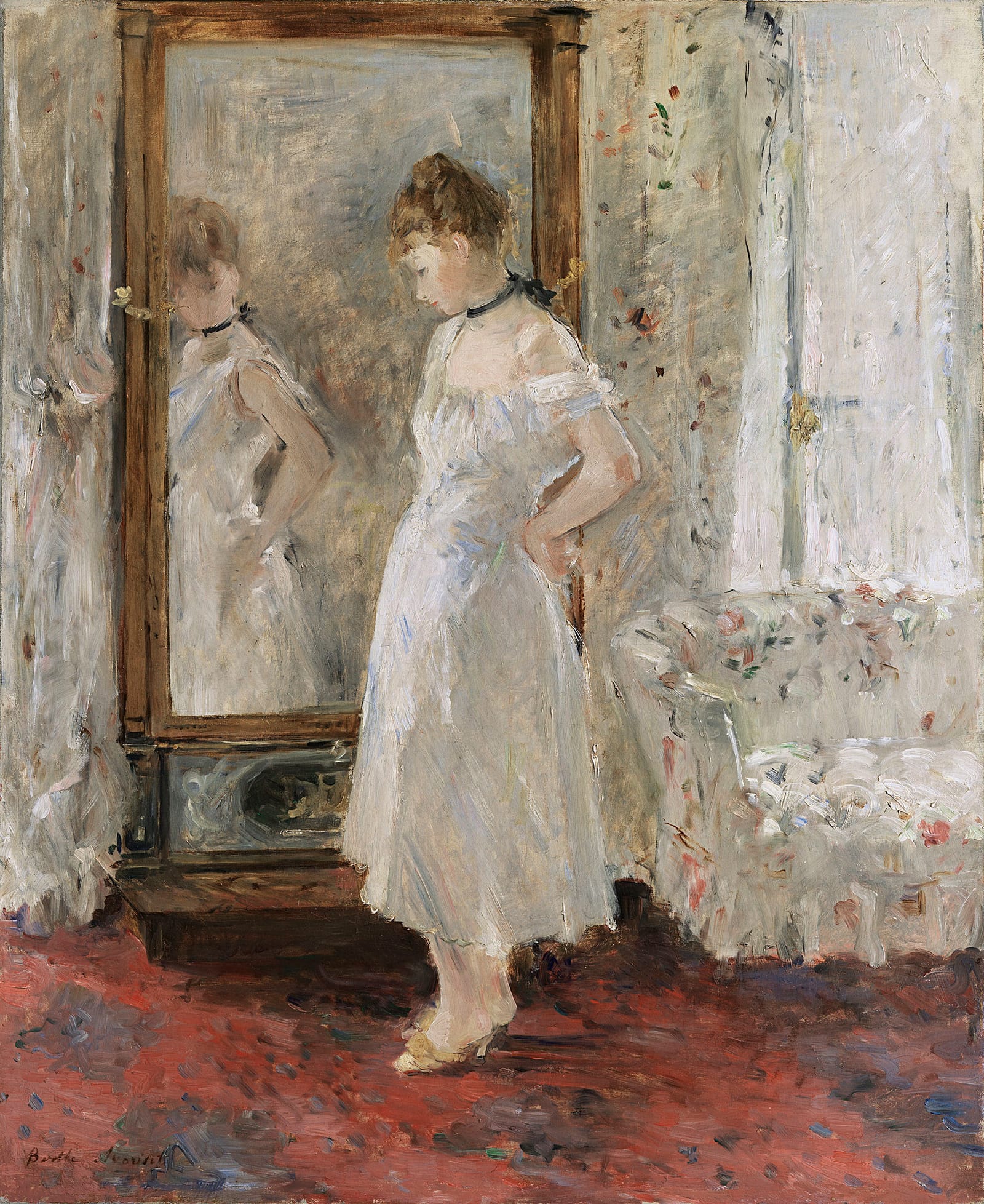
The Psyche Mirror
Berthe Morisot (1841–1895) · 1876 · Oil on canvas, 65 × 54 cm
Look for
- The windows either side of the mirror, half hidden by curtains on the left, which fill the room with light.
- The mirror's frame running up to the top edge of the canvas, which makes a picture inside the picture.
- How many different whites there are in the dress, the curtains, the wall and the sofa.
Transcript (2:03)
After a floor of big statements, here is a small canvas of a woman who is not interested in you at all. Only sixty-five centimetres by fifty-four. She stands in front of a tall tilting mirror, gathering up the waist of a white dress behind her back, with one shoulder bare. Her eyes are lowered, and so are the eyes in the reflection. That kind of mirror was called a psyche, which gives the painting its title, and psyche is also the Greek word for the soul.
Start with the whites, because that is what Berthe Morisot was really painting. Light comes in through the two windows on either side of the mirror, bounces off the glass, and turns the room into a whole range of pale tones, in the dress, the curtains, the wall and the sofa. Against all that, the red carpet is the one strong note, and from here it is nothing but dabs and specks. The mirror's frame runs right up to the top edge of the canvas, so you get a picture inside a picture.
Morisot painted this in 1876. It was one of eight canvases she made that year, and four of them are women at their toilette. She showed it at the Impressionist exhibition of 1877, the third, alongside another picture of a woman at her toilette, which the American painter Mary Cassatt later bought. By then she had finished with the official Paris Salon. After her debut there in 1864 she was accepted six more times, then in 1874 it rejected her. She never submitted again, and that year she joined the Impressionists in their first show. She also married Eugène Manet that year, the brother of her friend and colleague Édouard. Her mother was a great-niece of Jean-Honoré Fragonard, whose See-Saw is also in this collection.
It looks like a familiar subject. Women at mirrors were a conventional way of suggesting women were vain, and of giving men something to look at. But the art historian Whitney Chadwick read this one in 1990 as something daring, a sympathetic picture of a woman's awareness of herself. She is working out how she looks to herself, and nobody else is invited. I think that is right, and it is why this quiet canvas holds its own against everything upstairs.
In 1890 Morisot wrote in her diary that women's strength lay in feeling, in intuition, and in a gaze more delicate than men's. Then she added: I would like to continue working until I die. She had five years. On the second of March 1895 she died of pneumonia, caught while nursing her daughter Julie, who was sixteen.
Independent guide · Chiaro
Nine hundred and some paintings still to go.
The walk ends at Morisot, but the collection runs from the late thirteenth century to the 1980s. Stand in front of a Rembrandt, a Monet or a Hopper, take a photo, and Chiaro names the picture, tells you what it was doing before it reached Madrid, and keeps taking your spoken questions until you run out.
Before you go
Getting there
Paseo del Prado, 8, 28014 Madrid, near the Prado and part of the same stretch of art museums as the Reina Sofía. Tickets are sold online and at the museum's ticket office.
Metro line 2 to Banco de España is the nearest. Trains stop at Atocha and Recoletos. Its bus list reads 1, 2, 5, 9, 10, 14, 15, 20, 27, 34, 37, 41, 51, 52, 53, 74, 146, 150.
Tickets
- Mondays are short and free: 12.00 to 16.00, collection included, no ticket needed. Any other day, admission costs 14 euros, 10 for over-65s, pensioners and students, and free for under-18s.
- Hours by season: Tuesday to Friday 10.00 to 19.00 from September to June and to 21.00 in July and August, Sunday 10.00 to 19.00, and entry stops 30 minutes before closing. The museum lists Saturday as 10.00 to 23.00, but its ticket office shuts at 20.30 and the free session from 21.00 covers only temporary exhibitions on the ground floor and level -1, none of these five paintings, so come for them well before that.
- Between 15 October 2026 and 17 January 2027, 25 works from this collection are on loan to the Mauritshuis in The Hague, so check before making a special trip for any one painting.
- The museum names 14.00 to 16.00 as usually the quietest time. Your ticket has no time slot unless you add the ground-floor temporary exhibition, and you can step out and come back the same day.
The official audio guide
An official audio guide adds 5.50 euros to the ticket, sold online with it or on the day at the ticket office and audio guide desks. It runs on your phone or a museum device, with tours of 15, 30 or 50 works and a one-hour 10 Masterpieces tour. This page is narrower and costs nothing: five paintings, each script printed under its player.
Official site →Questions
Is there a free Thyssen-Bornemisza audio guide?
Yes, on this page. Five narrated paintings play from your browser with nothing to install or pay, and every script is printed underneath. Any other painting here gets its turn in the Chiaro app, from a photo.
How much is the official Thyssen-Bornemisza audio guide?
5.50 euros added to the ticket price, per the museum's price list. It is bought with your ticket online, or at the ticket office or audio guide desks on the day, and it works on your own smartphone or a museum device.
Where is Ghirlandaio's Giovanna Tornabuoni in the Thyssen-Bornemisza?
Room 5 on level 2, in the permanent collection. Go up to the second level, where the room numbering begins, and it comes early in the sequence. She is the first stop on this walk.
What day is the Thyssen-Bornemisza closed?
No weekday is a closing day. It closes altogether only for 25 December, 1 May and New Year's Day. Mondays are shortened to 12.00 to 16.00, while 24 and 31 December are 10.00 to 15.00 days.
How long does the Thyssen-Bornemisza take?
The museum estimates about two and a half hours for a visit, and suggests adding about 50 minutes if you also want the ground-floor temporary exhibition. These five stops take about half an hour, listening and walking together, if you go straight between them.
Is the Thyssen-Bornemisza free on Mondays?
Yes, from 12.00 to 16.00, which are also the only Monday hours. The sponsored session includes the collection, so all five stops here, and you can walk in without a ticket. Expect a shorter visit than the museum's usual two and a half hours.
More audio guides
Made by Chiaro. Not affiliated with the Thyssen-Bornemisza.