
Musée de Cluny · Paris · Independent guide
Musée de Cluny audio guide,
five stops, free.
Five recordings, from a Roman bathhouse to six tapestries, all playing in this tab. Around 2,300 objects are on display, and Chiaro tells you about any of them from a photo.
Made by Chiaro. Not affiliated with the Musée de Cluny.
Pillar of the Boatmen
Musée de Cluny, Paris
That was the free part
Chiaro narrates any work in the Musée de Cluny from a photo.
The five stops · 10 minutes of audio
Five stops, one walk,
in the order you will walk them.
Two floors, fifteen hundred years and five stops make up this Musée de Cluny audio guide. You begin in the cold room of the Roman baths, Room 1, with the boatmen's pillar, cross to Room 5 for the Kings of Judah and the Adam from Notre-Dame, then go up to the first floor for the Colmar Treasure in Room 12 and finish at the Lady and the Unicorn in Room 20, one of the last rooms on the museum's own route. Listening time for all five is roughly ten minutes. The walking between them is under ten, so with time to stand and look, the five stops fill about an hour.
Every stop has been held against two sources: the museum's own online collection database, which names the room each object is in, and an outside reference, Wikidata or Wikipedia. The room numbers were confirmed on 25 September 2026. A tapestry or a ring can still leave for a loan at short notice, so treat the gallery label as the final word, and write to us if we have fallen behind.
PHGCOM, Public domain, via Wikimedia Commons. Photo: PHGCOM

Stop 1 of 5 · Ground floor, Room 1 (the Frigidarium)
Pillar of the Boatmen
The guild of boatmen of Lutetia (nautae Parisiaci) · AD 14–37 · Limestone, four carved blocks; the Jupiter block 109 × 79 × 79 cm
Look for
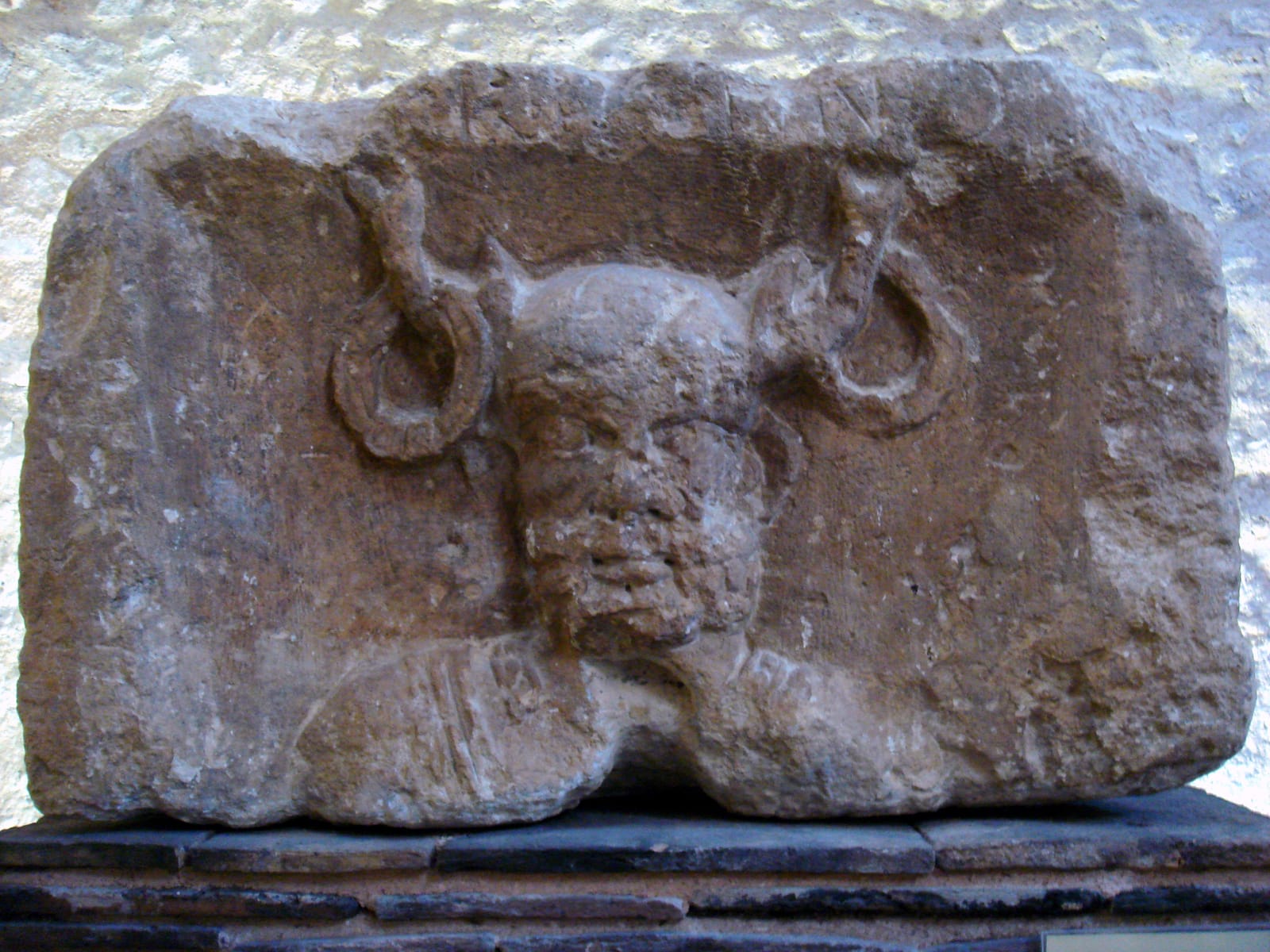
- Cernunnos on the top block: a bearded head with a stag's antlers, a Gaulish neck ring hanging from each, and the letters of his name carved above. Nowhere else in the ancient world is that name written beyond dispute.
- The boatmen themselves, marching with shields and spears on the dedication block. The right to bear arms was a Roman privilege, and a measure of how much the guild counted.
- The walls of the room: bands of small limestone blocks between courses of flat brick, the Roman building recipe, under a vault more than fourteen metres high.
- The two carved stone brackets still in place on the north wall of the frigidarium, which Wikipedia describes as shaped like the prows of ships.
Transcript (2:02)
Look up before you look at the stones. The vault over your head is more than fourteen metres high, and the Romans built it at the turn of the first and second centuries. This was the frigidarium, the cold room of the largest public baths in Roman Paris, which was then called Lutetia. People came to wash, exercise, have their hair cut and talk, and the cold pool is still here in the room. It is the one part of those baths that keeps its full height, and the museum grew up around it.
Now the four carved blocks. They are older than the room. This is the Pillar of the Boatmen, made between the years 14 and 37, under the emperor Tiberius, and it is the oldest monument in Paris. The boatmen were a guild of shipowners and traders who worked the Seine, the nautae Parisiaci, and their Latin inscription says they set this up publicly, to Jupiter Best and Greatest and to the emperor.
That sounds like a loyal Roman offering, and it is one. But look at who else made it onto the stone. Beside Jupiter, Vulcan and Mars stand gods the Romans did not bring with them. Esus, chopping at a tree with an axe. A bull with three cranes perched on it, labelled Tarvos Trigaranus. And on the top block, a bearded head with the antlers of a stag, and a torc, a Gaulish neck ring, hanging from each antler. The letters above him spell Cernunnos. This pillar is the only place where that god's name survives beyond any dispute.
On another face the boatmen themselves march with shields and spears. Carrying arms was a privilege the Romans granted, and it tells you how powerful this guild was. It is the first society of Paris that we know by name.
The pillar did not stay standing. In the third century its blocks were broken up and used to shore up walls on the Île de la Cité, and they lay there until workmen digging under Notre-Dame found them early in the eighteenth century. Not everything came back: for three of the four tiers, only the top half survives. Whole, it would have stood about five metres twenty high, and nobody knows for certain which way round the blocks were stacked. There are sixty-four possible arrangements.
The stones look pale today because in 2001 restorers cleaned off the black grime of three centuries. The walls around you had their own restoration in 2009, which found that the plaster was once pink, with tiny traces of an intense blue. In those colours, with the cold pool full of water, this was the room.
Tom Hilton, CC BY 2.0, via Wikimedia Commons. Photo: Tom Hilton
.jpg)
Stop 2 of 5 · Ground floor, Room 5 (Sculptures from Notre-Dame de Paris)
Heads of the Kings of Judah
Sculptors of Notre-Dame de Paris · First half of the 13th century · Stone with traces of paint; the head Cl. 22988 is 71 cm high
Look for
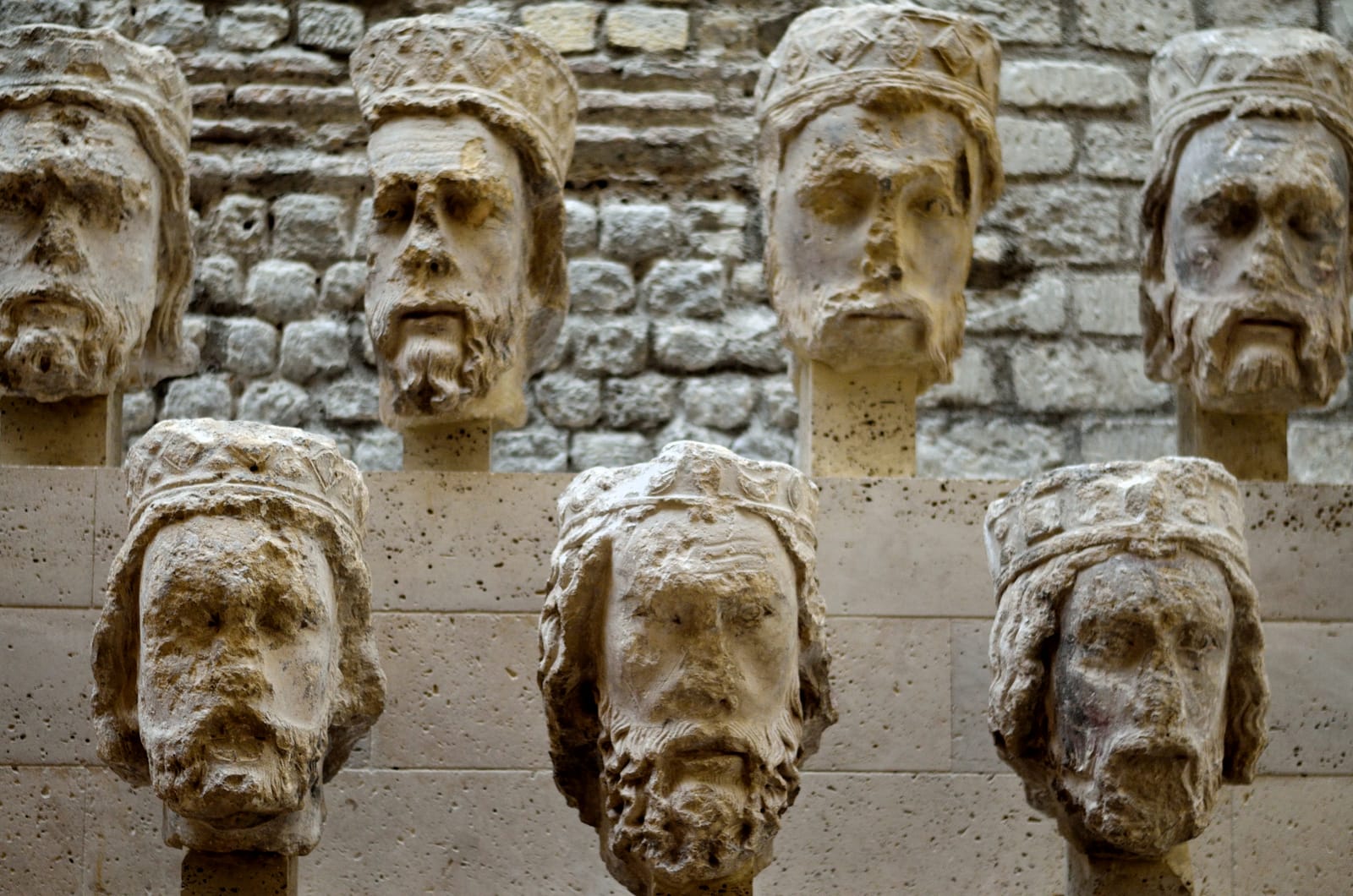
- Traces of colour on the faces. The heads were painted, delicately, and on several you can still pick out what is left of it.
- The beards, the curls and the bands of the crowns, carved with a care that no one in the square below the cathedral could ever have seen.
- The broken noses and chins. That damage is the Revolution, still written on the stone.
Transcript (1:37)
Every face in front of you once looked down on Paris from the front of Notre-Dame. Across the west façade of the cathedral ran a line of twenty-eight crowned figures, carved in the first half of the thirteenth century. They were the kings of Judah, the Old Testament ancestors of the Virgin Mary, placed there to say where she and her son came from.
During the Revolution nobody read them that way. People saw twenty-eight crowned men on a church, took them for kings of France, and pulled them down. The statues were beheaded, the heads disappeared, and for almost two centuries everyone assumed they had been smashed to rubble.
Then, in 1977, builders at work in the courtyard of a town house in the ninth arrondissement, the hôtel Moreau on the rue de la Chaussée-d'Antin, hit carved stone. About four hundred fragments of Notre-Dame came out of the ground, and among them were twenty-one of the kings. They had been buried there, it seems, by Jean-Baptiste Lakanal, whose brother Joseph had the house built. The museum calls it one of the most significant archaeological finds in twentieth-century Paris. The bank that owned the house, the Banque française du commerce extérieur, gave the heads to the museum in 1980, and a year later they had a room of their own.
Now look closely. The carving is careful everywhere, in the curls of the beards, the lids of the eyes, the bands of the crowns. Yet these faces stood so high on the façade that none of that detail could be seen from the street. The sculptors did it anyway. And look for colour. The heads were painted, and on several of them the traces are still there.
The damage is the other half of the story. Missing noses, sheared chins, worn cheeks: this is what the Revolution did to them, and it is part of what they are now.
What you are looking at is the thirteenth-century face of Notre-Dame, at eye level. Medieval Parisians crossing the square in front of the cathedral never stood this close to it.
Marie-Lan Nguyen, CC BY 2.5, via Wikimedia Commons. Photo: Marie-Lan Nguyen

Stop 3 of 5 · Ground floor, Room 5 (Sculptures from Notre-Dame de Paris)
Adam
Probably Pierre de Montreuil, or made under his direction · About 1260 · Parisian limestone with traces of paint, 200 cm high
Look for
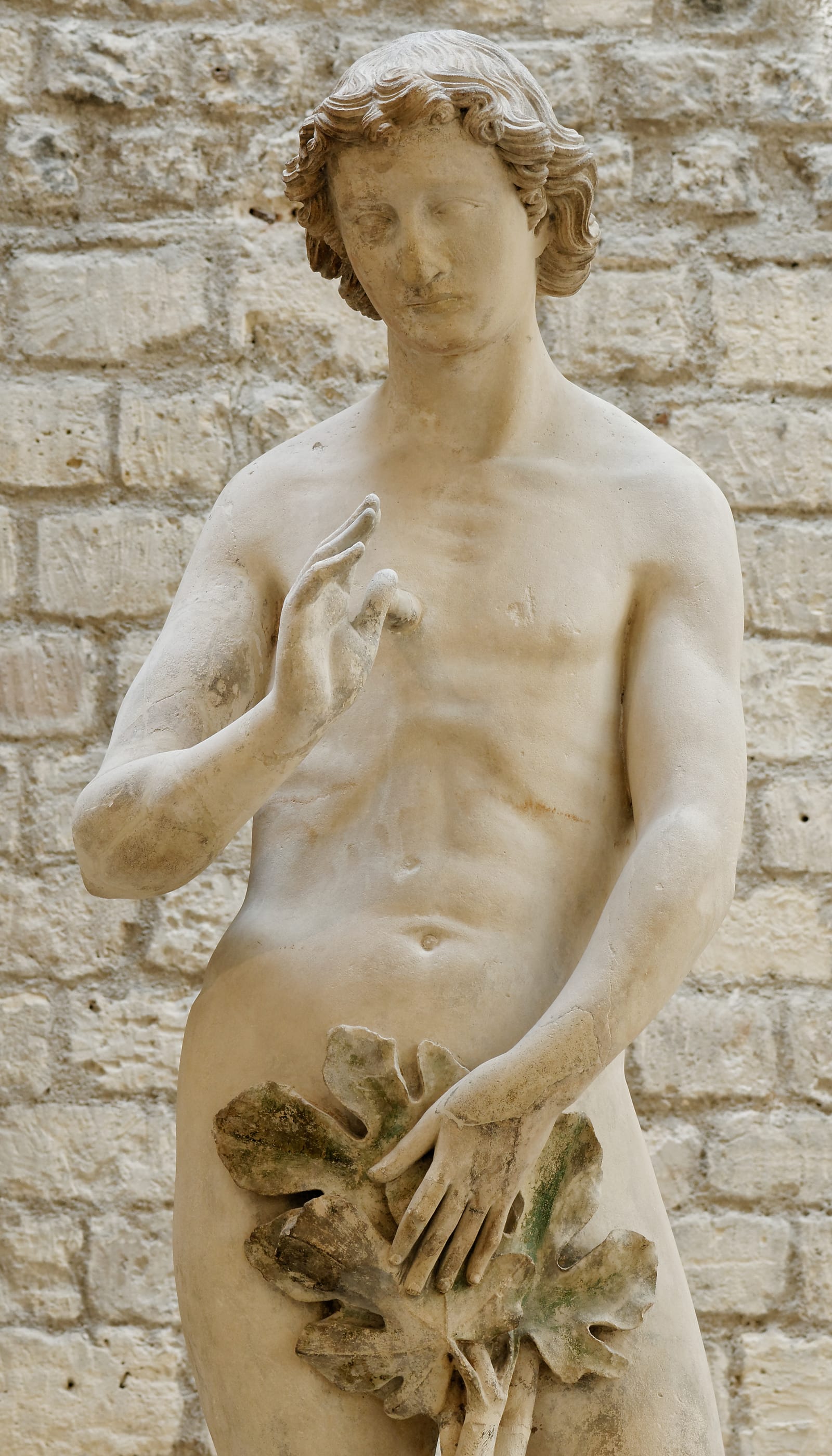
- The raised right hand. It is a warning, aimed at the clergy who walked under him on their way to the bishop's palace.
- The stance: weight on one leg, hip swung out, the other hand lowered in front of the fig leaf. It is the pose of the modest Venus of ancient Greek sculpture.
- The hair, tight rolling curls. It is the one part of him that belongs entirely to thirteenth-century Paris.
- The fig leaf, where the last traces of the paint that once covered the whole figure survive.
Transcript (2:05)
In the same room as the kings stands a tall white figure, and the first thing to notice is that he is naked. In the Middle Ages the nude was rare, though not unheard of, and a naked man two metres tall, carved in Parisian limestone, is not something Gothic sculptors made often.
He is Adam, and like the kings he comes from Notre-Dame, though from inside the building. He stood on the inner face of the south transept, beside the portal, and he had a partner: an Eve on the other side of the door, now lost. Above them, at the top of the gable, sat Christ of the Last Judgement. The statue was made around 1260, while the architect Pierre de Montreuil was in charge of building the south transept. The museum thinks Adam may be by his own hand, and was at least made under his direction. The clue is in the fig leaves, whose crisp, lively carving matches the foliage on another of his works in this museum, the portal of the Virgin chapel from Saint-Germain-des-Prés.
Look at his raised hand. It is a warning. The priests who came through that door on their way back to the bishop's palace passed right beneath him, and Adam, the first sinner, points them to his fall, and to the Christ above him who redeemed it.
Now look at how he stands. His weight is on one leg, the other is relaxed, the hip swings out, and the left hand comes down in front of the fig leaf. That pose is ancient. It is the pose of the Aphrodite of Cnidus by Praxiteles, the modest Venus of Greek sculpture, and it explains why this Adam has a curve to his body that looks almost feminine. The face has something classical about it too. Only the hair, those tight rolling curls, is pure thirteenth-century Paris. Whether the sculptor had seen an ancient statue, or knew one only from drawings in a sketchbook, nobody can say.
He was not always white. The whole figure was painted, and a little of it survives, most of all on the fig leaf. After the Revolution he was taken down and shown at the Musée des Monuments français. When that museum closed in 1816 he went into a stone store at Saint-Denis with other sculptures whose buildings had gone, and only in 1887 was he sent to Cluny. He has been heavily restored twice since, in 1888 and again at the end of the 1970s. The warning hand has been raised for more than seven hundred and fifty years.
Jastrow, Public domain, via Wikimedia Commons. Photo: Jastrow

Stop 4 of 5 · First floor, Room 12 (Art in Northern Europe in the 14th century)
The Colmar Treasure
Various goldsmiths; the wedding ring probably Italian · 13th century – first half of the 14th century · Gold, silver, enamel and precious stones: over 300 coins and about fifty pieces of jewellery. The wedding ring is 3.5 cm high
Look for
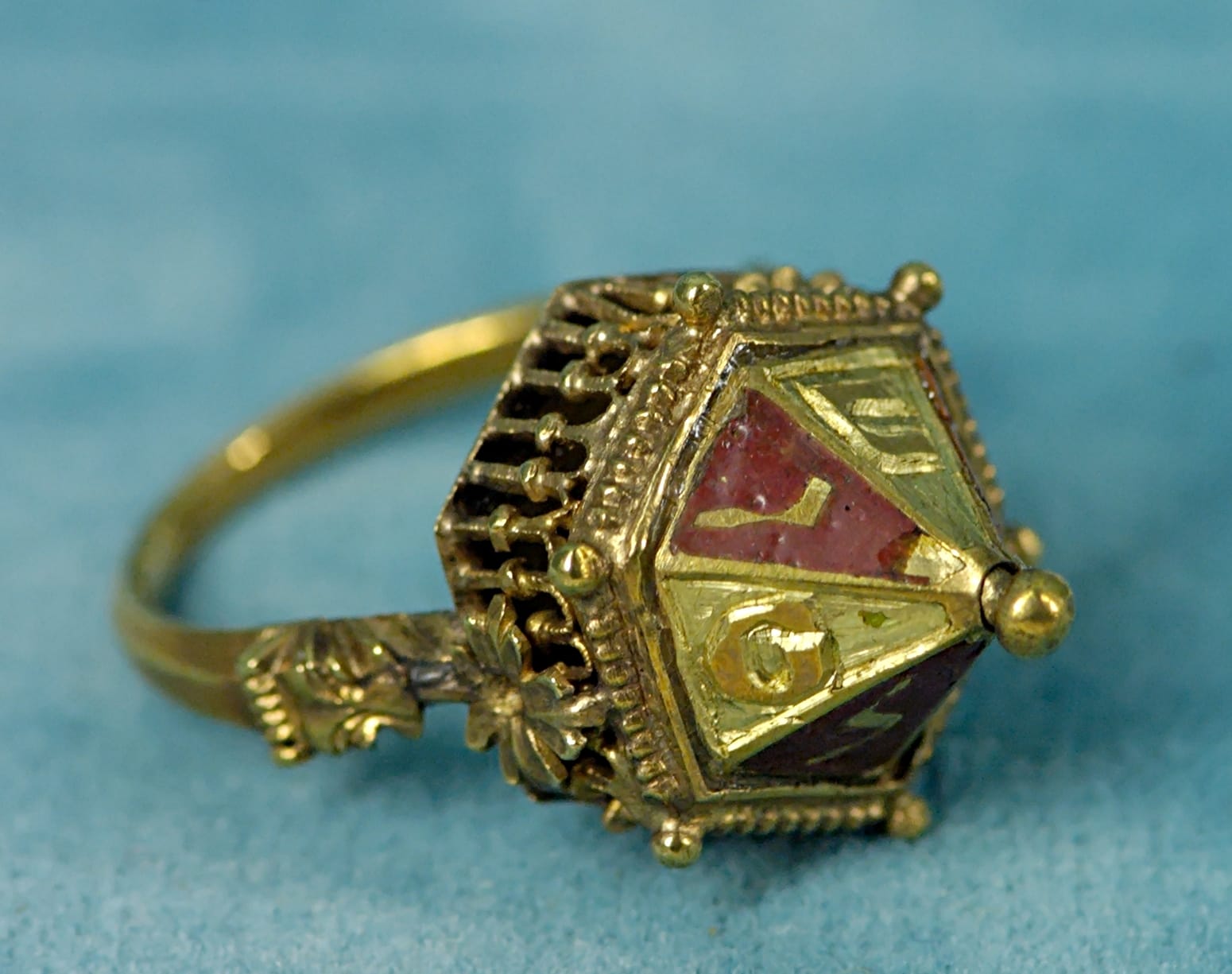
- The wedding ring with a tiny six-sided building on top: gold filigree arches and an enamelled pyramid roof carrying the Hebrew words mazel tov, good luck.
- The small key-jewel, never finished. The cone of metal from the casting is still attached.
- The belt plaques inscribed AMOR, LIEB, HAIL and ANCH. The last may be Annchen, little Anne, the woman it was made for.
- The four-lobed brooch set with sapphires, rubies, garnets and pearls, a 'bouquet of stones' of the kind jewellers loved in the thirteenth and fourteenth centuries.
Transcript (1:53)
These pieces are tiny, a ring three and a half centimetres tall, a key not quite five, and they spent five centuries hidden inside a wall.
In 1863 builders working on a house in the old Jewish quarter of Colmar, in Alsace, opened up a wall and found a hoard: more than three hundred coins and about fifty pieces of jewellery and goldsmiths' work, from the thirteenth century and mostly from the first half of the fourteenth. Some pieces were probably sold off by the finders before anyone had made a record. Most of what survives was bought by this museum in 1923.
Why it was in the wall is the dark part of the story. Between 1347 and 1352 the Black Death swept across Europe, Jews were blamed for it, and they were persecuted in wave after wave. The treasure most likely belonged to a Jewish family of Colmar. Perhaps they had to leave the house in a hurry. They never came back for what they had hidden.
Find the ring with the little building on top. It is a Jewish wedding ring, one of the oldest known, probably made in Italy around 1300. At the ceremony the groom gave it to the bride, and she wore it on that one day only. The tiny building has six sides, arches of gold filigree and a pyramid roof in enamel, and it stands for two things at once: the couple's new home, and the Temple of Jerusalem that had been destroyed. On the roof are Hebrew letters that spell mazel tov, good luck.
The treasure also holds a small key. On the Sabbath, Jewish women going to synagogue were not allowed to carry heavy things, so they locked their valuables in chests, kept the keys in a box, and wore the little key to that box as a jewel. This one is probably the oldest of its kind to survive, and it was never finished. It still has the cone of metal left from the casting, and the rough edges were never filed off.
Then there is the belt, a run of small enamelled plaques that were once sewn to a silk ribbon. They read AMOR and LIEB, both meaning love, then HAIL, meaning health, and ANCH, which may stand for Annchen, little Anne. It was probably a love token, perhaps a wedding present. Her name, if it is hers, survives in four letters on a belt.
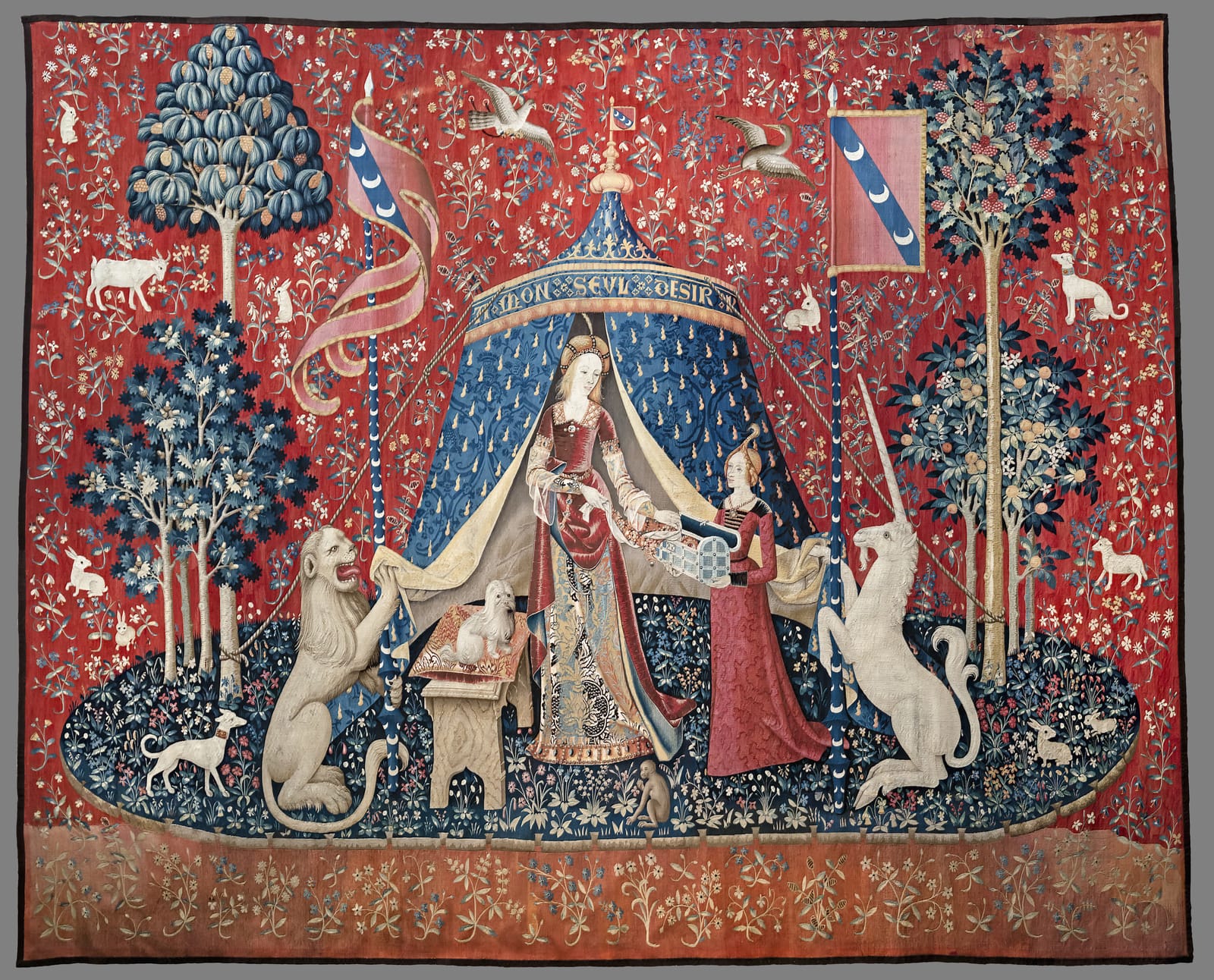
_Mon_seul_d%C3%A9sir_(La_Dame_%C3%A0_la_licorne)_-_Mus%C3%A9e_de_Cluny_Paris.jpg)
Stop 5 of 5 · First floor, Room 20 (The Lady and the Unicorn)
The Lady and the Unicorn
Designed by the Paris painter Jean d'Ypres; weavers unknown · About 1500 · Six tapestries, wool and silk; À mon seul désir 377 × 473 cm
Look for
- The mirror in Sight. The unicorn gazes into it, but the profile reflected there is not the unicorn's.
- A baby unicorn, its horn not yet grown, among the animals on the red background of Taste.
- The letters A and I on either side of the words mon seul désir on the tent. They may be the initials of Antoine Le Viste and his wife Jacqueline.
- Blue leaves. They were woven green, and on the front the yellow in the dye has faded away; on the back of the tapestries the greens survive.
Transcript (2:48)
Six tapestries hang around this room, all on the same red ground. In each one a young woman stands on a blue island of flowers, with a lion on one side of her and a unicorn on the other, and rabbits, foxes, lambs, birds and monkeys scattered over the red around them. They were designed in Paris around 1500, and they are the most famous thing this museum owns.
Five of them are the five senses. The museum reads them in the order medieval writers ranked the senses, from the most physical to the most spiritual. Touch: she holds a banner in one hand and just brushes the unicorn's horn with the other. Taste: she takes a sweet from a dish to feed the parrot on her gloved hand, while a monkey eats at her feet. Smell: she weaves a crown of carnations, and behind her a monkey holds a rose to its nose. Hearing: she plays a small organ while her maid works the bellows. Sight: the unicorn has put its front legs in her lap and gazes into the mirror she holds up. Look closely at that mirror. The face reflected in it is not the unicorn's.
Then the sixth, the one nobody has managed to settle. The lady stands in front of a blue tent. Woven across the top are the words mon seul désir, my only desire, with a letter A on one side and a letter I on the other. Her maid holds out an open box, and the lady's hands are at a necklace. Is she taking it out, or putting it back? One reading makes this a sixth sense, the heart, the one closest to the soul. Another reads the whole set as a story of courtly love, in a garden full of plants and animals that hint at it. The letters may be the initials of Antoine Le Viste and his wife Jacqueline.
The Le Viste arms are on every banner: red, with a blue band and three silver crescents. The family had risen fast through the law courts of Paris, and they wanted everyone to see it. The patron was either Jean the Fourth Le Viste, who died in 1500, or a younger relative, Antoine. The figures were drawn by the painter Jean d'Ypres, who also illuminated books for Queen Anne of Brittany. Where they were woven, nobody knows. Brussels, Tournai and Paris itself are all possible.
They very nearly did not make it. They are first recorded in 1814 at the château of Boussac, in the Creuse. In 1841 Prosper Mérimée, the inspector of historic monuments, reported them and worried about their fate, and George Sand wrote of curious, enigmatic tapestries. In 1853 three pieces were described lying rolled up in a corner of the Boussac town hall, with rats and damp eating at the edges. Only in 1882 did the town sell the set to the State, for 25,500 francs. Much of the damaged lower edge was rewoven over the following ten years. One restorer gave up, defeated by what he called an impossible red.
Before you go, look at the leaves. Some are blue. They were woven green, and on the front of the tapestries the yellow in that green has faded away. On the back, which almost no one ever sees, the greens are still green.
Independent guide · Chiaro
Point Chiaro at anything in the Musée de Cluny.
These five are a start; twenty-two rooms carry on without them. Photograph a Limoges enamel, a panel of Sainte-Chapelle glass or a carved choir stall, and the app tells you which church or abbey it was taken from, then takes your next question out loud.
Before you go
Getting there
28 rue Du Sommerard, 75005 Paris, in the Latin Quarter. That is the visitor entrance; 6 place Paul Painlevé, which also appears on the museum's letters, is its administrative address.
Métro Cluny–La Sorbonne on line 10 is the station named after the museum. Saint-Michel on line 4 and Odéon are also close, and RER B and C stop at Saint-Michel–Notre-Dame. Buses 21, 27, 38, 47, 63, 86 and 87 serve the area.
Tickets
- Mondays are the closed day, along with three holidays in the year: Christmas Day, New Year's Day and 1 May. Otherwise the galleries open at half past nine and close at a quarter past six, but the ticket desk shuts at half past five, so do not cut it fine. On 24 and 31 December everything shuts early, at 5 pm.
- On certain Thursday evenings Cluny keeps going until 9 pm and sells tickets until 8.30 pm. The evening dates are on musee-moyenage.fr.
- Nobody pays on the first Sunday of each month. Under-18s never pay, and neither does anyone aged 18 to 25 who holds EU nationality or has lived in the EU for more than three months, with proof. Everyone else buys a ticket, and the current prices are on musee-moyenage.fr.
- Travel light: backpacks and suitcases, cabin size included, are turned away at the door. Only small bags, no bigger than 40 × 30 × 40 cm, get in, held in the hand or worn on the front.
- Photos for your own use are fine, but no flash, tripods or selfie sticks.
The official audio guide
Cluny's own guide is a digital visitor companion rented at reception, with a masterpieces trail, themed visits and family tours in French, French Sign Language, English and Spanish. It costs 4 euros, or 2 at the reduced rate, and you leave a piece of ID while you have it. Rather not leave your ID at the desk? The five recordings above need nothing but your own phone and a pair of headphones.
Official site →Questions
Is there a free Musée de Cluny audio guide?
Yes: the five recordings on this page, from the Roman baths to the unicorn tapestries. They play in your phone's browser with the words printed under each track, and nothing needs installing. Everywhere else in the building, point your camera at an object and Chiaro puts a name and a story to it.
How much is the official Musée de Cluny audio guide?
The museum's digital visitor companion costs 4 euros, or 2 at the reduced rate. You rent it at reception against a piece of ID, and it comes in French, French Sign Language, English and Spanish.
Where is the Lady and the Unicorn in the Musée de Cluny?
Upstairs, in Room 20, a room named after the tapestries. The museum's route takes you through the Roman baths and the ground-floor rooms first, so the unicorn comes near the end of the visit.
Is the Musée de Cluny closed on Mondays?
Yes, Monday is the closed day every week, and the museum also shuts for Christmas Day, New Year's Day and 1 May. The rest of the week the doors open at half past nine and close at a quarter past six, and the last tickets are sold at half past five.
How long does the Musée de Cluny take?
The five stops take about an hour, of which the recordings take up about ten minutes. The whole museum is twenty-two rooms on two levels covering fifteen hundred years; our advice is two to three hours for the lot.
Has the Musée de Cluny reopened after its renovation?
Yes. After a long renovation that rearranged the collections in chronological order and added a new building for visitor facilities, the museum reopened on 12 May 2022.
More audio guides
Made by Chiaro. Not affiliated with the Musée de Cluny.