
Château de Chantilly · Chantilly · Independent guide
Château de Chantilly audio guide,
five stops, free.
Stream all five right in this browser tab, then photograph any of the Musée Condé's 800 paintings or princely salons for Chiaro to narrate.
Made by Chiaro. Not affiliated with the Château de Chantilly.
The Three Graces
Château de Chantilly
That was the free part
Chiaro narrates any work in the Château de Chantilly from a photo.
The five stops · 10 minutes of audio
Five stops, one walk,
in the order you will walk them.
Inside the moated château rebuilt for Henri d'Orléans, Duke of Aumale, hangs France's finest collection of pre-1850 paintings outside the Louvre — and this Château de Chantilly audio guide traces a single upper-floor loop through the Musée Condé. Begin in the jewel-box Santuario with Raphael's tiny Three Graces and Jean Fouquet's forty illuminated leaves from the Hours of Étienne Chevalier, walk into the red-walled Gallery of Painting for Nicolas Poussin's Massacre of the Innocents, continue to its far Rotunda for Piero di Cosimo's Portrait of Simonetta Vespucci, and step into the Isabelle Room for Jean-Léon Gérôme's Duel After the Masquerade. Audio runs to about ten minutes across roughly an hour on foot through the galleries.
Catalogue details, room names and visitor logistics draw on the estate's published Musée Condé records at chateaudechantilly.fr paired with an independent scholarly reference for each work. Under the Duke of Aumale's bequest to the Institut de France, no work may ever leave Chantilly on loan and the nineteenth-century wall hang cannot be rearranged, though conservation work inside the château can still shift visitor routing: if a room sign on the day differs from what follows, follow the room sign and let us know.

Stop 1 of 5 · The Santuario
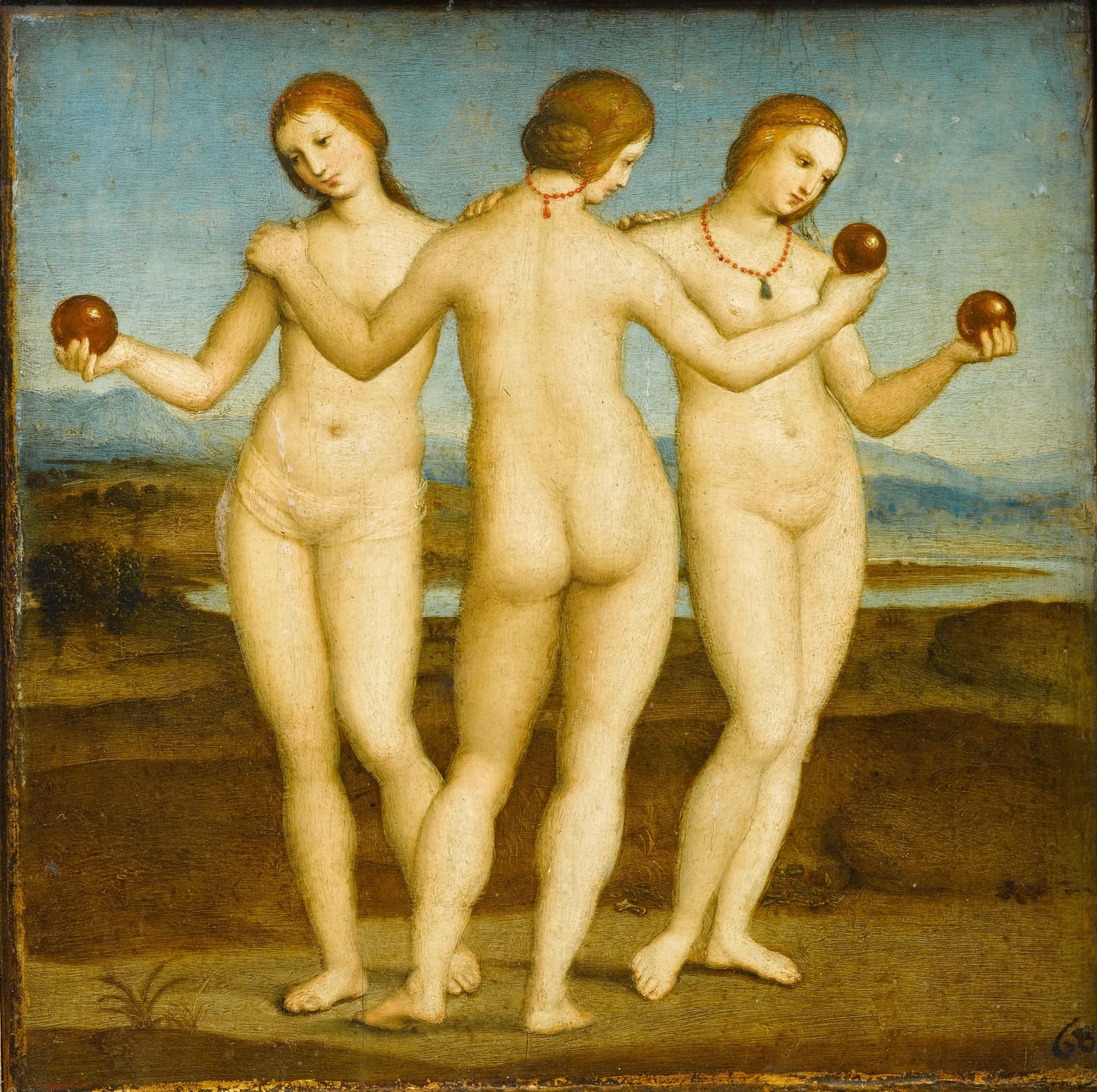
The Three Graces
Raphael (1483–1520) · c. 1504–1505 · Oil on panel, 17 × 17 cm
Look for
- The tiny 17-centimetre square panel — smaller than an open paperback — and the golden sphere poised in each figure's outer hand.
- Subtle differences in dress and jewellery: a sheer veil across the left figure's hips, red coral necklaces on the central and right figures.
- Raphael's Madonna of the House of Orléans hanging nearby in this purpose-built room alongside Jean Fouquet's forty framed miniatures.
Transcript (2:07)
Lean in close to the glass in this small, quiet room, because the most famous painting at Chantilly is no bigger than a ceramic tile. Seventeen centimetres high by seventeen wide. When Henri d'Orléans, Duke of Aumale, bought this panel in England in December 1885 for twenty-five thousand pounds, he had his architect design the Santuario around it as a secular shrine.
Raphael painted it around 1504 or 1505, barely out of his teens, between Urbino, Siena, and his first months studying Leonardo and Michelangelo in Florence. It is one of his earliest secular pictures and the first time he painted the female nude from both front and back, borrowing the linked-shoulder pose of a ruined Roman marble group he could have seen in the Piccolomini Library at Siena Cathedral. Yet where Roman stone stands cold and symmetrical, Raphael tilts the three heads gently inward against a pale Umbrian valley of blue hills, turning antique marble into warm skin.
Look at the three golden spheres in their hands. X-ray photography inside the museum's conservation studio uncovered a surprise underneath the paint. When Raphael started the panel, only the woman on the left held a golden ball, which means he almost certainly began painting the Judgement of Paris, with Aphrodite holding the prize beside Hera and Athena. Midway through, he changed his mind and painted a golden apple into every hand.
Why make that change? A clue sits in the National Gallery in London, where another Raphael panel of the exact same seventeen-centimetre square size shows a young sleeping knight flanked by stern Virtue offering a sword and book, and Pleasure holding out a sprig of blossom. In 1930 the art historian Erwin Panofsky argued that the London and Chantilly panels were made together — either hinged as a miniature diptych or set front and back like a medal and its cover — for a young Roman nobleman of the Borghese family. Read that way, these three women are not only the classical Graces of Chastity, Beauty, and Love, subtly graded from the veiled maiden on the left to the coral-jewelled figure on the right, but also the Hesperides offering the golden apples of immortality as the hero's reward.
Both panels sat together in the Villa Borghese in Rome by 1633, slipped out of Italy after French troops entered Rome in 1800, and crossed the Channel into British collections. London kept the sleeping knight; the Duke of Aumale brought the three sisters to France, and under the terms of his will they can never cross the moat again.

Stop 2 of 5 · The Santuario
The Hours of Étienne Chevalier
Jean Fouquet (c. 1420–c. 1480) · c. 1452–1460 · Tempera and gold on parchment, 40 illuminated leaves mounted on wood, each c. 16.5 × 12 cm
Look for
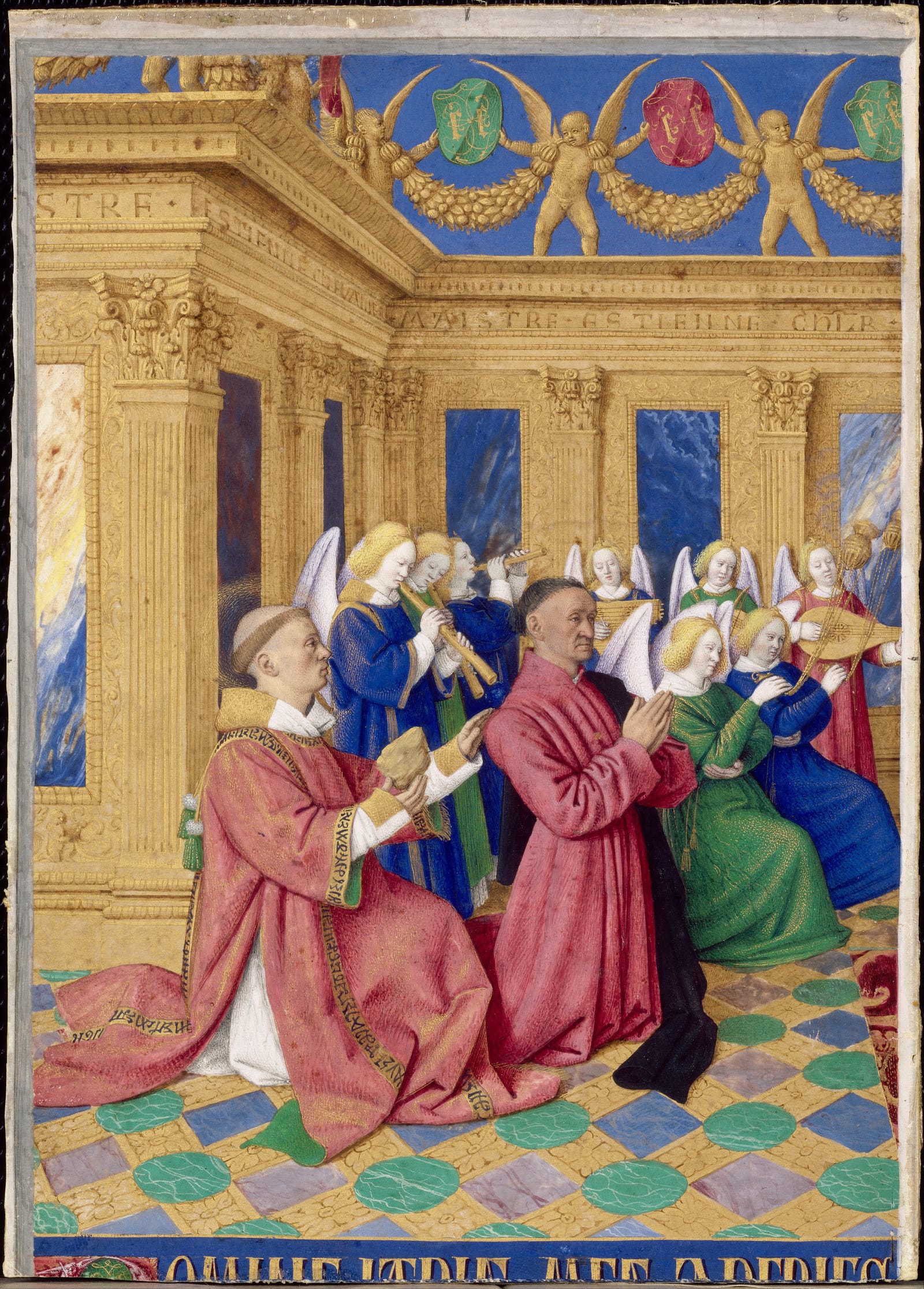
- In the dedication leaf, Saint Stephen's bleeding tonsured scalp and the jagged stone balanced in his hand as he commends the kneeling donor.
- The classical gilt pilasters carved with MAISTRE ESTIENNE CHEVALIER along the frieze, and winged putti overhead holding shields with his double-E cipher.
- Medieval Paris landmarks tucked into biblical scenes across the surrounding frames, including the Sainte-Chapelle and the towers of Notre-Dame.
Transcript (2:11)
Turn from Raphael to the forty small framed panels lining the walls around you in the Santuario. They look like miniature easel paintings, and for two centuries dealers treated them that way. In fact, every single one is a page cut with a blade out of a fifteenth-century prayer book.
Around 1452, Étienne Chevalier, royal treasurer to King Charles the Seventh of France and newly widowed, commissioned a personal Book of Hours from Jean Fouquet, the master painter of Tours who had recently returned from Italy. Fouquet spent most of the 1450s working on this manuscript. Where earlier French illuminators boxed tiny scenes inside thorny borders of ivy leaf, Fouquet knocked the borders away, dropped the horizon, and brought Italian Renaissance architecture and northern light onto sheets of vellum sixteen and a half centimetres tall.
Now find the opening dedication panel, originally half of a facing two-page spread. Kneeling in a crimson robe with his hands pressed together is Étienne Chevalier himself, bareheaded and unidealised. Kneeling right beside him with a fraternal hand on his shoulder is his name-saint, Saint Stephen, the first Christian martyr: look closely at the saint's tonsured head and you can see a trickle of blood, matched by the sharp, heavy stone balanced on the book in his left hand. Around them rises a hall of golden Corinthian pilasters whose carved frieze spells out Maistre Estienne Chevalier in Roman capitals, while winged cherubs along the blue rim hold shields stamped with his linked double-E monogram.
Now scan the other thirty-nine leaves around the room and watch how Fouquet folds fifteenth-century France straight into Scripture. When the Holy Spirit descends or evil spirits scatter from the sky, the skyline underneath is Paris, complete with the Île de la Cité, the twin towers of Notre-Dame, and the spire of the Sainte-Chapelle.
Chevalier's descendants kept the intact book until the late seventeenth century. Then, sometime in the eighteenth century, an owner dismembered it, pasting strips over the Latin prayers so each picture could be sold separately. Forty of the finest leaves were mounted onto oak boards in Paris, carried to Basel during the French Revolution, and bought in 1809 by the Frankfurt banker Georges Brentano. Only seven other illustrated leaves survive anywhere in the world today, scattered from the Louvre and the Marmottan to London and New York. In 1891 the Duke of Aumale paid Brentano's son two hundred and fifty thousand francs for all forty panels in front of you, reuniting most of Fouquet's broken masterpiece in one room.

Stop 3 of 5 · Gallery of Painting
The Massacre of the Innocents
Nicolas Poussin (1594–1665) · c. 1628–1629 · Oil on canvas, 147 × 171 cm
Look for
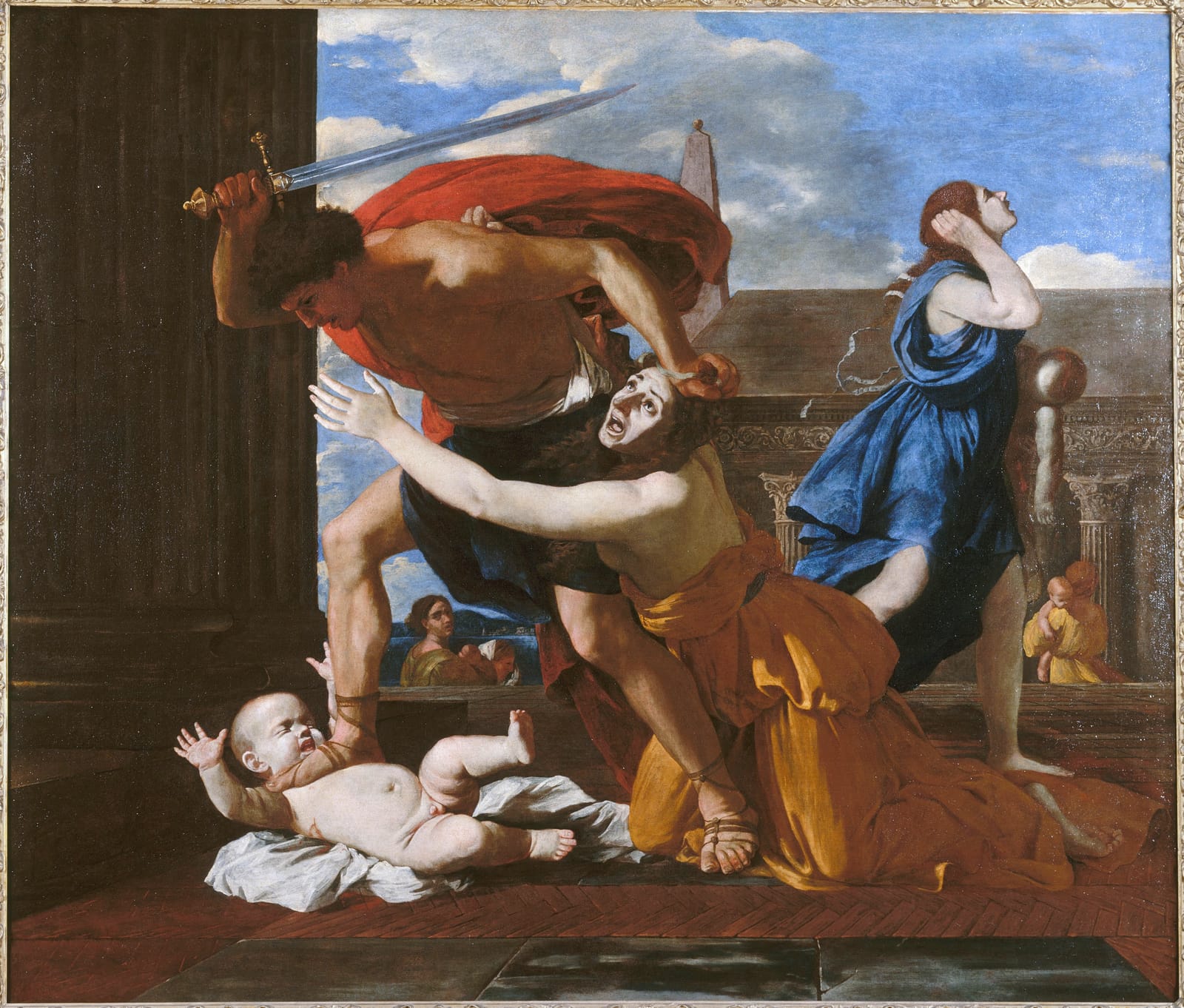
- Two harsh diagonals — the soldier's raised sword and bracing leg crossing the mother's flung-back arm — meeting straight on her open, screaming mouth.
- The executioner's left fist wrenching the mother's hair backward while her right hand claws his back beneath his red cloak.
- Behind them at the right, a woman in deep blue clapping a hand to her brow as she walks away cradling her dead infant.
- The three-tiered salon hang of 85 paintings around the gallery, arranged by visual symmetry rather than date and unchanged since 1898.
Transcript (2:03)
Walk out through the narrow stained-glass gallery into the grand, top-lit Gallery of Painting, where eighty-five canvases climb the crimson walls frame to frame. Halfway along, one picture cuts across the quiet nineteenth-century room like a shout.
Nicolas Poussin painted The Massacre of the Innocents in Rome around 1628 or 1629, when he was in his mid-thirties and fighting to establish his name among Italian patrons. His buyer was Marchese Vincenzo Giustiniani, one of the boldest collectors in Rome and an early champion of Caravaggio. Giustiniani had a personal reason to commission Matthew's Gospel story of King Herod slaughtering the infants of Bethlehem: in 1566 Ottoman forces had seized the island of Chios and taken children of the Giustiniani family hostage, several of whom died rather than renounce their faith.
Earlier Renaissance painters had staged Herod's order as a tangled crowd scene of dozens of soldiers and mothers. Poussin threw the crowd out. He locked the entire horror onto three bodies at life scale, painted in fierce primary red, yellow, and blue against cold classical stone. Look at the geometry. One brutal diagonal runs from the infant pinned beneath the soldier's sandalled foot up through the executioner's bare leg and raised sword. A second diagonal shoots down the mother's white-lit left arm as she shoves toward his shoulder while his fist yanks her hair backward and her right hand claws his back, and the two lines collide right on her open, screaming mouth. Behind them at the right, tragedy has already turned to numbness: a second mother in blue walks away, eyes raised to an indifferent sky, carrying her dead child under one arm.
Lucien Bonaparte bought the canvas out of the Palazzo Giustiniani in 1804, and five decades later, in 1854, the exiled Duke of Aumale acquired it in London and eventually hung it on this wall, balanced by size and colour rather than by century, just as he left all eighty-five works in this hall.
For two hundred years critics admired Poussin as a cool, rational classicist and walked past this canvas slightly unsettled. The twentieth century recognized what it really was. Pablo Picasso studied that flung-back head and open mouth before painting the screaming mother in Guernica, and the British painter Francis Bacon came out from Paris to Chantilly again and again just to stand where you are standing now, calling that mother's cry the greatest scream in the history of painting.

Stop 4 of 5 · The Rotunda (at the far end of the Gallery of Painting)
Portrait of Simonetta Vespucci
Piero di Cosimo (1462–1521) · c. 1480 · Tempera on poplar panel, 57 × 42 cm
Look for
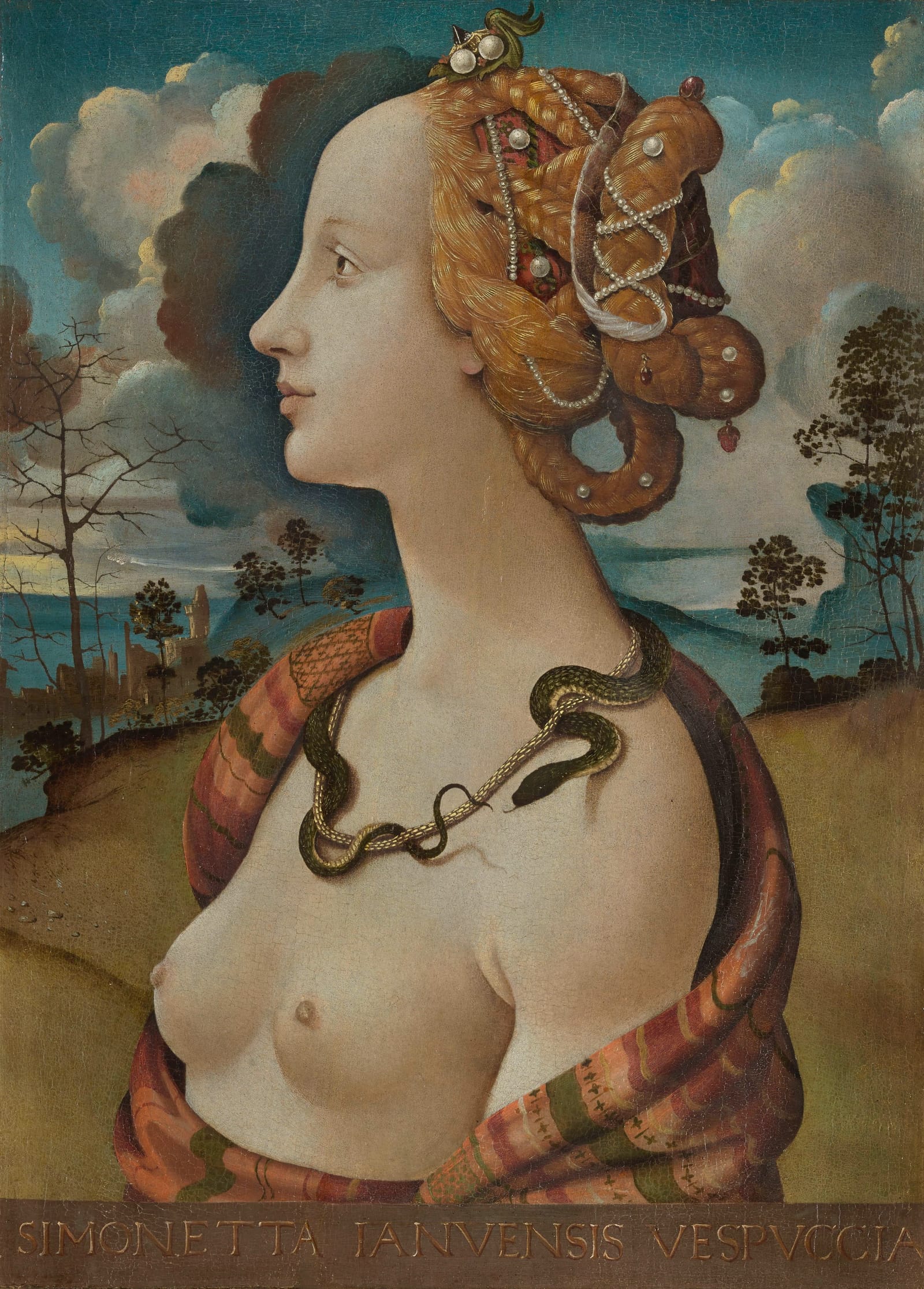
- The live green-and-gold snake twined around her thin golden collar, curving back to bite toward its own tail.
- The split landscape behind her head: a dark thundercloud and bare, dead branches in front of her face on the left, living green trees behind her on the right.
- The capitalised Latin inscription SIMONETTA IANVENSIS VESPVCCIA painted across the faux-stone parapet along the bottom.
Transcript (2:05)
Continue to the far end of the Gallery of Painting and enter the apse-like Rotunda reserved for Italian Renaissance panels. Halfway round, a pale woman in strict left profile stares toward a dark storm cloud, bare-breasted, a striped silk mantle slipped off her shoulders, her blonde hair braided with ropes of pearls and ribbons, and a live snake coiled around her neck.
Read the gold capitals painted along the stone ledge beneath her: Simonetta Ianvensis Vespvccia — Simonetta Vespucci of Genoa. Born Simonetta Cattaneo around 1453 into a noble Genoese family, she married the Florentine banker Marco Vespucci — a cousin of Amerigo Vespucci, after whom America would later be named — at sixteen and arrived in Medici Florence to universal astonishment. Poets wrote verses to her; Sandro Botticelli is long thought to have kept her features in his head years later when painting Venus. At the famous Florence joust of 1475, Lorenzo the Magnificent's younger brother Giuliano de' Medici rode into the Piazza Santa Croce carrying a silk banner painted by Botticelli that showed Simonetta as helmeted Pallas Athena, proclaimed Queen of Beauty. Fourteen months later, on the twenty-sixth of April 1476, tuberculosis killed her at twenty-three. All Florence followed her open coffin through the streets, and two years after that Giuliano himself was stabbed to death in the Pazzi conspiracy.
Piero di Cosimo painted this poplar panel around 1480, several years after both of them were in their graves, as a posthumous memorial associated with the Medici and Vespucci circle. Look at how every detail behind her speaks of a life cut short. Directly before her eyes on the left, a bruise-dark cloud rises behind leafless, dead branches. Behind the nape of her neck on the right, trees stand in full leaf under clear blue light.
When the sixteenth-century biographer Giorgio Vasari saw this painting in the Vespucci house in Florence, he ignored — or never saw — the Latin name along the bottom and described it as Cleopatra with the venomous asp at her throat. Modern curators read the serpent differently: poised to catch its own tail against her gold torque, it becomes the ancient ouroboros, emblem of time coming full circle and beauty outlasting death.

Stop 5 of 5 · Isabelle Room (Logis)
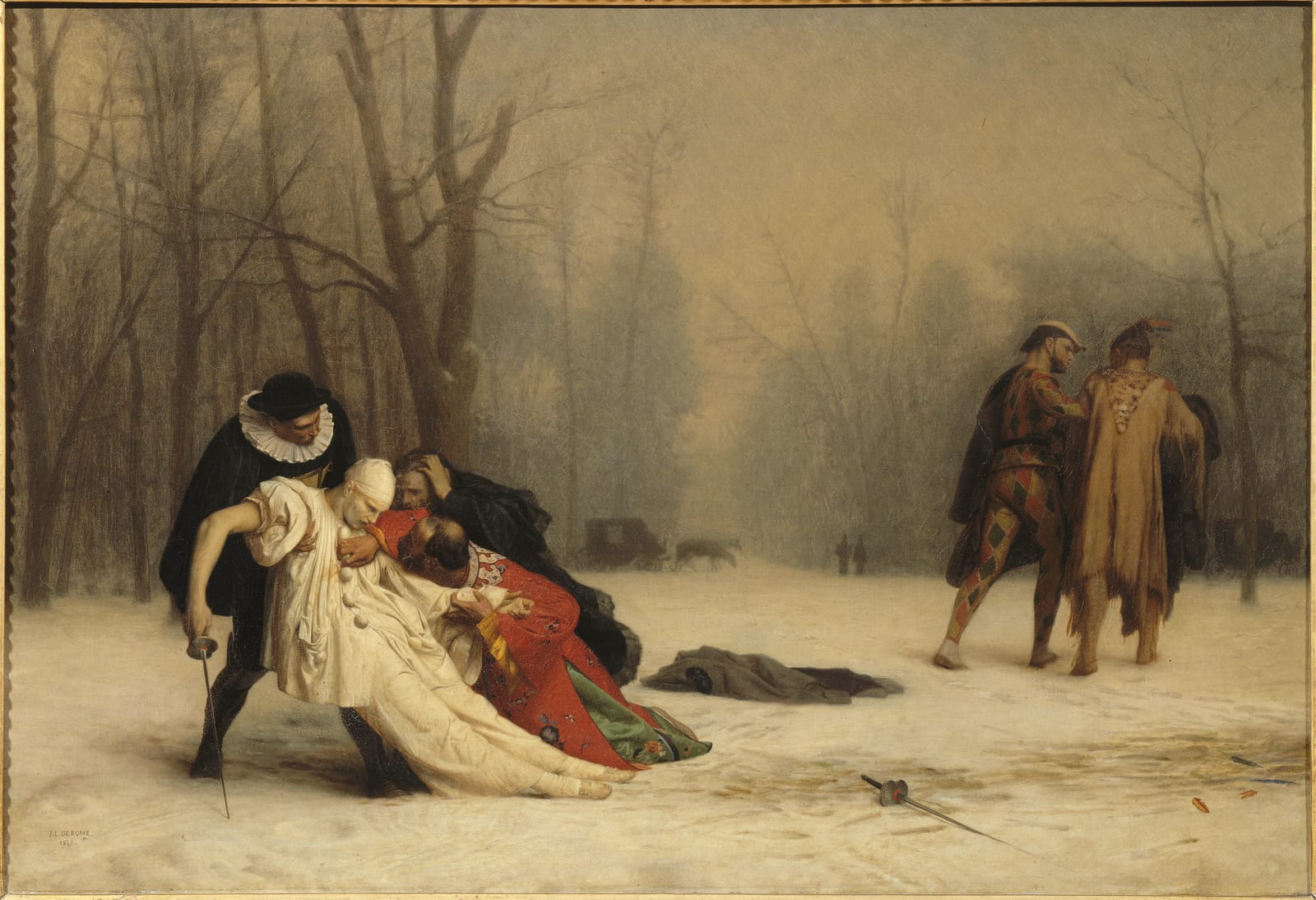
The Duel After the Masquerade
Jean-Léon Gérôme (1824–1904) · 1857 · Oil on canvas, 68 × 99 cm
Look for
- Across the trampled foreground snow: the victor's discarded rapier on the right, bright feathers torn from his headdress, and footprints trailing toward the waiting carriages.
- Each carnival costume given a grim role: white Pierrot bleeding from the chest, a Venetian Doge staunching the wound, a sixteenth-century Duke of Guise supporting him, and Harlequin leading the victor away.
- Jean-Léon Gérôme's signature and 1857 date inscribed into the snow at the lower left.
Transcript (1:53)
Leave the Rotunda into the adjoining rooms of the nineteenth-century Logis and stop in the Isabelle Room before a winter forest shrouded in grey mist. Nobody is fighting on this canvas. The sword stroke has already landed, and Jean-Léon Gérôme — who made a career out of painting the hush right after violence rather than the blow itself — lets you piece the crime together from the snow.
It is dawn in the Bois de Boulogne outside Paris after an all-night carnival ball. Six men have driven out into the freezing woods without stopping to change out of their fancy dress. On the left, a duellist costumed as white-faced Pierrot collapses backward, his loose white satin blouse blooming red at the ribs, his limp right hand barely grazing the hilt of his rapier. Behind him, a second in the black ruff of the Duke of Guise takes his weight, a surgeon dressed in the crimson and gold cap of a Doge of Venice presses a hand to the puncture wound, and a fourth friend in a black domino mask grabs his own head in horror.
Now follow the trampled snow to the right. A dropped sword lies abandoned on the ice, beside two bright feathers torn loose in the scuffle. Beyond them, the man who dealt the fatal thrust — dressed as a Native American warrior — walks stiffly toward a waiting horse-drawn cab in the fog, leaning heavily on the shoulder of his second in Harlequin's diamond patchwork.
When thirty-three-year-old Gérôme showed this canvas at the Paris Salon of 1857 under the title Suites d'un bal masqué, Parisian newspapers immediately began guessing which real scandal from the Second Empire winter season he had put in paint. Shown in London later that year, it caught the eye of the exiled Duke of Aumale, then living along the Thames at Twickenham, who bought it in 1858 for twenty thousand francs. Demand was so fierce that Gérôme painted smaller replicas for an American railway magnate in Baltimore and for the future Tsar Alexander the Third in Saint Petersburg — yet the canvas in front of you is the 1857 original. Aumale lent it back to Gérôme just once, for the Paris World's Fair of 1867, where it helped win the Grand Prize for Painting, before bringing it home to Chantilly for good.
Independent guide · Chiaro
Point Chiaro at anything in the Château de Chantilly.
Five stops barely scratch a collection where canvases hang three deep from Wainscot to cornice and not a single wall label is allowed to disturb the nineteenth-century hang. Snap a portrait in the Gallery of Painting, a stained-glass panel of Psyche, or the monkey frescoes of the Grande Singerie: Chiaro identifies the piece on the spot and answers whatever follow-up questions you ask.
Before you go
Getting there
Château de Chantilly, 60500 Chantilly, 40 kilometres north of Paris. Follow the drive past the Great Stables across the moat terrace and enter through the Cour d'Honneur. Inside the listed historic monument, step-free wheelchair access is limited to the ground-level Reading Room and Large Suites (via the Cour d'Honneur) plus the shop and Graphic Arts Gallery (via the Capitainerie courtyard); all five stops on the upper-floor Musée Condé loop require stairs.
SNCF main-line TER trains from Paris Gare du Nord reach Chantilly-Gouvieux in 25 minutes; RER line D takes about 45 minutes to the same station. From platform A1 outside the station, the free municipal DUC shuttle, regional Bus 645 towards Senlis, and La Navette Touristique (on weekends and French public holidays) reach the château in about 10 minutes, or you can walk the woodland path in roughly 25 minutes.
Tickets
- The château, Great Stables, and grounds close every Tuesday, and the estate also closes temporarily each January for annual maintenance and conservation; confirm exact seasonal hours (château 10 am–5 pm in winter, 10 am–6 pm from spring to autumn) and holiday openings on chateaudechantilly.fr.
- 1-Day tickets for château entry (21 euros full price over 25, 17.50 euros ages 7–25, under-7s free) are time-stamped and require booking a mandatory entry slot; they include the Musée Condé art galleries, Large Suites, park, and Great Stables, while the Reading Room (3-euro supplement) and downstairs Private Apartments (7-euro guided tour) require separate add-ons.
- Travelling by train from Paris Gare du Nord? Look for SNCF's combined Pack TER + 1-Day Ticket, which bundles return regional rail travel from Paris with full estate admission.
- Do not expect to see the original Très Riches Heures du Duc de Berry on the permanent route: because of extreme light sensitivity, the medieval manuscript stays in the library vault outside rare special exhibitions, while Jean Fouquet's forty framed leaves in the Santuario remain on permanent view.
The official audio guide
The estate sells a 3-euro official Castle audio guide alongside its free Château de Chantilly Visit App on iOS and Android and optional 7-euro staff-led tours of the painting galleries and Private Apartments. Our page gives you five narrated stops straight in your mobile browser with full written scripts underneath — useful when mobile reception dips behind thick stone walls — and the Chiaro app handles any other painting in the room from a photo.
Official site →Questions
Is there a free Château de Chantilly audio guide?
Yes. The five audio tracks on this page stream free in your phone's browser with transcripts printed below every player and nothing to download. Château de Chantilly also offers a free official Visit App on iOS and Android alongside its 3-euro Castle audio guide, while the Chiaro app can narrate any other painting or salon from a quick photo.
How much is the official Château de Chantilly audio guide?
The estate's official Castle audio guide ticket costs 3 euros, while its Château de Chantilly Visit App is free to download on iOS and Android. Staff-led 45-minute guided tours — required to enter the Duke and Duchess of Aumale's downstairs Private Apartments, and offered on weekends for the painting collections — cost 7 euros on top of the 1-Day timestamped ticket.
Where are Raphael's Three Graces in the Château de Chantilly?
In the Santuario, a small purpose-built cabinet on the upper floor of the Musée Condé just off the Galerie de Psyché. Raphael's Madonna of the House of Orléans and Jean Fouquet's forty miniatures from the Hours of Étienne Chevalier hang in the exact same room.
Can I see the Très Riches Heures du Duc de Berry on an ordinary visit?
No — the original fifteenth-century manuscript is too fragile for permanent light exposure and rests in the Reading Room vault except during rare conservation exhibitions, with digital facsimiles shown instead. For medieval illumination on permanent display every open day, head straight to Jean Fouquet's forty framed miniatures in the Santuario.
Is the Château de Chantilly closed on Tuesdays?
Yes, the château, grounds, and Great Stables close every Tuesday, and the château also closes temporarily each January for annual maintenance and artwork conservation. On open days the château welcomes visitors from 10 am until 5 pm in winter and 6 pm in high season, with mandatory timed-entry slots on 1-Day tickets; check chateaudechantilly.fr before setting off from Paris.
More audio guides
Made by Chiaro. Not affiliated with the Château de Chantilly.