
Conciergerie · Paris · Independent guide
Conciergerie audio guide,
five stops, free.
Beneath a 47-metre clock tower and 1,785 square metres of fourteenth-century Gothic vaults, five recordings play right here, and Chiaro can explain any carved capital or revolutionary relic you photograph.
Made by Chiaro. Not affiliated with the Conciergerie.
The Tour de l'Horloge and the Quai de l'Horloge towers
Conciergerie, Paris
That was the free part
Chiaro narrates anything at the Conciergerie from a photo.
The five stops · 11 minutes of audio
Five places, one walk,
in the order you will walk them.
Begin on the corner of the boulevard du Palais and the quai de l'Horloge, where this self-guided Conciergerie audio guide opens in front of Paris's oldest public clock and the river towers before you cross security. Past ticket control and down fourteen steps onto the medieval ground level, stand among the four vaulted naves of the Hall of the Men-at-Arms; walk west down the colonnade to the tall iron bars of La Rue de Paris; continue on the ground level into the prisoners' chapel and Marie-Antoinette's expiatory oratory behind its black altar curtains; then step outside into the Women's Courtyard just ahead of the bookshop and the twenty steps back to the street. Listening takes around eleven minutes inside a visit the monument puts at sixty to ninety minutes.
Fares, opening times and courthouse security rules on this page come from paris-conciergerie.fr and its English visitor leaflet, while historical dates and measurements draw on those publications alongside Wikipedia. Because the monument shares its island perimeter with the working Paris law courts, security notices or staff instructions on the boulevard always override what is printed here; if anything on the ground has shifted, drop us a message so future visitors get the updated version.

Stop 1 of 5 · Corner of the boulevard du Palais and the quai de l'Horloge, on the pavement outside the entrance at 2 boulevard du Palais; public street, before any ticket
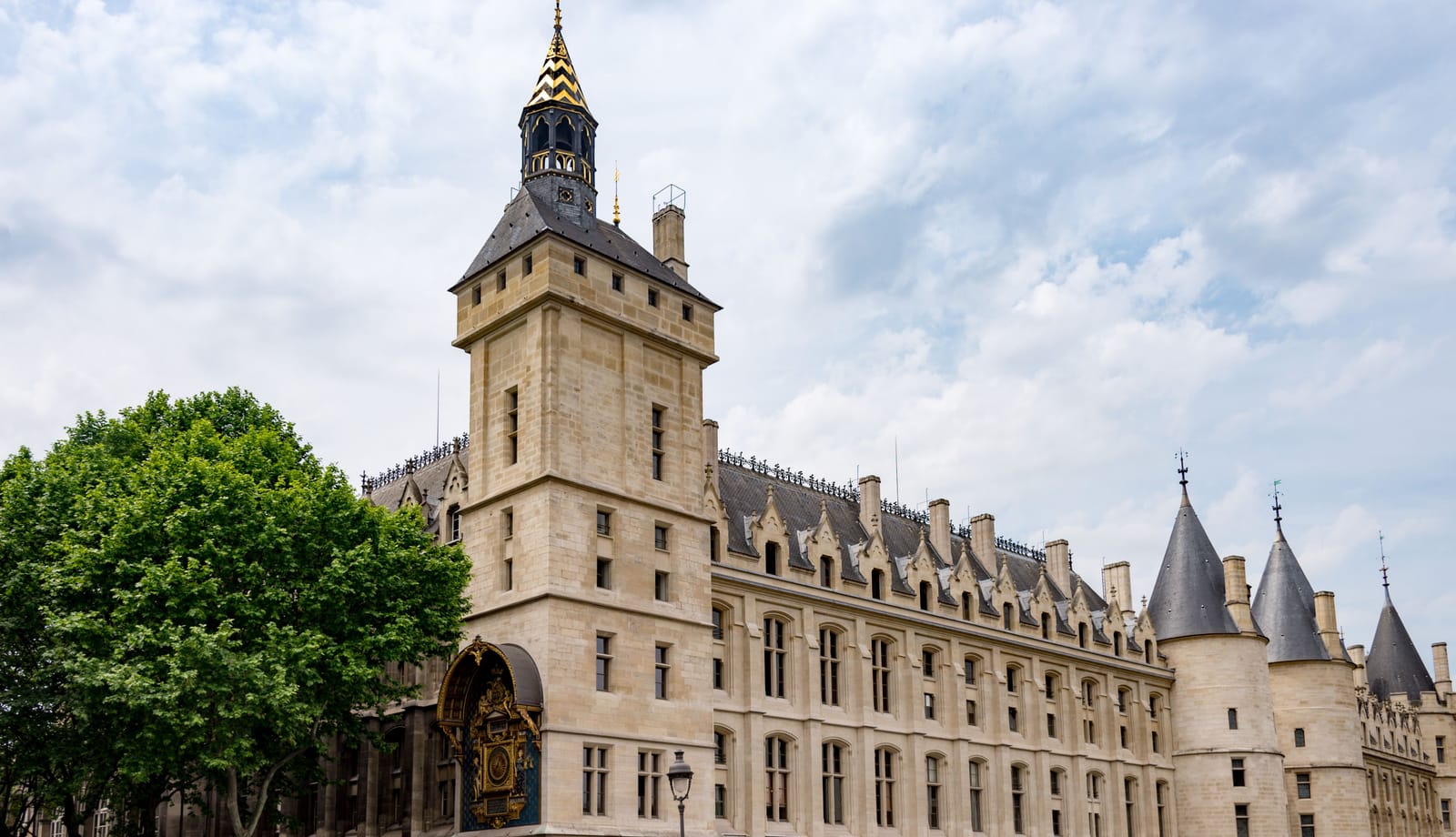
The Tour de l'Horloge and the Quai de l'Horloge towers
Tower built under Jean II the Good (1350–1353); clock by Henri de Vic (1370) and frame by Germain Pilon (1525–1590); river towers by Louis IX and Philip IV; neo-Gothic north riverfront by Antoine-Marie Peyre (1820–1828) and east front by Joseph-Louis Duc (1802–1879) and Étienne-Théodore Dommey · Tour Bonbec 13th century; Tour de César and Tour d'Argent early 14th century; Tour de l'Horloge 1350–1353; clock 1370, redecorated 1585; north front 1820–1828, east front 1847–1871 · Limestone watchtower 47 m high with walls nearly 1 m thick and a painted and gilded clock dial 1.5 m across, joined to three cylindrical river towers
Look for
- Germain Pilon's two standing figures flanking the 1585 clock dial on the boulevard du Palais face: Law holding her tablet and sceptre on the left, Justice with her sword and scales on the right.
- The two Latin plaques above and below the gilded sun-ray dial: the upper promising Henry the Third a third crown after Poland and France, the lower comparing twelve equal hours to the keeping of law and justice.
- Round the corner along the Quai de l'Horloge, the twin conical roofs of the Tour de César and Tour d'Argent, and beyond them the crenellated Tour Bonbec, the only tower with battlements along the river.
- How low the medieval ground floor sits relative to the pavement: stone river embankments built from 1611 under Louis the Thirteenth raised the quay by several metres around the palace.
Transcript (2:10)
Stand on the corner where the boulevard du Palais meets the river quay and look up at the square stone tower above you. At forty-seven metres high, with walls nearly a metre thick, the Tour de l'Horloge went up between 1350 and 1353 on old marshy ground under King John the Good as a watchtower for the royal palace. Everything behind it on this western half of the Île de la Cité was power long before the Louvre mattered: Roman governors fortified this tip of the island, the Frankish king Clovis died here in 511, and Hugh Capet made it his seat after 987.
Drop your eyes to the blue-and-gold canopy low on the boulevard wall. In 1370 Charles the Fifth mounted the very first public clock in Paris on this tower, built by the Lorrain clockmaker Henri de Vic, and hung a silver bell in the lantern a year later. By 1418 Parisians demanded an outside dial so the town could order its business day and night. The frame you see dates from 1585, commissioned by Henry the Third from the sculptor Germain Pilon: a square dial a metre and a half across, gold sun rays over a royal mantle sown with fleurs-de-lis, flanked by Law on the left and Justice with her scales on the right.
Read the two Latin plaques if your eyes are sharp. The upper one promises that He who gave Henry two crowns, Poland in 1573 and France in 1574, will grant him a heavenly third. The lower one says this machine that divides twelve hours so justly teaches men to uphold Justice and guard the laws. Up in the lantern, the palace alarm bell rang for royal births and deaths and is said to have sounded on the twenty-fourth of August 1572 during the Saint Bartholomew's Day Massacre; revolutionaries melted that bell down in 1792. Restorers returned to the dial again and again, last in 2012 using old drawings in the Bibliothèque nationale to recover the exact blue ground.
Now look west along the Quai de l'Horloge. Three round medieval towers break the nineteenth-century neo-Gothic front: first the twin conical roofs of the Tour de César, built on Roman foundations, and the Tour d'Argent, which once held royal treasure, both raised under Philip the Fourth; furthest west stands Louis the Ninth's thirteenth-century Tour Bonbec, the only one with battlements, nicknamed good beak because its torture chamber made prisoners talk. After a great fire in 1776 an architect proposed pulling all four towers down, until his successor Pierre Desmaisons stepped in and saved the skyline that metal band Gojira played from during the 2024 Paris Olympics.

Stop 2 of 5 · Ground floor, down the 14 entrance steps past ticket control: the great four-nave vaulted hall
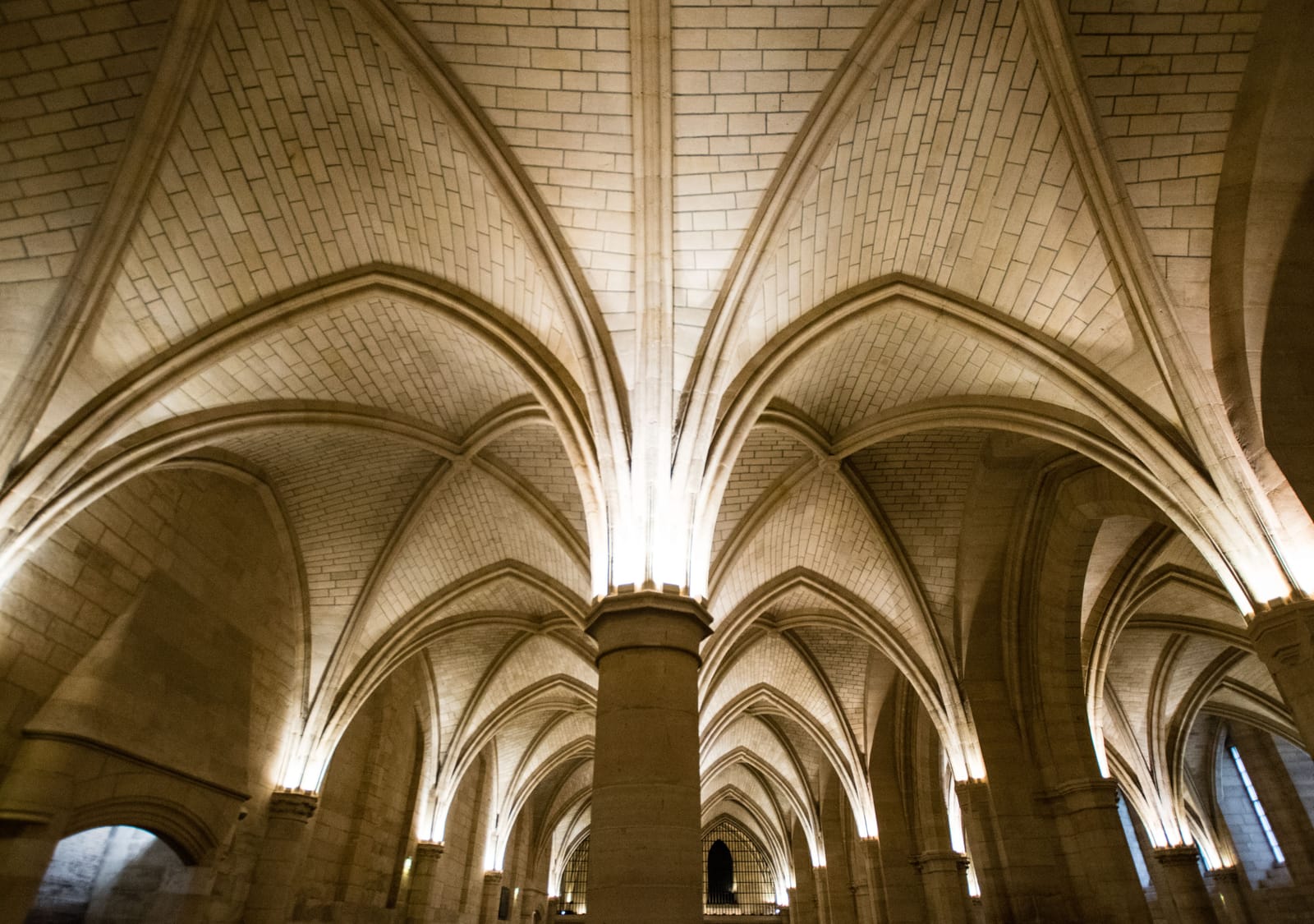
The Hall of the Men-at-Arms (Salle des Gens d'Armes)
Built for Philip IV the Fair (1285–1314) under his chamberlain Enguerrand de Marigny (1260–1315); vaults restored by Antoine-Marie Peyre (1770–1843) · 1302–1313; restored 1812–1819 · Limestone Gothic hall in four rib-vaulted naves, 64 m long, 27.5 m wide and 8.5 m high to the keystones, covering 1,785 square metres
Look for
- The four rib-vaulted naves rising 8.5 metres to their keystones, carried on three rows of pillars and columns with carved foliage capitals.
- The four medieval fireplaces set around the walls to warm a hall where between one and two thousand palace staff ate each day.
- On the north wall, the surviving slab of the German black marble table from the vanished ceremonial Grand'Salle upstairs, and along the south wall the blocked outlines of the medieval twin windows.
- In the north-west pavilion next door, John the Good's 1353 kitchens: four corner fireplaces with stone hoods in a 280-square-metre square room.
Transcript (2:04)
Walking down the fourteen entrance steps explains something you noticed outside: you are descending to the medieval street level, left behind when Louis the Thirteenth raised the stone river quays in 1611. What opens in front of you is the largest surviving Gothic civil hall in Europe. Sixty-four metres long, twenty-seven and a half metres wide, and eight and a half metres high to the keystones, it covers 1,785 square metres in four rib-vaulted naves.
Philip the Fourth, called Philip the Fair, built it between 1302 and 1313 through his chamberlain Enguerrand de Marigny, tripling the palace's footprint to house a centralized state. At Pentecost in 1313 the finished palace was inaugurated before Philip, the king of Navarre and Edward the Second of England. Two years later Philip was dead, and Marigny himself sat locked inside the palace he had built, accused of corruption under Louis the Tenth before going to the gallows.
No king dined down here. This floor was the engine room of the household: between one thousand and two thousand soldiers, clerks, officers and servants ate, met and sometimes slept under these vaults, warmed by four huge fireplaces. Along the south wall you can still trace the outlines of tall twin Gothic windows, bricked up in the seventeenth century when a new gallery went up outside.
The royal spectacle happened directly overhead in the vanished Grand'Salle, a twin-naved hall of the same size lined with painted wooden statues of every French king. Look on the north wall down here for a dark polished slab: it is the last piece of the great German black marble table where kings held banquets and swore oaths upstairs. That upper hall burned in March 1618. When Salomon de Brosse rebuilt it in 1622, he made a structural blunder and set his new columns off-centre from Philip the Fourth's pillars below. Two centuries later the vaults began to give way, forcing Antoine-Marie Peyre to clear out prison rubble and restore the hall between 1812 and 1819.
Before you walk west, look inside the square pavilion off the north-west corner: John the Good's kitchens of about 1353, 280 square metres with four corner fireplaces, supplied straight from Seine boats. On the sixth of January 1378, both kitchen floors worked together for Charles the Fifth's Epiphany feast welcoming Emperor Charles the Fourth, sending thirty dishes upstairs for eight hundred French and German knights.

Stop 3 of 5 · West end of the Hall of the Men-at-Arms, facing the raised floor and floor-to-vault iron grille that lead into the revolutionary prison
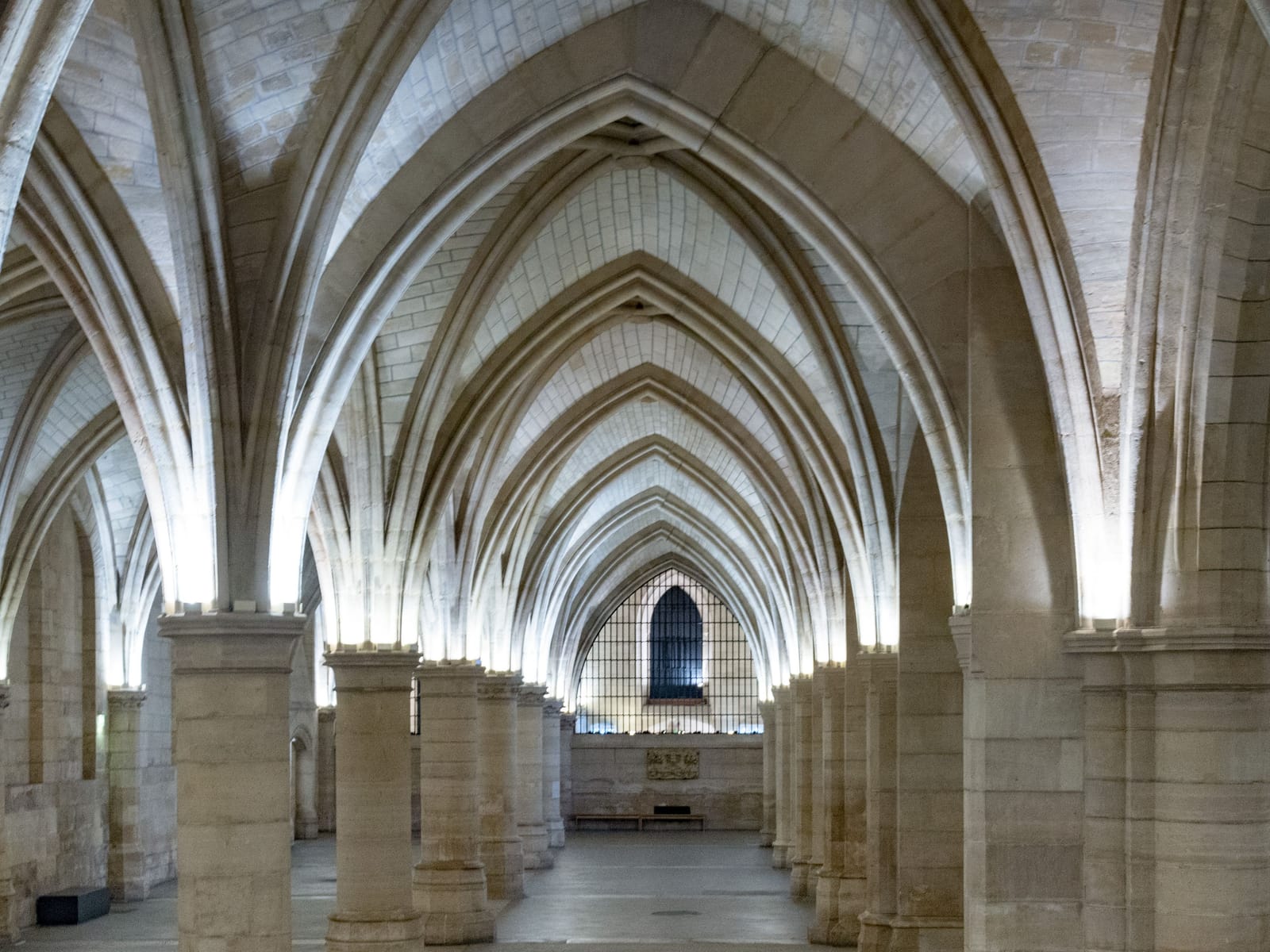
La Rue de Paris, at the west end of the hall
Fourteenth-century palace masons under Philip IV, isolated and barred off as a prison passage after Charles V left the palace (from 1364–1381) · Hall built 1302–1313; western bay raised and barred off in the late 14th century · Raised limestone bay closed by a tall wrought-iron grille across the west end of the 27.5 m wide, 8.5 m high vaulted hall
Look for
- The tall wrought-iron grille filling the pointed Gothic arch at the west end of the hall, slicing off the raised fifth bay that led into the men's prison.
- The step change in floor level behind the bars: La Rue de Paris sits higher than the medieval hall you are standing in.
- Mounted on the stone wall just below the iron bars, a carved stone relief of Medusa's head framed by two overflowing horns of plenty.
Transcript (2:23)
Stop at the western end of the colonnade, where the Gothic hall hits a wall of wrought-iron bars reaching right into the point of the arch. Behind those bars the stone floor sits higher than the paving under your shoes. That sliced-off bay is where a royal palace turned into a prison.
The break came in 1358. During the Hundred Years' War, Paris merchants led by Étienne Marcel burst into the palace and murdered two royal marshals in front of the teenage Dauphin, spraying his clothes with blood. Once crowned as Charles the Fifth, he never trusted the island again. He moved the court out to the Hôtel Saint-Pol, the Louvre and Vincennes, leaving the Parlement courts upstairs and handing the lower palace to a royal custodian vested with judicial authority, the Concierge. Philip Augustus had invented the post; in the fifteenth century Queen Isabeau of Bavaria even held its revenues. From the 1380s cells multiplied across the ground floor, and the western bay ahead of you was raised and barred off as the secure route into them.
Prisoners gave that passage a grim joke of a name: La Rue de Paris, after Monsieur de Paris, the traditional title of the city's executioner, who walked through here to fetch the condemned. Under the old monarchy, Henry the Fourth's assassin Ravaillac, the poisoner Brinvilliers, the bandit Cartouche and Louis the Fifteenth's attacker Damiens all passed these vaults.
Then in March 1793 the National Convention installed the Revolutionary Tribunal upstairs in the old Grand'Chambre, renamed the Hall of Liberty, with public prosecutor Fouquier-Tinville working between the Caesar and Silver towers. Danton told the deputies to be terrible so that the people would not have to be. Down here, money still decided how you waited. Penniless inmates, the pailleux, slept on rat-ridden straw, while pistoliers paid twenty-seven livres twelve sous, later fifteen livres, for a bed. Because swift executions freed the same bed for a new paying inmate days later, one memoirist called the Conciergerie the most lucrative furnished lodgings in Paris.
Beyond the grille ran the dark Prisoners' Corridor, past the registrar's ledger, the concierge's office and the Grooming Room, where the condemned had their belongings taken, their shirt collars slit and their hair cropped at the nape before boarding carts in the Cour du Mai. Over four thousand defendants passed through here between 1793 and 1795. Nearly half walked out acquitted during the Tribunal's first year, before the law of the tenth of June 1794 stripped away witnesses and lawyers; across its full run roughly two-thirds of defendants were condemned, with an average of thirty-eight people a day sent to the guillotine that summer and 2,780 executions in all, ending with Fouquier-Tinville himself after nine months in his own cells.

Stop 4 of 5 · Ground floor of the revolutionary prison, beyond the Prisoners' Corridor: stand in the prisoners' chapel facing the altar and the black-curtained doorway behind it
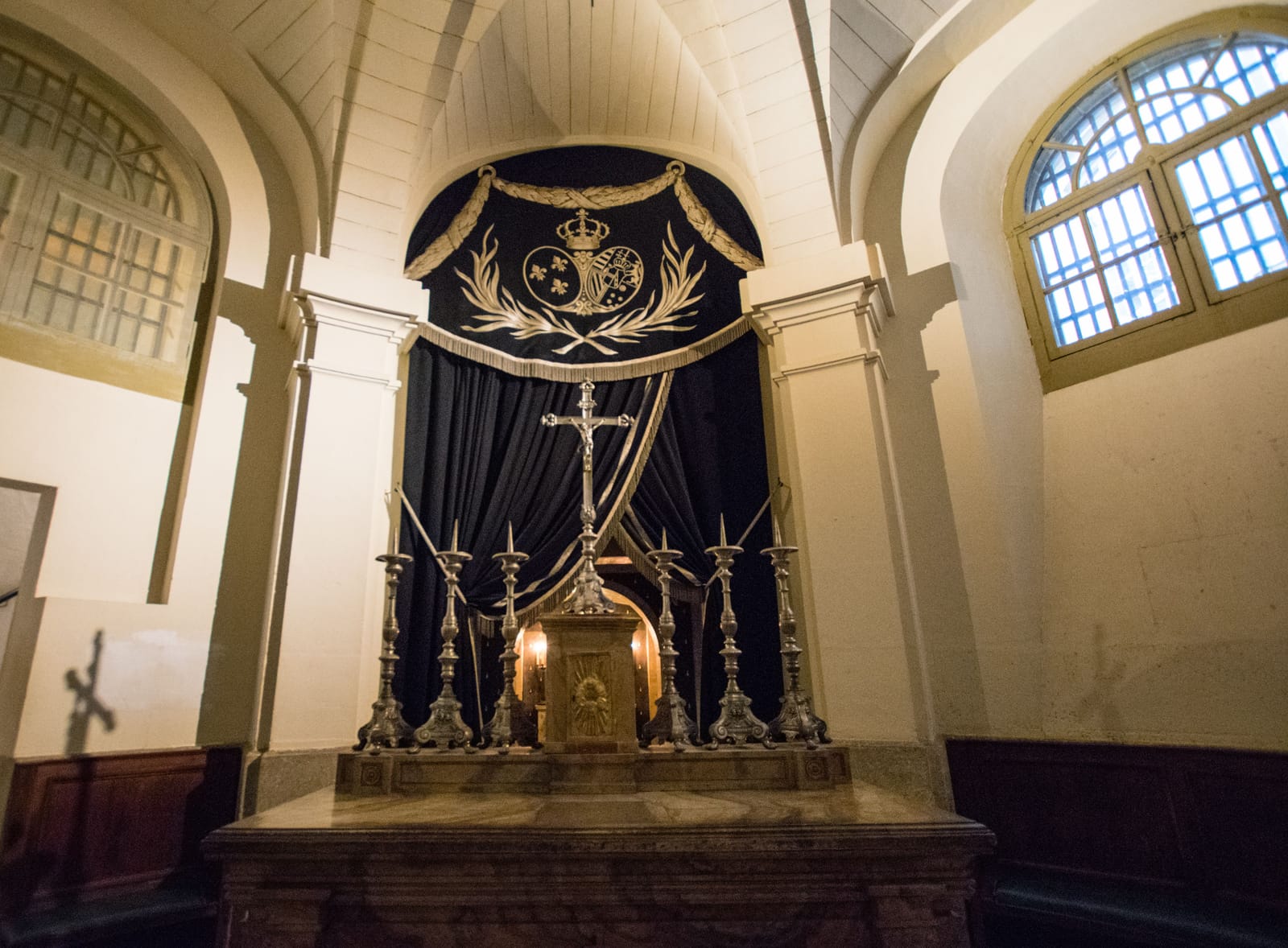
The Chapelle des Girondins and Marie-Antoinette's Expiatory Chapel
Prisoners' chapel rebuilt after 1776 by Joseph-Abel Couture (1728–1789) and Pierre Desmaisons (1711–1795); expiatory chapel built 1816 by Antoine-Marie Peyre (1770–1843) for Louis XVIII · Prisoners' chapel rebuilt after the 1776 fire; expiatory chapel erected 1816 · Vaulted limestone prison chapel with an 18th-century marble altar and barred upper gallery, opening behind black curtains into the 1816 expiatory oratory inside the former 130 m by 110 m palace enclosure
Look for
- High in the walls of the outer prisoners' chapel, the barred semicircular windows of the upper gallery from which women inmates heard Mass behind iron grilles.
- Above the 18th-century marble altar and its six candlesticks, the black mourning canopy embroidered with crowned royal shields and crossed martyr's palms.
- Through the parted black curtains behind the altar, Peyre's 1816 Expiatory Chapel: faux black marble walls dotted with silver teardrops, the monogrammed stained-glass window and the marble monument inscribed with the Queen's Testament.
Transcript (2:04)
Walk inside the white vaulted chapel and look first high up on either side, at the semicircular windows crossed with iron bars. Pierre Desmaisons rebuilt this prisoners' chapel after the palace fire of January 1776 on the footprint of King Louis the Seventh's twelfth-century royal oratory, and those upper grilles were where women prisoners heard Mass shut off from the men below.
You are standing inside a nineteenth-century tug-of-war over memory. During the Terror, overcrowding turned this chapel into a shared cell, and a later republican legend claimed twenty-one Girondin deputies held a last banquet here on the twenty-ninth of October 1793, earning it the name Chapelle des Girondins. Yet straight ahead, behind the eighteenth-century marble altar, six candlesticks and black mourning curtains embroidered with royal arms, opens the Bourbon monarchy's answer: the Expiatory Chapel of Marie-Antoinette.
Brought alone from the Temple during the night between the first and second of August 1793, the deposed queen spent seventy-six days in the Conciergerie, watched continuously by two gendarmes behind a screen and denied pen and paper. On the twenty-eighth of August the Chevalier de Rougeville slipped into her first cell with police commissioner Michonis and dropped two carnations hiding rolled notes offering men and money. She pricked her reply into paper with a pin, and five days later made it past two wickets almost to the courtyard gate before a bribed guard panicked and turned her back. After that Carnation Plot failed, jailers moved her here to a tighter second cell for her last forty-four days.
Her trial opened upstairs on the fourteenth of October 1793 before forty-one witnesses, with her two lawyers given less than a day to prepare. When accused of incest with her young son, she turned and appealed to every mother in the courtroom. Condemned at four in the morning on the sixteenth of October after twenty straight hours of sitting, she wrote a farewell letter to her sister-in-law Madame Élisabeth and rode an open cart to the Place de la Révolution.
Nine months later, on the twenty-seventh of July 1794, a wounded Maximilien Robespierre spent his last hours in the infirmary room right next door before going to the same blade. In 1816 King Louis the Eighteenth had architect Antoine-Marie Peyre knock both rooms together into this dark sanctuary: faux black marble walls painted with silver teardrops, a stained-glass monogram, and a marble altar where her bed once stood, carved with her final letter.

Stop 5 of 5 · Ground floor, out in the open courtyard at the end of the revolutionary circuit, just before the bookshop and exit
The Women's Courtyard (Cour des Femmes)
Rebuilt after the 1776 fire by Joseph-Abel Couture (1728–1789) and Pierre Desmaisons (1711–1795) on the site of the medieval king's garden · Late 1770s–1780s, layout unchanged since the Revolution · Open limestone prison courtyard ringed by two storeys of barred cells above a ground-floor arcade, sunk several metres below the raised river quays inside the 130 m by 110 m palace precinct
Look for
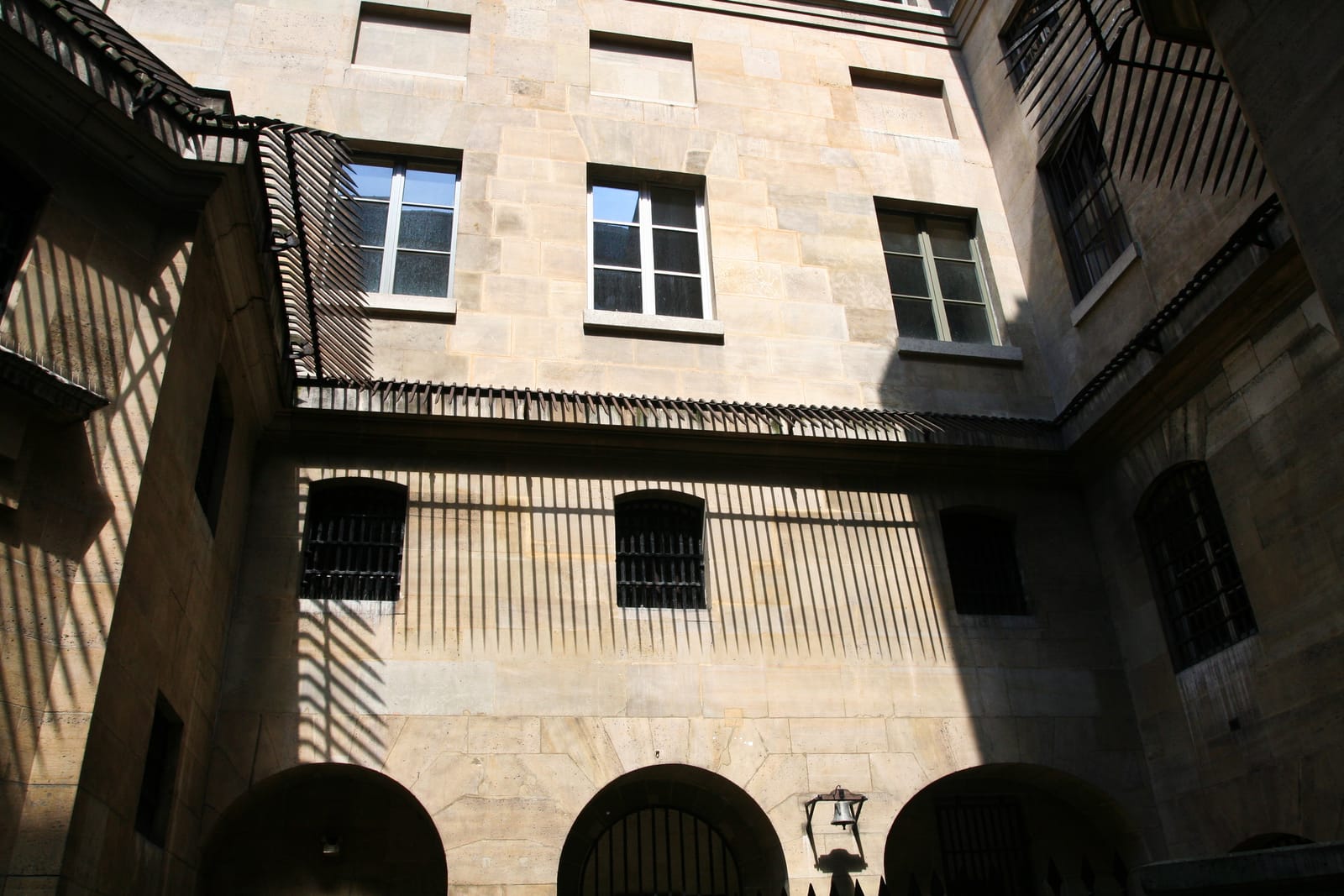
- The row of long iron spikes projecting horizontally from the cornice above the ground-floor arcades, casting barred shadows across the limestone walls.
- The stone washing fountain and stone table in the courtyard, survivors of the 1790s where women inmates washed their linen and took meals.
- In the north-east corner, the iron-gated triangular enclosure (the Coin des Douze) where male and female prisoners spoke through the bars.
- The iron bell hung on its bracket beside the central ground-floor arch, rung to mark the opening and locking of the cells.
Transcript (2:01)
Come out into the open air, and notice how the prison still closes over you even without a roof. Along the cornice above the first-floor cell windows, a row of long iron spikes juts horizontally out from the stone, throwing a second set of bars in shadow across the limestone. Where you are standing was once a garden beside the medieval king's lodgings; rebuilt after the 1776 fire, this Women's Courtyard has kept its revolutionary layout almost untouched.
Look around the ground-floor arcades. Marie-Antoinette's first cell opened onto this yard through a narrow window before the Carnation Plot forced her move indoors. Before the Tribunal even existed, these flagstones saw the September Massacres on the second and third of September 1792, when armed militants stormed Paris prisons and killed 378 of the Conciergerie's 488 inmates, many of them right here; seventy-four women were spared and one woman, Marie Gredeler, was killed.
Once the cells were unlocked each morning during the Terror, this small rectangle became the whole social world of the women's prison. Poorer inmates were locked on the damp ground level while those with money rented airier rooms upstairs, yet by day they mingled around the same eighteenth-century stone table and scrubbed their linen at the stone fountain that still stands here. Some wrote letters or paid a fellow prisoner to sketch one last portrait. Think of the minds that crossed these cobbles in a single year: Olympe de Gouges, who wrote the Declaration of the Rights of Woman; Charlotte Corday, calm in the days after stabbing Marat; Manon Roland, the Girondins' political voice; Louis the Fifteenth's former favourite Madame du Barry; and Louis the Sixteenth's sister Madame Élisabeth.
Glance into the north-east corner, where an iron grille cuts off a small triangle called the Corner of the Twelve. That patch belonged to the men's side, allowing couples and families to talk through the bars, and holding groups of twelve condemned prisoners before they walked out to the twelve-seat carts in the Cour du Mai. Not one execution ever happened inside the Conciergerie itself.
Nor did prison life end with Robespierre. Marshal Ney in 1815, the future Emperor Napoleon the Third in 1840 and the anarchist Ravachol in 1892 all sat in cells here, and although France listed the building as a historic monument in 1862, the last prisoners did not leave until 1934.
Independent guide · Chiaro
Point Chiaro at anything at the Conciergerie.
These five stops skip dozens of details along the route: fighting beasts carved on medieval column capitals, the stone hoods of John the Good's four corner hearths, Latin mottos high on the boulevard and revolutionary keepsakes behind glass. Snap a capital, an inscription or an object in a showcase, and Chiaro identifies who made it and how it fits between Capetian palace and tribunal prison, ready for follow-up questions all the way to the Cour des Femmes.
Before you go
Getting there
2, boulevard du Palais, 75001 Paris, on the north-east edge of the Palais de Justice on the Île de la Cité, between the Tour de l'Horloge and the twin round towers on the Seine.
Métro line 4 to Cité, or lines 1, 7, 11 and 14 to Châtelet. RER lines B and C stop at Saint-Michel. Bus lines 21, 24, 27, 38, 58, 81, 85 and 96 serve the island and adjacent quays.
Tickets and entry
- Standard adult entry is 13 euros for the entire open circuit (from 4 November, archaeological excavations keep the Salle des Gardes closed). Booking ahead is advised though not mandatory, and purchased tickets cannot be exchanged or refunded. Pairing the monument with the Sainte-Chapelle next door comes to 23 euros if you hold EEA nationality or regular residency over four months, or 30 euros for non-EEA travellers, sold online on the Sainte-Chapelle site where your booked slot governs the chapel alone and lets you tour the Conciergerie before or after.
- Under-18s enter free, as do EU citizens aged 18 to 25 and non-European regular residents of France in that age bracket, a disabled visitor accompanied by one adult (who receive priority entry at reception), and every visitor without advance booking on the opening Sunday of January, February, March and November.
- Doors open daily from 1 January through 31 December between 9.30am and 6pm; the final visitors are admitted at 5.30pm, Histopad tablets go out until 4.15pm, and the monument shuts only on 1 May and 25 December.
- Sharing a perimeter with the Palais de Justice brings Vigipirate screening and occasional police identity checks nearby: bulky bags, motorbike helmets, scooters, skateboards, rollerblades, aerosols, glass containers, scissors and sharp blades are refused, pushchairs must fold compactly enough for the X-ray tunnel, animals are barred apart from guide and assistance dogs, and no cloakroom exists. Full step-free PRM access is unavailable — entering descends 14 steps (fitted with a ramp) and leaving climbs 20 steps, with another 15 steps each way in the upper revolutionary section — though security holds two loan wheelchairs.
The official audio guide
Included with admission at the entrance is the monument's own Histopad augmented-reality tablet in six languages, handed out until 4.15pm to show 360-degree reconstructions of the medieval halls and revolutionary rooms. Reception also gives out free printed visit leaflets in eleven languages, a downloadable app carries the written tour texts, and monument staff lead a one-hour tour in French daily at 11am and 3pm at no extra charge when an agent is free. Our browser guide is unofficial and free, adding spoken stories from the public pavement outside to the Cour des Femmes with full text under every track.
Official site →Questions
Is there a free Conciergerie audio guide?
Yes: the five spoken recordings here play directly in your mobile browser with complete written transcripts underneath, beginning out on the boulevard du Palais before security. Inside the doors, admission also covers the monument's Histopad augmented-reality tablet in six languages at no extra fee (issued until 4.15pm), free printed leaflets in eleven languages, and a daily French staff tour at 11am and 3pm. Whenever a carved capital, Latin plaque or showcase relic outside these five stops catches your eye, snap it in the Chiaro app for an instant spoken guide.
Can I listen to the Conciergerie audio guide without a ticket?
Stop one works from the public street at the corner of the boulevard du Palais and the quai de l'Horloge, facing the Tour de l'Horloge, Germain Pilon's clock frame and the medieval river towers, with no ticket required. Stops two through five lie inside courthouse security and need admission: 13 euros for the Conciergerie alone, or 23 euros (EEA citizens and regular residents) and 30 euros (non-EEA visitors) when paired with the Sainte-Chapelle.
How much is the official Conciergerie audio guide?
Nothing extra beyond your entrance ticket: staff hand out the Histopad augmented-reality tablet at the entrance in six languages until 4.15pm. Reception also stocks free printed visit leaflets in eleven languages, and monument agents lead an hour-long tour in French daily at 11am and 3pm with registration on arrival.
How does the combined Conciergerie and Sainte-Chapelle ticket work?
When bought online, the joint ticket is issued through the Sainte-Chapelle website at 23 euros for EEA citizens and four-month regular residents, or 30 euros for visitors from outside the EEA. Only the Sainte-Chapelle uses the timed slot on your booking, so you can walk through the Conciergerie either earlier or later on the same ticket, keeping its 5.30pm last admission and seventy-five-minute average visit in mind.
When is the Conciergerie closed?
Its standing annual closures are 1 May and 25 December; on every other day of the year, 1 January included, it opens from 9.30am to 6pm with last entry at 5.30pm. Court security or archaeological work can occasionally close specific dates or spaces — the Salle des Gardes is shut from 4 November for excavations — so check paris-conciergerie.fr before you travel.
More audio guides
Made by Chiaro. Not affiliated with the Conciergerie.