
Musée Carnavalet · Paris · Independent guide
Musée Carnavalet audio guide,
five stops, free.
The museum of the history of Paris in five recordings, playing straight from this page. For the rest of the 3,800 things on show, from painted shop signs to Proust's brass bed, aim Chiaro at them.
Made by Chiaro. Not affiliated with the Musée Carnavalet.
The Bastille in the Early Days of its Demolition
Musée Carnavalet, Paris
That was the free part
Chiaro narrates any work in the Musée Carnavalet from a photo.
The five stops · 10 minutes of audio
Five stops, one walk,
in the order you will walk them.
The Carnavalet tells the history of Paris in date order, and this Musée Carnavalet audio guide follows that timeline across two of its floors. On level 2 it starts in the Revolution rooms with Hubert Robert's Bastille coming down, moves on to Gérard's Juliette Récamier where the Napoleon rooms begin, and stops with Lehmann's Liszt among the Romantics. Then it drops to level 1 for the late nineteenth and twentieth centuries: the silver-and-sepia ballroom Sert painted for the Wendels, and Mucha's Fouquet jewellery shop to finish. The five recordings last about ten minutes together; give yourself around an hour for the walk and the looking.
The Carnavalet does not number its rooms, so each work here is placed by level and by the section name the museum itself uses, checked against its route on 25 September 2026. The facts about each work come from the museum's own pages or Paris Musées Collections, the City of Paris museums' catalogue, and from one source independent of them. If a work has moved, follow the museum's label, and write to us so the page can catch up.

Stop 1 of 5 · Level 2, The French Revolution, The Storming of the Bastille section
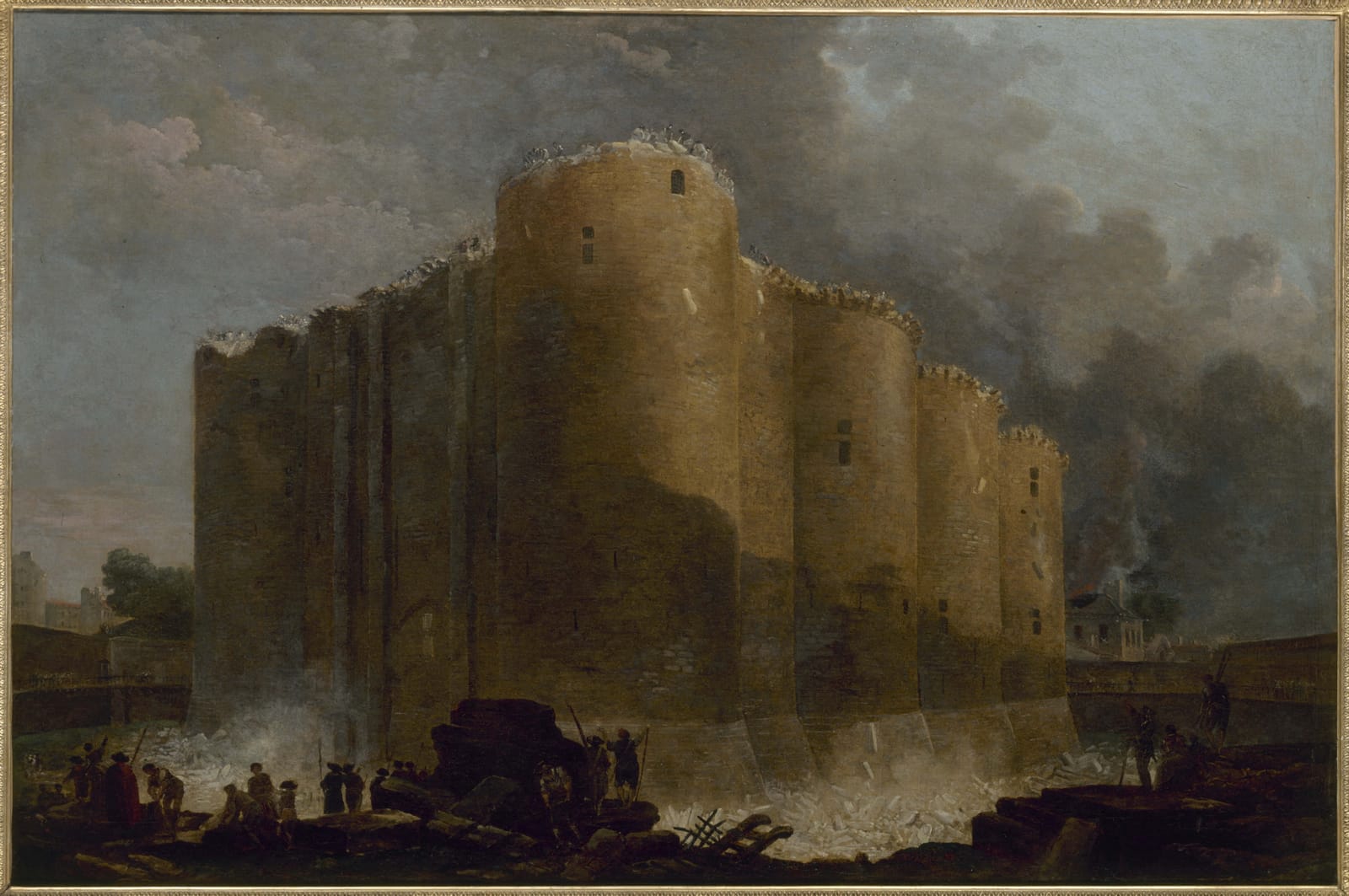
The Bastille in the Early Days of its Demolition
Hubert Robert · 1789 · Oil on canvas, 77 × 114 cm
Look for
- The stone in the lower right corner, carved with the date 20 July 1789 and the signature H. Robert pinxit. Six days after the storming.
- The sheer bulk of the towers. Robert blew the fortress up in size on purpose, to paint the ideal ruin rather than the real one.
- The case facing the canvas, with Bastille keys, handcuffs and bits of the walls, and the stove shaped like the fortress in the middle of the room.
Transcript (2:04)
Stand back from this canvas and the fortress fills it, a wall of stone towers with tiny figures swarming at their feet and along the top. It was never quite that big. Hubert Robert made it bigger on purpose. Paris knew him as Robert des ruines, Robert of the ruins, a nickname he brought home from eleven years in Rome among the circle of Piranesi. In the summer of 1789 the greatest ruin of his career was being made in front of him.
For Parisians the Bastille meant one thing. Until 1785, a sealed letter from the king, a lettre de cachet, could lock up anyone who displeased royal power without a trial, and this was where they went. On the fourteenth of July 1789 the crowd stormed it. The very next day its demolition was ordered, and the contract went to a builder named Pierre-François Palloy.
Now find the big stone in the lower right corner. Robert carved his own caption into it: demolition of the Bastille, the twentieth of July 1789, H. Robert painted it. Six days after the storming. He does not show you the fighting. He shows you the morning after, workmen already up on the walls, smoke drifting across the sky, the towers lit like a monument that knows its time is up. The museum calls it the ideal ruin, history turned into a meditation while the stones were still warm.
The painting went straight to the Salon of 1789, number 36 in the catalogue. A label on the back records that it once belonged to Lafayette, and later to Madame de Rémusat. The Society of Friends of the Carnavalet gave it to the museum in 1929.
Now turn around. The case facing the painting holds what is left of the real building: its keys, handcuffs, fragments of stone. Palloy did not just knock the Bastille down; he turned its stones into commemorative souvenirs. In the middle of the room stands a heater in the shape of the fortress, made by the Olivier manufactory and later installed for the National Convention at the Tuileries. Within a few years of the storming, the Bastille had become furniture.
Robert did not stay a spectator. He was arrested in October 1793 and spent ten months in the prisons of Sainte-Pélagie and Saint-Lazare, where he painted at least fifty-three canvases. He was freed a week after Robespierre fell, by which time the prison in this picture had been gone for years.
_-_mus%C3%A9e_Carnavalet.jpg)
Stop 2 of 5 · Level 2, Napoleon I section (1804–1815), where it opens the rooms
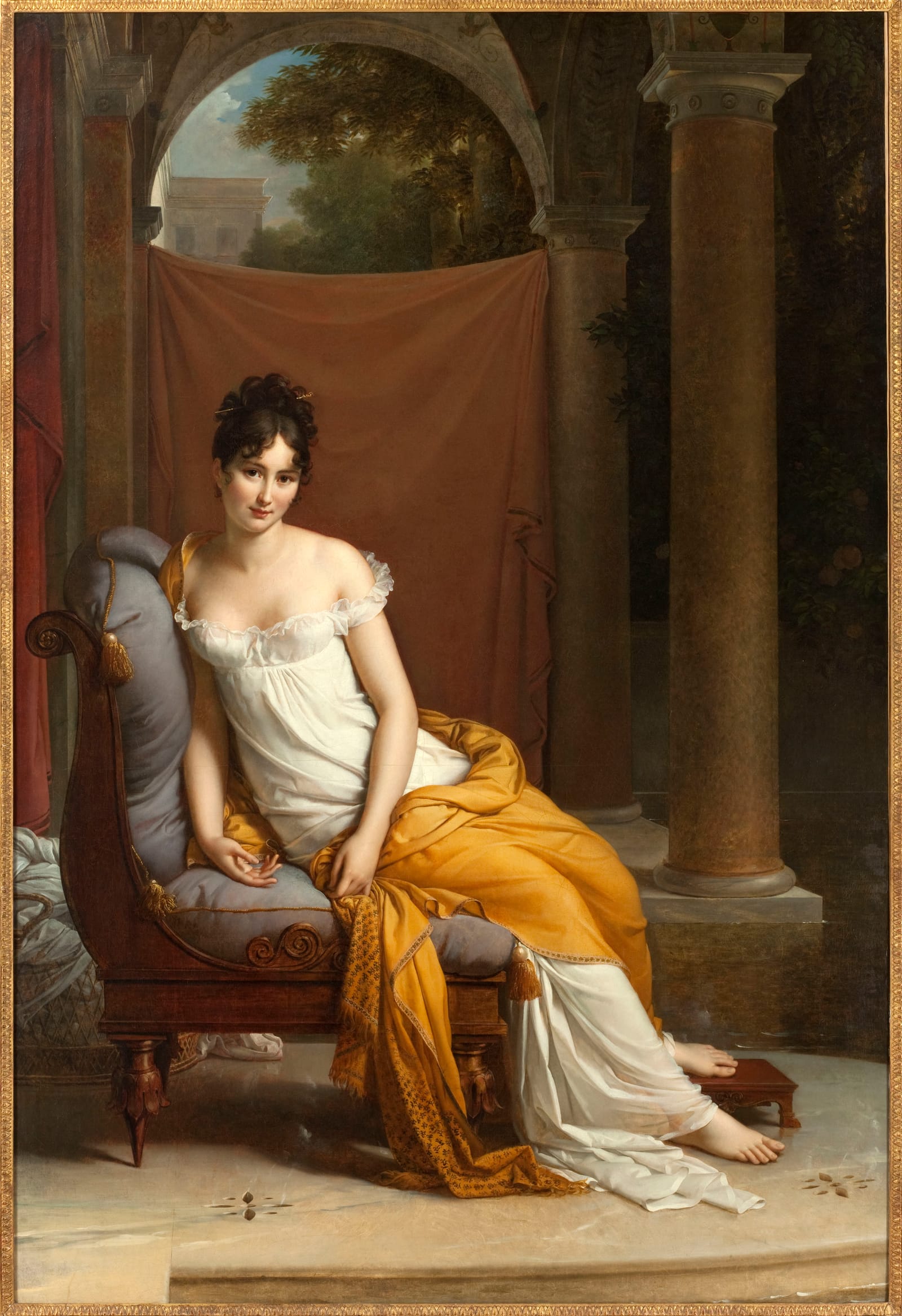
Portrait of Juliette Récamier
François Gérard · 1802–1805 · Oil on canvas, 225 × 148 cm
Look for
- Bare feet on a little footstool, and the thin white dress in the Greek style that every society woman wanted for her portrait.
- The shawl, the one loud colour in the picture, spilling off the chair.
- The columns, the hanging curtain and the antique-style chair: an ancient bath, left over from Gérard's first idea of painting her stepping out of the water.
- Napoleon's field kit in the big central case of the same section.
Transcript (2:03)
This part of the museum opens with her, and it is hard to think of a better person to hold the door. Juliette Récamier, born Bernard in 1777, was married to a rich banker, Jacques-Rose Récamier. From their mansion on the rue du Mont-Blanc, in the new Chaussée-d'Antin district, she ran a salon where the artists and intellectuals of the capital met. The museum calls her the epicentre of worldly life in the first decades of the nineteenth century.
She managed her own image with great care. She sat for David, for Gérard, for Chignard, for the sculptor Canova. The story of this canvas starts with David. In May 1800 he began a portrait of her reclining on a sofa, and when he learned that she had also gone to his former pupil, François Gérard, he may simply have stopped. David's unfinished version went to the Louvre in 1826. This one is the portrait she wanted.
Gérard's first idea was bolder. He planned to paint her standing and nude, stepping out of a bath, and this museum still owns two preparatory drawings of that version. In the end he sat her down. Look at what remains of the bath: the columns, the curtain hung behind her, the antique chair the catalogue calls Etruscan. Look at her feet, bare, resting on a little footstool. And look at the dress, white and thin, cut in the Greek style that every fashionable woman in Paris fought to be painted in. Then the shawl, the one strong colour here, pouring off the seat.
She was delighted. She had the portrait copied as an engraving, and her letters to Gérard show her fussing over the preparatory drawing. Her salon was full of people who disliked Napoleon, and he eventually exiled her from Paris. In 1822 she gave the painting to Prince Augustus of Prussia, a man who had once proposed to her and been refused.
Its later life is a small tour of the city. Bought at a public sale in 1860, it belonged to the Carnavalet by 1880, hung in the prefect's office at the Hôtel de Ville from 1882, went into storage at Auteuil in 1896, moved to the Petit Palais in 1911, and came back here in 1934.
A type of sofa she liked to recline on is still called a récamier. And in the large case in the centre of this section sits Napoleon's own field kit, a few steps from the woman he sent away.
,_compositeur_et_pianiste,_P1683_(1_of_7).jpg)
Stop 3 of 5 · Level 2, Paris, Capital of Romanticism
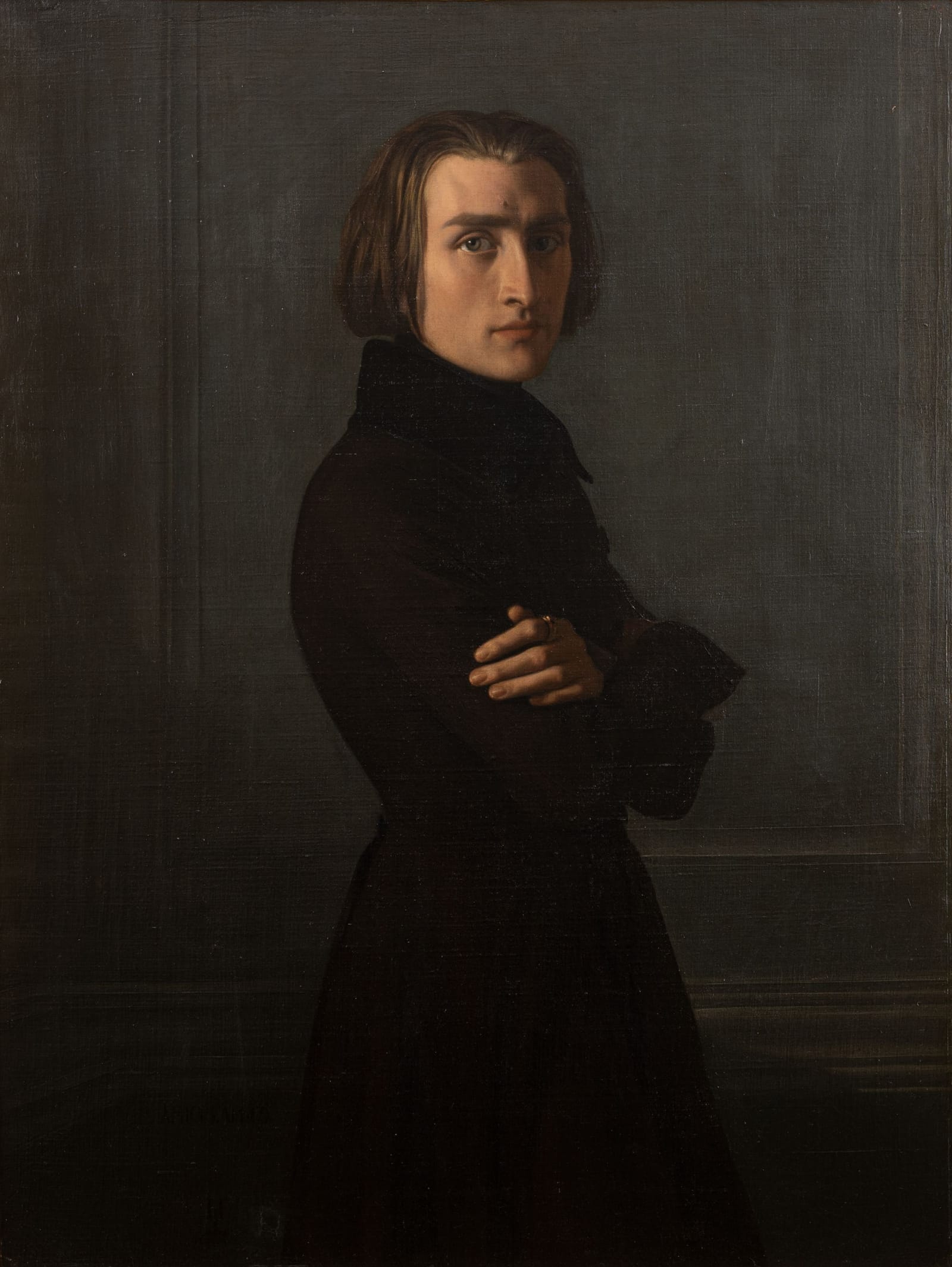
Portrait of Franz Liszt
Henri Lehmann · 1839 · Oil on canvas, 113 × 86 cm
Look for
- The Latin at lower left: AMICVS AMICO, from a friend to a friend, with Lehmann's interlaced HL, Rome and 1839 in Roman numerals.
- What is missing. No piano, no score, no audience: folded arms, a black coat, a ring, a grey wall.
- Marie d'Agoult's portrait nearby in the same section. Lehmann painted Liszt's companion too.
Transcript (1:55)
No piano. That is the first thing to notice about this portrait of the man the museum calls the lion of the piano. No keyboard, no score, no concert hall. Just a young man in a black coat, arms folded, a ring on his finger, standing against a bare grey wall and looking straight back at you.
Franz Liszt was born in 1811, so here he is twenty-seven or twenty-eight. The painter, Henri Lehmann, was younger still. Born in Kiel, he had come to Paris at seventeen to study under Ingres and became one of his most accomplished pupils. In 1838 Lehmann went to Rome, where Ingres was then running the French Academy, and there he fell in with Liszt and with Liszt's companion, the writer Marie d'Agoult. He painted them both.
Liszt sat for this one at the Villa Massimiliana in Lucca, and Lehmann finished it in Rome. Look at the lower left corner and you will see how he signed it. AMICVS AMICO, Latin for from a friend to a friend. Then his initials, H and L woven together. Then Rome, and the year in Roman numerals, 1839. It reads like a dedication, and the portrait looks like one: no flattery, no props, only the long hair, the pale face, the stare.
You can see the lesson of Ingres in the pure, clean line. The mood, though, is pure Romanticism, which is why the picture hangs in this part of the route. After the revolution of 1830, Paris became a melting pot of writers, musicians and artists, and this section gathers their faces: Victor Hugo, the novelist Eugène Sue, Liszt, and Marie d'Agoult, also painted by Lehmann. Find her portrait, and you have the couple in the same room again. In the cases are Eugène Sue's writing desk and statuettes by the sculptor Dantan.
The painting was shown at the Salon of 1840, in the Louvre. That was just before Lisztomania took hold and his concerts began to draw fanatical crowds across Europe. It came to the Carnavalet in 1942, a gift from a Madame Ollivier.
Take one last look at the hands. Within a few years crowds would fight to watch them play, and here the painter has tucked them away, folded over the black coat, perfectly still.
Sailko, CC BY 3.0, via Wikimedia Commons. Photo: Sailko

Stop 4 of 5 · Level 1, outside the chronological route
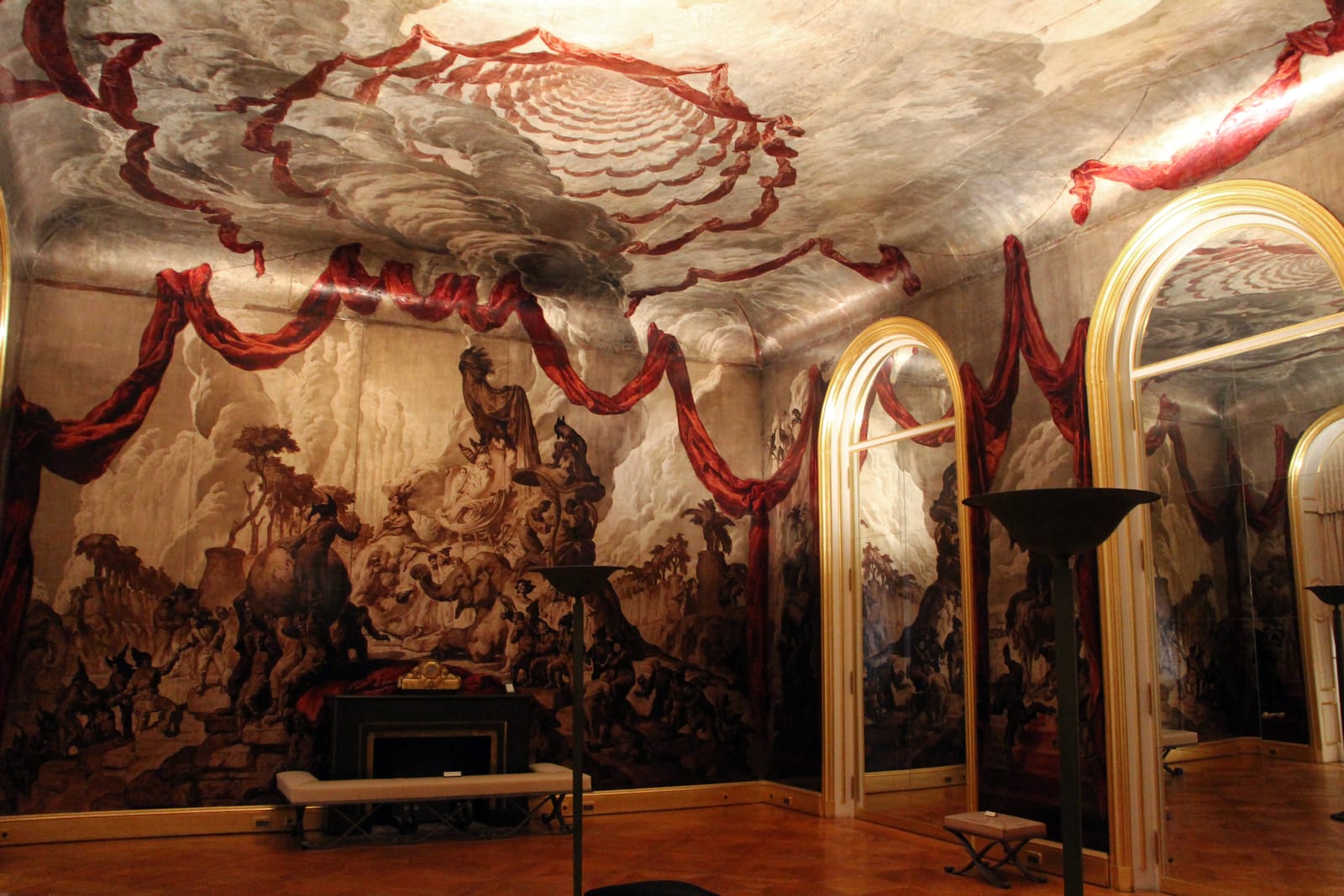
The Wendel Ballroom
José Maria Sert · 1925 · Glaze over metal leaf on plywood panels, a complete painted room
Look for
- The Queen of Sheba riding high on a white elephant, leading her court off to meet King Solomon.
- The sheen. Sepia glazes laid over metal leaf give the walls a lacquered look that shifts as you walk.
- How the painting refuses to stop at the edges and runs on over every surface, the ceiling included.
Transcript (1:56)
Walk in and the walls seem to be made of smoke and metal. Mostly sepia and silver, a glow that shifts as you move, and then, out of the haze, an elephant. This is a ballroom, taken whole from a private house in Paris, the Sourdeval-Demachy mansion, and rebuilt inside the museum.
In 1925 Maurice de Wendel, the great steelmaker from Lorraine, and his wife Andrée commissioned it for the ballroom of their Paris mansion. They went to the painter society wanted for exactly this. José Maria Sert was a Catalan who had moved to Paris in 1899, and in the nineteen-twenties he was thought of as the greatest muralist of the century. Over his career he covered more than seven thousand square metres with paint, in churches, cathedrals, palaces, hotels and public buildings. Later he painted the Council Chamber of the League of Nations in Geneva, and a mural at Rockefeller Center in New York, commissioned to replace the Diego Rivera that Nelson Rockefeller had destroyed.
The subject here is the Queen of Sheba. Find her: she rides on the back of a white elephant, high above her whole court, leaving her kingdom to go and meet King Solomon. Sert does not keep her inside a frame. The procession spreads over every surface he could reach, walls and ceiling alike, so the room itself becomes the picture.
Now look closely at the surface, because that is the real trick. When the room was restored in 2020 and 2021, the restorers worked out how he did it. Sert laid down a thin sheet of electrum, an alloy of gold and silver. On top of it he painted up to three successive coats of glaze, rubbing each one with a cloth and picking out highlights with metal powder. The metal shines back through the paint. That is why the whole room looks lacquered, and why it seems to be lit from inside.
The mansion was sold in 1981. The decor came to the Carnavalet, and in 1989 it was reinstalled here, in a room designed specially for it. It stands outside the museum's chronological route, which makes it easy to miss and all the more of a reward when you find it. From the middle of the floor, the elephant carries the queen the whole way round the room.
Sailko, CC BY 3.0, via Wikimedia Commons. Photo: Sailko

Stop 5 of 5 · Level 1, Belle Époque Paris, the Art Nouveau rooms
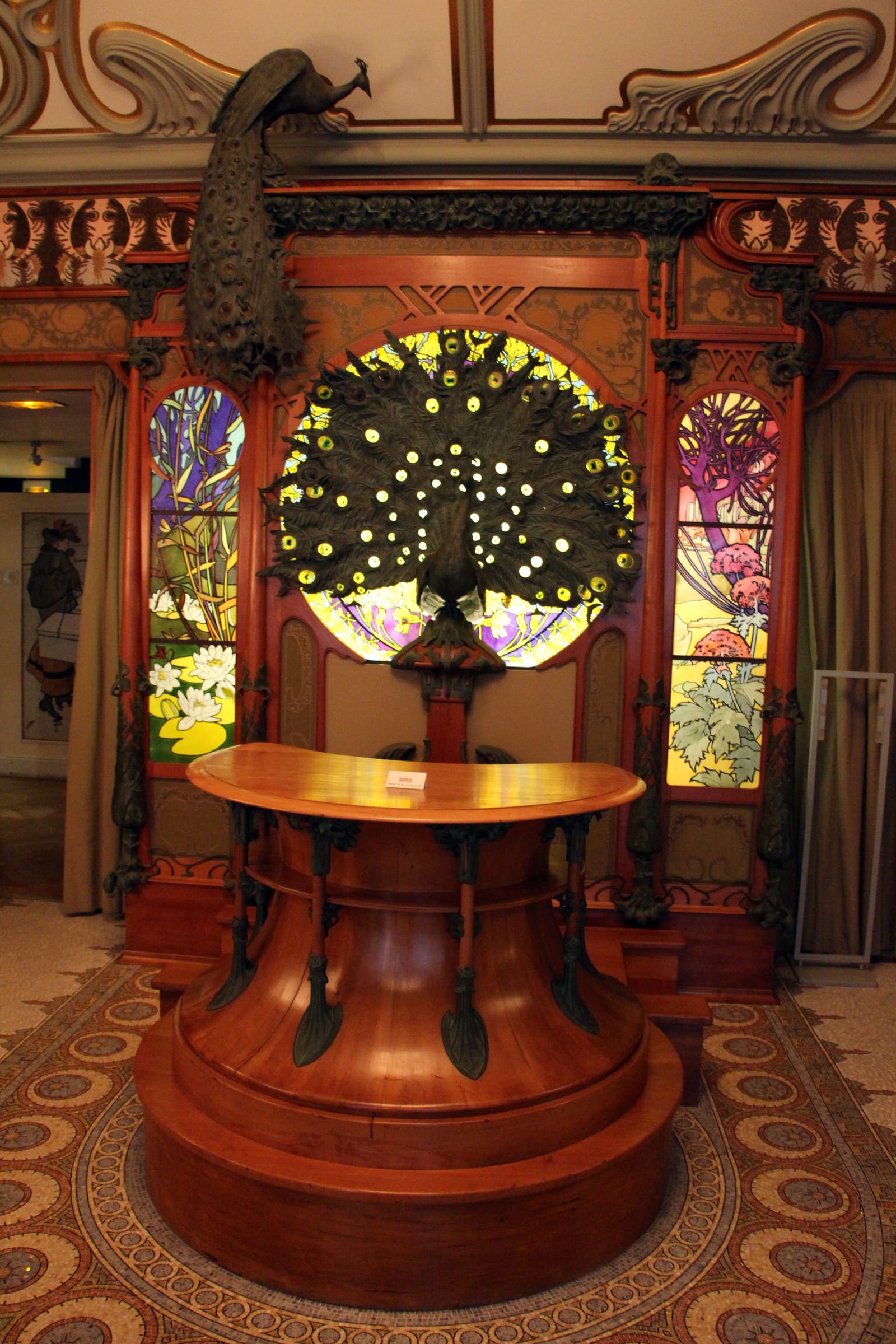
The Fouquet Jewellery Shop
Alphonse Mucha, with Auguste Seysses and Léon Fargue · 1901 · Carved wood, wrought metal, stained glass and mosaic: a complete shop interior
Look for
- The two peacocks: one perched on the frieze with its tail hanging down, the other fanning out in front of the glowing stained-glass disc behind the counter.
- The mosaic floor, remade exactly from Mucha's own drawings.
- The whiplash line: asymmetric curves running through the wood and metal, the signature move of Art Nouveau.
- Next door, the private dining room of the Café de Paris by Henri Sauvage and Louis Majorelle.
Transcript (1:56)
Stand in front of the counter and look up. A peacock is perched on the frieze above you, letting its long tail spill down the woodwork, and straight ahead a second one fans its feathers against a disc of glowing stained glass. This is not a room about a shop. It is the shop, the whole interior of a Paris jeweller's, moved here piece by piece.
Georges Fouquet took over his father's jewellery business in 1895. He was already working with Alphonse Mucha, the Czech artist whose posters of Sarah Bernhardt had gone up all over Paris in 1895 and made him suddenly famous. In 1899 the two of them made a gold and enamel serpent bracelet for Bernhardt herself. After the great Exposition of 1900, Fouquet opened a new shop at number 6 rue Royale and asked Mucha to design the interior. It opened in 1901.
Mucha rarely worked in three dimensions, and he did not do this alone. Léon Fargue made the stained glass and the sculptor Auguste Seysses made the figures. Look at how little in here is straight. The wood curls, the metal climbs like a plant, flowers and coral and animals creep over every panel. The museum calls it the full flowering of Art Nouveau, with its taste for asymmetry and the curve they called the whiplash line.
Now look down. The mosaic under your feet was remade exactly from Mucha's original drawings.
The shop did not last. By 1923 Art Nouveau had gone out of fashion, and Fouquet replaced the decor with something newer. But he did not throw it away. Out of respect for his friend's work, he had it taken apart piece by piece and stored, and later he gave it to the Carnavalet. It stayed in pieces for decades. In 1989, when the museum took over the neighbouring Hôtel Le Peletier de Saint-Fargeau, the shop was finally put back together, at the same time as the Wendel ballroom and the dining room of the Café de Paris, which you will find next door, designed by Henri Sauvage and furnished by Louis Majorelle.
So this is where the walk ends: in a jeweller's that was out of date twenty-two years after it opened, and survived only because the man who owned it could not bring himself to break it up. The peacocks were saved by a shopkeeper.
Independent guide · Chiaro
Point Chiaro at anything in the Musée Carnavalet.
We stopped at five, and the Carnavalet puts about 3,800 things in front of you. Photograph one of the old shop signs on the ground floor, Marie Antoinette's slipper, the door handles from Marat's bathroom or the cork tile from Proust's bedroom wall: Chiaro tells you who owned it before the city did, then keeps up with every follow-up question.
Before you go
Getting there
23 rue Madame de Sévigné, 75003 Paris, in the Marais. That is the visitor entrance; the museum's map also marks a garden entrance on rue des Francs-Bourgeois.
Saint-Paul on métro line 1 is the usual stop. Chemin Vert (line 8), Bréguet-Sabin (line 5) and Pont-Marie (line 7) are the alternatives. Buses 29 and 96 stop at Place des Vosges, 69 and 76 at Saint-Paul, and 91 at Saint-Gilles – Chemin Vert; the nearest Vélib' docks are 3002 Saint-Gilles – Turenne and 4010 Saint-Antoine – Sévigné.
Tickets
- You pay nothing for the permanent collection and need no reservation. Only the temporary exhibition is ticketed, and a timed booking online is the one way to be sure of getting into it.
- Plan around Monday, the closed day; from Tuesday through Sunday the museum keeps 10 am to 6 pm, and nobody is let in after 5.15 pm. New Year's Day, 1 May and Christmas Day are closed too.
- Leave the suitcase at the hotel. Bags are checked at the door and only handbag-sized ones get in; self-service lockers behind the welcome desk hold up to 40 × 36 × 36 cm.
- You may take photographs for yourself; leave the flash off and the tripod at home.
The official audio guide
The Carnavalet's own guide is a free app, Musée Carnavalet – Histoire de Paris, for Android and iPhone. It has a 30-work highlights itinerary and five chronological ones, each with notes to read or listen to, in six languages including English; only its temporary-exhibition tours are paid, at 2.99 euros each. This page goes deeper on fewer: five works, about two minutes each, and the Chiaro app for any of the other 3,800 objects from a photo.
Official site →Questions
Is there a free Musée Carnavalet audio guide?
Yes, and so is the museum's own: the Carnavalet's app costs nothing for its permanent-collection tours. This page adds five narrated stops in your browser, scripts printed under each player, nothing to install. For anything beyond those, photograph it and let the Chiaro app talk you through it.
How much is the official Musée Carnavalet audio guide?
Nothing, for the permanent collection. It comes as the museum's free app, with a 30-work highlights route and five chronological ones in six languages. Tours of the temporary exhibitions inside the app cost 2.99 euros each.
Where is the Fouquet jewellery shop in the Musée Carnavalet?
On level 1, in the Belle Époque part of the route, where two rooms show the Art Nouveau decors of the Café de Paris and the Fouquet shop. It is highlight number 12 on the museum's map guide. The Wendel ballroom is on the same floor, just off the chronological route.
Is the Musée Carnavalet closed on Mondays?
Yes, the Carnavalet is shut every Monday. From Tuesday through Sunday it welcomes visitors between 10 am and 6 pm. It also closes for New Year's Day, 1 May and Christmas Day, and on 24 and 31 December the rooms empty early, at 5 pm.
Does the Musée Carnavalet cost anything?
Not for the permanent collection, where all five stops are: entry is free and you do not book. You pay only for the temporary exhibition, and the museum strongly recommends a timed online slot for that.
How long does the Musée Carnavalet take?
Give the five stops here roughly sixty minutes, ten of them spent listening. The full chronological route runs from prehistory in the basement to the present day and passes some 3,800 objects, so a complete visit is closer to half a day.
More audio guides
Made by Chiaro. Not affiliated with the Musée Carnavalet.