
Toledo Cathedral · Toledo · Independent guide
Toledo Cathedral audio guide,
five stops, free.
Begun in 1226, consecrated in 1493, 120 metres long under one 92-metre tower: five of its places play right here, and Chiaro can tell you about the rest from any photo you take outside.
Made by Chiaro. Not affiliated with Toledo Cathedral.
The west front and the Puerta del Perdón
Toledo Cathedral
That was the free part
Chiaro narrates anything at Toledo Cathedral from a photo.
The five stops · 11 minutes of audio
Five places, one walk,
in the order you will walk them.
Begin under the cathedral's lone tower: with it and the Door of Forgiveness in front of you, the opening stop of our Toledo Cathedral audio guide, free and self-guided like the other four, plays on the open square, where nobody checks tickets. From the square, go round to the Puerta Llana on Calle Cardenal Cisneros, the one door visitors use. Inside, the choir fills the middle of the nave; directly behind the high altar, in the ambulatory, is the Transparente; the sacristy, with El Greco's El Expolio over its altar, is on the north side; and the walk ends in the cloister, north of the church. Played back to back, the five come to some eleven minutes of listening; the church is 120 metres from end to end, so getting between stops takes moments and the time goes on looking.
Where this page gives a time, a price or a rule, it is quoting the Cabildo Primado's visitor pages at catedralprimada.es; the history, names and measurements come from the Cabildo's pages and from Wikipedia. The Cabildo keeps its own calendar of feast days with different opening times, published on its ticket page, and the staff at the Tienda de la Catedral sell to that calendar, not to ours: what they tell you on the day is the version to follow.

Stop 1 of 5 · Plaza del Ayuntamiento, on the public square in front of the west front, facing east towards the three portals; outside any ticket control
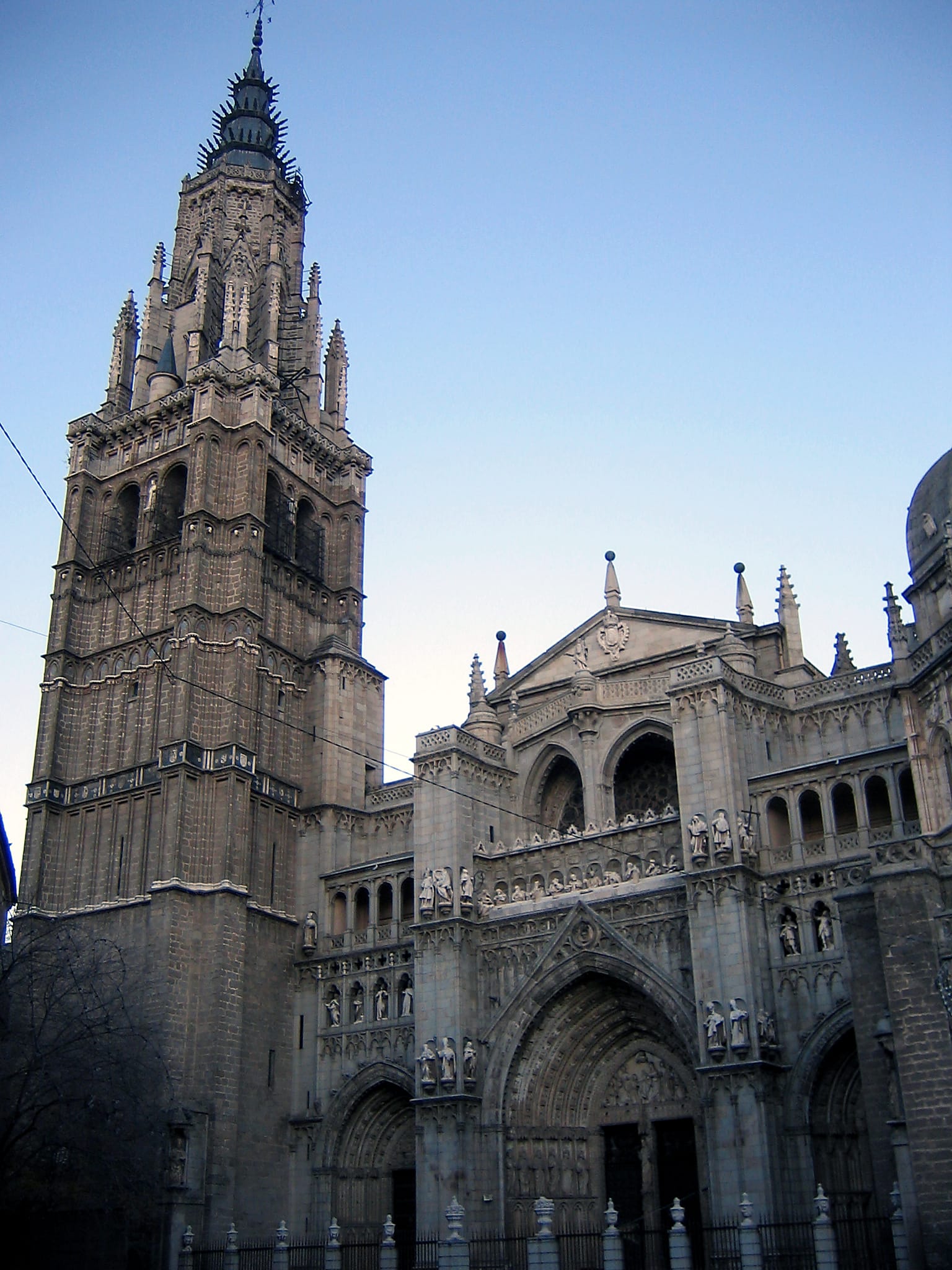
The west front and the Puerta del Perdón
Alvar Martínez, master of the works, who began the Puerta del Perdón in 1418; the tower begun under Archbishop Pedro Tenorio to the plans of Rodrigo Alfonso and Alvar Martínez, crowned by Hanequin de Bruselas; the front reworked in 1787 by Eugenio Durango with the sculptor Mariano Salvatierra · Portal begun 1418; tower 1380–1422 in the Cabildo's dating, its octagonal top later in the fifteenth century; front reworked 1787 · White limestone from the Olihuelas quarries; the tower 92 m high, the bronze-plated leaves of the Puerta del Perdón more than 5 m high
Look for
- The dark band across the tower between its first and second stages: black marble, inlaid in white marble with the arms of Archbishop Juan Martínez de Contreras, who held the see from 1422 to 1438.
- The tympanum over the central door, where the Virgin hands a chasuble to Saint Ildephonsus. You will meet the same scene twice more inside, in the sacristy.
- The three crowns stacked on the spire, an imitation of a papal tiara, on the octagonal top that Hanequin de Bruselas added.
- The dome on the right, standing where a second tower was planned until the ground proved unstable: the Mozarabic Chapel, domed by El Greco's son.
Transcript (2:20)
Stand on the Plaza del Ayuntamiento and look at the cathedral's west front. Three doors, one tower, and on the right, where a second tower ought to be, a dome. That lopsidedness is the first story.
The plan was two towers, one at each corner. The northern one went up, on your left. When the builders turned to the southern corner they found the ground there unstable, because an underground stream runs beneath it. The second tower was never built, and the space became the Mozarabic Chapel, which Cardinal Cisneros founded and which still keeps the old Hispano-Mozarabic rite. Its dome came last of all, between 1622 and 1631, and it was designed by Jorge Manuel Theotocópuli, El Greco's son.
Now the tower itself, 92 metres of it. The Cabildo dates it to between 1380 and 1422. It was begun under Archbishop Pedro Tenorio, to plans by its master builders, Rodrigo Alfonso and Alvar Martínez, and finished under his successors. Find the dark band between the first and second stages. It is black marble, with the arms of Archbishop Juan Martínez de Contreras set into it in white. The octagonal top is the work of a Fleming, Hanequin de Bruselas, and the spire ends in three crowns stacked like a papal tiara. Somewhere up there hangs the Campana Gorda, cast inside the tower itself, more than seventeen tonnes of bronze. The first time they tried to ring it, it cracked, and it has been silent ever since.
Now the central doorway, the Puerta del Perdón, the Door of Forgiveness. Alvar Martínez began it in 1418. It is named for the indulgences granted to penitents who came in through it, and it stays shut, opened only on rare occasions and for the arrival of a new archbishop. Its leaves are more than five metres high and plated in fourteenth-century bronze. In the tympanum the Virgin is handing a chasuble to Saint Ildephonsus. He mattered so much in Toledo that he pushed the Last Judgement, which by custom takes the middle door, out to the portal on the right.
What you see is not quite the medieval front, though. The stone was poor, and in 1787 the architect Eugenio Durango and the sculptor Mariano Salvatierra reworked it for Cardinal Lorenzana, which is why nobody can now say exactly how Alvar Martínez meant it to look.
Underneath is older ground still: a Visigothic church of Santa María, then the city's great mosque, which the archbishop and Queen Constance had seized by force while King Alfonso the Sixth was away. The king was so angry he ordered everyone involved put to death. The Gothic church in front of you was begun in 1226 and consecrated in 1493.

Stop 2 of 5 · Central nave, in the choir enclosure two bays long, facing the presbytery across the crossing
The choir and its two rows of stalls
Lower stalls by Rodrigo Alemán; upper stalls by Felipe Vigarny on the Gospel side and Alonso Berruguete on the Epistle side, in an arcade designed by Alonso de Covarrubias; screen by Domingo de Céspedes · Lower stalls 1489–1495; upper stalls 1539–1543; screen 1541–1548 · Walnut; the lower stalls 54 seats, the upper stalls walnut, boxwood and Cogolludo alabaster under 71 arches on 72 red marble columns
Look for
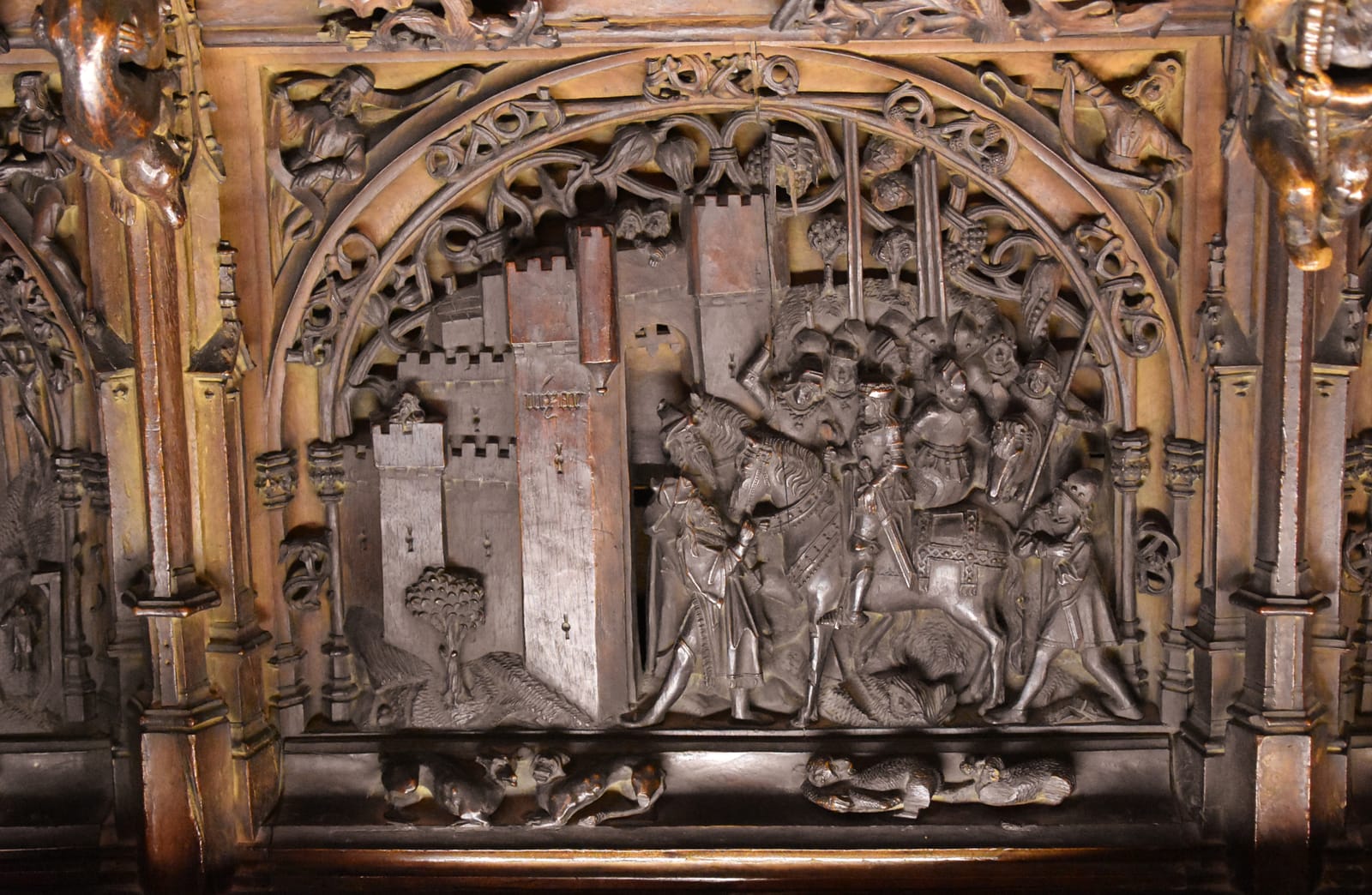
- The backs of the lower stalls: walled towns, horsemen, lances and banners from the conquest of Granada, carved by Rodrigo Alemán.
- The two halves of the upper stalls. Vigarny carved the Gospel side and Berruguete the Epistle side, and the Latin inscriptions at the ends of the choir say so.
- The red marble columns of the upper arcade, seventy-two of them carrying seventy-one arches, with alabaster figures in the niches above.
- The eagle lectern, a German Gothic piece of 1425, older than any of the stalls around it.
Transcript (2:15)
You are in the middle of the nave, in front of a room built inside the church: the choir, two bays long, facing the high altar across the crossing. French cathedrals keep the choir up by the altar. The builders of Spain's cathedrals preferred it here, out in the central nave, and this one is closed off by a Renaissance iron screen that Domingo de Céspedes made between 1541 and 1548.
There are two rows of seats inside, carved half a century apart, and they could hardly be less alike.
Start low. The lower stalls are walnut, fifty-four seats carved by Rodrigo Alemán; the Cabildo dates them to between 1489 and 1495. Look at the backs. Panel after panel tells the conquest of Granada by the Catholic Monarchs: walled towns with towers and gates, horsemen with lances, banners, men at arms on foot, kings and bishops, castle after captured castle. The misericords, the little ledges under the hinged seats, carry the same war. Nobody ever proposed replacing these, which is more than can be said for the row above.
The first upper stalls were thought mean, so in 1533 Cardinal Tavera called a competition, and in 1539 the job went to two sculptors at once, Felipe Vigarny and Alonso Berruguete, who promised to finish within three years, and did. They split the choir down the middle. Latin inscriptions at the two ends record the completion in 1543 and say who carved what: Felipe de Borgoña, which is Vigarny, on this side, the Spaniard Berruguete on the other. So stand in the middle and compare. Vigarny, on the Gospel side, is the more classical. Berruguete took the Epistle side, and art critics call it the most beautiful thing that Castilian sculptor ever made.
The seats sit inside an arcade designed by Alonso de Covarrubias, seventy-one arches on seventy-two columns of red marble, with alabaster figures in the niches above them. Vigarny was also meant to carve the archbishop's chair in the centre, but he died before he could start it, so Berruguete did that too, and topped it with a Transfiguration of his own design. Vigarny's very first stall is thought to be Saint Catherine's, and it is signed Philippi opus, the work of Philip.
Before you move on, find the eagle lectern in the middle, a German Gothic piece made in 1425, older than every stall around it. And look up at the two organs facing each other over the seats. They have been answering one another since the eighteenth century, in what Toledo calls the battles of organs.

Stop 3 of 5 · The ambulatory, directly behind the high altar, facing the back of the Capilla Mayor
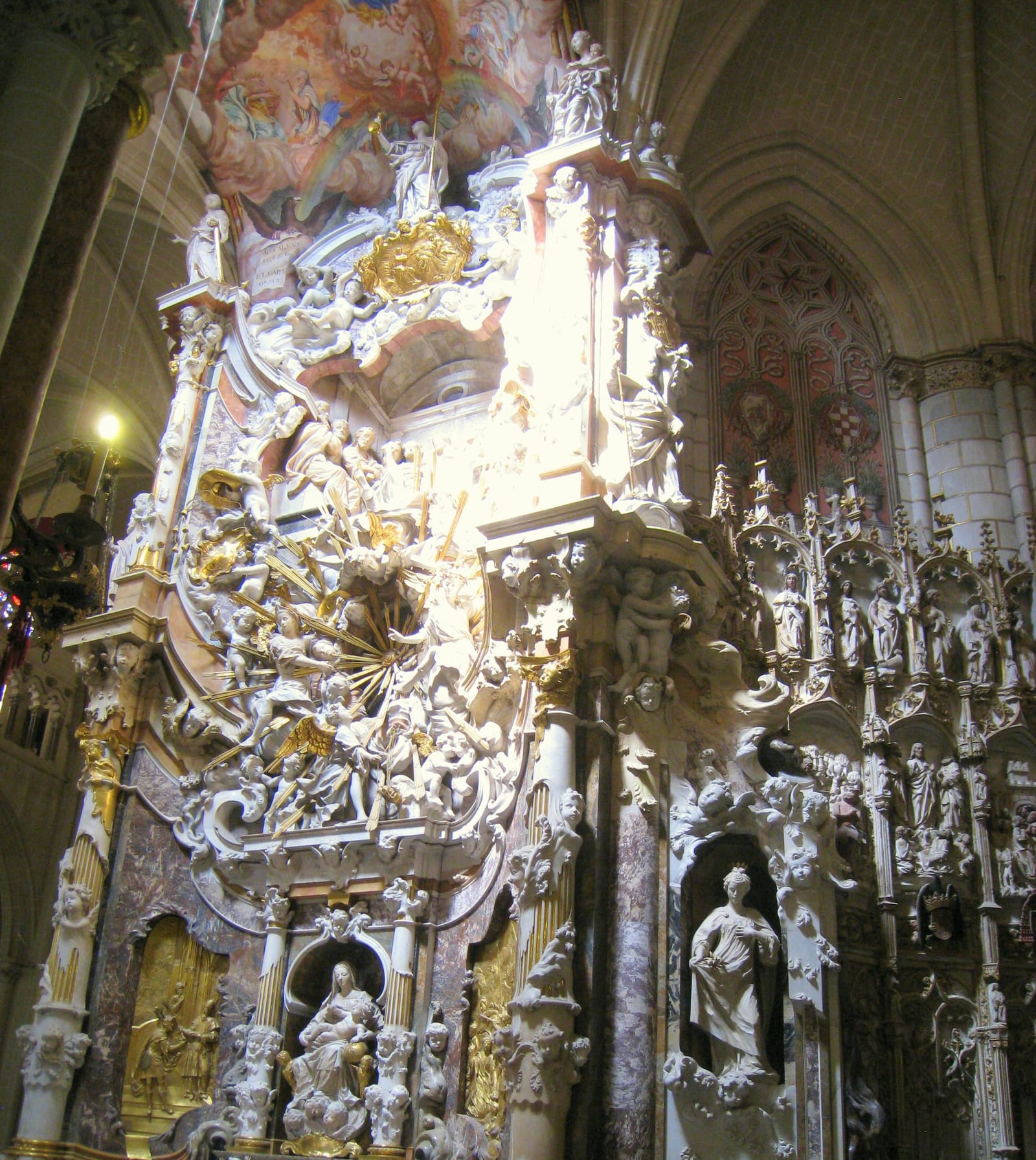
The Transparente, in the ambulatory behind the high altar
Narciso Tomé (1690–1742) and his four sons, for Archbishop Diego de Astorga y Céspedes · 1721–1732, inaugurated 9 June 1732 · Spanish and Genoese marble, jasper, bronze and stucco, rising in storeys from the floor to the pierced vault; the Last Supper group slightly larger than life size
Look for
- Straight up: the hole cut through the ambulatory vault, painted round its rim, where the daylight comes in.
- The oval window in the middle, ringed by a bronze sun and by archangels. It opens through the wall to the tabernacle on the far side.
- The Last Supper above it, its figures slightly larger than life.
- Archbishop Astorga's tomb, in front of the altar. He paid for the whole thing.
Transcript (2:09)
Walk round behind the high altar into the ambulatory and face the back wall. Then, before anything else, look straight up. There is a hole in the vault. Narciso Tomé cut it, deliberately, through the roof of a thirteenth-century church, so that daylight could fall onto what you are about to look at.
The problem he was solving is on the other side of this wall. The tabernacle, which holds the Blessed Sacrament, stood behind the tall high altarpiece in constant shadow. Archbishop Diego de Astorga y Céspedes wanted it honoured with something glorious and wanted the sun on it. So Tomé, master of the cathedral since 1721, opened the vault above you, and then cut a second hole through the back of the altarpiece itself, so that the light could pass through to the tabernacle. Anyone standing where you are could see through it too, as if the wall were transparent. That is the name.
Now find the oval window in the middle, glazed, ringed by a bronze sun and by archangels: that is the opening through to the tabernacle. Above it is the Last Supper, its figures a little larger than life. Higher still, crowning the whole thing, are Faith, Hope and Charity. Who carved those three, and when, is less certain than the rest. Now look back up at the hole in the vault. Round its edges, Biblical figures seem to tumble out of the sky into the church, with Christ on a bank of clouds at the outer rim, and carved drapery and foliage spill over the corners to hide where the stone was cut.
Lower down, the Virgin and Child, and beside them two bronze reliefs. On the left Abigail brings King David bread and wine to calm his anger; on the right the priest Ahimelech hands David the sword of Goliath. Tomé signed his name in those reliefs. He signed it again, at more length, in a Latin inscription in the lower right corner, announcing that Narciso Tomé drew, sculpted and painted this whole work of marble, jasper and bronze by himself. That is generous to Narciso Tomé, since his four sons worked on it with him: two architects, a painter and a sculptor.
It was inaugurated on the ninth of June 1732. It cost two hundred thousand ducats, a poet hailed it as the Eighth Wonder of the World, and its exuberance has divided people from the day it was finished. The Cuban novelist Alejo Carpentier called it the true miracle of this cathedral.
Before you go, look at the foot of the altar. The man who paid for all this lies there: Archbishop Astorga, buried at the foot of his Transparente.

Stop 4 of 5 · The Sacristy, on the north side, at the far end of the room on its altar
The Sacristy and El Greco's El Expolio
El Greco (1541–1614), commissioned by the Cabildo for this altar; the room by Nicolás de Vergara el Mozo, its vault painted by Luca Giordano · Painting begun summer 1577, finished spring 1579; room late sixteenth century; marble and bronze altar frame 1798 · Oil on canvas, 285 × 173 cm
Look for
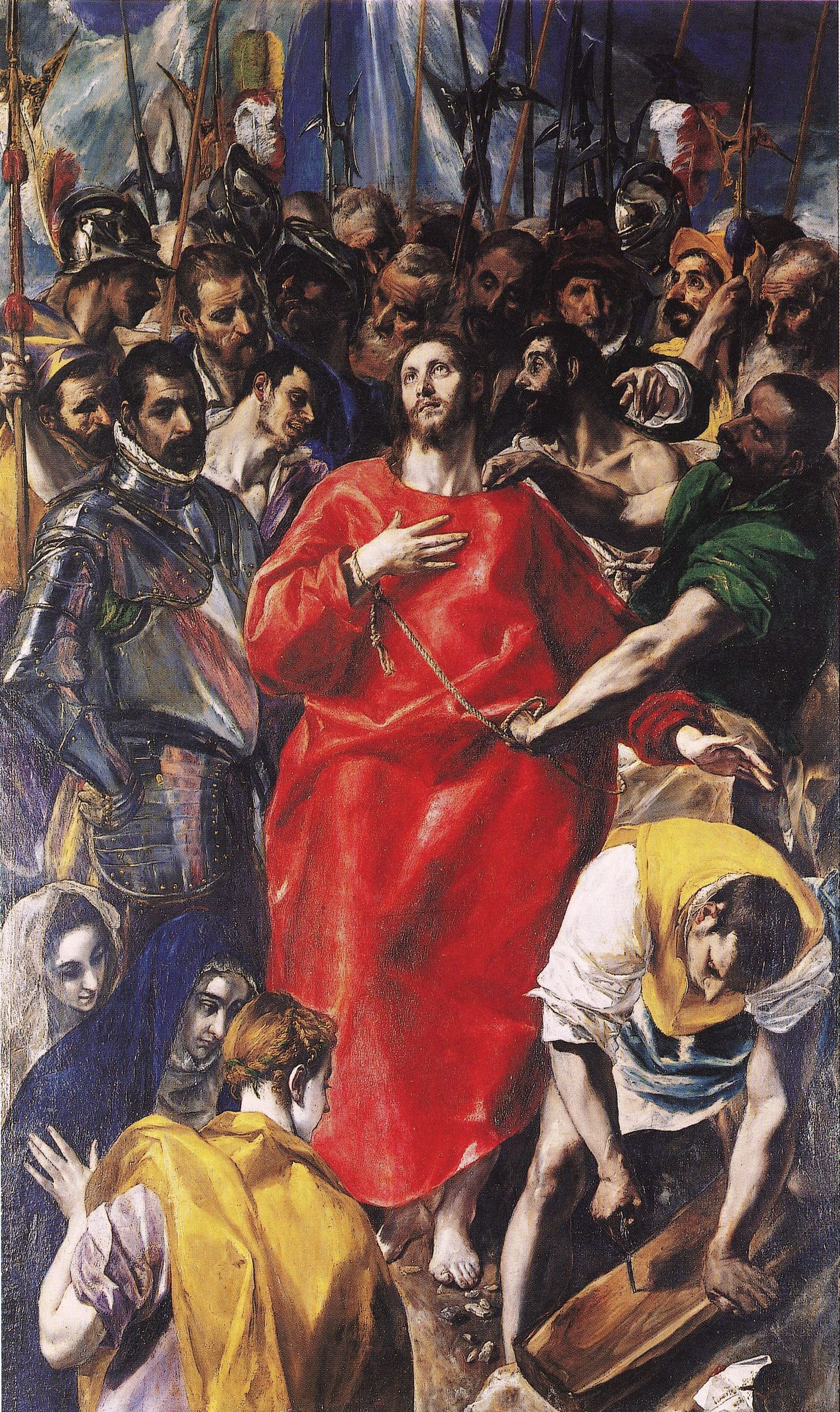
- The red of Christ's robe. Every other colour on the canvas is arranged around it.
- The man in yellow at the lower right, boring a hole in the cross for the nail.
- The small carved group at the foot of the frame, the Virgin giving the chasuble to Saint Ildefonso: El Greco's own sculpture, and all that is left of the altar he designed.
- Luca Giordano's self-portrait, in the last window on the left-hand side of the painted vault.
Transcript (2:10)
At the far end of this long room, over the altar, hangs the painting El Greco's story in Spain begins with. Walk towards it slowly; the red gets louder as you come.
It is El Expolio, the Disrobing of Christ, 285 by 173 centimetres, and it was commissioned for this altar. A document about it dated the second of July 1577 is the earliest record of El Greco in Spain at all. He owed the job to a friendship made in Rome with Luis de Castilla, whose father Diego was dean of this cathedral. He began that summer and finished in the spring of 1579.
Look at the moment he chose, just before the Crucifixion. Christ stands in the centre in bright red, the colour the whole picture is built around, looking upwards, calm, while the crowd presses in behind him in rows of heads and helmets and lances. A man in green holds him by a rope and is about to tear the robe away. At the lower right a man in yellow bends over the cross, boring the hole for the nail that will go through Christ's feet. And at the lower left, three women, watching.
Those women caused a row. The cathedral's commissioners objected that the three Marys are not in the Gospels at this point, and they disliked the tormentors' heads set higher than Christ's. The quarrel went to arbitration over the price. El Greco's own valuer put the picture at 950 ducats; he was paid 350, and told to take the offending figures out. Look at the bottom left corner and you can see that he never did.
For all that, the picture was a success: more than seventeen versions of it are known. This one went to the Prado to be cleaned, and came home in 2014.
Now look at the frame. The marble and bronze altarpiece dates from 1798 and replaced the one El Greco designed. Only one piece of his survives, the small carved group at the foot of the frame: the Virgin giving the chasuble to Saint Ildefonso, the same scene you saw over the Door of Forgiveness outside.
Then turn round and look up, because it is there again. Nicolás de Vergara the Younger built this room at the end of the sixteenth century, and Luca Giordano painted its vault with the Virgin descending to give Ildefonso his vestment. Giordano put himself in it, too: his self-portrait is in the last window on the left-hand side. Around the walls hang more El Grecos, fifteen in the sacristy including a complete set of apostles, among Caravaggio, Titian, Van Dyck and Goya, whose Arrest of Christ is here as well.

Stop 5 of 5 · Cloister, on the north side of the cathedral, in the lower galleries round the garden
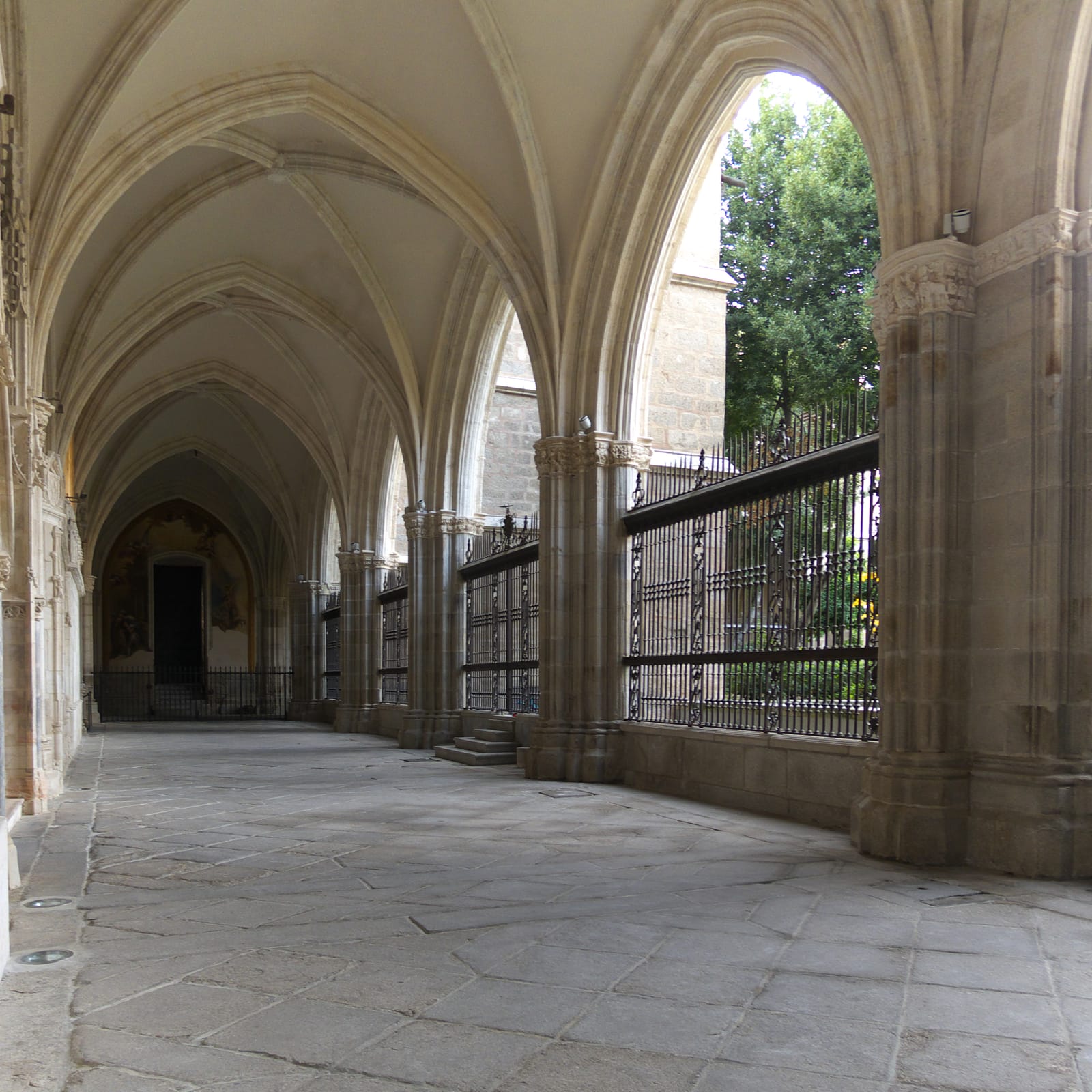
The cloister, on the north side
Rodrigo Alfonso, master of the works, for Archbishop Pedro Tenorio, with Alvar Martínez; wall paintings by Francisco Bayeu for Cardinal Luis de Borbón · Begun 14 August 1389, finished 1425; paintings eighteenth century · Four Gothic galleries with quadripartite vaults round a garden, the floor raised about a metre and a half above the cathedral's
Look for
- The garden through the arches: cypresses and orange trees, descended from the orchard that grew here before.
- The painted walls of the galleries, Francisco Bayeu's eighteenth-century frescoes, commissioned by Cardinal Luis de Borbón.
- The tombs, coats of arms and memorial slabs of canons, archbishops and benefactors set into the walls.
- The doors in the corners: one to the chapter house, one to the passage to the Treasury, one to the Chapel of San Blas.
Transcript (1:56)
Come out of the church into the cloister and the first thing to notice is the floor under you: you have gone up. The ground slopes here, so the cloister was built about a metre and a half above the level of the cathedral, and built strong enough to carry a second storey, which arrived under Cardinal Cisneros.
This is the north side of the cathedral, and before 1389 it was the alcaná, the city's market quarter. Archbishop Pedro Tenorio wanted the ground for a cloister and for his own burial chapel. The stallholders did not want to sell. While they were still haggling over the price, a fire broke out and burned the whole market down. The legend that has followed Tenorio ever since accuses him of starting it to clear the ground.
The first stone went down on the fourteenth of August 1389, and the master of the works, Rodrigo Alfonso, laid out four vaulted Gothic galleries round a garden. Look out through the arches. The cypresses and orange trees in there descend from the orchard that grew on this spot before the cloister did.
Then look at the walls. They are crowded with tombs, coats of arms and memorial slabs to canons, archbishops and benefactors. In the eighteenth century Cardinal Luis de Borbón had them painted with a cycle of frescoes by Francisco Bayeu, court painter to Charles the Third, and Goya's brother-in-law.
There was never a monastery at this cathedral, so the cloister has done more jobs than most: storeroom, classroom, marketplace again, a place of prayer, and for a while the town hall. The choirboys had their first lessons here. Cardinal Silíceo founded a college for them, the seises, on the twenty-second of July 1557, and they still sing in red, with a white surplice over it.
Processions came this way, and readings, and private devotions. The doors in the corners lead off to the chapter house, to the passage that runs to the Treasury, and to the Chapel of San Blas, Tenorio's own burial chapel, which the late medieval archbishops shared, painted with Italianate frescoes early in the fifteenth century. It lies seven metres below the street outside. Tenorio never saw it finished. The work began in 1398, and he died on the tenth of May 1399, ten years after the first stone of the cloister that a burned-out market had made room for.
Independent guide · Chiaro
Point Chiaro at anything at Toledo Cathedral.
Inside, the Cabildo's rules forbid photographs, so keep the camera for the outside, where there is more than enough: the Portal of the Lions with Villalpando's bronze doors, the Clock door on the north side, a coat of arms over a lintel, a weathered saint on the west front, the spire seen down a narrow street of the old town. Send Chiaro a photograph of any of them and ask whose arms those are, which saint that is or why the great door stays shut; the answer reaches you while you are still standing in the street.
Before you go
Getting there
Calle Cardenal Cisneros 1, 45002 Toledo. Visitors go in by the Puerta Llana on that street, the only entrance the cultural visit uses, and tickets are sold online or at the cathedral's own shop, the Tienda de la Catedral, directly opposite that door. The first stop on this page is on the Plaza del Ayuntamiento, in front of the west front, outside any ticket control.
Toledo's railway station, a Neo-Mudéjar building of 1919, is on the Madrid–Toledo high-speed line, which opened in 2005; there is no longer a conventional rail line into the city. The cathedral's postal address and its visitors' entrance are the same: the Puerta Llana, Calle Cardenal Cisneros 1.
Tickets and entry
- One Basic Ticket at 12 euros reaches all four inside stops: the cultural visit takes in the choir, the Transparente, the sacristy and the cloister, along with the main chapel, the chapter house and the principal chapels. Reduced tickets are 8 euros and 6 euros buys a child's ticket for ages 8 to 14; under-8s with a family member, and anyone born in or resident in Toledo city, are admitted free. Each ticket is good for the single date and time printed on it, with no re-entry.
- On weekdays and Saturdays the visit opens at 10:00 and ends at 18:30, and on Sundays it opens at 14:00 and ends at 18:30; the door shuts thirty minutes before closing and every space is cleared ten minutes before the end. It is closed on 1 January and 25 December and can close for a celebration, which the Cabildo announces in advance. Feast days have times of their own: on 8 December, 6 January and 23 January the visit runs from 14:00 to 18:30, on 24 and 31 December from 10:00 to 14:00, and Holy Week, Corpus Christi, 15 August and 1 November each have their own hours, all listed on the official ticket page.
- Photography and filming are not allowed anywhere inside, and the house rules ask for mobile phones to be switched off in the church. Our advice: play stops two to five before you enter by the Puerta Llana, then put the phone away and go in with the pictures in your head.
- Dress with decorum and leave food and drink outside. Almost all of the visit is accessible, and wheelchairs are lent free at the ticket desk.
The official audio guide
The Cabildo's own official guide to the visit is an app, Visita Catedral de Toledo, free on the App Store and Google Play, in Spanish, English, French, German, Italian and Portuguese; the cathedral links it from every page of its website. These five recordings are a separate thing, made by Chiaro: they take five places, from the square to the cloister, and spend a few unhurried minutes on each, free, and every word of each script is printed below its player, so you can hear it, or read it, before you go through the door.
Official site →Questions
Is there a free Toledo Cathedral audio guide?
Yes: this page is one, and it costs nothing and installs nothing. Because the Cabildo asks for phones to be switched off inside the church, it works best as a briefing: listen to the choir, the Transparente, the sacristy and the cloister before you reach the Puerta Llana, and read them again afterwards, since each one is written out on the page. The Cabildo's own guide, the Visita Catedral de Toledo app, is also free to download.
Can I listen to the Toledo Cathedral audio guide without a ticket?
Yes, anywhere, because it is a web page, but only the first stop is written for a spot you can stand on without one: the Plaza del Ayuntamiento, facing the west front. The choir, the Transparente, the sacristy and the cloister are inside, on the 12-euro Basic Ticket, sold online or at the Tienda de la Catedral opposite the Puerta Llana.
How much is the official Toledo Cathedral audio guide?
The Cabildo's official guide is an app called Visita Catedral de Toledo, and downloading it is free on both iPhone and Android phones, with six languages to choose from, English among them. What you do pay for is admission: 12 euros for the Basic Ticket, 8 reduced, and 6 for children from 8 to 14.
Where is El Greco's El Expolio in Toledo Cathedral?
In the sacristy, on the north side of the cathedral, over the altar at the far end of the room it was painted for between 1577 and 1579. The Basic Ticket covers it: the Cabildo names the sacristy and its El Grecos among the spaces of the visit. It hangs in a marble and bronze frame of 1798, with El Greco's own small carving of Saint Ildefonso at its foot.
When is Toledo Cathedral closed to visitors?
On 1 January and 25 December, and on any day a celebration requires it, which the Cabildo announces beforehand. Sundays are afternoon only, from 14:00, as are several feast days, and the visitors' door shuts thirty minutes before closing time.
More audio guides
Made by Chiaro. Not affiliated with Toledo Cathedral.