
Royal Palace of Madrid · Madrid · Independent guide
Royal Palace of Madrid audio guide,
five stops, free.
More than 135,000 square metres and 3,418 rooms, built to replace a castle lost on Christmas Eve 1734. Five stops of it play here, facade to throne; a photo in the Chiaro app takes on the rest.
Made by Chiaro. Not affiliated with the Royal Palace of Madrid.
The main facade, across the Plaza de la Armería
Royal Palace of Madrid, Madrid
That was the free part
Chiaro narrates anything at the Royal Palace of Madrid from a photo.
The five stops · 11 minutes of audio
Five places, one walk,
in the order you will walk them.
Begin this free, self-guided Royal Palace of Madrid audio guide at the railing of the Plaza de la Armería, facing the main facade from the Almudena Cathedral side, before you have shown anyone a ticket; the visitors' gate is on that same esplanade. Inside, the stops follow the order of Patrimonio Nacional's own self-guided route on the main floor: up the Grand Staircase from the entrance vestibule, through Charles the Third's apartment to the Salón de Gasparini, round the main courtyard to the Real Capilla on the north side, and finally the Salón del Trono on the south front, where the tour of the state apartments ends. Roughly ten minutes of audio altogether, and the palace itself reckons on roughly forty-five minutes for the unguided walk.
The dates, names and makers on this page come from Patrimonio Nacional's descriptions of the palace, its visitor PDFs and its ticket office website, read on 26 September 2026 and set against the English and Spanish Wikipedia articles; each visit fact is kept on file with the operator's own sentence, so a change on their side is noticed. The Palacio Real is still the King's official residence, and state occasions can close rooms, or the whole building, at short notice. Whatever the attendants and the posted notices tell you on the day takes precedence over this page.
Joseolgon, CC BY 4.0, via Wikimedia Commons. Photo: Joseolgon

Stop 1 of 5 · Plaza de la Armería, the public side of the railing between the Almudena Cathedral and the palace forecourt, facing north at the main (south) facade; the official visitors' gate is here, on the Almudena esplanade at the corner of Calle Bailén
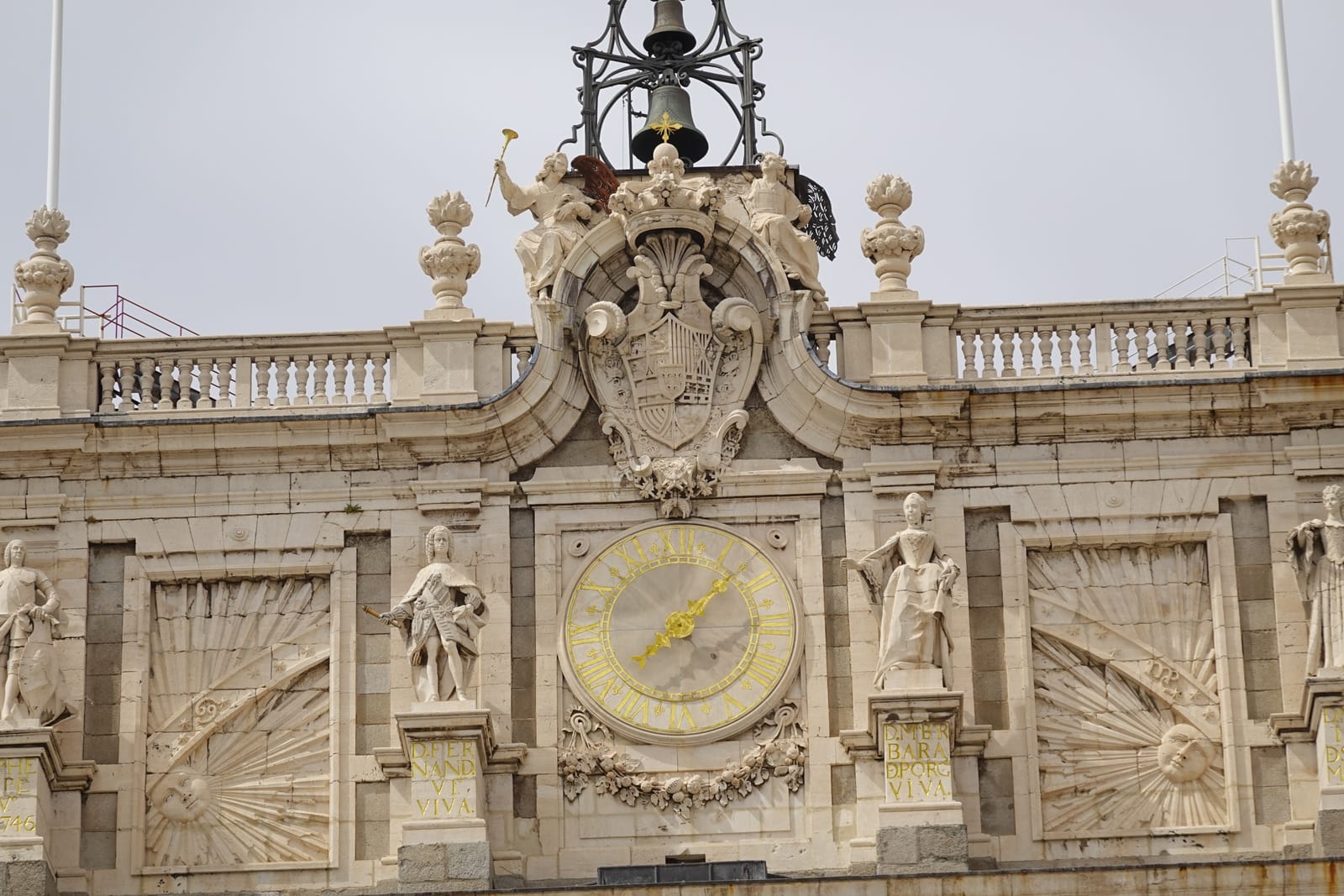
The main facade, across the Plaza de la Armería
Giambattista Sacchetti (1690-1764) on Filippo Juvarra's scheme, finished by Francesco Sabatini (1722-1797) with Ventura Rodríguez (1717-1785), for Philip V, Ferdinand VI and Charles III · First stone 6 April 1738; building essentially complete 1751-1754; Charles III moved in on 1 December 1764 · Grey granite and white limestone; a palace of more than 135,000 square metres and 3,418 rooms, six storeys where lowest and eight where the ground falls away
Look for
- The clock at the centre of the roofline. Sabatini designed it, and a bell from the burnt Alcázar is built into it.
- The two statues either side of the clock, Ferdinand the Sixth and Barbara of Braganza, survivors of a plan to line the whole roof with kings.
- The two colours of stone: grey granite below, white limestone above, the contrast the design relies on.
- The bells in the iron frame above the clock, dated 1637 and 1761; the older one is from before the fire.
Transcript (2:15)
Look up at the middle of the roofline, where the facade rises into a block with a clock in it. That clock is Francesco Sabatini's, and built into it is a bell from the building that stood here before, the Alcázar of Madrid. Keep that bell in mind, because everything you are looking at is the answer to a fire.
Madrid grew up around this ridge. Between 860 and 880 the Umayyad emir of Córdoba, Muhammad the First, put a fortress on this ridge above the Manzanares, and the settlement around it was called Majrit. In 1561 Philip the Second made the Alcázar the official home of the kings of Spain and brought the court to Madrid. Then, on Christmas Eve 1734, it caught fire. It burned for three days. Paintings and furniture were thrown out of the windows, many of them broke in the fall, and more than five hundred paintings from the royal collection were lost. By the twenty-seventh of December only a few walls and one tower were still standing.
You will hear that Philip the Fifth's French courtiers started it on purpose, to get a palace like Versailles. Patrimonio Nacional, which runs this place, says plainly that it is a legend.
Philip sent for the most famous architect in Europe, Filippo Juvarra, who drew a palace four times the size of this one, with twenty-three courtyards and a facade 480 metres long. Juvarra died in January 1736, the plan was judged too expensive, and his pupil Giambattista Sacchetti was told to fit it onto the old Alcázar's cramped, sloping site. So he built upwards instead of outwards: six storeys where the ground is level, eight where it falls away behind the palace. And no wood. Every floor is a vault, with timber only in the doors and windows, so that this building could never burn the way the last one did. The first stone went in under the centre of this facade on the sixth of April 1738, and its inscription says that Philip the Fifth rebuilt the castle to face eternity.
Now the two statues either side of the clock: Ferdinand the Sixth and his queen, Barbara of Braganza. There were meant to be kings all along this roofline, back to the Visigoths, with Moctezuma and Atahualpa among them. Charles the Third, the first king actually to live here, from 1764, found it too much and had the statues taken down off the cornices. Before you go in, look at the stone itself: grey granite below and white limestone above, two colours doing the work that all those statues were supposed to do.
Joseolgon, CC BY 4.0, via Wikimedia Commons, cropped. Photo: Joseolgon
.jpg)
Stop 2 of 5 · Main vestibule (zaguán principal) and the Grand Staircase up to the main floor, the start of the self-guided route
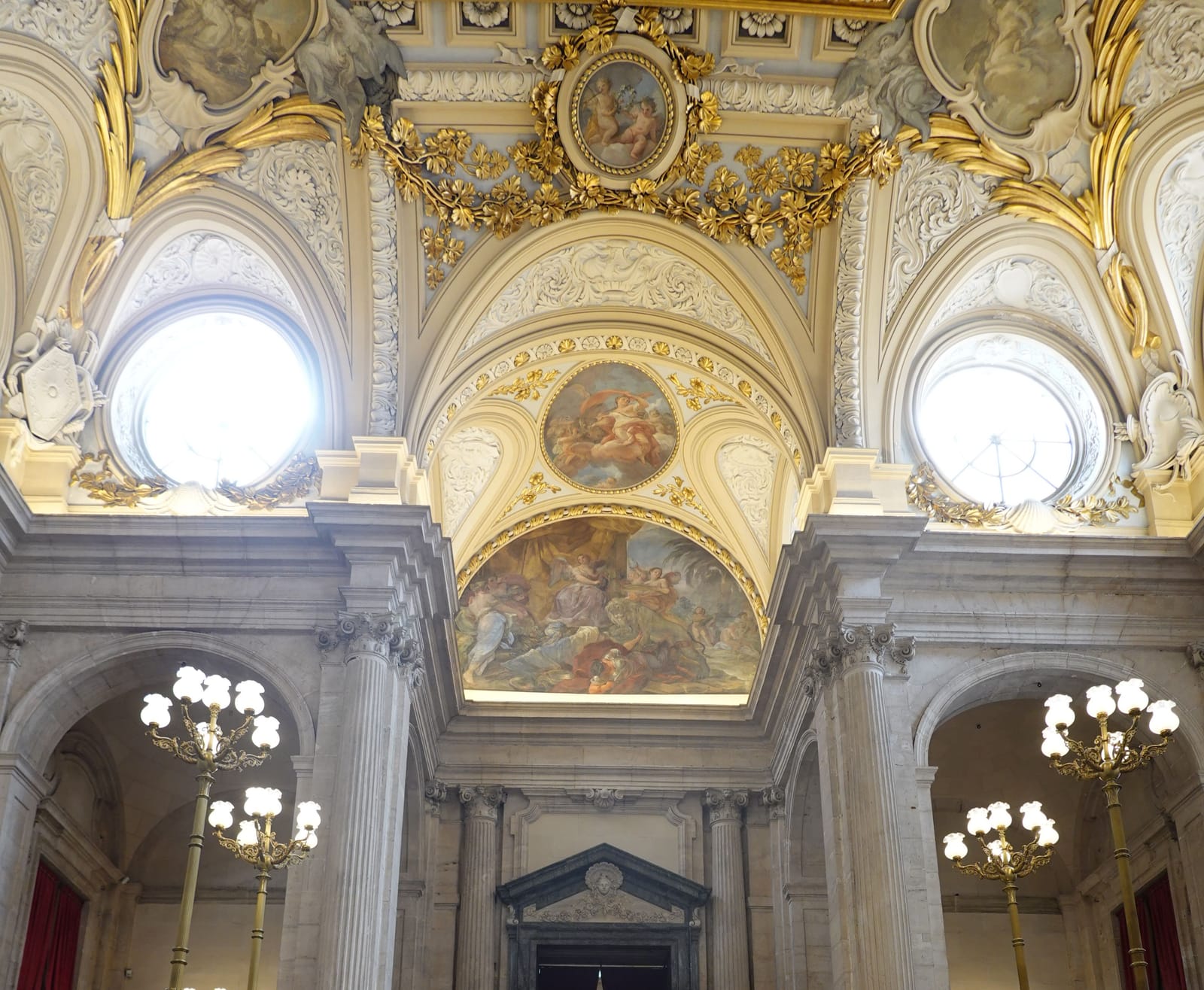
The Grand Staircase
Francesco Sabatini (1722-1797) for Charles III, inside Giambattista Sacchetti's stair hall; vault frescoes by Corrado Giaquinto (1703-1766), stucco by Giovanni Battista Andreoli, landing lions by Felipe de Castro and Robert Michel · Built by Sabatini in 1760 on the left side; moved to the right, reusing the same steps, on Charles IV's order in 1789; vault frescoes finished in Ferdinand VI's lifetime · Marble and granite; 72 steps, each carved from a single piece of marble 4.5 metres wide
Look for
- The steps: broad, very shallow, each a single piece of marble four and a half metres wide.
- The two marble lions on the first landing, one by Felipe de Castro and one by Robert Michel. The palace's notes call Michel's the livelier one.
- Giaquinto's vault, Religion protected by Spain, with the four elements in the corner medallions.
- The white Carrara marble vases carved with hunting scenes and trophies.
Transcript (2:11)
Stand at the bottom and look at the first step. It is one piece of marble, four and a half metres wide, and so is every other one: seventy-two of them, so broad and so shallow that you barely feel the climb. Patrimonio Nacional's own notes add that women did not walk up them at all. They were carried to the main floor in sedan chairs.
Behind you is the main vestibule. Carriages came in through the three central doors of the facade, and monarchs and ambassadors stepped down right here, facing a statue of Charles the Third dressed as a Roman general.
This staircase was argued over for almost two decades. Sacchetti's plan, accepted in 1742 on an idea of the Marquis Scotti, was twin staircases, the right one for the king and the left one for the queen. Then Scotti and his protégé Bonavia complained that the steps were too high, and the court quarrel that followed produced project after project. Sacchetti's most ambitious version, with ramps opening onto nine exits on the main floor, was only ever built in wood, so that the king could see the effect. Charles the Third did not like any of it. He told Francesco Sabatini to build one staircase, like the one Vanvitelli built for the palace of Caserta near Naples, and to turn the other stair hall into a ballroom. That ballroom is the Hall of Columns, and it has had a busier life than most rooms in Europe: Spain signed its treaty of accession to the European Communities there in 1985, it hosted the Madrid Peace Conference in 1991, and Juan Carlos the First signed his abdication there in 2014.
Here is the strange part. Sabatini built this staircase in 1760 on the other side, the left. When Charles the Fourth came to the throne in 1789, he had the same architect take it apart and rebuild it on the right, where it is now, reusing the same steps. You are walking up a staircase that has already moved house once.
On the first landing sit two marble lions. One is by Felipe de Castro, the other by Robert Michel, and the palace's own notes call Michel's the more dynamic of the two. Then look straight up. Corrado Giaquinto painted the vault: Religion protected by Spain, surrounded by Abundance, Peace, Justice and Magnificence, virtues meant to belong to Ferdinand the Sixth, with the four elements in the medallions at the corners.
When Napoleon came to Madrid he stopped on this landing, turned to his brother Joseph, the new king, and said: Brother, you are going to have a much better house than mine.
Joseolgon, CC BY 4.0, via Wikimedia Commons. Photo: Joseolgon
.jpg)
Stop 3 of 5 · Main floor, King Charles III's apartment, reached from the Hall of Columns through the Saleta and the Antechamber
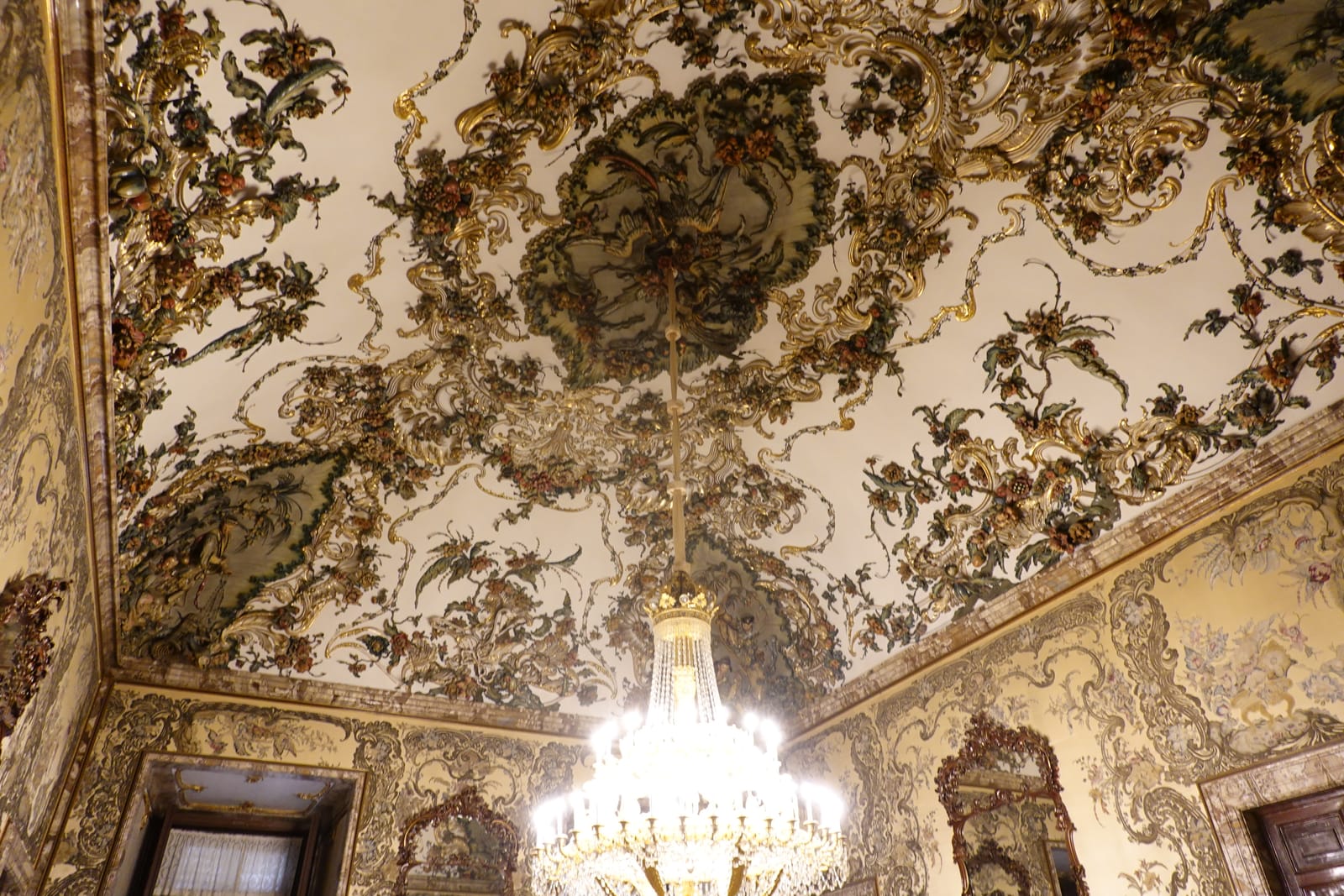
The Gasparini Room, Charles III's dressing room
Mattia Gasparini (d. 1774) for Charles III; floor by Domenico Galeotti and Nicola Rappa, vault stucco by Gennaro di Matteo, with the palace's cabinetmaking, embroidery and bronze workshops · Begun under Charles III after 1759; floor and vault finished by 1788; hangings under Ferdinand VII and the chairs under Alfonso XII · Inlaid coloured-marble floor, painted and gilt stucco vault, satin hangings embroidered in coloured silks and silver-gilt thread; a decoration that took decades, about fifty years, to complete
Look for
- The stucco vault: leaves, flowers, fruit and birds in green and gold, finished before Charles the Third died in 1788.
- The coloured-marble floor, the only other part he saw complete.
- The Jaquet-Droz clock El Pastor, bought by Ferdinand the Sixth, whose shepherd plays the flute on the hour.
- The wall hangings: satin embroidered in coloured silks and silver-gilt thread, the old embroidery moved onto new silk.
Transcript (1:58)
Look up first, then down, because the ceiling and the floor are the only two parts of this room that Charles the Third ever saw finished.
This was his Pieza de Vestir, his dressing room, and after the throne room the most important room in his apartment. It was not a private room. The king dressed here in front of the court, as kings did then, so the room had to be a performance in its own right. He gave it to Mattia Gasparini, a painter and decorator who had come with him from Naples in 1759, and Gasparini produced this: Italian rococo taken as far as it will go, fleshy leaves, flowers, birds and oriental figures, the century's craze for chinoiserie in every corner.
To make it, three workshops were set up. Cabinetmaking was run by a German, José Canops. Bronzes were under Antonio Vendetti. And the embroidery workshop was headed by María Luisa Bergonzini, Gasparini's wife, so one of the three workshops behind this room was run by a woman.
It took decades. When Charles the Third died in 1788, only the marble floor, laid by Domenico Galeotti and Nicola Rappa, and the stucco vault, by Gennaro di Matteo, were done. The whole programme took about fifty years. The embroidered hangings went up under Ferdinand the Seventh, and the chairs only arrived under Alfonso the Twelfth, in the late nineteenth century. More recently the silk on the walls wore out and was replaced, and the original embroidery was painstakingly sewn onto the new fabric.
Find the clock called El Pastor, the Shepherd, by the Swiss maker Jaquet-Droz, which Ferdinand the Sixth bought. On the hour a seated shepherd plays the flute while little figures in eighteenth-century dress dance. The bronze chandelier and the candelabra in the corners are from Ferdinand the Seventh's time, and the table in the middle came from the Vatican workshops, a present from Pope Pius the Ninth to Isabella the Second.
One more thing about the rooms you have just walked through. Charles the Third liked his walls covered from the ceiling down to the dado with paintings, swapped for tapestries in winter against the cold and damp of Castile. In the antechamber next door, where he dined and talked with his ministers, the summer hang included Velázquez's Las Meninas. It stayed on that wall until it left for the Prado for good.
Joseolgon, CC BY 4.0, via Wikimedia Commons. Photo: Joseolgon
_03.jpg)
Stop 4 of 5 · Main floor, north side, entered from the gallery that runs round the main courtyard
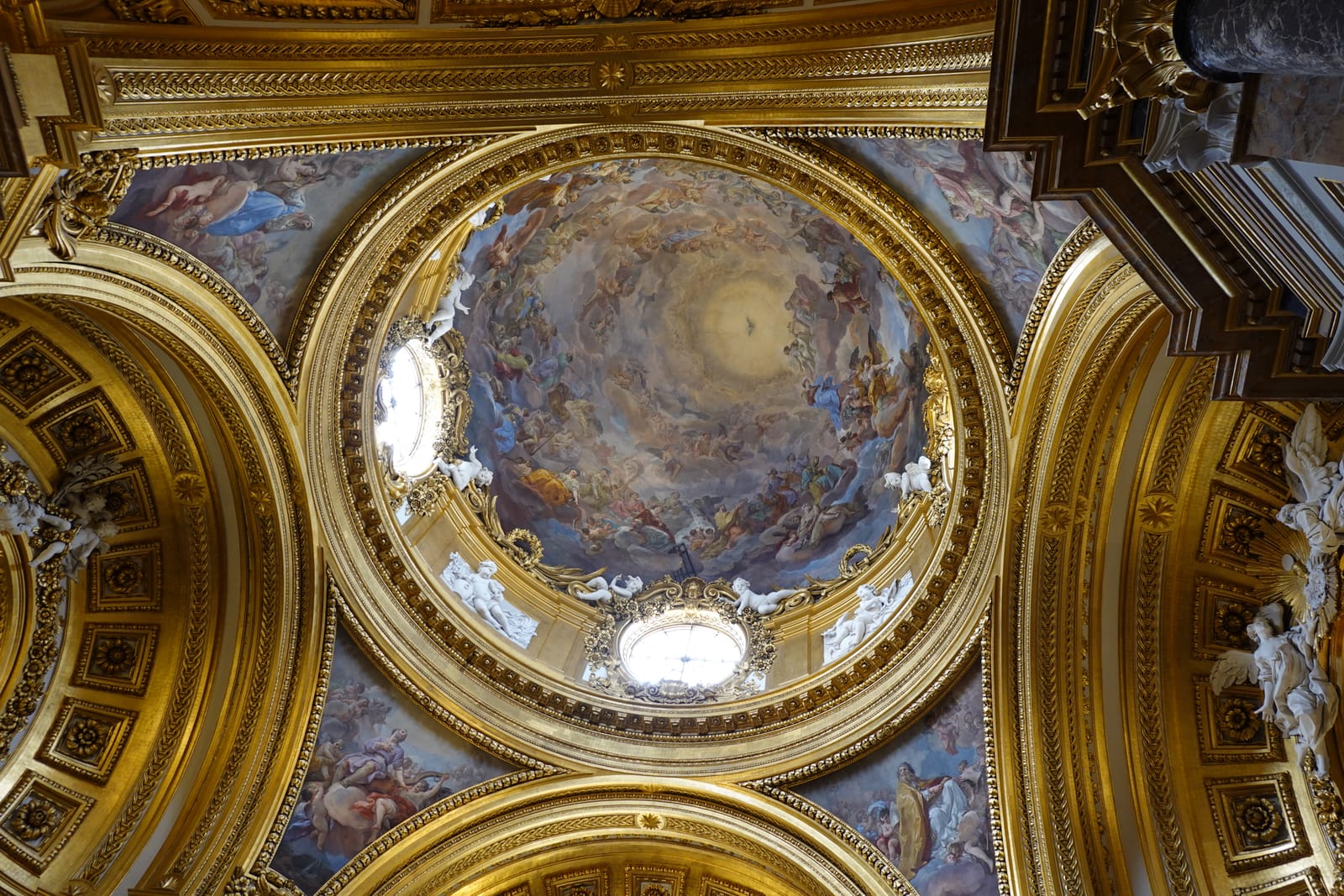
The Royal Chapel, under Giaquinto's dome
Giambattista Sacchetti (1690-1764), with Ventura Rodríguez (1717-1785) and Corrado Giaquinto (1703-1766), for Ferdinand VI; stucco by Andreoli, drum angels by Felipe de Castro; altar architecture by Sabatini · Placed on the main floor in 1742; Sacchetti's final design 1748; built 1750-1759 (Spanish Wikipedia) · Stucco, gilding and fresco over a central domed plan, with ten great columns each cut from a single piece of veined black Mañaria marble
Look for
- The rings of cloud in the dome, painted so that the Trinity crowning the Virgin seems to float higher than it is.
- The black columns, each a single piece of veined marble from Mañaria in the Basque Country.
- The pendentives: Saint Isidore the farmer, Saint Mary de la Cabeza, Saint Leander and Saint Damasus.
- The organ at the west end, its case designed by Ventura Rodríguez and spared the nineteenth century's alterations.
Transcript (2:12)
Tip your head back. The dome looks higher than it really is, and that is deliberate: Corrado Giaquinto painted rings of cloud around the central scene, the Trinity crowning the Virgin Mary, so that your eye keeps travelling upwards.
Everything above the cornice is Giaquinto's. He designed the stucco, which Andreoli carried out, and he painted the frescoes, among them the Battle of Clavijo and an Allegory of Religion. In the four pendentives under the dome are saints with a Madrid accent: Isidore the farmer and his wife, Saint Mary de la Cabeza, with Saints Leander and Damasus.
The chapel nearly ended up somewhere else. The first plan put it where the Hall of Halberdiers is now. In 1742 it was decided to build it here on the main floor instead, and after several versions, each one trying to make it bigger, Patrimonio Nacional says Sacchetti's final design of 1748 is what was built, with his assistant Ventura Rodríguez closely involved; other accounts give the winning design of 1749 to Rodríguez himself. What was not built is the rest of Sacchetti's idea. He wanted the floor and every wall in marble, with capitals and bases in bronze. Charles the Third wanted the chapel finished, so the decoration was completed in stucco as a stopgap, and the stopgap is what you see. The part that was made properly is spectacular: ten great columns, each one a single piece of veined black marble from Mañaria in the Basque Country.
Now picture how the room was used. On ordinary days the king followed Mass from the Cancel, the enclosure at the foot of the chapel, which he reached from inside the royal apartments. On great feast days he walked in procession along the gallery outside, hung with tapestries for the occasion, bowed to the altar, bowed to the queen, and took his seat under the canopy. The court had fixed places. The public was allowed only into the entrance.
Music mattered here. Works by Domenico Scarlatti and José de Nebra were heard in this chapel, and the organ at the west end is a rarity: its case was designed by Ventura Rodríguez, it was built in 1778 by Jorge Bosch, and it is unique in Spain for having escaped the alterations of the nineteenth century.
Two last details. The painting over the high altar, Saint Michael, is by Ramón Bayeu, after a lost original by Luca Giordano, and next to Giaquinto's vault it looks almost shy. And at the altar table, in a glazed niche, lies a wax figure of the Roman martyr Saint Felix, whose relics are kept there.
Joseolgon, CC BY 4.0, via Wikimedia Commons. Photo: Joseolgon
_1.jpg)
Stop 5 of 5 · Main floor, south front, over the Plaza de la Armería; the last room of the self-guided route
The Throne Room
Decoration directed by Felice Gazzola for Charles III; vault fresco by Giambattista Tiepolo (1696-1770); furniture designed by Giovanni Battista Natali and carved in Naples by Gennaro di Fiore; wall embroidery by Andrea Cotardi · Conceived by Sacchetti in 1737; decoration completed 1772 · Fresco, gilt stucco, Genoese velvet embroidered in silver-gilt, gilt wood and La Granja glass; twelve consoles and twelve mirror frames, with four gilt-bronze lions cast in 1651-1652
Look for
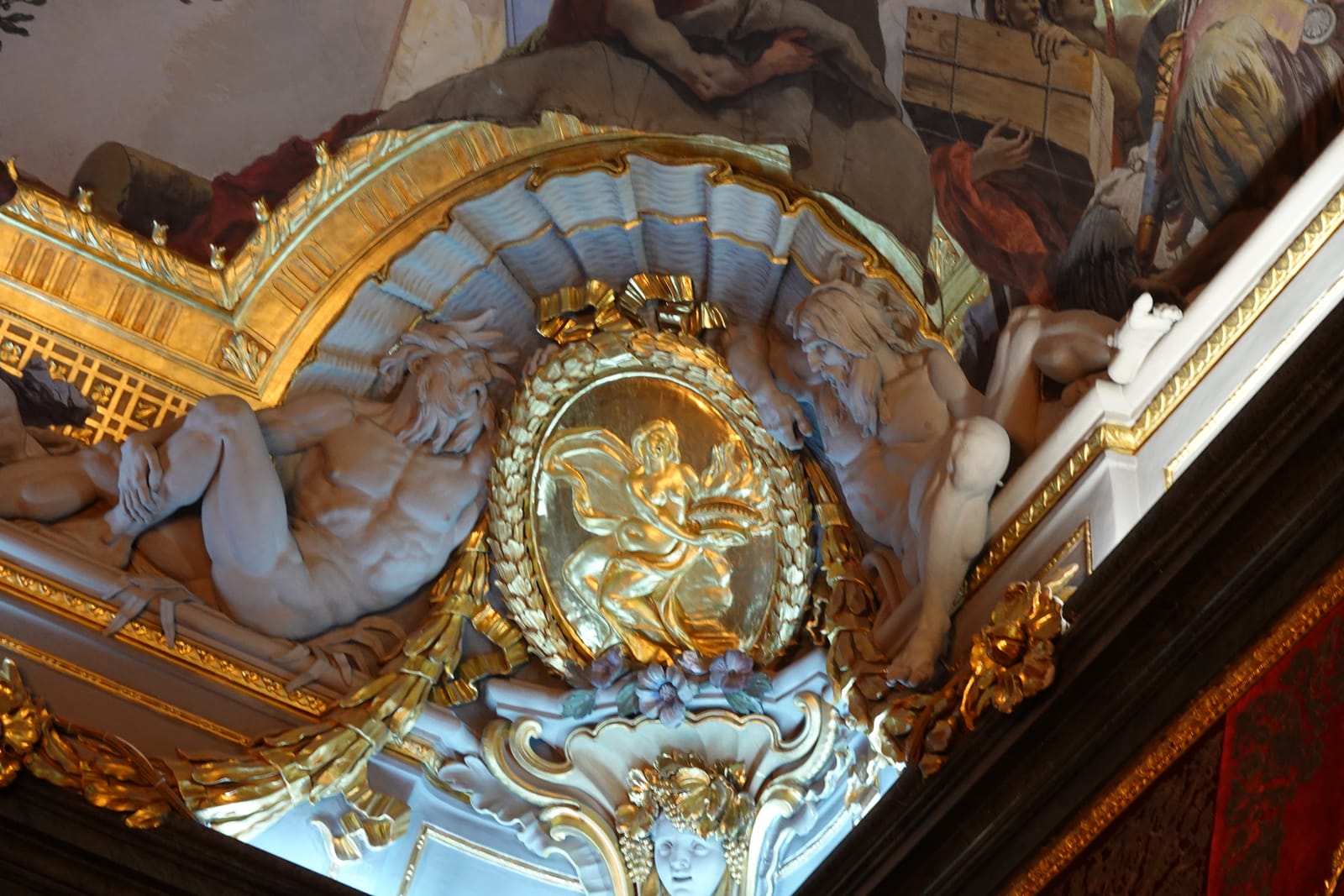
- The corners of the vault, where stucco figures lean out of the frame of Tiepolo's painting.
- The four gilt-bronze lions by the dais, each with a paw on a reddish stone ball; seven of their brothers are in the Prado.
- The consoles and mirror frames, twelve of each, all different within one design, made in Naples.
- The red Genoese velvet on the walls and its silver-gilt embroidered borders.
Transcript (2:18)
If the palace has a point, this is it. It is the one room that has never changed its job since Sacchetti drew it in 1737. Stand back from the dais and look up before anything else.
The ceiling is Giambattista Tiepolo's, The Triumph of the Spanish Monarchy, one of the last works of his life. Follow its lower edge around the room: the figures sitting along the cornice are allegories of Spain's regions and possessions, each with its own attributes, and at the corners stucco figures lean right out of the painted frame, so that you cannot quite tell where the plaster stops and the paint begins.
Charles the Third handed the room to Felice Gazzola, whose team finished it in 1772, and it is Naples in Madrid. Charles had been king of Naples and Sicily until 1759, and the furniture was made there, designed by Giovanni Battista Natali and carved by Gennaro di Fiore: twelve consoles and twelve mirror frames, all different within one design. The mirror glass came from the Royal Glass Factory at La Granja, and flat plates of glass this big were a technical feat. The walls are Genoese velvet embroidered by Andrea Cotardi. The palace reads the whole arrangement as a code: the four parts of the world, the four seasons and the four cardinal virtues, everything a king needed to govern well.
Now the lions. Four of them, gilt bronze, each with a paw resting on a reddish stone ball. They are older than the palace. Velázquez ordered them in Italy on his second journey there, for the Hall of Mirrors in the old Alcázar, and they were cast in 1651 and 1652 by Matteo Bonuccelli. There were twelve. Seven are in the Prado, holding up tables, and one was badly damaged in the fire of 1734. Charles the Third set these four here on purpose, together with Jacques Jonghelinck's bronze Planets from the Alcázar, to say that the new Bourbon kings were the continuation of the old ones.
The two thrones on the dais look like the heart of the room, and they are among its youngest things: twentieth-century copies of Charles the Third's own throne chair, and the arms on the canopy behind them were embroidered in the 1990s. The original chair, with Charles's likeness on the back, is kept in the Crown Room, and every later throne was modelled on it.
This room also had a sadder duty. When a king died, his body was laid out here before it went to the pantheon at El Escorial. Charles the Fourth wanted to redecorate it, and a 1790 design by Sabatini and the French decorator Dugourc still exists, never carried out. So above you is what Charles the Third signed off on: Tiepolo overhead, Naples on the walls, and Velázquez's lions guarding an empty throne.
Independent guide · Chiaro
Point Chiaro at anything at the Royal Palace of Madrid.
Five tracks barely scratch a building of 3,418 rooms. A porcelain cabinet, a Goya portrait, a clock with dancing figures, a tapestry in the gala dining room: aim the Chiaro app at it and hear who made it and for which king, then ask what happened in that room next.
Before you go
Getting there
Calle de Bailén, s/n, 28071 Madrid. Everyone, with or without a group, goes in through the gate on the esplanade of the Almudena Cathedral, at the corner of Calle Bailén, on the Plaza de la Armería side. Track one of this walk is meant to be played at the railing a few steps from that gate.
Ópera, on metro lines 2 and 5, is the nearest station. Príncipe Pío is the stop for Cercanías commuter trains. The palace lists bus lines 3, 25, 39 and 148 for getting there, and BiciMAD dock number 36 is the closest for a shared bike.
Tickets and entry
- Tickets are sold for a date and an entry time. The standard self-guided ticket is 18 euros; the reduced rate of 9 euros is for ages 5 to 16, over-65s and students up to 25, and under-5s go free. Admission and the ticket office stop one hour before closing time.
- Opening hours follow the season: April to September, Monday to Saturday 10:00 to 19:00; October to March, Monday to Saturday 10:00 to 18:00; Sundays 10:00 to 16:00 all year. In 2026 the palace is shut all day on 25 December and from 15:00 on 24 and 31 December, and official events can close it on other days as well.
- Citizens and residents of the European Union, and Latin American citizens, get in free from Monday to Thursday, 17:00 to 19:00 (16:00 to 18:00 from October to March), with ID, at the ticket office only and for the unguided visit only. The Royal Kitchen, sold only as a combined ticket with the palace, cannot be seen in those hours.
- Photographs without flash, for personal use, are allowed except where a sign says otherwise; tripods and selfie sticks are not. Because of works on the visitor facilities, the palace asks you not to bring large backpacks, suitcases or bulky bags.
The official audio guide
Patrimonio Nacional's own audio guide costs extra and comes in two forms: a handset handed out once you are through the access control, or a digital version in the palace's app, unlocked with the code in your booking confirmation, for which you bring your own headphones and a charged phone. Its price is given on the palace's own visitor page at patrimonionacional.es. Book the guided visit led by palace staff, an 8-euro supplement, and the palace says you will not need the audio guide at all. The five tracks here are a separate thing: free, streamed in the browser, with each script printed under its player.
Official site →Questions
Is there a free Royal Palace of Madrid audio guide?
Yes: the five tracks on this page cost nothing, need no download, and print their full scripts under each player. The palace's own audio guide, on a handset or inside its app, is a paid extra on top of admission. For the thousands of objects neither one reaches, take a photo with the Chiaro app and it tells you about that instead.
Can I listen to the Royal Palace of Madrid audio guide without a ticket?
The first track, yes. It is written for the public side of the Plaza de la Armería railing, looking at the main facade, beside the visitors' gate. Tracks two to five play indoors, along the unguided route through the state apartments that standard admission pays for; the Royal Kitchen is a separate combined ticket and not part of this walk.
How much is the official Royal Palace of Madrid audio guide?
It is charged separately from the 18-euro admission, either as a rental handset or as an in-app guide unlocked with your booking code, and its price is given on the palace's own visitor page at patrimonionacional.es. The alternative is a staff-led guided visit for an 8-euro supplement, which the palace says makes the audio guide unnecessary.
Which days is the Royal Palace of Madrid closed in 2026?
For the rest of 2026 the published closures are 25 December all day and early closing from 15:00 on 24 and 31 December; earlier in the year it also shut on New Year's Day, 6 January and 1 May. Because it remains the King's official residence, state events can close it on other dates too, so look at the ticket site before setting out. On Sundays it closes at 16:00 all year.
Where does the self-guided visit of the Royal Palace of Madrid end?
In the Throne Room, on the south front above the Plaza de la Armería, after the Royal Chapel on the north side. That is the sequence of Patrimonio Nacional's own material for the self-guided visit, and this page keeps to it: facade, Grand Staircase, Gasparini Room, Royal Chapel, Throne Room. The palace puts the unguided visit of the state rooms at about forty-five minutes.
Can I take photos inside the Royal Palace of Madrid?
Patrimonio Nacional allows photographs without flash for personal use, except in places where that is expressly prohibited. Tripods, selfie sticks and similar accessories are not permitted, and the privacy of other visitors and staff has to be respected.
More audio guides
Made by Chiaro. Not affiliated with the Royal Palace of Madrid.