
Seville Cathedral · Seville · Independent guide
Seville Cathedral audio guide,
five stops, free.
A minaret finished on 10 March 1198, now a bell tower about 95 metres to the top of its weathervane: hear five of the cathedral's places here, then let Chiaro take a photo of any of its eighty chapels and tell you the rest.
Made by Chiaro. Not affiliated with Seville Cathedral.
The Giralda, from the Plaza Virgen de los Reyes
Seville Cathedral, Seville
That was the free part
Chiaro narrates anything at Seville Cathedral from a photo.
The five stops · 11 minutes of audio
Five places, one walk,
in the order you will walk them.
Seville Cathedral starts outside, and so does this free, self-guided audio guide: stop one plays on the Plaza Virgen de los Reyes at the cathedral's north-east corner, with the whole Giralda above you and no ticket in your hand. Once inside, the Cabildo sends everyone up the tower first, so stop two is at the bell level, looking north-west into the Patio de los Naranjos. Back on the ground, cross the east end to the south arm of the transept for the tomb of Christopher Columbus; walk north to the crossing, where the high altarpiece faces you through its gilded grille; and finish in the Patio de los Naranjos, where the Door of Forgiveness lets you out onto Calle Alemanes. Listening time for all five comes to roughly ten minutes, the climb is thirty-five ramps each way, and the Cabildo puts a full visit of cathedral and tower at about 75 minutes.
Prices, entrances and timetables here were copied from the Cabildo's own pages at catedraldesevilla.es and compared with them line by line on 27 September 2026; names, dates and measurements rest on those pages and on Wikipedia, and where the two give different figures the page says whose it is using. This is a working cathedral before it is a monument, and services reshape the visiting day at short notice, so a verger or a notice at the Prince's Gate outranks anything written here; tell us when they disagree with it.
Daderot, CC0, via Wikimedia Commons. Photo: Daderot

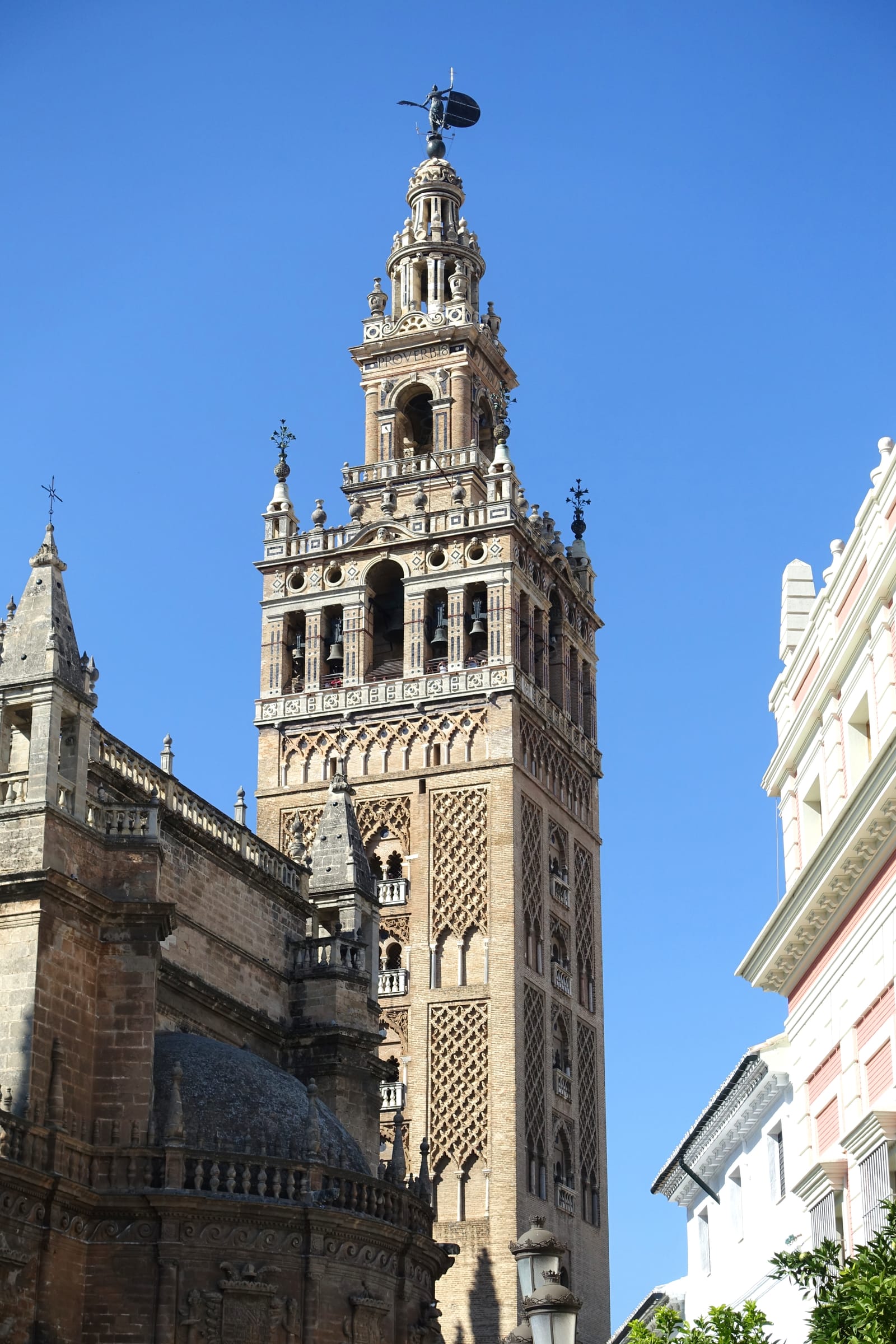
Stop 1 of 5 · Plaza Virgen de los Reyes, the public square on the north-east side of the cathedral in front of the Archbishop's Palace, looking up at the Giralda; outside any ticket control
The Giralda, from the Plaza Virgen de los Reyes
Almohad minaret begun by Ahmad ibn Baso and built in brick by Ali al-Ghumari for the caliph Abu Yaqub Yusuf and his son Abu Yusuf Yaqub al-Mansur; Renaissance belfry by Hernán Ruiz the Younger; Giraldillo cast by Bartolomé Morel · Minaret 1184–1198; belfry 1558–1568; Giraldillo placed 13 August 1568 · Brick above a cut-stone base 13.6 m square; the Almohad shaft 50.51 m tall, and about 95 m to the top of the Giraldillo
Look for
- The lozenge-net panels on either side of the central windows. That is sebka, Almohad brickwork, and from a distance the Cathedral's own description has it right: a network of lozenges.
- The line where the plain brick shaft ends and the Renaissance belfry of 1558 to 1568 begins, with its open bell arches and the Latin inscription running round the frieze above.
- The bronze figure on the very top, a woman holding a banner that swings with the wind. She is the Giraldillo, and the whole tower is named after her.
- The domed apse on your left. It belongs to the Capilla Real, the royal chapel begun in 1551, and its dome was finished by the same Hernán Ruiz who built the belfry.
Transcript (2:07)
Tip your head back and follow the tower from the ground to the bronze woman at the top, because you are looking at two buildings stacked on one another, four centuries apart. The lower two thirds is a minaret. Everything from the bell arches upwards is a Christian belfry that was put on top of it in the fifteen-sixties.
The minaret came first. Work on it began in 1184, a tower for the great mosque that the Almohad caliph Abu Yaqub Yusuf, whose capital was Seville, had built on this spot. It did not go smoothly. The building stopped almost as soon as it had started, and it only got going again around 1188, under the caliph's son, Abu Yusuf Yaqub al-Mansur. Ahmad ibn Baso had begun the base in cut stone, on a foundation that reuses blocks from the walls of an older palace and from the Roman city walls, and a Maghrebi architect, Ali al-Ghumari, raised the shaft above it in brick. On the tenth of March 1198 it was finished with four metal spheres on top, to celebrate al-Mansur's victory over Alfonso the Eighth of Castile.
Now look at the face turned towards you. It is divided into three vertical strips. The windows run up the middle, and they climb in steps, because behind them a ramp spirals up inside the tower and each window lights a stretch of it. On either side is that lattice of lozenges, sebka, and if you could get close you would find the little columns under it topped with marble capitals two or three centuries older than the tower: Umayyad capitals of the ninth and tenth centuries, in the style of Madinat al-Zahra, and the historian Leopoldo Torres Balbás counted ninety-two of them reused here.
The spheres did not last. An earthquake in 1356 brought them down. Two centuries later Hernán Ruiz the Younger built the belfry you see above the plain brick, between 1558 and 1568, and round its top he wrote in Latin that the name of the Lord is a most strong tower. On the thirteenth of August 1568 the bronze figure of Faith, cast by Bartolomé Morel, was set on the summit, turning with the wind. A weathervane in human or animal shape is a giralda in Spanish, and Cervantes still uses the word for the statue in Don Quixote. Only later did the name slide down to cover the whole tower.
One more thing before you go in. The figure up there is the original, back since 2005 after six years away being restored, with instruments inside now to watch how she is ageing.
Jebulon, CC0, via Wikimedia Commons. Photo: Jebulon

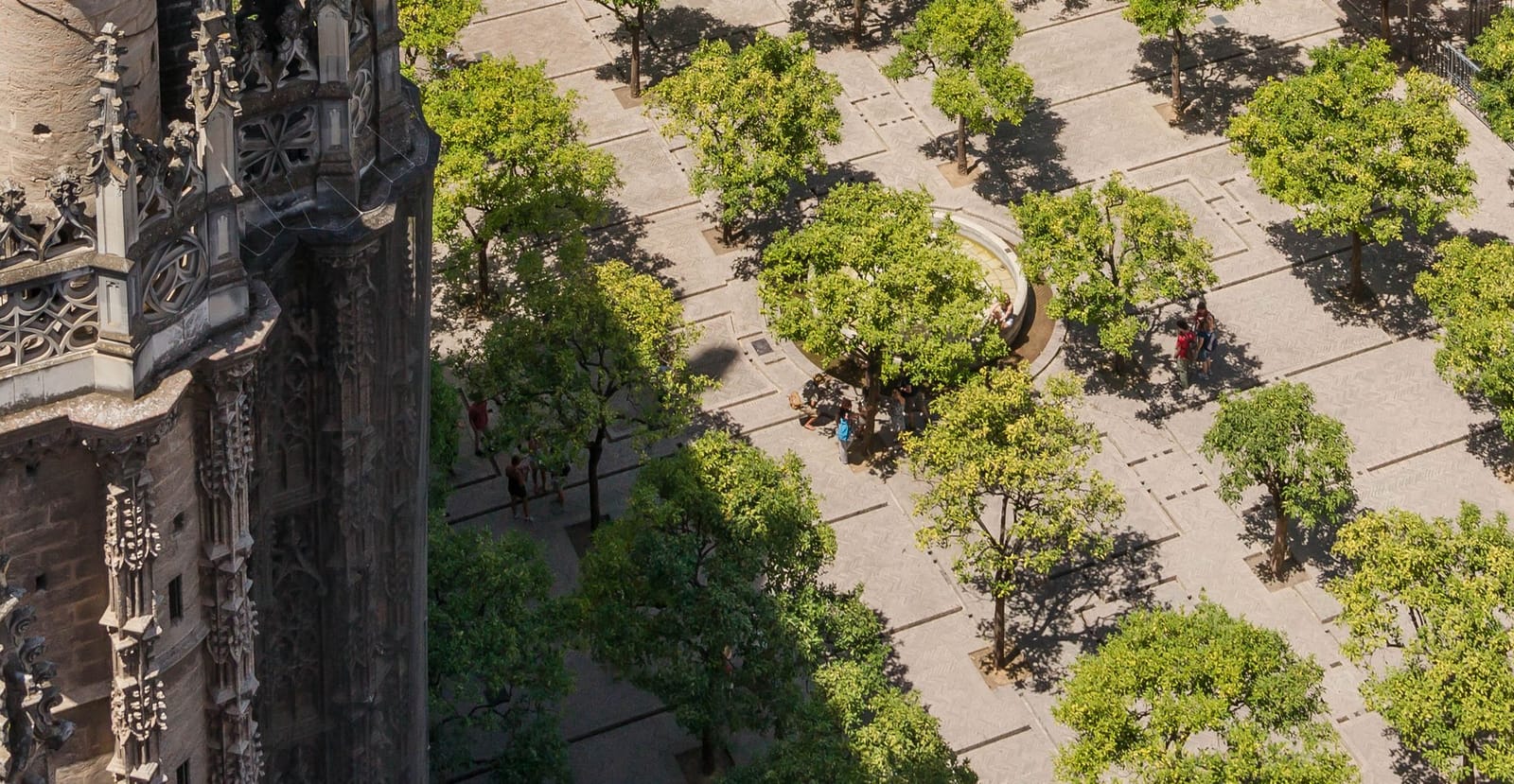
Stop 2 of 5 · The Giralda, bell level, north-west side, looking down into the Patio de los Naranjos
The top of the Giralda, looking down on the Patio de los Naranjos
Ramps built inside the Almohad minaret under Ali al-Ghumari; bell level by Hernán Ruiz the Younger; the courtyard below laid out as the mosque's ablutions court · Ramps 1184–1198; bell level 1560–1562 · 35 brick ramps and a final 17 steps up to the bell level, about 50 m above the square on top of the Almohad shaft; the courtyard below measures 43 by 81 metres
Look for
- The grid of orange trees below, and the narrow channels cut into the paving between them. They draw geometric figures and they still carry water.
- The round fountain in the middle of the courtyard. Its upper bowl is Visigothic, older than the mosque, and it is the same bowl Almohad Seville washed at before prayer.
- The two surviving galleries along the courtyard's sides. There were three; the west one was pulled down in 1618 to build the church of the Sagrario.
- The ramp you have just walked up. The Cathedral says it was wide enough for a rider on horseback.
Transcript (1:59)
Get your breath back first. You have just walked up thirty-five ramps and seventeen steps, and nobody built those ramps for tourists. A chronicler of the time wrote that they were made wide and high enough for beasts of burden, people and the custodians, and the Cathedral's own description goes further and says a rider could go up on horseback. The story goes that the man who called the prayer could ride all the way to the top. The honest version is that the ramps would allow it and that nobody has ever found a document saying anyone did.
What you walked round on the way up is the core of the minaret: a square prism with seven vaulted chambers stacked inside it, and the ramp wound between that core and the four outer walls. You are standing where the Almohad shaft stops, about fifty metres above the square, and everything around and above you is Hernán Ruiz's belfry. When the Cathedral chose him in December 1557 he came from Córdoba with the design finished and a model of the tower made at a fiftieth of full size.
The bells round you make this the Spanish cathedral with the most bells: twenty-four of them, eighteen that swing right over and six struck with a clapper, and one more on the floor above that sounds the clock. That one, San Miguel de las Victorias, is the oldest. This tower had the first public tower clock in Spain, put up in 1400 in the presence of King Henry the Third; its eighteenth-century successor was built by a Franciscan friar, José Cordero. When the bells were restored in 1998 six had to be cast new, ten were welded and four retuned.
Now go to the north-west side and look straight down. That rectangle of orange trees, forty-three metres by eighty-one, was the ablutions courtyard of the mosque, the sahn, where the faithful washed before entering the prayer hall. The prayer hall itself was where the cathedral now stands, a building of about a hundred and thirteen by a hundred and thirty-five metres with seventeen aisles. Follow the thin lines in the paving between the trees: they are water channels, laid out in geometric figures, and they still carry water to every tree. In the middle is the fountain, whose upper bowl is Visigothic, older than the mosque, the same bowl the Almohad fountain used.
Count the arcades round the courtyard. There should be three galleries and there are two. The west one came down in 1618 so the church of the Sagrario could be built over it, and the Sagrario still fills that side of the courtyard today.
Jl FilpoC, CC BY 4.0, via Wikimedia Commons, cropped. Photo: Jl FilpoC

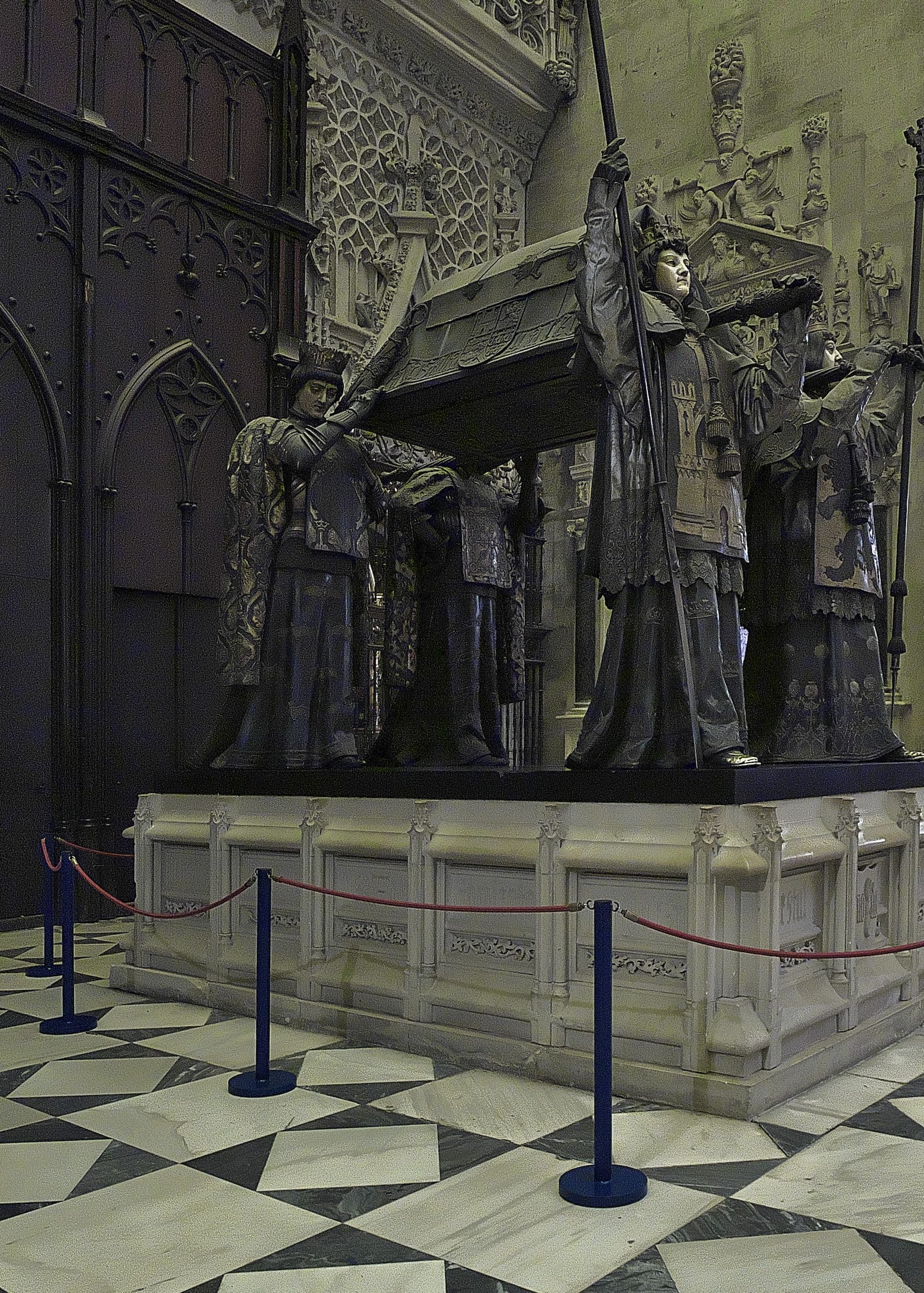
Stop 3 of 5 · South arm of the transept, facing the Prince's Gate (Puerta de San Cristóbal), beside the great mural of Saint Christopher
The tomb of Christopher Columbus
Arturo Mélida y Alinari (1849–1902), designed for Havana Cathedral · Designed 1891; installed in Seville 17 November 1902 · Four heralds 260 cm tall, cast in bronze with alabaster faces and hands, carrying the coffin on a stone plinth
Look for
- The heralds' pale faces and hands. They are alabaster; the rest of each figure is bronze. The two at the front stand for Castile and León, the two behind for Aragon and Navarre.
- The coat of arms between the heralds of Castile and Aragon. It is the door of the coffin, and the Admiral's remains are behind it in a gilded lead urn of 1795.
- The giant Saint Christopher painted on the wall beside the tomb, and the Prince's Gate it faces, also dedicated to Saint Christopher. Mélida chose this spot himself.
Transcript (2:19)
Four men in bronze, each two metres sixty tall, carry a coffin on their shoulders at the end of the south transept: a funeral procession, cast in metal. Their faces and hands are alabaster, which is why they look so pale against the dark metal. The two in front are the kingdoms of Castile and León, the two behind Aragon and Navarre. Between Castile and Aragon, on the side of the coffin, is the Admiral's coat of arms, and it is in fact the coffin's door.
The coffin is not Columbus's size, and it was never meant to be. What is inside is a gilded lead urn, made in 1795, with a lid that reads: here lie the bones of Christopher Columbus, first admiral and discoverer of the New World.
Those bones travelled more after his death than most people do in a lifetime. Columbus died in Valladolid on the twentieth of May 1506 and was buried there in the Franciscan convent. His son Diego had him moved to the Carthusian monastery in Seville, La Cartuja, which received the body in April 1509. Some time after 1536, nobody knows exactly when, the remains crossed the Atlantic to the cathedral of Santo Domingo. When Spain handed its part of Hispaniola to France, they were dug up on the twentieth of December 1795 and taken to Havana. And when Spain lost Cuba in 1898, they came back, reaching Seville on the nineteenth of January 1899 aboard a ship that happened to be called Giralda.
The monument came with them, in a sense. Arturo Mélida, a Madrid sculptor, designed it in 1891 for Havana Cathedral, and it was finished here instead. Mélida chose the spot himself, beside the huge Saint Christopher painted on the wall and facing the doorway dedicated to the same saint, the Admiral's namesake. It was inaugurated on the seventeenth of November 1902. Mélida died in Madrid four weeks later.
Are they really his bones? Santo Domingo says no: in 1877 a lead box inscribed to the discoverer was found in its cathedral, and those bones, kept since 1992 in the Columbus Lighthouse, have never been DNA-tested. Seville's remains have been. In 2003 samples were taken from them and from the bones of his brother Diego and his son Hernando. The short fragments of mitochondrial DNA matched the brother's, and the researchers concluded that at least what lies here is Christopher Columbus.
Before you move on, look up at the Saint Christopher. The Italian painter Mateo Pérez de Alesio, working on a Saint Christopher in this cathedral, is said to have told his colleague Luis de Vargas that one painted leg of Vargas's was worth more than his entire saint.
Daderot, CC0, via Wikimedia Commons. Photo: Daderot

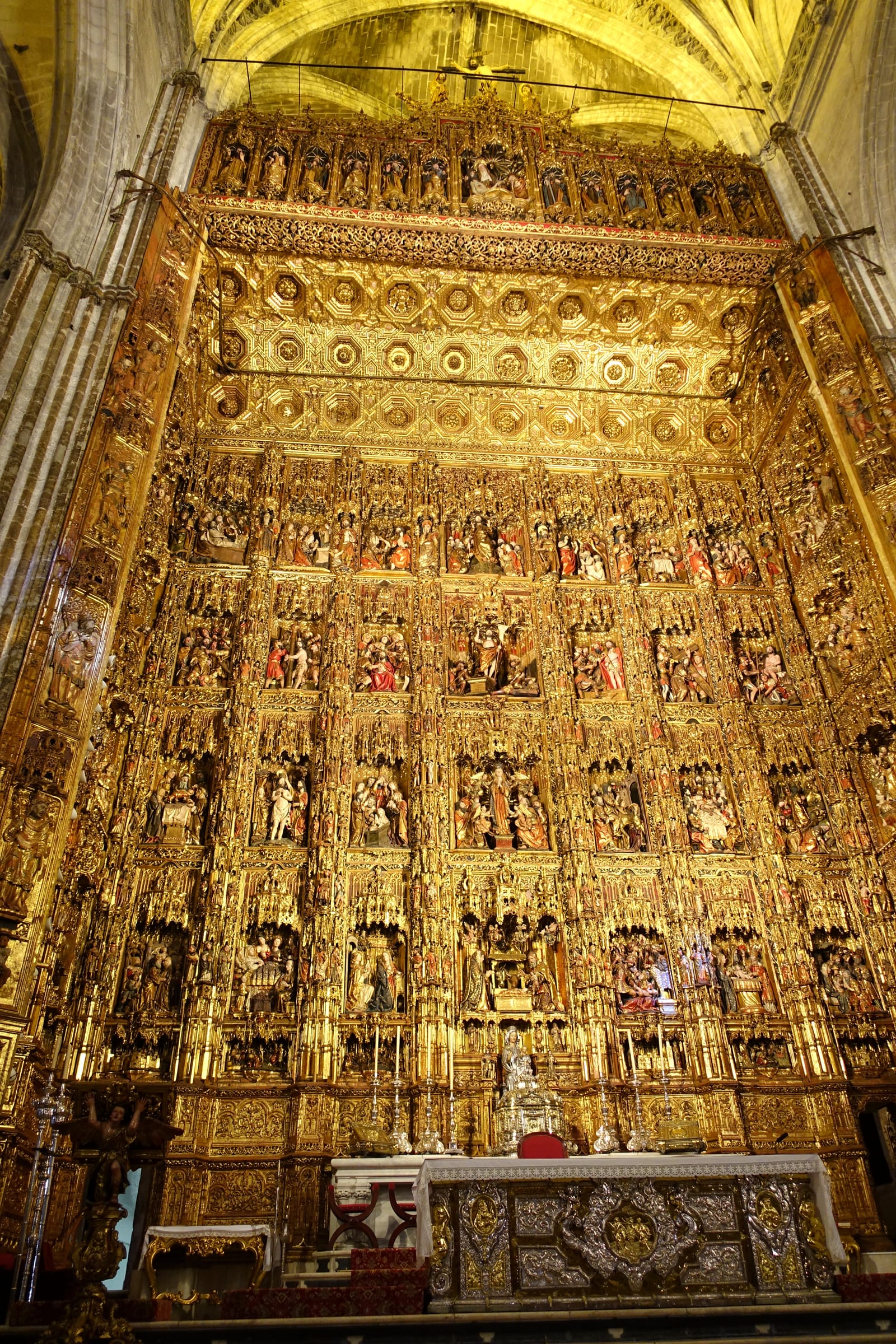
Stop 4 of 5 · Central nave, at the crossing where the main naves intersect, facing the Main Chapel (Capilla Mayor) through its gilded grille
The high altarpiece of the Capilla Mayor
Designed by the Flemish sculptor Pieter Dancart (d. by 1488), continued by Pedro Millán and by Jorge Fernández Alemán and his brother Alejo; side sections by Roque Balduque, Juan Bautista Vázquez and Pedro de Heredia · 1482–1564 · Gilded and polychrome carved wood, nearly 30 metres high and almost 20 metres wide by the Cathedral's figures; 44 reliefs and more than 200 figures
Look for
- The small seated Virgin in the middle of the lowest row, above the silver tabernacle. She is the thirteenth-century Virgen de la Sede, and the cathedral is named after her.
- The crucifix at the very top, under the vault: the Christ of the Million, from a fourteenth-century Calvary kept from the older church.
- The figures getting bigger as the rows go up. It is deliberate, so the top tiers still read from where you stand.
- Seville itself, and this cathedral, carved into the reliefs of the base.
Transcript (2:10)
Stand in the crossing and look east through the gilded grille. The wall of gold filling the far end of the chapel is a single piece of carpentry, nearly thirty metres high and almost twenty wide, and the Cathedral considers it the largest altarpiece in Christendom. It took most of a century. The Flemish sculptor Pieter Dancart drew it up and started carving in 1482; by the spring of 1488 he seems to have been dead, because a commission came to inspect how far he had got. Another Flemish master carried on until 1505, then Pedro Millán, then the brothers Jorge and Alejo Fernández, who finished the main front in 1529. In 1550 the Chapter decided to widen it with two side sections folding forward at right angles, and those were only done in 1564.
The way to read it is in rows, from the bottom up, like a book of scenes: forty-four reliefs, more than two hundred figures, the life of the Virgin and of Christ. And here is the trick. The figures grow as the rows rise. The carvers made the top tiers larger so that, seen from the floor with the top up to thirty metres above you, they would look the same size as the ones at your eye level. Look at the top row against the bottom and you will see it.
Two things are older than the whole structure. At the very top, against the vault, is a Gothic Calvary of the fourteenth century that was kept from before and lifted up to crown it; its crucifix is called the Christ of the Million, for the million graces the people of Seville believed it granted them in times of epidemic. At the other end, in the middle of the lowest row, is a small seated Virgin of the thirteenth century, the Virgen de la Sede, the Virgin of the See. She is the reason the building is called the Cathedral of Saint Mary of the See. Under her sits a silver tabernacle made by Francisco de Alfaro in 1593.
The grille you are looking through is a masterpiece of its own, paid for by Archbishop Diego de Deza and made by a Dominican friar, Francisco de Salamanca. It has had a good deal to protect. The lantern over the crossing where you stand collapsed in 1511, and again in 1888, when an earthquake brought it down and, in one account, destroyed every precious object beneath it. The altarpiece itself was last restored in a two-year campaign finished in 2014.
One last detail for good eyesight: along the base, among the martyrdoms, the carvers put views of Seville and of this cathedral itself.
Jebulon, CC0, via Wikimedia Commons. Photo: Jebulon

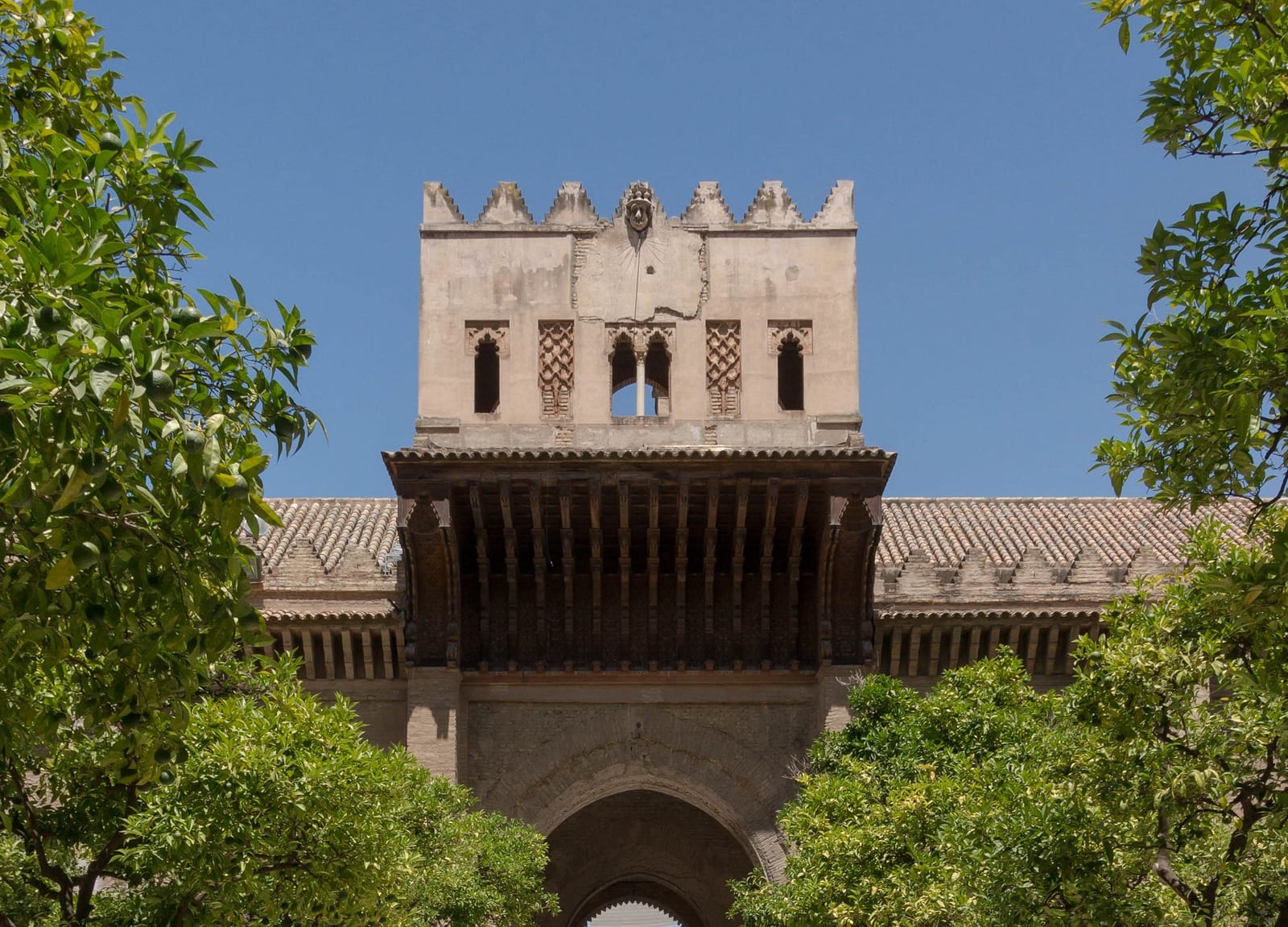
Stop 5 of 5 · Patio de los Naranjos, north side of the cathedral, by the central fountain facing north to the Door of Forgiveness (Puerta del Perdón), the exit for cultural visitors
The Patio de los Naranjos and the Door of Forgiveness
Builders of the Almohad mosque under the caliph Abu Yaqub Yusuf; terracotta sculpture by Miguel Florentín (1520) and plasterwork by Bartolomé López (1522) · Courtyard and gate 1172–1198; sculpture 1520, plasterwork 1522 · Brick courtyard of 43 by 81 metres with orange trees and water channels; the gate a pointed horseshoe arch under a crenellated upper storey
Look for
- The shape of the arch in the Door of Forgiveness: a pointed horseshoe, the form the Almohad builders gave it, which the Cathedral says it has kept.
- The fountain beside you. The basin round it is modern, but the upper bowl is Visigothic, the one the mosque's own fountain used.
- The crocodile hanging from the ceiling of the covered gallery at the north-east corner, by the Lagarto Gate: an old votive offering, taken for a lizard (lagarto), that gave the gate its name.
- Once you are out in the street, turn round: the terracotta relief of Christ expelling the merchants, by Miguel Florentín, 1520, sits above the arch on the outside.
Transcript (2:02)
The gate in front of you, at the north end of the courtyard, has been a way in and out of this site for more than eight hundred years. The Door of Forgiveness was the main entrance to the Almohad mosque, lined up with the central aisle of the prayer hall and with the mihrab, the niche that showed the direction of Mecca. Look at the arch under the deep wooden eaves. It is a pointed horseshoe, and the Cathedral's own description says it has kept its original form since the twelfth century. Every worshipper who came to Friday prayer in Almohad Seville walked in under that curve.
This courtyard was where they washed first. It was the mosque's sahn, the ablutions court, and the Christians kept it after 1248 and found other uses for it: a cemetery, a place for the city's annual fairs, a place to preach. The fountain by you is modern, but its upper bowl is Visigothic, older than the mosque, and it is the same bowl the Almohad fountain had. The orange trees stand in a strict grid, and the thin channels between them, which you saw from the top of the tower, still carry the water.
Before you leave, find the covered gallery at the courtyard's north-east corner, the Nave del Lagarto, and look up by the Lagarto Gate. Lagarto means lizard, and the lizard hanging from the ceiling is in fact a crocodile, stuffed, an old votive offering. On the floor above that gallery is the Colombina library. It grew from the bequest of Hernando Colón, Christopher Columbus's son, in 1552: some six thousand items, nine hundred and forty of them books printed before 1501, and among the manuscripts the original of the Book of Prophecies that Columbus himself wrote in 1504. So the man whose bones you have just seen has his handwriting in the same building.
The doors of the gate are Almohad too, wood sheathed in bronze and worked with interlace and Kufic inscriptions that repeat two phrases from the Quran: power belongs to God, and eternity belongs to God. The knockers on them now are replicas; the originals are kept inside the Giralda.
Walk through, out into Calle Alemanes, and turn round. The street face is where the Christian city dressed the old gate: terracotta figures of 1520 by Miguel Florentín, Saint Peter and Saint Paul at the sides, the Virgin and the Archangel Gabriel above them, and over the arch a large relief of Christ driving the merchants out of the Temple, set on the front door of a former mosque.
Independent guide · Chiaro
Point Chiaro at anything at Seville Cathedral.
Eighty chapels, fifteen doors, twenty-four bells and forty-four carved reliefs on a single altarpiece: a five-stop walk barely scratches it. Photograph a tomb slab in the floor, a painted saint over a side altar, the Kufic lettering on a bronze door or the coat of arms on a grille, and Chiaro tells you who made it, who paid for it and what it says, and keeps going for as long as you stay under the vaults.
Before you go
Getting there
Avenida de la Constitución s/n, 41004 Seville. Visitors with online tickets go in through the Lagarto Gate; tickets bought on the day are sold at the ticket office and used at the Prince's Gate (Puerta del Príncipe, also called the Puerta de San Cristóbal), the doorway in the south arm of the transept. The way out is the Door of Forgiveness, from the Patio de los Naranjos into Calle Alemanes.
The cathedral's own directions: the Metrocentro tram to its Archivo de Indias stop; Seville Metro line 1 to Puerta de Jerez; Tussam buses C1, C2, C3, C4, 5, 41 or 42 to Jardines del Cristina, which is also where the airport's special AE bus stops; or a Cercanías Renfe train to San Bernardo.
Tickets and entry
- One ticket, the general visit, covers the cathedral, the Giralda and the Church of El Salvador: 13 euros online or 14 at the ticket office, 7 or 8 reduced for over-65s, students up to 25, visitors with a disability between 33% and 65% and adult members of large families, and free for children up to 13 with an adult, with a proof document for every concession. The time on the ticket is when you go in; after that there is no time limit before closing.
- The ticket office stops selling at 18:00 and the building empties at 19:00. Sundays are afternoon-only, with the ticket offices opening at 14:30, and the weekday opening time moves with the liturgical calendar. Tourist visits pause whenever a service is being held, and the Cabildo can change the timetable without notice, so look at its agenda for your day.
- On Sundays other than holidays there is a free public visit from 16:30 to 18:00, bookable online in advance and with limited places.
- Photographs are allowed without flash or tripod as long as nobody at prayer is disturbed. Dress with respect and take hats off inside. The cathedral roofs are not on the general ticket; they are a separate guided tour.
The official audio guide
The Cabildo's own audio guide costs 5 euros, or 4 euros in app format, and the Cabildo also runs guided tours of the cathedral and the Giralda at 20 euros online, about ninety minutes each; deaf visitors can ask for a free sign-guide, and the tour brochure and general plan at the information point cost nothing. Our five stops are free, go deeper on fewer places, and print every word under each player, which suits a church where you would rather keep the volume down.
Official site →Questions
Is there a free Seville Cathedral audio guide?
This page is one: five stops from the square below the Giralda to the Door of Forgiveness, streamed in your phone's browser at no charge, each script printed out beneath its player. The Cabildo's own audio guide is not free, at 5 euros or 4 in app format. For a chapel, a tomb or a painting that none of the five covers, photograph it and let Chiaro do the talking.
Which part of the Seville Cathedral audio guide plays outside, without a ticket?
The first stop: it is written for the Plaza Virgen de los Reyes, the public square at the north-east corner, where you can see the whole Giralda without passing any control. The other four are inside and need the general visit ticket, which covers the cathedral, the Giralda and the Church of El Salvador.
How much is the official Seville Cathedral audio guide?
5 euros for the Cabildo's audio guide, or 4 euros in its app format. A guided tour of the cathedral and the Giralda is 20 euros online or 21 at the ticket office, with a 1 euro online handling fee, and lasts about ninety minutes.
Is climbing the Giralda included in the Seville Cathedral ticket?
Yes. The standard ticket is the general visit to the cathedral and the Giralda, and the visit actually begins at the tower, which has its own access control. The way up is thirty-five ramps and a short final flight of seventeen steps to the bell level. The roofs are the part that needs a separate guided tour.
Which door do I use at Seville Cathedral, and when is it open?
With an online ticket you enter by the Lagarto Gate; buying on the day, you use the ticket office and the Prince's Gate in the south transept. The ticket office closes at 18:00 and the building at 19:00, Sundays are afternoon only, and tourist visits stop during services, so the Cabildo's agenda for the day is the thing to check.
More audio guides
Made by Chiaro. Not affiliated with Seville Cathedral.