
Brandenburg Gate · Berlin · Independent guide
Brandenburg Gate audio guide,
five stops, free.
Sandstone, 26 metres high to the top of the Quadriga and raised between 1788 and 1791: hear its story from Pariser Platz to the Reichstag roof, then photograph any carving here and Chiaro tells you whose it is.
Made by Chiaro. Not affiliated with the Brandenburg Gate.
Pariser Platz, facing the gate
Brandenburg Gate, Berlin
That was the free part
Chiaro narrates anything at the Brandenburg Gate from a photo.
The five stops · 11 minutes of audio
Five places, one walk,
in the order you will walk them.
Most visitors give the gate one photo and walk on, but our Brandenburg Gate audio guide holds you there about ten minutes longer, on a self-guided walk that finishes on the roof of the Reichstag. The first three stops are open pavement and ask nothing of you: the east side of Pariser Platz for the whole front of the gate, the foot of the columns for the Quadriga overhead, then through the passages to Platz des 18. März on the west side, where the Wall ran. One block north, the fourth is the lawn in front of the Reichstag's West Portal, still public ground. The fifth is the Reichstag's roof terrace, which costs nothing either but needs a registration with the Bundestag before you go up.
Every date, name and measurement here comes from the Bundestag's own visitor pages, the city's visitBerlin and berlin.de pages, or the English and German Wikipedia articles, and on 27 September 2026 each visit rule was checked on bundestag.de against the sentence it is quoted from. The Bundestag keeps the right to change its arrangements at short notice and puts up signs when it does, so on the day, the signs at the Reichstag outrank anything written here.
Pierre-Selim Huard, CC BY 4.0, via Wikimedia Commons, cropped. Photo: Pierre-Selim Huard

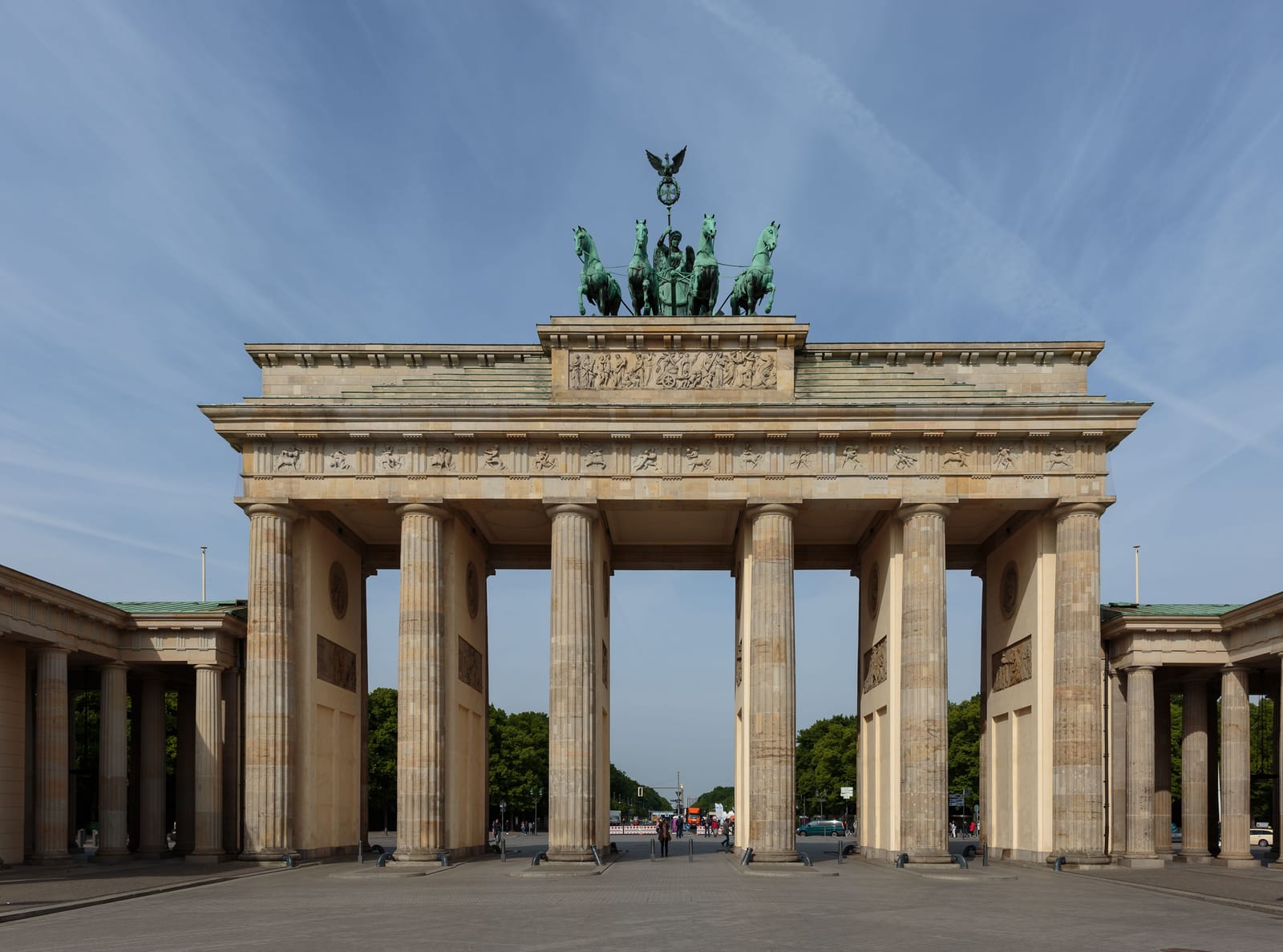
Stop 1 of 5 · Pariser Platz, the pedestrian square at the western end of Unter den Linden; stand well back on the east side, facing the gate
Pariser Platz, facing the gate
Carl Gotthard Langhans (1732–1808), royal architect to King Frederick William II of Prussia; sculpture after Johann Gottfried Schadow (1764–1850) · 1788–1791; restored 2000–2002 · Elbe sandstone, 26 metres high to the top of the Quadriga and 11 metres deep; twelve fluted Doric columns, each 13.5 metres tall
Look for
- The middle passage, visibly wider than the four beside it: 5.65 metres against 3.80. It was the royal carriageway, and until the end of the monarchy almost nobody else could drive through it.
- The walls set between each pair of columns, with their round medallions and relief panels. They are there because Langhans's slim columns could not have carried the top of the gate and the Quadriga on their own.
- The row of square reliefs under the cornice: sixteen on this face, centaurs fighting Lapiths, borrowed from the south side of the Parthenon.
- The two low colonnaded wings reaching towards you on either side, like the arms of a forecourt. The south one housed the guard, the north one the customs office.
Transcript (2:05)
Stand far enough back on the cobbles that the whole thing fits in front of you, because you are on the side it was built to be looked at from. The gate faces the city. The wings on either side reach towards you like the arms of a forecourt, the sculpture is concentrated on this face, and the idea was never to impress people arriving from outside. It was meant to remind the people who lived in Berlin who ruled them.
The man who ordered it was Frederick William the Second of Prussia, and the architect was Carl Gotthard Langhans, head of the royal office of works. It went up between 1788 and 1791, on the site of an older customs gate, and it is the only one left of the eighteen gates Berlin last had. Its model was the Propylaea, the entrance to the Acropolis in Athens, and here is the first surprise: Langhans never went to Greece. He designed it from books, from the engravings of Julien-David Le Roy and of James Stuart and Nicholas Revett.
He also cheated on his model, on the king's orders. The king wanted as open a view as possible from the city through to the Tiergarten, so Langhans made the gate far shallower than the Greek original, and the columns slimmer and taller. Count them: twelve, six on each side, making five passages. Then look at the walls between the pairs. Those are not decoration. The slender columns alone could not have carried the weight above them, so each pair got a masonry wall to lean on.
Now look at the middle passage. It is 5.65 metres wide, the other four 3.80, and it was the royal carriageway. Until the end of the monarchy only the royal family could use it, and from 1814 the family of General Ernst von Pfuel, in thanks for bringing the Quadriga home from Paris.
The gate was first called the Friedenstor, the Peace Gate, and it was opened to traffic in August 1791 before it was even finished. The peace it celebrated was a Prussian military intervention in the Netherlands in 1787. The square you are standing in had no name at all until March 1814, when it became Pariser Platz, after the allies marched into Paris.
One more thing to take in before you walk forward. In 1945 every building around this square was rubble, and the gate was the only structure still standing. Everything you see around you was rebuilt after 1990, to rules that fixed the eaves height at 22 metres.
Nightflyer, CC BY 4.0, via Wikimedia Commons. Photo: Nightflyer

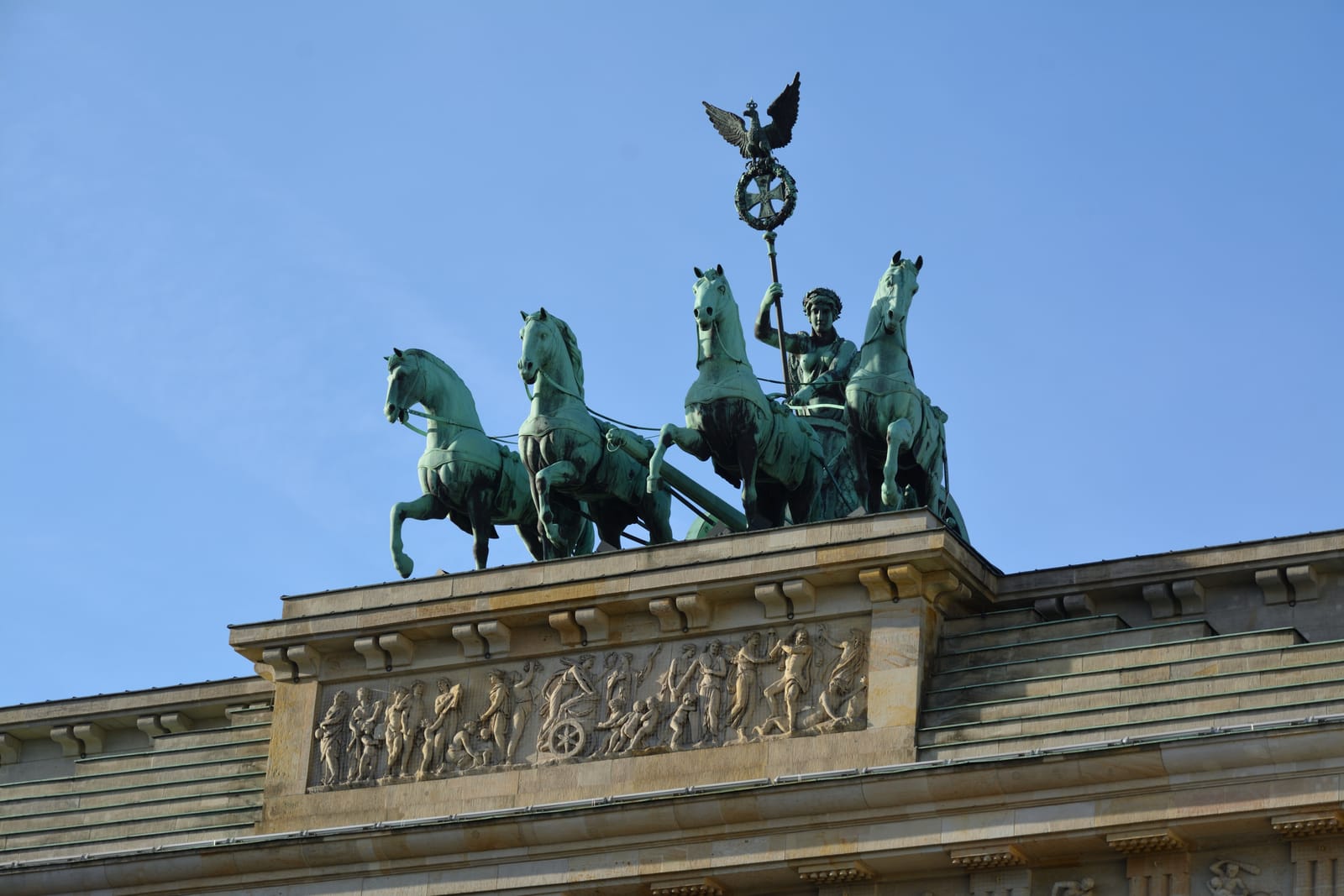
Stop 2 of 5 · Pariser Platz, close under the east face of the gate, looking up at the attic
The Quadriga and the attic relief
Designed by Johann Gottfried Schadow (1764–1850) and driven in copper by Emanuel Jury, with Victoria by the Potsdam master Koehler; the standard redesigned by Karl Friedrich Schinkel (1781–1841); the present group recast in 1957–58 by the sculptor Otto Schnitzer and the Hermann Noack foundry · Raised 1793; taken to Paris 1806 and returned 1814; recast 1957–58; restored after 1990 · Hammered copper, the horses planned at twelve Prussian feet, 3.77 metres, high; a sandstone relief in the attic below, on the city side only
Look for
- The standard in Victoria's hand: an Iron Cross inside an oak wreath with a crowned eagle on top. Schinkel designed it in 1814, East Berlin removed it in 1958, and it went back after 1990.
- The four horses' heads, each held differently. Only two horse bodies were ever modelled, to save work, but all four heads were given their own pose.
- The green. It is copper, never gilded: the king decided on 11 July 1793, on the Academy of Arts' advice, to leave it as it was.
- The long sandstone relief in the attic just below the horses. It exists only on this, the city side.
Transcript (2:23)
Walk in close under the columns and look straight up. That chariot is the reason the gate is famous, and very little of what you see is as old as the gate.
The design is Johann Gottfried Schadow's. In March 1789 it was agreed that he would make a model at one-eighth scale, that carvers would enlarge it into a full-size wooden model, and that a coppersmith, Emanuel Jury, would hammer sheet copper over the wood. To save time only two horse bodies were made, in two different poses, with four different heads. Look at the heads, not the legs, and you will see the trick. The horses were meant to be ten feet high, until the Academy of Arts decided halfway through that they should be twelve: about 3.77 metres each.
It went up in the middle of 1793, and nobody had yet decided whether to gild it. In July the king chose plain copper, which is why it is green.
Then history started using it. In October 1806, after beating Prussia at Jena and Auerstedt, Napoleon rode through this gate, and in December his men took the Quadriga down, packed it into twelve crates and sent it to Paris by river and sea. It arrived in May 1807, was never put up on any French monument, and ended up on show in the Louvre. When the allies took Paris in 1814 it came home, and Berliners gave it a nickname, the Retourkutsche, the carriage sent back.
On its return Karl Friedrich Schinkel gave Victoria a new standard: an Iron Cross inside a wreath of 169 oak leaves and 90 acorns, with a crowned eagle on top. That is what she holds now. It has not been there continuously.
In the Second World War the Quadriga was all but destroyed. One horse's head survived, and it is in the Märkisches Museum. What saved the rest was a plaster cast taken in 1942, just in case. From that cast the sculptor Otto Schnitzer and the Noack foundry made a new group, and in 1958, after hard negotiation between the two halves of the city, it went back up. That summer, on the night of the second to the third of August, East Berlin quietly took it down again and removed the eagle and the Iron Cross, as emblems of Prussian militarism.
They came back after the Wall fell, and for a sorry reason. On New Year's Eve 1989 people climbed onto the gate and walked off with pieces of the group, the bridles among them. When it was taken down to be examined, the damage inside turned out to be far worse, and in the restoration that followed Victoria got her cross and her eagle back.
One last look, lower down. The long carved panel in the attic under the hooves was drawn by Bernhard Rode in 1791 and modelled by Schadow, a Triumph of Peace, its figures mostly women and children. It is only on this side. The gate saves its best for the city.
Gary Todd from Xinzheng, China, CC0, via Wikimedia Commons. Photo: Gary Todd from Xinzheng, China
.jpg)
Stop 3 of 5 · Through any of the gate's passages to Platz des 18. März, the square on the west side, then turn round to face the gate
Through the passages to the west side
Passage reliefs drawn by Bernhard Rode and carved by ten sculptors under the supervision of Johann Gottfried Schadow (1764–1850); the west metopes after Schadow's models · Reliefs commissioned March 1792; Wall 1961–1989; square named Platz des 18. März in 2000 · Twenty sandstone reliefs of Hercules in the five passages; in the paving of the square, a double row of stones marks the line of the Wall, here a tank barrier three metres thick
Look for
- The relief panels high on the passage walls as you walk through: Hercules, in twenty scenes across the five passages.
- The double row of stones set into the paving of the square, curving round in front of the gate. That is where the Wall stood.
- The plain attic on this side. A relief of seven scattered arrows bound together, meaning the Dutch provinces, was planned for it and never carved.
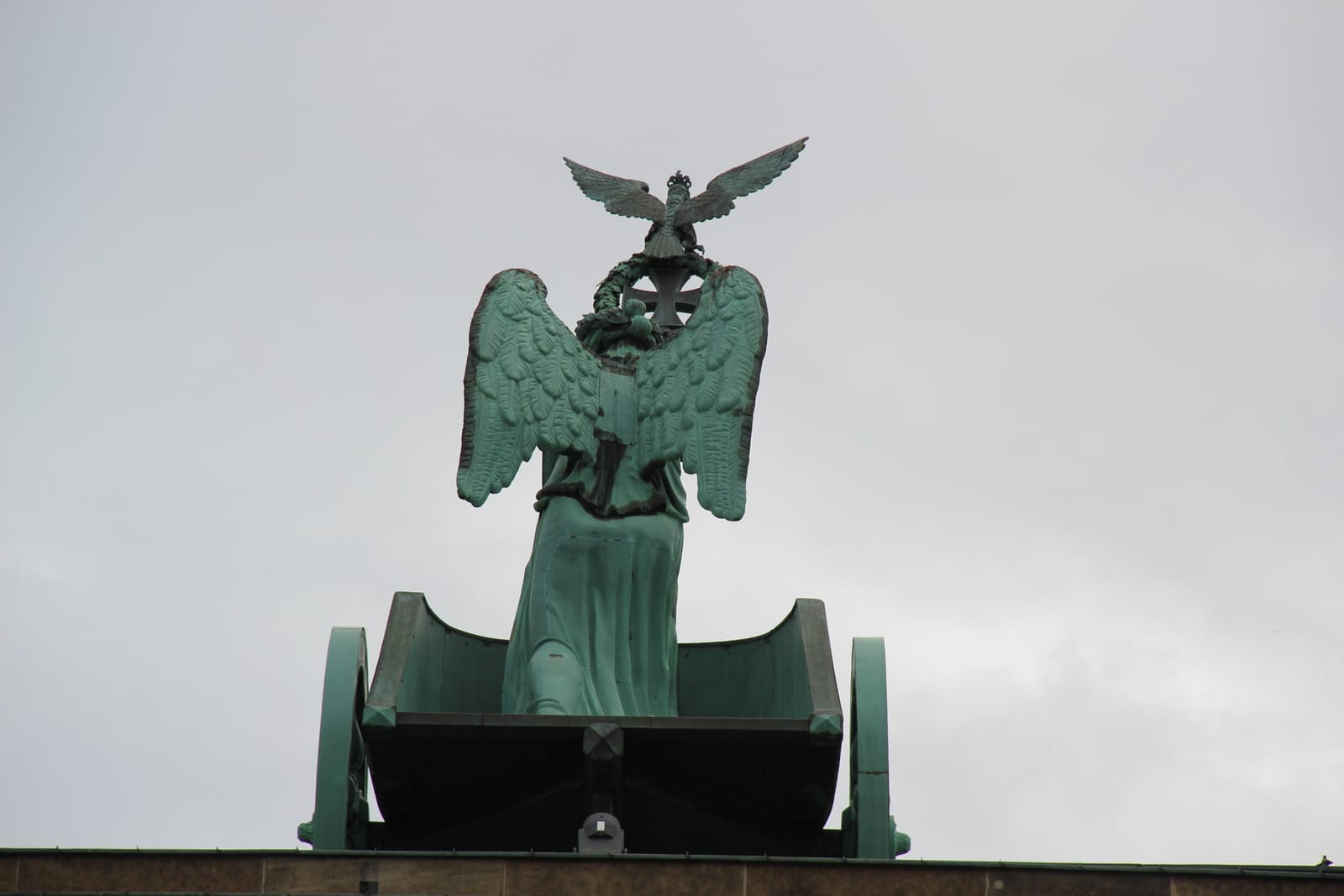
- Victoria from behind: the wings, the chariot's back, and the fluttering garment Schadow added because from this side she looked stiff and bare.
Transcript (2:10)
Walk through one of the side passages, slowly, and look up at the walls either side of you. Those carved panels are Hercules: strangling snakes as a baby, fighting centaurs, carrying off the apples of the Hesperides. There are twenty of them across the five passages, drawn by Bernhard Rode and carved by ten different sculptors. They were meant as an allegory of Frederick the Great, and Schadow himself, who oversaw them, later dismissed them as reliefs in the five passages that nobody can see. You are one of the few who has looked.
Notice too the tall recesses in the passage walls. That is where the gates folded back. In the daytime the wooden leaves stood open, so that nothing blocked the view through to the Tiergarten.
Now come out onto the square and turn round. This is the back of the gate, and it shows. The only decoration on this face is the row of square reliefs under the cornice. The attic above it is blank: a relief was planned here showing seven scattered arrows bound back into one bundle, meaning the seven Dutch provinces, and for reasons nobody knows it was never made. And look at Victoria. She is driving away from you, towards the city. Schadow had a flowing garment added to her because, he said, from behind she looked so stiff and bare.
The square has been called Platz des 18. März since June 2000, after two eighteenths of March: 1848, when hundreds of civilians died in the barricade fighting of Berlin's revolution, and 1990, East Germany's first free election. Between those two dates it had a much harder history. From 1961 this was East Berlin's border zone, and a curving section of the Wall ran round in front of the gate, reinforced as a tank barrier three metres thick. Look down at the paving. The double row of stones is its line.
On the thirteenth of August 1961 West Berliners gathered on this side to protest, the mayor Willy Brandt among them. In 1963 the Soviets hung red banners across the gate so that John F. Kennedy could not look through. Richard von Weizsäcker, as mayor, put the whole problem in one sentence: the German question is open as long as the Brandenburg Gate is closed. And on the twelfth of June 1987, in front of the Wall here, Ronald Reagan said the line everyone remembers: Mister Gorbachev, open this gate. Mister Gorbachev, tear down this wall.
The gate opened on the twenty-second of December 1989, when Helmut Kohl walked through from the west and Hans Modrow was waiting on the other side.
Leonhard Lenz, CC0, via Wikimedia Commons. Photo: Leonhard Lenz

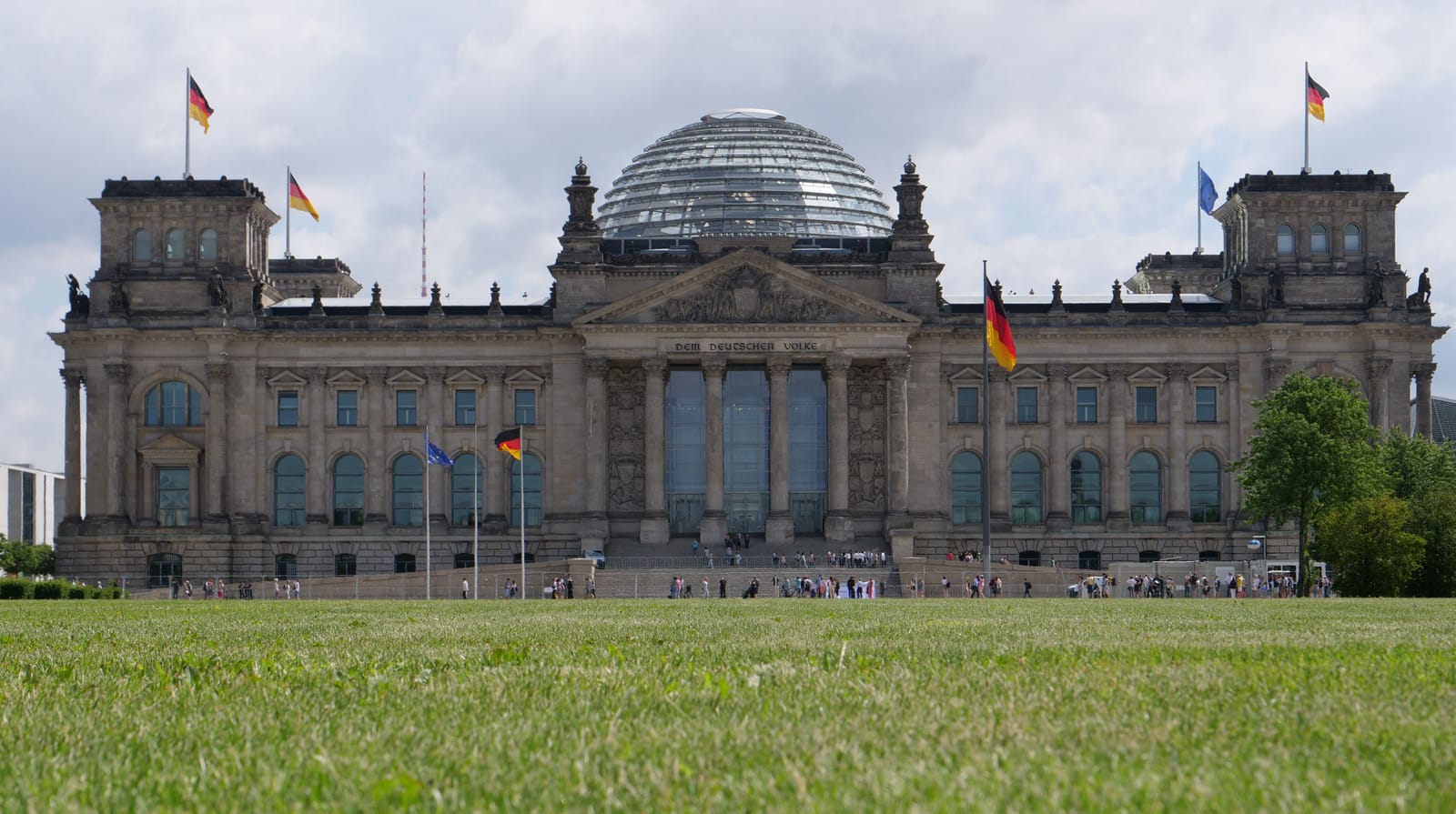
Stop 4 of 5 · Platz der Republik, on the lawn in front of the West Portal, one block north of the gate
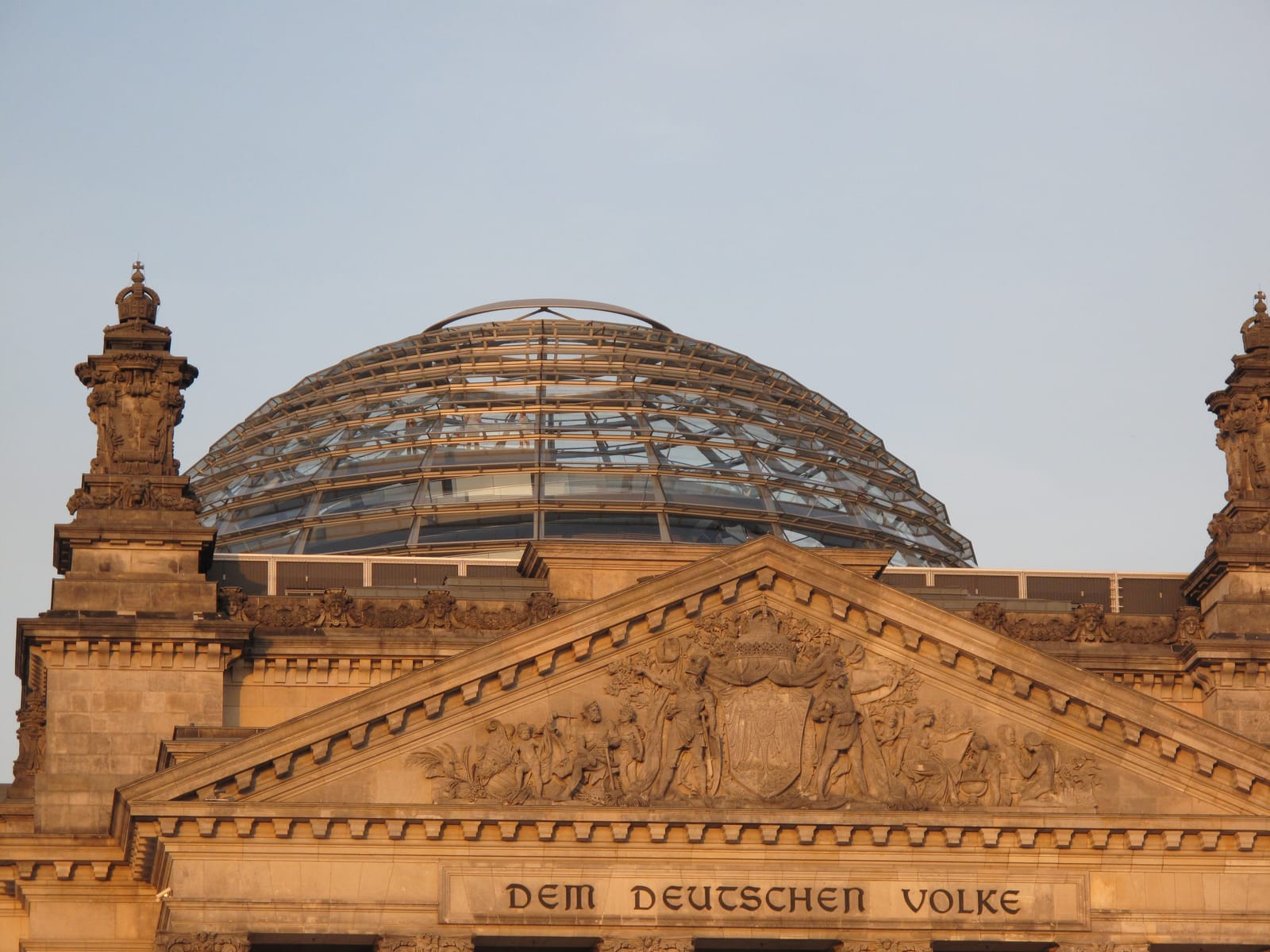
The Reichstag's West Portal and Dem Deutschen Volke
Paul Wallot (1841–1912), architect; the lettering by Peter Behrens (1868–1940) with Anna Simons, cast by the Loevy bronze foundry; the building rebuilt 1995–1999 by Norman Foster · Built 1884–1894; inscription installed 20–24 December 1916 · Silesian sandstone, 30,000 cubic metres of it over more than 32 million bricks; the inscription 16 metres long, in letters 60 centimetres high cast from melted-down cannon
Look for
- DEM DEUTSCHEN VOLKE across the beam over the columns: 16 metres of letters, each 60 centimetres high, cast from two melted-down cannon.
- The shape of the letters, neither Roman capitals nor German Fraktur. Peter Behrens drew a compromise because the choice of typeface had become a political fight of its own.
- The four corner towers, one for each of the kingdoms that joined the empire in 1871: Prussia, Bavaria, Saxony and Württemberg.
- The imperial coat of arms in the pediment, with figures for North and South Germany on either side of it.
Transcript (2:17)
Stand on the grass with the whole west front in front of you and read the words over the columns. Dem Deutschen Volke. To the German People. For the building's first twenty-two years they were not there at all, and getting them up took an emperor's objection and a world war.
Paul Wallot, a Frankfurt architect, won the competition in 1882, and it went up between 1884 and 1894, paid for out of the reparations France had to hand over after the war of 1870 and 1871: 24 million gold marks, 30,000 cubic metres of Silesian sandstone, more than 32 million bricks. The four corner towers stand for the four kingdoms that made up the new empire, Prussia, Bavaria, Saxony and Württemberg.
Wallot always meant the beam over the portal to carry that dedication. The emperor did not like it. Wilhelm the Second, the grandson of the Wilhelm who laid the foundation stone, came to loathe the whole building, calling it the height of tastelessness and in private the imperial monkey house, and he is said to have rejected the phrase because it honoured the people as sovereign. So the space stayed blank until 1915, when, with officials worried that the war was costing the emperor the loyalty of his people, the idea came back. Wilhelm let it be known that he would not approve it, but would not object if the decorating commission did.
Then they argued about the typeface: classical capitals, or German Fraktur. Peter Behrens, working with Anna Simons, drew the compromise you see. The bronze came from two cannon captured from the French in the wars of liberation of 1813 to 1815, melted down, and the letters were cast by the Loevy foundry, a Jewish family firm. They went up between the twentieth and the twenty-fourth of December 1916.
Two years later, on the ninth of November 1918, Philipp Scheidemann proclaimed a republic from one of this building's balconies. On the twenty-seventh of February 1933, four weeks after Hitler became chancellor, it was gutted by fire, and the fire became the excuse for suspending civil liberties. During the division it stood in West Berlin, with the Wall running directly along its eastern side.
And in the summer of 1995, for two weeks, it vanished altogether: Christo and Jeanne-Claude wrapped the entire building in silver fabric tied with blue rope, and five million people came to look at a parcel. When the wrapping came off, Norman Foster gutted it down to the outer walls and rebuilt it, keeping the bullet holes and the graffiti Soviet soldiers left here in 1945. The Bundestag sat under these words for the first time on the nineteenth of April 1999.
Schlaier, Public domain, via Wikimedia Commons. Photo: Schlaier

Stop 5 of 5 · Roof terrace of the Reichstag Building, reached by lift from the West Portal after the security check; the one stop on this walk that needs the free advance registration
The roof terrace, beside the dome
Norman Foster (born 1935), after the walk-in glass dome first proposed by Gottfried Böhm; on Paul Wallot's building of 1884–1894 · Dome design presented 8 May 1995; rebuilt building handed over 19 April 1999 · A roof terrace 24 metres above the ground; the glass dome 38 metres across and 23.5 metres high, its top 47 metres above the ground, on about 800 tonnes of steel clad in 3,000 square metres of glass
Look for
- The Brandenburg Gate to the south-south-east, where this walk began, with the Quadriga side-on, driving left, east, towards the city centre.
- The Victory Column and the Chancellery, both named by the Bundestag's own dome guide among the sights on the round.
- Wallot's corner towers rising at the edges of the terrace, one for each kingdom of 1871, now at eye level.
- The outside of the dome's frame: 24 vertical steel ribs crossed by 17 rings.
Transcript (2:06)
You are 24 metres up, on the roof of the building you were just looking at from the lawn, and the corner towers that seemed so tall from down there are now more or less at eye level. Walk to the edge of the terrace and find the Brandenburg Gate to the south-south-east. From up here you see the Quadriga side-on, driving left, east, towards the city centre, exactly as it was built to.
The Bundestag describes this roof as offering views of the parliamentary and government district and Berlin's sights, and its own guide for children names three of them: the Chancellery, the Victory Column and the gate. In the divided city, foreign state guests were routinely brought onto this building's outer terraces for one reason, to look over the Wall.
Now turn to the dome beside you. Wallot's building had a cupola too, of steel and glass, considered an engineering feat in 1894, and the emperor resented it partly because it rose higher than the 67-metre dome of his own palace. It was damaged in the fire of 1933 and again in the war, and on the twenty-second of November 1954 Soviet specialists blew up what was left of it, officially because it was unstable.
The new one very nearly did not happen. Norman Foster's design for the rebuilding had no dome at all, and he said in writing that he could not recommend any structure on the roof built for purely symbolic reasons. The politicians wanted one. The roof was redesigned several times under that pressure, and on the eighth of May 1995 Foster presented a walk-in glass dome, which the members approved. The idea of a glass dome that visitors could walk up had already been drawn years earlier, in 1988, by the architect Gottfried Böhm. So the dome is a compromise its own architect argued against.
Look at its outside. It is half an ellipsoid, 38 metres across and 23.5 metres high, and its top stands 47 metres above the ground, well below where Wallot's cupola rose. The frame is 24 vertical ribs and 17 rings, about 800 tonnes of steel carrying 3,000 square metres of glass. More than 300 square metres of solar panels on this roof help power the building.
Almost three million visitors a year come to this building, which makes it the most visited parliament building in the world. Before you go, look down over the west parapet at Platz der Republik. The big flag on the lawn is the Flag of Unity, six by ten metres, raised there at the stroke of midnight on the third of October 1990, and it still flies there.
Independent guide · Chiaro
Point Chiaro at anything at the Brandenburg Gate.
Twenty Hercules panels in the passages, thirty-two metopes, a Victoria who has been to Paris and back, and a parliament whose every corner tower means something: five stops only scratch that. Aim the Chiaro app at a relief, a coat of arms or a building on the skyline from the Reichstag roof and it names the thing, dates it and says who paid for it, then takes your next question, and the one after that.
Before you go
Getting there
The gate stands on Pariser Platz in Berlin-Mitte, where Unter den Linden meets Ebertstraße; the square is a cobbled pedestrian zone and the gate is closed to traffic, so the first three stops are open to anyone, and so is the fourth, on the lawn of Platz der Republik. The Reichstag is one block north on Platz der Republik. For the roof terrace, go to the main entrance for visitors marked on the Bundestag's own site plan; access from the north, from the Paul-Löbe-Haus and main station side, is restricted by building work. Wheelchair users and visitors with prams use the entrance below and to the right of the West Portal, called West C.
S-Bahn lines S1, S2, S25 and S26 and U-Bahn line U5 stop at Brandenburger Tor, under Unter den Linden beside Pariser Platz. For the Reichstag end of the walk, U5 also stops at Bundestag.
Tickets and entry
- The roof terrace and dome are free, but only with advance registration on bundestag.de, giving surname, first name and date of birth for every person; there is no registration by phone. With no booking, try the Visitors' Service centre on Platz der Republik in front of the Reichstag: if places remain it issues a personal confirmation, at least two hours before your visit, and everyone aged 16 or over must show an original photo ID, which is checked again at the entrance.
- The terrace and dome are open daily, with admission every quarter of an hour and last admission at 21.45. On 24 December they stay shut for the whole day, and on 31 December they shut at 16.00, with last admittance at 14.30. Walk-in registration at the service centre runs 8.00 to 20.00 in the summer season, April to October, and 8.00 to 18.00 in winter, November to March; at weekends it is 10.00 to 18.00 only, and on Tuesdays in the Bundestag's sitting weeks it closes at 14.00.
- The dome itself is shut for cleaning and maintenance between 28 September and 2 October 2026, and again between 19 and 30 October 2026. The roof terrace, and so the last stop on this page, stays open on those days, but the Bundestag's audioguide is not handed out while the dome is shut.
- Expect an airport-style check at the Reichstag: bags and coats are X-rayed and you walk through a metal detector. Large luggage is not allowed in and there is nowhere on site to leave it.
The official audio guide
The gate has no official guide of its own: it is a public monument with no operator and no audio. The Reichstag has one, and it is free. The Bundestag hands out a 20-minute audioguide on the roof terrace, in twelve languages including English, with German versions for children, in easy language and for visitors with disabilities; it covers the building, the parliament and the sights you see from the dome, and it is not available while the dome is closed. The visit up there is always self-guided. This page covers the ground first: four stops at street level before any registration, then the roof, each with its full script beneath the player.
Official site →Questions
Is there a free Brandenburg Gate audio guide?
The one on this page is free and runs in your browser: five narrated stops from Pariser Platz to the Reichstag roof, with the script printed under each. The gate itself has no official audio of its own, but the Bundestag lends a free audioguide on the Reichstag roof terrace. For a relief or a building neither of them mentions, the Chiaro app will narrate it from a photo.
Can I hear the Brandenburg Gate audio guide without registering for the Reichstag?
Four of the five stops, yes. Pariser Platz, the Quadriga, the west side and the lawn in front of the Reichstag's West Portal are all public ground. Only the last stop, the roof terrace, is behind the Bundestag's security check, and getting up there is free but needs a registration in advance or a short-notice confirmation from the service centre on Platz der Republik.
How much is the official Brandenburg Gate audio guide?
There isn't one for the gate: it is a public monument with no operator. On the Reichstag roof the Bundestag's own audioguide costs nothing. It lasts 20 minutes, comes in twelve languages including English, and is collected on the roof terrace, though not while the dome is closed for cleaning.
Where should I stand to start the Brandenburg Gate walk?
On Pariser Platz, the pedestrian square at the western end of Unter den Linden, well back on the east side so the whole front fits in view. That is the side the gate was built to face, and where the Quadriga looks. The S-Bahn and U5 station Brandenburger Tor comes up beside the square.
When is the Reichstag dome closed?
On 24 December the dome and the roof terrace both stay shut for the whole day, and on 31 December they shut at 16.00. The dome alone also shuts for cleaning in two spells, 28 September through 2 October 2026 and 19 through 30 October 2026, while the roof terrace stays open. For other closures the Bundestag's Visitors' Service answers by phone.
Where did the Berlin Wall run at the Brandenburg Gate?
Just west of it, around what is now Platz des 18. März. A curving section of the Wall enclosed the square in front of the gate, reinforced as a tank barrier three metres thick, and a double row of stones in the paving marks its line today. From 1961 until 22 December 1989 the gate stayed closed.
More audio guides
Made by Chiaro. Not affiliated with the Brandenburg Gate.