
Alte Nationalgalerie · Berlin · Independent guide
Alte Nationalgalerie audio guide,
five stops, free.
Press play on any of the five below, straight from this tab. The museum owns some 1,800 paintings and 1,500 sculptures besides, and Chiaro will narrate whichever one you photograph.
Made by Chiaro. Not affiliated with the Alte Nationalgalerie.
The Monk by the Sea
Alte Nationalgalerie, Berlin
That was the free part
Chiaro narrates any work in the Alte Nationalgalerie from a photo.
The five stops · 10 minutes of audio
Five stops, one walk,
in the order you will walk them.
This Alte Nationalgalerie audio guide works from the roof down, which is also the order in which the museum tells its own story. On the third floor, Room 3.06 holds Caspar David Friedrich's famous pair, the monk on his beach and the funeral in the ruined abbey. One floor lower, in Room 2.02, Böcklin's island of cypresses waits on the main axis. Then the first floor: Menzel's ironworks in the hall at the back, and Schadow's two princesses near the entrance, as a last look on the way out. Roughly ten minutes of audio in all, and about twenty minutes of walking with the stairs.
Each room number was taken off the floor plan the museum prints for visitors, and the titles, dates, sizes and inventory numbers from the Staatliche Museen zu Berlin's online collection, cross-checked against Wikidata. Until 28 February 2027 a special presentation called Across Epochs slips twentieth- and twenty-first-century pieces in among the old ones on every floor, so hangs can shift. When the small printed panel on the gallery wall and this page tell two different stories, trust the panel, then send us a line about the slip so we can mend it.

Stop 1 of 5 · Third exhibition floor, Room 3.06 (Caspar David Friedrich)
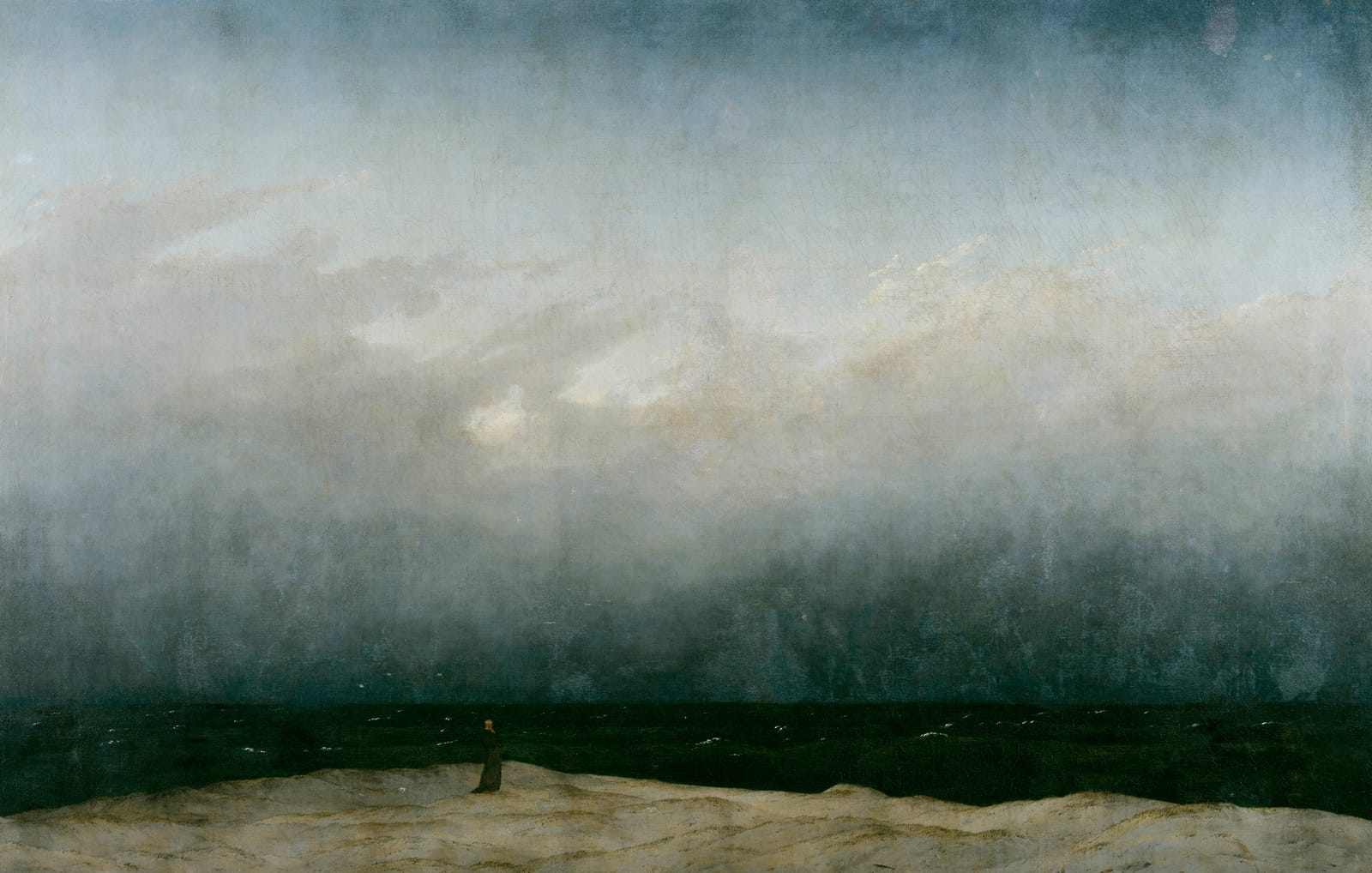
The Monk by the Sea
Caspar David Friedrich · 1808–1810 · Oil on canvas, 110 × 171.5 cm
Look for
- The feet. Friedrich first painted the man in profile, walking along the shore, then turned him to face the sea, and the feet still point the old way.
- Three bands and nothing else: pale dune, black sea, and a sky that takes about three quarters of the canvas. No tree or boat to lead you in.
- The tiny white flecks over the water. Friedrich described gulls circling the man, crying as if to warn him off the sea.
- Blue breaking through the grey near the top edge, and faint warm tones in the sky that came back when the old varnish was removed.
Transcript (2:23)
Give the room a moment before you look for him. Most of this canvas is sky, about three quarters of it, and the man you came to see is a dark stroke no taller than your thumb, standing at the end of a pale strip of dune with a band of black sea in front of him. Nothing else. No boat, no tree, no path to lead you in. Land, sea and sky, stacked on top of each other, and then the frame.
That emptiness was hard work. Caspar David Friedrich spent two years on this picture, from 1808 to 1810, changing it and painting over it again and again. Infrared photographs show what he took away: two ships, one on either side of the figure, and posts for fishing nets along the shore. The figure himself was first drawn in profile, walking along the beach. Friedrich swung him round to face the water, and if you look closely at the feet, you can still see that he was once going the other way.
In his own words, Friedrich described a sea piece with a man in a black garment walking on the shore, and gulls crying around him as though to warn him not to venture out. Those little white flecks above the water are where to find them.
He sent it to the Berlin Academy exhibition in the autumn of 1810 with the painting that hangs beside it now, The Abbey in the Oakwood, and asked for the Monk to be hung above the Abbey. Berlin had seen nothing like it. Goethe thought it so empty that it could be looked at standing on your head. Heinrich von Kleist, rewriting a review by Clemens Brentano for his own newspaper, found the line that has stuck ever since: because the picture has no foreground except the frame, looking at it is as if your eyelids had been cut away.
Then something unexpected happened. The fifteen-year-old Crown Prince of Prussia asked his father to buy both pictures, and King Frederick William the Third, whose purse had been emptied by war, paid 450 thalers for the pair. That boy became Frederick William the Fourth, the king whose own idea gave this museum its shape, a temple on a plinth. He is the rider on horseback at the top of the outside stairs.
After Friedrich died in 1840 he was largely forgotten. It was this museum that brought him back, with thirty-five of his paintings in its Century Exhibition of 1906.
Now look up into the sky. For decades this canvas sat under several layers of yellowed varnish that turned everything a dull, flat grey. Restorers took them off between 2013 and 2016, and since then the picture is brighter, with faint warm, reddish tones in the cloud and blue breaking through near the top. Mark Rothko, Gerhard Richter and Gotthard Graubner all pointed back to this painting. Grey closing in at eye level, blue opening far above, and one small man on the sand between them.

Stop 2 of 5 · Third exhibition floor, Room 3.06 (Caspar David Friedrich), beside The Monk by the Sea
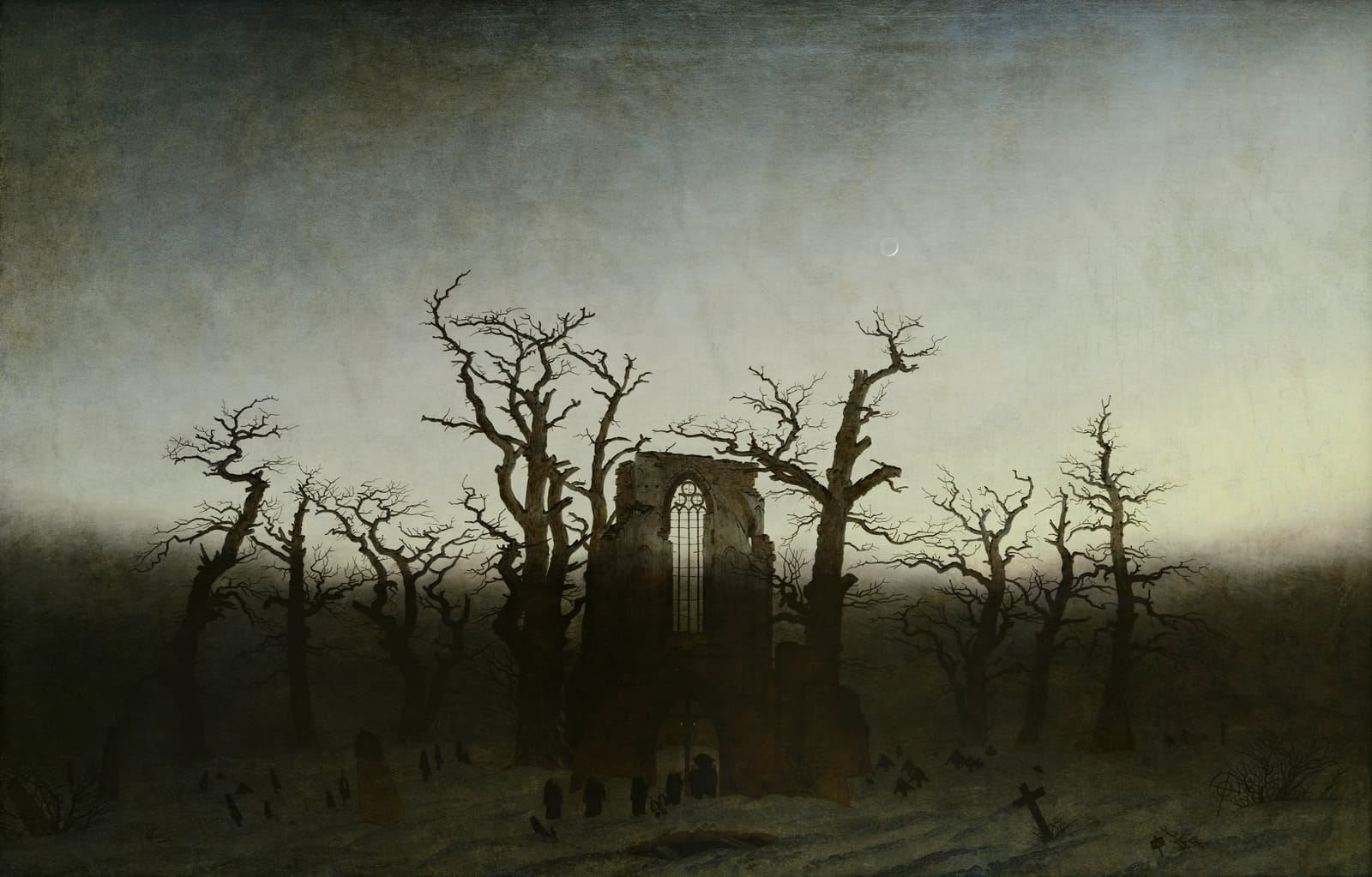
The Abbey in the Oakwood
Caspar David Friedrich · 1809–1810 · Oil on canvas, 110.4 × 171 cm
Look for
- Two tiny lights inside the doorway of the ruin, on the altar behind the crucifix. They are the only lights in the picture.
- The fresh grave open in the snow along the bottom edge.
- The thin crescent moon high on the right, just as Friedrich promised in his letter.
- The procession of monks carrying a coffin toward the gate, small and dark against the snow.
Transcript (1:48)
Turn to the companion picture and the daylight has gone. The sun is already down, fog lies over the ground, and what is left of a Gothic church stands up out of it among bare, broken oaks, with a thin crescent moon above.
Friedrich knew exactly what he was after. In a letter he wrote that he was working on a large picture in which he meant to show the secret of the grave and of the future: the remains of a Gothic church among ancient oaks, graves under snow, the evening star and the first quarter of the moon, and a thick fog in which the shapes grow more and more uncertain the nearer they come to the earth. That is this canvas, almost line for line.
He painted it as the partner to the Monk, and the two have stayed together since. At the Berlin Academy in 1810 they hung one above the other, the Monk on top, and the king bought them both at the request of his teenage son. One reading has lasted a long time: the man on the beach, and then his funeral. It is a reading, not a fact.
Look along the bottom of the picture. A procession of monks is carrying a coffin through the snowbound cemetery toward the doorway, and in front of them a freshly dug grave lies open in the snow. Now look inside the doorway itself. Two tiny points of light burn on the altar behind the crucifix. Nothing else in the painting gives off light.
The ruin is real, more or less. Friedrich took the great window from the abbey of Eldena, near Greifswald, and then improved it: he left out the stone tracery and set a portal into the west wall. About twenty years later the real ruin at Eldena was remodelled until it looked very much like Friedrich's invented one, probably with a push from the Crown Prince, who had owned this painting for two decades by then.
His friend the painter Carl Gustav Carus called it perhaps the most profound poetic work in all modern landscape painting. It is also a fragile one. Both pictures are painted in one or two very thin layers on a fine cloth, and by about 1900 they were in a desolate state. What you see today is the result of the same restoration that brightened the Monk: two canvases side by side again, the beach and the burial.

Stop 3 of 5 · Second exhibition floor, Room 2.02 (German Romans)
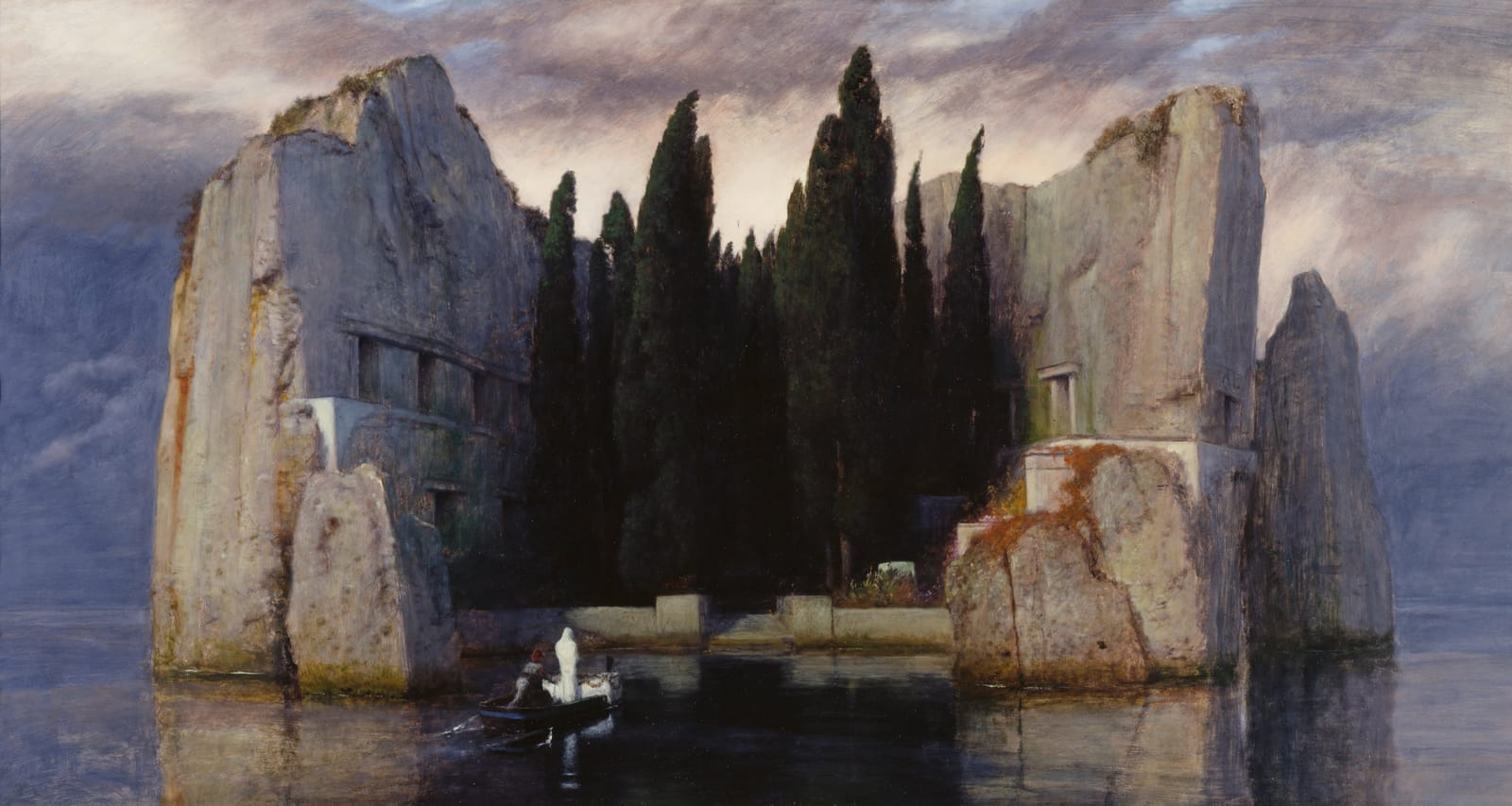
Isle of the Dead
Arnold Böcklin · 1883 · Oil on wood, 80 × 150 cm
Look for
- The initials A. B. carved over a burial chamber in the cliff on the right. Böcklin first added them in this version.
- The figure wrapped in white standing in the bow, beside a white coffin hung with garlands.
- The symmetry. The steps lead your eye into the centre, and then the cypresses close and you never see inside.
Transcript (1:52)
One floor down, the mood stays dark but the light changes completely. A rocky island rises out of flat, glassy water, walled in by cliffs and crowded with tall black cypresses. A boat glides toward a stone landing. An oarsman sits at the stern, and in the bow stands a figure wrapped entirely in white, beside a white coffin hung with garlands.
Arnold Böcklin never called it the Isle of the Dead. In the spring of 1880, in his studio in Florence, a young widow named Marie Berna asked him for a picture to dream over, and the first versions grew out of that request. The title came later, from his dealer, Fritz Gurlitt. Gurlitt ordered this canvas in 1883, the third of five versions, and then had Max Klinger make an etching of it. It was this version, multiplied in prints and photographs, that made the image famous. Vladimir Nabokov wrote that you could find a print in every Berlin home. Sigmund Freud kept one in his office.
Where is the island? Nobody knows for sure. Böcklin had spent the autumn of 1879 on Ischia, where a castle stands on a small island just off the shore, and that view may have stayed with him. Death was never far from his mind, either. He lost eight of his fourteen children.
Now look at the cliff on the right, at the burial chambers cut into the rock. From this version on, one of them carries the painter's initials, A. B. Böcklin gave himself a tomb on his own island.
The later life of this particular canvas is darker than anything in it. In the 1930s Adolf Hitler, who admired Böcklin, bought it. He hung it at the Berghof, his mountain house, and from 1940 in the New Reich Chancellery here in Berlin. The Nationalgalerie acquired it in 1980.
One more admirer, a happier one. Sergei Rachmaninoff wrote his tone poem Isle of the Dead in 1909 after seeing a black-and-white print, and said that if he had seen the original in colour he probably would not have written the music at all. So step back and take in the colour he missed: the bruised violet of the sky, the rust and moss on the pale rock, and one white figure in a dark boat.

Stop 4 of 5 · First exhibition floor, the Menzel rooms in the rear transverse hall and apse
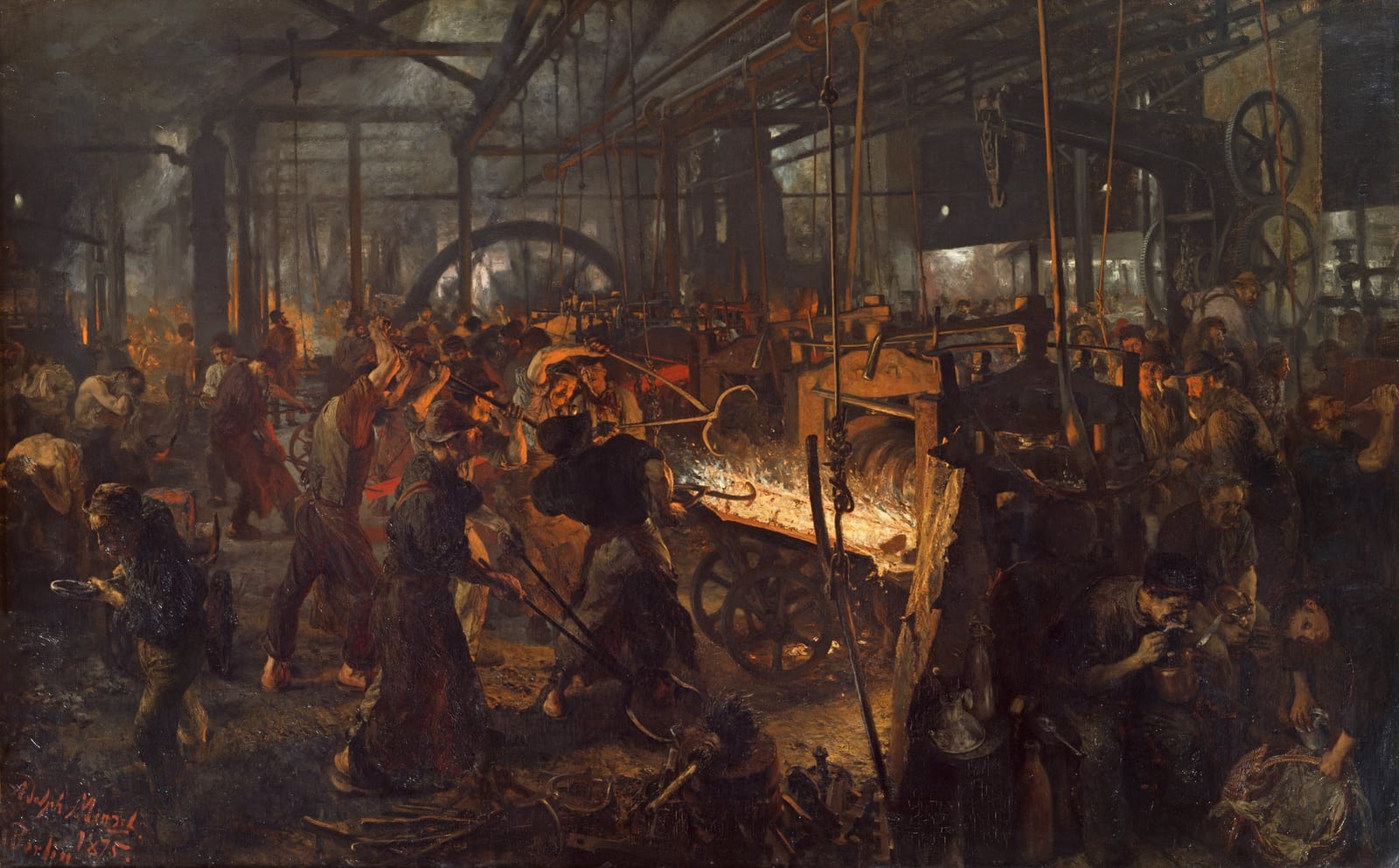
The Iron Rolling Mill (Modern Cyclopes)
Adolph Menzel · 1872–1875 · Oil on canvas, 158 × 254 cm
Look for
- The signature in the bottom left corner: Adolph Menzel, Berlin, 1875.
- The young woman with the food basket at the lower right, the only face in the crowd that looks back at you.
- Men stripped to the waist washing at the left edge, their shift already over.
- The white-hot block on the iron cart in the middle, about to go under the first roller and become a railway rail.
Transcript (1:54)
Come down to the first floor and the nineteenth century suddenly gets loud. Look at the middle of this canvas: a block of iron so hot it has turned white, riding on an iron cart that the men are tipping up to feed it under the first roller of the mill. In a few minutes it will be a railway rail.
Adolph Menzel described the scene himself, in a text he wrote for the Nationalgalerie's catalogue in April 1879, with an engineer's precision: the glowing bloom fresh from the furnace, three men with tongs steering it into the rollers, three more on the far side waiting to catch it and send it back through the next groove.
To get it right he travelled, in the late summer of 1872, to Königshütte in Upper Silesia, one of the big ironworks of the day. He read engineering books, drew the machines and the tools, and above all drew the men in motion, again and again. More than a hundred of his pencil studies for this one picture survive in Berlin's print room, the Kupferstichkabinett.
What made it radical was the size. A canvas this big, a metre and a half high and two and a half wide, was a format reserved for history painting: kings, battles, saints. Menzel gave it to a shift of factory hands, and nobody else in Europe had yet put machine labour on that scale.
Now find the edges of the story. On the left, men stripped to the waist are washing at the end of their shift. At the lower right, worn-out workers eat a meal that a young woman has brought in a basket, and she is the one person in a crowd of more than forty who seems to look straight back at you. Up in the haze, a man in a bowler hat and street clothes strolls through the hall with his hands behind his back while everyone else strains. Menzel called him the conductor.
The banker Adolph von Liebermann bought the picture in 1875 for 11,000 thalers. Within months he was bankrupt, and the Nationalgalerie paid 30,000 for it. In 1878 it went to Paris for the Exposition Universelle. The grand nickname Modern Cyclopes, after the giant smiths of the gods, was not Menzel's idea.
Before you go, look down at the bottom left corner, where he signed his name and told you where and when it was finished: Adolph Menzel, Berlin, 1875.

Stop 5 of 5 · First exhibition floor, Room 1.01 (Classicist sculpture)
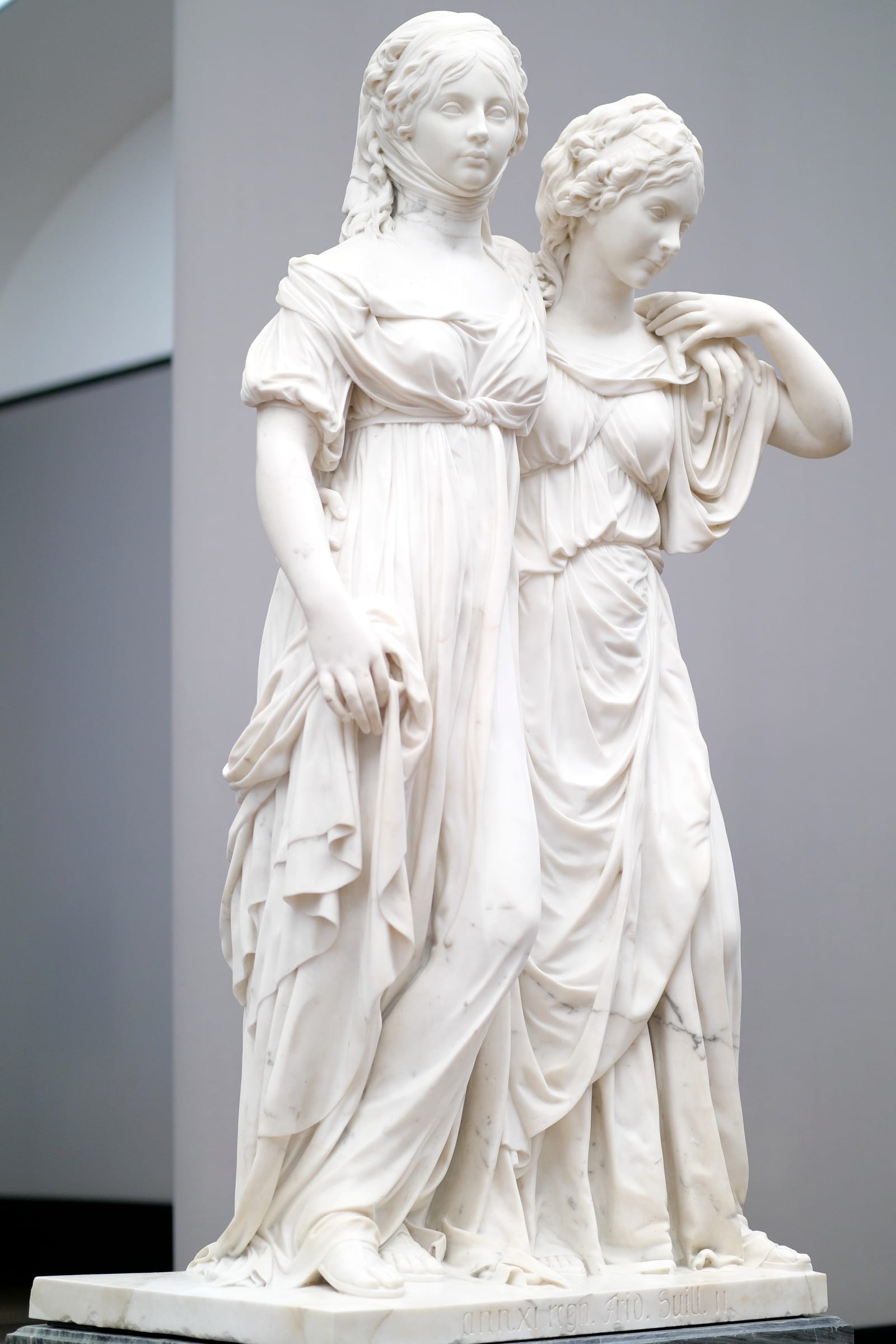
Princesses Group
Johann Gottfried Schadow · 1795–1797 · Carrara marble, life-size
Look for
- The narrow cloth tied around Louise's chin and neck. It hid a swelling, and it started a fashion.
- The two sisters leaning into one another in an embrace, the elder slightly in front.
- The back. Schadow carved it with as much care as the front, though for decades it stood pushed against a wall.
Transcript (1:59)
Two young women lean into each other, arms around one another, as if they had paused in the middle of a conversation. The one on your left, slightly in front, is Louise, Crown Princess of Prussia. The one leaning on her is her younger sister, Frederica.
At Christmas 1793 the two sisters married two Prussian brothers in the Berlin Palace, two days apart. They were seventeen and fifteen. King Frederick William the Second was so taken with his new daughters-in-law that he had them portrayed by Johann Gottfried Schadow, who ran the court sculpture workshop. First came clay busts, then a life-size plaster group that delighted the Academy exhibition of 1795, and then this marble. Schadow asked 5,000 thalers for eighteen months of work and the white Carrara stone. The carving was done by a craftsman named Claude Goussaut, and it was finished on the twelfth of July 1797.
Look at Louise's chin. A narrow cloth is tied round her head and neck. Schadow said it was there to hide a swelling on her neck, which later went down. Berlin did not care why. The band became a fashion almost at once, and for the rest of the century it was the sign by which you knew Louise in nearly every picture of her.
The arrangement is protocol, not chance. Louise, the elder and higher in rank, takes the place of honour, and Frederica stands a little behind.
Then the story turns. The old king died soon after the marble was shown, and his son, Louise's husband, now King Frederick William the Third, did not like it at all. His verdict was two words, Mir fatal, roughly, I find it awful. Too natural, no royal dignity, the young bodies too visible under the drapery. After three years of not deciding, he had it put in a guest room of the palace, close against a wall. For about ninety years hardly anyone saw it, least of all the back, which Schadow had carved as carefully as the front.
It came through the Second World War in the vaults of Berlin Cathedral. The original is now thought too fragile to travel, so this hall is the only place to see it; the Berlin porcelain factory still makes a small copy, fifty-five centimetres high and assembled from eighty-eight parts. Here, at full size and in marble, are two sisters on the way out of the museum, one of them with a scarf at her throat.
Independent guide · Chiaro
Point Chiaro at anything in the Alte Nationalgalerie.
Our walk ends with Schadow's sisters, but the building holds three floors of Romantics, Impressionists and Berlin realists. Photograph a Monet, a Liebermann or a portrait you have never heard of: Chiaro names it from the picture, talks you through who painted it and why it matters, and stays with you for whatever you want to ask next, about the brushwork, the sitter or the frame.
Before you go
Getting there
Bodestraße, 10178 Berlin, on Museum Island. Visitors go in on the Bodestraße side; the building is the raised temple with Frederick William IV on horseback at the top of its outside stairs. Access for wheelchairs is only partial.
The nearest U-Bahn stop is Museumsinsel on line U5. On the S-Bahn, use Hackescher Markt (S3, S5, S7, S9) or Friedrichstraße. Trams stop at Am Kupfergraben and at Hackescher Markt.
Tickets
- Mondays the building is shut; Tuesday through Sunday it keeps ten-to-six hours. Public holidays normally run on Sunday hours, but the island's museums all close on 24 December and again on 31 December 2026, and on New Year's Day 2027 they open at noon.
- Neither ticket has a time slot: each is good for any hour of the date printed on it. The current Across Epochs + Alte Nationalgalerie ticket is 16 euros (8 reduced); the Museum Island ticket, 24 euros (12 reduced), opens every museum and exhibition on the island that day. The museum's own advice is to reserve online, up to four weeks out, rather than queue at the counter.
- Under-18s go in free. Photography is generally allowed; anything larger than a small bag (over 30 × 20 × 10 cm) gets checked in at the cloakroom.
- Start at the top floor. The museum's chronological route begins up there with the Romantics, and so does this walk.
The official audio guide
The Staatliche Museen run an audio guide of their own in this building and publish a dedicated Alte Nationalgalerie app. Chiaro has no connection to either. We chose five works, recorded a track for each and set out the full scripts on this page at no charge; for the rest of the three floors, the Chiaro app takes over from your phone's camera.
Official site →Questions
Is there a free Alte Nationalgalerie audio guide?
Yes, this page: five stops with recordings and full scripts that run in a phone browser, with nothing to install. The Staatliche Museen also run their own audio guide and an Alte Nationalgalerie app, which are a separate thing from us. Past these five works, the Chiaro app narrates whatever you point your camera at.
How much is the official Alte Nationalgalerie audio guide?
Two official options exist: the Staatliche Museen's own audio guide for this building, and a separate Alte Nationalgalerie app for your phone. What you pay at the door is the ticket the museum sells as Across Epochs + Alte Nationalgalerie, 16 euros in full or 8 with concessions.
Where is The Monk by the Sea in the Alte Nationalgalerie?
Third floor, Room 3.06, the room given to Caspar David Friedrich, side by side with its partner The Abbey in the Oakwood. The museum's chronological route starts on that floor, so it is one of the first rooms you reach.
Is the Alte Nationalgalerie closed on Mondays?
Yes, it shuts every Monday; Tuesday through Sunday the doors stay open from 10:00 until 18:00. This winter the whole island is shut on 24 December and 31 December 2026, and on 1 January 2027 opening moves to noon, with closing at 18:00 as usual.
Is the Museum Island ticket worth it?
If you are seeing a second museum on the island the same day, our advice is yes. It costs 24 euros, 12 reduced, and covers every museum and exhibition on the island for one day, against 16 euros for the ticket the museum sells as Across Epochs + Alte Nationalgalerie.
How long does this walk take?
Roughly ten minutes of recordings, plus some twenty minutes walking down from the third floor to the first. Leave longer if the Friedrich room holds you, as it tends to.
More audio guides
Made by Chiaro. Not affiliated with the Alte Nationalgalerie.