
Cologne Cathedral · Cologne · Independent guide
Cologne Cathedral audio guide,
five stops, free.
Begun in 1248 and finished in 1880, with a south tower of 157.22 metres: five of its places are narrated below, and Chiaro's camera takes the questions about the six centuries in between.
Made by Chiaro. Not affiliated with Cologne Cathedral.
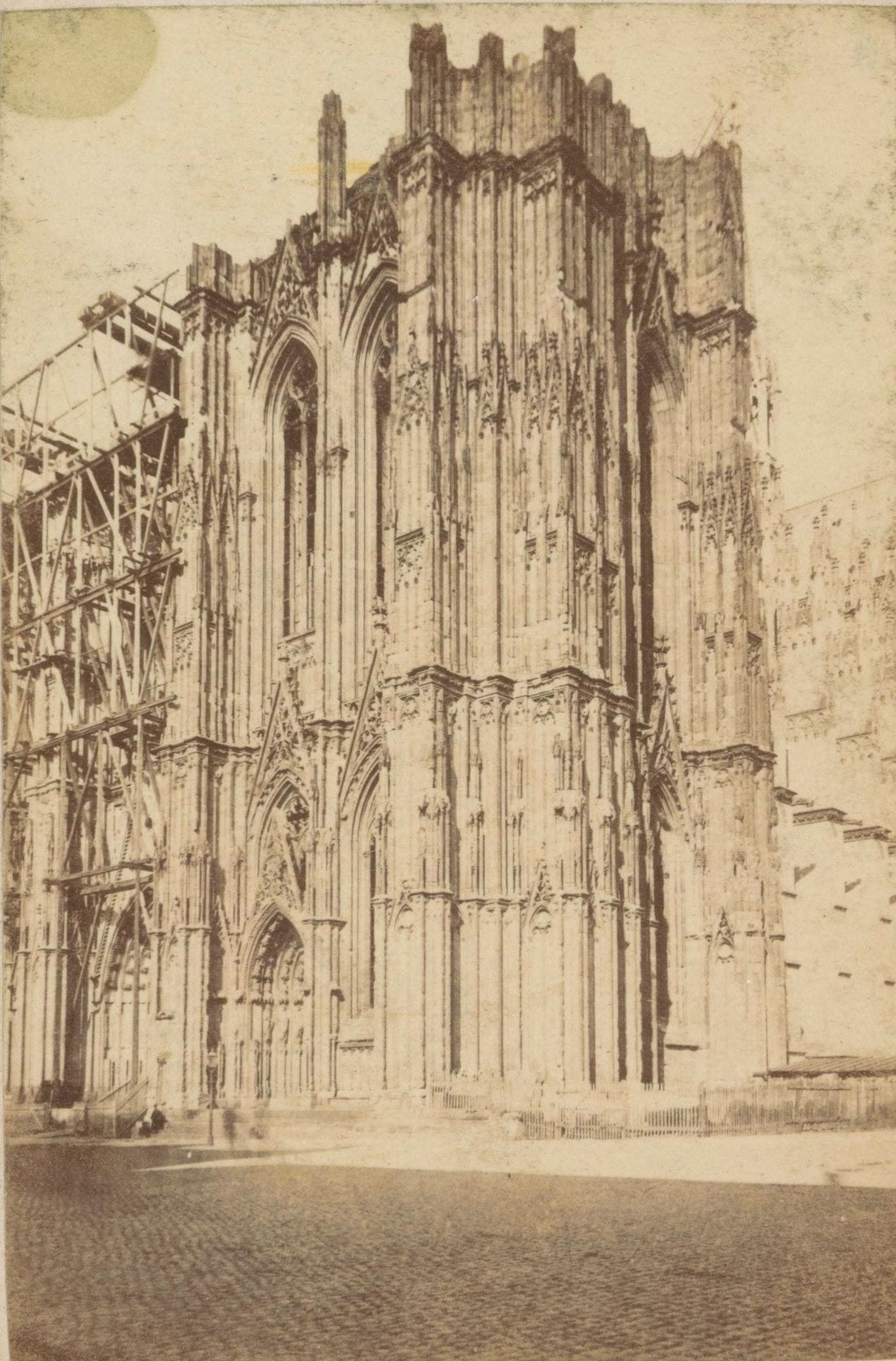
The west front and its twin towers
Cologne Cathedral, Cologne
That was the free part
Chiaro narrates anything at Cologne Cathedral from a photo.
The five stops · 11 minutes of audio
Five places, one walk,
in the order you will walk them.
Cologne Cathedral takes a minute to walk past and six centuries to explain, so our Cologne Cathedral audio guide picks just five places on one short, self-guided loop. Two are out on the Domplatte and cost nothing: the west front, heard from the square in front of the Main Portal, and the Petersportal at the right-hand end of that same front. The next two are inside, on the interior ticket the chapter has charged for sightseeing since 1 July 2026: the nave, from a few steps inside the Main Portal, and the crossing, where you face east down the choir to the high altar and the Shrine of the Three Kings behind it. The fifth is the south tower, with a ticket and an entrance of its own, down the steps beside the tower on the Roncalliplatz side. About ten and a half minutes of listening and roughly three hundred metres on the level, plus 533 steps if you climb.
What this page says about getting in comes from koelner-dom.de and the chapter's ticket pages, read on 26 September 2026, and every date and measurement in the recordings rests on a second source as well. Parts of the building close at short notice when worship needs them; the stewards in red gowns at the door have the last word, and if their instructions differ from this page, their word stands and ours gets rewritten.
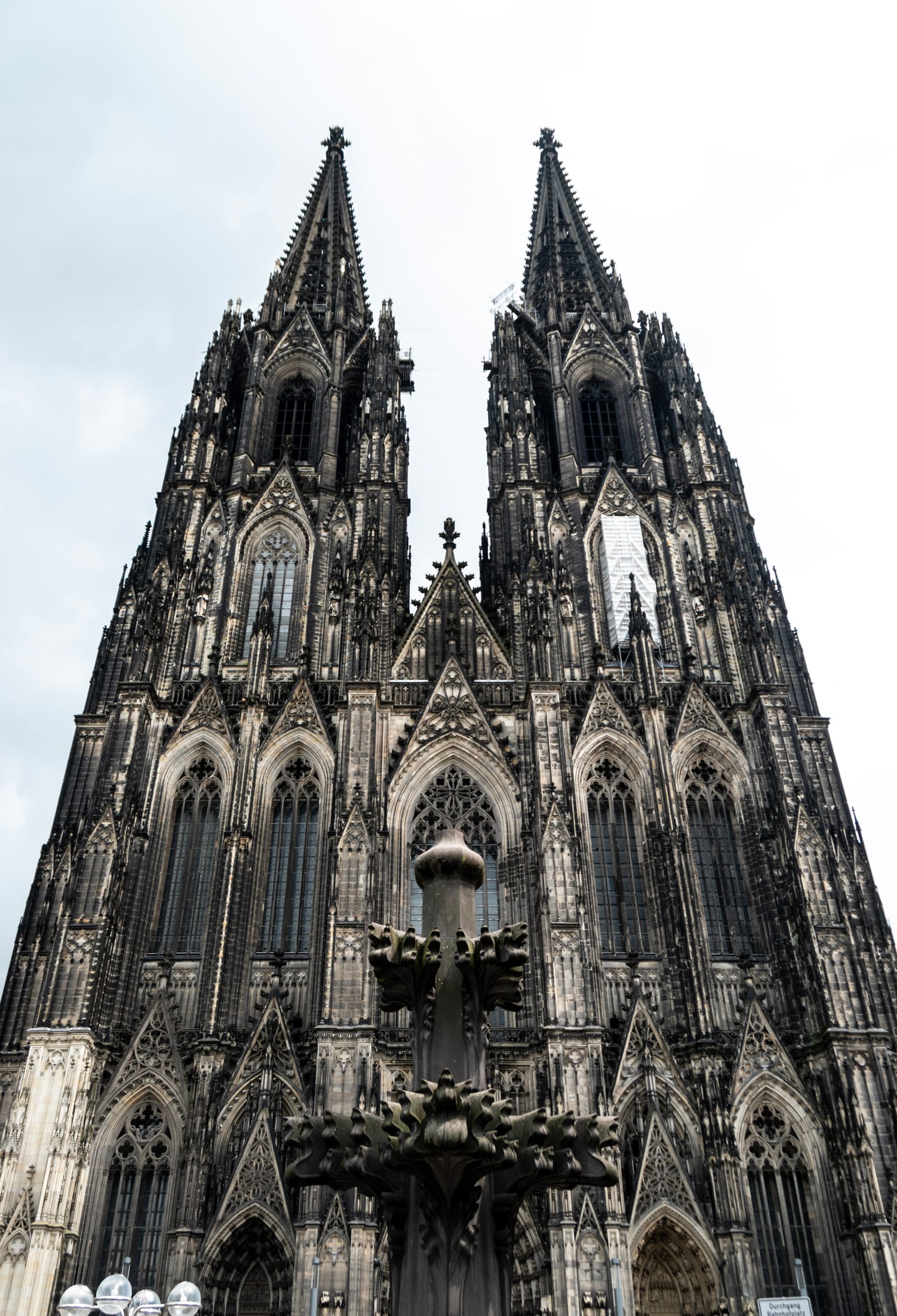
Julian Lupyan, CC0, via Wikimedia Commons. Photo: Julian Lupyan

Stop 1 of 5 · Domplatte, the square in front of the Main Portal on the west front, outside the cathedral and free
The west front and its twin towers
Completed 1842–1880 by the cathedral architects Ernst Friedrich Zwirner (in office 1833–1861) and Richard Voigtel (in office 1861–1902), to the medieval façade drawing known as Riss F; the lower south tower is fourteenth- and fifteenth-century · Begun about 1350; south tower halted about 1450; towers completed 15 October 1880 · Stone; south tower 157.22 m, north tower 157.18 m, west front 61.54 m wide
Look for
- The spires. They are open stone tracery, eight-sided and pierced right through, a form the medieval designer took from goldsmiths' reliquaries.
- The full-size stone finial standing on the square: the same many-tiered flower that crowns each spire 157 metres up.
- The two towers side by side. The chapter measures the south tower at 157.22 metres and the north at 157.18, four centimetres apart.
- The blackened stone. Repairing masonry damaged by weather and pollution is the main work of the cathedral's own workshop today.
Transcript (2:09)
Stand far enough back on the Domplatte that both towers fit into one look, and then keep going back, because from most of this square they will not. The south tower, on your right, is 157.22 metres. The north tower, on your left, is 157.18. Four centimetres between them, over a front sixty-one and a half metres wide.
Look at the spires first. They are not solid. They are open stone tracery, eight-sided and pierced right through, and each ends in a great finial, a stone flower with its petals turned up. One of those finials stands full size on the square in front of you, so you can see what sits on top of a spire 157 metres up. The shape comes from goldsmiths' work: the medieval designer drew these towers as if the building were a reliquary, which, as you will hear inside, is exactly what it was meant to be.
Now the surprise. Most of what you are looking at is nineteenth-century, and it is still a medieval design. Building began here in 1248, under a Master Gerhard of whom almost nothing is known but his name. After 1520 the work slowed, and around 1560 it stopped altogether, with the choir finished at the far end and the south tower a stump. It stayed that way for three centuries, and Cologne had a saying for it: when the cathedral is finished, the world will end.
What rescued it was a drawing. The medieval elevation of this front, known as Riss F, is just over four metres high, twenty sheets of parchment glued edge to edge. It went missing and came back in two halves: the north tower in 1814, in the loft of an inn in Darmstadt, and the centre and south tower in 1816, at a dealer in Paris. Put together, it told the nineteenth-century builders exactly what to build. From 1842 they did, nave and transepts first; when the towers went up from the 1860s it was with more than five hundred workers, winch wagons running on rails across the site and a steam engine, and on 15 October 1880, six hundred and thirty-two years after the foundation stone, the towers were finished. For four years this was the tallest building in the world.
The architect Richard Voigtel announced shortly before his death in 1902 that the cathedral was complete at last. In May 1906 the wing of a stone angel fell from above the main portal after Sunday Mass, and an umbrella broke its fall. The workshop has been repairing this front ever since, one weathered block at a time, on a building that has now been declared finished twice.
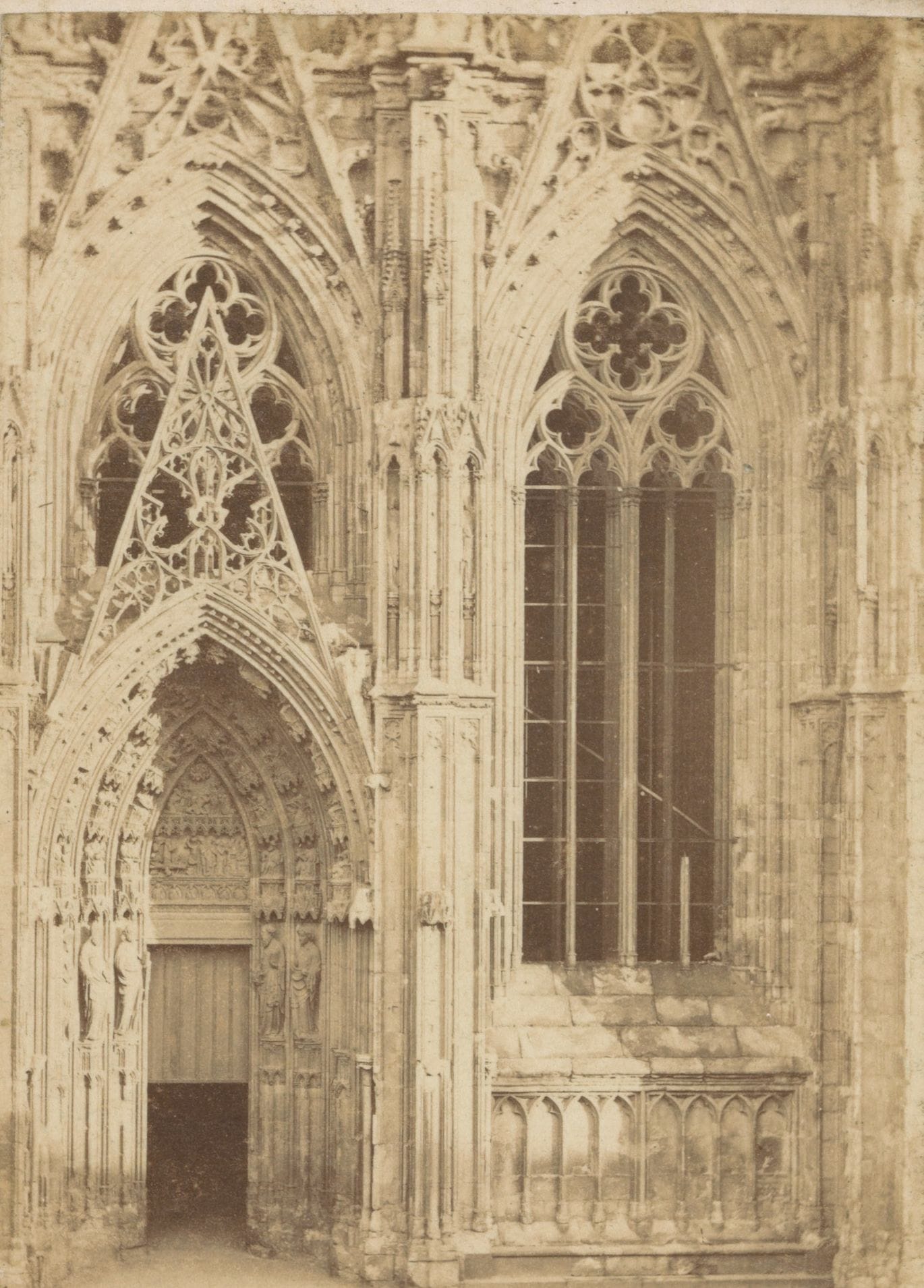
Rijksmuseum, CC0, via Wikimedia Commons. Photo: Rijksmuseum

Stop 2 of 5 · West front, the right-hand (southern) doorway under the south tower, on the Domplatte; the bronze tactile model of the cathedral stands in front of it
The Petersportal, the one medieval doorway
Sculptors of the Parler circle under the cathedral architect Michael of Savoy; five jamb figures medieval, the rest nineteenth-century · About 1370–1380; original figures replaced by copies 1972–1980 · Stone portal in the base of the south tower, which stood at 56.14 m from the fifteenth century until the 1860s; five over-life-size medieval jamb figures, now copies
Look for
- The jamb figures nearest the door: three on the left, Peter, Andrew and James, and two on the right, Paul and John, are the medieval set, here as copies. The figures further out are nineteenth-century and differ in colour and carving.
- The seated prophets and angels in the arches over the door, carved to be seen by someone walking through rather than from across the square.
- The bronze model of the cathedral in front of the portal, 65 by 90 centimetres, with braille and printed labels round its base.
Transcript (1:58)
Walk to the right-hand end of the west front, to the doorway under the south tower, and you are standing at the only door of this cathedral that the Middle Ages got even partly finished. There are twelve portals on the building. This one, the Petersportal, was made around 1370 to 1380, and when the builders came back in the nineteenth century they used it as the model for all the others.
Look at the tall figures standing either side of the door, and start nearest the opening. Three on the left, Peter, Andrew and James, and two on the right, Paul and John: those five are the medieval set. Everyone further out is nineteenth-century, and once you know, you can see it, in the colour and in the carving. One honest correction: the five in front of you are copies in cast stone, put up between 1972 and 1980 because the originals were crumbling. The originals are in the Treasury now.
The carvers came from the circle of the Parlers, the leading family of builders and sculptors of the fourteenth century, the family of Peter Parler, who built Saint Vitus Cathedral in Prague. Cologne's cathedral architect, Master Michael, was related to them: in 1381 his daughter married Heinrich, a nephew of Peter Parler, and the Saint Catherine on this portal is attributed to Heinrich. Look up into the arches over the door for the seated prophets and the angels. They were carved to be met as you pass through, not admired from across the square; the sculptors meant the whole portal as a space you walk into. One of the angels is swinging a bell, and it has been called the most enchanting stone sculpture of its time.
The wall around this door is the base of the medieval south tower. By the middle of the fifteenth century it had reached 56.14 metres, and there it stopped, with a timber crane left on top that was, for four centuries, the emblem of Cologne. It came down in 1868. In 1401 a German king, Rupert of the Palatinate, was crowned in this cathedral and entered in procession along the south aisle, just the other side of this wall.
Before you go in, look down in front of the portal. There is a bronze model of the whole cathedral, ninety centimetres long, made to be touched, with braille round its base. Put a hand on the two towers. It is the only time today you will be able to hold them.
Rijksmuseum, CC0, via Wikimedia Commons. Photo: Rijksmuseum

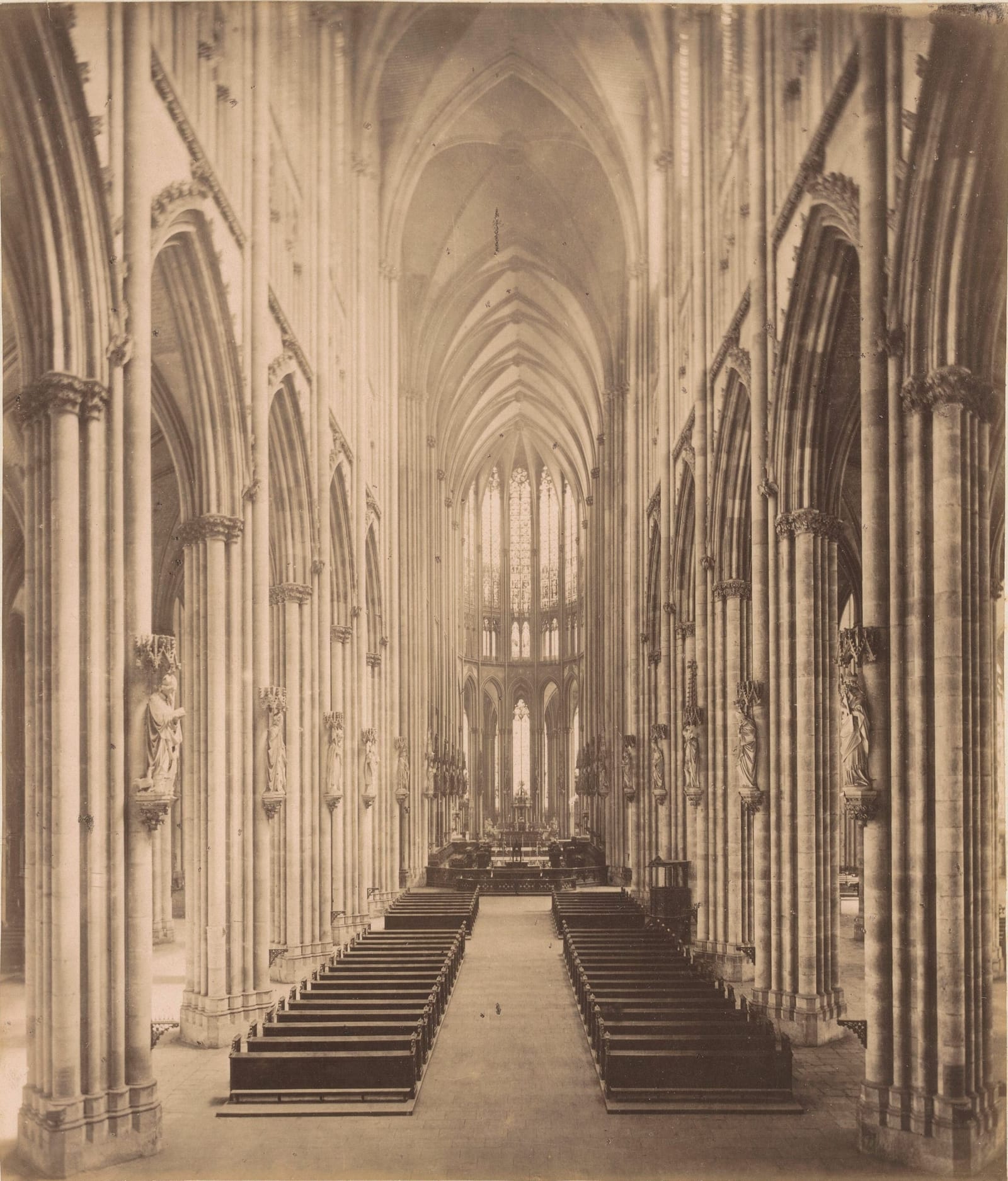
Stop 3 of 5 · Just inside the Main Portal at the west end, looking east down the nave; the Bavarian Windows are in the south aisle, to your right
The nave, from inside the main portal
Built 1842–1863 under the cathedral architects Ernst Friedrich Zwirner (in office 1833–1861) and Richard Voigtel (in office 1861–1902), to the medieval design; vaults rebuilt after 1945 under Willy Weyres · Nave completed 1863; restored after war damage by 1956 · Stone; vault 43.35 m high inside, main vessel 12.50 m wide, nave with its aisles 45.19 m wide
Look for
- The vault, 43.35 metres up, running without a break to the choir at the far end: nave, crossing and choir share one height and one width.
- To your right, the Bavarian Windows in the south aisle, large painted scenes from the royal glass workshop in Munich, given by Ludwig I in 1848.
- To your left, the north aisle windows of 1507 to 1509, with their donors, archbishops, the dean and the city of Cologne, shown in the glass.
- The piers: every one a round cluster of twelve shafts, one every seven and a half metres.
Transcript (2:04)
Come in through the main portal, take a few steps, and stop. From here the vault runs east for the whole length of the church, and it is 43.35 metres high all the way. Nave, crossing and choir share one height and one width, twelve and a half metres between the piers, and every pier is the same round cluster of twelve shafts, one every seven and a half metres. That regularity is the strange thing. This space took more than six centuries and five campaigns to build, and it looks as though it went up in one.
It did not. For most of its life this was two buildings. The choir at the far end was finished in the fourteenth century and sealed off by a wall. Where you are standing was a half-built shell under a makeshift roof. The wall between them stood for five hundred and sixty years. It came down in 1863, when this nave was finished, and neither the Prussian king who had laid the stone for the completion nor the architect Ernst Friedrich Zwirner lived to see it: both had died in 1861.
Now look to your right, into the south aisle, at the big painted windows. These are the Bavarian Windows. King Ludwig the First of Bavaria gave them in 1848 for the six hundredth anniversary of the foundation stone; they were made at the Royal Glass Painting Institute in Munich and unveiled on 14 August that year. Then turn to the north aisle on your left. Those windows are three hundred and forty years older, made between 1507 and 1509, among the last things done before medieval building slowed after 1520 and then stopped, and the people who paid for them are in the glass: archbishops, the dean, the city of Cologne.
Two hard times left their marks on this room. Under the French occupation the cathedral was closed and used as a store and a prison camp, and in the winter of 1797 the prisoners burned the wooden furnishings of this nave to keep warm. In the Second World War it took fourteen heavy bombs, and most of the high vaults above you fell in. The medieval glass survived because it had been taken out in time, some of it to a bunker under the north tower. The nave was not whole again until 1956.
There are about ten thousand square metres of window in this building, roughly as much glass as there is ground under it, and of all the great cathedrals Cologne has the most window for its length. Let your eyes run up the nearest pier to where the light comes in, forty-three metres overhead.
Rijksmuseum, CC0, via Wikimedia Commons. Photo: Rijksmuseum
,_RP-F-F06064.jpg)
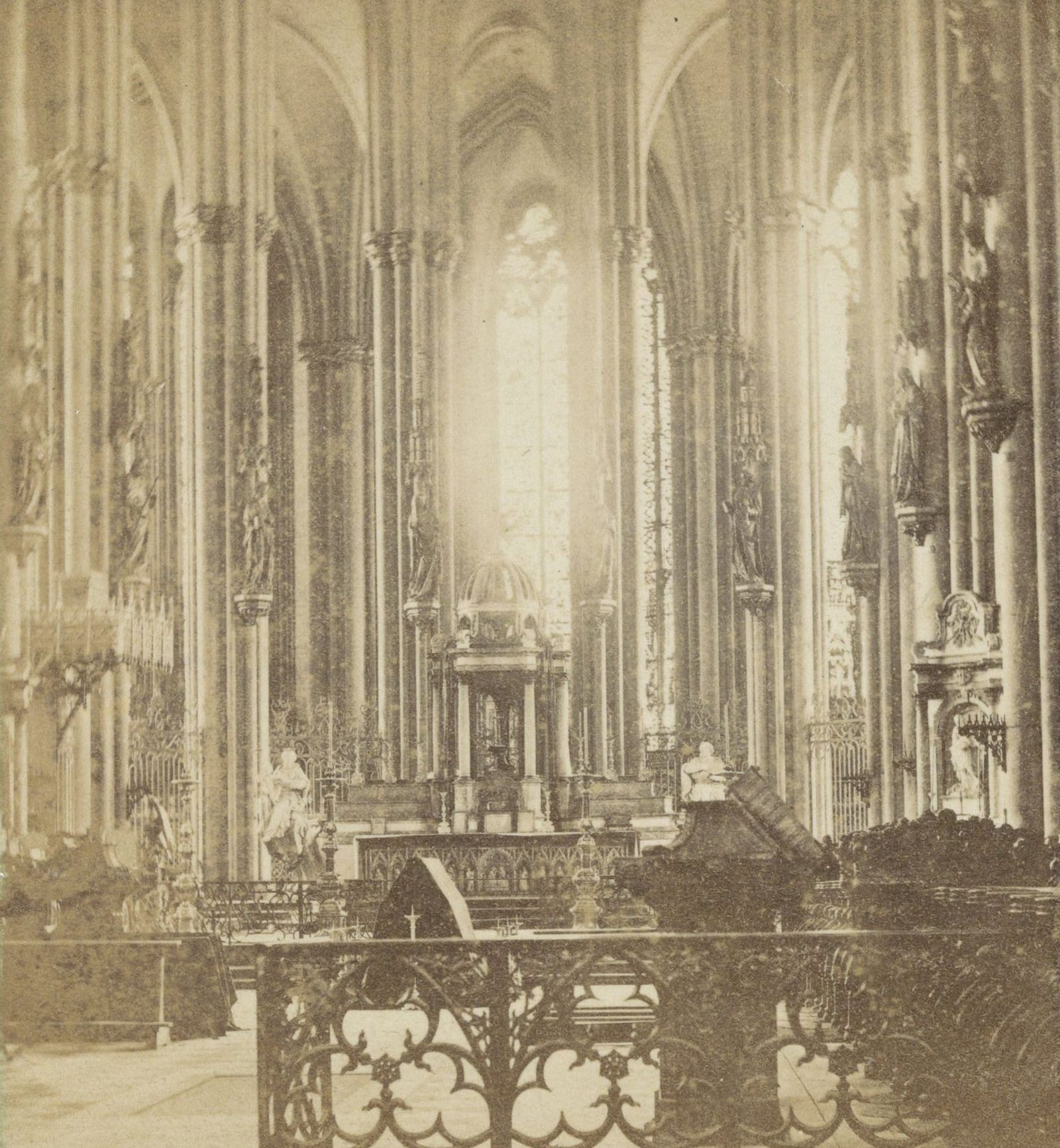
Stop 4 of 5 · The crossing, facing east down the choir; the shrine stands behind the medieval high altar at the east end
The high altar, and the Shrine of the Three Kings behind it
Workshop of the goldsmith Nicholas of Verdun and following Cologne and Mosan workshops, for Archbishop Philipp von Heinsberg (died 1191); restored 1961–1973 · About 1190 to about 1220; behind the high altar since 1948 · Gilded silver over a wooden core, with enamel and over 1,000 gems and pearls; 220 cm long, 110 cm wide, 153 cm high
Look for
- Straight down the choir, past the high altar: the gold shape in its glass case is the shrine, set on the cathedral's central axis.
- The high altar's black marble block with its white marble arcades of small figures. Only the figures on the front are medieval.
- The painted and gilded figures on the choir piers, Christ, Mary and the twelve apostles, made by the cathedral workshop in the early fourteenth century.
Transcript (2:44)
Walk up the nave to the crossing, where the transepts open out on either side, and face east, down the choir. At the far end, past the dark block of the high altar, there is a shape of gold in a glass case. That is the reason this building exists.
It is the Shrine of the Three Kings, and the cathedral's own description does not hedge: the largest, the most important and the most ambitious reliquary of the Middle Ages. It is shaped like a small church, 220 centimetres long, 110 wide and 153 high, covered in gilded silver, with seventy-four chased figures, more than a thousand gems and pearls, and about three hundred cut stones, many of them ancient cameos and intaglios. No other medieval object carries so many carved gems from antiquity.
What it holds explains everything else. On 23 July 1164 Archbishop Rainald of Dassel brought to Cologne bones venerated as those of the Three Wise Men, a gift from the emperor Frederick Barbarossa out of the spoils of Milan. Pilgrims came in such numbers that Cologne became one of the great pilgrimage cities of Europe, and the city put three crowns on its coat of arms, which it still carries. From around 1190 the workshop of the goldsmith Nicholas of Verdun made the shrine, and the work ran on to about 1220. In 1248 Cologne began a new cathedral to house it, and the chapter still describes the building as a reliquary in stone for the one in gold. Those pierced spires outside are the same idea at 157 metres.
The shrine has not had a quiet life. King Otto the Fourth gave three golden crowns for the kings around 1200 and had himself put on the shrine, walking behind the Magi, labelled Otto Rex. On 28 January 1574 a thief took the great cameo from the front. It was recognised only in 1952, in Vienna, as the Ptolemy Cameo, about two thousand three hundred years old. In 1794 it was carried off to escape the French army, and on that flight it was shortened by a whole bay. In the Second World War it went first to a castle at Pommersfelden, then in 1944 on a journey through a country being bombed flat: to Fulda, which was hit while the transport was on the road, to Siegen, where the bunker door turned out to be too small, and back to Cologne, into the bunker under the sacristy.
In 1948, for the seven hundredth anniversary of the foundation stone, it was reassembled and brought back into the church, and it has stood there ever since, behind the altar on the central axis. The restoration of 1961 to 1973 gave it back its original form. Since its new case of 2004, processions have been able to pass underneath it.
The altar in front of it deserves a look of its own. It was consecrated to Saint Peter on 27 September 1322, black marble fronted with little arcades of white marble full of figures, and its top is a single slab, the largest stone in the whole cathedral. Only the figures on the front are medieval. Behind it, framed by the painted apostles on the choir piers, the gold catches whatever light the choir windows let in.
Rijksmuseum, CC0, via Wikimedia Commons. Photo: Rijksmuseum

Stop 5 of 5 · Tower entrance at the foot of the steps beside the south tower, towards Roncalliplatz, signed Dom-Turm / Parkhaus / Toiletten; the stop is the viewing platform at the top
The south tower: 533 steps to the platform
Lower tower by the medieval cathedral workshop, fourteenth and fifteenth centuries; upper tower and spire completed in 1880 under the cathedral architect Richard Voigtel (in office 1861–1902) · Begun about 1350; upper tower 1860s–1880 · Stone; 533 steps to a viewing platform about 100 m up, bell chamber at about 53 m, tower 157.22 m high
Look for
- In the bell chamber, the Petersglocke: 3.22 metres across, 3.2 metres high, with a clapper of about 600 kilograms.
- From the platform, the Rhine and the Hohenzollern Bridge, six railway tracks wide, running across to Deutz, with the main station just beyond the north tower.
- The north tower's spire beside you, close enough to read its tracery, four centimetres lower than the one you are standing in.
Transcript (2:11)
Out of the cathedral, head for Roncalliplatz and find the steps going down beside the south tower. The climb starts below ground, in a passage through the tower's medieval foundations, and then it is a spiral: 533 steps to the top, on a stair so narrow that two people can only just pass. Take it slowly. Everyone does.
This is the oldest thing you will climb in Cologne and also one of the newest. The lower part is medieval. By the middle of the fifteenth century the tower stood at 56.14 metres, and there it stopped. On top of the stump the builders left their crane, a revolving timber machine more than twenty-five metres tall, and for four hundred years it was the emblem of the city, and a symbol of a city left behind, until it was taken down in 1868. In 1842, when the completion began, the new foundation stone was hauled up onto this unfinished tower and walled in. Most of what rises above the bell chamber went up in the eighteen-sixties and seventies.
After 291 steps, at about fifty-three metres, you come into the bell chamber, where eight of the cathedral's twelve bells hang. Two of them, Pretiosa and Speciosa, were cast right here on site in 1448 and 1449. The giant is the Petersglocke, in Cologne dialect the Decke Pitter, fat Peter: twenty-four tonnes, 3.22 metres across, with a clapper of about six hundred kilograms. It was cast in Apolda in May 1923 to replace the Kaiserglocke, which had been made from captured French cannon and was cut up by hand for war metal in 1918. Hauling the new bell up to this level in December 1924 took ten ropes, two hand winches and eight men, at about five minutes a metre. The first attempt to ring it, on Christmas Eve 1924, failed; Cologne heard it for the first time on 28 October 1925. Until the end of the twentieth century it was the largest free-swinging bell in the world, and it still rings only on a handful of great feasts.
Keep going. The spiral ends at about seventy metres and a metal staircase takes you up the last stretch to the platform, about a hundred metres above the square. Now look. The Rhine is right there to the east, with the Hohenzollern Bridge carrying six tracks across to Deutz and the main station just beyond the north tower. Then look across at the north tower's spire, close enough to read the tracery: four centimetres lower than the one under your feet, and four centuries in the making.
Independent guide · Chiaro
Point Chiaro at anything at Cologne Cathedral.
The chapter's own count runs to 1,125 pinnacles over three metres tall, about ten thousand square metres of glass and twelve bells, and this page names a few dozen things among them. The rest is for your camera: photograph a weathered saint on a buttress, a pane in the north aisle or one of the gilded apostles on the choir piers, and Chiaro tells its story, from the workshop that made it to what 1794 and 1942 did to it.
Before you go
Getting there
Domkloster 4, 50667 Köln. With a ticket for the interior you go in by the Main Portal, in the middle of the west front facing the Domplatte. The North Transept entrance, on the side facing the main station, is free, but only for prayer, a candle at the Schmuckmadonna and the Blessed Sacrament Chapel. The tower has its own door: facing the Main Portal, turn right towards Roncalliplatz and take the steps down beside the south tower, signed Dom-Turm / Parkhaus / Toiletten. Wheelchair users reach the Domplatte by the Domgässchen; the interior and the Treasury are step-free.
Dom/Hauptbahnhof, the underground Stadtbahn stop on lines 5, 16 and 18, sits under the cathedral's northern edge, and Köln Hauptbahnhof, the main railway station with ICE, Intercity, regional and S-Bahn trains, is right next to the cathedral.
Tickets and entry
- Sightseeing inside has needed a ticket since 1 July 2026. Book it for your date online, up to three months ahead, or buy it at the Central Ticket Office in the Kurienhaus, Roncalliplatz 2, which is staffed every day between 09:00 and 17:30. Children under 14 go free with ID; pupils from 14, apprentices, students and NRW social-pass holders pay the reduced rate. Services, prayer and lighting a candle stay free.
- Tourist visits stop for services. The chapter gives the visiting hours as generally between 10:00 and 17:45 from Monday to Saturday, with last admission at 17:30, and between 13:30 and 16:30 on Sundays and church holidays, last admission 16:15; building work or events can close parts of the cathedral at short notice, and its service calendar shows what is on for your date.
- The tower is a separate ticket: 8 euros, 4 reduced, or 12 and 6 combined with the Treasury. It is open between 09:00 and 18:00 in the months March to October and between 09:00 and 16:00 in November to February, last entry half an hour before closing, and it is shut on New Year's Day, Weiberfastnacht, Carnival Saturday and Sunday, Rose Monday, 11 November and 24, 25 and 31 December. There is no lift, and the bell chamber on the way up is closed on Sundays and holidays until 14:00.
- Bring a small bag or none: 40 by 35 by 15 centimetres is the limit for the cathedral, the Treasury and the tower, and suitcases, trolleys and hiking rucksacks are turned away, with no left-luggage on site. Expect a security check at each door. Shoulders and upper body must be covered and skirts and shorts must reach at least mid-thigh.
The official audio guide
Kölner Dom offiziell, the chapter's free app, is where its own guidance lives, and the tour in it is a spiritual one: thoughts to read at ten places in the cathedral, with service times and notes on the works of art alongside. Human guides come from DOMFORUM, the chapter's official partner, which sells public tours on its website and at the DOMFORUM and books group tours in advance, since only licensed cathedral guides may lead a group inside; an interior tour needs an admission ticket on top. Set beside those, this page is a history of the building told in five places, two of them free on the square, with each narration printed under its player for reading instead of listening.
Official site →Questions
Is there a free Cologne Cathedral audio guide?
All free, and the first two play out on the Domplatte before any ticket comes into it: five stops, streamed to your phone. The chapter's app, Kölner Dom offiziell, is free as well, but its tour is spiritual, thoughts at ten places, rather than a history of the building. For a pinnacle, a window or a saint that neither covers, aim the camera in the Chiaro app at it and ask.
Can I listen to the Cologne Cathedral audio guide without a ticket?
Yes, and two of the stops need none: the west front and the Petersportal are on the Domplatte, a public square. The nave and the crossing, stops three and four, are inside, where a sightseeing visit has needed a ticket since 1 July 2026. The south tower, stop five, needs its own tower ticket.
How much is the official Cologne Cathedral audio guide?
Nothing: the chapter's own guide is its app, Kölner Dom offiziell, free to download, with a spiritual tour at ten places in the cathedral. Guided tours are a separate purchase from DOMFORUM, the chapter's official partner, and an interior tour needs an admission ticket as well.
How much does it cost to climb the Cologne Cathedral tower?
8 euros, or 4 reduced; a combined ticket with the Treasury is 12 euros, or 6 reduced, and children up to 13 go free. Booking ahead is not required, though the chapter suggests booking online to avoid a wait. Allow 30 to 45 minutes for the 533 steps and the platform, about 100 metres up.
Where is the Shrine of the Three Kings in Cologne Cathedral?
Behind the high altar at the east end of the choir, in a glass case on the cathedral's central axis, where it has stood since 1948. From the crossing, where the transepts meet the nave, you look straight down the choir to it.
When is Cologne Cathedral closed to sightseeing?
During services, and at short notice for building work or special events; the chapter's service calendar shows each day. Sightseeing runs generally between 10:00 and 17:45 on weekdays and Saturdays, and between 13:30 and 16:30 on Sundays and church holidays. The tower closes on New Year's Day, the main carnival days, 11 November and 24, 25 and 31 December.
More audio guides
Made by Chiaro. Not affiliated with Cologne Cathedral.