
Berlin Cathedral · Berlin · Independent guide
Berlin Cathedral audio guide,
five stops, free.
A dome 98 metres high today and 114 metres when it opened in 1905, over Germany's largest Protestant church: listen from the park outside to the walkway at the top, then photograph any tomb, statue or window and ask Chiaro whose it is.
Made by Chiaro. Not affiliated with Berlin Cathedral.
The west front from the Lustgarten
Berlin Cathedral, Berlin
That was the free part
Chiaro narrates anything at Berlin Cathedral from a photo.
The five stops · 11 minutes of audio
Five places, one walk,
in the order you will walk them.
Emperor Wilhelm the Second wanted Berlin's reply to Saint Peter's in Rome, and our Berlin Cathedral audio guide follows that ambition from the grass outside to the top of the dome. The first stop is free: the Lustgarten, the park in front of the west front, where you can listen before you have a ticket. The next three are inside the Sermon Church, the main space under the dome: its centre, the chancel at the east end, and the organ on the north side with the royal coffins beneath and opposite it. The last is the walkway round the dome, 50 metres up, reached by stairs only. Allow about ten minutes of listening, short strolls from one stop to the next indoors, and the climb; the cathedral itself suggests about an hour and a half for a full self-guided visit.
Every name, date and measurement here is drawn from berlinerdom.de, the cathedral's own site, from the Berlin state monument register and from Wikipedia in English and German, and each visit rule was checked on berlinerdom.de on 1 October 2026 against the sentence it rests on. This is a working church where services and concerts come before sightseeing, so a steward's word or a sign at the door on the day overrules this page.
Chainwit., CC BY 4.0, via Wikimedia Commons, cropped. Photo: Chainwit.

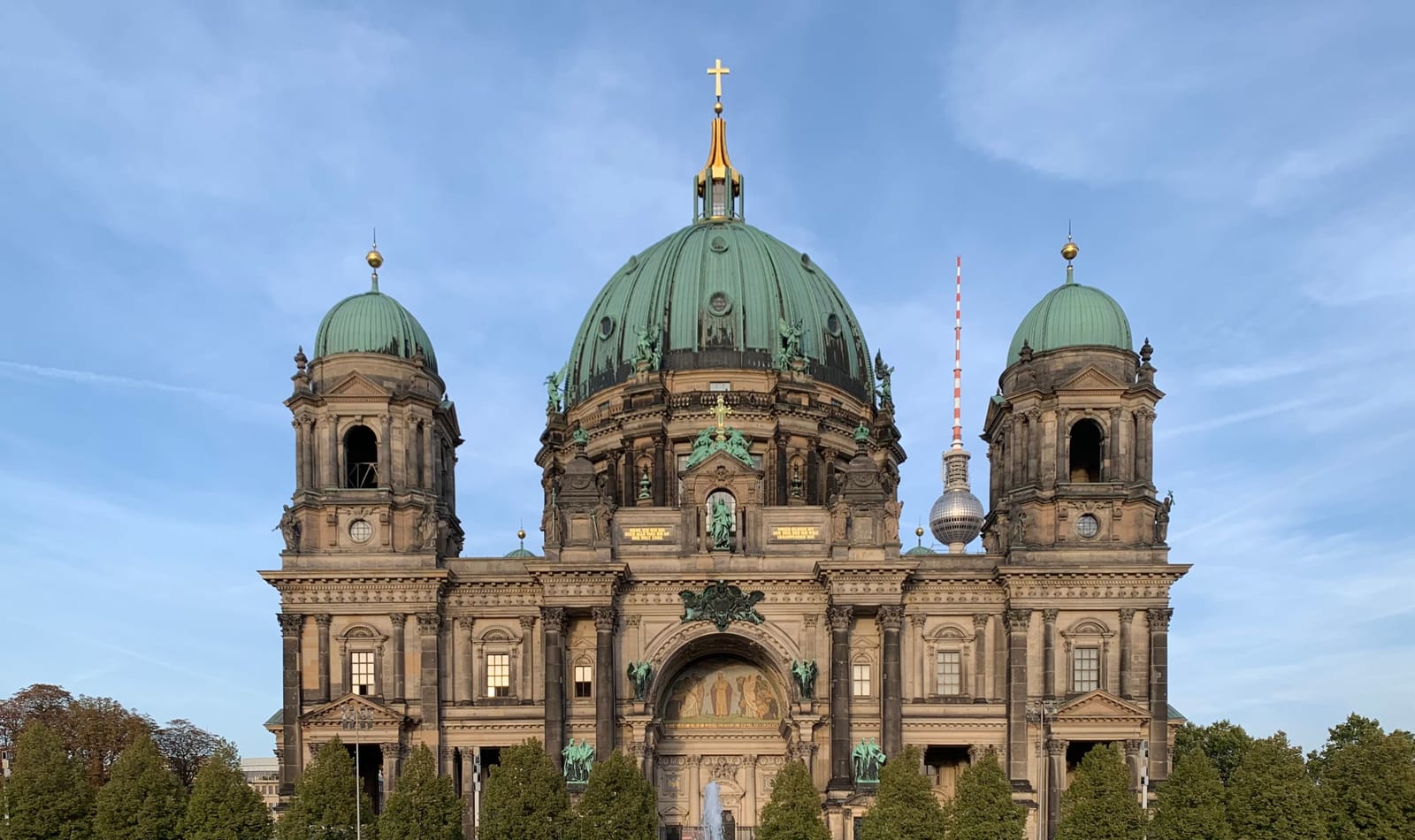
Stop 1 of 5 · The Lustgarten, the public park in front of the main front; stand on the paths near the fountain, facing east
The west front from the Lustgarten
Julius Carl Raschdorff (1823–1914), cathedral architect, with his son Otto Raschdorff (1854–1915), for Emperor Wilhelm II; dome and tower tops rebuilt in simplified form under the GDR, 1975–1984 · Foundation stone 17 June 1894; inaugurated 27 February 1905; exterior rebuilt 1975–1984 · Sandstone facade hung about 30 centimetres thick; the dome 98 metres high today, 114 metres as built
Look for
- The arched mosaic over the main portal, one of the last pieces added to the building, in 1920, fifteen years after the inauguration.
- The dome and the tops of the towers. They were rebuilt in simplified form under the GDR, each 16 metres lower than in 1905, with their crowning lanterns gone.
- The grey-black crust on the sandstone: soot, dust and rubber from the traffic, which the cathedral says is slowly eating into the stone.
- The north-western tower, on your left as you face the front. It holds the bells, only three of them, which ring twice a day for services.
Transcript (2:10)
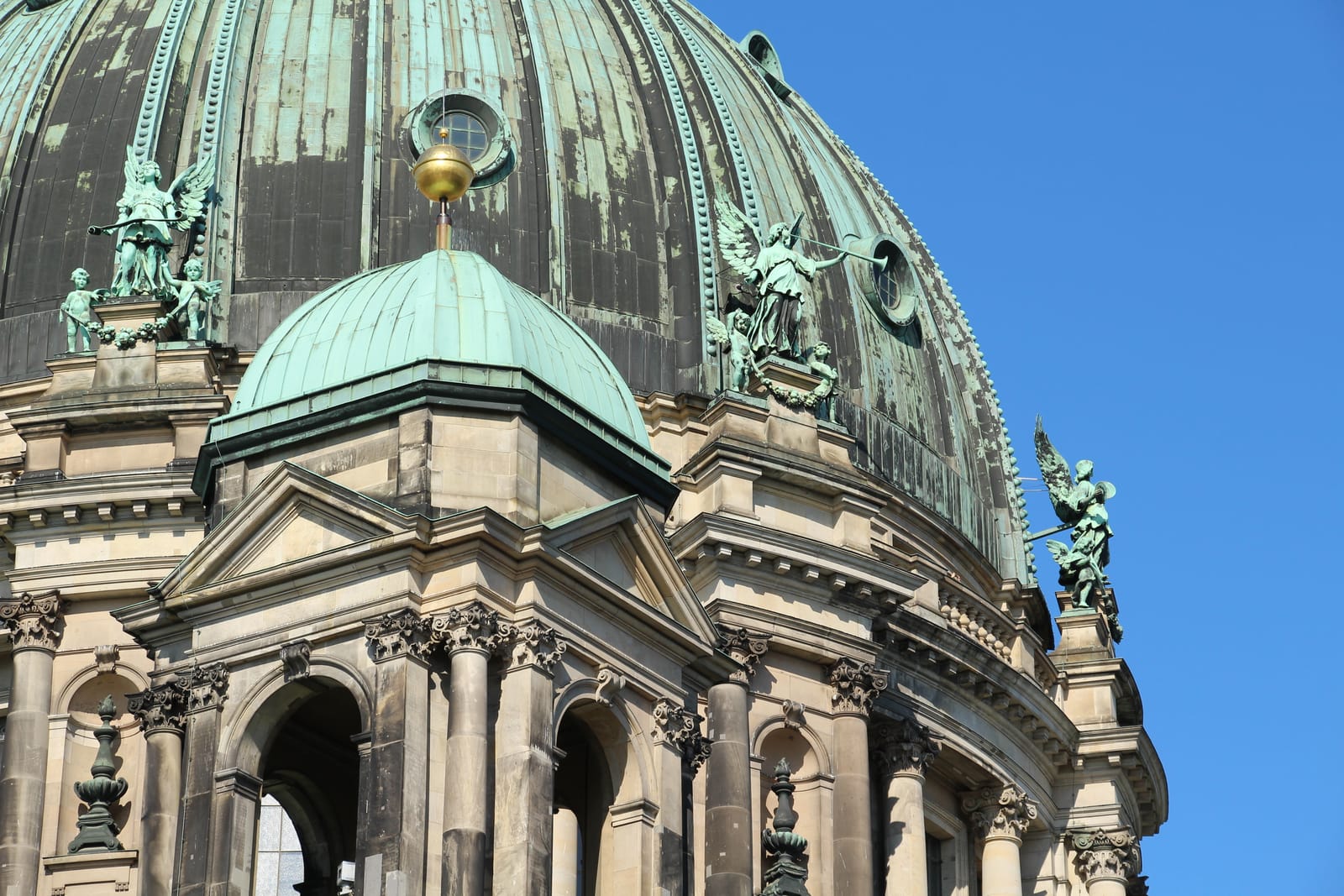
Stand on the paths near the fountain and let the whole front fill your view, because this is the side it was built to be seen from. The cathedral faces west, onto the Lustgarten, and everything about this face is meant to stop you: a two-storey front, a hall of columns, a granite staircase, and above it all a dome of green copper.
The ambition behind it was not modest. The cathedral itself describes the building as Emperor Wilhelm the Second's Berlin answer to Saint Peter's in Rome. The architect was Julius Carl Raschdorff, a Catholic from Silesia who had been city master builder in Cologne, which is a nice irony for the largest Protestant church in Germany. The foundation stone went down on the 17th of June 1894, with 1900 as the target. Delays pushed the opening to the 27th of February 1905. Raschdorff had to rework his plans more than once, not least after the Prussian parliament granted him only 10 of the 20 million marks he had hoped for.
Now look up at the dome, and then at the four towers, because what you are seeing is not quite what 1905 saw. In May 1944 the dome burned. When East Germany finally rebuilt the exterior, from 1975, the main dome and the tower tops came back in a much plainer form, each one 16 metres lower, with every lantern that crowned them removed and a completely new cross on top. The reason was political. The government did not want a fully restored monument of the Empire outshining its own new state buildings nearby, the Palace of the Republic among them. So the cathedral was 114 metres high when it opened and is 98 today.
The arched mosaic over the main door came late, in 1920, and the bronze doors below it in 1907. Notice too how dark the stone is. That is not age alone. The cathedral's own builders say soot, dust and rubber from the traffic settle on the sandstone, and air pollution mixed with rain forms acids that slowly eat into it.
The ground under your feet has had a busier life than the church. The Lustgarten began as the palace kitchen garden, became a formal pleasure garden in 1646, and in 1713 the soldier king Frederick William the First turned it into a sand-covered parade ground. The Nazis paved it over for mass rallies in 1934. Only at the end of the 1990s did it become a park again, and the fountain in front of you stands where Schinkel had planned one, on the spot where the first fountain here threw its water 13 metres high on the power of a steam engine.
LarsMueller, CC0, via Wikimedia Commons. Photo: LarsMueller

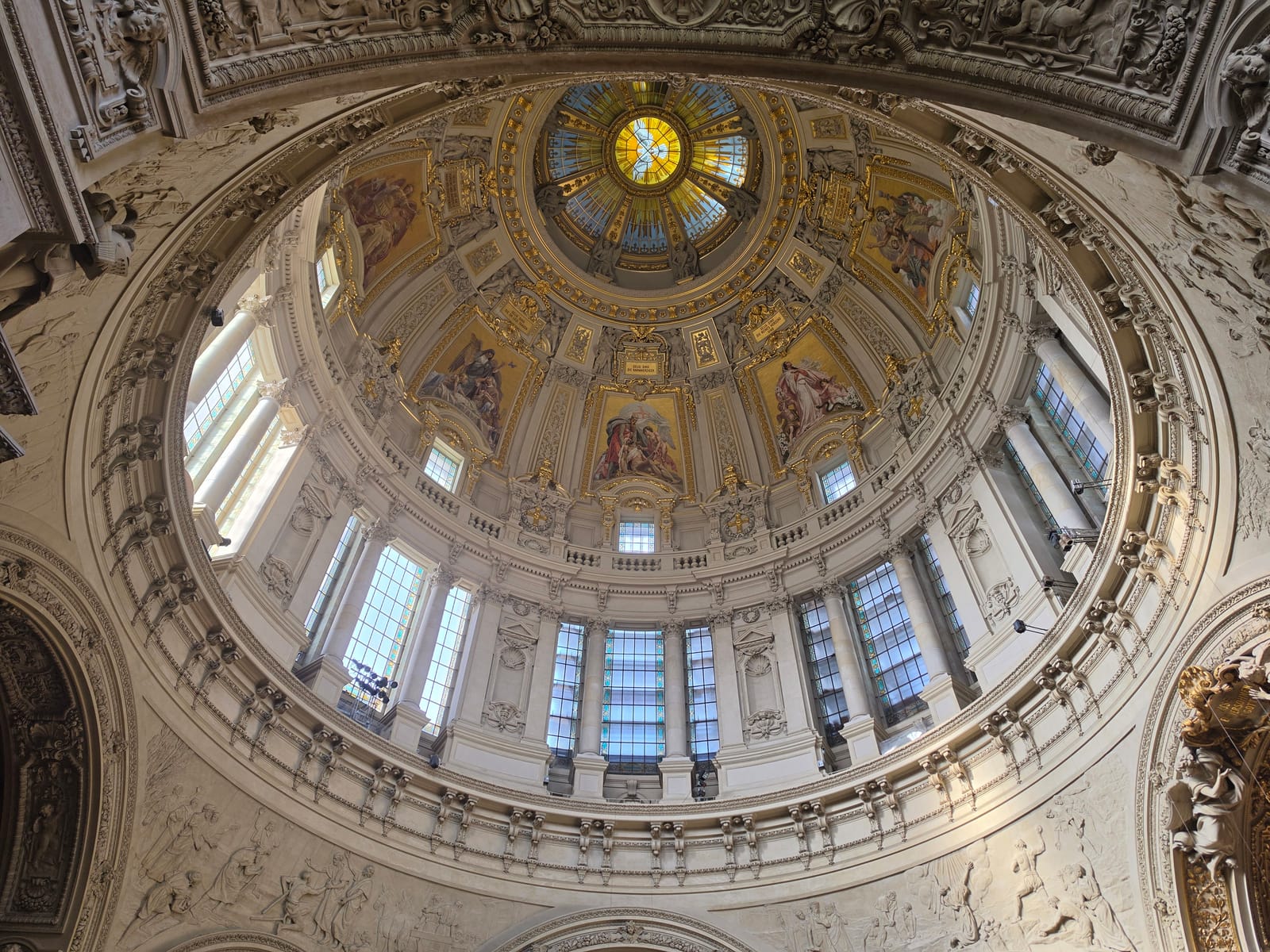
Stop 2 of 5 · Sermon Church (Predigtkirche), the main room: stand in the centre, under the dome
Under the dome of the Sermon Church
Julius Carl Raschdorff (1823–1914); dome mosaics after Anton von Werner (1843–1915); reliefs by Otto Lessing (1846–1912); steel structure of the dome calculated by Heinrich Müller-Breslau (1851–1925) · 1894–1905; dome burned 24 May 1944; emergency dome 1952–53; re-inaugurated 6 June 1993; mosaics completed 2002 · Sandstone, stucco, gilding and stone mosaic; the dome 33 metres in diameter
Look for
- The round window at the very top, with the dove of the Holy Spirit inside a halo of rays.
- The gold-ground mosaic fields of the Beatitudes around the dome. They are recreations, made to Anton von Werner's own surviving models and finished only in 2002.
- The white reliefs by Otto Lessing in the curved fields just above the statues, scenes from the Acts of the Apostles: the stoning of Stephen, the conversion of Paul, Paul in Athens, the healing of the lame man.
Transcript (2:04)
Walk to the middle of the church, stop, and tip your head back. This is the Predigtkirche, the Sermon Church, the main room of the cathedral, and the dome above you is 33 metres across. The cathedral's own description is that the room feels bright and sublime, and for once the official word is the right one: tall windows all round the drum, gold everywhere, and colour poured into the mosaics.
At the very top is a round window with the dove of the Holy Spirit in a halo of rays. Around it run the mosaic fields of the Beatitudes, the blessings from the Sermon on the Mount. They were designed by Anton von Werner, the painter who more or less directed the look of this whole interior and who enjoyed the Emperor's personal favour. Wilhelm the Second was not a hands-off patron. Von Werner changed his designs for these fields to suit the Emperor's own wishes.
Now for the surprise, and it is the reason this room exists in the form you see. On the 24th of May 1944, during one of the heaviest raids on Berlin, a canister of liquid incendiary hit the lantern on top of the dome. Under the copper roof was a wooden lining insulated with peat, and it caught fire where no fire crew could reach it. The burning lantern collapsed straight down, through the inner stone dome above you, into this church, where it smashed through the floor you are standing on and broke open coffins in the royal crypt below. There is a story, handed down rather than proven, that the cathedral organist Fritz Heitmann carried on playing with the dome open to the sky.
For years there was a hole 20 metres wide above this spot. It was only sealed with an emergency dome in 1952 and 1953, and by then wind and weather had destroyed most of the mosaics. What you are looking at was recreated, with Italian specialists, from von Werner's original models, which had survived. The last section was finished in 2002. The church itself had reopened on the 6th of June 1993, with Chancellor Helmut Kohl in the congregation and the service on national television.
One more thing to take in from here. The steel frame that holds all this up was calculated by the engineer Heinrich Müller-Breslau, and in 2007 the historic dome structure was nominated as a landmark of German civil engineering. Then lower your eyes to the curved fields just above the big statues. The white reliefs there are Otto Lessing's scenes from the Acts of the Apostles: Stephen stoned, Paul converted, Paul in Athens, and Peter and John healing a lame man.
LarsMueller, CC0, via Wikimedia Commons. Photo: LarsMueller

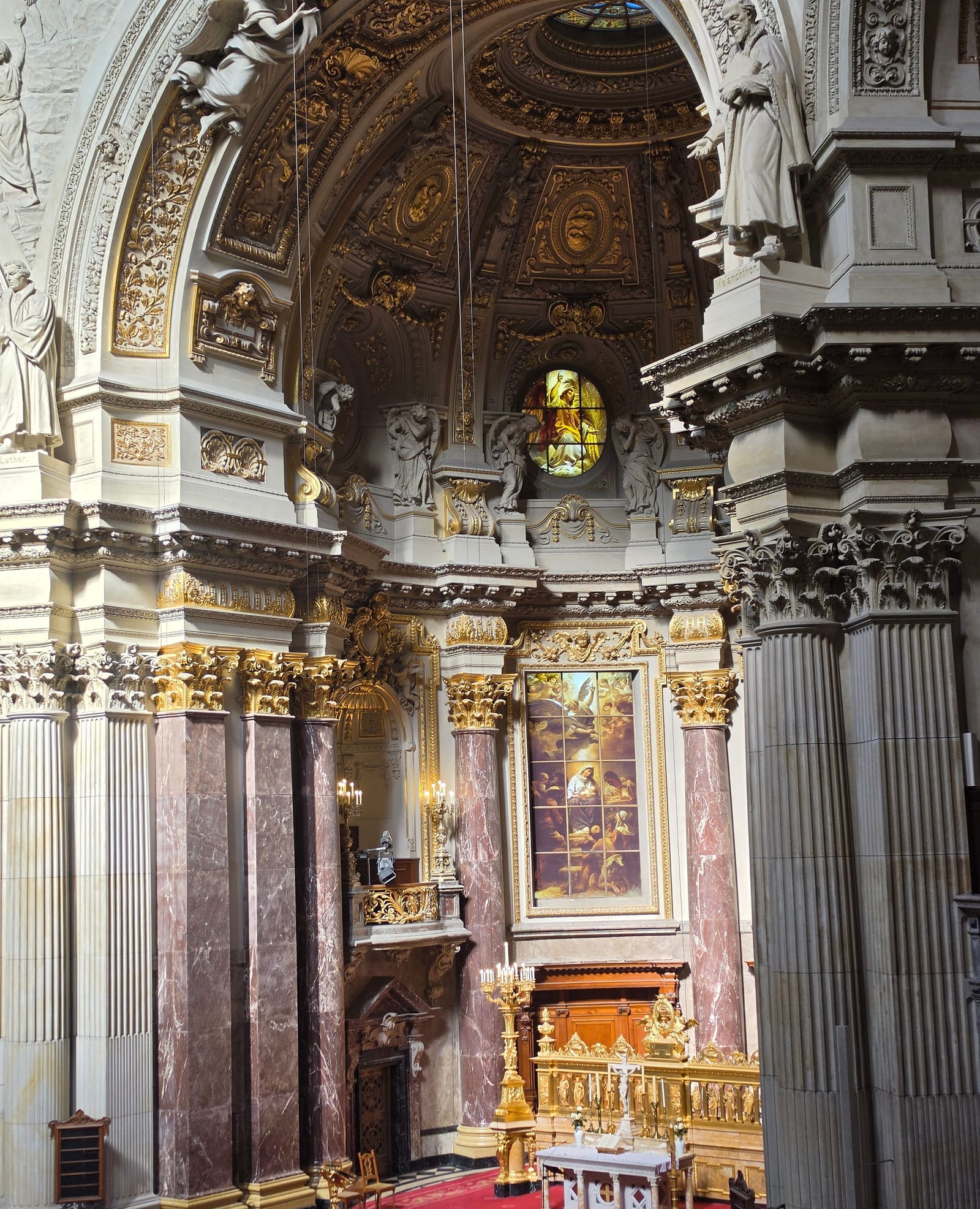
Stop 3 of 5 · Sermon Church (Predigtkirche), east end: the chancel (Altarraum), seen from the floor of the church
The chancel and its altar windows
Altar by Friedrich August Stüler (1800–1865); Apostles' Screen and candelabra designed by Karl Friedrich Schinkel (1781–1841); windows after Anton von Werner (1843–1915); pulpit by Otto Raschdorff (1854–1915) · Altar 1850 and screen from the earlier cathedral; pulpit 1908; windows reconstructed by 1999 · White marble and onyx altar, gilded bronze screen, oak pulpit; the chancel raised seven steps, flanked by sandstone reformer statues four metres high
Look for
- The three tall windows behind the altar: the Nativity in the middle, the Crucifixion and the Resurrection on either side, all after Anton von Werner's designs.
- The gilded screen behind the altar with its row of small apostles. Schinkel designed it for the old cathedral, in bronze; it has since been gilded all over.
- The white altar table of marble and yellowish onyx, half Lutheran block altar and half Reformed table, made to stand for the union of the two churches.
- The carved oak pulpit and its inscription, Des Herrn Wort bleibet ewiglich, the Word of the Lord endures for ever.
Transcript (2:06)
Turn from the middle of the dome towards the east end, where the floor rises seven steps to the chancel. The cathedral calls this part particularly splendid, and it is the one place in the room where the Emperor's builders were happy to reuse the past. Most of what stands up there came from the older cathedral that was knocked down to make way for this one.
Start with the three tall windows behind the altar. The middle one is the Nativity, and on either side are the Crucifixion and the Resurrection. They are Anton von Werner's designs, but the glass is not his. In December 1940 the blast from a British air raid blew out these windows along with every other window in the building. Von Werner's designs survived, and the altar windows were remade to them, a job finished in 1999. So the colour falling on the altar is late twentieth century glass telling you exactly what the Emperor saw.
Now the altar itself, the white table at the top of the steps. It is marble with yellowish onyx, designed by Friedrich August Stüler and made in 1850 for the old cathedral, and it is a piece of theology in stone. It mixes a Lutheran block altar with a Reformed table altar, because this church stood for the union of the two Protestant traditions in Prussia. Behind it rises the gilded Apostles' Screen, designed by Karl Friedrich Schinkel. It was bronze to begin with and is now gilded all over, and the small apostles along it are copies of the figures on the tomb of Saint Sebald in Nuremberg. The two tall floor candelabra of gilded iron are Schinkel's too, modelled by the sculptor Theodor Kalide; Raschdorff had them made taller and added to for the new church. Behind the screen, in the baptismal area, stands a white marble font by Christian Daniel Rauch.
Then look to the side at the oak pulpit, designed by Otto Raschdorff, the architect's son, who worked in his father's office. It was one of the few things not ready for the opening and was only finished in 1908. Carved along it are the words Des Herrn Wort bleibet ewiglich, the Word of the Lord endures for ever.
Finally, the stone giants guarding this end of the church. On the altar side stand four-metre sandstone statues of the reformers, Luther, Melanchthon, Zwingli and Calvin. Face the other way and you will find their political counterparts, the four princes who backed the Reformation, gathered around the Emperor's own box. The reformers face the rulers across the room, which is the whole argument of this building in two rows of statues.
LarsMueller, CC0, via Wikimedia Commons. Photo: LarsMueller

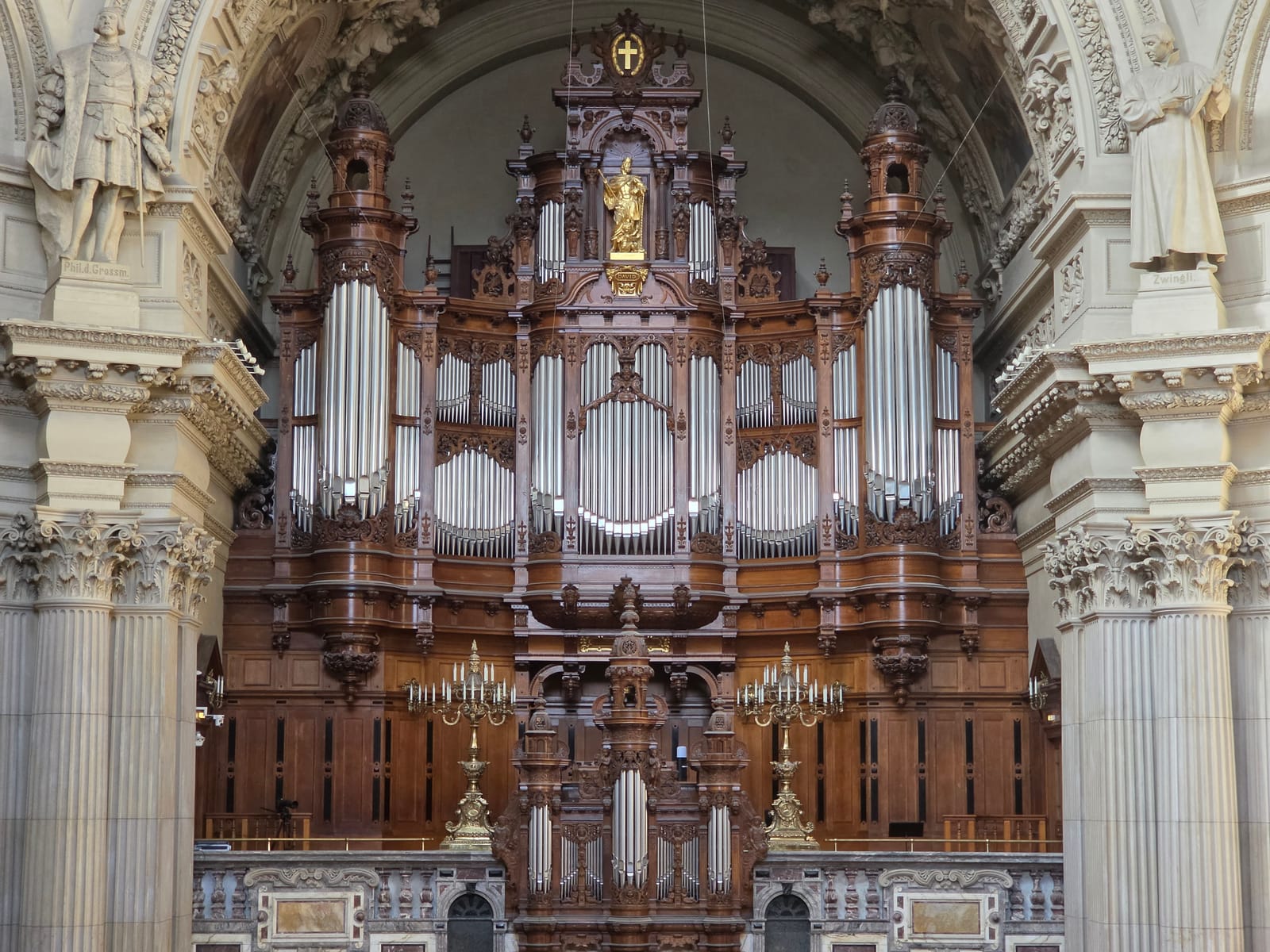
Stop 4 of 5 · Sermon Church (Predigtkirche), north side, facing the organ; the Great Elector's sarcophagus stands beneath the organ, Schlüter's pair opposite under the south gallery
The Sauer organ and the royal sarcophagi
Wilhelm Sauer (1831–1916), organ builder of Frankfurt an der Oder; case after Otto Raschdorff (1854–1915) and the sculptor Richard Moest (1841–1906); ceremonial sarcophagi of Frederick I and Sophie Charlotte by Andreas Schlüter (1659–1714) · Organ 1905, restored to its 1905 state 1988–1993; Schlüter's sarcophagi 1705 and 1713, in the Sermon Church since the Memorial Church came down · Oak case and metal pipes: 7,269 pipes and 113 stops over four manuals and pedal, with three ranks of 32-foot pedal pipes
Look for
- The carved oak case and its silver front pipes. Otto Raschdorff, the architect's son, designed the case.
- Beneath the organ, the Baroque ceremonial sarcophagi of the Great Elector Frederick William and his second wife Dorothea.
- Across the room, behind bars under the south gallery, Andreas Schlüter's two gilded coffins for Frederick I and Sophie Charlotte. At the foot of hers, Death sits wrapped in a shroud, writing her name.
Transcript (2:08)
Face the north side of the church, where the organ stands on its gallery in a case of carved oak. When it was inaugurated in 1905 it was reckoned the largest organ in Germany: 7,269 pipes, 113 stops, four keyboards and a pedal board. Three of its pedal stops use pipes 32 feet long. It was built by the court organ builder Wilhelm Sauer of Frankfurt an der Oder, and it marks the end of an era. It was one of the last great Romantic orchestral organs, voiced to sound like the symphony orchestras of its day, and the cathedral says it is now the largest organ of the Late Romantic period preserved in its original state.
After the war thieves stole about a third of the pipes and ripped out parts of the mechanism to sell the metal. Between 1988 and 1993 Sauer's own firm restored it to its 1905 state, adding only a stronger blower so that the wind holds steady when everything is pulled out at once.
Now drop your eyes to the floor below the organ. Those large Baroque coffins belong to the Great Elector, Frederick William of Brandenburg, and to his second wife, Dorothea. They used to stand in the Memorial Church, a whole wing on the north side of the cathedral. East Germany blew it up in 1975, and the ceremonial coffins were moved in here, under the organ and under the south gallery. They are cenotaphs. The bodies lie in the crypt beneath your feet.
Turn right round and look across the room, under the south gallery, for the gilded pair behind the bars. The cathedral itself admits they are badly placed, visible only from two sides and through the bars. To my eye they are the finest things in the building, and they are by Andreas Schlüter, the sculptor and architect of the Berlin Palace. The queen's came first, in 1705, the king's in 1713, both cast in gilded tin and lead. Sophie Charlotte was clever and well connected; she kept company with scholars, the philosopher Leibniz among them, and gave the push that led to the Academy of Sciences in Berlin, and her husband named Charlottenburg Palace after her. At the foot of her coffin sits Death, wrapped in a shroud, writing her name on the tablet of history. Frederick I, who crowned himself the first King in Prussia in 1701, loved pomp above everything, and his coffin is the richer of the two. At its head, two women standing for Brandenburg and Prussia hold up his crowned portrait. At its foot, a woman weeps into her hands, and beside her a putto, a little boy, is blowing soap bubbles.
Fred Romero from Paris, France, CC BY 2.0, via Wikimedia Commons. Photo: Fred Romero from Paris, France
.jpg)
Stop 5 of 5 · The dome walkway (Kuppelumgang) at 50 metres, reached by the visitors' staircase; walk the full circle
The walkway around the dome
Julius Carl Raschdorff (1823–1914); dome rebuilt in simplified form 1975–1984, with cathedral builder Rüdiger Hoth overseeing the reconstruction from 1975 · 1905; outer dome burned 24 May 1944; rebuilt exterior completed 1984 · A walkway around the drum 50 metres above the ground; the dome itself 98 metres high
Look for
- West, straight down: the Lustgarten, where the first stop was, with Schinkel's Altes Museum along its northern side.
- East-north-east, about 600 metres away: the television tower, one of the sights the cathedral itself names for this view.
- The angels with their instruments on the dome behind you, close enough up here to see properly.
- The Spree below the east side, with its tourist boats, and on a good day music drifting up from the Lustgarten.
Transcript (2:05)
You have earned this one. You are on the walkway round the drum of the dome, 50 metres above the ground, and there is no glass between you and the city, only a wide balustrade. The cathedral says you can hear music being played down in the Lustgarten from here, and on a quiet day you can.
Start by finding the park you stood in at the beginning. It is due west, straight below you, a rectangle of lawns and paths, and the long colonnade along its right-hand, northern side is Schinkel's Altes Museum. Once, this was the palace kitchen garden, then a parade ground, then a paved rally square, and now it is a park again. Now look past the park, due west and a little under two kilometres away, for the Reichstag, one of the sights the cathedral names for this walk.
Now walk round to the east and north-east. The television tower is there, about 600 metres off, and a little to the right of it, due east, the red brick tower of the Rotes Rathaus, the city hall. Below you on the east side runs the Spree, with its tourist boats. To the south-south-east, very close, is the Humboldt Forum, standing on the site of the Berlin Palace. That neighbour explains the building you are standing on. The cathedral's story began as a chapel inside the palace, its crypt and tombs document five hundred years of the ruling family's burial customs, and the cathedral itself says it is still closely linked to the palace.
Then look up behind you at the dome itself. You are close now to the angels with their instruments that ring it. The dome above them is not the dome of 1905. After the fire of 1944 East Germany rebuilt it, lower and plainer, and the cathedral's own history admits that the shape of the dome had been argued over by architects since the day it was built. The plain version has now been protected as a monument in its own right, which makes any return to the old outline all the harder.
Finally, on the north side, look down at the edge of the building. Roughly a third of the cathedral as first laid out is missing, and this is where it was: the Memorial Church, a wing for the dynasty's ceremonial tombs, which was blown up on the 30th of October 1975. Some 204 of its carved facade stones were saved, and they still lie in a wood at Ahrensfelde. The cathedral's own description of the empty ground below you is an unattractive spot, and from up here you can see exactly what it means.
Independent guide · Chiaro
Point Chiaro at anything at Berlin Cathedral.
Reformers four metres tall, 91 Hohenzollern burials in the crypt, a marble font by Rauch and a whole city laid out below the dome: five recordings leave most of it unsaid. Hold up the Chiaro app to a coffin, a statue or a rooftop seen from the walkway, and it names the maker, the person buried there or the building on the skyline, then carries on for as many follow-up questions as you care to ask.
Before you go
Getting there
The postal address is Am Lustgarten, 10178 Berlin; the cathedral itself stands on the Museum Island in the Mitte district. The main front faces west onto the Lustgarten park, where the first stop is. Since March 2026 the building has been step-free as far as the Cathedral Museum: a self-service lift on the north side brings you up from street level to the cathedral arcades, and from the arcades everyone goes in through the large portals; inside, a lift beside the visitors' staircase in the south tower runs from the crypt up to the Cathedral Museum. The dome walkway is the exception and cannot be reached by visitors with reduced mobility.
By U-Bahn, line U5 to Museumsinsel; by S-Bahn, lines S3, S5, S7, S9 or S75 to Hackescher Markt; by tram, M4, M5 or M6 to the Spandauer Straße stop; by bus, lines 100, 200 and 300, getting off at Am Lustgarten beside the park. These are the directions the cathedral itself gives.
Tickets and entry
- On most days the cathedral opens at 9 a.m. and closes at 6 p.m., except Sunday, when it opens at noon; last admission is at 5 p.m., an hour before closing, after which the areas close one by one. Services, weddings and concerts change the hours on some days and may restrict access while they last, and the main church cannot be toured during a service, so look at the daily calendar on berlinerdom.de before you set off.
- Admission costs 15 euros, or 12 with a concession, and one adult with up to four children under 18 pays 15. That single ticket takes in the church itself, the Imperial Staircase, the wedding and baptism chapel, the royal crypt, the museum and the dome walkway. Buy online, at the machines or at the ticket office; payment is cashless only, and a ticket stays valid for a year from the day you buy it.
- The walkway round the dome is nearly 300 steps up, with no lift and no way to turn back on the last section. It stays closed in heavy rain, heavy snow, ice and strong wind.
- Bags bigger than A3, suitcases and luggage of any kind are not allowed in. There are a limited number of lockers in the basement, which the cathedral asks you to use before your visit; photography is fine for private use, without flash or tripod, but not during services.
The official audio guide
The cathedral has its own audio guide and it comes with the ticket at no extra charge. You pick it up right next to the ticket office and hand it back at the exit; it speaks German and English, plus French, Spanish, Italian, Russian or Polish; a version for children exists in the first two. Thirty-minute guided tours are included as well, generally every day at 1, 2 and 3 in the afternoon, starting in the Sermon Church. Where the official audio walks you through the whole building, this page picks five places, starts outside where no ticket is needed, and prints each script in full under its player.
Official site →Questions
Is there a free Berlin Cathedral audio guide?
This page is free: five narrated places from the Lustgarten up to the dome walkway, playable in your browser, with the full text of each recording set out under it. The cathedral's own audio guide adds nothing to your bill either, since it comes with the admission ticket, in seven languages.
Can I listen to the Berlin Cathedral audio guide before I buy a ticket?
For the first stop, you can: it is meant for the Lustgarten, the public park outside the main front, and all it asks is that you can see the building. The other four are inside the cathedral and up on the dome walkway, all covered by one admission ticket.
How much is the official Berlin Cathedral audio guide?
Nothing on top of admission. The cathedral's audio guide is included in the ticket price, collected next to the ticket office and returned at the exit, and the standard ticket is 15 euros. The thirty-minute guided tours at 1, 2 and 3 in the afternoon are included too.
Is Berlin Cathedral open on Sundays?
Yes, generally from 12 to 6 p.m., with last admission at 5 p.m. On weekdays and Saturdays it opens at 9 a.m. Services come first in a working church, so the cathedral's daily calendar is the place to check the hours for a particular day.
How high is the Berlin Cathedral dome walkway, and is there a lift?
The walkway runs round the dome 50 metres above the ground, and there is no lift: it is nearly 300 steps, and on the final section you cannot turn back. It closes in heavy rain, snow, ice and strong wind, and it is the one part of the visit not open to visitors with reduced mobility.
More audio guides
Made by Chiaro. Not affiliated with Berlin Cathedral.