
Musée Marmottan Monet · Paris · Independent guide
Musée Marmottan Monet audio guide,
five stops, free.
Play the five tracks on this page in any browser. The museum holds more than a hundred Monet canvases and the largest Berthe Morisot collection in the world, and Chiaro can take you through any work in the house from a photo.
Made by Chiaro. Not affiliated with the Musée Marmottan Monet.
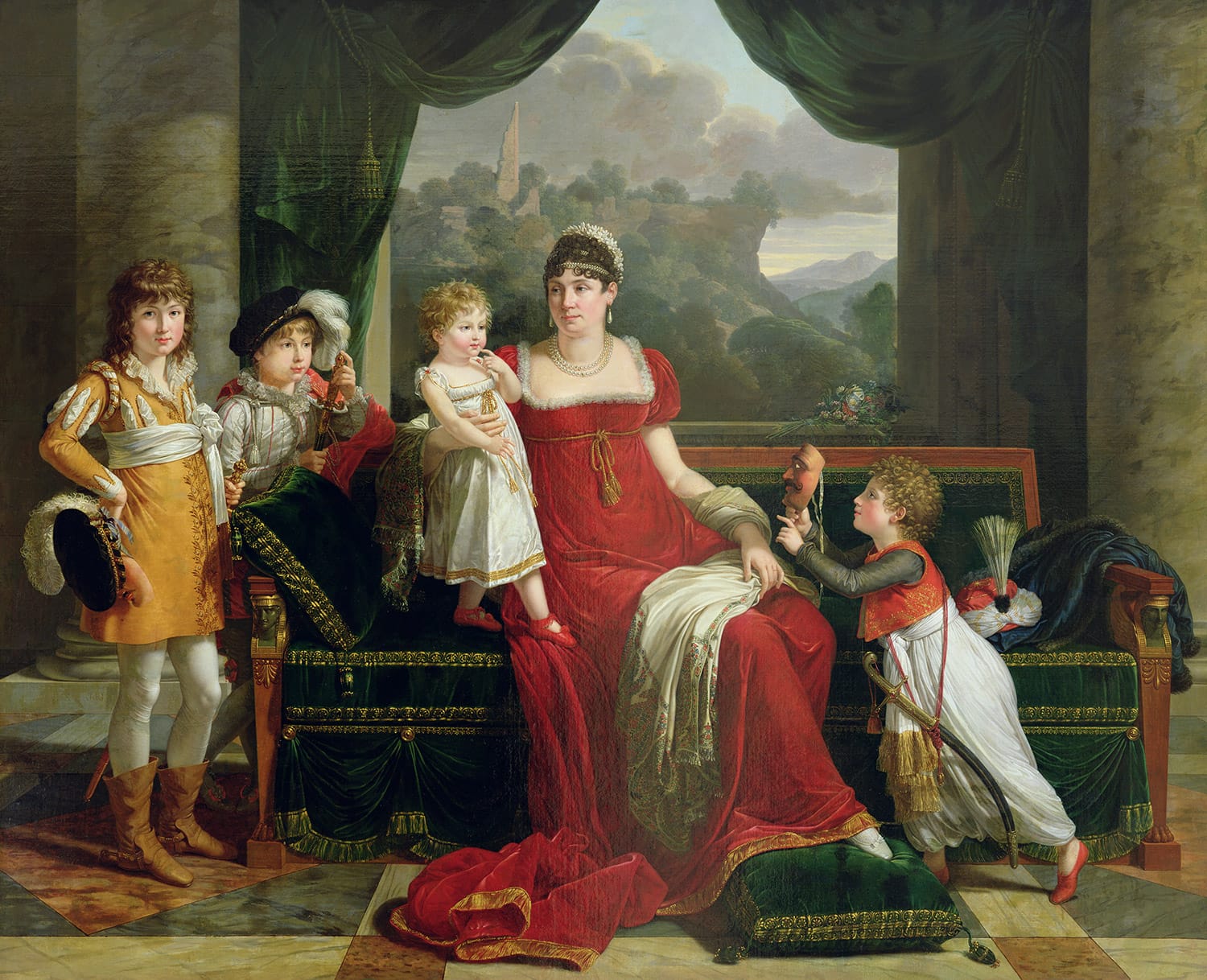
Portrait of the Duchess of Feltre and Her Children
Musée Marmottan Monet, Paris
That was the free part
Chiaro narrates any work in the Musée Marmottan Monet from a photo.
The five stops · 11 minutes of audio
Five stops, one walk,
in the order you will walk them.
Paul Marmottan's house became the home of Impressionism through a run of gifts, and this Musée Marmottan Monet audio guide walks you through them. Begin in the Empire rooms Paul Marmottan furnished, with Fabre's giant family portrait of 1810; move on to the Berthe Morisot collection for her honeymoon picture of Eugène Manet and The Cherry Tree; then go down to the Salle Monet, the room built under the garden and opened in 1970, for The Train in the Snow and, last, Impression, Sunrise. The recordings come to about ten minutes. It is one townhouse, so the walking between stops takes minutes, and with time to look the visit runs to about an hour.
We checked every claim twice, against the museum's own catalogue notice for each work and then against a second, independent reference, most recently on 25 September 2026. Paintings here do leave the building, Impression, Sunrise among them, and the museum publishes no room numbers, only its collections and the Salle Monet; so if what hangs in front of you doesn't match these notes, the label beside the frame is right and we are wrong, and a message to us gets the page fixed.

Stop 1 of 5 · Empire rooms of Paul Marmottan's house
Portrait of the Duchess of Feltre and Her Children
François-Xavier Fabre · 1810 · Oil on canvas, 227 × 276 cm
Look for
- Alphonse, the small boy on the right in oriental costume, holding up a moustachioed mask to frighten his baby sister Elphride, the only one of the four children not in fancy dress.
- The two older boys on the left dressed as troubadours: feathered cap, slashed doublet, turned-down musketeer boots, every medieval cliché at once.
- The signature and date at the lower left, Fs Xs Fabre 1810, the year this family went on show at the Salon.
Transcript (2:07)
Start with the red. A velvet dress, a green sofa trimmed with gold, heavy green curtains pulled back on a landscape, and four children arranged around their mother like a family on parade. The canvas is more than two and a quarter metres high and nearly three wide, and it was painted to be seen at the Salon of 1810, with Napoleon's Empire at its height.
The woman is the wife of Henri Clarke, Duke of Feltre, Napoleon's Minister of War. The painter, François-Xavier Fabre, was a pupil of Jacques-Louis David who had spent the Revolution in Florence, and he probably met Clarke in Tuscany, where Clarke was the French ambassador. At that same Salon, Fabre showed a full-length portrait of the duke himself, an official commission, and a portrait of the eldest son that he had painted in Florence in 1802. Father, heir and this family group went on the walls together.
Now read the children from the left. Edgar, born in 1799. Arthur, born in 1802. The little girl standing on the sofa, held by her mother, is Elphride, the only daughter, born in 1808. And the boy on the right is Alphonse, born in 1806. Every child except the girl is in fancy dress. The two older boys are got up as troubadours, with a feathered cap in the style of Henri the Fourth, slashed and laced doublets and turned-down musketeer boots. Alphonse wears an oriental costume, and he is holding up a mask with a big moustache to frighten his sister. Look at her face. That is the only joke in the whole picture.
The rest is dead serious, and that is the point. The museum reads portraits like this one as advertisements for Napoleon's new nobility: large families, plenty of sons, ready to inherit titles that had only just been invented. Clarke's own title came in 1809, after he helped defeat a British landing at Walcheren, in the Netherlands. Five years later he was one of the generals pressing Napoleon to abdicate, and King Louis the Eighteenth made him a peer of France.
The man who brought the painting into this house was Paul Marmottan, a historian of the Consulate and the Empire, who redecorated his home in Empire style and bought this portrait to furnish one of his salons. In 1886 he wrote that the painters of his own day no longer drew, they sketched, and no longer painted, they brushed. He meant the Impressionists. Their most famous picture now hangs under his garden.

Stop 2 of 5 · Berthe Morisot collection
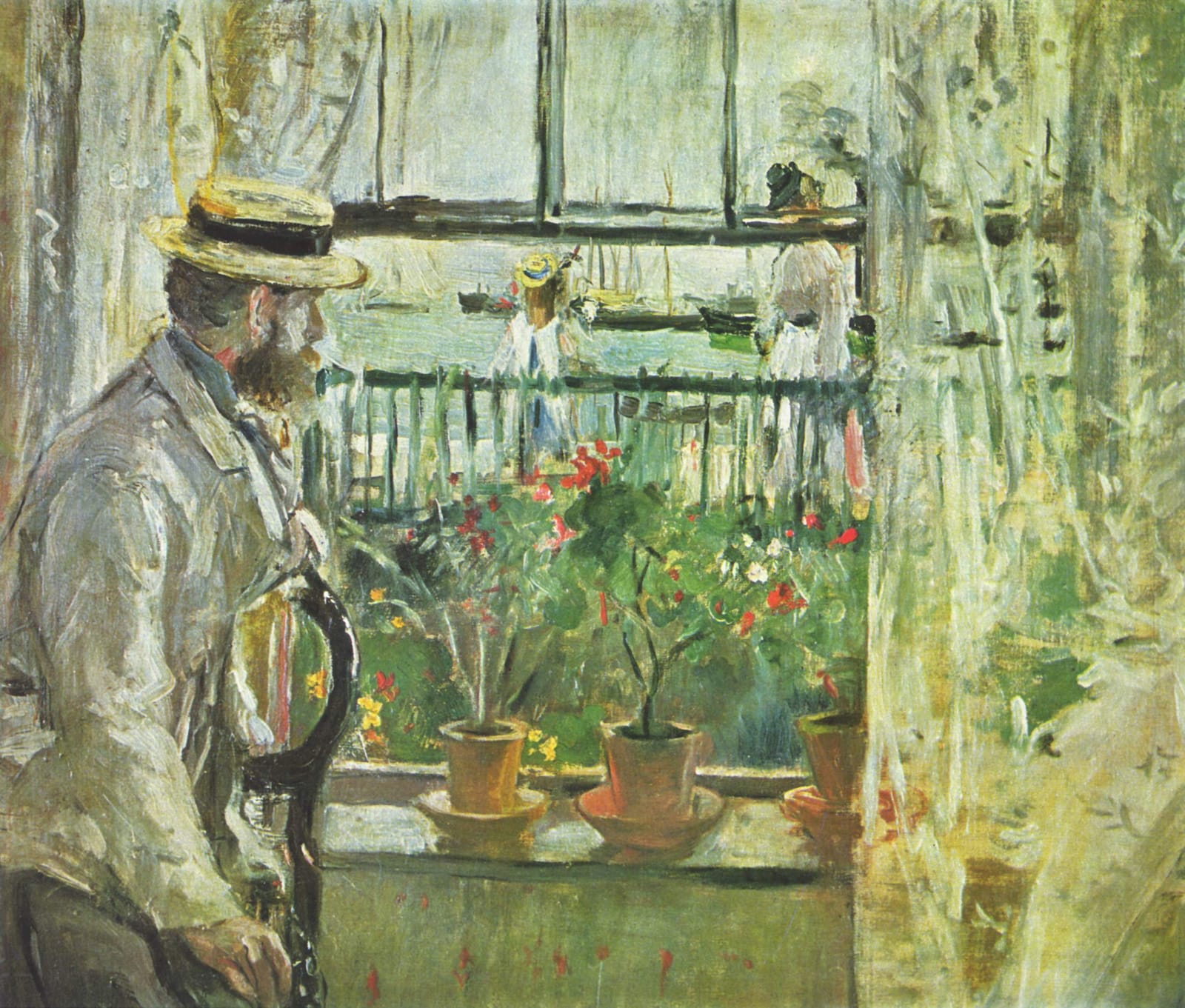
Eugène Manet on the Isle of Wight
Berthe Morisot · 1875 · Oil on canvas, 38 × 46 cm
Look for
- Eugène himself, squeezed against the left edge in a straw boater and seen in profile. Morisot gives her new husband less room than the view.
- The pots of red flowers on the sill and, past the railing, figures in white and boats on the water of Cowes.
- The glass. The window frame and the sheer curtain on the right are painted as light passing through, which is what the museum says really interested her.
Transcript (1:56)
The man in the straw hat is pressed right up against the left edge of the canvas, in profile, looking out. His wife painted him from across the room. They had been married for a matter of months.
Berthe Morisot married Eugène Manet on the twenty-second of December 1874, in the church of Notre-Dame-de-Grâce in Passy, the same old village on the edge of Paris where this museum stands. Eugène was a brother of the painter Édouard Manet. Morisot had met Édouard in 1868 in the galleries of the Louvre, where she worked as a copyist, and she posed for him many times. But she was no apprentice marrying into a family of painters. She had been showing at the official Salon since 1864, and earlier in 1874 she had hung her work in the first Impressionist exhibition, alongside Monet. Eugène encouraged her to keep going, and after the wedding she went on exhibiting under her own maiden name.
This small canvas, thirty-eight by forty-six centimetres, was painted on their honeymoon in England, in the drawing room of the Globe Cottage Hotel at Cowes, on the Isle of Wight. It is the first picture she made of him, and he did not sit for her often.
Now look at where she has put him, and where she has put her attention. He gets a sliver of the left side. The rest belongs to the window: the red flowers in their pots on the sill, the railing, two figures in white passing by, the boats on the water beyond. And the glass itself, with the frame and the sheer curtain on the right, painted as a film of light that you look through rather than at. The museum's reading is that the figure was never really the subject. The view was.
Some historians see something sharper in that arrangement. Women in the 1870s were far less free than men to set up and paint in public space, so Morisot paints the busy waterfront from inside a hotel room, behind a curtain, and lets her husband do the looking out. The painting makes no complaint about it. It simply shows you the room she had to work from, and how much of the world she managed to get in through one window.
There is a reason you can see this picture, and so many of hers, in one place. Morisot sold relatively little in her lifetime, so she is thin on the walls of most museums. Here her descendants left the museum the largest collection of her work anywhere.

Stop 3 of 5 · Berthe Morisot collection
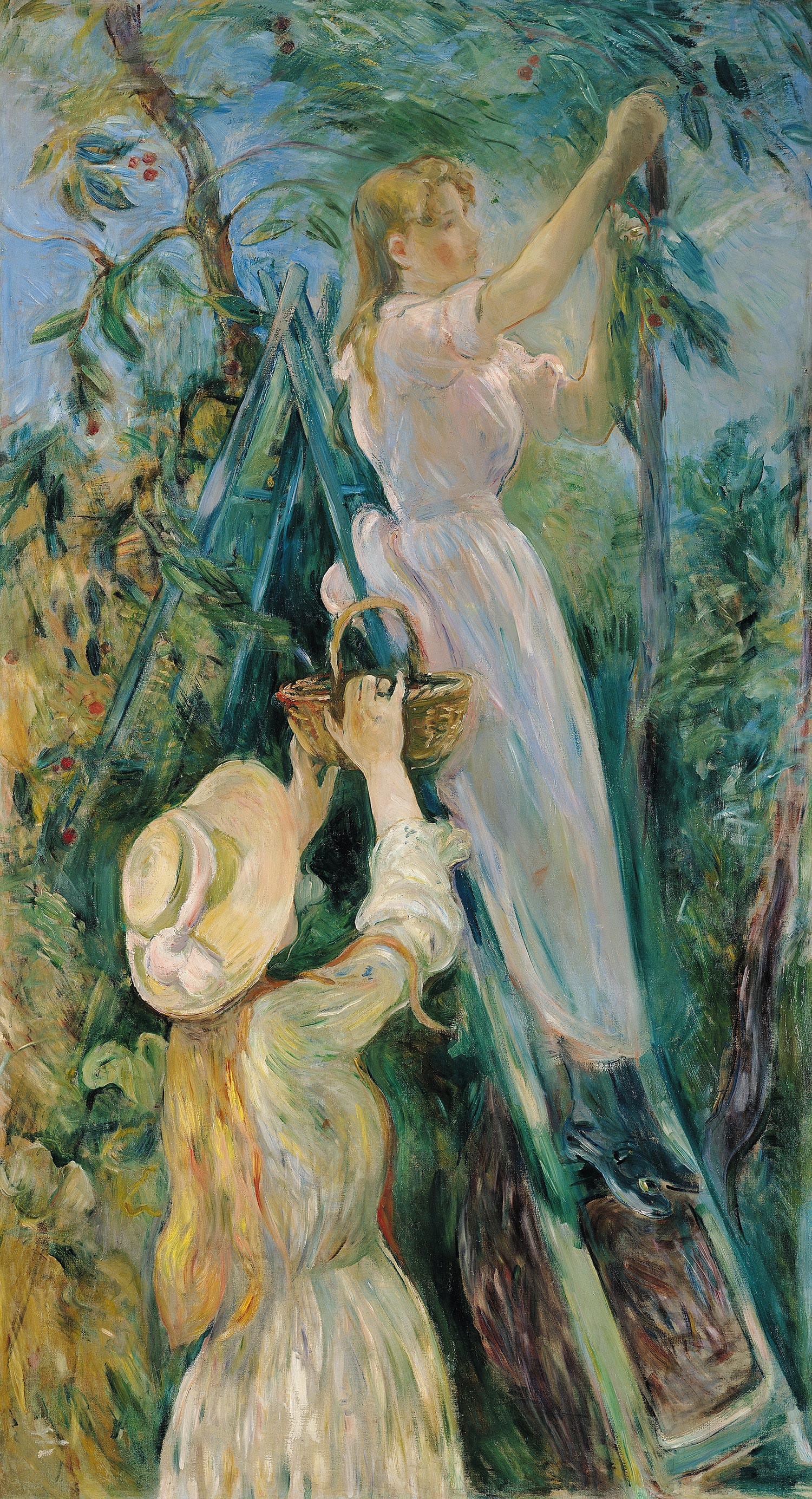
The Cherry Tree
Berthe Morisot · 1891 · Oil on canvas, 154 × 84 cm
Look for
- The girl in pink at the top of the ladder, arm raised into the branches. She began as Morisot's daughter Julie and was finished with a professional model.
- The girl below in the straw hat, lifting the basket up to her. That is Julie's cousin Jeannie Gobillard.
- The shape of the canvas, more than one and a half metres tall and only 84 centimetres wide, so your eye climbs from the basket to the cherries.
Transcript (2:02)
Your eye goes up this painting the way the girl goes up the ladder. The canvas is tall and narrow, more than a metre and a half high and only eighty-four centimetres wide, and everything in it climbs: the blue ladder, the pink dress, the arm reaching into the leaves, and at the very top, the cherries.
The museum calls this Berthe Morisot's most ambitious composition, and it took her two years. She began it in 1891 in the country, at Mézy, in a house the family called la Maison Blotière, with her daughter Julie posing at cherry-picking time. Julie is the girl on the ladder. Below her, in the straw hat, holding up the basket, is Julie's cousin, Jeannie Gobillard.
Morisot worked from life first, a small painted sketch and several drawings, and then carried the composition back to Paris to finish it. There she had a problem. Julie was a teenager and rarely available, so her mother replaced her with a professional model named Jeanne Fourmanoir. Look at the girl on the ladder with that in mind: the pose and the pink dress started as a portrait of a daughter and were finished on a stranger.
She painted two large versions of this scene, and the one in front of you is considered the more accomplished. Renoir advised her to show it at the Salon du Champ-de-Mars, and for a while she thought about it. In the end it was not seen in public until 1896, at a retrospective at the dealer Durand-Ruel's. Morisot had died the year before, in 1895, of pneumonia. Julie was sixteen, and since her father had died three years earlier, she was left an orphan.
The two cousins in this painting married on the same day. In May 1900, Julie married the painter Ernest Rouart and Jeannie married the poet Paul Valéry, in a double wedding in Passy. Their families went on living in this part of Paris, in the sixteenth arrondissement, and when the museum opened in 1934 they came to the inauguration as neighbours. It was the Rouart descendants who finally brought Morisot's paintings here, in a bequest of 1993.
So the girl holding the basket and the girl on the ladder ended up living in the same arrondissement as the house where their picture now hangs. Look at the top of the canvas once more, where the red of the fruit is dotted through the green in quick single touches, the last thing your eye reaches on the way up.

Stop 4 of 5 · Salle Monet, lower level (Claude Monet collection)
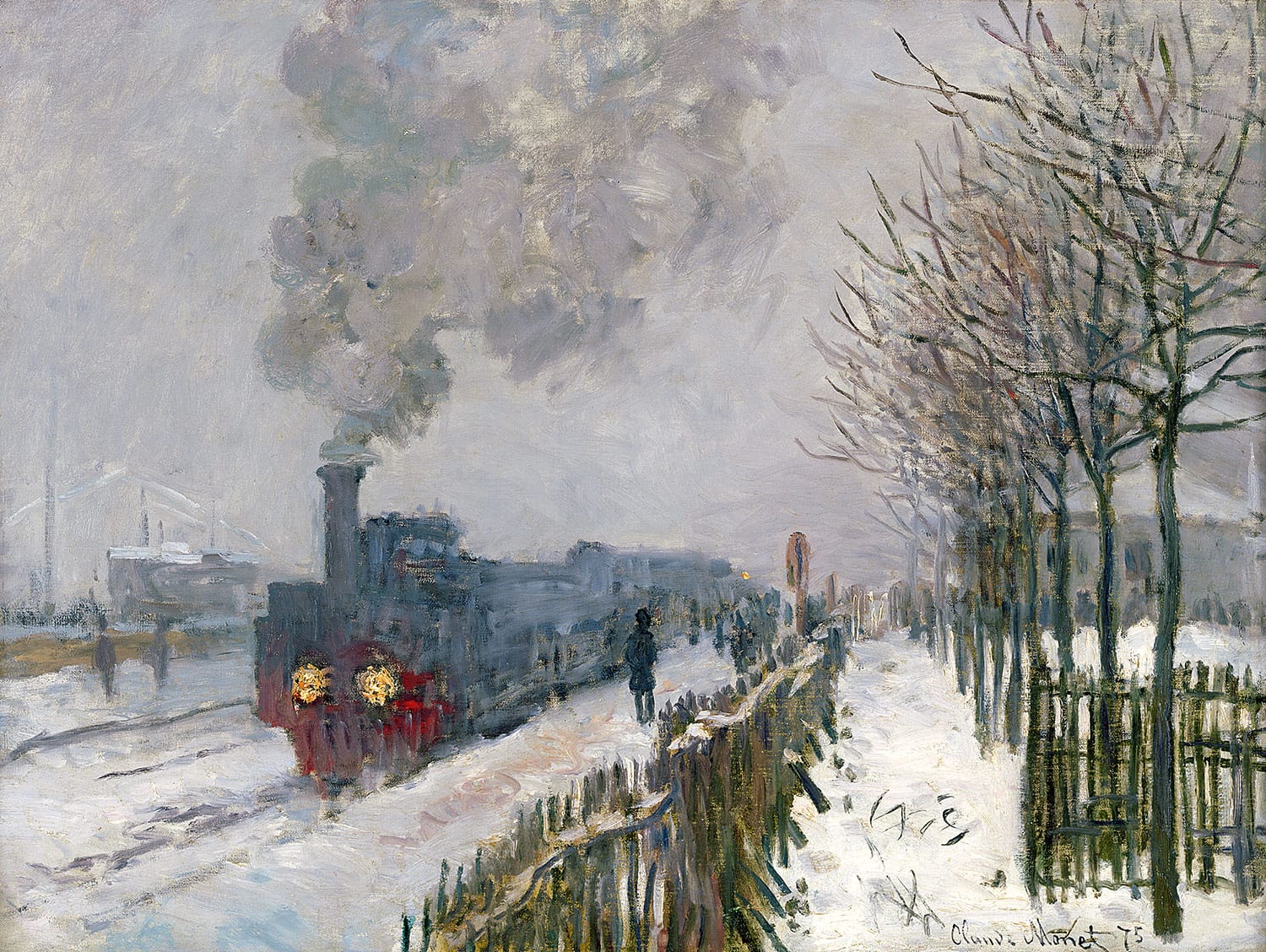
The Train in the Snow. The Locomotive
Claude Monet · 1875 · Oil on canvas, 59 × 78 cm
Look for
- The two yellow headlights and the dab of red on the front of the engine, the only warm colour in a picture made of greys and whites.
- The smoke. It fills most of the sky, and the museum singles it out as an especially subtle study in tones.
- The signature in the lower right corner, Claude Monet 75, written into the snow beside the fence.
Transcript (1:57)
Grey sky, grey smoke, grey snow, and then two small yellow lights coming at you out of the murk. That is the whole trick of this painting, and it takes a second to notice it. Almost everything here is a shade of white or brown-grey, and Monet has saved the only warm colour for the front of the engine: a touch of red and two dabs of yellow for the headlights.
This is the station at Argenteuil, the town on the Seine just outside Paris where Monet settled with his family in 1871. It was his own commuter stop, and he painted it standing on the platform. In the winter of 1874 and 1875 he made a series of sixteen snow landscapes around Argenteuil, most of them quiet rural scenes. This one is the odd one out. It is about a machine.
Two years later, in 1877, Monet would paint the Gare Saint-Lazare in Paris over and over, steam and iron and glass, and the museum sees this picture as the first announcement of that series. Look at how he builds it. The fence and the row of bare trees run along the platform on the right and pull your eye toward the train, and the smoke is doing most of the work, rolling up to fill the sky until you can hardly tell where the cloud stops and the engine's breath begins. The museum calls the treatment of that sky an especially subtle study in tones. It is also a very modern thing to paint in 1875: a timetable, a commute, travellers waiting on a cold platform.
The painting's first owner was a doctor, Georges de Bellio, one of the earliest collectors to back Monet. He bought it in 1876, and he was so keen that he told Monet to sell it to him or keep it himself, because he was afraid it would fall into the hands of a fool. In 1883 he lent it to a Monet exhibition at the dealer Durand-Ruel's.
And then it came here, by the same route as the most famous painting in the building. In 1940 de Bellio's daughter, Victorine, and her husband, Eugène Donop de Monchy, gave the museum eleven Impressionist canvases from her father's collection. This was one of them. Impression, Sunrise was another. Before you go and find it, look down at the bottom right corner, where Monet signed and dated this one in the snow: Claude Monet, seventy-five.

Stop 5 of 5 · Salle Monet, lower level (Claude Monet collection)
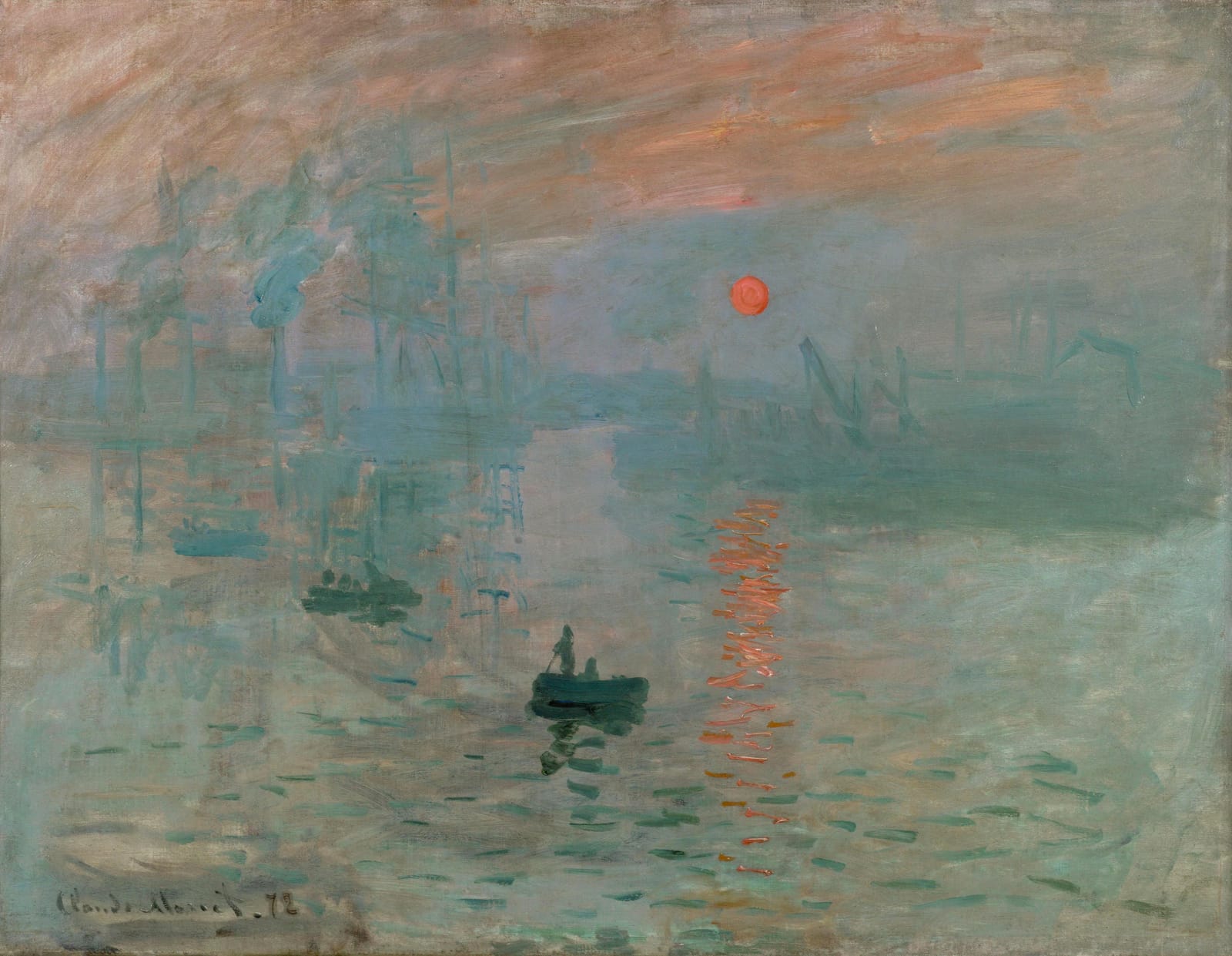
Impression, Sunrise
Claude Monet · 1872 · Oil on canvas, 50 × 65 cm
Look for
- The orange sun and the broken streak of its reflection on the water. The museum says Monet added them last, when he was finishing the picture.
- The dark rowing boats of the ferrymen in the foreground, each one only a few strokes, also added at the end.
- The cranes, smokestacks and masts of Le Havre's port, barely there in the blue-grey mist behind.
- The signature at the lower left, Claude Monet, with the date 72 added afterwards.
Transcript (2:48)
It is smaller than people expect. Fifty centimetres by sixty-five, a blue-grey haze with one hot orange disc in it, and a streak of orange on the water underneath. A whole movement in painting was named after this canvas.
It is a view of Le Havre, the port town where Monet grew up. Around November 1872 he was staying at the Hôtel Amirauté, and from the window of his room he looked south-east over the outer harbour in the early morning. You can find the structure if you look for it. The Quai au Bois on the left, the Quai Courbe on the right, where building work was going on, and in the middle, the opening of the tide lock that let the transatlantic ships through to the Bassin de l'Eure. Cranes, smokestacks and masts stand in the autumn mist. Then look at the foreground, at the ferrymen's rowing boats, and at the sun and its reflection. The museum says those were added last, when Monet was finishing, and that the whole picture was painted in a few hours.
The morning has since been pinned down. In 2014 an astronomer, Donald Olson, and his colleagues used the position of the sun, the tide tables for the harbour, old weather records and the direction of the smoke in the painting to date it to the thirteenth of November 1872, at about twenty-five to eight in the morning.
The name came in 1874. Monet and his friends, shut out of the official Salon, organised their own exhibition in the photographer Nadar's former studio, and Monet sent this picture. When he was asked for a title for the catalogue, he decided it could not decently pass for a view of Le Havre, so he called it Impression. A conservative critic, Louis Leroy, went to review the show for the satirical paper Le Charivari and saw his chance. His article of the twenty-fifth of April 1874 was called The Exhibition of the Impressionists, and it was meant as an insult. A few days later a friendlier critic, Jules Castagnary, used the word as praise, and it stuck to the whole group.
The irony of where you are standing is hard to beat. This museum belongs to the Académie des Beaux-Arts, the institution that had shut these painters out of the Salon, and it was founded on the collection of Paul Marmottan, who had written against them. Then in 1940 Victorine Donop de Monchy, whose father, Doctor Georges de Bellio, had been one of Monet's first supporters, gave the museum this painting and ten other Impressionist canvases. From that day the Académie owned the picture that gave its old enemies their name.
It has not always been here. On the twenty-seventh of October 1985, in broad daylight, five masked gunmen walked into the museum and took nine paintings, this one among them. They were found five years later, in December 1990, in a small villa in Corsica, and the painting went back on the wall in 1991. More recently it has travelled on purpose: to the Musée d'Orsay for the spring of 2024, then to the National Gallery of Art in Washington until January 2025.
Before you leave it, go close to the lower left corner. The signature reads Claude Monet, and the date beside it, seventy-two, was added later. For the painting that Impressionism dates itself from, its own date went on as an afterthought.
Independent guide · Chiaro
Point Chiaro at anything in the Musée Marmottan Monet.
Five paintings end this page, not the museum. Photograph a late Water Lilies panel, Renoir's portrait of Monet or a medieval miniature from the Wildenstein collection, and the app tells you its story, down to the family whose gift brought it to the house, and then takes your questions out loud.
Before you go
Getting there
2, rue Louis-Boilly, 75016 Paris, on the edge of the Ranelagh garden in Passy. You go in through the round Empire vestibule that was once Paul Marmottan's entrance hall.
Métro line 9 to La Muette or Ranelagh, or RER line C to Boulainvilliers. Buses 22 and 52 stop at La Muette–Boulainvilliers, 32 and 70 at Louis Boilly or Ingres, and 63 at Porte de la Muette. Drivers can use the Vinci Park Passy car park at 78 rue de Passy.
Tickets
- Mondays are out: the doors stay shut all day, as they do on New Year's Day, May Day and Christmas Day. Tuesday to Sunday it runs 10 am to 6 pm, last admission 5 pm.
- Thursdays run late, to 9 pm, with the last visitors let in at 8 pm. Whatever the day, the galleries start clearing fifteen minutes before the doors close.
- Booking is optional. A desk ticket is valid only on the day you buy it; an online ticket comes with a fifteen-minute entry slot, lets you skip the ticket queue, must be printed or shown on your phone, and cannot be exchanged or refunded.
- Heading to Giverny as well? A double ticket with the Fondation Monet in Giverny costs 27 euros, or 16 for under-18s and students under 25.
The official audio guide
You can hire the museum's own audioguide at the desk for 4 euros; it covers the permanent collections and the temporary exhibition, and for the current exhibition it comes in French and English. The five tracks here are free, and for any other canvas in a collection of more than a hundred Monets, a photo is all the Chiaro app needs.
Official site →Questions
Is there a free Musée Marmottan Monet audio guide?
You are on it. Five recordings, from Fabre's Empire portrait to Impression, Sunrise, play straight from this page with the full text printed below each one. For the rest of a collection that includes more than a hundred Monets, photograph the work and the Chiaro app narrates it.
How much is the official Musée Marmottan Monet audio guide?
4 euros, on top of admission. It covers the permanent collections and the temporary exhibition, and the page for the current exhibition, Histories of Landscape, lists it in French and English.
Where is Impression, Sunrise in the Musée Marmottan Monet?
With the Monet collection in the Salle Monet, the large room built on the lower level under the garden and opened in 1970. The museum does not number its rooms, and the painting is lent out from time to time: in 2024 it went to the Musée d'Orsay and then on to Washington.
Is the Musée Marmottan Monet closed on Mondays?
Yes, every Monday, and on New Year's Day, May Day and Christmas Day as well. The rest of the week it opens at 10 am and closes at 6 pm, except Thursdays, when it stays open until 9 pm.
How much does the Musée Marmottan Monet cost?
A standard ticket is 14 euros, and under-18s and students under 25 pay 9; either one includes the temporary exhibition. Children under 7 go free, as do disabled visitors with a companion, job seekers, teachers and art history students, with proof.
How long does the Musée Marmottan Monet take?
Set aside roughly an hour for this five-stop walk, ten minutes or so of it listening. The house is compact, three levels with the Monet room underground, so a full visit including the current exhibition fits comfortably into two hours.
More audio guides
Made by Chiaro. Not affiliated with the Musée Marmottan Monet.