
Arc de Triomphe · Paris · Independent guide
Arc de Triomphe audio guide,
five stops, free.
Thirty years in the building and 49.54 metres high: five parts of the arch explain how it came to be, and any carving they leave out, Chiaro identifies from a photo.
Made by Chiaro. Not affiliated with the Arc de Triomphe.
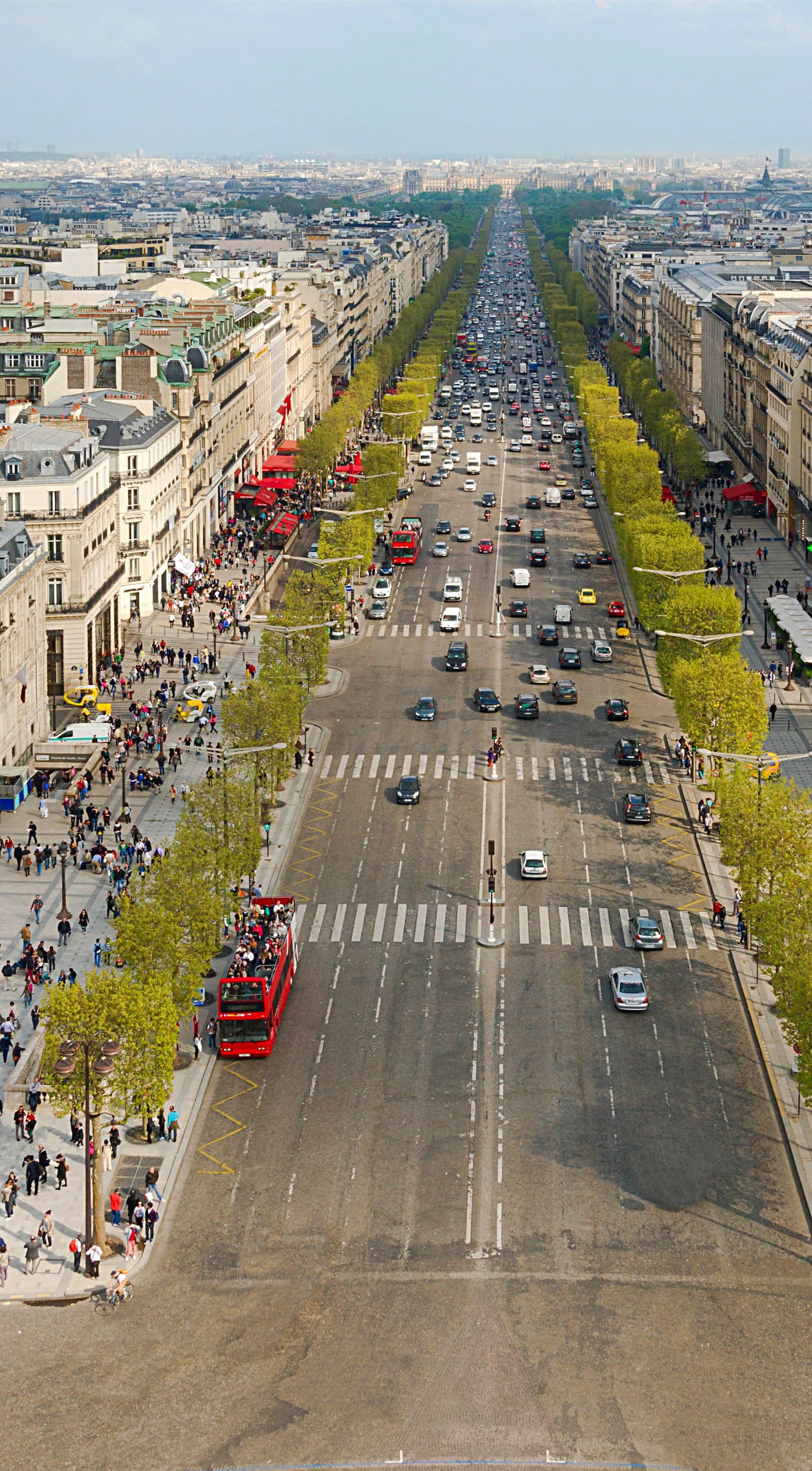
The Champs-Élysées face of the arch
Arc de Triomphe, Paris
That was the free part
Chiaro narrates anything at the Arc de Triomphe from a photo.
The five stops · 11 minutes of audio
Five places, one walk,
in the order you will walk them.
The head of the Champs-Élysées, where the arch closes the end of the avenue and nothing has to be bought yet, is where this Arc de Triomphe audio guide begins: a free, self-guided route in five parts. From there the route goes down into the Passage du Souvenir, the underpass beneath the roundabout, and up onto the terre-plein at the foot of the north-east pillar for Rude's Marseillaise; a few paces on into the great arch for the Tomb of the Unknown Soldier and the walls of names; then, with a ticket, into a pillar and up the spiral stair to the attic; and last onto the roof terrace above the twelve avenues. Together the five recordings run to roughly ten and a half minutes. On the ground it is a couple of hundred metres of walking at most, the climb is 284 steps, and the monument's own visit document reckons forty minutes for an average visit inside.
Each date, name and dimension below rests on the Centre des monuments nationaux, which runs the arch, and on a second published reference, and we went back through both on 26 September 2026. The arch keeps a summer timetable and a winter one, opens an hour later on Tuesdays and can shut at short notice for a state ceremony, so look up your day on paris-arc-de-triomphe.fr before you set out. Should a guard at access control say otherwise, the guard wins; tell us, and the next version of this page will say what the guard said.
Andrew H, CC BY 2.0, via Wikimedia Commons. Photo: Andrew H
.jpg)
Stop 1 of 5 · At the top of the Avenue des Champs-Élysées, on the pavement where the Passage du Souvenir begins, looking west at the arch; no ticket
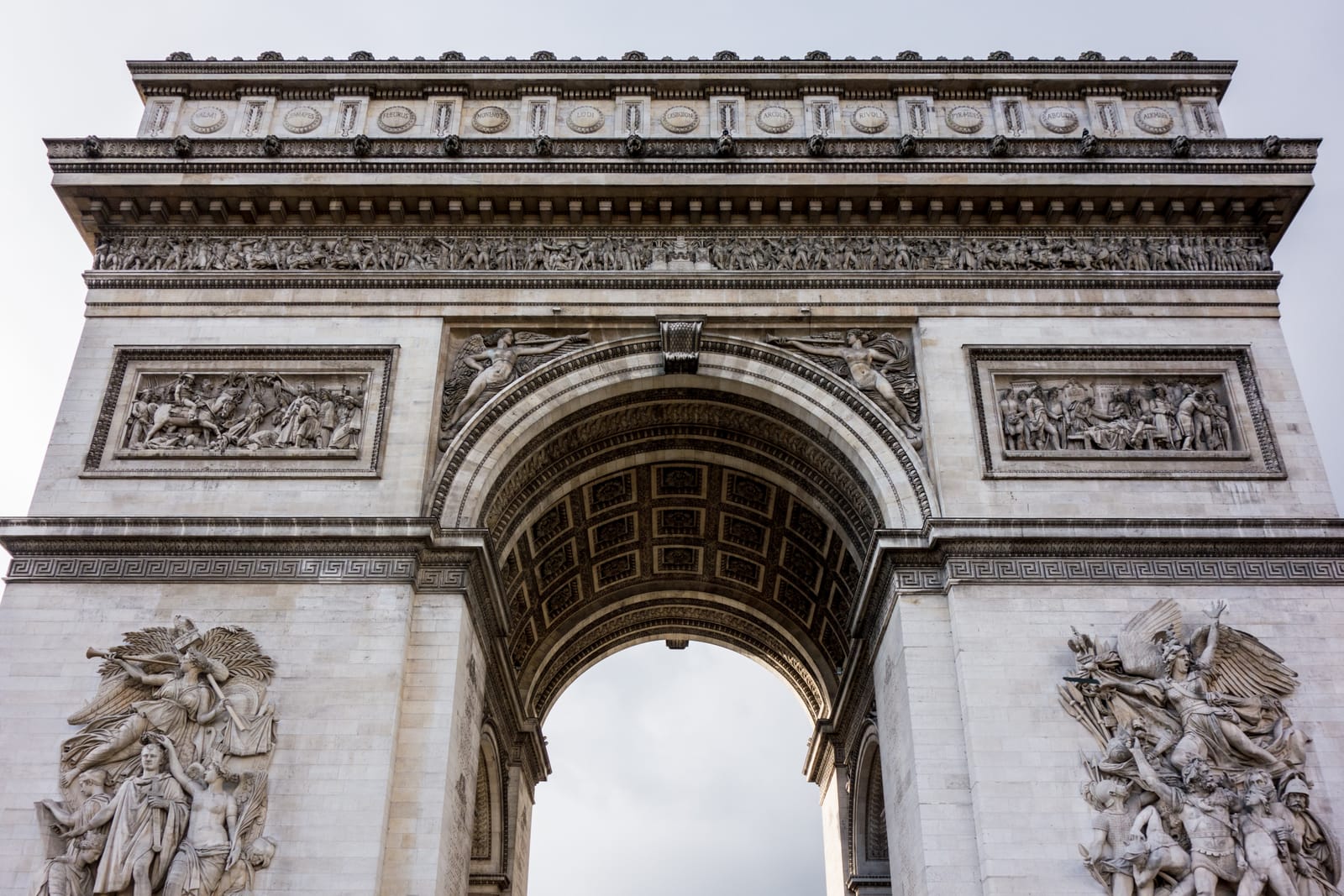
The Champs-Élysées face of the arch
Jean-François Chalgrin (1739–1811), continued by Louis-Robert Goust and Jean-Nicolas Huyot and completed by Guillaume-Abel Blouet; sculpture by Jean-Pierre Cortot, François Rude, James Pradier and others · 1806–1836 · Stone, 49.54 m high, 44.82 m wide and 22.21 m deep; the great vault is 29.19 m high and 14.62 m wide
Look for
- Left pillar: Jean-Pierre Cortot's Triumph of 1810, Napoleon in a toga being crowned by a Victory while a Fame blows a trumpet above him.
- Right pillar: François Rude's Departure of the Volunteers, the winged Genius of Liberty with her sword out. The two groups were placed on this face as an answer to each other.
- The attic, right at the top: thirty shields, each carved with a victory. Valmy, Jemappes, Austerlitz and Wagram are among them.
- The ring of a hundred bollards round the foot of the arch, one for each of the Hundred Days.
Transcript (2:13)
Stand at the top of the Champs-Élysées and look west, and the arch closes the end of the avenue exactly as it was meant to. That was the whole reason for putting it here. Napoleon's architects proposed the west end of this avenue so that the arch could be seen from the Tuileries palace, the imperial residence down at the far end, and the Emperor agreed.
He ordered it the day after Austerlitz, in December 1805, and signed the decree in February 1806: an arch in honour of the Grande Armée. The foundation stone went in on the fifteenth of August 1806, his birthday, eight metres down between the two southern pillars. After that, almost nothing about this building went to plan.
In 1810 Napoleon married Marie-Louise of Austria and was due to bring her into Paris through this spot, when the pillars were barely out of the ground. So the architect, Jean-François Chalgrin, had a full-size arch put up in painted canvas on timber frames, with five hundred workers hired to finish it in time. The carpenters struck over their pay; six were arrested, and the rest saw their daily wage go from four francs to twenty-four. Chalgrin died in January 1811 with the real pillars about a dozen metres high. When Napoleon fell, work stopped, and in 1814 one architect proposed simply knocking the stumps down.
It was a king, Louis-Philippe, who finished it, rededicated to the armies of the Revolution and the Empire, and it was inaugurated on the twenty-ninth of July 1836, thirty years after that first stone. Eleven people came. The big celebration had been cancelled for fear that someone would try to kill the king.
What you are looking at is 49.54 metres high and 44.82 wide, and that single great opening is a deliberate quotation of the Arch of Titus in Rome. Now drop your eyes to the two groups at the foot of the pillars. On the left, Jean-Pierre Cortot's Triumph of 1810, Napoleon in a toga being crowned by Victory. On the right, François Rude's Departure of the Volunteers, all wings and open mouths. The sculptor David d'Angers said Cortot's work was made of ice, flawless in its proportions and without a soul, and from here you can see exactly what he meant.
Right at the top, along the attic, runs a row of thirty shields, each carved with a victory. And the arch never got the crown it was built to carry. A plaster chariot by Alexandre Falguière stood up there from 1882 to 1886, weathered badly and was taken down, and after that the idea was quietly given up. The flat skyline you see is the compromise.
Jebulon, CC0, via Wikimedia Commons. Photo: Jebulon
_par_Rude,_Arc_de_Triomphe_Etoile_Paris.jpg)
Stop 2 of 5 · On the terre-plein at the foot of the north-east pillar, Champs-Élysées side, reached through the Passage du Souvenir; free
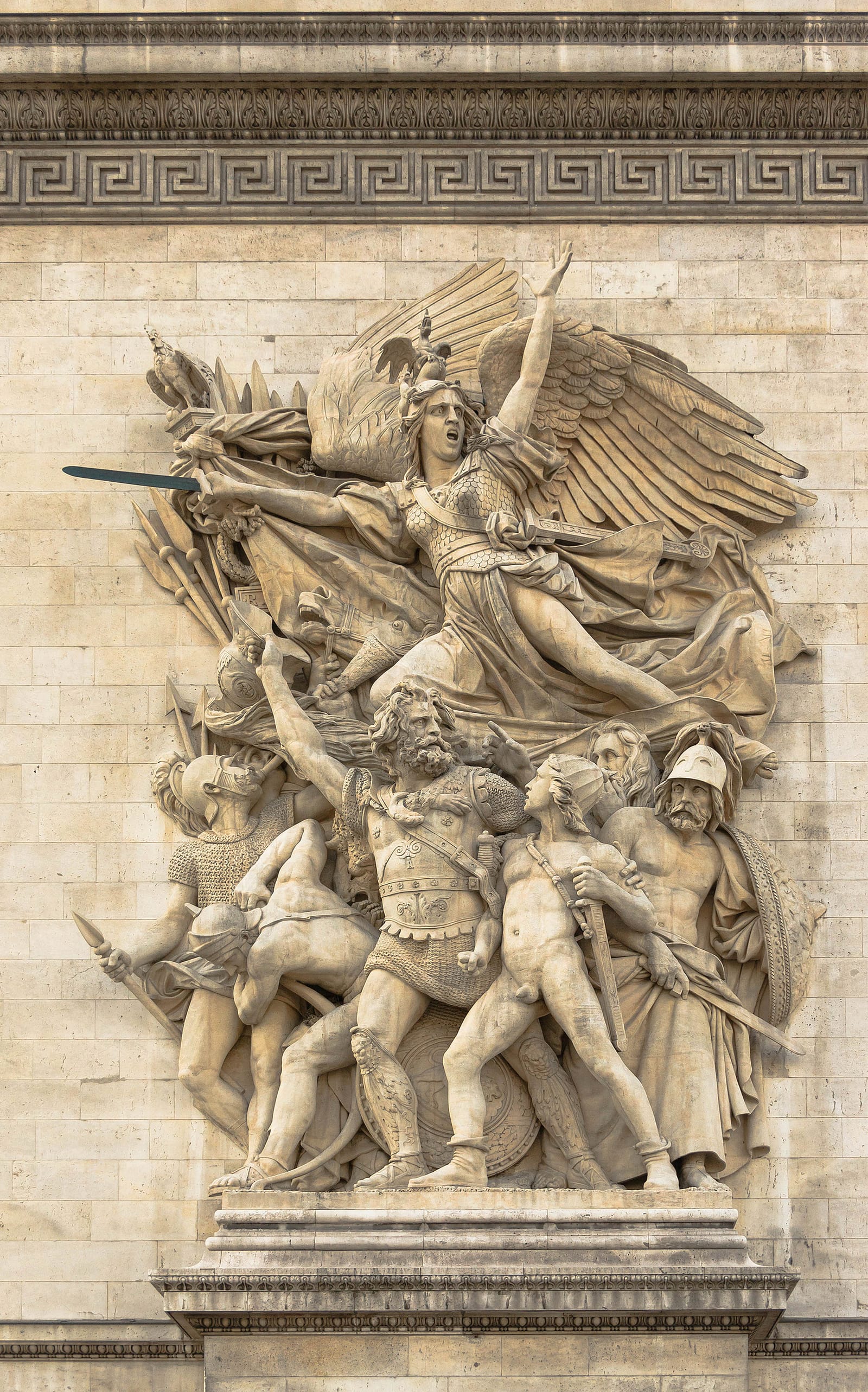
Rude's Departure of the Volunteers, La Marseillaise
François Rude (1784–1855), commissioned under Louis-Philippe through Adolphe Thiers · 1833–1836 · Stone high relief on the Champs-Élysées face of the north-east pillar, one of four groups on raised plinths at the foot of an arch 49.54 m high
Look for
- The Genius of Liberty's open mouth. She is shouting, which is why everyone calls the group La Marseillaise.
- The bearded warrior in the cuirass, waving his helmet and hauling the naked boy along by the shoulder, and the old man behind them giving advice nobody hears.
- Her sword, thrust out to one side: the blade that is said to have broken off in 1916.
- Cortot's Triumph on the other pillar of this face, for the contrast the sculptor David d'Angers drew between the two: fire here, ice there.
Transcript (2:07)
You are at the foot of the north-east pillar now, on the island in the middle of the traffic, and the group above your head is the reason most people bother with the underpass at all. Its real title is the Departure of the Volunteers of 1792; everyone calls it La Marseillaise.
Start at the top. The winged woman is the Genius of Liberty, and her mouth is wide open: she is shouting. One arm is flung up, the other thrusts her sword out to the side, and her whole body leans off the wall as if the stone could not hold her. François Rude carved this between 1833 and 1836, and his wife, Sophie Rude, posed for that face.
Below her is what she is shouting about. In 1792 the Legislative Assembly called the country up against the foreign armies on its borders, and nearly two hundred thousand men answered. Rude refused to put a single one of them in period dress. No Revolutionary muskets, no cockades. Instead there is a bearded warrior in a cuirass, waving his helmet as a rallying signal and hauling a naked boy along by the shoulder, while an old bearded man behind them offers advice that nobody is listening to. The monument's own account says Rude wanted a people, any people, defending what belongs to them, which is why it still lands without the history lesson.
The group has had a busy afterlife. The watermark of the violet five-franc note of 1917 is a helmeted head taken from the young warrior. The face of the Genius became the belt buckle of a Marshal of France. During the Prussian siege of 1870 and 1871 the carving turned into a symbol of resistance, and before German troops were allowed their symbolic march down the Champs-Élysées in March 1871, Parisians boarded up the four sculpted pillars with planks and blocked the passage under the arch.
Then there is the sword. The story goes, and Wikipedia is careful to say apparently, that on the day the Battle of Verdun began in 1916 the blade broke off, and the relief was hidden under tarpaulins at once so that nobody could read it as an omen.
Now look across the arch at the other pillar, at Cortot's Triumph. It was placed on this face in response to Rude's group, and history picked a winner. In March 1943 a young member of the Resistance, Daniel Cordier, came here to salute the Unknown Soldier and found the arch surrounded by German soldiers having their photographs taken in front of Rude's Marseillaise. Upstairs in the attic, a plaster cast of her head from 1898 lets you meet her at eye level.
Reza1615, Public domain, via Wikimedia Commons. Photo: Reza1615

Stop 3 of 5 · On the terre-plein, under the great arch; the generals' names are on the inner walls of the small arches and the battles under the great arches; free
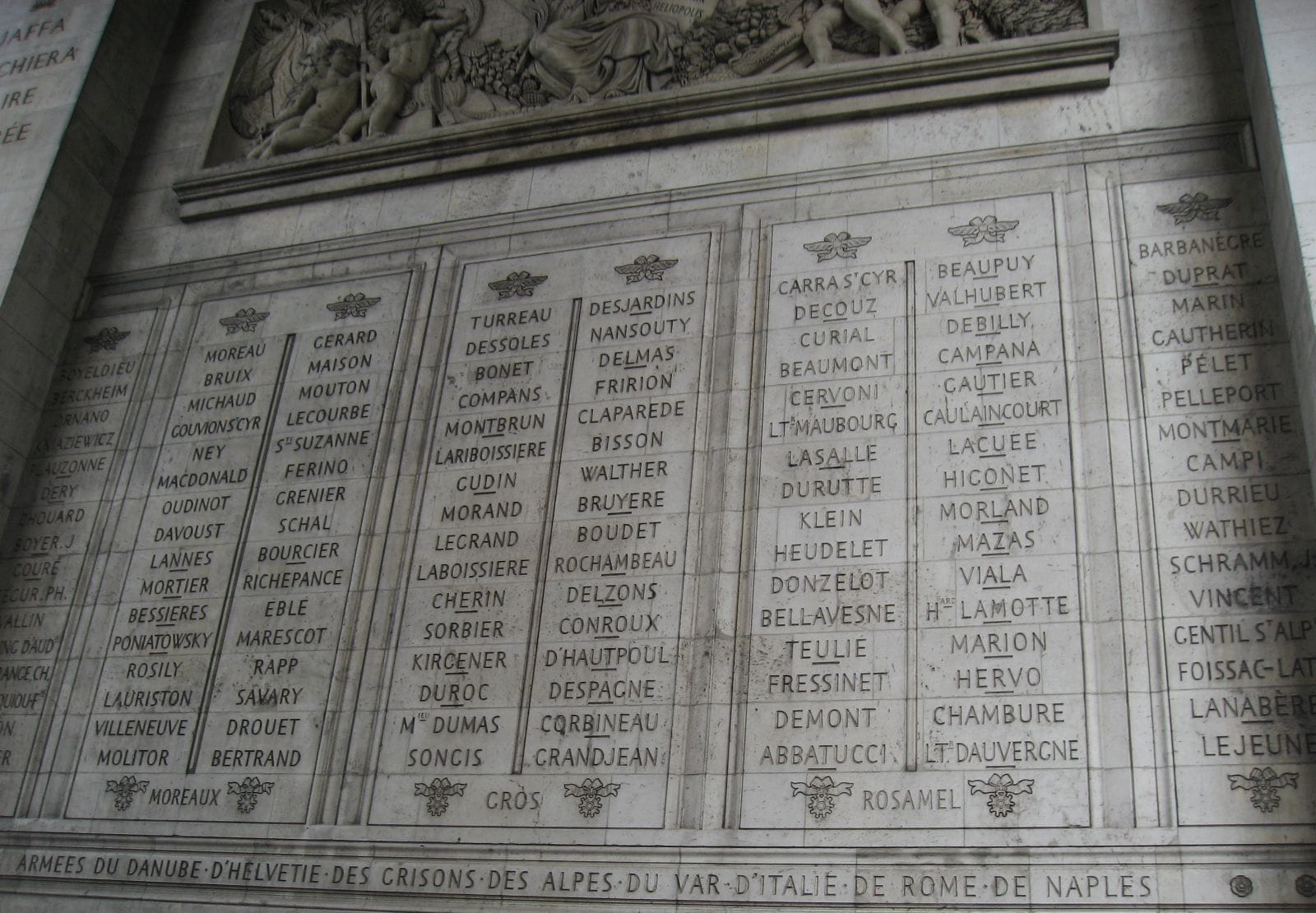
Under the great arch: the Unknown Soldier and the names
Inscriptions set out under Guillaume-Abel Blouet (died 1853), with additions until 1895; the Unknown Soldier interred in 1921; the flame's burner designed by the architect Henri Favier and made by the ironworker Edgar Brandt · 1836; tomb 1921; flame 1923 · Under a great vault 29.19 m high and 14.62 m wide: a slab of granite from Vire over the grave, and the names of 660 officers engraved on the inner walls of the smaller arches
Look for
- The slab and its single line: Ici repose un soldat français mort pour la Patrie, 1914–1918.
- A line under a name on the walls of the small arches. Each one marks a general who died on the battlefield.
- Straight up: the ceiling of the great vault, laid out in coffers with carved rosettes, as a commission of architects decided in 1826.
- A few steps west, on the Grande-Armée face, Antoine Étex's Resistance and Peace: in the second, a soldier sheathing his sword beside a plough and a bull.
Transcript (2:53)
Walk in under the great arch and look down before you look up. In the middle of the floor, inside a ring of black posts linked by chains, is a flat slab of granite from Vire with one line cut into it: Ici repose un soldat français mort pour la Patrie, 1914–1918. Here rests a French soldier who died for his country.
The First World War killed nearly one million four hundred thousand French soldiers. The idea of burying one unknown man for all of them was first put forward in 1916, while the fighting was still going on, and the first plan was the Panthéon. It was set aside, partly because the Panthéon had begun as a church, and partly because it is a temple for great men, when the entire point of this soldier is that he is nobody in particular. On the eighth of November 1920 the Chamber of Deputies voted, unanimously, for this arch instead.
Nine bodies were exhumed from the sectors where the fighting had been worst. One was set aside because nobody could be certain he was French. The other eight were laid out in the citadel at Verdun, and André Maginot, a wounded veteran himself, handed a bouquet to a young soldier named Auguste Thin and asked him to place it on one coffin. Thin chose the sixth. He explained later that he belonged to the Sixth Corps, and that the digits of his regiment, the 132nd, added up to six as well. The seven he did not choose are buried together near Verdun.
The coffin was brought under this vault on the eleventh of November 1920, but the grave was not ready, so the dead man was kept in vigil inside the arch, day and night, until the burial on the twenty-eighth of January 1921. The minister of war, Louis Barthou, who had lost his only son, Max, to the war in December 1914, stood over him and cried out, in tears, Long live France.
The flame came two years later. Its burner is a round shield with the mouth of a cannon at the centre and twenty-five swords radiating out in a star, made by the ironworker Edgar Brandt to a design by the architect Henri Favier. Maginot lit it on the eleventh of November 1923, and it has never gone out; veterans' associations rekindle it every evening. After her husband was killed in 1963, Jacqueline Kennedy remembered it from their visit in 1961 and asked for an eternal flame at his grave at Arlington.
Since the burial, parades on this square go round the arch, never through it. The German parade of 1940 kept to that custom, and so did de Gaulle in 1944. Before any of that, in August 1919, a pilot called Charles Godefroy flew a biplane clean through this opening, after circling the arch twice.
Now find the smaller side arches, and the columns of names on their inner walls. Those are 660 officers of the Revolution and the Empire, and a line under a name means the man died in battle. When the lists were unveiled in 1836 there was an uproar about who had been left out. Victor Hugo's father, a general, was not on them, and Hugo lamented it in a poem about this arch in 1837, which ends on the words, Phidias absent and my father forgotten.
Graeme Maclean from Glasgow, UK, CC BY 2.0, via Wikimedia Commons. Photo: Graeme Maclean from Glasgow, UK
.jpg)
Stop 4 of 5 · Inside the pillars, past access control: the spiral staircase up to the mezzanine, then the museum hall in the attic; standard ticket
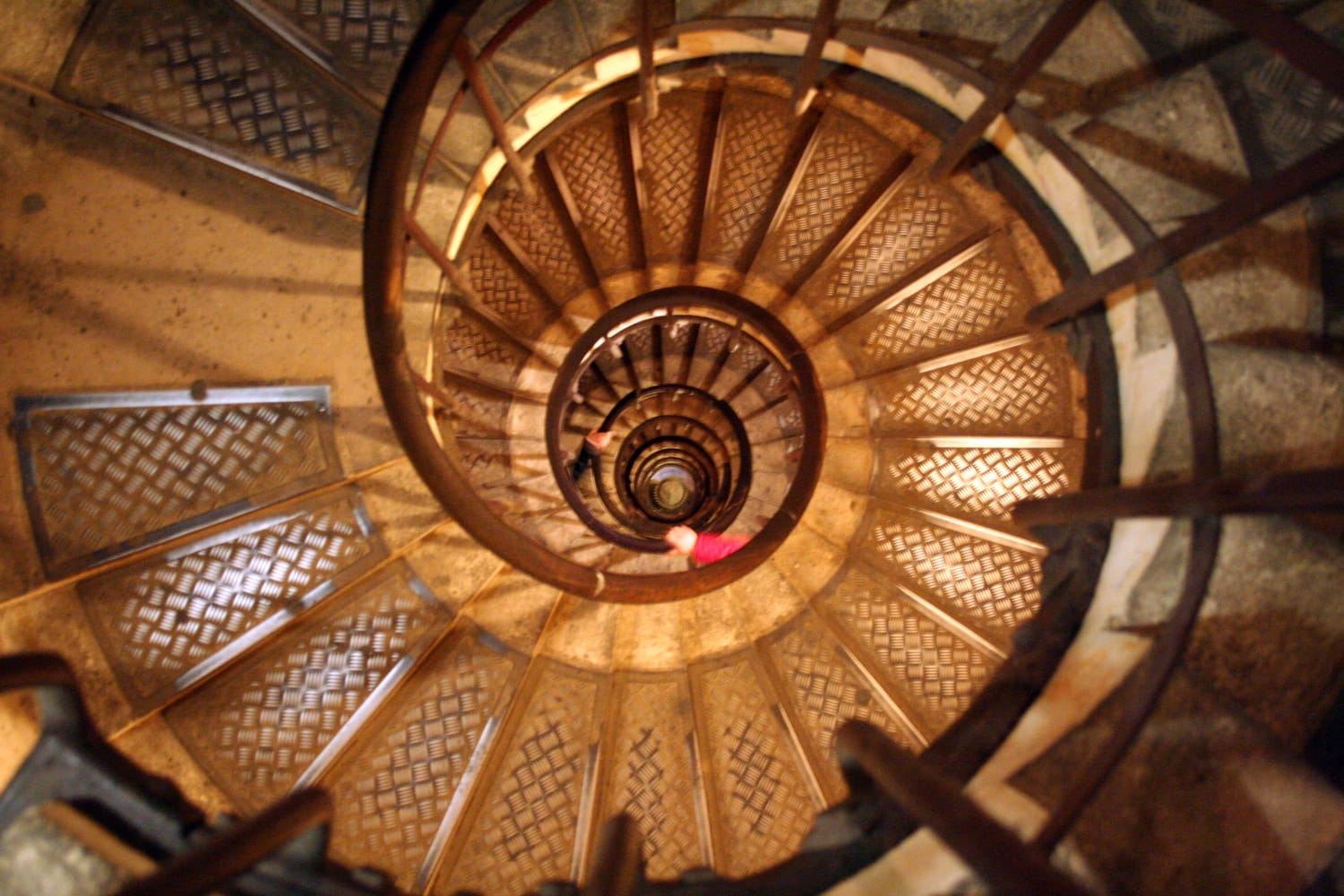
The spiral staircase and the attic room
Jean-François Chalgrin's design, completed by Guillaume-Abel Blouet (died 1853); the historic staircases renovated in 2022 · 1806–1836; staircases renovated 2022 · Stone stairs inside the pillars, 284 steps from the ground to the terrace, rising through an arch 49.54 m high
Look for
- The spiral itself. Stop on one of the upper turns and look down the well at how tightly the stair winds.
- The plaster cast of the Genius's head from Rude's group, made in 1898: the shouting face from the terre-plein, now at arm's length.
- The bronze wreaths on the walls of the attic room, tributes brought when the Unknown Soldier was buried below.
- The model of the monument, which shows you at a glance the whole building you are standing inside.
Transcript (1:52)
From here on you are inside the stone. The stair climbs through one of the pillars, and it opens with a spiral of 240 steps, winding up and up around its own well. Altogether it is 284 steps from the ground to the roof. The stairs were renovated in 2022, but the stone around you is the pillar itself, raised course by course between 1806 and 1836 while four architects and three regimes came and went.
At the top of the spiral comes the attic, the heavy block across the top of the arch that you looked up at from the avenue. This storey very nearly did not exist. During the building campaigns it was taken out to simplify the work, and then put back, because it was needed to carry a crowning group on the roof. Four of those crownings were built up there in plaster, one after another, and not one was ever made permanent. The one Blouet put up for the return of Napoleon's ashes in 1840, the Emperor on a chariot surrounded by allegories, was seen by Victor Hugo, who called it a mediocre operatic decor and a piece of monumental galimatias.
The arch keeps a quieter history inside it as well. When the Unknown Soldier was brought here in November 1920 his grave was not ready, and he was laid in the Salle des Palmes inside the monument and watched over, day and night, until the burial in January. The bronze wreaths on the walls of the attic room are tributes that arrived when he was finally laid under the vault.
Look for two plaster figures. One is a cast of the head of Rude's Genius of Liberty, made in 1898 in the moulding workshops of the Musée des Monuments français, so that you can finally see at arm's length the shouting face you looked up at from the terre-plein. The other is an original plaster by the sculptor Jean Boucher of a poilu, an ordinary French infantryman in his field dress with his weapon at his feet, a man with no name on purpose. Between them they hold the two moods of this building: the call to arms, and what it cost.
There is also a model of the whole arch, and it is worth a minute before the last flight, because it shows you the entire building you are now standing inside, pillars, vaults and all. From the museum hall to the real roof it is about forty more steps.
Jebulon, CC0, via Wikimedia Commons. Photo: Jebulon

Stop 5 of 5 · The terrace, on the roof of the arch, about 40 steps above the attic museum hall; standard ticket
The terrace and the twelve avenues
Terrace of Chalgrin's arch, completed by Guillaume-Abel Blouet in 1836; the star of avenues and its matching mansions designed by Jacques Ignace Hittorff for Baron Haussmann · 1836; the square remodelled under the Second Empire · Stone roof terrace on top of an arch 49.54 m high, above a square 241 m across where twelve avenues meet
Look for
- East, straight down the Champs-Élysées: 2.2 kilometres to the Place de la Concorde, with the Tuileries and the Louvre beyond on the same line.
- The Eiffel Tower, one avenue away.
- Count the avenues round the circle: twelve, with Hittorff's matching four-storey mansions closing the gaps between them.
- The golden dome of Les Invalides, and on a clear day the Sacré-Cœur on Montmartre.
Transcript (2:07)
You are on the roof, close to fifty metres up, and for the first time the name of the square makes sense. Look down at the circle around the arch. Twelve avenues run into it like the points of a star, which is why this was the Place de l'Étoile, the square of the star, until it was renamed after Charles de Gaulle in 1970.
It was not always twelve. The seventeenth-century plans had eight. The star below you is the work of the architect Jacques Ignace Hittorff for Baron Haussmann, under the Second Empire, and Hittorff did something quietly clever with it: between the avenues he lined the circle with four-storey mansions all built to the same design, so that the square closes in on itself whichever way you turn. Walk round the parapet and count them. The old toll pavilions that had stood at this gate into Paris were pulled down in 1860.
Now face east, straight down the Champs-Élysées. That line is older than the arch by well over a century. In 1667 André Le Nôtre laid out a vista from the Tuileries to the hill you are standing on, and in 1709 the lower part of it was named the Champs-Élysées, after the Elysian Fields of Greek and Roman myth. The Place de la Concorde is 2.2 kilometres away down there, and beyond it the Tuileries and the Louvre sit on the same line. Turn round and the axis keeps going the other way, out to the towers of La Défense. This arch was put here to close that view, and from up here you can see how exactly it does.
The hill itself used to be higher. In the eighteenth century the engineer Perronet cut four or five metres off the top of it. A few years before that, in 1758, an engineer called Ribart de Chamoust proposed crowning it with a sixty-metre elephant, a fountain with concert halls, ballrooms and apartments inside. Louis the Fifteenth turned it down, which is a loss for eccentric Paris and a gain for everyone else.
The Eiffel Tower is one avenue away from you. Further round you can pick out the golden dome of Les Invalides, the colonnaded dome of the Panthéon, the towers of Notre-Dame in the distance, and to the north-east the Sacré-Cœur on the hill of Montmartre.
One last picture, and the least peaceful. In 1871, during the Commune, the Fédérés hauled a battery of cannons up onto this roof to fire back at the army of Versailles. The roof you are standing on was built for a victory arch, and for a while it was a gun platform.
Independent guide · Chiaro
Point Chiaro at anything at the Arc de Triomphe.
Six hundred and sixty names on the inner walls, thirty shields on the attic, six battle reliefs and a frieze that runs round all four faces: five recordings only scratch the stone. Aim your camera at an underlined general, a shield, a face in the frieze or a figure on the Grande-Armée side, and Chiaro says who or what it is, then carries on fielding questions until you leave the vault.
Before you go
Getting there
Place Charles de Gaulle, 75008 Paris: the arch is the island at the centre of the roundabout that crowns the Champs-Élysées. The square cannot be crossed on foot: the way in is the Passage du Souvenir, an underpass that starts at the top of the Avenue des Champs-Élysées or of the Avenue de la Grande-Armée and comes up at the foot of the arch. Visitors in wheelchairs reach the arch by the drop-off point on the Grande Armée side, by taxi or private car.
Charles-de-Gaulle-Étoile, on Metro lines 1, 2 and 6 and RER A, is the station for the arch. Six bus lines call here as well, the 22, 30, 31, 52, 73 or 92, plus the Balabus, and Vélib' bikes can be docked on rue Arsène Houssaye, avenue Hoche, rue Beaujon, rue Balzac and rue Traktir.
Tickets and entry
- The top of the Champs-Élysées, the underpass and the Tomb of the Unknown Soldier cost nothing, so the first three stops need no ticket. After that there is a single ticket and it covers the whole interior, the attic and the terrace. At the rates on the official site it is 22 euros from April to September, 16 euros on Wednesdays in that season, and 16 euros from October to March. Admission is free below the age of 18, and between 18 and 25 for nationals of the European Union and non-European residents of France; and for everybody it is free on the opening Sunday of every month between November and March.
- Summer hours, 1 April to 30 September, are 10am to 11pm; winter hours, 1 October to 31 March, are 10am to 10.30pm. Tuesday is the exception, opening at 11am all year. Entry stops 45 minutes before the doors close.
- It shuts every year on 1 May, 8 May and 14 July, and on the morning of 11 November, and official ceremonies or bad weather can close it wholly or partly at short notice. E-tickets bought on the Centre des monuments nationaux's own ticketing site are then refunded automatically.
- The climb is 284 steps. A lift is kept for visitors who need it, but the monument's accessibility page currently says it is under maintenance and the terrace can be reached by the stairs only, so check before relying on it. Pushchairs stay with the access-control staff, bags must fit within 40 by 40 by 20 centimetres, there is no left-luggage office, and selfie poles, tripods, flags and glass bottles are refused.
The official audio guide
The arch has no audio-guide handset to hire. The Centre des monuments nationaux hands out printed visit documents free of charge in the museum room in the attic, in eleven languages, and they can be downloaded before you go. It also runs a web app for smartphones, with nothing to download, in five languages and three routes: the essentials, the facades and the timeline. Lecturer-guides lead paid tours in French and English of about an hour and a half, bookable online only. The five recordings on this page sit alongside all of that, and because the first three are on free ground they work while you are still deciding whether to climb.
Official site →Questions
Is there a free Arc de Triomphe audio guide?
Five recordings on this page cover the approach, the Marseillaise, the tomb, the stair and the roof, at no charge, with every script printed under its player. The monument itself has no handset to rent; its own help is a printed visit document, free in eleven languages, and a web app for smartphones. For the carvings and names these five skip, the Chiaro app will narrate whatever you photograph.
Can I listen to the Arc de Triomphe audio guide without a ticket?
For the first three stops, yes. The top of the Champs-Élysées is public pavement, and the foot of the arch and the Tomb of the Unknown Soldier are free, reached through the Passage du Souvenir underpass. The fourth and fifth stops, the stair inside the pillar and the roof terrace, need the monument's ticket, which covers the whole interior and the terrace.
How much is the official Arc de Triomphe audio guide?
There is no official audio guide to rent. The Centre des monuments nationaux gives out printed visit documents free of charge, in eleven languages, in the museum room in the attic, and offers a web app in five languages that needs no download. Its lecture tours, in French and English and about an hour and a half long, are a paid extra booked online.
How do you get to the Arc de Triomphe on foot?
Underground. The arch stands in the middle of a roundabout that cannot be crossed on foot, so go down into the Passage du Souvenir at the top of the Champs-Élysées or of the Avenue de la Grande-Armée and come up at the foot of the arch. Play the first stop on the Champs-Élysées pavement before you go down.
When is the Arc de Triomphe closed?
Every year on 1 May, 8 May and 14 July, and on the morning of 11 November, the Armistice anniversary. It can also close in part or completely at short notice for official ceremonies or bad weather. On other days it is open, from an hour later on Tuesdays, and nobody is let in during the final 45 minutes.
How many steps are there to the top of the Arc de Triomphe?
284, from the ground to the terrace: a long spiral inside one pillar up to the mezzanine, then about forty more above the museum hall in the attic. The lift kept for visitors who need it is listed by the monument as under maintenance for now, so plan on the stairs and check the accessibility page before relying on it.
More audio guides
Made by Chiaro. Not affiliated with the Arc de Triomphe.