
Eiffel Tower · Paris · Independent guide
Eiffel Tower audio guide,
five stops, free.
All five stream in this tab, with nothing to install and nothing to collect. Then let Chiaro narrate the rest of the 18,038 iron parts from a photo.
Made by Chiaro. Not affiliated with the Eiffel Tower.
The Champ de Mars and the four pillars
Eiffel Tower, Paris
That was the free part
Chiaro narrates anything at the Eiffel Tower from a photo.
The five stops · 11 minutes of audio
Five places, one walk,
in the order you will walk them.
Five stops, and the first two need no ticket at all. It starts out on the Champ de Mars, south-east of the tower, where all 330 metres fit into one view; then in under the four pillars on the esplanade, head back, reading the seventy-two names raised on the beam beneath the first-floor balcony; then up to the first floor at fifty-seven metres for the ironwork and a surviving piece of Gustave Eiffel's own staircase; on to the second floor at a hundred and fifteen metres for the view straight down the Trocadéro axis; and last the top, two hundred and seventy-six metres up, which needs the dearer summit ticket. About eleven minutes of listening. Reckon two to three hours in the monument once the security queue at entrance 1 or entrance 2 is counted in.
Our sources are the Société d'Exploitation de la Tour Eiffel, the company the City of Paris owns and has entrusted the tower to, and one independent reference behind every figure; we last went through both on 21 September 2026 and noted which line each fact rests on, so an operator change reaches us quickly. Hours follow a calendar set day by day that moves with the seasons, fares are revised each January, and bad weather can shut the top, so look up your date on the operator's site before setting off. Where a sign at the gate says otherwise, go by the sign, and drop us a line so we can correct this page.
Dmarcovitz, CC0, via Wikimedia Commons. Photo: Dmarcovitz

Stop 1 of 5 · Champ de Mars, on the central walk between the École Militaire and the tower, outside the security perimeter and free
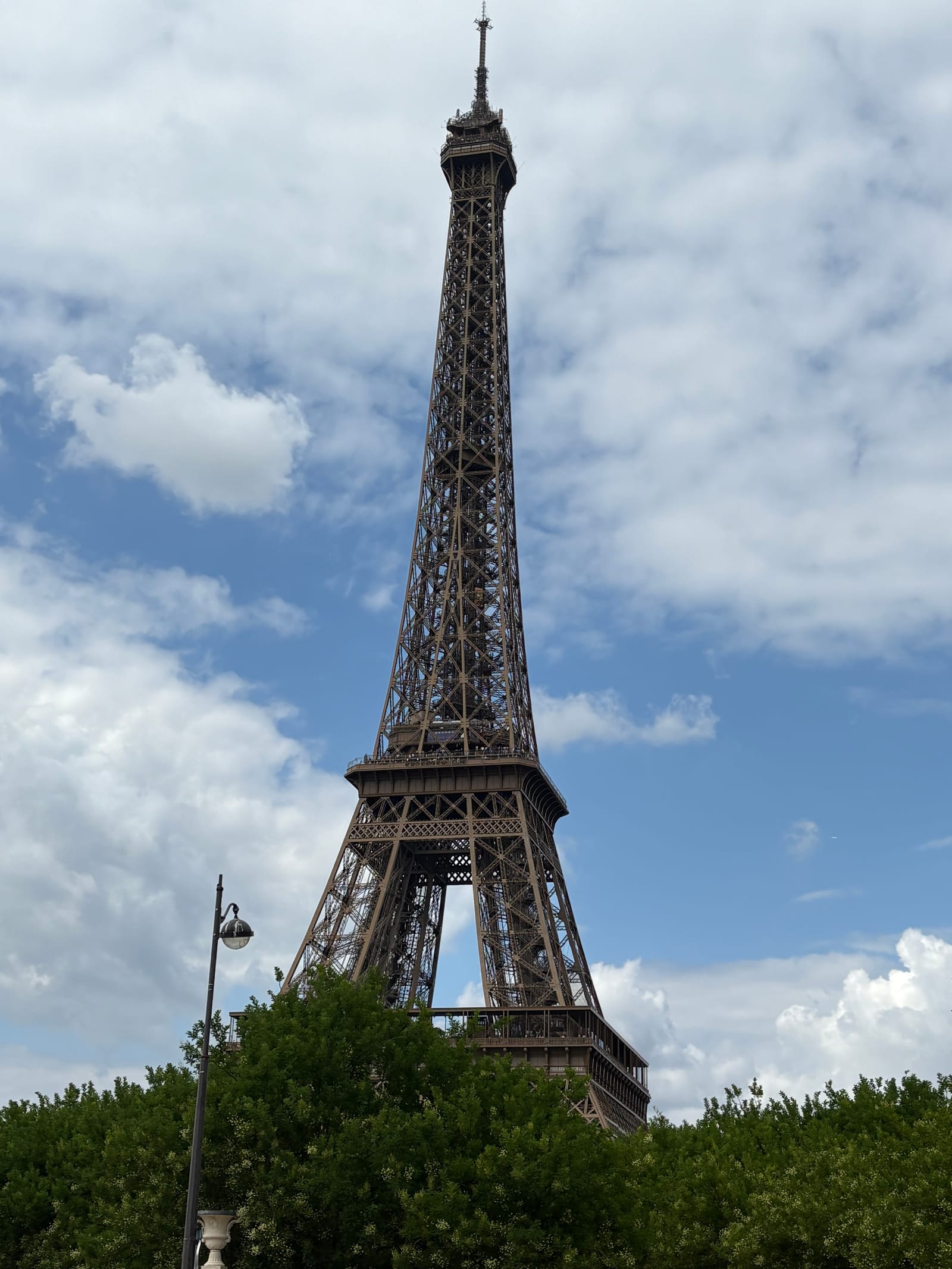
The Champ de Mars and the four pillars
Maurice Koechlin and Émile Nouguier, engineers in Gustave Eiffel's company, with the architect Stephen Sauvestre; built by Gustave Eiffel (1832–1923) · Sketched June 1884, built 26 January 1887 to 31 March 1889 · Puddled iron, 330 m tall and 125 m square at the base; 7,300 tonnes of metal in 18,038 parts
Look for
- The curve of the four legs. It is a wind calculation made visible: in the operator's own words the uprights appear to burst out of the ground and to be shaped by the action of the wind.
- The colour. It is not brown any more. The twentieth painting campaign, begun in 2019, took the tower back to the yellow-brown Gustave Eiffel chose in 1907, laid on in three tones — darkest at the base, lightest at the top — so the whole reads as one shade.
- The lifts crossing inside the legs. The hydraulic machines in the west and east pillars were installed by Fives-Lille in 1899 and still carry visitors to the second floor; their machinery sits in basements under those two pillars, closed to the public except for the occasional heritage open day.
- The four arches between the pillars. They are the architect Stephen Sauvestre's addition, kept when the rest of his ornament was simplified away, and they are most of what gives the tower its outline.
Transcript (2:54)
Stand out on the Champ de Mars with the whole thing in front of you, because this is the only place you get all 330 metres at once. From under the pillars it is too close; from here the four legs, the two braced platforms and the spire read as one shape.
Look at the curve of the legs first, because it is not a styling decision. The uprights follow a line that is mathematically determined for wind resistance: tangents drawn to each leg at the same height always meet at the point through which the wind load above them passes, so the whole cutting force of a storm runs down inside the leading edges and into the ground. The operator's own description is that the uprights appear to burst out of the ground and to be shaped by the action of the wind, and once you have read the curve that way you cannot unsee it.
It was not Gustave Eiffel's idea. In May 1884, in the Eiffel drawing office, two of his engineers, Maurice Koechlin and Émile Nouguier, were talking about the coming World Exhibition and wondering what could be done to make it more attractive. On the sixth of June, at home, Koechlin made a rough calculation and a sketch and titled it 300-Metre-Tall Pylon: four legs of solid columns, joined by lattice girders, rising obliquely to meet at the top. Eiffel was not impressed and set it aside, but he let them carry on. They brought in an architect, Stephen Sauvestre, who stood the legs on stone pedestals, threw the four great arches between them and rounded off the crown. Most of Sauvestre's ornament was simplified away before building began. The arches stayed, and they are most of what you are looking at.
Eiffel's project won the competition of 1886 against 106 others. Digging started on the twenty-sixth of January 1887 and the structure was finished on the thirty-first of March 1889: two years, two months and five days, 18,038 iron parts, 2,500,000 rivets.
The best-known writers and artists in France signed a protest in the newspaper Le Temps against what they called the useless and monstrous Eiffel Tower. Charles Gounod signed, and Guy de Maupassant, and Charles Garnier, who had built the Paris Opéra. Maupassant called it a high and skinny pyramid of iron ladders. The writer Léon Bloy called it a truly tragic street lamp. Eiffel answered in the same paper: because we are engineers, does one assume that beauty does not concern us in our constructions?
He never owned it, either. A convention signed in January 1887 let him build it at his own expense and run it for twenty years, and on the first of January 1910 it passed to the City of Paris, which owns it still. Twenty years was all it was ever meant to stand, and in 1906 the City had decided to destroy the 1889 Gallery of Machines, then the largest building in the world, because it had not found a use for it. What saved this one was radio: an aerial at the top made it too useful to dismantle.
One last thing before you walk towards the pillars. The colour is not the brown you remember from old photographs. The twentieth painting campaign, begun in 2019, took the tower back to the yellow-brown Gustave Eiffel chose in 1907, and it goes on in three tones, darkest at the bottom and lightest at the top, so that from where you are standing it reads as one single shade against the sky.
Reza1615, Public domain, via Wikimedia Commons. Photo: Reza1615

Stop 2 of 5 · Esplanade, under the pillars, looking up at the beam beneath the first-floor balcony; free, through the queue for visitors without tickets at entrance 1 or 2
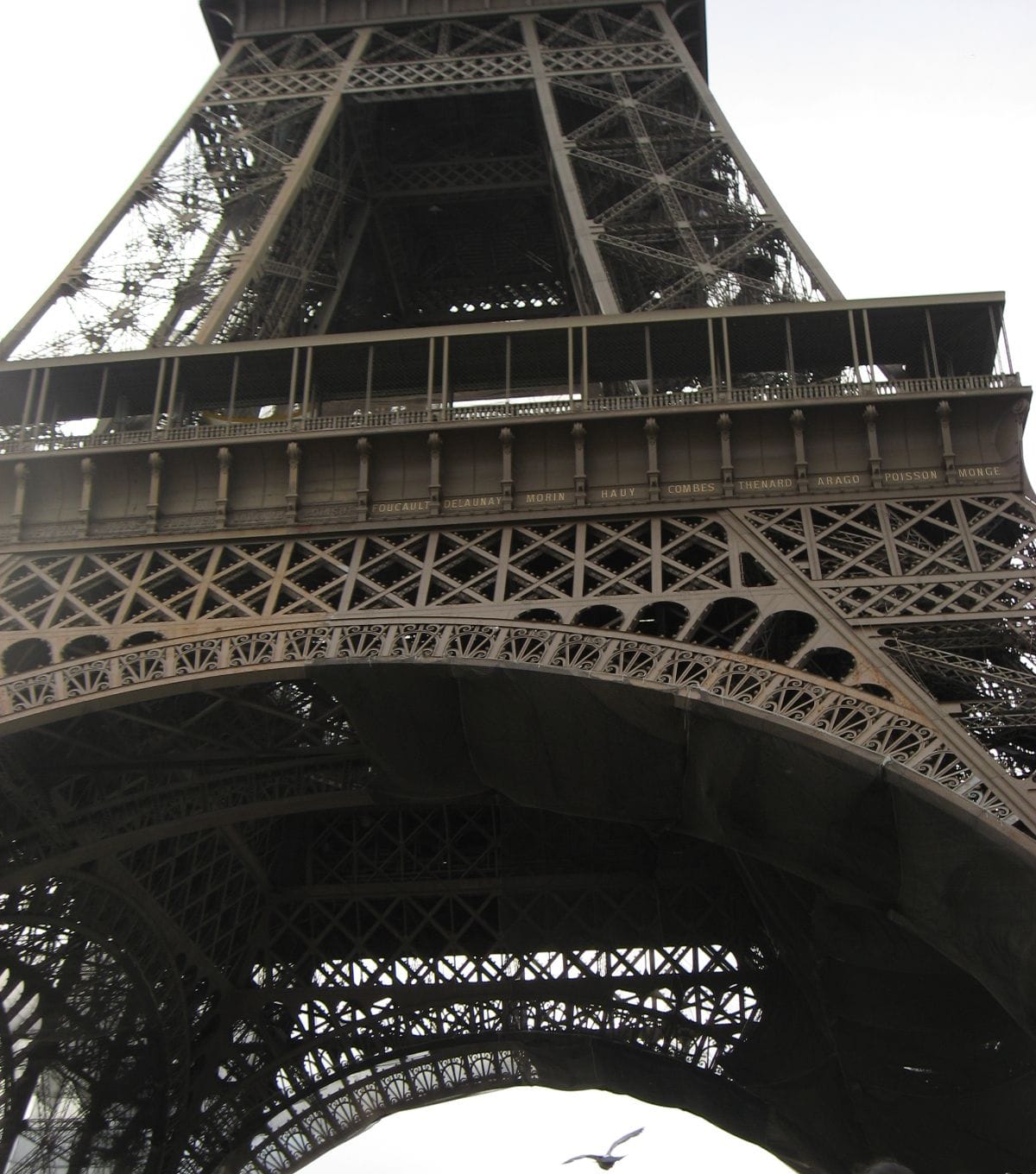
The frieze of 72 names
Chosen and inscribed by Gustave Eiffel (1832–1923); uncovered by the tower's operating company in 1986–87 and regilded in the 2010–11 repainting · 1889 · Raised letters about 60 cm high, painted gold, on the continuous beam under the first-floor balcony; eighteen names to each of the four faces
Look for
- Read along the beam on the face towards the Champ de Mars and you get Foucault, Delaunay, Morin, Haüy, Combes, Thénard, Arago, Poisson and Monge. The letters are about sixty centimetres high, which is why they are legible from down here.
- The brackets. The names sit in the bays between the consoles that carry the balcony above them, so this is not decoration stuck on the front: it is written into a structural beam.
- Antoine Bourdelle's bust of Gustave Eiffel, at the corner of the North pillar. It was unveiled on 2 May 1929, proposed by General Ferrié, and Bourdelle worked on it with the architects Auguste Perret and André Granet.
- The exact centre of the esplanade, which the operator marks with a plaque and a QR code. It is the one spot where all four legs frame you at once.
Transcript (2:23)
Tip your head back and find the beam that runs right round under the first-floor balcony. In the bays between the brackets that carry that balcony, on all four faces, there are names in gold capitals. Seventy-two of them, eighteen to a side, each letter about sixty centimetres high, which is precisely why you can read them from the ground.
On this face, the one looking down the Champ de Mars towards the École Militaire, you get Foucault, Delaunay, Morin, Haüy, Combes, Thénard, Arago, Poisson, Monge.
They are up there because of the protest. Gustave Eiffel had just been told in print by the most celebrated artists in France that his tower was a monstrosity, so he placed it under the auspices of science and progress instead, and called the gesture an invocation of science. All seventy-two are French, and all of them lived and worked between 1789 and 1889. Nearly all were dead before the tower was finished, and two were not. Hippolyte Fizeau, who made the first accurate measurement of the speed of light, lived until 1896. And the chemist Chevreul died on the ninth of April 1889, nine days after Eiffel raised the flag on the summit; the tower's own account puts him at a hundred and three.
They are also not all scientists, which is the part nobody tells you. Flachat and Polonceau were civil engineers. Perdonnet and Clapeyron were railway men. Schneider made steel and Vicat made cement. Belgrand built the sewers of Paris. Seguin built suspension bridges. Cail and Gouin were contractors who had been competing against Eiffel's own company for years, which is a generous thing to carve into your own building. Thirty-four of the seventy-two went to the École Polytechnique.
The second criterion was brutally practical. There was only so much space on the beam, so no name could run past twelve letters, first names dropped. That is how Le Chatelier just squeezes in, and how Étienne Geoffroy-Saint-Hilaire missed out altogether.
Then the letters disappeared. Early in the twentieth century they were painted over, and they stayed buried for most of it. The company running the tower uncovered them again in 1986 and 1987, and the repainting of 2010 and 2011 put them back to gold.
There are no women. The absence usually named is Sophie Germain, whose work on the theory of elasticity was used in building this tower. In 2025 the mayor of Paris appointed a commission, which came back recommending that seventy-two women's names be inscribed beside the men's, and in January 2026 a proposed list was published. Germain is on it, and so are Marie Curie and her daughter Irène Joliot-Curie.
DeveshT, CC0, via Wikimedia Commons. Photo: DeveshT

Stop 3 of 5 · First floor, 57 metres up; the outer passageway between the south and west pillars is signed Rue Maurice Koechlin et Émile Nouguier, and the staircase section stands along it
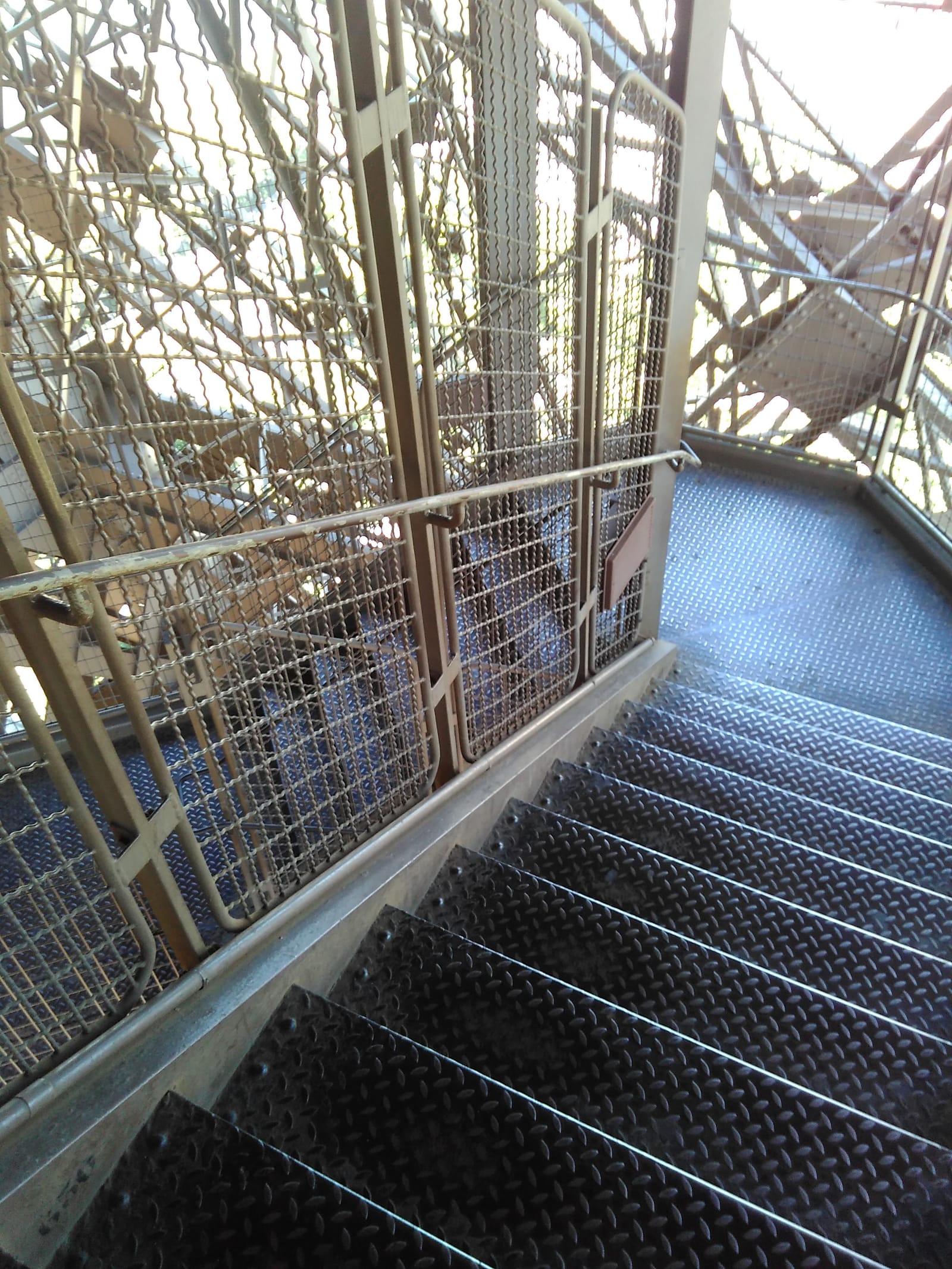
The first floor, and Gustave Eiffel's staircase
Maurice Koechlin (1856–1946) and Émile Nouguier (1841–1897), Gustave Eiffel's chief engineers, between them responsible for 5,300 workshop drawings · The four legs joined at this level by the end of March 1888; the spiral staircase taken down in 1983 · Puddled iron, 57 m above the ground, a platform of 1,346 square metres; the surviving section of spiral staircase stands 4.3 m
Look for
- The section of the original spiral staircase along the outer passageway, 4.3 metres of it. Gustave Eiffel climbed the rest to reach his office at the top, until it was dismantled in 1983.
- The street sign reading Rue Maurice Koechlin et Émile Nouguier on the passageway between the south and west pillars. The two engineers who drew the tower got a street on it.
- The rivet heads, in rows, everywhere on this level. About two thirds of the 2,500,000 rivets in the tower were driven in the factory rather than up here.
- The cultural path along the outer passageway: screens, displays and reproductions covering the parts of the tower's history nobody mentions.
Transcript (1:55)
Fifty-seven metres up, and the first thing worth doing is looking down at the lattice apron under your feet, because this platform is where the whole thing could have failed. The four legs went up as separate cantilevers and had to be brought together here, at this level, to the millimetre. Hydraulic jacks able to push 800 tonnes were fitted into the shoes at the base of each leg, the legs were deliberately raised at a slightly steeper angle than they needed and held on boxes of sand on a timber scaffold, and then they were eased into line. The joining was finished at the end of March 1888. There was no version of this where you fix it afterwards.
Walk round to the outside passageway between the south pillar and the west pillar and look for a street sign. This walkway is called Rue Maurice Koechlin et Émile Nouguier, after the two engineers who drew the tower and did not get their name on the front of it. Koechlin oversaw 5,300 workshop drawings and the calculations behind all of them, then supervised the foundations and the construction. Asked in 1939 whether it ought not to have been called the Koechlin Tower, he said that Eiffel was the undeniable father of the Tower.
Along the same passageway there is a piece of staircase standing on its own, 4.3 metres of it. A spiral staircase used to run from the second floor to the top, and it is how Gustave Eiffel reached the office he had built for himself up there. It became obsolete and came down in 1983. Twenty of its sections went to auction and did very well; this is one of the pieces that stayed behind.
Now the iron around you, and it is iron, not steel: puddled iron from the Pompey forges in eastern France, refined to burn off the excess carbon until it was nearly pure. Less rigid than steel, lighter, and in Eiffel's judgement the best material he could get. Only about a third of the 2,500,000 rivets were driven on site, and each one took four men: one to heat it, one to hold it, one to shape the head, one with the sledgehammer.
The journalist Émile Goudeau came up here while they were still working and wrote that a thick cloud of tar and coal smoke seized the throat, and that the riveters, striking sideways instead of down, threw off sparks with every blow and looked as though they were reaping lightning bolts in the clouds. Three hundred men worked on this site. One of them died.
Guilhem Vellut from Paris, France, CC BY 2.0, via Wikimedia Commons. Photo: Guilhem Vellut from Paris, France
.jpg)
Stop 4 of 5 · Second floor, 115 metres up, on the upper level where visitors coming up from the esplanade meet those coming down from the top; the view described here is from the north-west side
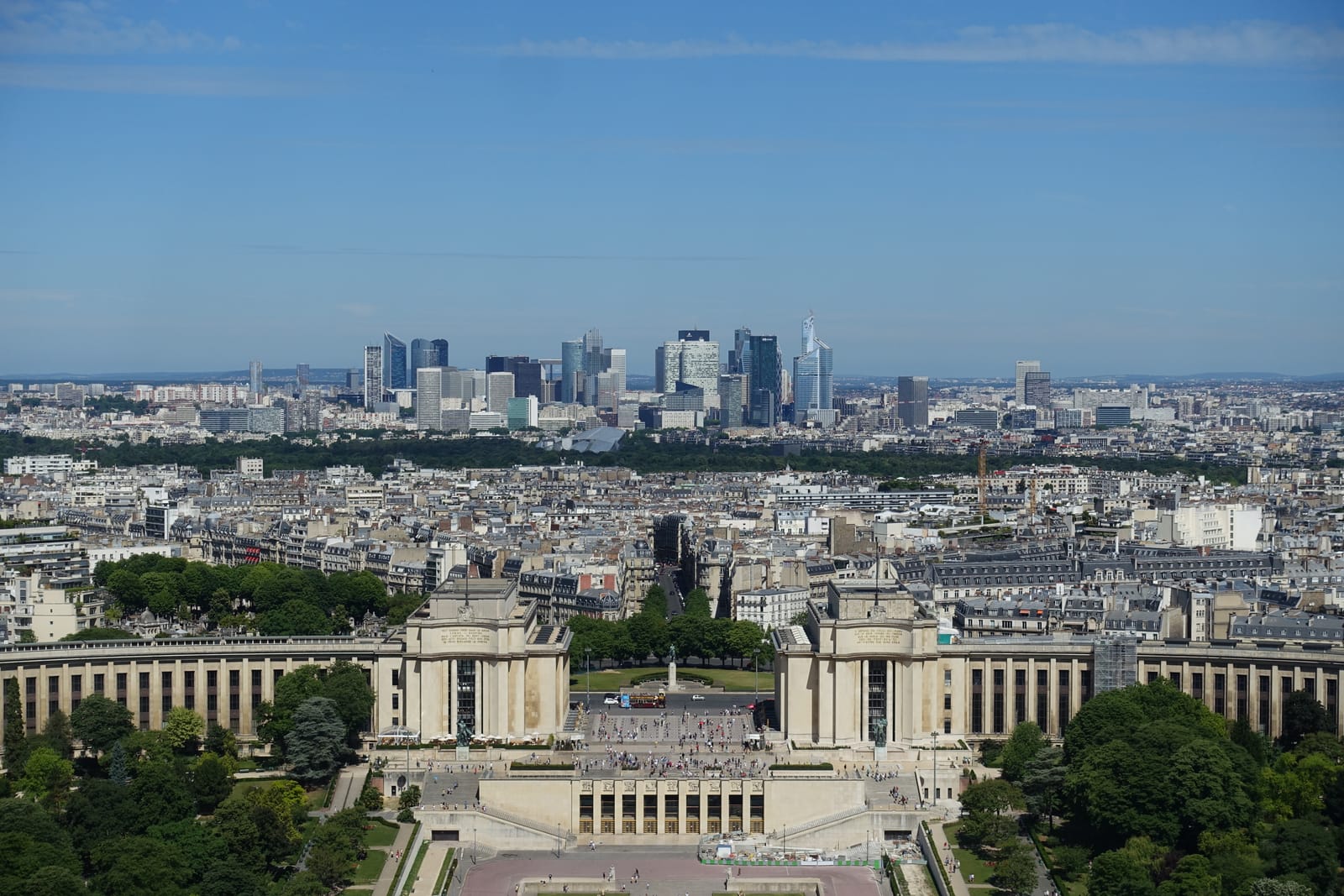
The second floor, and the axis through the Trocadéro
Émile Nouguier (1841–1897), Gustave Eiffel's head of technical surveys and assembly, with Maurice Koechlin (1856–1946) · 1888; remodelled for the 1900 Exposition Universelle · Puddled iron on two levels, 115 m above the ground, a platform of 436 square metres
Look for
- The bends in the Seine, then the Invalides, the Grand Palais, the Louvre and Montmartre on its hill. The operator names these as the monuments this level is for.
- The axis. Look north-west across the river and the whole line the tower was built to close runs away from you to the towers of La Défense on the horizon.
- The lift cables and pulley gear in the pillar beside you. The east and west machines have been running on the same 1899 principle for over a century.
- The paint. It goes on in three tones and this is roughly where the middle one sits: lighter than the base, darker than the top.
Transcript (2:02)
A hundred and fifteen metres up, and this is the level where Paris stops being a skyline and turns into a plan. High enough to read how the city is laid out, low enough to recognise individual buildings, which is why a good many people who have been to the top will tell you this is the better view.
Face the Trocadéro. Across the river, a few hundred metres off, the Palais de Chaillot spreads its two curved wings towards the tower like a pair of arms, and behind it the roofs of the sixteenth arrondissement run flat and pale to the horizon, where the towers of La Défense stand up out of them. Turn the other way and you have the bends in the Seine, the Invalides, the Grand Palais, the Louvre, and Montmartre on its hill.
Then look at the pillar beside you, because something quietly extraordinary is going on inside it. The machines that brought you up through the east and west legs were put in by Fives-Lille in 1899, and they are not lifts in any ordinary sense. They are not funiculars and not cable cars and they fit no current category of machine at all. Underground, a hydraulic system drives two pistons; a cab rides on those pistons and carries cables over a set of pulleys; and because the angle of the climb changes where the leg straightens at the first floor, a recovery mechanism keeps your cabin level the whole way up. Until 1986 the pressure came from three accumulators of about 200 tonnes each, holding water at forty to sixty bar. Two of those three are still down there, doing nothing now but acting as counterweights.
Two things happened in this tower that had nothing to do with the view, and neither of them on this floor. In 1910 a priest called Theodor Wulf carried instruments to the foot of the tower and then to the top to measure radiant energy, found more of it up there than he could account for, and had, without quite realising it, discovered cosmic rays. And in August 1914 a transmitter in the tower jammed German radio traffic well enough to slow the advance on Paris and help the French hold the Marne. Radio is the whole reason this tower still exists.
One more thing, and you can almost check it yourself. The metal is not still. Depending on the air temperature, the top of the tower leans away from the sun by as much as eighteen centimetres, because the sunlit side of all this iron expands more than the side in shadow.
Juanedc from Zaragoza, España, CC BY 2.0, via Wikimedia Commons. Photo: Juanedc from Zaragoza, España
_(9317281230).jpg)
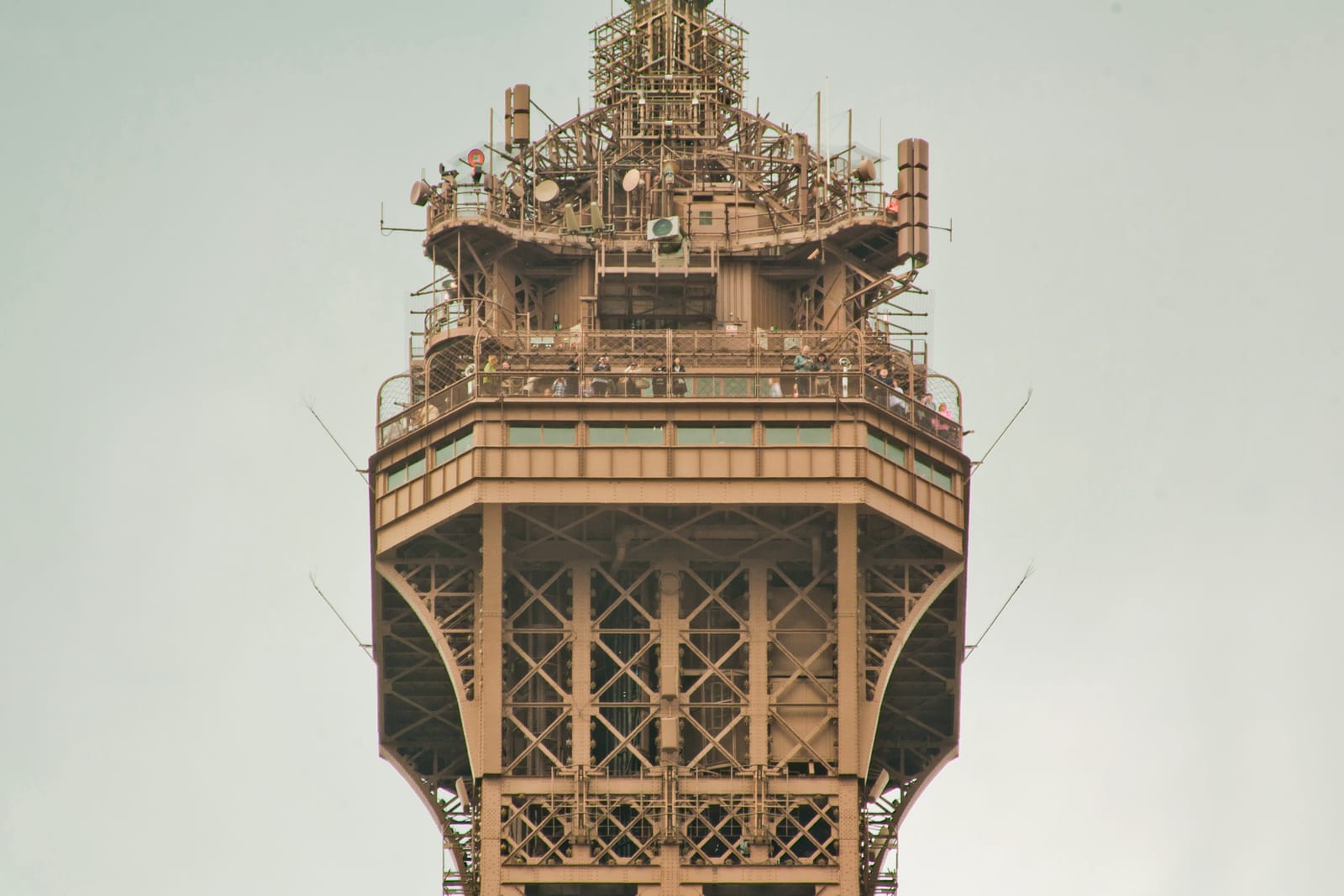
Stop 5 of 5 · The top, on the open-air upper platform, 276 metres up with only the aerials above you; the office is seen through windows on this level, and this stop needs the dearer summit ticket
The top at 276 metres, and Gustave Eiffel's office
Stephen Sauvestre (1847–1919), who gave the tower's crown its shape, for Gustave Eiffel (1832–1923); the apartment furnished by Jean Lachaise · 1889; the crown rebuilt after a fire in 1956 · Puddled iron; an open-air upper platform 276 m above the ground on a floor of 76 square metres, with an indoor level beneath it
Look for
- The windows of Gustave Eiffel's office, with the wax Eiffel, his daughter Claire and Thomas Edison, and the phonograph Edison brought him as a present in 1889.
- The panoramic maps, which give the bearing and the distance to cities around the world and draw each one's landmark at its true relative height against a line for this tower.
- The model of the 1889 summit at a fiftieth of full size, in the original red-brown paint.
- The plaque recording the six Paris firefighters who put the tricolour back up here on 25 August 1944.
Transcript (2:10)
Two hundred and seventy-six metres, nothing above you but the aerials, and the noise of the boulevards simply does not reach this far. The wind does.
Before the view, find the windows. Set into this level is a reconstruction of Gustave Eiffel's office, and behind the glass are wax figures of Eiffel himself, his daughter Claire, and a visitor, the American inventor Thomas Edison. The office is too small to walk into, so you look in from outside, which is oddly fitting, because hardly anybody was ever let in.
Eiffel kept a flat for himself from the start, not out here on the open platform but in the level just under the spire. About a hundred square metres, much of it taken up by the lift cabin, the stair landing and machinery, holding a sitting room with a table, a couch, a piano and three small desks, a kitchen and a bathroom. No bedroom. He almost certainly never slept here. He used it to entertain.
The Edison visit is real. He came to Paris for the 1889 exposition, Eiffel brought him up, and he gave Eiffel one of his phonographs and signed the guest book on the tenth of September 1889.
Claire is not scenery in that tableau. The eldest of Eiffel's five children, born in 1863, she took over running the household at fourteen when her mother died, and for more than forty years she was her father's confidante and private secretary. She married the engineer he had picked to succeed him at the head of the company.
Now the other list of names. The seventy-two on the first-floor beam are scientists and engineers of the century before, and not one of them built this. Up here there is a plaque carrying the names of the engineers who actually did.
There is a second plaque up here, and it is about a morning in 1944. On the twenty-fifth of August, with fighting still going on at the foot of the tower, six Paris firefighters under Captain Lucien Sarniguet climbed the stairs, dodging German fire, and put a French flag made out of scraps of fabric back where it belonged. Sarniguet was the same officer who had been ordered to take the French flag down in June 1940.
Getting up here used to be harder. The tower opened on the fifteenth of May 1889 with the lifts unfinished, and nearly thirty thousand people climbed the 1,710 steps to this platform before the machines started running on the twenty-sixth of May. Somewhere near your feet is a model of this summit as it looked in 1889, at a fiftieth of full size, painted in the tower's first red-brown.
Independent guide · Chiaro
Point Chiaro at anything at the Eiffel Tower.
Five stops and you have barely started. There are seventy-two names on that beam and this guide reads you nine of them; there are four pillars, three levels, a century of aerials on the crown and a whole city to identify from the railing. Point the camera at a line of rivets, a lift mechanism or a roof on the skyline you cannot name: Chiaro identifies it, names whoever built it, and goes on taking questions for as long as you linger at the railing.
Before you go
Getting there
5 avenue Anatole France, 75007 Paris, on the Champ de Mars in the 7th arrondissement. There are two ways into the perimeter: entrance 1 (SOUTH) on the Allée des Refuzniks and entrance 2 (EAST) on the Allée Jean Paulhan. Each has separate queues for visitors with tickets and visitors without, and each has a security check. Once you are on the esplanade the information desk is at the West pillar.
Métro line 6 to Bir-Hakeim is the closest station, under ten minutes on foot from entrance 1. Trocadéro on line 9 and École Militaire on line 8 are both about fifteen minutes away. RER line C stops at Champ de Mars – Tour Eiffel, five minutes from entrance 1. Buses 82, 30 and 42 stop five minutes from entrance 2; buses 69 and 86 stop on the Champ de Mars, seven minutes from entrance 1; bus 72 leaves you near Trocadéro, about fifteen minutes away.
Tickets and entry
- The Champ de Mars, where this walk starts, is a public park: no ticket, no queue, no check. The gardens and the esplanade underneath the tower cost nothing either, but they sit inside the security perimeter, so the frieze of 72 names means going through the check at entrance 1 or entrance 2 in the queue for visitors without tickets.
- Ascent tickets are timed, and the time printed on yours is the time you need to be already underneath the tower in the queue for visitors with tickets. The operator's own advice is to allow fifteen to twenty minutes for the security check at the entrance before that.
- A ticket to the top reaches all three levels, and the visit runs downwards: you go up to the second floor or the summit first and come down to the first floor afterwards. A second-floor ticket cannot be upgraded to the top once you are inside. At the rates in force since January 2026 the adult lift ticket to the second floor is 23.50 euros, the stairs to the second floor 14.80, the lift to the top 36.70, and the stairs to the second floor plus the lift to the top 28.00; the operator revises them each January.
- There is no weekly closing day — the tower is open on Tuesdays and all year round — but arrive at least two hours before closing, because the ticket offices for the top shut about an hour and three quarters before the monument does. Large luggage and pets other than guide dogs are not allowed inside and there is no left-luggage office.
- The top and the stairways are not suitable for visitors with limited mobility; the first floor and the lower level of the second floor are fully accessible to wheelchair users. That puts the first three stops on this page and the Trocadéro view of the fourth within reach, and leaves the fifth out.
The official audio guide
The tower's own guide is free and there is nothing to install: a web guide at guide.toureiffel.paris, in French, English, Spanish and Chinese, with a map of every level from the esplanade to the summit and getting on for three dozen points of interest. If you have no mobile signal there is free WiFi on site, called _WiFi_Tour_Eiffel, to reach it. There is also a plaque with a QR code at the exact centre of the esplanade that starts a free experience narrated by Gustave Eiffel. Guided tours led by an official Eiffel Tower guide are a separate and much dearer ticket. What you are reading now is a third option: five stops, no code to scan, and a written transcript below every player for the platforms where the wind drowns out the audio.
Official site →Questions
Is there a free Eiffel Tower audio guide?
Yes, two of them. You are on one: five stops you play in your phone's browser, each with its script written out beneath it, and no app or device to pick up. The tower's own guide is free as well, a web guide at guide.toureiffel.paris in four languages that covers getting on for three dozen points of interest. For everything neither covers — a mechanism, a rivet line, a roof you cannot name from the railing — photograph it and the Chiaro app narrates that.
Do I need a ticket to listen?
Not for the first two stops. The Champ de Mars is a public park outside the perimeter, so the opening stop needs no ticket and no queue at all. The frieze of 72 names is read from the esplanade underneath the tower, which is also free but sits inside the security check: you pass it at entrance 1 or entrance 2 using the queue for visitors without tickets. The first floor, the second floor and the top all need an ascent ticket, and the top needs the dearest of them.
How much is the official Eiffel Tower audio guide?
Nothing. The operator's own visitor guide is free and works in a browser at guide.toureiffel.paris, in French, English, Spanish and Chinese, with a map of each level and nearly three dozen points of interest, and there is free WiFi on site to load it. What does cost money is a guided tour with an official Eiffel Tower guide, which is a separate and considerably dearer ticket than an ordinary ascent.
Stairs or lift to the second floor?
The stairs are the cheaper way and the better one if you can manage them: over 300 steps from the ground to the first floor and about as many again to the second. At the rates in force since January 2026 the adult stairs ticket to the second floor is 14.80 euros against 23.50 for the lift. Stairs tickets go on sale fourteen days ahead and are timed like the lift tickets. And from 29 September 2026 the operator requires a reservation in advance for them. The stairways are not suitable for visitors with limited mobility.
Do I need the summit ticket to hear all five stops?
For the fifth one, yes. The top is 276 metres up and reached by a second pair of lifts from the second floor, and it is sold as its own ticket: 36.70 euros for an adult by lift, or 28.00 if you climb the stairs to the second floor first. That ticket covers all three levels. A second-floor ticket cannot be upgraded on the spot, and access to the top can be closed in severe weather or at peak periods.
Is the Eiffel Tower ever closed?
There is no weekly closing day: the operator says the tower is open on Tuesdays just as on every other day of the week, and open all year, though it can close for all or part of a day in exceptional circumstances. Opening and closing times are set on a day-by-day calendar that changes with the season; the operator's own page has the times for your date. Arrive at least two hours before closing time, because the ticket offices for the top shut around an hour and three quarters earlier.
More audio guides
Made by Chiaro. Not affiliated with the Eiffel Tower.