
Musée Guimet · Paris · Independent guide
Musée Guimet audio guide,
five stops, free.
Musée Guimet has no audio guide of its own—play five stops right in this browser tab, then photograph anything else among its 60,000 Asian works in the Chiaro app.
Made by Chiaro. Not affiliated with the Musée Guimet.
Portrait of King Jayavarman VII
Musée Guimet, Paris
That was the free part
Chiaro narrates any work in the Musée Guimet from a photo.
The five stops · 9 minutes of audio
Five stops, one walk,
in the order you will walk them.
Our Musée Guimet audio guide climbs three open levels of the Place d'Iéna galleries in visitor order, spanning two thousand years of Asian sacred sculpture and royal goldwork. You start on the ground floor in the sunlit Khmer Court before the sandstone head of King Jayavarman VII, cross into the Indian galleries for an eleventh-century Chola bronze Shiva Nataraja, head up to the first-floor Himalayan galleries for Kathmandu's giant gilded Mask of Bhairava, and finish on the second floor with a fifth-century Korean Silla royal crown and Japan's rock-crystal-eyed warrior god Bishamonten. The five tracks run to roughly nine minutes of narration inside the ninety minutes the museum suggests for its permanent rooms.
Visitor details, admission rates and gallery locations here come from guimet.fr alongside catalogue and historical records on Wikipedia and Wikidata. Objects occasionally leave their plinths for conservation or loan displays, so whenever a gallery label or attendant says something different from what appears below, go with the museum's sign and drop us a note.

Stop 1 of 5 · Ground floor, Southeast Asia galleries (Khmer Court)
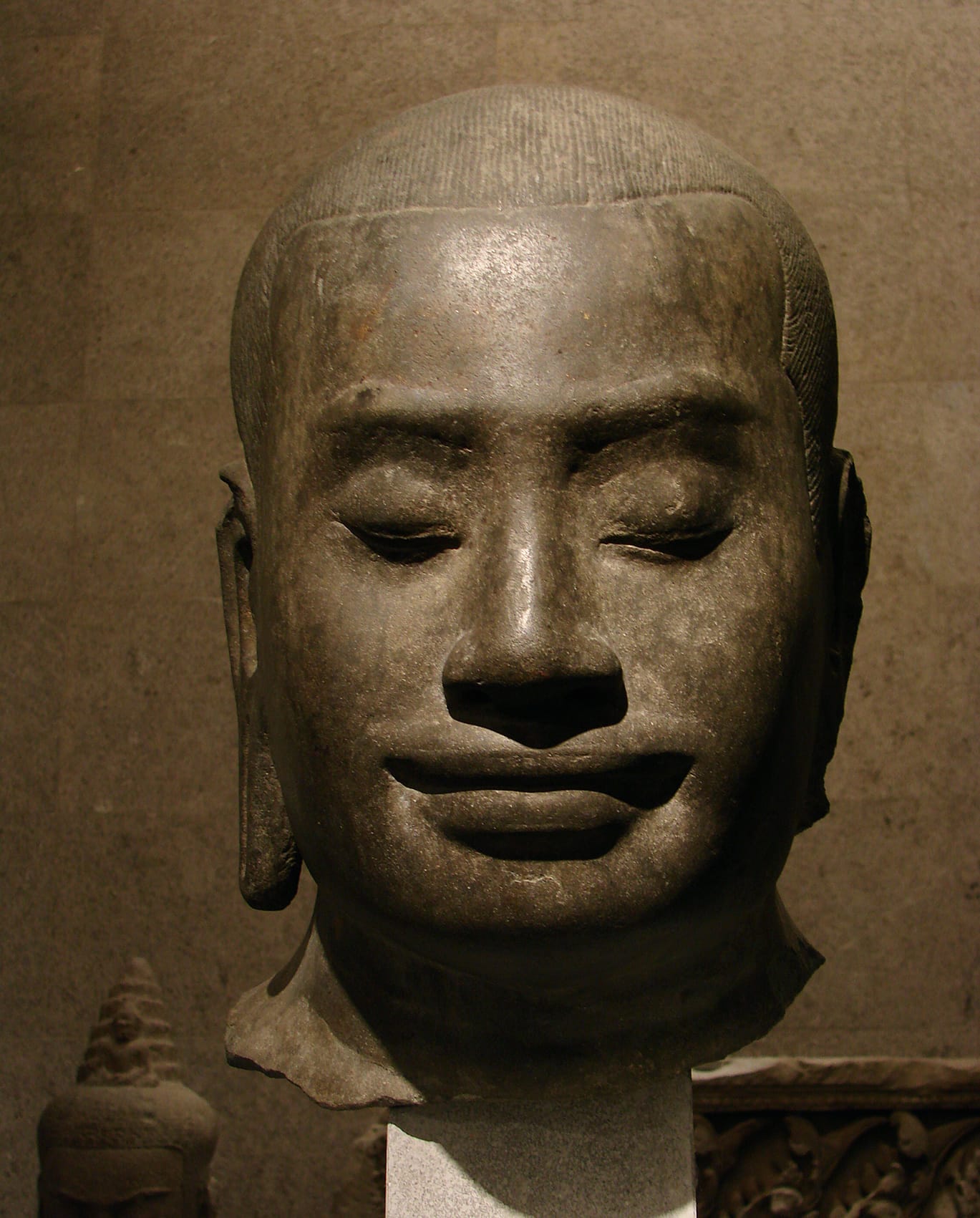
Portrait of King Jayavarman VII
Khmer sculptor, Bayon style (Angkor Empire) · Late 12th – early 13th century · Sandstone, 42 × 25 × 31 cm (inventory P 430)
Look for
- No royal diadem and no earrings: only fine parallel grooves of hair pulled tightly backward and bare, elongated earlobes.
- Heavy lowered eyelids and full cheeks curving into the quiet inward smile characteristic of Angkor's Bayon style.
Transcript (2:13)
Walk straight into the ground-floor Khmer Court and stop in front of the quietest face in the room. You are looking at the most powerful monarch the Khmer Empire ever produced, and the first thing to notice is everything he refused to wear. Earlier kings of Angkor had themselves carved like distant Hindu gods, stiff with tall conical crowns, armbands and idealised teenage bodies. Here there is no crown at all, no jewellery in the stretched earlobes, only tight parallel lines of hair combed straight back from a broad forehead, slightly rounded mature cheeks, lowered eyelids and a faint inward smile.
This is King Jayavarman the Seventh, who ruled from Angkor between 1181 and 1218, carved in sandstone in the late twelfth or early thirteenth century. To understand why a conqueror chose to look like a bare-headed monk at prayer, go back four years before his coronation. In 1177, rival Cham fleets sailed up from central Vietnam and sacked Angkor. For centuries Khmer kings had relied on the Hindu god Shiva to protect the capital, and to Jayavarman's eyes that old compact had failed.
After driving out the invaders, he broke with state Shivaism and made Mahayana Buddhism the religion of the court. He built the walled capital of Angkor Thom, raised the face-towers of the Bayon temple, strung hospitals and rest houses along his highways, and sent portrait statues of himself out across the provinces—not towering in triumph, but seated with hands together in humble devotion. Sculptors of his Bayon workshops invented a new kind of naturalism to match: human flesh over bone, closed eyes, royal authority expressed through stillness. Within decades of his death Angkor reverted to Shivaism and chisels defaced scores of Buddhist shrines, making survivors like this forty-two-centimetre head all the rarer.
Look around the open court behind him. Musée Guimet owes this extraordinary hall of Cambodian sandstone to French naval officer Louis Delaporte's expeditions of the 1870s and 1880s, first shown across the hill at the old Trocadéro before moving here in 1927 and growing through transfers from the French School of the Far East in 1936, while this particular head arrived in 1965 on permanent deposit from the science faculty in Marseille. One rumour is worth putting to rest right here: visitors often wonder whether the reliefs young André Malraux notoriously pried off Banteay Srei in the 1920s ended up in this room. They did not—Malraux was arrested in Phnom Penh, and every stone stayed in Cambodia.

Stop 2 of 5 · Ground floor, Indian World galleries
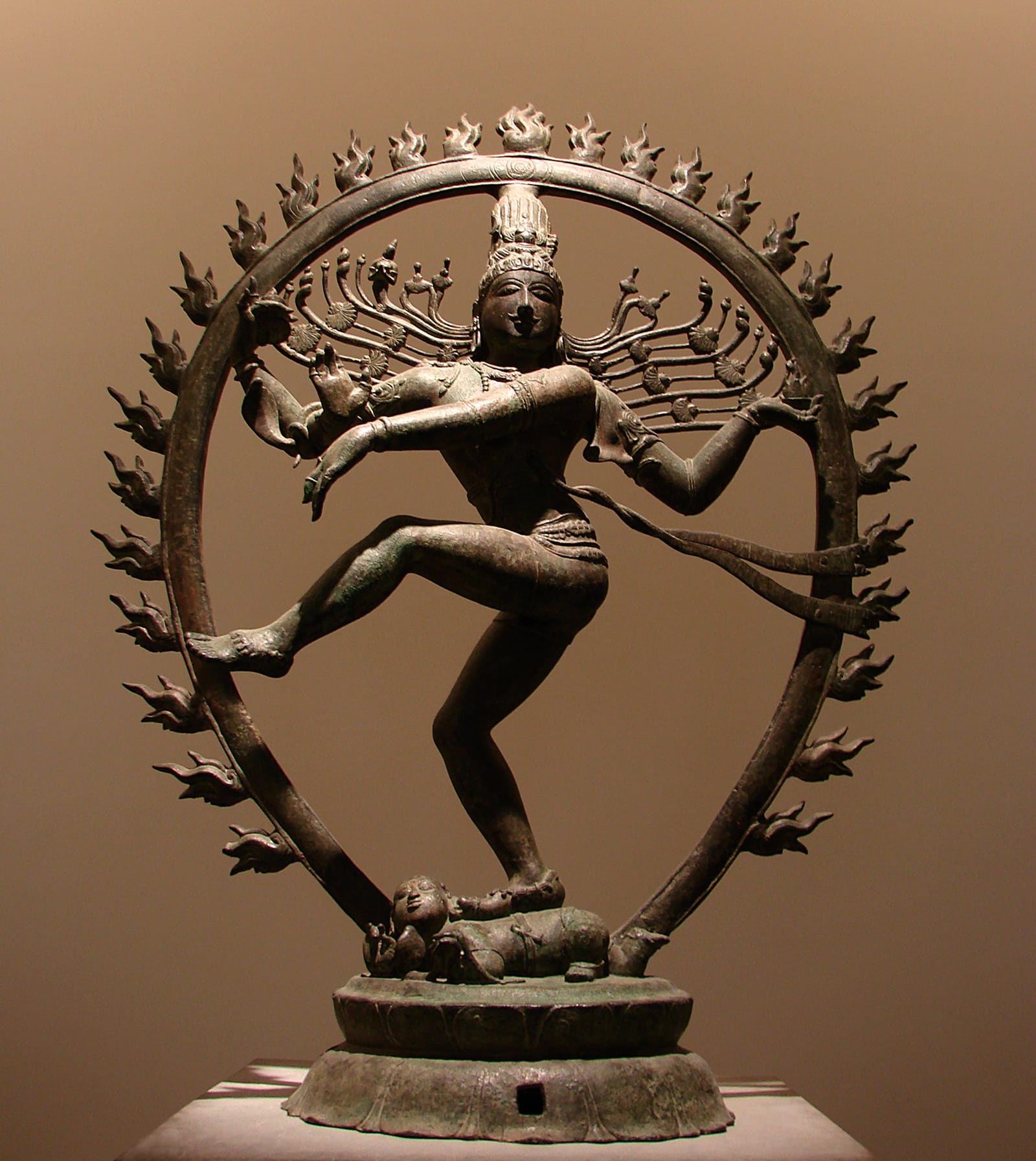
Dancing Shiva (Shiva Nataraja)
Chola dynasty bronze workshop, Tamil Nadu, southern India · 11th century · Lost-wax cast bronze, 96 × 80 × 23 cm (inventory MG 17471)
Look for
- The square hole pierced straight through the lotus pedestal, made to hold wooden poles when worshippers carried the bronze through Tamil temple streets.
- Tiny mermaid-like Ganga, goddess of the River Ganges, tucked into the flying braids to the left of Shiva's face.
- Four arms mapping the cosmic cycle: hourglass drum of creation, flame of destruction, 'fear not' palm, and swept arm pointing to his raised left foot.
Transcript (1:44)
Before your eyes climb to the ring of fire, drop them to the bottom of the bronze lotus base. Right in the middle of the pedestal sits a neat rectangular hole. That socket explains what this eleventh-century Chola bronze actually did. Nearly a metre tall and cast in southern India's Tamil Nadu region, it was never meant to stay locked inside a dark stone sanctuary. On festival days priests threaded wooden poles through the base, dressed the bronze in silks and flowers, and carried the god out into the streets so worshippers and deity could lock eyes.
Southern India's Chola rulers revered no image higher than Shiva as Nataraja, Lord of the Dance. Cast in a single pour by the lost-wax method—meaning the clay mould had to be smashed to free the metal, so no two Chola bronzes are identical—the god balances on one leg in a classical Tamil Bharatanatyam pose inside an arch of flames representing the universe in endless motion.
Read his four hands clockwise and the entire Hindu cosmos unfolds at once. In his upper right hand he pinches a small hourglass drum that beats the first pulse of creation. Across from it, his upper left palm cradles a tongue of fire that will burn the universe back to ash at the end of an age. Between birth and ruin comes human life: his lower right palm faces you in the gesture that says have no fear, while his lower left arm sweeps gracefully across his chest like an elephant's trunk, pointing down toward his lifted left foot, the refuge where devotees find release.
Now look under his planted right foot. Crushed flat on his belly lies the dwarf demon of ignorance, staring upward while the god dances effortlessly on his back. And look closely at the braided ascetic locks flying out horizontally from Shiva's head to touch the fiery halo. Caught inside the strands to the left of his face rides a tiny mermaid-like figure: Ganga, goddess of the sacred River Ganges, whose violent fall from heaven Shiva caught in his hair so the waters would not shatter the earth.

Stop 3 of 5 · First floor, Himalayan World galleries
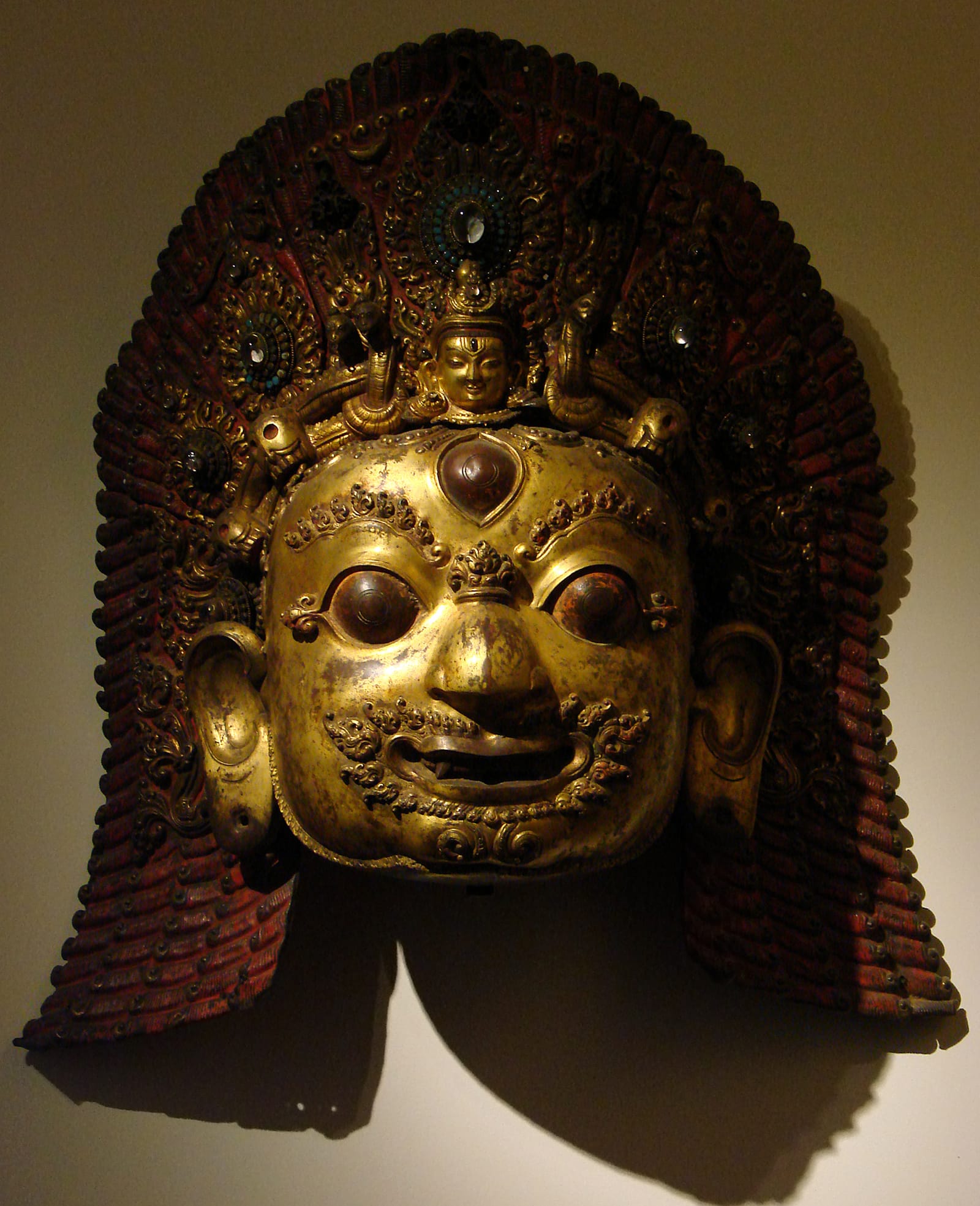
Mask of Bhairava, the 'Fearsome One'
Newar workshop, Kathmandu Valley, Nepal · Late 16th – early 17th century · Gilded repoussé copper inlaid with turquoise, glass and rock crystal, 82.7 × 80.9 × 35 cm (inventory MA 5941)
Look for
- Right above the vertical third eye at the centre of the cobra-and-skull diadem: the small, tranquil face of Shiva looking calmly out above Bhairava's fury.
- The half-open fanged mouth, built to hold a pouring pipe so ritual grain beer hidden behind the mask flowed straight out to festival crowds.
- Twisted red copper locks framing gilded cheeks, inlaid rosettes of turquoise and rock crystal, and a crescent moon tucked into the hair.
Transcript (1:38)
Head up to the first-floor Himalayan galleries and stop before this huge golden face glaring out from a fan of red copper curls. More than eighty centimetres tall and almost as wide, with bulging eyes, flame-like brows, coiled cobras, human skulls and bared fangs, it looks built to terrify anyone who comes near. Yet in the Kathmandu Valley of Nepal, where Newar metalworkers hammered this gilded copper sheet around 1600, crowds pushed forward to drink straight from its mouth.
You are looking at Bhairava, the Fearsome One—the wrathful face of the Hindu god Shiva—and this sculpture was not a wall ornament. It was a monumental festival spout. Every year at the September full moon, as monsoon rains clear from the Kathmandu Valley, Hindu and Buddhist neighbours gather together for Indra Jatra, a week-long celebration of harvest, fertility and civic life. Priests set giant masks like this one outdoors in front of a hidden vat of fermented local grain beer. A pipe ran from the jar right through Bhairava's parted lips. When the tap opened, the god's own intoxicating blessing poured out through his fangs for revellers to catch and drink.
Step closer to see how Newar repoussé masters balanced ferocity with jeweller's delicacy. Working copper sheet from the reverse with hammers and punches, they raised full, taut cheeks, scrolled moustaches like flickering fire, and studded the towering crest with cabochons of blue-green turquoise, glass and clear rock crystal.
Now find the vertical third eye in the middle of the forehead, and lift your gaze just above it into the crown of writhing cobras and skulls. Perched right at the centre sits a second, much smaller golden head with lowered eyelids and an unruffled smile. That is Shiva in his peaceful aspect. In one visual stroke the Kathmandu artist explains the theology behind the mask: terror and benevolence are not rival gods here, because Bhairava's protective rage flows directly out of Shiva's calm.

Stop 4 of 5 · Second floor, Korea galleries
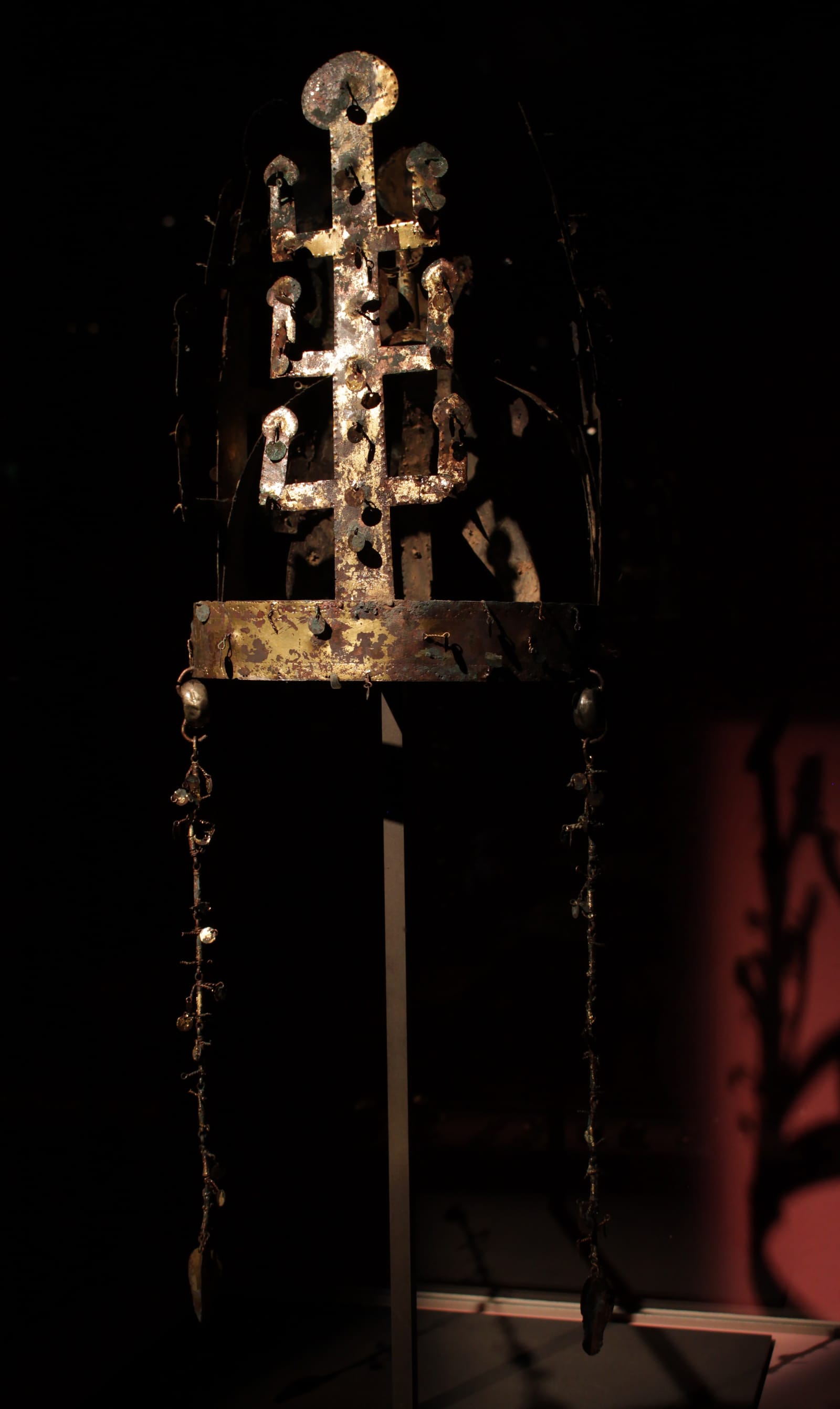
Crown of the Silla Kingdom
Silla kingdom goldsmith workshop, Three Kingdoms period, Korea · 5th–6th century CE · Hammered and cut gilt bronze, 59.5 × 17 cm (inventory MA 1642)
Look for
- Five soaring trident-shaped uprights rising nearly 60 centimetres above the circular brow band, evoking sacred tree branches, mountain peaks or antlers.
- Tiny shimmering spangles wired onto the thin hammered gilt sheet so the whole crown trembled and caught the light at the slightest breath.
- Two long articulated chains hanging down at ear level on either side, imitating ceremonial braided hair.
Transcript (1:50)
Come up to the second-floor Korea galleries and pause before the tall silhouette gleaming inside its dark case. Nearly sixty centimetres high—almost the length of your arm—this crown from Korea's ancient Silla kingdom looks less like European royal headgear than a golden forest growing straight from the wearer's brow.
Look at how thin the metal is. Fifth- and sixth-century goldsmiths in southeastern Korea's Gyeongsang region did not cast heavy rings of solid metal. Drawing on traditions carried across northern Asia from the nomadic horsemen of the Eurasian steppe, they hammered gilt bronze into paper-thin sheets, snipped out a circular headband, riveted five towering three-branched uprights around the rim, hung tiny fluttering discs from twisted wires, and dropped two long chains past the ears to mimic braided locks. Walk slightly to one side and you realize immediately how fragile it is: nobody wore a crown like this into battle or everyday council. It was made for rare sacred rites—or to accompany a ruler into a timber-lined mound tomb.
Why build a crown shaped like tridents and branches? Before Buddhism became Silla's state faith, Korean kingship was bound up with shamanism: the ruler stood as chief intermediary between human society and the spirit world. Read through that lens, those five symmetrical uprights double as branches of the cosmic tree linking earth to heaven, craggy sacred mountains, reindeer antlers and ascending bird wings—all classic emblems of shamanic flight across Siberia and the steppe.
Curators place this piece, acquired by Musée Guimet in 1954 from the Mayuyama collection, in the middle 'standard' phase of Silla crowns, when the balanced trident design reached its cleanest proportions. Not long after it was made, in the sixth century under King Beopheung, Silla adopted Buddhism as its official state religion. Slowly the old shaman-king regalia lost its political charge, crowns grew simplified or purely funerary, and the forest of golden branches vanished underground for fourteen hundred years until twentieth-century excavations brought Silla's forgotten treasury back into the light.

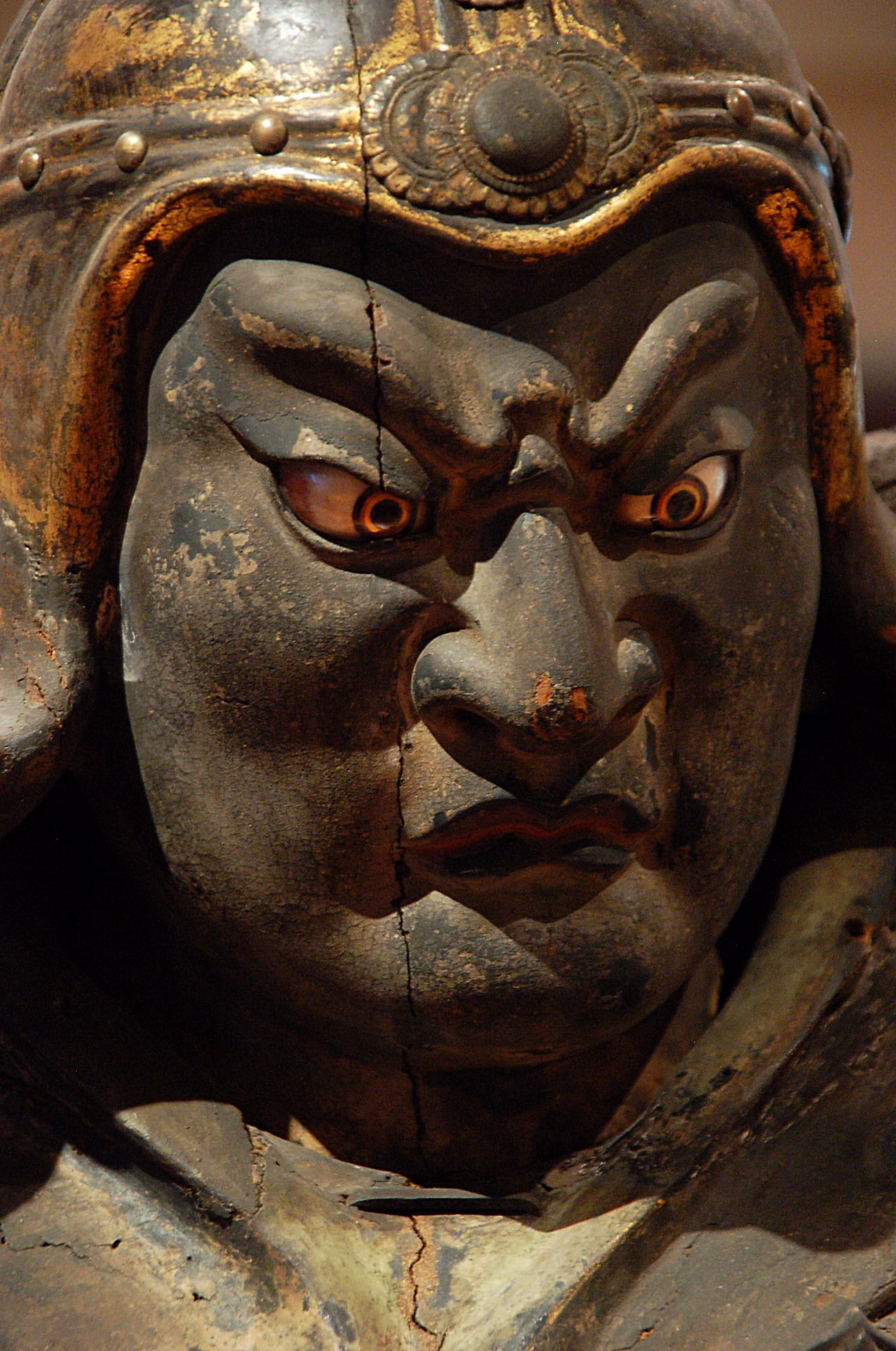
Stop 5 of 5 · Second floor, Japan galleries
Guardian King of the North, Bishamonten
Kamakura period sculptor, Japan · Early 13th century · Lacquered and gilded cypress wood with inlaid rock-crystal eyes (inventory EO 1536)
Look for
- The wet gleam of his eyes—curved lenses of polished rock crystal painted on the back and inserted from inside the hollowed cypress skull—and the fine vertical join down the brow.
- His twin attributes: a weapon in one hand, a miniature treasure stupa-pagoda of Buddhist teachings in the other, and an original grimacing demon pinned underfoot.
Transcript (1:47)
Cross into the neighbouring second-floor Japan galleries and look straight into this warrior's eyes. Even in dim museum lighting they glint with a wet, startlingly human catchlight. That is not paint on wood. Early in the thirteenth century, during Japan's samurai-ruled Kamakura period, sculptors split a block of Japanese cypress front and back, hollowed out the torso and head so the timber would never warp, chiselled open the eye sockets from the inside, and fitted curved lenses of polished rock crystal painted with irises and bloodshot whites on the reverse.
Look right down the bridge of his nose and forehead and you can still trace the vertical seam where the hollowed front and back halves of the head were rejoined, lacquered and gilded. The technique, called gyokugan—literally jewel eyes—turned temple sculpture in Kamakura Japan toward fierce anatomical realism.
Who is he glaring at? Bishamonten is the Guardian King of the North, chief of the Four Heavenly Kings who stand watch at the corners of Buddhist altars to crush enemies of the faith. Like Buddhism itself, he travelled the whole breadth of Asia to get here: he started in India as Kubera or Vaishravana, Hindu lord of wealth and ruler of nature spirits, crossed Central Asia into China dressed in Tang-dynasty scale armour, and arrived in Japan as both a ferocious martial protector and one of the popular gods of good fortune.
Clad in layered armour over billowing sleeves, brows knotted and lips clamped tight, he holds two things that pull in opposite directions: a spear to strike down ignorance, and a miniature stupa—a treasure pagoda enshrining the Buddha's teachings—held carefully aloft. Under his armoured boots squirms a grimacing yaksha demon pinned onto a carved rock base, both original to the thirteenth century.
Finding him on this floor brings you back to how the Musée Guimet began. In 1876 the Lyon industrialist Émile Guimet sailed to Meiji Japan dreaming of a museum of world religions; the hundreds of Japanese Buddhist statues he gathered—moved into this Paris building in 1889—still anchor the top of the house.
Independent guide · Chiaro
Point Chiaro at anything in the Musée Guimet.
These five recordings barely scratch open galleries holding Cambodian lintels, Chola bronzes, Tibetan gilt deities, Goryeo celadons and Grandidier imperial porcelains—in a building that rents out no audio guide of its own. Photograph any sculpture, vessel or wall label in the Chiaro app to hear its story on the spot and ask follow-up questions out loud.
Before you go
Getting there
6, place d'Iéna, 75116 Paris. A step-free ramp to the left of the front stairs leads into the entrance lobby, and lifts serve the garden level, all three collection floors and the fourth-floor rotunda. Inside Place d'Iéna, note that the Afghanistan gallery, Historical Library and Historic China gallery are currently closed for works, and the rooftop terrace is closed until spring 2027; standard tickets also exclude walk-up entry to Maison Guimet (19 avenue d'Iéna, reserved guided tours only), and the Musée d'Ennery at 59 avenue Foch is closed until 2028.
Métro line 9 stops right outside at Iéna; Métro line 6 at Boissière and RER line C at Pont de l'Alma are a brief walk away (Métro line 9 also stops across the Seine at Alma–Marceau; none of those rail stations has step-free lifts). Wheelchair-accessible RATP buses call at Iéna, Kléber-Boissière and Albert de Mun, with Vélib' docks at Longchamp – Place d'Iéna.
Tickets
- One combined ticket covers both permanent galleries and temporary exhibitions at 15 euros standard or 12 euros at the concession rate (no age-based senior discount; American Express is not accepted). Online booking is recommended on weekends and busy exhibitions, though walk-up tickets are sold at the desk and timed bookings allow a window from 30 minutes early to 90 minutes late.
- Open Wednesday to Monday from 10am to 6pm; closed every Tuesday as well as January 1, May 1, July 14 and December 25. The cash desk shuts at 5:15pm, final entry is at 5:30pm, and rooms start clearing at 5:45pm (4:45pm on December 24 and 31); any exit from the building is final.
- Free entry applies to under-18s (straight to ticket check with ID), 18-to-25 European Union nationals (via cashier or online booking), disabled visitors plus one companion with priority access, Paris Museum Pass holders for the permanent rooms (do not confuse this with the City of Paris 'Paris Musées' card, which is invalid here), and everyone without booking every month's opening Sunday.
- Under Vigipirate security rules, suitcases and cabin-size bags are strictly refused; bags smaller than 45 × 100 × 62 cm are accepted and a free cloakroom is available while space lasts. Flash photography is prohibited.
The official audio guide
Musée Guimet states on its visitor page that it provides no official audio-guide handset or mobile app. Instead, reception hands out a free printed floor plan in French and English, runs paid guided lecture-tours, and hosts free walk-up gallery talks each month's opening Sunday. Our five free browser tracks here fill that gap with full written scripts beneath each player, while photographing an unmarked piece in Chiaro brings up spoken commentary on the spot.
Official site →Questions
Is there a free Musée Guimet audio guide?
Yes—right on this page. Because the Musée Guimet does not offer an audio guide of its own, these five English stops stream free in your phone browser with complete transcripts below each player and no sign-up. When you pause before any other statue, bronze or porcelain upstairs, open Chiaro and aim your camera for spoken context.
How much is the official Musée Guimet audio guide?
There isn't one: guimet.fr notes explicitly that the museum offers no audio-guide device or app. At the reception desk you can pick up a free floor plan in English and French, book paid thematic lecture-tours on select dates, or join free unreserved gallery presentations held each month's opening Sunday.
Where is the Portrait of King Jayavarman VII in the Musée Guimet?
On the ground floor in the central Khmer Court, the first gallery space you enter past ticket control. His sandstone head sits among the monumental Cambodian sculptures gathered around Henri and Bruno Gaudin's light-filled courtyard.
Do I need to book Musée Guimet tickets in advance?
Advance online booking is optional rather than mandatory, though the museum recommends it for weekends and headline temporary exhibitions. Walk-up tickets (15 euros standard, 12 euros reduced) are sold at the Place d'Iéna cashier's desk within slot capacity, and online time slots give you leeway from 30 minutes before to 90 minutes after the printed time. No reservations are used on free opening Sundays.
Is the Musée Guimet closed on Tuesdays?
Yes, every Tuesday throughout the year, alongside January 1, May 1, July 14 and December 25. On all other days the Place d'Iéna museum opens from 10am to 6pm, with the ticket counter closing at 5:15pm and last admission at 5:30pm.
More audio guides
Made by Chiaro. Not affiliated with the Musée Guimet.