
Monet's House and Gardens · Giverny · Independent guide
Monet's House and Gardens audio guide,
five stops, free.
A hectare of paintbox flowerbeds above the lane, a diverted stream of hybrid water lilies below it, and forty-three years of Claude Monet's life in between. Play all five stops in your browser, then point Chiaro at any Japanese woodblock print indoors.
Made by Chiaro. Not affiliated with Monet's House and Gardens.
The approach along Rue Claude Monet
Monet's House and Gardens, Giverny
That was the free part
Chiaro narrates anything at Monet's House and Gardens from a photo.
The five stops · 10 minutes of audio
Five places, one walk,
in the order you will walk them.
Before Claude Monet ever squeezed paint onto a Water Lilies canvas, he dug a pond, argued with his neighbours over a stream, and laid out a hectare of flowers by colour. This free Monet's House and Gardens audio guide follows that work on foot, self-guided, from the village street to the far end of the water. You start outside the ticket gate on Rue Claude Monet, looking east along the old lane towards the spire of Sainte-Radegonde; step inside onto the top gravel path of the Clos Normand facing the pink-and-green south front of the house; walk down to the foot of the Grande Allée to look back up through the iron rose arches; cross beneath Chemin du Roy by the pedestrian underpass to the open bank of the lily pond; and finish at the western narrows facing the green Japanese Bridge under its wisteria pergola. Together the five tracks run about ten minutes, inside an estate visit the Foundation puts at an hour and a half to two hours.
Season dates, admission rates, bag limits and access notes follow the Fondation Claude Monet's visitor pages and online ticket office; construction dates, land parcels and history draw on the Académie des Beaux-Arts, France's Monument historique register and the English and French Wikipedia. Giverny welcomes visitors only from April to the first of November, and one-way garden paths shift with the blooms, so on the day the Foundation's signs and gardeners outrank this page; let us know whenever a detail has moved on and we will update it.

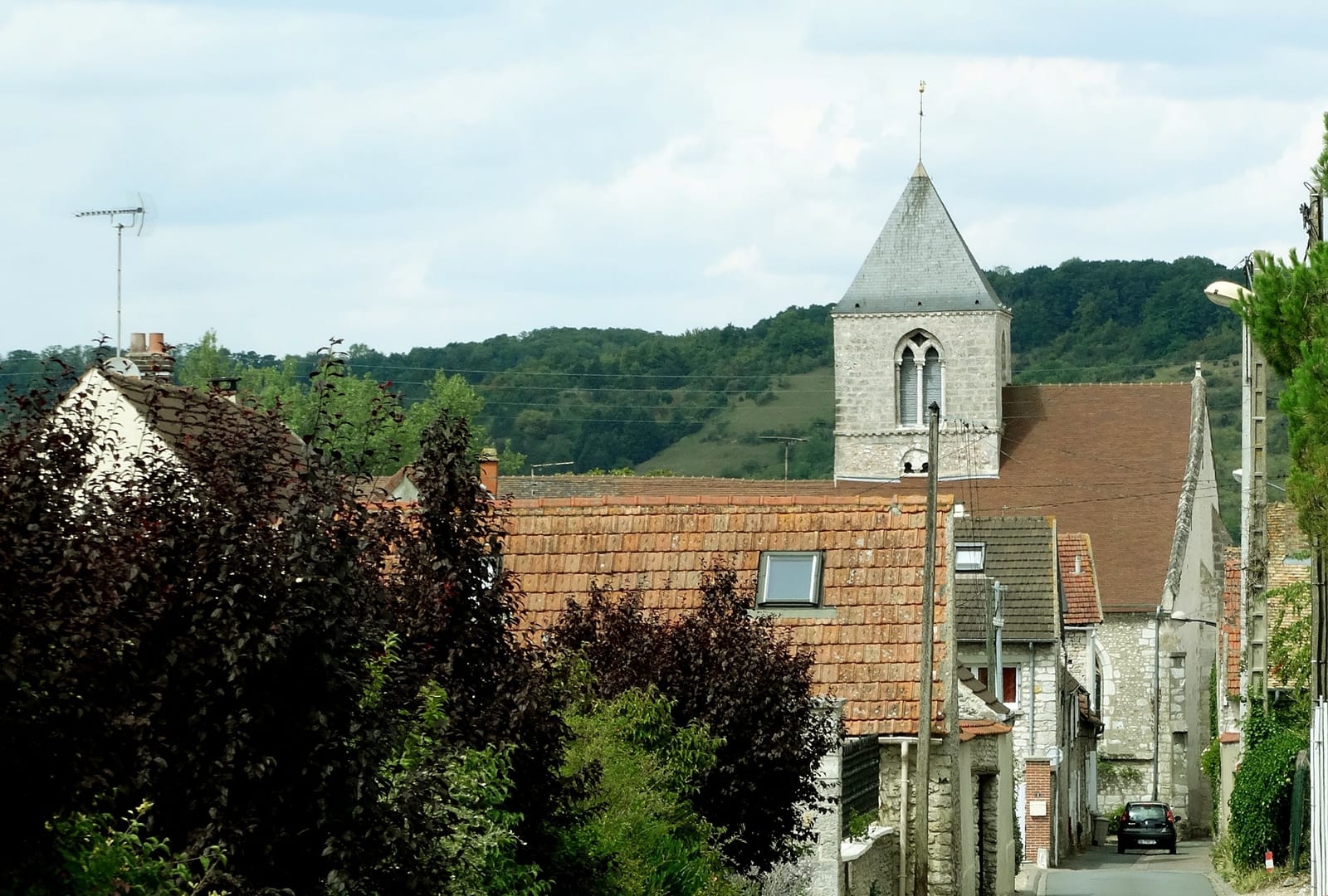
Stop 1 of 5 · On Rue Claude Monet, outside the estate wall before the ticket gate and Sente Leroy entrance, looking east towards the bell tower of Sainte-Radegonde; free
The approach along Rue Claude Monet
Village cottages and boundary walls of Giverny; bell tower and church of Sainte-Radegonde (eleventh to sixteenth centuries); estate at 84 Rue Claude Monet remodelled by Claude Monet (1840–1926) · Church eleventh to sixteenth centuries; Monet settled on this street on 29 April 1883 · Limestone, brick, render and tile along the village lane; Monet's walled plot beside the street covered 96 ares, about 1 hectare, and ran 46 m south to Chemin du Roy
Look for
- The stone bell tower with twin Gothic openings and an octagonal slate spire straight ahead up the lane: the parish church of Sainte-Radegonde, where Monet is buried.
- The long stone and rendered boundary walls lining the narrow village street, once called the Grand'Rue before it took Monet's name.
- The wooded chalk ridge rising north of the rooftops along the Epte valley, which sheltered Monet's south-facing orchard from cold winds.
Transcript (1:46)
Stand on the village street outside the wall before you even reach for a ticket, and look east up the lane towards the pointed slate spire ahead. Today the street carries Claude Monet's name, and coaches roll into the car parks at the edge of the village, yet in the spring of 1883 it was simply the Grand'Rue of a farming hamlet of 279 people.
Monet came here because he was broke and out of time. His landlord at Poissy had threatened court action over unpaid rent and given him until the middle of April 1883 to get out. Worse, Monet needed a roof big enough for ten people at once: himself, his two sons Jean and Michel, Alice Hoschedé, who was still legally married to the bankrupt collector Ernest Hoschedé, and her six children. He wanted Normandy, close enough to Paris to deal with buyers, far enough out to escape Parisian gossip, and near a secondary school across the river in Vernon.
On the fifth of April 1883 he rode the slow local train that clattered up the Epte valley from Vernon towards Gasny, peering out of the carriage window at every stop. Giverny had three mills, a blacksmith, a schoolhouse and one long vacant farmhouse called Le Pressoir, the cider press, enclosed inside stone walls along this street. Its owner, the farmer and winegrower Louis-Joseph Singeot, knew nothing about Monet's rent arrears and agreed to let it. Monet borrowed five thousand francs against future paintings from his dealer Paul Durand-Ruel, moved in with his boys on the twenty-ninth of April, and welcomed Alice and her six children the next day.
He stayed for forty-three years. Word spread quickly, and within a decade young American painters were renting rooms down this same lane until Giverny became an international art colony.
Keep that stone church tower ahead of you in mind for the end of your walk. Sainte-Radegonde has an eleventh-century Romanesque apse and a fifteenth- and sixteenth-century nave and belfry. When Monet died at number 84 on the fifth of December 1926, his neighbours carried him up this exact stretch of road to the churchyard beside that tower, where he lies with Alice, Jean and Blanche.

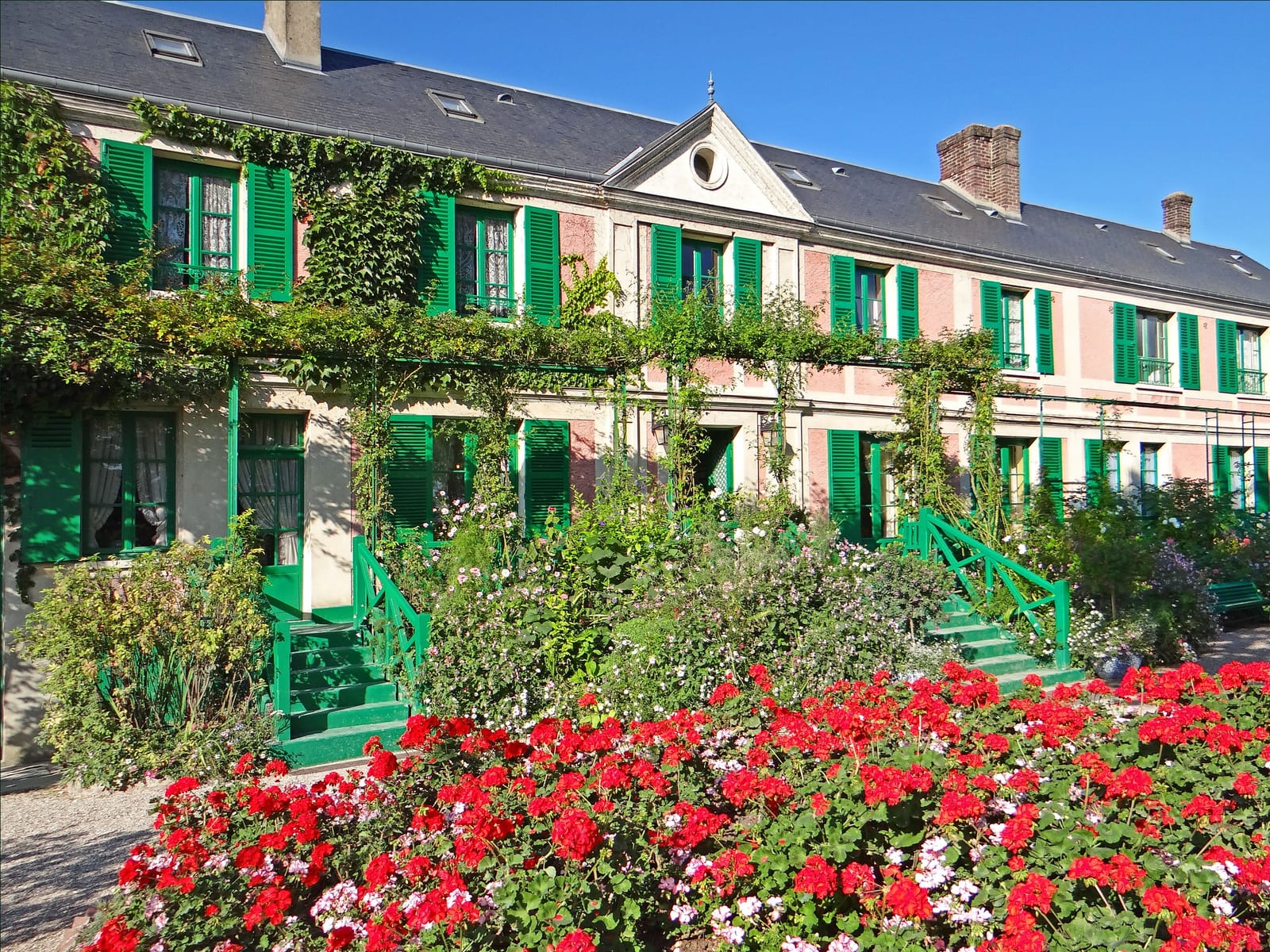
Stop 2 of 5 · Top path of the Clos Normand, along the south front of the house, facing the pink façade and green veranda steps
The pink house and green shutters
Early nineteenth-century farmhouse, Le Pressoir, formerly owned by Louis-Joseph Singeot; extended, rendered and repainted by Claude Monet (1840–1926) · First half of the nineteenth century; rented by Monet 1883, bought 1890, enlarged by 1899 · Pink crushed-brick render over stone, slate mansard roof, pine-green wooden shutters and green timber veranda steps, at the head of a 1-hectare walled plot
Look for
- The crushed-brick pink plaster paired with bright pine-green wooden shutters: Singeot's farmhouse had dull grey shutters until Monet repainted them in his first year here.
- The green iron trellis running across the ground-floor front and the two green timber staircases stepping straight down into the flowerbeds.
- The sheer length of the building under its slate mansard roof and central round attic window, stretched outward as Monet converted barns and added studio wings.
Transcript (2:05)
Turn to face the house from the top gravel terrace, and the first thing that hits you is the colour. Warm crushed-brick pink on the plaster, sharp pine green on every shutter, door and timber step, and climbing vines laced along an iron frame across the front. When Monet rented Le Pressoir in 1883 the walls were already pink, a vernacular Norman render, while the shutters were a flat country grey. Almost the first thing he did was paint every shutter and door green so the house answered the leaves in front of it.
Behind those windows lived a noisy blended household of ten. Four ground-floor spaces, four bedrooms above and two rooms tucked under the slate mansard roof had to hold eight children, steaming copper pans and stacks of wet canvases. Inside, Monet treated the interiors as exercises in pure colour: two shades of bright chrome yellow for the dining walls and furniture, hung with a large share of the 243 Japanese woodblock prints by Utamaro, Hokusai and Hiroshige that he collected over his life, beside a kitchen tiled ceiling to floor in blue and white ceramics from Rouen.
In May 1890 Singeot put the farm up for sale. Panic-stricken at the thought of losing his garden, Monet wrote to Durand-Ruel begging an advance, certain he would never find another setting like it, and bought the property in November 1890 for twenty thousand francs paid in four yearly instalments. He had already turned the western barn into his first Giverny studio in 1885; by 1898 he raised a second studio building at the north-west corner, and in 1915 he added a vast sky-lit hall 23 metres long at the north-east end so he could wheel his giant Water Lilies panels around on castors.
What you see very nearly vanished. Monet's surviving son Michel preferred African safaris to Giverny, so Monet's stepdaughter and daughter-in-law Blanche Hoschedé-Monet kept the house intact with the head gardener Louis Lebret, even refusing to shake Field Marshal Erwin Rommel's hand when he called here in 1944. After Blanche died in 1947 the roof leaked, a staircase collapsed and shatter-glass littered the floors. Michel left the estate to the Académie des Beaux-Arts in 1966, and between 1977 and June 1980 the curator Gérald Van der Kemp raised roughly seven million dollars, ninety-five percent of it from American patrons, to bring the pink house back from ruin.

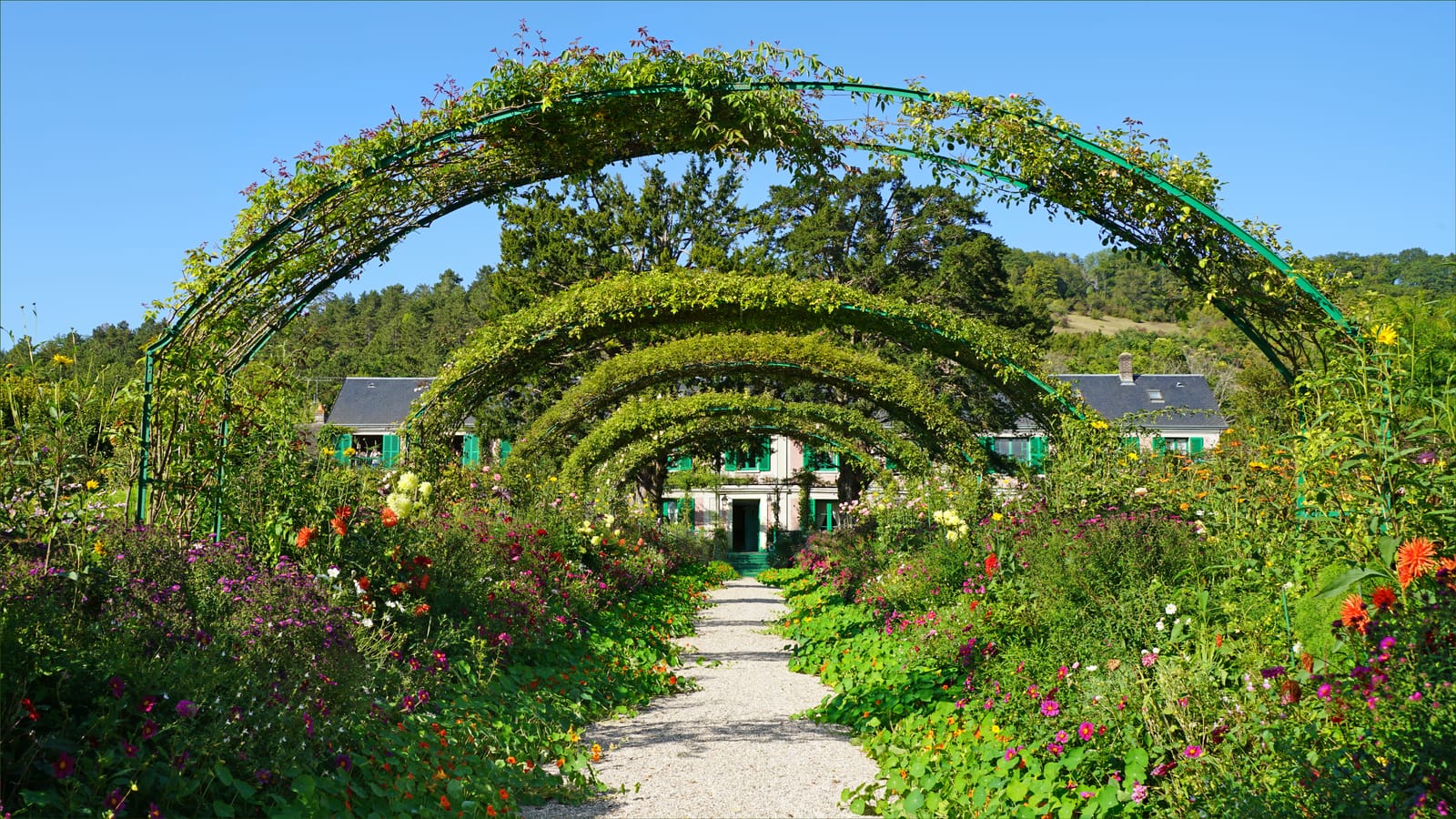
Stop 3 of 5 · Southern end of the central path, the Grande Allée, in the Clos Normand, looking north through the iron arches towards the front door of the house
The Grande Allée and the Clos Normand
Designed and planted by Claude Monet (1840–1926), with head gardener Félix Breuil from 1892; restored to Monet's planting plan in 1977–1980 under Gérald Van der Kemp (1912–2001) and Gilbert Vahé · Laid out from 1883 onwards; restored 1977–1980 · Painted iron rose arches over the central path and single-colour flowerbeds across a walled garden of 96 ares, about 1 hectare, extending roughly 46 m from the house to Chemin du Roy
Look for
- The sequence of green-painted iron arches spanning the gravel Grande Allée and framing the open green front door of the house straight ahead.
- Behind the arches near the house, the two tall dark yew trees: the sole evergreens Monet spared after Alice fought him over cutting down the old alley trees.
- To the west of the central path, the long rectangular beds planted in blocks of a single colour, laid out side by side like dabs of pigment on a wooden palette.
Transcript (1:59)
Walk down to the southern foot of the Clos Normand and look straight back up the central gravel path towards the front door. Those green iron arches curving overhead, heavy with climbing roses while nasturtiums creep out across the stones in late summer, are the backbone of a 1-hectare walled plot that began life as a plain Norman cider orchard and vegetable patch.
When Monet moved in, this central alley was dark and stiff, edged with clipped boxwood hedges and tall spruces and cypresses. Monet hated clipped geometry and wanted full sun on his petals; Alice loved the evergreens and begged him to leave them alone. They argued over those trees for years. In the end Monet tore out the boxwood, felled the spruces so light could flood the beds, put up these painted metal arches in their place, and spared just the two dark yews closest to the house as a peace offering to Alice. Look behind the arches near the façade and you can still spot their dark crowns.
Everything else here was composed with a painter's eye rather than a Victorian parks manual. Old apple and pear trees gave way to Japanese flowering cherries and apricots. Along the western half of the garden he laid out long rectangular beds of single colours side by side, blocks of blue irises, crimson Oriental poppies, yellow daffodils, peonies, dahlias and asters, so wind and sun mixed them optically the way unblended strokes work on canvas. Tall stems stood behind low clumps to build depth and cast coloured shadow.
Keeping a hectare in continuous bloom from April to autumn became an obsession. Monet swapped seeds and botanical journals with his friends Gustave Caillebotte and Octave Mirbeau. In September 1892 he put up a heated glasshouse and stayed awake until morning with Alice and his stepdaughters checking the boiler so frost would not kill his gloxinias. By 1904 six full-time gardeners worked here under Félix Breuil. When passing carts and early motorcars kicked white chalk dust over his borders from Chemin du Roy behind you, Monet paid out of his own pocket to have the public road tarred.
By 1977 brambles choked the whole enclosure and the ironwork had rusted through. Head gardener Gilbert Vahé and Gérald Van der Kemp had to scrape off accumulated soil just to find Monet's original path levels before replanting his exact varieties.

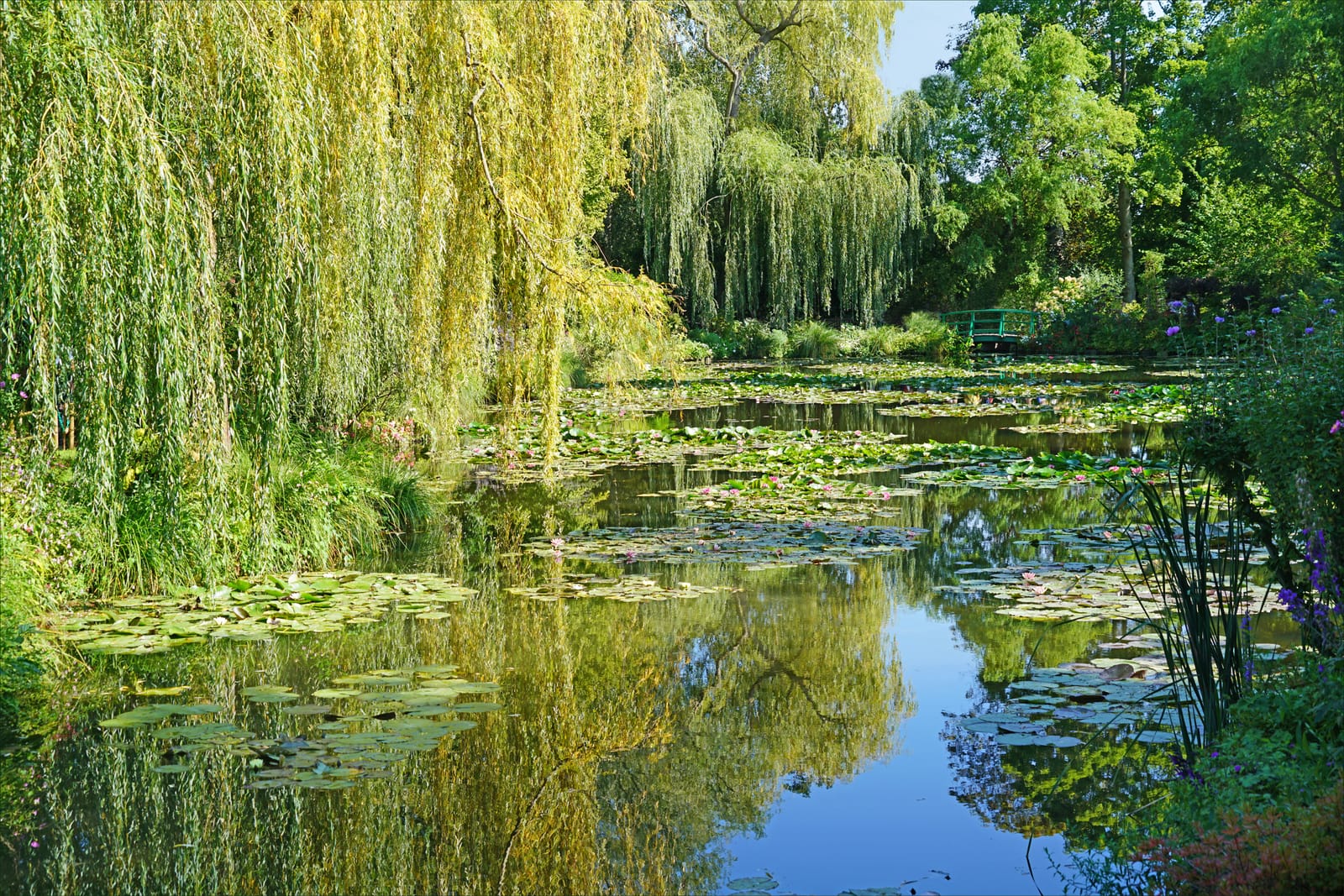
Stop 4 of 5 · Bank of the Water Garden, the Jardin d'eau, south of Chemin du Roy via the pedestrian underpass, facing across the open mirror of the lily pond
The Water Garden and the lily pond
Excavated and planted by Claude Monet (1840–1926), with hybrid water lilies bred by Joseph Bory Latour-Marliac (1830–1911) · First plot bought and dug 1893; enlarged 1901–1902; banks reshaped after the 1910 flood · Diverted arm of the Ru stream filling an asymmetrical basin begun on a 1,268 square metre plot and enlarged to roughly four times that size, planted with hybrid water lilies, weeping willows and bamboo
Look for
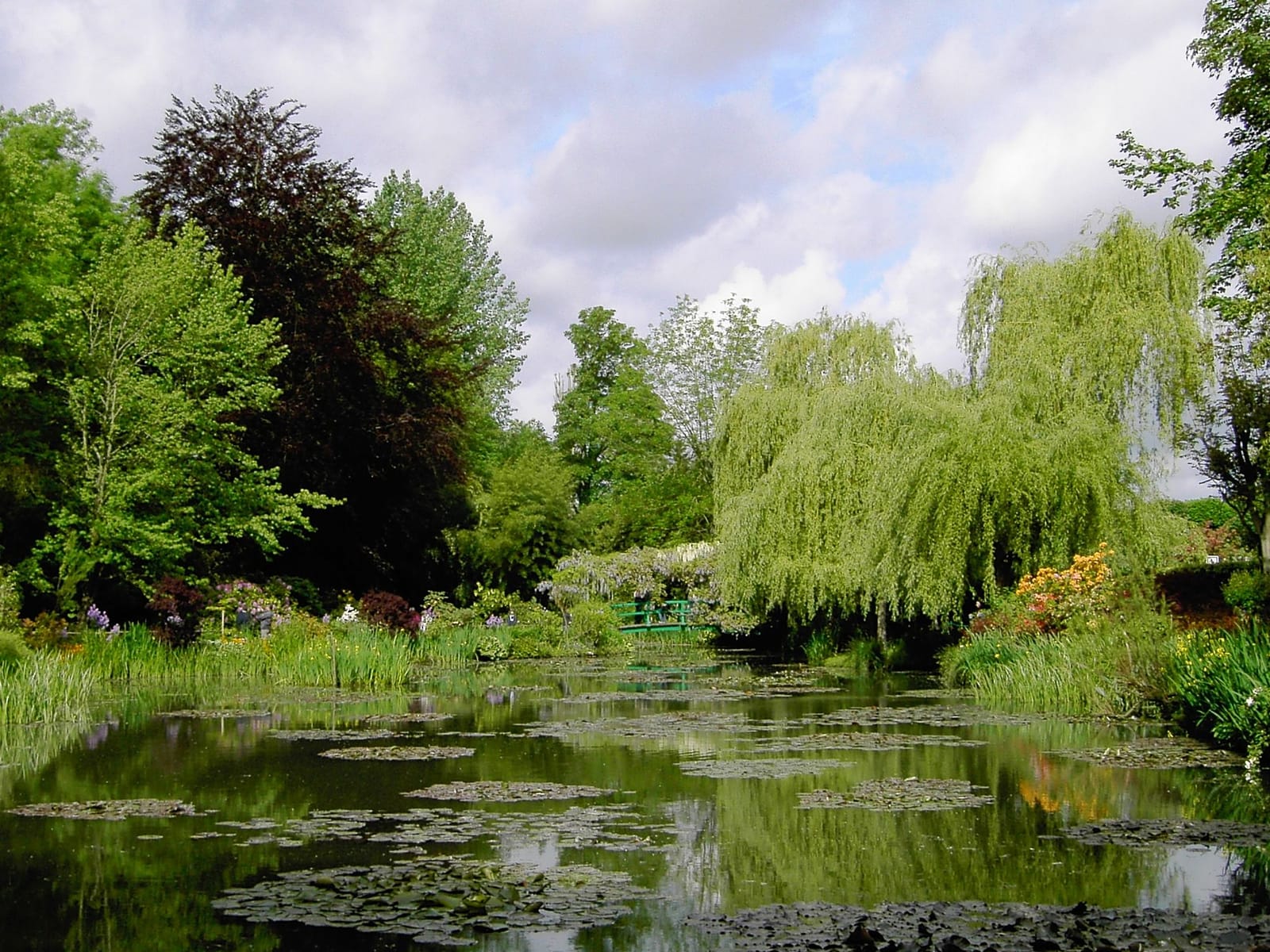
- The upside-down sky and trailing weeping-willow branches reflected between the clusters of round lily pads: the exact frameless view Monet painted after 1897.
- The pink, crimson and pale-yellow hybrid water lilies, bred in south-west France by Joseph Bory Latour-Marliac rather than native white pond lilies.
- The screen of bamboo, maples and willows hiding the surrounding fields so the water reads as a self-contained world with no distant horizon.
Transcript (2:01)
Follow the underpass beneath Chemin du Roy, a tunnel added in the late 1970s with funds from Walter Annenberg so visitors no longer dodge traffic where four daily trains once rattled past Monet's gate, and everything changes rule. Up in the Clos Normand every path is straight. Down here in the Water Garden not a single bank runs in a straight line.
In February 1893, ten years after arriving at Giverny, Monet bought 1,268 square metres of marshy meadow on this side of the tracks, crossed by a cold little brook called the Ru, an arm of the Epte. When he asked permission in March to divert water from the Ru into a dug pond, the village rose up against him. Farmers insisted his foreign aquatic plants would poison the stream and kill their cattle, and in April the municipal council voted him down. Monet exploded in a letter, cursing the villagers and the civil engineers and threatening to dump his lilies in the river, then appealed to the Prefect of the Eure in July 1893 with one disarming sentence: he wanted to grow water plants for the pleasure of the eyes and in order to have subjects to paint. Ten days later the Prefect signed the permit.
Up to that generation, European wild water lilies bloomed white. At the 1889 World's Fair in Paris, Monet had seen sensational hardy hybrids in pink, yellow and deep red bred by the French botanist Joseph Bory Latour-Marliac, and he ordered them straight from Latour-Marliac's nursery catalogues. He bought more land in 1901, shifted the bed of the Ru southward in 1902 to triple the basin, planted giant bamboo in 1906, and after two devastating Seine floods in 1910 buried the garden in mud, contoured the banks into the sweeping curves you see now, roughly four times the size of his first pond.
One gardener worked full time in a flat-bottomed boat doing nothing else: skimming dead leaves and washing dust and morning dew off the pads. Look straight down into the water between the floating leaves, where clouds and willow fronds hang upside down. From 1897 until his death, Monet dropped the shoreline out of his canvases altogether and painted only this liquid mirror, culminating in the ninety-one metres of curved Water Lilies murals at the Musée de l'Orangerie in Paris.

Stop 5 of 5 · Western end of the Water Garden, the Jardin d'eau, facing east across the lily pond towards the green arched footbridge and wisteria canopy
The Japanese Bridge and wisteria pergola
Built for Claude Monet (1840–1926) by a local craftsman; pergola added for Monet; bridge reconstructed in beechwood to Monet's design in 1977–1980 under Gérald Van der Kemp · Bridge built 1893–1895; wisteria pergola added around 1904 to 1905; reconstructed 1977–1980 · Green-painted arched beechwood footbridge and wisteria pergola spanning the western narrows of the lily pond, on the water-garden plot begun at 1,268 square metres
Look for
- The colour of the curved wooden rails: Monet chose soft garden green rather than traditional Japanese vermilion lacquer so the timber would blend into the willows and reeds.
- The gap of open air beneath the arch of the deck, set high enough for daylight to slip underneath and brighten the shadowed water.
- The twisted old wisteria trunks climbing the overhead trellis pergola, Monet's own surviving vines saved when the rotted timber bridge was rebuilt in beechwood.
Transcript (2:20)
Stand at the western curve of the pond and look straight east across the lily pads towards the arched wooden bridge. If you drew an invisible line north through the middle of that span, across the road and up the slope, it would run straight up the Grande Allée of the Clos Normand to Monet's front door. Even in an asymmetrical Japanese-inspired garden, he anchored the bridge on the spine of the whole estate.
A local carpenter built the first span here while the pond was still raw earth. When the fifteen-year-old Julie Manet visited with her mother Berthe Morisot in October 1893, she noted in her diary an ornamental lake crossed by a green bridge that looked rather Japanese, and the finished arch was in place by 1895. Monet knew curved timber footbridges by heart from the Hiroshige and Hokusai woodblock prints covering his walls indoors, and in June 1891 he had also sought advice from the Japanese gardener Wasuke Hata, who stayed in France after building the Japanese pavilion for the Paris World's Fair. Yet Monet refused one obvious cliché. Traditional temple and garden bridges in Japan are lacquered vermilion red. Monet painted his green so it would sink into the weeping willows, bamboo and sedges rather than shout against them, and he bowed the deck just high enough for daylight to pass underneath and lift the dark reflection on the water.
A few years later he raised a trellis pergola over the railings and trained mauve and white Japanese wisteria across the top so blossoms hung like chandeliers above the water every spring.
No single structure in modern painting was tested under harsher changes of eyesight. In the summer of 1899 Monet planted his easel right where you are standing and painted a tight series of near-square canvases, balanced and cool in emerald and blue-green, including Green Harmony now in the Musée d'Orsay. Twenty years on, between 1918 and 1924, dense cataracts clouded both of his eyes, filtering out blues and violets and turning the world muddy yellow and rust-red. Refusing at first to risk surgery, and then painting furiously again after two operations on his right eye in 1923, the eighty-year-old artist came back to this bridge and attacked it with thick crusts of ochre, scarlet and burnt green, canvases now hanging in the Musée Marmottan Monet where the timber arch nearly dissolves into pure paint.
During the three decades of abandonment after 1947, termites hollowed out the planks until the bridge rotted into black water while coypu tore away the banks. When Van der Kemp and Gilbert Vahé drained and sheet-piled the pond between 1977 and 1980, carpenters rebuilt the bridge identically in seasoned beechwood, threading the new frame carefully underneath the gnarly living wisteria vines that Monet himself had planted.
Independent guide · Chiaro
Point Chiaro at anything at Monet's House and Gardens.
Inside the pink house hang 211 Japanese woodblock prints by Utamaro, Hokusai and Hiroshige alongside reproductions of canvases by Cézanne, Renoir, Signac and Caillebotte, and outside hundreds of flower varieties trade places from April to autumn. Photograph a print on the yellow dining wall, a Rouen tile or an unfamiliar bloom along the path, and Chiaro tells you what you are looking at and answers your next question out loud.
Before you go
Getting there
84 rue Claude Monet, 27620 Giverny, in the Eure department of Normandy. Stop 1 plays free on Rue Claude Monet outside the boundary wall before the ticket entrance; visitors holding a disability card have priority entry via the group gate on Sente Leroy.
From Paris Gare Saint-Lazare, regional trains reach Vernon-Giverny station in roughly forty-five minutes to an hour. Outside the station, a shuttle bus runs to Giverny for 5 euros single or 10 euros return, and bikes can be hired at the station exit to follow the Seine à Vélo cycleway into the village. Drivers find free car parks with bicycle racks at the edge of Giverny.
Tickets and entry
- Monet's House and Gardens open seasonally every day, Mondays and public holidays included, from 1 April to 1 November, 10 am to 6 pm with last admission at 5.30 pm. The estate stays closed through winter from 2 November to 31 March; the official ticket portal announces spring reopening on 1 April 2027, with online sales opening in March 2027.
- Individual unguided tickets cost 13 euros for adults, 7 euros for ages 7 to 17 and students (fine-art and art-history students enter free with proof), free for children under 7 outside school groups, and 6 euros for visitors with disabilities (accompanying person at full rate). Combined tickets sold on site only pair Giverny with the Musée des Impressionnismes Giverny for 25 euros, the Musée de l'Orangerie for 25.50 euros, or the Musée Marmottan Monet for 27 euros.
- Online booking on the official ticket portal is strongly recommended, though tickets are also sold on site daily; e-tickets are non-refundable, free-admission tickets are issued on site against proof rather than online, there is no skip-the-line access, and any exit from the site is final.
- The Clos Normand and Water Garden paths (linked by the underpass beneath Chemin du Roy) are accessible to visitors with reduced mobility, whereas the historic house is not wheelchair accessible. There is no left-luggage room: bags are checked at entry and only cabin-sized bags up to 55 by 35 by 20 cm carried in your hand or on your back are allowed, while pets (except recognised assistance dogs), picnics, painting and drawing are forbidden.
The official audio guide
The Fondation Claude Monet does not rent or provide an official on-site audio guide handset or mobile app: standard individual admission is strictly an unguided visit, while pre-booked groups of twenty or more bring external independent guides. The five tracks on this page fill that gap for free in any phone browser, begin outside the wall on Rue Claude Monet, and print every word below each player.
Official site →Questions
Is there an official audio guide at Monet's House and Gardens in Giverny?
No. The Fondation Claude Monet does not offer an official audio guide handset or app on site; individual admission is sold as an unguided visit, with a recommended stay of 1 hour 30 minutes to 2 hours. You can play all five stops on this page for free in your phone's browser, with full written scripts underneath.
When is Monet's House and Gardens in Giverny open?
The estate opens only from spring to autumn: every day from 1 April to 1 November, 10 am to 6 pm, with last admission at 5.30 pm, including Mondays and French bank holidays. From 2 November through the end of March it is closed to visitors; the official ticket office lists the next reopening for 1 April 2027, with online booking from March 2027.
Can I use this Giverny audio guide without a ticket?
Stop 1 is written for the public street outside the boundary wall on Rue Claude Monet, looking east towards the church of Sainte-Radegonde where Monet is buried, so you can play it free even without entering or out of season. Stops 2 to 5 stand inside the Clos Normand and the Water Garden and require an admission ticket (13 euros for an adult).
How do I get from Paris to Monet's House and Gardens in Giverny?
Take the train from Paris Gare Saint-Lazare to Vernon-Giverny, then catch the Vernon–Giverny shuttle bus outside the station (5 euros one way, 10 euros return) or hire a bike at the station exit to ride the cycle path into Giverny. If you drive, free public car parks sit at the edge of the village.
Do I need a separate ticket for the Water Garden and Japanese Bridge?
No. One admission ticket covers the house exterior and rooms, the Clos Normand flower garden, and the Water Garden with the lily pond and Japanese Bridge across Chemin du Roy, reached through the pedestrian underpass. Keep in mind that any exit from the estate is final.
Can I bring a suitcase or backpack into Monet's gardens at Giverny?
There is no luggage storage on site under French Vigipirate security rules, and large suitcases are turned away. Only cabin-sized bags measuring at most 55 by 35 by 20 cm, carried in your hand or on your back, are permitted past the bag check.
More audio guides
Made by Chiaro. Not affiliated with Monet's House and Gardens.