
Freer Gallery of Art · Washington DC · Independent guide
Freer Gallery of Art audio guide,
five stops, free.
Whistler's peacocks, a Chola bronze and the Cosmic Buddha, narrated in this tab. For the rest of the Freer's more than 26,000 objects, from ancient Chinese jades to Korean bronzes, Chiaro works from a photo.
Made by Chiaro. Not affiliated with the Freer Gallery of Art.
Queen Sembiyan Mahadevi as the Goddess Uma
Freer Gallery of Art, Washington DC
That was the free part
Chiaro narrates any work in the Freer Gallery of Art from a photo.
The five stops · 11 minutes of audio
Five stops, one walk,
in the order you will walk them.
The Freer's galleries are all on one floor, around a courtyard, and this Freer Gallery of Art audio guide makes a single loop of them. Begin by the National Mall entrance in Gallery 1 with a Chola queen cast in bronze as a goddess, follow the north side east into the Chinese rooms for the Cosmic Buddha in Gallery 17 and the Sogdian funerary couch next door in Gallery 16, then turn south to Gallery 12, where Whistler's Princess hangs over the fireplace of the Peacock Room and the room itself closes the walk. All five tracks together run about ten minutes; with the short walks and a pause at each case, the loop takes half an hour.
We held each claim on this page against two things: the museum's own object records, published in the Smithsonian's open-access collection data, and one outside reference, and we confirmed the gallery numbers on 25 September 2026. The Freer never lends out its collection, but it does rotate what is on show from its store, so where a gallery sign disagrees with us, believe the sign over this page and let us know, and we will correct it.
CC0, National Museum of Asian Art, Smithsonian Institution. Photo: National Museum of Asian Art, Smithsonian Institution
Stop 1 of 5 · West Building, Gallery 1 (Body Image: Arts of the Indian Subcontinent)
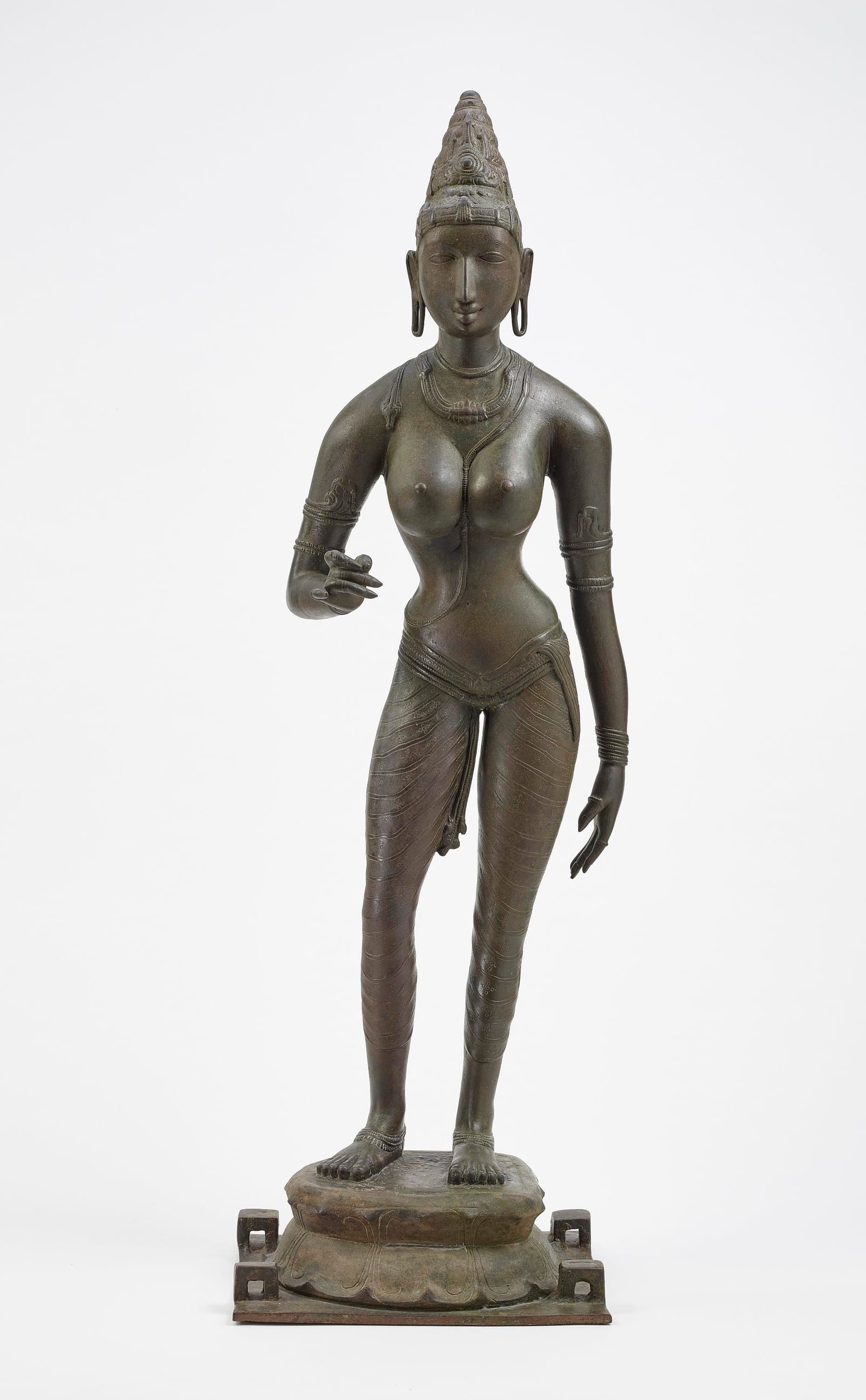
Queen Sembiyan Mahadevi as the Goddess Uma
Chola dynasty, Tamil Nadu, India · 10th century · Bronze, 107.3 × 33.4 × 25.7 cm
Look for
- The face. Pursed lips and a long nose make her more individual than the usual serene goddess, which is why the museum thinks she may be a portrait.
- The triple bend. Hips out to one side, shoulders tilted back the other way, head settling in between: the stance called tribhanga.
- The cloth over her legs, carved so thin that it clings like wet silk.
Transcript (1:56)
The first thing you notice is the sway. Her weight rests on one leg, her hip pushes out to the side, her shoulders lean back the other way, and her head settles in between. Indian sculptors called this stance tribhanga, the triple bend, and it is the reason a metre of bronze standing perfectly still on its base seems to be moving.
The label calls her Queen Sembiyan Mahadevi as the Goddess Uma, and both halves of that title matter. The pose belongs to a goddess, and recalls Parvati. The queen was a real woman. Her husband, Gandaraditya Chola, ruled in the south of India from 949 to 957, and she was widowed young. From then on she wore white, the colour of mourning. Over some sixty years she poured her wealth into temples, building many and endowing many more. The museum calls her a highly respected patron of the arts.
In her own lifetime, her birthday was celebrated in a Shiva temple in a town that carried her name, and a metal portrait of the queen was presented to that temple in her honour. The museum is careful here: it says only that it is possible this is that very sculpture. What is certain is how a figure like this was used. It is a processional bronze. On festival days it would have been wrapped in silk, hung with jewellery and flower garlands, and carried through the streets for the whole town to see.
Now look at her face, because it is the best argument for the story. She has pursed lips and a long nose, and the museum calls the shape of her face uncommonly individual for an image of this kind. And yet nobody in the tenth century would have picked out the queen by likeness. A statue like this was known by where it stood and what was done with it, here the procession on her birthday. A face this particular, on a statue nobody needed to recognise, is exactly the kind of detail that keeps the portrait theory alive.
The Freer bought her in 1929, with the endowment named after its founder, and she has stood in this room since the current installation opened in 2017. Before you walk on, drop your eyes to her legs. The cloth is carved so thin that it clings like wet silk, and every fold runs with the sway of her body, down to the base her feet have stood on for a thousand years.
CC0, National Museum of Asian Art, Smithsonian Institution. Photo: National Museum of Asian Art, Smithsonian Institution
Stop 2 of 5 · West Building, Gallery 17 (Promise of Paradise)
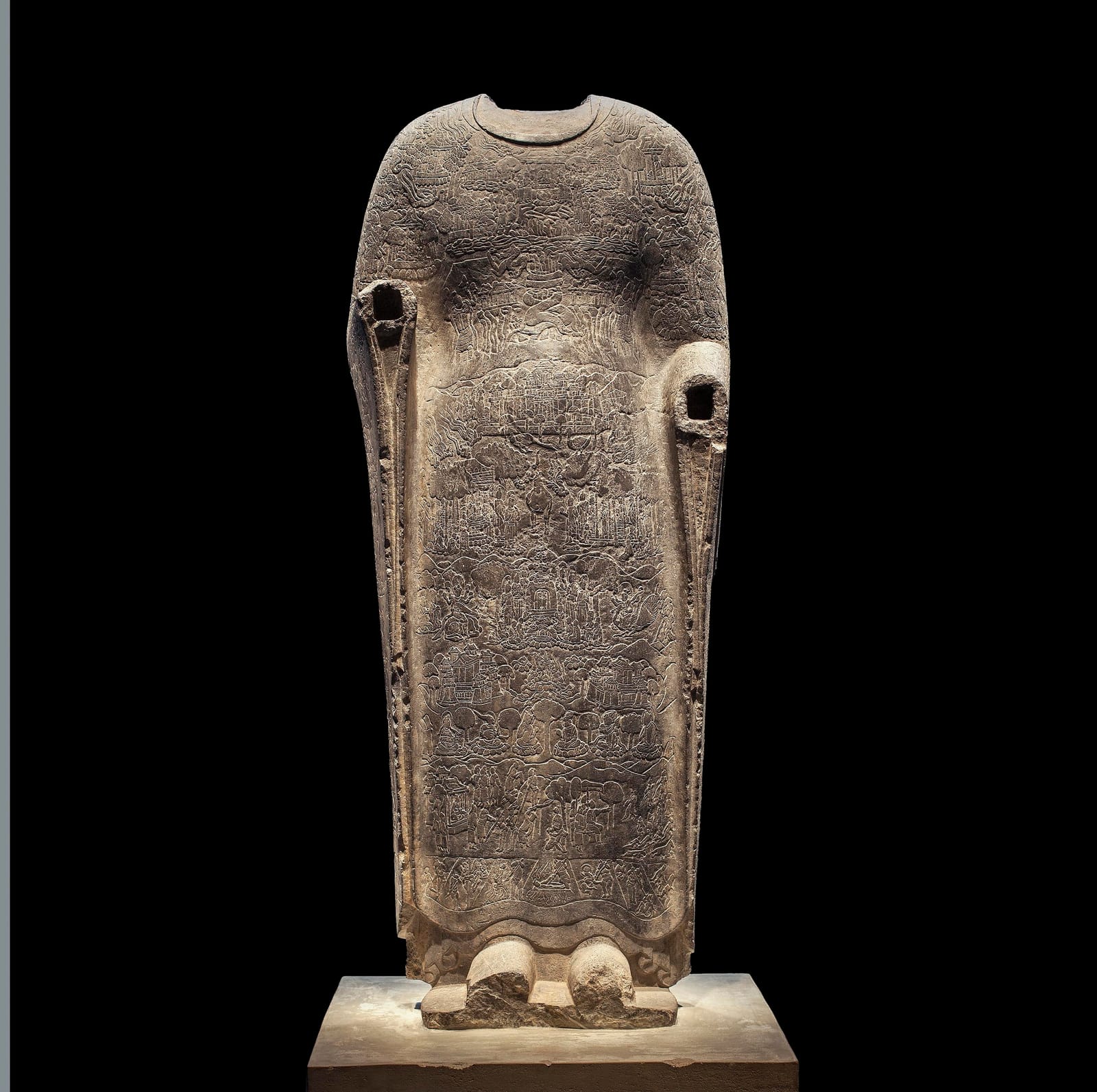
Buddha draped in robes portraying the Realms of Desire (the Cosmic Buddha)
Northern Qi dynasty, Anyang region, Henan province, China · 550–577 · Limestone, 151.3 × 62.9 × 31.3 cm
Look for
- Mount Sumeru on the chest, with two snakes coiled around it: the mountain Buddhists believed joined heaven and earth.
- The crowded scenes just above the hem. They are the tortures of hell, the bottom of the map.
- Faint colour in the grooves. Every scene on the robe was once painted.
Transcript (1:53)
Follow the north side of the building east into the Chinese galleries, and in Gallery 17 you meet a figure with no head and more stories carved on him than any other object on this walk. He is life-size, just over one and a half metres of limestone, and he weighs more than 800 pounds without his base. He wears the plain robe of a monk, as every Buddha does. What makes him extraordinary is that the robe is a map of the universe.
Scholars identify him as Vairochana, the Cosmic Buddha, called Piluzhena in Chinese. The idea comes from the Lotus Sutra: when the historical Buddha preached, a vision of the whole cosmos was said to appear in front of him. So the carvers of northern China, some time between 550 and 577 under the Northern Qi dynasty, covered this robe, front and back, with everything that exists.
Start at the chest. That peak is Mount Sumeru, the sacred mountain Buddhists believed joined heaven to earth, and the two snakes wound around it are naga. Below it are scenes of the Buddha as a young prince, before his enlightenment. Now let your eyes drop to just above the hem. Those crowded little figures are the tortures of hell. The sacred mountain at the top, the prince's life in the middle, hell at the hem, all on one garment. The museum calls the scheme the Realms of Existence.
Look into the grooves and you may catch a trace of colour. These scenes were painted once, and slight traces of the pigment survive.
For a long time, scholars could hardly read the carving. The relief is so low that they made ink rubbings on paper to bring it out. Then in the autumn of 2011 a Smithsonian digitisation team spent two weeks laser-scanning the figure, and the 3D model made scenes readable that nobody had been able to make out before. Working from it, Keith Wilson, the museum's curator of ancient Chinese art, came to think the sculpture may have been made for teaching, probably in a monastery, with someone standing beside it and explaining each scene in turn.
If he is right, this is the oldest audio guide in the building. Fourteen centuries ago, somebody stood about where you are standing and talked the faithful through that robe, from the mountain on the chest down to hell at the hem.
CC0, National Museum of Asian Art, Smithsonian Institution. Photo: National Museum of Asian Art, Smithsonian Institution
Stop 3 of 5 · West Building, Gallery 16 (Center of the World: China and the Silk Road)
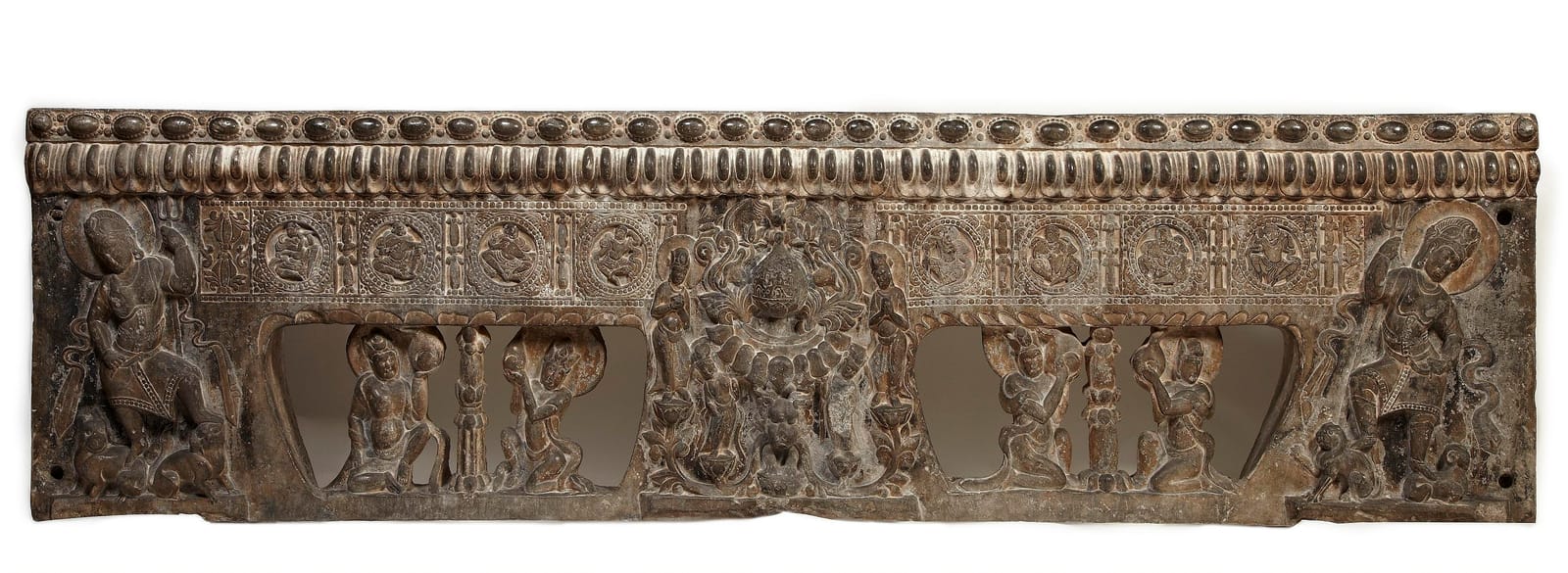
Funerary couch with Sogdian musicians and dancers
Northern Qi dynasty, China; made for a Sogdian patron · 550–577 · Grey marble with traces of pigment; front 60.3 × 234 cm, with two side stretchers
Look for
- The incense burner in the centre, topped by a bird and flanked by haloed figures on lotus flowers: a purely Chinese Buddhist image.
- The eight beaded circles above the openings, each framing a musician or dancer in foreign dress, carved in a Persian style.
- The guardian at each end, in long coat and boots, forcing a wild animal down.
- The bent-neck lute on one of the side pieces, the Silk Road ancestor of the Chinese pipa.
Transcript (2:06)
Next door, in Gallery 16, a long slab of grey marble, more than two metres wide, stands in front of you with two shorter pieces beside it. Together they are the base of a funerary couch: a stone platform, shaped like a Chinese bed, on which a coffin was laid in an underground tomb in sixth-century northern China.
Start in the middle. The incense burner with a bird on top, flanked by haloed heavenly beings standing on lotus flowers, is a Chinese Buddhist image through and through. Now look along the band above the openings. Those eight beaded circles frame musicians and dancers in foreign dress, carved in a Persian style. At each end, a guardian in a long coat and boots forces a wild animal to the ground.
The man laid on this bed was a Sogdian. The Sogdians came from Central Asia, and by the sixth century Chinese sources describe their communities scattered right across China, merchants and officials among them. Far from home they adopted Chinese customs, and a stone bed like this was one of them. But the carving on the rest of the couch mixed Buddhist images with Mazdean ones, from the faith whose priests tend a holy fire, and with scenes from the life of an immigrant who was apparently a leader of his community. His name went missing with his epitaph.
And most of the couch is not in this room. The tomb was found in 1911, and the pieces went onto the art market and scattered. The two gate walls, where priests with their mouths covered tend the fire, are in Cologne. Two back slabs went to the Museum of Fine Arts in Boston in 1912, a side slab to the Musée Guimet in Paris in 1913, and the location of one side panel is still unknown. Nobody recognised that they belonged together until the scholar Gustina Scaglia made the connection in 1958.
Even where it came from is argued over. The Smithsonian's own research on the Sogdians says purportedly Anyang, near Ye, the capital of the Northern Qi dynasty. The museum's object record says scholars suggest it was made for Cave 4 at the northern Xiangtangshan cave temples, while admitting that a Buddhist cave was an unusual place for a burial.
Before you leave, find the lute on one of the side pieces. Its bent neck came into China with musicians travelling the Silk Road, and the instrument it influenced, the pipa, is still played in Chinese chamber ensembles. These three pieces of marble were already on show when the Freer first opened its doors, in May 1923.
Stop 4 of 5 · West Building, Gallery 12 (the Peacock Room), over the fireplace
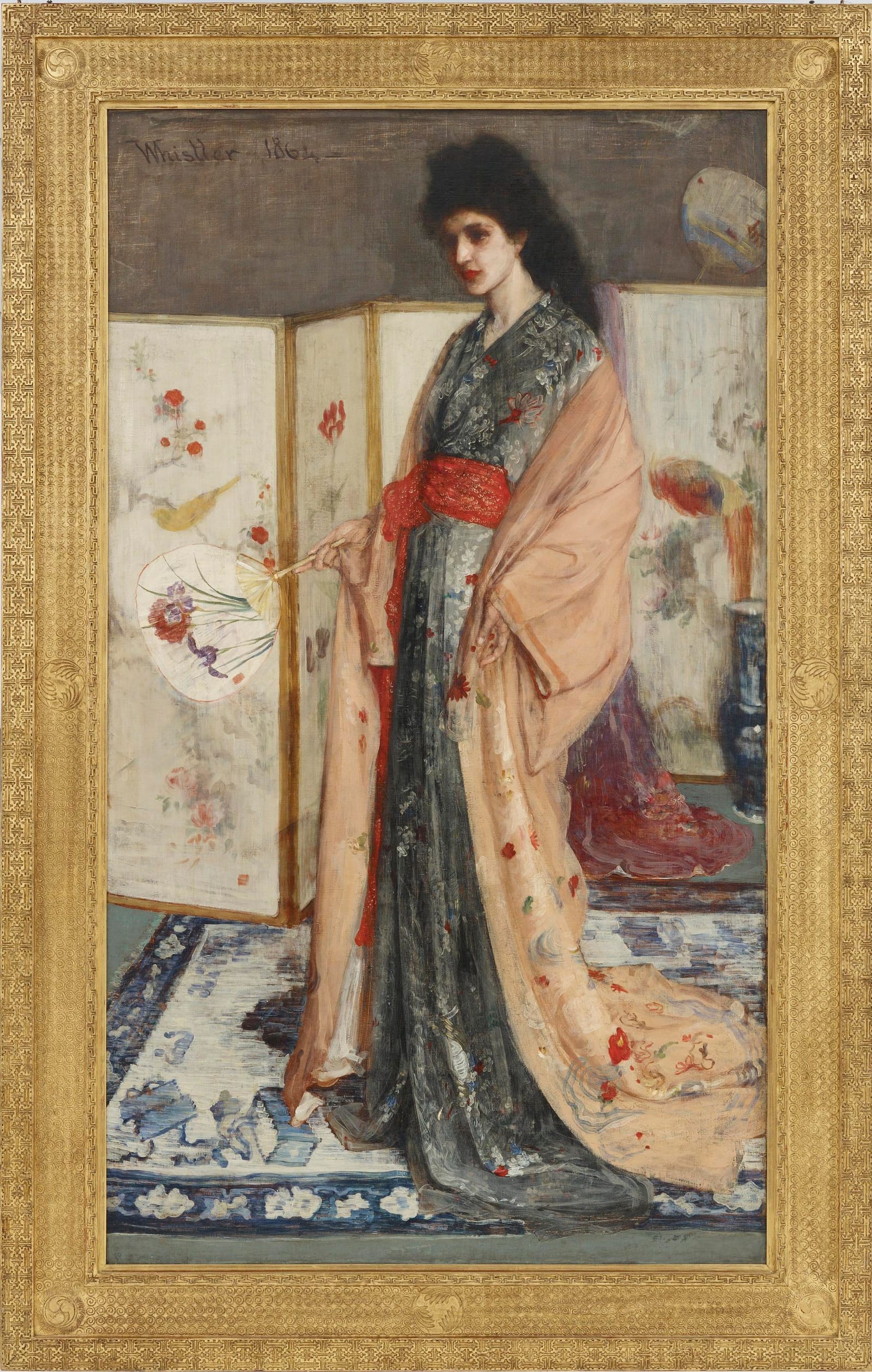
The Princess from the Land of Porcelain
James McNeill Whistler · 1863–1865 · Oil on canvas, 201.5 × 116.1 cm
Look for
- The signature at the upper left, Whistler 1864, written out large. Later he signed with a small butterfly instead.
- The round fan in her hand and the white Japanese folding screen behind her, props of the kind Whistler collected.
- The blue-and-white vase at the right edge, the kind of porcelain this whole room was built to hold, and the blue-and-white rug under her feet.
Transcript (2:03)
Now cross the building to the south side and walk into Gallery 12. You are inside the Peacock Room, and we will come to the room in a moment. First, face the painting over the fireplace, because everything around you was built for her.
A tall young woman in a kimono stands on a blue-and-white rug in front of a white Japanese folding screen, a round fan in her hand. James McNeill Whistler painted her between 1863 and 1865, when the Anglo-Japanese taste was sweeping artistic London. The model was Christina Spartali, a young woman of Greek descent and the sister of the painter Marie Spartali Stillman. But this was never meant as her portrait. The museum reads it as Whistler inventing a new ideal of beauty, built out of Japanese woodblock prints and the long, slender ladies painted on Chinese porcelain, and dressed with objects from his own collection. He never set foot in Asia. The land of porcelain in the title is an invention.
Look at the upper left corner: Whistler 1864, in large letters. That signature may have cost him a sale. Christina's father refused to buy the picture, and another would-be buyer is said to have backed out because the name was so big. It may be one reason Whistler later stopped writing his name at all and signed with a small butterfly. Keep that butterfly in mind. You will find it on the walls around you.
The critics were not kind either. When she was shown at the Paris Salon of 1865, one reviewer, Gustave Vattier, wrote that a child's breath could blow her over.
The buyer who mattered was Frederick Leyland, a shipowner from Liverpool. He owned the painting years before this room existed, and after he bought a new house in London in 1875 he hung her over the dining-room mantelpiece. Whistler suggested that the colours of the room should change to suit the painting. What that suggestion turned into is all around you.
After Leyland died in 1892 she was sold at auction, and a few years later she belonged to the Glasgow collector William Burrell. On the 20th of August 1903, Charles Lang Freer bought her for 3,750 pounds, in the year Whistler died, and took her home to Detroit. The following year he bought the room as well. The two have been shown together here since the Freer opened in 1923: the princess and her palace, reunited an ocean away from the London house they were made for.
CC0, National Museum of Asian Art, Smithsonian Institution. Photo: National Museum of Asian Art, Smithsonian Institution
Stop 5 of 5 · West Building, Gallery 12
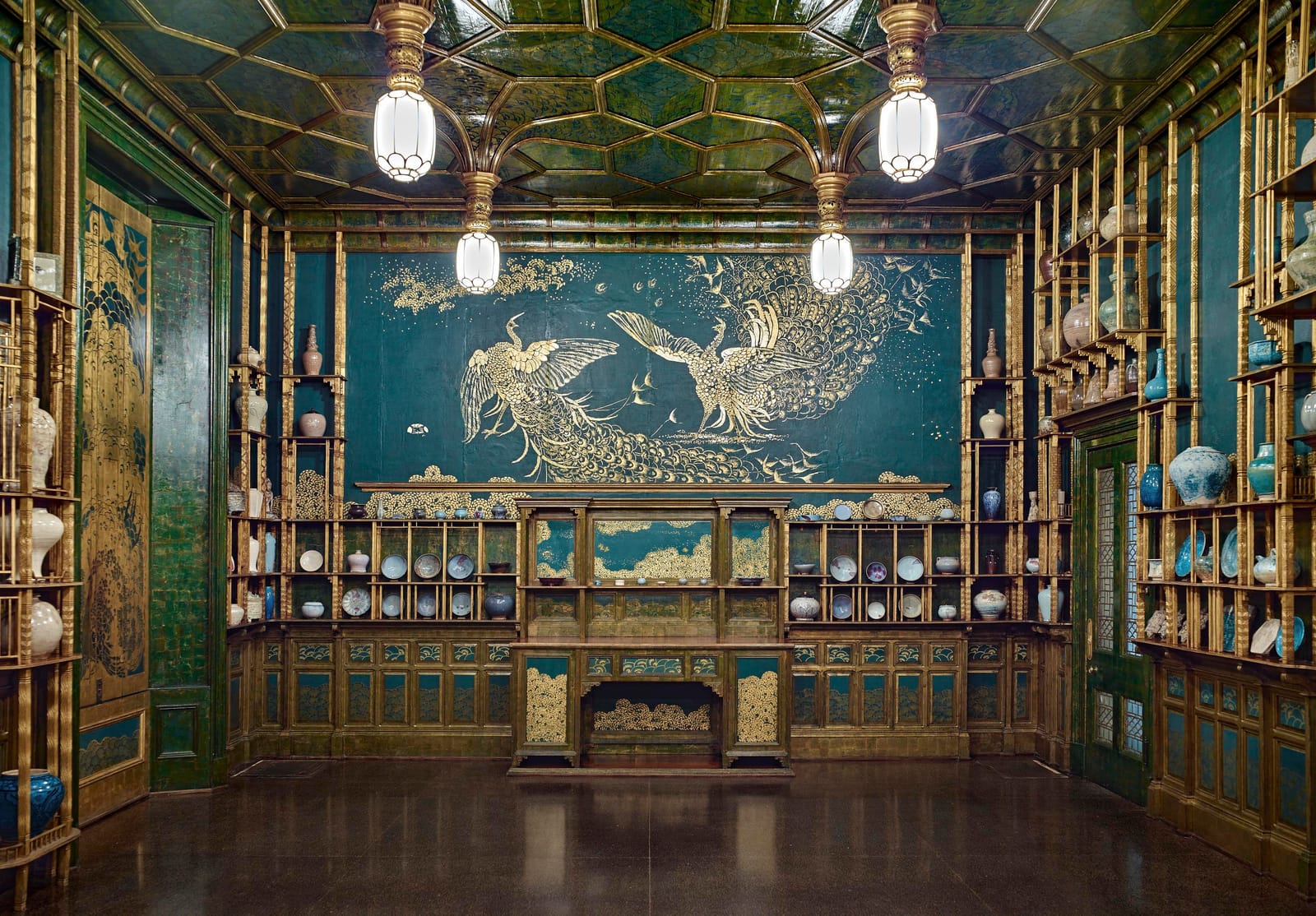
Harmony in Blue and Gold: The Peacock Room
James McNeill Whistler, in a room designed by Thomas Jeckyll · 1876–1877 · Oil paint and gold leaf on canvas, leather, mosaic tile, glass and wood; 421.6 × 613.4 × 1026.2 cm
Look for
- The two fighting peacocks on the wall facing the fireplace. The one with silver throat feathers is Leyland; the one with a single silver crest feather is Whistler.
- Whistler's butterfly signature. He put it into the room several times; see how many you can find.
- The peacocks painted on the inside panels of the window shutters.
- The porcelain. On the fireplace and window walls it is the museum's own Kangxi-period collection; on the other two walls, reproductions made with potters in Jingdezhen.
Transcript (2:40)
Turn your back on the fireplace. You are standing inside the work now: a whole dining room, walls, shelves, ceiling and shutters, painted in blue and gold in 1876 and 1877 and brought here piece by piece from London, by way of Detroit. It is the one stop on this walk you can walk around inside.
It began as somebody else's design. The architect Thomas Jeckyll built this lattice of shelves for Frederick Leyland's collection of Chinese blue-and-white porcelain from the Kangxi period, and hung the walls with antique gilt leather painted with red roses. Then Jeckyll fell ill and had to give up the job. Whistler, who was decorating Leyland's entrance hall, offered to finish it. His first proposal was modest: paint the red roses over in yellow so they would stop fighting the princess, and add a wave pattern along the cornice and the panelling. Leyland agreed and went home to Liverpool.
Whistler kept going. He covered the ceiling with Dutch metal, an imitation gold leaf, and a pattern of peacock feathers. He gilded every shelf. Look at the window wall: the peacocks on the inside of the shutters are his too. He later said that he just painted on, without design or sketch, that it grew as he painted, and that by the time he came round to the corner where he had started, he had to paint part of it over again to match.
Then it went wrong. Whistler invited visitors and the press into Leyland's house to admire the room, and the two men fell out bitterly over the bill. So Whistler coated the costly old leather in Prussian blue, and on the empty wall facing the fireplace he painted what you see there now: two peacocks squaring up to each other. The furious bird has silver feathers at its throat, a jab at the ruffled white shirts Leyland always wore. The other has a single silver crest feather, like the white lock that rose above Whistler's own forehead. He called the mural Art and Money, or, The Story of the Room, and he is reported to have told Leyland that he would be remembered only as the owner of the Peacock Room. Then he signed the room several times with his butterfly.
Leyland left it as it was until he died in 1892. Twelve years later Charles Lang Freer bought it, had it taken apart in 1904 and rebuilt in his house in Detroit, where it held his own ceramics. After his death it came to Washington, and it has been here since the Freer Gallery opened in 1923. The room was restored again in the summer of 2022.
What stands on the shelves is the newest chapter. Since September 2025 the museum has shown the room as the Leylands knew it, filled with blue and white. Leyland collected porcelain from Jingdezhen, which from the late thirteenth century was the world centre for blue-and-white ware. On the fireplace wall and the window wall you are looking at Kangxi-period pieces from the museum's own collection. On the other two walls the pots are reproductions, made with potters in Jingdezhen today.
So stand in the middle and take it in whole: two walls of old porcelain and two of new, a quarrel in gold on one side of you, and on the other, the princess who started it all.
Independent guide · Chiaro
Point Chiaro at anything in the Freer Gallery of Art.
Our five recordings finish among Whistler's peacocks; the app carries on from there. Photograph an ancient jade in Gallery 19, a bronze mirror in the Korean room or a single pot on the Peacock Room shelves, and Chiaro names it, tells its story, and then takes your spoken questions right there at the case.
Before you go
Getting there
The Freer is the West Building of the Smithsonian's National Museum of Asian Art, at Jefferson Drive and 12th Street SW on the south side of the National Mall. The Mall-side door brings you in next to Gallery 1; step-free entry is on the Independence Avenue side, through the automatic bronze doors to the left of the stairs. The museum's mailing address, 1050 Independence Ave. SW, is the Sackler building next door, which connects to the Freer underground.
The nearest Metro stop is Smithsonian, served by the Orange, Silver and Blue Lines. Come up through the exit signed 12th St. at Jefferson Dr. SW (The Mall) and cross the road heading south: the pink granite building facing you is the Freer.
Tickets
- You walk in without a ticket or a reservation, and it costs nothing, the museum says.
- The doors are open every day of the week, 10 a.m. to 5:30 p.m. The only closed day in the year is December 25.
- Expect a security check at whichever door you use; the museum screens visitors at every entrance.
- The Freer neither lends nor borrows, a condition of its founder's gift, so none of these five ever goes out on loan to another museum.
The official audio guide
The museum's own guided offer is in person: free drop-in tours with no booking, led mostly by trained volunteer docents and sometimes by curators, including a highlights tour that takes in the Peacock Room and a series marking the room's 150th year. Its website's audio section holds podcasts and recorded talks. Our five recordings need no booking either and play whenever you tap them; the Chiaro app takes on any other object you photograph.
Official site →Questions
Is there a free Freer Gallery of Art audio guide?
Yes: tap any of the five players above and the recording plays in your phone's browser, over a transcript you can read along with. The museum itself adds free docent-led drop-in tours, and for the thousands of objects we leave out, aim the Chiaro app at one and ask.
How much is the official Freer Gallery of Art audio guide?
Nothing is charged for the guiding the museum offers: free drop-in tours, most led by docents and some by curators, with no reservation. The audio section of its website holds podcasts and recorded talks, and entry to the building is free as well.
Where is the Peacock Room in the Freer Gallery of Art?
In Gallery 12, at the south-east corner of the gallery floor, next to Gallery 11 on the Independence Avenue side. From the Mall entrance, walk round the courtyard; from the Independence Avenue entrance it is close by. Whistler's Princess from the Land of Porcelain hangs over its fireplace.
Is the Freer Gallery of Art open every day?
Yes, all year round except December 25, from 10 a.m. to 5:30 p.m.
Is the Freer the same as the National Museum of Asian Art?
The Freer is part of it. The National Museum of Asian Art is two buildings joined underground: the Freer Gallery of Art as the West Building and the Arthur M. Sackler Gallery as the East Building. Together they hold more than 46,000 objects. So this Freer page doubles as a National Museum of Asian Art audio guide for the West Building.
How long does the Freer Gallery of Art take?
About half an hour for the whole loop, of which ten minutes is the audio itself. Every stop is on the one gallery floor around the courtyard, so there are no stairs between stops; step-free entry is from Independence Avenue.
More audio guides
Made by Chiaro. Not affiliated with the Freer Gallery of Art.