
MoMA · New York · Independent guide
MoMA audio guide,
five stops, free.
Five recordings on this page, no download needed. MoMA owns nearly 200,000 works; photograph whichever one is in front of you and Chiaro tells you about it.
Made by Chiaro. Not affiliated with MoMA.
The Starry Night
MoMA, New York
The five stops · 10 minutes of audio
Five stops, one walk,
in the order you will walk them.
Floor 5 holds the first half century of modern art, and this MoMA audio guide never leaves it: four rooms, five paintings. Van Gogh's The Starry Night and Rousseau's The Sleeping Gypsy share Gallery 501, Matisse's Dance (I) is in Gallery 506, Malevich's White on White is in Gallery 507, and Monet's Water Lilies fill Gallery 515 in the David Geffen Wing. Nine minutes of recordings, and only a few minutes of walking between the rooms, though the crowd at the Van Gogh can add more.
We took every date, measurement and gallery number from MoMA's online collection, which also records whether each work is on view, and matched each story with a second, independent source; as of early September 2026 all five were listed in their rooms. Works do move, because MoMA rotates its galleries: if what you find on the wall contradicts this page, trust the wall, and tell us what you found.

Stop 1 of 5 · Floor 5, Gallery 501, The Alfred H. Barr, Jr. Galleries
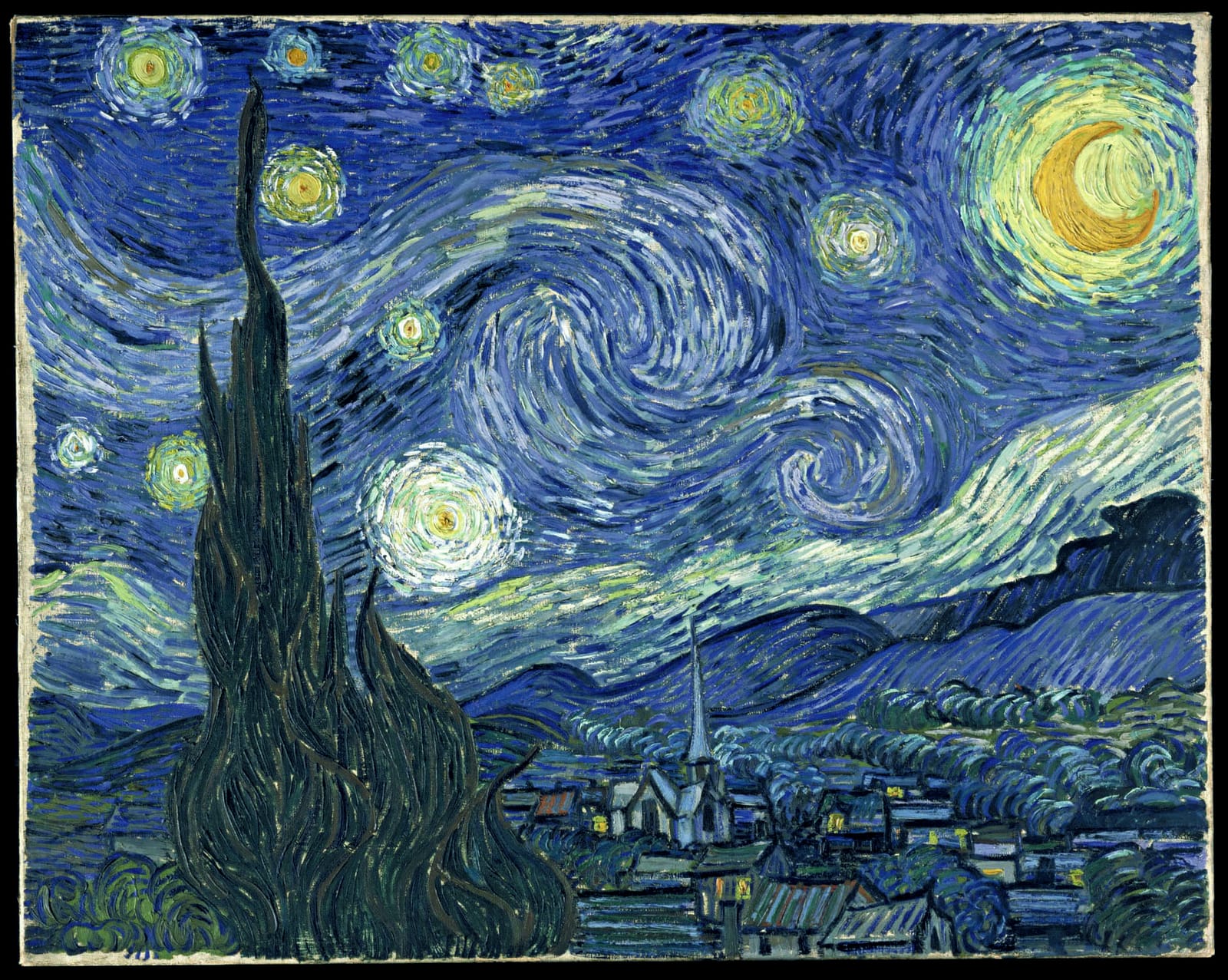
The Starry Night
Vincent van Gogh · Saint Rémy, June 1889 · Oil on canvas, 73.7 × 92.1 cm
Look for
- Venus, the brightest light in the sky, just left of centre beside the cypress, wrapped in rings of white and yellow. Van Gogh called it the morning star.
- The church steeple, tall and needle-thin. It looks like the churches of Holland, where he grew up, not like anything in Provence.
- The paint itself. Short, thick strokes laid side by side and standing up off the canvas; the ridges show even from a step back.
- The crescent moon at the far right, wrapped in its own glow of yellow.
Transcript (2:17)
Most people's first thought is that it is smaller than they imagined. Seventy-four centimetres by ninety-two, not much bigger than a window, which is fitting, because a window is where it started.
In 1889 and 1890 Vincent van Gogh spent twelve months at the asylum of Saint-Paul-de-Mausole in Saint-Rémy, in the south of France, trying to find some relief from his mental illness. His bedroom window looked east. He painted that view twenty-one times. This is the only version set at night.
In early June he wrote to his brother Theo: this morning I saw the countryside from my window a long time before sunrise, with nothing but the morning star, which looked very big. Find it now. It is the brightest light in the sky, just left of centre, next to the dark cypress, ringed in white and yellow. That is Venus. Astronomers have checked, and in the spring of 1889 it really was visible at dawn over Provence, close to as bright as it ever gets.
So part of this is observation. A lot of it is not. It is a night scene painted in daylight, in several sessions. The village below the hills could not be seen from his window at all; he took it from other views. The cypress on the left was much further away than this, and he pulled it forward until it almost touches the top of the canvas. And look at the church steeple, thin and sharp. That is a steeple from Holland, where he grew up, not from the south of France.
Then there is the paint. The sky fills three-quarters of the picture and it is built of short, heavy strokes that you can see from where you are standing. When scientists at the Rochester Institute of Technology and at MoMA analysed it, they found ultramarine and cobalt blue in the sky, and for the stars and the moon a rare pigment called Indian yellow, mixed with zinc yellow.
Van Gogh was not proud of it. In September 1889 he listed it as a night study among a batch of paintings for Theo, and said most of that batch told him nothing; when he held back three canvases to save on postage, this was one of them, and it only went to Paris on the twenty-eighth of September. In a letter to the painter Émile Bernard at the end of November he called it a failure. But he had once written down exactly what night skies meant to him: just as we take the train to go to Tarascon or Rouen, we take death to go to a star.
MoMA acquired it in 1941 from the dealer Paul Rosenberg, by exchange. According to the museum's director Glenn Lowry, the price was two paintings by Cézanne and one by Toulouse-Lautrec. The museum almost never lends it out, so for more than eighty years the place to see this sky has been Midtown Manhattan, not Provence.

Stop 2 of 5 · Floor 5, Gallery 501, The Alfred H. Barr, Jr. Galleries
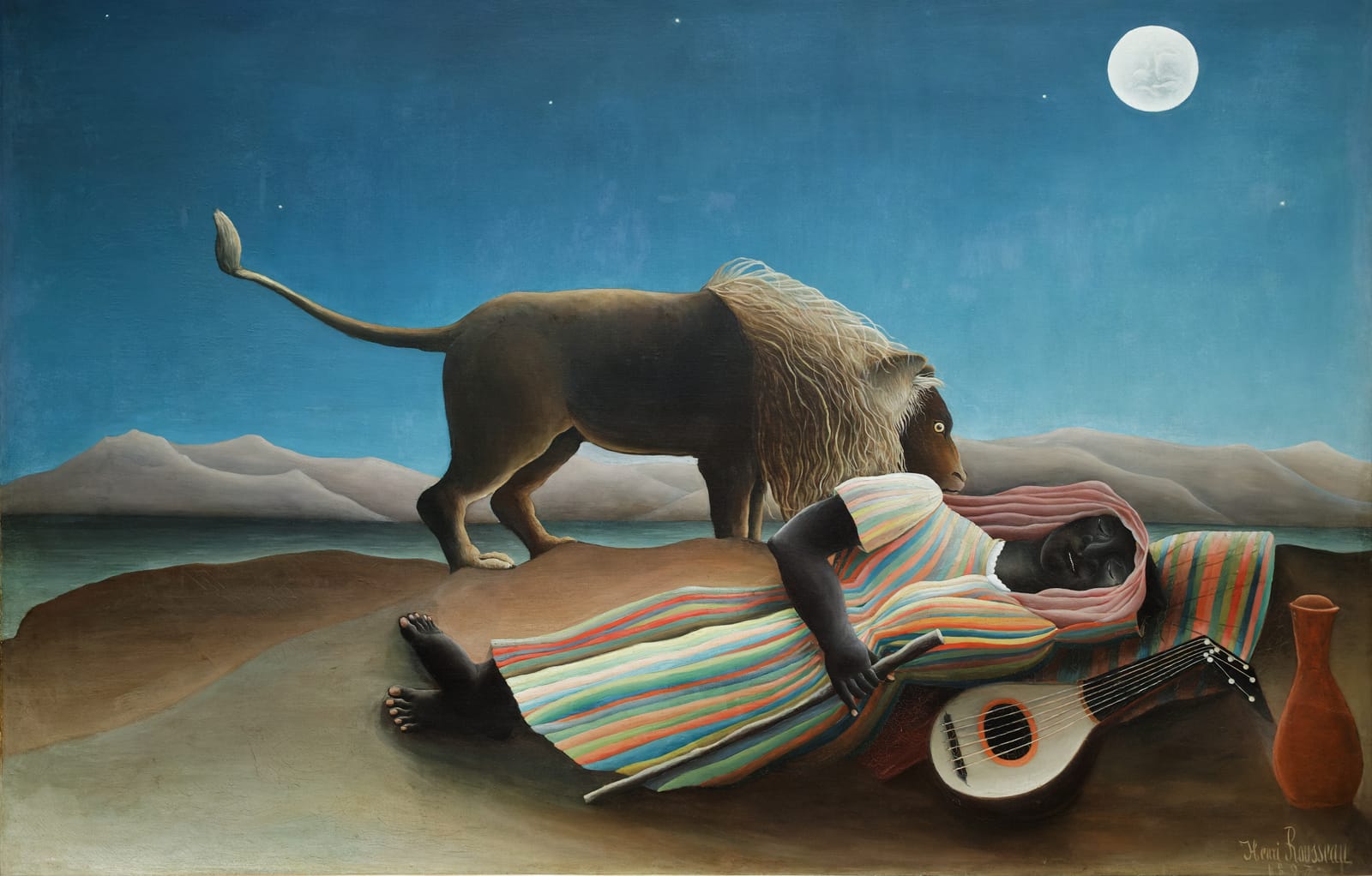
The Sleeping Gypsy
Henri Rousseau · 1897 · Oil on canvas, 129.5 × 200.7 cm
Look for
- The lion's tail, held up stiff behind him, while his head dips down to sniff at her.
- Her striped robe in every colour of the rainbow, the staff still in her hand, and the mandolin and tall water jar at her side.
- The sky: a full moon and only a handful of stars, in a clear, dark blue night over a desert.
Transcript (1:58)
Start with the lion's tail. It is held up stiff behind him, the only tense line in the picture, while his head goes down to her shoulder. He has come out of the desert night and caught her scent, and she has not woken.
Henri Rousseau described the scene himself, and his account is wonderfully matter of fact. A wandering mandolin player, he wrote, has fallen into a deep sleep from exhaustion, with her jar of drinking water beside her. A lion happens by, picks up her scent, and does not devour her. Then he adds, as if reading from a catalogue: there is a moonlight effect, very poetic. The scene is set in a completely arid desert.
Everything he lists is there. The mandolin at her side, the tall jar, the staff still in her hand, a robe striped in every colour of the rainbow, and a full moon in a sky with only a handful of stars. Nothing moves, nothing casts much of a shadow, and that stillness is exactly what makes it strange.
Rousseau was not a trained painter. People called him Le Douanier, the customs officer, a joke about his job as a toll and tax collector. He started painting seriously in his early forties, taught himself, and never left France. His lions and jungles came from the natural history museum and the botanical garden in Paris. The critics of his day laughed at him.
He showed this canvas at the Salon des Indépendants in 1897, then tried to sell it to the mayor of his hometown, Laval. The mayor turned it down. The painting vanished into the collection of a Paris charcoal merchant and stayed there until 1924, when the critic Louis Vauxcelles came across it. By then Rousseau was being recognised as a self-taught genius; back in 1908 Picasso had thrown a half-serious banquet in his honour. And the rediscovery came with a quarrel over whether the painting was a forgery.
In December 1939 Olga Guggenheim, the wife of Simon Guggenheim, bought it and gave it to MoMA. It now hangs in the same room as The Starry Night: two night skies painted eight years apart, one by a man staring out of a window in Provence, the other by a man who had never set foot in a desert.

Stop 3 of 5 · Floor 5, Gallery 506, The Alfred H. Barr, Jr. Galleries
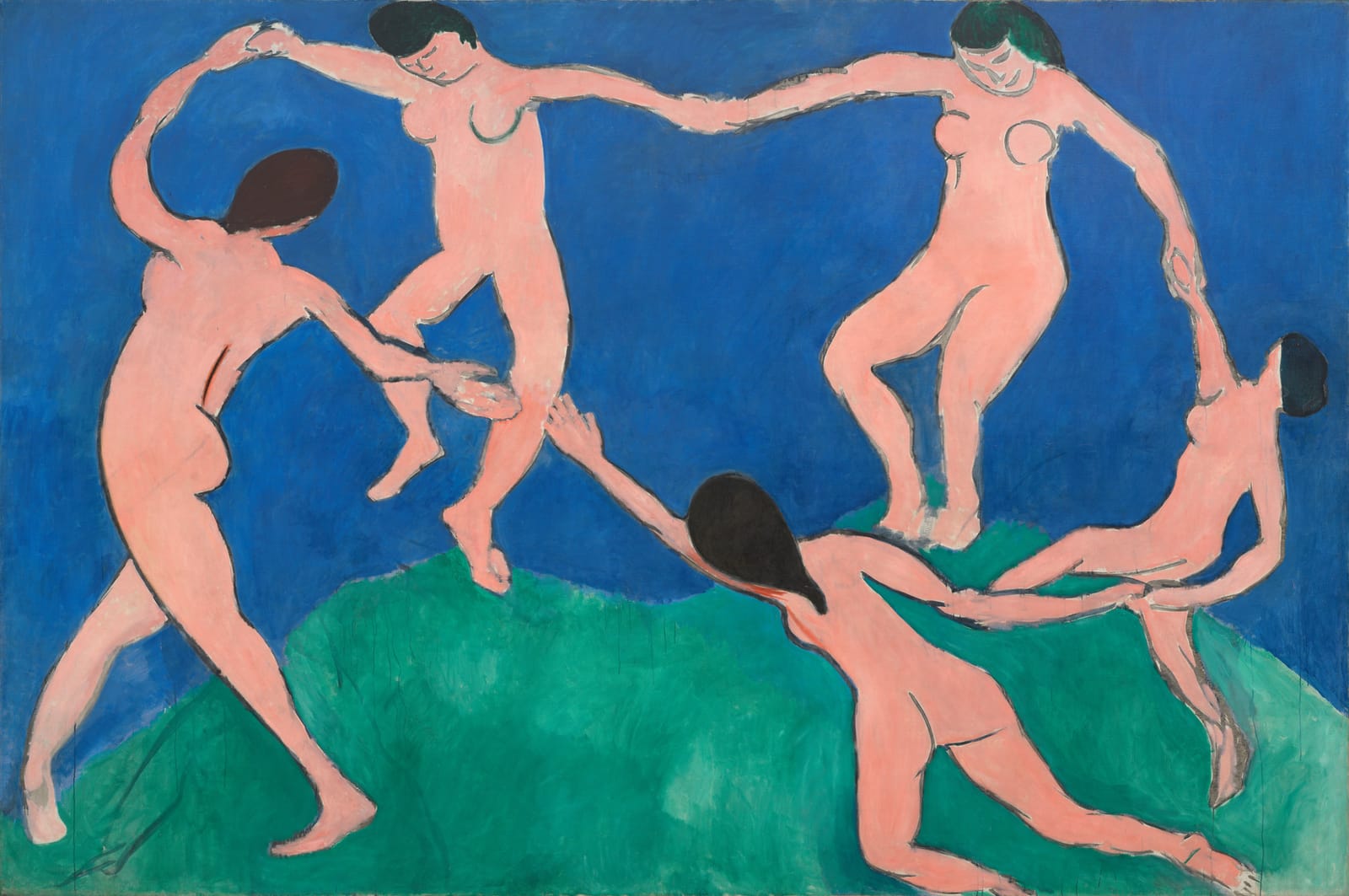
Dance (I)
Henri Matisse · Paris, Boulevard des Invalides, early 1909 · Oil on canvas, 260.4 × 390.4 cm
Look for
- The gap in the ring at the front. One dancer is reaching for a hand she has not caught yet, so the circle is open towards you.
- The left-hand figure: her whole front, from raised arm to back foot, is one long unbroken curve.
- The count of colours. Blue sky, green ground, pale pink bodies, black hair and outlines. That is all there is on nearly four metres of canvas.
Transcript (1:45)
Nearly four metres of canvas, and four colours. Blue for the sky. Green for the hill. Pale pink for the five bodies, and black for the hair and the outlines. That is the whole painting, and it is enough to make the room feel as if it is turning.
In March 1909 a Russian businessman and collector named Sergei Shchukin commissioned two large decorative panels from Henri Matisse, one called Dance and one called Music, for the staircase of his house in Moscow. Dance was to hang on the landing. Matisse painted this canvas first, quickly, as a study to work out the composition. The finished Dance, painted in a strong, hot red, was shown at the Salon d'Automne in Paris in 1910 and hung on Shchukin's staircase until the Russian Revolution of 1917. It is in the Hermitage in Saint Petersburg now. The study is the one in front of you.
People hated it at first. The bodies were so simplified and the space so flat that critics called it inept, or crude on purpose. Matisse's answer was that it had life and rhythm, and he meant it as a deliberate choice. That same year he said that photography could now record details a hundred times better and more quickly than any painter, so the painter no longer had to bother. What was left for painting was the thing a camera could not catch: movement, feeling, the swing of a line.
Follow that line. The figure on the left is one continuous curve from her raised arm down to her back foot. Now look at the front of the circle. Two dancers are stretching for each other's hands and they have not quite made it. The ring is open, right where you are standing, as if there is a place for one more.
Matisse thought highly of this first version. He painted it into the background of another picture, Nasturtiums with the Painting Dance I, in 1912. Nelson Rockefeller later gave it to MoMA in honour of Alfred Barr, the museum's first director, whose name is on these galleries. The gap between those two hands has never closed.

Stop 4 of 5 · Floor 5, Gallery 507, The Alfred H. Barr, Jr. Galleries
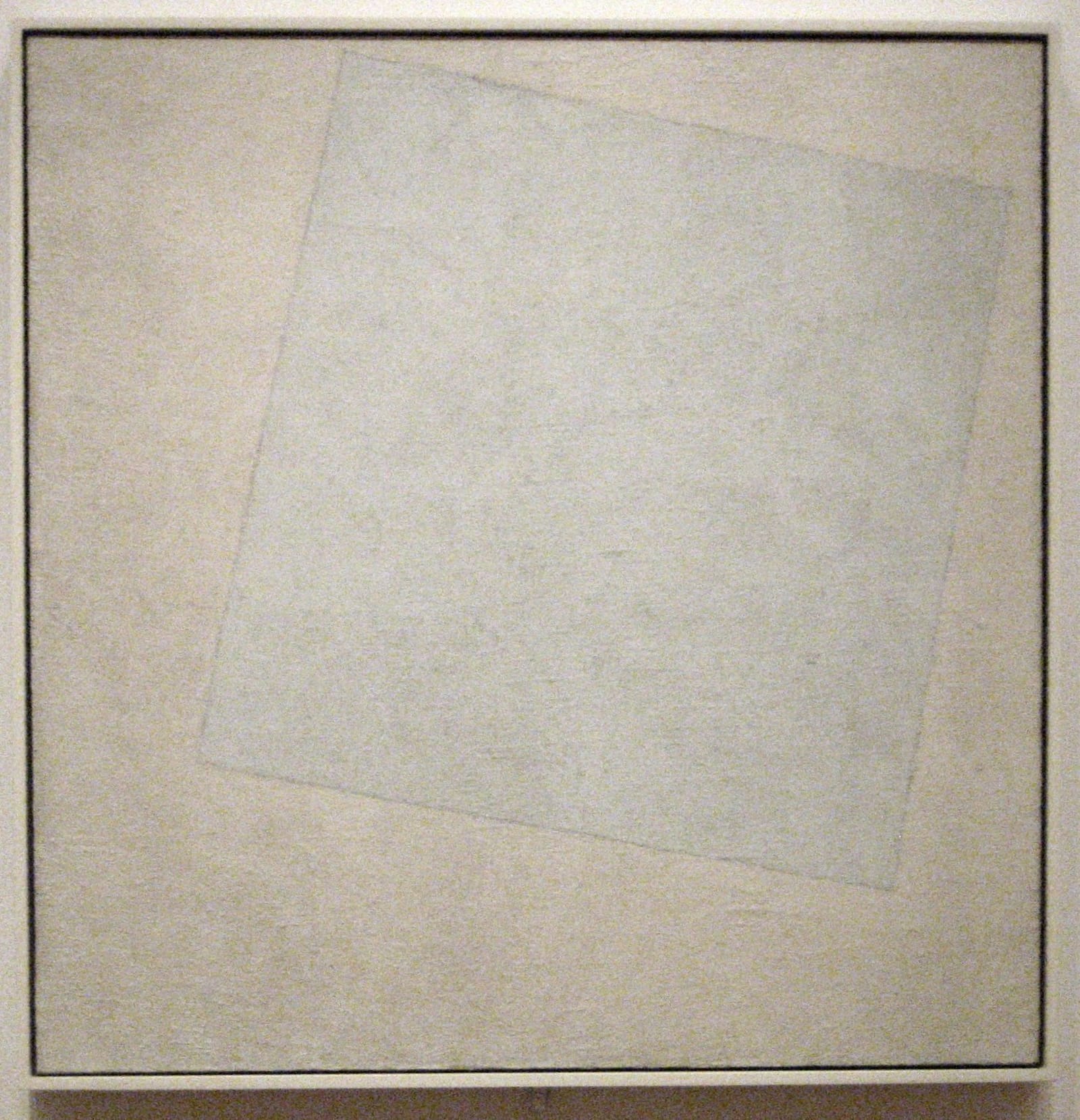
Suprematist Composition: White on White
Kazimir Malevich · 1918 · Oil on canvas, 79.4 × 79.4 cm
Look for
- Two whites, not one. The tilted square is the cooler of the two; the ground around it is a shade warmer.
- The edges of the square. They are soft and a little uneven, drawn by hand rather than ruled.
- Brushstrokes in the white paint. Up close the surface is full of texture and nothing about it is blank.
Transcript (1:59)
Give your eyes a few seconds here, because the painting does not do the work for you. From across the room it can look like an empty canvas. Up close, it is two whites. A square, tipped at an angle and pushed off centre, painted in a cool white, sitting on a square ground of a slightly warmer white. No colour, no depth, no object. Kazimir Malevich took painting down to almost nothing and left it there.
Almost nothing, but not nothing. Look at the edges of the tilted square. They are not ruled with a straight edge; they wobble a little, and the square is not exactly symmetrical. Look at the surface and you can see his brush moving through the white. MoMA's own curators make the point that this is not an impersonal picture. The hand is everywhere in it.
Malevich painted it in 1918, a year after the Russian Revolution, as part of a series of white on white pictures he had begun in 1916. He called his theory Suprematism, which he defined as the supremacy of pure feeling or perception in the pictorial arts. He was also obsessed with the airplane. He studied aerial photographs, and he wanted this square to feel as if it were floating. White, for him, was the colour of infinity. When the series was first shown to the public, in Moscow in 1919, he wrote a line that could hang on the wall beside it: swim in the white free abyss, infinity is before you.
The story of how it reached New York is a quieter drama. In 1927 Malevich took it to an exhibition in Berlin and, when he went home, left it with the architect Hugo Häring. In 1930 it passed to Alexander Dorner, the director of the museum in Hanover, who put it into storage once the Nazis came to power in 1933. Malevich died in 1935 without leaving instructions for his estate. MoMA dates the painting's acquisition to 1935, and it took until 1999 for that acquisition to be confirmed by agreement with Malevich's heirs.
Not everyone was convinced. A critic from the rival Constructivist camp, reviewing an exhibition by Malevich's circle, is said to have called it the only good canvas there: an absolutely pure, white canvas with a very good prime coating. Something could be done on it.

Stop 5 of 5 · Floor 5, Gallery 515, The David Geffen Wing
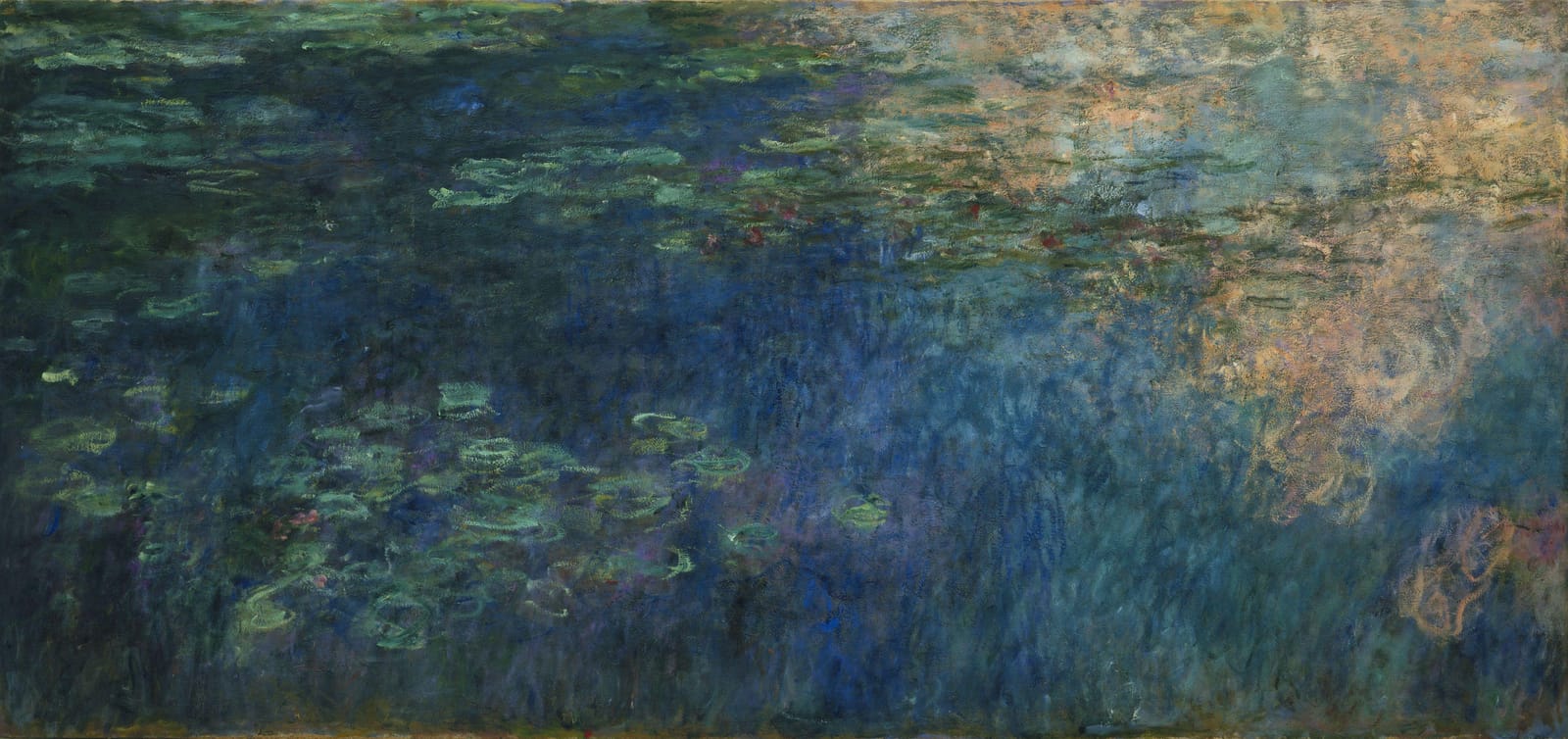
Water Lilies
Claude Monet · 1914-26 · Oil on canvas, three panels, overall 200 × 1276 cm
Look for
- The centre panel: lilies floating in a pool of green and blue, frothed with lavender where the clouds are reflected.
- The left panel, where thicker strokes in darker shades creep in from the edge.
- The right panel, where sky and water disappear under reddish-green growth.
- The horizon, which is not there. The only sky in nearly thirteen metres of canvas is the one reflected in the water.
Transcript (1:48)
Nearly thirteen metres of pond, in three panels, and nowhere in it is there a horizon. That is the first thing to notice, and the reason this room feels different from every other room on the floor. There is no edge of the water, no bank, no sky overhead. The only sky is the one reflected in the pond, clouds turned lavender and floating among the lilies. Your eye has nowhere to stop, so it keeps going.
Walk the length of it. In the centre panel the lilies float in a bright pool of green and blue. On the left, thicker, darker strokes seep in from the edge. On the right, sky and water are swallowed up by reddish-green vegetation. MoMA's own description is that the whole thing hovers at the threshold of abstraction, and standing here it is easy to forget that this is a real pond, in a real garden, at Giverny in northwestern France.
Claude Monet spent the last years of his life painting that pond. He called these canvases his grandes décorations, and in 1915 he built a large new studio near his house to make them. From 1914 until his death in 1926 he produced some forty of these huge panels and kept reworking them, many while he was suffering from cataracts. After he died, twenty-two of them were installed on the curved walls of the Musée de l'Orangerie in Paris, his gift to France. The rest stayed in his studios until the late 1940s.
What brought them back was New York. In 1955 MoMA became the first museum in the United States to buy one of the big panels, and the reason had as much to do with the present as the past. Jackson Pollock and the Abstract Expressionists were making enormous paintings with no single focal point, and suddenly an old Impressionist's lily pond looked like the future.
Then, on the fifteenth of April 1958, a fire broke out on MoMA's second floor. Workmen installing air conditioning had been smoking near paint cans and sawdust. One of them died. The fire destroyed an eighteen-foot Monet Water Lilies. This triptych was acquired shortly afterwards, as its replacement. So the painting in front of you exists here because another one burned.
Independent guide · Chiaro
Point Chiaro at anything in MoMA.
We picked five paintings; MoMA's collection galleries run across three floors. Aim the app at a Cézanne in 501, a Brancusi bird, a chair in the design galleries or a photograph you have never seen before, and Chiaro names it, tells you why it matters and takes your follow-up questions by voice.
Before you go
Getting there
11 West 53 Street, Manhattan, New York, NY 10019. Visitors with general admission go in through the main entrance of the Rockefeller Building on 53rd Street, between Fifth and Sixth Avenues, close to Sixth Avenue and just east of the big Museum Store. The 54th Street entrance is for members.
Subway E or M to 5 Avenue-53 Street. The station is on the opposite side of 53rd Street from the museum; cross over and walk down the block heading west to the entrance.
Tickets
- Buy your ticket online before you go. MoMA says that is the only way to be sure of getting in; the desk holds back only a small number, first come, first served, and there can be a queue in the morning and when it rains.
- MoMA opens seven days a week at 10:30 am, stays open until 8:30 pm on Fridays, and shuts only for Thanksgiving and Christmas. The galleries start closing about 15 minutes before the building does.
- New York State residents get in free on Friday evenings from 5:30 to 8:30 pm, but only with a free ticket reserved in advance and proof of residency.
- Children 16 and under are free but still need a ticket. Keep yours after it is scanned: it gets you back in if you step out for lunch, and staff may ask to see it again at the entrances to the galleries.
- Our advice is to go to Gallery 501 first, straight after the doors open. The Van Gogh draws a crowd all day, and the rest of this walk is quieter.
The official audio guide
MoMA's own audio guide costs nothing and needs no rented device. It runs on your own phone: stream the playlists at moma.org/audio, or use the free digital-guide app MoMA recommends, which adds a museum map and comes in 40 languages. The Floor 5 playlist alone has 77 commentaries, and the museum suggests bringing headphones. This page is free too and stays with five paintings; whatever MoMA's playlists skip, photograph it in the Chiaro app.
Official site →Questions
Is there a free MoMA audio guide?
Yes, and MoMA's own is one of them: its audio comes free with admission and plays on your phone. This page is the other, five tracks with their scripts, open in any browser, nothing to install. Anything outside those, snap it with the Chiaro app and hear its story on the spot.
How much is the official MoMA audio guide?
Nothing. The Museum of Modern Art audio guide is free with general admission and plays on your own device, through moma.org/audio or a free digital-guide app in 40 languages. There is no device to rent, so bring headphones and a charged phone.
Where is The Starry Night in MoMA?
On Floor 5, in Gallery 501 of the Alfred H. Barr, Jr. Galleries, which hold the collection from the 1880s to the 1940s. Henri Rousseau's The Sleeping Gypsy hangs in the same room, and MoMA's own highlights tour begins there too.
What day is MoMA closed?
None in a normal week. Doors open at 10:30 am all week and close at 5:30 pm, or 8:30 pm on Fridays; the only days off are Thanksgiving and Christmas. Weekend mornings from 9:30 to 10:30 are for members in some galleries.
How much are MoMA tickets?
Adults pay $30, seniors 65 and over with ID $22, and full-time students with ID $17; children 16 and under are free but need a ticket. One ticket covers every gallery and special exhibition. Tickets cannot be refunded or exchanged, so check the date before you pay.
Can I see Les Demoiselles d'Avignon and The Persistence of Memory on this walk?
Both are on Floor 5, a short detour from these stops: Picasso's Les Demoiselles d'Avignon in Gallery 502, and Dalí's The Persistence of Memory in Gallery 517 among the Surrealists. Point the Chiaro app at either one and it will tell you its story.
More audio guides
Made by Chiaro. Not affiliated with MoMA.