
National Museum of Natural History · Washington DC · Independent guide
National Museum of Natural History audio guide,
five stops, free.
Five narrated stops that start in your browser, beginning at the elephant. The museum holds more than 148 million specimens; whichever one is in front of you, Chiaro can tell its story from a photo.
Made by Chiaro. Not affiliated with the National Museum of Natural History.
Henry, the African Bush Elephant
National Museum of Natural History, Washington DC
That was the free part
Chiaro narrates any work in the National Museum of Natural History from a photo.
The five stops · 11 minutes of audio
Five stops, one walk,
in the order you will walk them.
This National Museum of Natural History audio guide begins under the dome with Henry, the bush elephant in the Rotunda, goes into the Sant Ocean Hall for the giant squid, then on to the Deep Time fossil hall for the T. rex pinning its Triceratops. From there it climbs to the second floor and the Hall of Geology, Gems, and Minerals, for the turquoise diadem Napoleon gave his second wife, and ends in the room beside it with the Hope Diamond. Press play five times and you have eleven minutes of narration; with the stairs and a pause at each case, budget an hour.
Each fact on this page was checked twice: against the Smithsonian's own material, meaning the museum's exhibit pages, its GeoGallery gem records and Smithsonian magazine, and against one outside reference, and every hall named here was confirmed on 25 September 2026. Specimens do get moved, cleaned and sent to the lab, so the label beside the case is the final word; where it and this page part ways, believe the label and let us know.
颐园居, CC BY 4.0, via Wikimedia Commons. Photo: 颐园居

Stop 1 of 5 · Rotunda, first floor
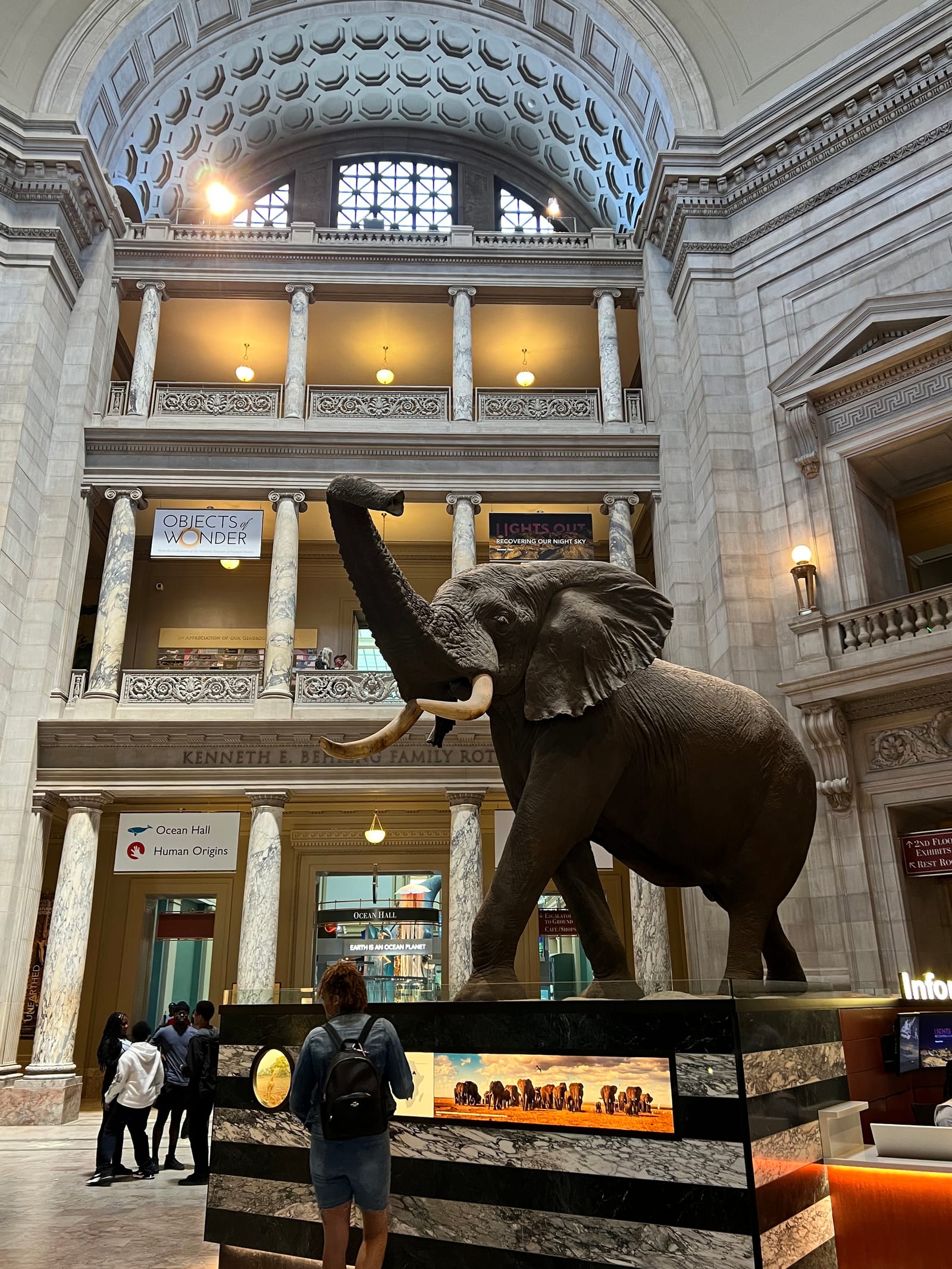
Henry, the African Bush Elephant
Bull African bush elephant shot in Angola in 1955; mounted by Smithsonian taxidermists William Brown and Norman Deaton · Shot 1955, unveiled 1959 · Mounted hide, 13 feet (about 4 m) tall, 11 tons
Look for
- The pose. Trunk up, ears spread: the taxidermist studied living elephants and set this one at a fast walk.
- The creases in the skin. They trap dust, and the cracks were filled in 2015 with beeswax coloured by hand to match.
- Round the base of the platform: a small diorama of elephants at a watering hole, and pieces of illegal ivory seized by the U.S. Fish and Wildlife Service.
Transcript (2:09)
Stand beside the platform and look up. The trunk is raised, the ears are spread as wide as they go, and the whole animal seems to be leaning into a stride. That was deliberate. William Brown, the Smithsonian's chief taxidermist in the 1950s, watched how elephants actually move before he built this mount, and he set this one at a fast walk, trunk lifted and ears fanned out. He weighs eleven tons and stands thirteen feet tall, and he has been the first thing visitors see in this Rotunda since 1959.
The elephant was a male African bush elephant. A Hungarian-born engineer and big-game hunter, Josef Fénykövi, tracked him and shot him on the thirteenth of November 1955, in the Cuando River region of southeastern Angola. Fénykövi took the elephant's measurements and drew them up in a sketch, and that sketch, which is still in the Smithsonian's archives, was what the taxidermists worked from.
What actually came to Washington was the hide, all two tons of it. A tanner scraped and soaked it until it was thin and pliable enough to work, and Brown and his colleague Norman Deaton mounted it. On the sixth of March 1959 the finished elephant was unveiled here, in the place of honour at the centre of the Rotunda, and at that moment he was the largest land mammal on display in any museum. He is sometimes called the Fénykövi elephant, after the man who gave the hide, but almost everyone, the museum included, calls him Henry.
Now look at the skin up close. Those deep wrinkles are exactly where dust collects, with more than four million people a year walking past. In 2015 a team cleaned him from end to end and patched every crack with beeswax, coloured by hand to match, and gave him the platform you are standing beside, with an information desk built into its side. In January 2025 the same restorer, the sculptor and taxidermist Paul Rhymer, came back with a small crew for two nights. One group blew the dust off Henry's back from ladders and lifts while the others stood below with vacuum cleaners to catch it, and then they went through every fold with soft brushes.
Before you walk on, go once around the base. There is a miniature diorama of bush elephants drinking at a watering hole, a family tree of elephants and their ancestors, and a case of illegal ivory confiscated by the U.S. Fish and Wildlife Service. The museum's own writers call Henry the largest elephant mount in the world, and after the last cleaning Rhymer's verdict on a hide nearly seventy years on display was two words: excellent condition.
Donald E. Hurlbert, Smithsonian Institution, Public domain, via Wikimedia Commons. Photo: Donald E. Hurlbert, Smithsonian Institution

Stop 2 of 5 · Sant Ocean Hall, first floor
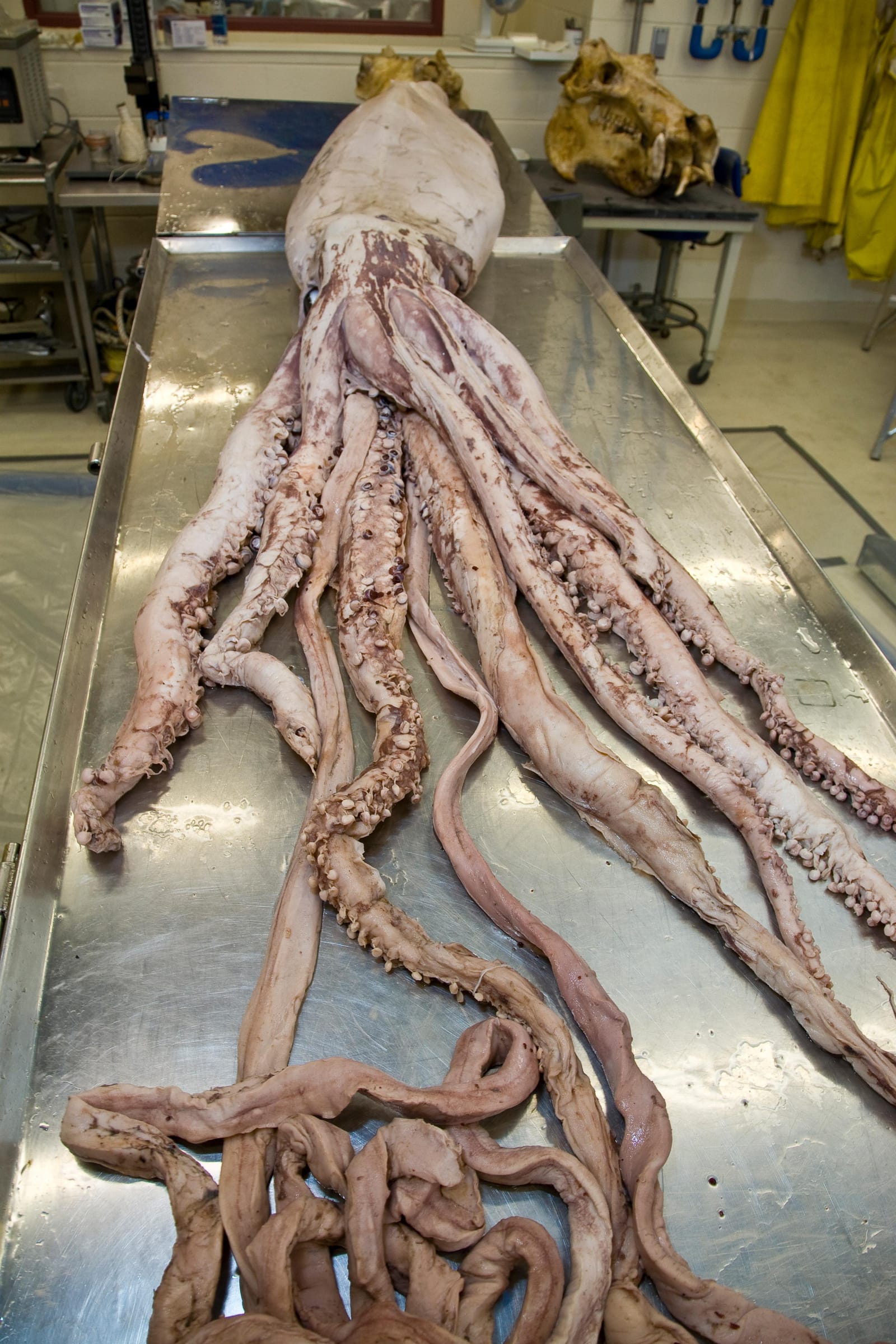
Female Giant Squid
Architeuthis dux, a female netted by a fisherman off Spain in 2005 · Caught 2005, on display since 2008 · Preserved specimen, 25 feet (7.6 m) long today; 36 feet at capture
Look for
- The two feeding tentacles, far longer than the arms. They made up 22 of her 36 feet when she was caught.
- The clusters of suckers at the tentacle tips, which a giant squid uses on prey and on predators alike.
- The male. He came from Spain on the same flight, and he is smaller, because female giant squid outgrow males.
Transcript (2:09)
Most of what you are looking at is arm and tentacle. The body is the pale tube at one end, and everything else trails away from it: the arms, and then the two much longer feeding tentacles that end in clusters of suckers. When she was pulled out of the water she measured thirty-six feet, about eleven metres, and twenty-two of those feet were the two tentacles. The preservative has shrunk her since. She is about twenty-five feet now, seven and a half metres, and she is still the thing people crowd around in this hall.
She is here because in 2005 the museum was building a new ocean hall and wanted a giant squid at its heart. At the time only a couple of these animals had ever been glimpsed alive, and most of what scientists knew came from broken pieces found in the stomachs of sperm whales or rotting on beaches. The Smithsonian's own specimen was one of those, a battered female that washed up on Plum Island in Massachusetts in the 1980s. The zoologist Clyde Roper drove her to Washington himself, got pulled over on the way, and talked his way out of a ticket by telling the policeman about his passenger.
Then word came from Spain. A fisherman had found a female giant squid in his nets, and a Spanish marine research group agreed to send her, along with a smaller male caught days before. The problem was getting them across the Atlantic. Both were sitting in hundreds of gallons of formalin, and no airline would touch that. Somebody at the museum joked that the orca from Free Willy had been moved by cargo plane, so why not call the Navy. Someone did. The Spanish scientist Ángel Guerra drove the pair seven hours from Asturias to the naval base, arrived on the Fourth of July to find it closed for the American holiday, and spent the night in the parking lot with the squid. The next morning they flew out on an Air Force cargo plane. The cargo travelled under a nickname, VIS, for Very Important Squid.
Weeks before the hall opened in September 2008, the team drained off the formalin and moved both specimens into a new experimental preservative. Their first visitor was President George W. Bush. According to the project manager, he thought Operation Calamari, as the museum called it, was the funniest thing he had ever heard.
Every giant squid in every ocean belongs to her one species, Architeuthis dux. Her eyes, in life, were the size of dinner plates, the largest in the animal kingdom, good for spotting a sperm whale coming from almost four hundred feet away. And for anyone who has ever wondered, Roper has settled it: giant squid tastes intolerably bitter.
Ryan Schwark, CC0, via Wikimedia Commons. Photo: Ryan Schwark

Stop 3 of 5 · David H. Koch Hall of Fossils – Deep Time, first floor
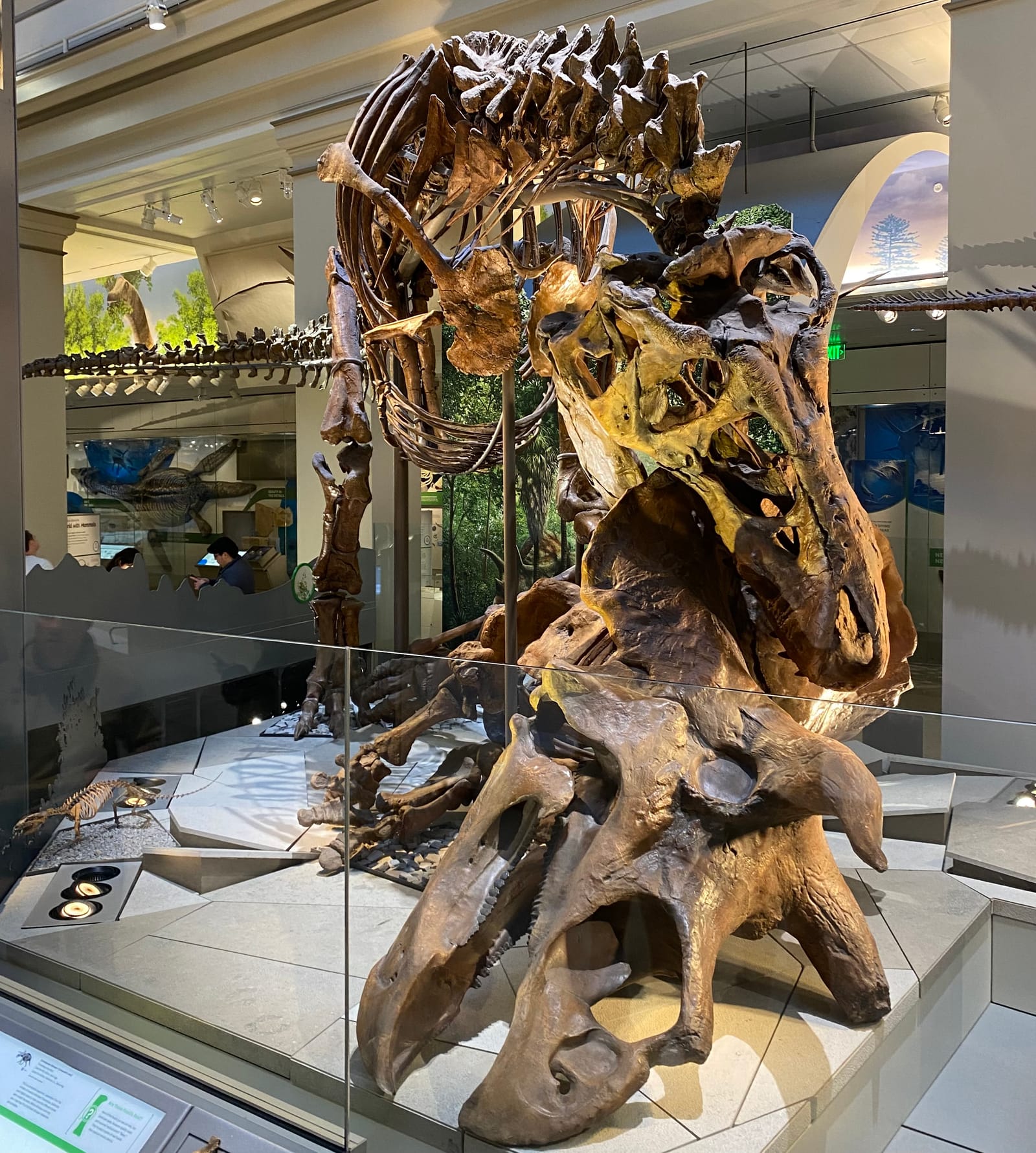
The Nation's T. rex
Tyrannosaurus rex from Montana, found by Kathy Wankel in 1988; on loan from the U.S. Army Corps of Engineers · About 66 million years old; mounted 2019 · Fossil skeleton with cast elements, about 40 feet long and 15 feet tall
Look for
- The arms. Short, but thick where the muscles attached. This was the first skeleton complete enough to show how short they really were.
- One foot pinning the Triceratops while the jaws lever its head off the neck. No museum had put the two in direct combat before.
- The Triceratops's broken horn and cracked ribs, added to show the force of the attack.
Transcript (2:08)
Look at the balance of it. The body is flat to the ground, the tail held out straight behind as a counterweight, one foot planted on the flank of a Triceratops, and the jaws working the victim's head off its neck. It is about forty feet from snout to tail and fifteen feet high, and it is the centrepiece the whole hall was rebuilt around.
On Labor Day weekend in 1988, a rancher called Kathy Wankel was out bone-hunting with her family near Fort Peck Reservoir in Montana, and she spotted a fossil sticking out of ground that the summer had baked as hard as concrete. She and her husband, Tom, dug out part of a shoulder blade and an arm and took them to the Museum of the Rockies in Bozeman, where the paleontologist Jack Horner told them what they had found: Tyrannosaurus rex. The skeleton turned out to be about eighty-five percent complete, and it held something nobody had ever seen, a complete T. rex forelimb.
Look at those arms now. They are famously short, and this was the first skeleton complete enough to show just how short. But the bones carry big attachment areas for muscle, so they were strong. Growth rings inside the bones, read like the rings of a tree, show this animal was about eighteen when it died.
The land it was found on belongs to the U.S. Army Corps of Engineers, which is why the skeleton is federal property, and in 2013 the Corps lent it to the Smithsonian for fifty years. That autumn's government shutdown held it up in Montana. It finally arrived in April 2014, seven tons of fossils on a two-thousand-mile road trip in the back of a FedEx truck. It then went to Research Casting International in Ontario, where each bone was given its own metal cradle that can be unbolted, so scientists can still take a bone down and study it.
The real skull and most of the ribs are too fragile to be put on show, so just over half of what you see is original bone and the rest is careful reconstruction. The Triceratops is a cast as well, a replica of the museum's own Triceratops, nicknamed Hatcher, whose history at the Smithsonian goes back to 1905. The designers gave the copy a broken horn and a couple of fractured ribs, and the museum's curator of dinosaurs, Matthew Carrano, wanted exactly this: a pose nobody had done before, with the two animals directly engaged.
The hall reopened around them on the eighth of June 2019. And this T. rex left one more mark on science: when Mary Schweitzer tested its bones, she found heme, a form of iron from blood, still inside a sixty-six-million-year-old skeleton.
Cliff from Arlington, Virginia, USA, CC BY 2.0, via Wikimedia Commons. Photo: Cliff from Arlington, Virginia, USA

Stop 4 of 5 · Janet Annenberg Hooker Hall of Geology, Gems, and Minerals, second floor
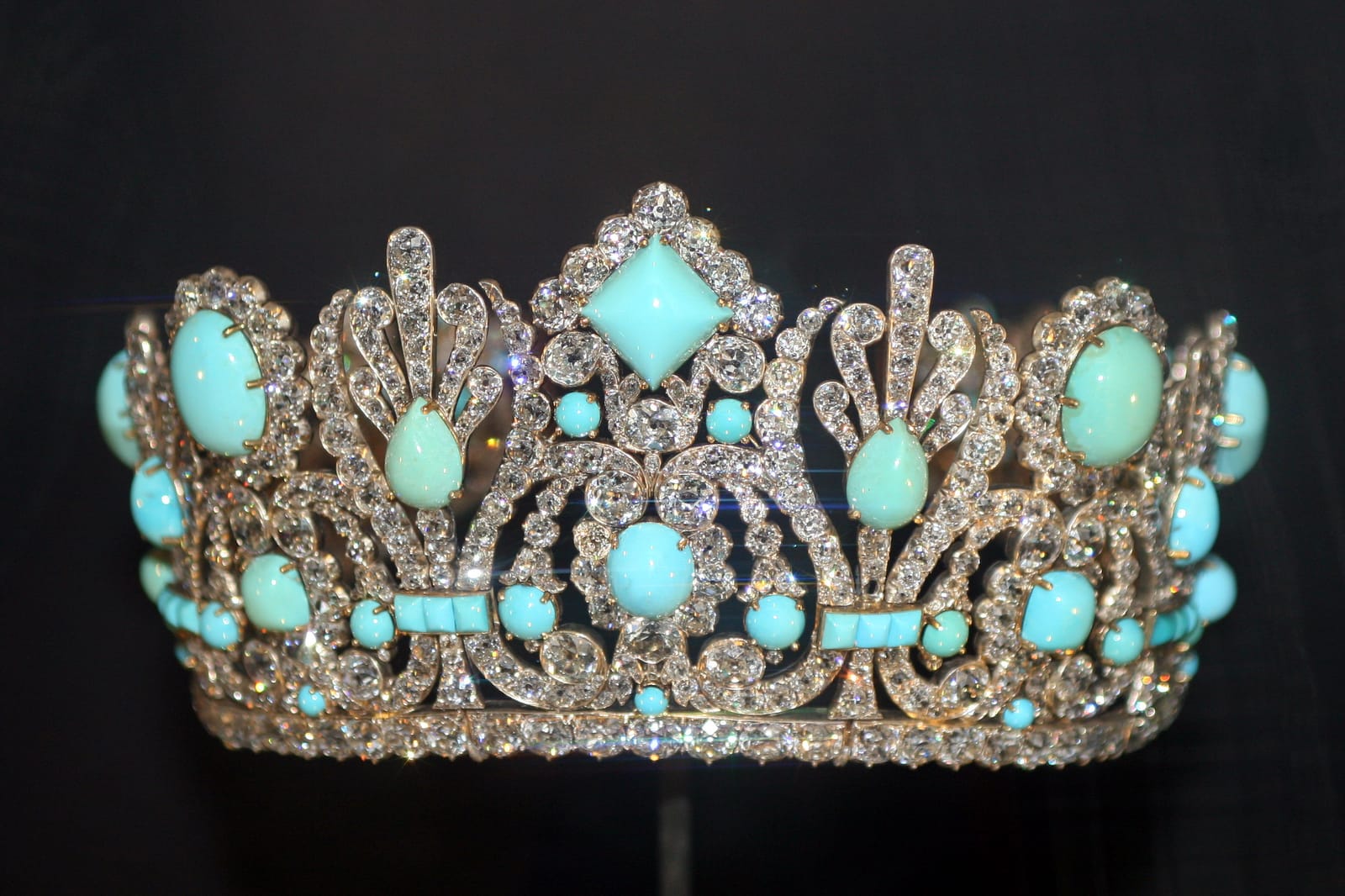
Marie Louise Diadem
Etienne Nitot et Fils, Paris · 1810; turquoise set 1956–1962 · Silver and gold, 1,006 old mine cut diamonds (700 carats) and 79 Persian turquoises (540 carats)
Look for
- The 79 sky-blue turquoises. Every one sits in a setting that was cut for an emerald.
- The square stone at the centre front. It fills the setting of the diadem's biggest emerald, a square-cut stone of about 12 carats.
- The pattern of scrolls, palmettes and medallions, all hand work from Napoleon's Paris.
Transcript (2:06)
Everything here looks as if it belongs together: the silver and gold scrollwork, the flash of more than a thousand diamonds, and those soft, sky-blue stones set all the way round. The blue is the part that does not belong. When this diadem was made, every one of those seventy-nine settings held a Colombian emerald.
It was made in Paris in 1810 by the court jewellers Etienne Nitot et Fils, for Napoleon's second wife, Marie Louise of Austria. The two married that year, and the diadem was part of the wedding gift, a full set in emeralds and diamonds: this diadem, a necklace, earrings, a comb and a belt buckle. A French royal bride was expected to arrive with nothing from her homeland, so Marie Louise needed jewels from the ground up. When she left France after Napoleon's fall she took this set with her, because it was her own property, not the state's.
She left it to her Habsburg aunt, and it passed down the family for a century. In 1952 an archduke of the family sold the diadem and the buckle to the Paris jewellers Van Cleef and Arpels, who put them on show in the window of their New York store. What happened next is the reason for the turquoise. Between May 1954 and June 1956 the firm took out the emeralds and sold them as separate pieces of jewellery. A newspaper advertisement in 1955 offered the public an emerald from the historic Napoleonic tiara, and the company's secretary later said that within twenty-four hours they were sold out.
Some time before 1962 the empty settings were filled with Persian turquoise, five hundred and forty carats of it. Jeffrey Post, who looked after the national gem collection for years, points out why turquoise made sense: it is hard enough to take a polish but soft enough to be shaped to fit holes that were cut for other stones. Even the name is a trade route: it comes from the French word for Turkey, the country Persian turquoise passed through on its way to Europe.
In 1962 the diadem went back to Paris for an exhibition at the Louvre, reunited with the necklace and earrings from the same set. Nine years later the cereal heiress Marjorie Merriweather Post bought it for the Smithsonian, and it has been in Washington ever since. The diadem's emeralds are scattered across the jewellery boxes of the 1950s, but two pieces of the wedding set kept theirs. If you have been to the Louvre, you may have seen them: the necklace and the earrings, still green.
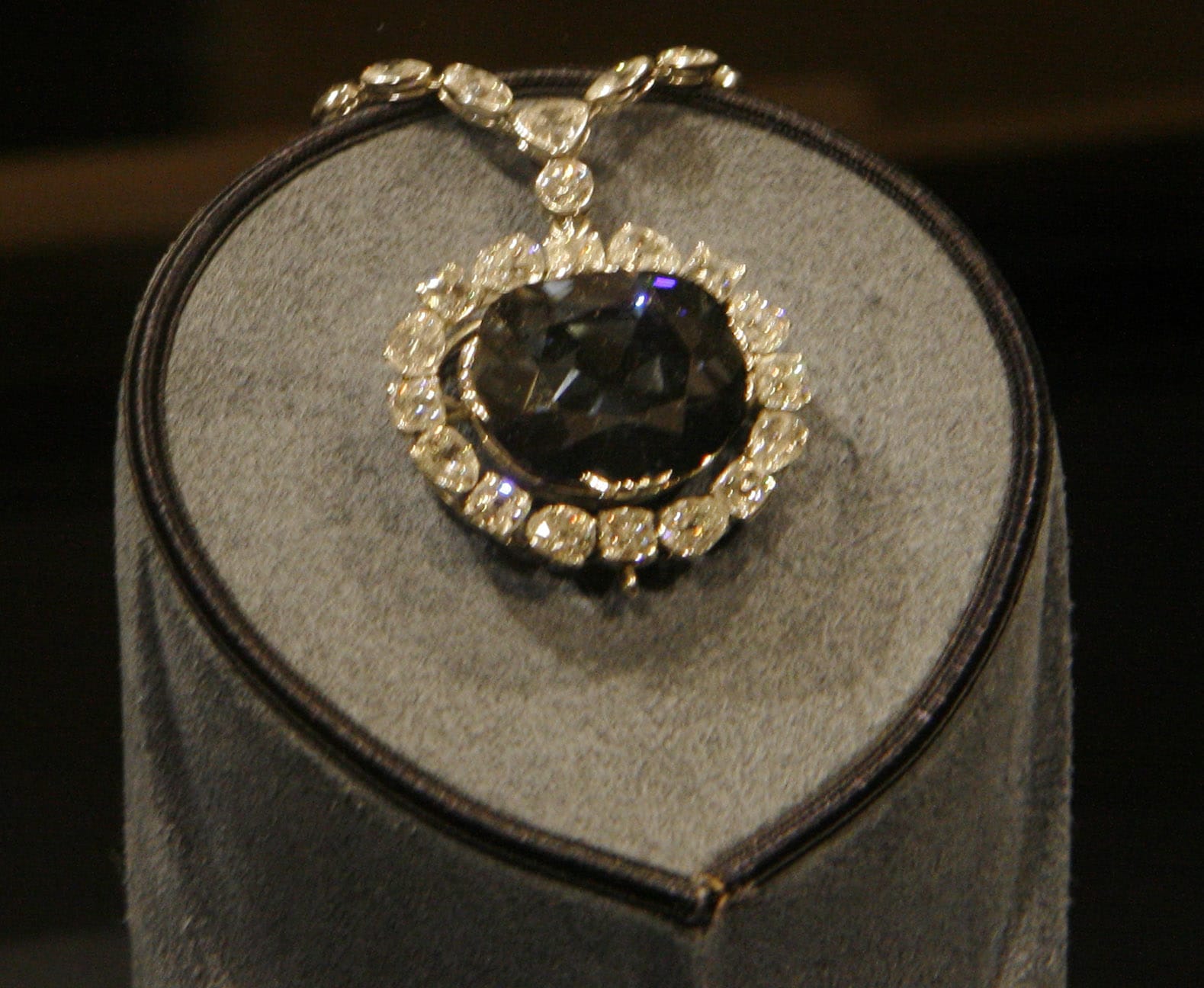
dbking, CC BY 2.0, via Wikimedia Commons. Photo: dbking
.jpg)
Stop 5 of 5 · Janet Annenberg Hooker Hall of Geology, Gems, and Minerals, second floor, Harry Winston Gallery
The Hope Diamond
Formed deep in the Earth about 1.1 billion years ago; mined in India, recut in Europe after 1792 · Known since 1666; given to the museum in 1958 · Blue diamond, 45.52 carats, in a platinum setting ringed by sixteen white diamonds
Look for
- The colour. Under the gallery's bright display lights it reads as a deep, greyish blue, darker and greyer than a sapphire.
- The sixteen white diamonds around it, alternating old mine cuts and pear shapes, in the setting made for Evalyn Walsh McLean.
- The pedestal turning slowly inside a cylinder of bulletproof glass three inches thick.
- The Winston Fancy Color Diamonds nearby, laid out as a rainbow with the Winston Red at the centre.
Transcript (2:46)
It turns. Stand still for a minute and the pedestal carries the necklace round inside its glass cylinder, three inches of bulletproof glass, so the stone catches the light from one side and then the other. The blue is not the blue of a sapphire. It is a deep, greyish blue, set in a ring of sixteen white diamonds. It weighs 45.52 carats, and it is the largest blue diamond known.
The colour comes from a trace of boron inside the carbon, a few parts per million at most. And there is a property you will never see here: put it under short-wave ultraviolet light and switch the lamp off, and it glows red, like a coal, for some time afterwards. That eerie glow may well have fed the stories that grew up around it.
Its known history starts in India. The stone most likely came from the Kollur mine, in the old kingdom of Golconda, and in the seventeenth century the French gem merchant Jean-Baptiste Tavernier bought it and brought it to Europe. In 1668 he sold it to King Louis the Fourteenth, who had it cut into a gem the French called the Blue Diamond of the Crown, and later writers the French Blue.
Then it vanished. In September 1792, with the king in prison, thieves broke into the royal storehouse in Paris and spent five days looting the jewels of the French crown. The French Blue was never recovered under that name. In 1812 a blue diamond of exactly this size and shape turned up in London, recut, and it later took its name from one owner, the collector Henry Philip Hope. In 2005 the Smithsonian published computer-aided research showing that this stone was indeed cut from the stolen French Blue.
And the curse? A newspaper was already telling the tale of a stone torn from the eye of an idol in 1888, and the stories of ruin for everyone who owned it multiplied in the early twentieth century. They were almost certainly invented, and they helped sell newspapers and diamonds. In 1911 the American heiress Evalyn Walsh McLean bought it, and the platinum setting with the sixteen diamonds you are looking at was made for her. After her death the New York jeweller Harry Winston bought her whole collection in 1949.
Winston liked to say that America had no king and queen, but should have a treasure to match. On the tenth of November 1958 it arrived here as his gift, and it came by post: a small box wrapped in brown paper, plastered with stamps and marked fragile, sent from New York by registered mail. The total fee was $145.29, of which $2.44 was postage and the rest was insurance for a million dollars. The wrapper is kept today by the Smithsonian's National Postal Museum.
Since 1997 the diamond has had its own room next to the rest of the national gem collection. In 2025 Winston's son Ronald gave the rare Winston Red and a collection of forty fancy coloured diamonds, and they now sit beside it in the Harry Winston Gallery. The Hope has left Washington only a handful of times, to the Louvre in 1962 and to Johannesburg in 1965 among them. The rest of the time it has been in this building, ever since a postal carrier named James Todd picked up a brown paper parcel at the City Post Office and drove it here.
Independent guide · Chiaro
Point Chiaro at anything in the Natural History Museum.
The Hope Diamond is one specimen out of more than 148 million. Photograph a meteorite, the woolly mammoth, a mummy upstairs or something alive in the Insect Zoo, and Chiaro names it, explains how it ended up in Washington, then answers your follow-up questions out loud while you are still at the glass.
Before you go
Getting there
10th Street and Constitution Avenue NW, Washington, DC 20560, on the north side of the National Mall. There are two ways in: the Mall doors on Madison Drive, or the Constitution Avenue doors on the opposite side of the building.
Federal Triangle, on the Blue, Orange and Silver lines, is the nearest Metro station. Archives–Navy Memorial (Green and Yellow lines) and Metro Center (Red line) are a short walk further. The Smithsonian runs no public parking on the Mall.
Tickets
- No ticket, no pass, no booking: you just walk in, free. Everyone goes through airport-style screening with a metal detector on the way in.
- Travel light. There is no coat check and no lockers, and tripods, monopods and selfie sticks cannot be used inside.
- The doors shut at 5:30 pm sharp and everyone has to leave, so do the Hope Diamond before the last half hour rather than after it.
- The free Wi-Fi network is called si-visitor and needs no password.
The official audio guide
The museum does not rent out an audio guide. The audio it makes itself is the Deep Time Audio Description app for iPhone and Android, a self-guided tour of the fossil hall written for blind and partially sighted visitors, along with visual description tours of several halls on its website. Our five stops cost nothing as well and play in any browser; for the rest of the building, there is the Chiaro app.
Official site →Questions
Is there a free National Museum of Natural History audio guide?
Yes, this Smithsonian National Museum of Natural History audio guide. Tap play on any of the five stops and it runs on your phone's browser, and the text of every recording sits right beneath it, so nothing needs installing. Anything else in the halls, from a meteorite to a mummy, you can photograph and hear about in the Chiaro app.
How much is the official National Museum of Natural History audio guide?
There is no paid guide to buy. The museum rents no audio device; its own audio is the Deep Time Audio Description app for the fossil hall, made for blind and partially sighted visitors, plus visual description tours on its website. Entry to the museum is free as well.
Where is the Hope Diamond in the National Museum of Natural History?
On the second floor, in the Harry Winston Gallery of the Janet Annenberg Hooker Hall of Geology, Gems, and Minerals. It has a room of its own beside the main display of the National Gem Collection, and the elevators from the first floor reach it.
Is the National Museum of Natural History closed on any day?
Only on 25 December. The rest of the year, holidays and weekends alike, the doors open at 10 in the morning and close at 5:30 in the afternoon, when every visitor has to be out.
Do I need a ticket for the Natural History Museum?
No. Admission is free and the museum asks for no passes or tickets. Expect a security check with a metal detector at the door, and since there is no cloakroom, bring as little as possible.
Is the T. rex skeleton real?
Just over half of it. The fossils were found in Montana in 1988 and are on a fifty-year loan from the U.S. Army Corps of Engineers, but the skull and most of the ribs are too fragile to show, so those parts are reconstructions. The Triceratops under its foot is a cast.
More audio guides
Made by Chiaro. Not affiliated with the National Museum of Natural History.