
National Air and Space Museum · Washington DC · Independent guide
National Air and Space Museum audio guide,
five stops, free.
Five aircraft and spacecraft, five recordings, Wright Flyer to Columbia. The Mall building has eighteen galleries open, and Chiaro narrates any aircraft, capsule or spacesuit in them from a photo.
Made by Chiaro. Not affiliated with the National Air and Space Museum.
1903 Wright Flyer
National Air and Space Museum, Washington DC
That was the free part
Chiaro narrates any work in the National Air and Space Museum from a photo.
The five stops · 12 minutes of audio
Five stops, one walk,
in the order you will walk them.
The Jefferson Drive doors put you straight into the Boeing Milestones of Flight Hall, and this National Air and Space Museum audio guide starts a few steps away and ends upstairs. Step through to gallery 107 for the 1903 Wright Flyer, come back into the hall for the orange Bell X-1 and Lunar Module LM-2, then climb to the second floor for Apollo 11's Columbia in Destination Moon, gallery 206, and finish two rooms east with the Spirit of St. Louis in Pioneers of Flight, gallery 208. Twelve minutes of narration and ten or so of walking between galleries: an hour covers it with time to look.
Every object here was traced twice, once through its record in the museum's own online collection, whose display line names the gallery it sits in, and once through a second, independent reference; gallery numbers come from the museum's floor map, and all five were confirmed as on view on 25 September 2026. The Mall building is still finishing its renovation, with two more galleries due this autumn, so things can move: if a sign in the building says otherwise, the sign is right, and a word from you gets the page put straight.
Photo: National Air and Space Museum, Smithsonian Institution, CC0, via Wikimedia Commons. Photo: National Air and Space Museum, Smithsonian Institution

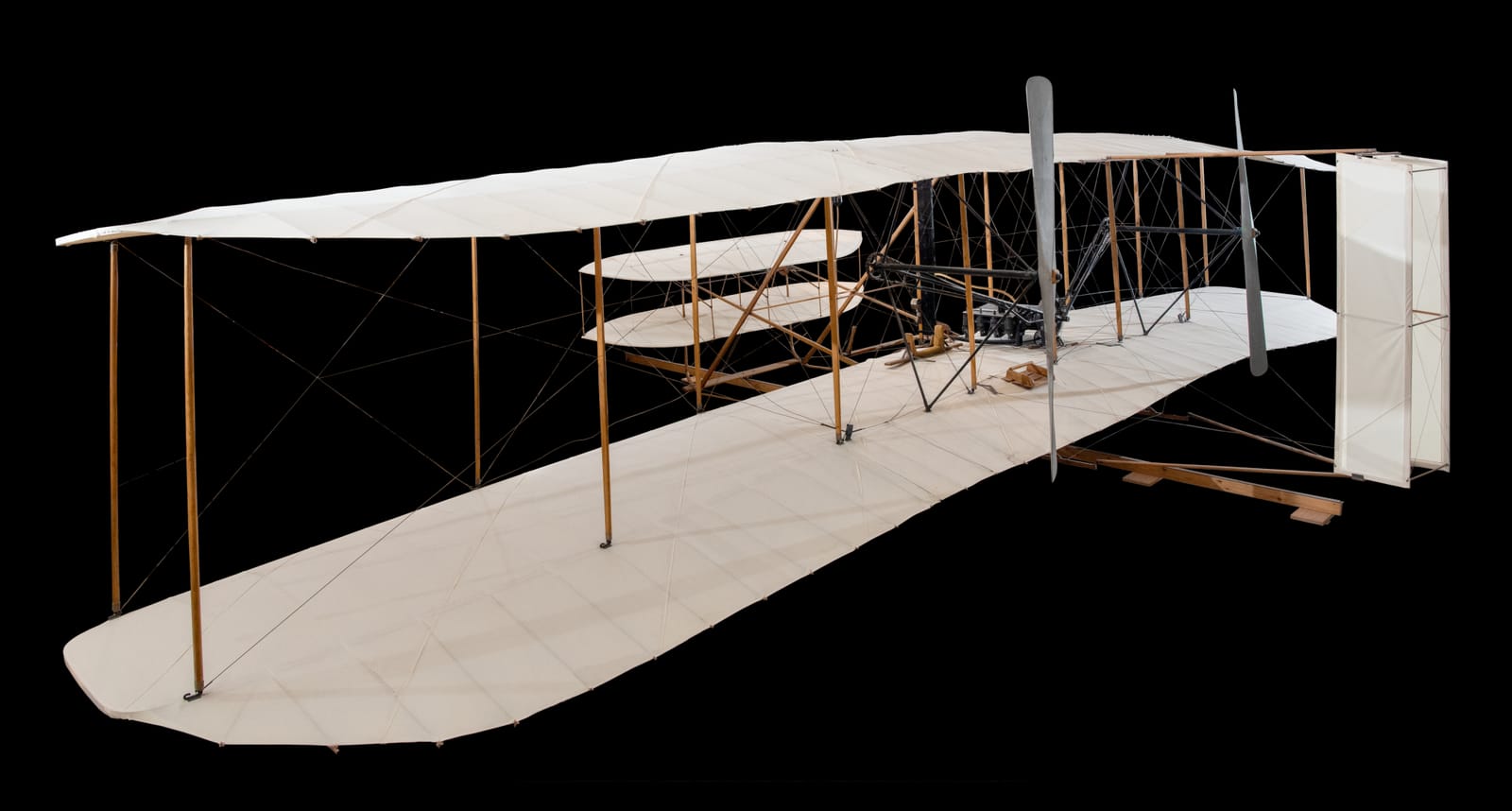
Stop 1 of 5 · The Wright Brothers & The Invention of the Aerial Age, gallery 107, first floor
1903 Wright Flyer
Wilbur and Orville Wright, Dayton, Ohio · 1903 · Wood airframe with muslin covering, 12-horsepower Wright engine; wingspan 12.3 m, length 6.4 m
Look for
- The skids. There are no wheels anywhere: two long runners served as the landing gear.
- The elevator out in front of the wings and the two propellers behind them, driven by chains and sprockets from the engine on the lower wing.
- The bare fabric. No paint or sealant of any kind, just natural muslin, as the brothers left it.
Transcript (2:50)
Take a moment before anything else. Wood, pale muslin, two long skids where you would expect wheels, and not a drop of paint anywhere; the fabric is left in its natural finish. It looks like something a strong gust could destroy, and the honest answer is that one did. This is the actual machine that flew at Kitty Hawk, North Carolina, on the seventeenth of December 1903, and the whole gallery around you is built around it.
Wilbur and Orville Wright ran a bicycle shop in Dayton, Ohio. In May 1899 Wilbur wrote a letter to the Smithsonian, the same institution whose building you are standing in, asking for whatever it had published about flight. Four years of patient work followed: a kite in 1899, full-size gliders in 1900, 1901 and 1902, and, when those gliders lifted far less than their calculations predicted, a small wind tunnel of their own to test wing shapes. By 1902 they could glide under control. What they still needed was power.
So look behind the wings. Two propellers, pushing rather than pulling, turned by chains from a twelve-horsepower engine they built with their shop mechanic, Charles Taylor. The propellers were the cleverest idea of all. The brothers treated each blade as a wing turned on its side, making lift forwards instead of upwards. Now look to the front. That horizontal surface out ahead of everything is the elevator; there is no tailplane at all. To bank, the pilot twisted the wingtips in opposite directions, a trick called wing warping.
On the fourteenth of December Wilbur won a coin toss, took the first try, and damaged the machine. Three days later it was Orville's turn. At 10:35 in the morning he flew for twelve seconds and thirty-six metres. They made four flights that day, and on the last one Wilbur stayed up for fifty-nine seconds and covered 255 metres. Then, while they stood talking about it, a gust flipped the Flyer over and sent it tumbling across the sand. It never flew again.
Its afterlife is almost stranger. It sat crated in a shed in Dayton, spent eleven days under floodwater and mud in 1913, and then became the prize in a feud. The Smithsonian's secretary, Charles Walcott, refused to credit the Wrights and honoured the failed Aerodrome of his predecessor Samuel Langley instead. In 1928, with the quarrel still unsettled, Orville lent the Flyer to the Science Museum in London. It spent the Second World War in an underground store near Corsham, not in the London Underground, whatever you may have heard. Only after the Smithsonian printed a retraction in 1942 did it come home, and it was handed over on the seventeenth of December 1948, forty-five years to the day after Kitty Hawk.
The fabric you see dates from 1985, cut using a large piece of the original 1903 covering as its pattern. Some of that original went much further. In July 1969 a scrap of cloth from the upper left wing and a sliver of wood from the left propeller were inside the lunar module Eagle when it landed on the Moon. Sixty-six years separate the sand at Kitty Hawk from the Sea of Tranquility.
Photo: National Air and Space Museum, Smithsonian Institution, CC0, via Wikimedia Commons. Photo: National Air and Space Museum, Smithsonian Institution
.jpg)
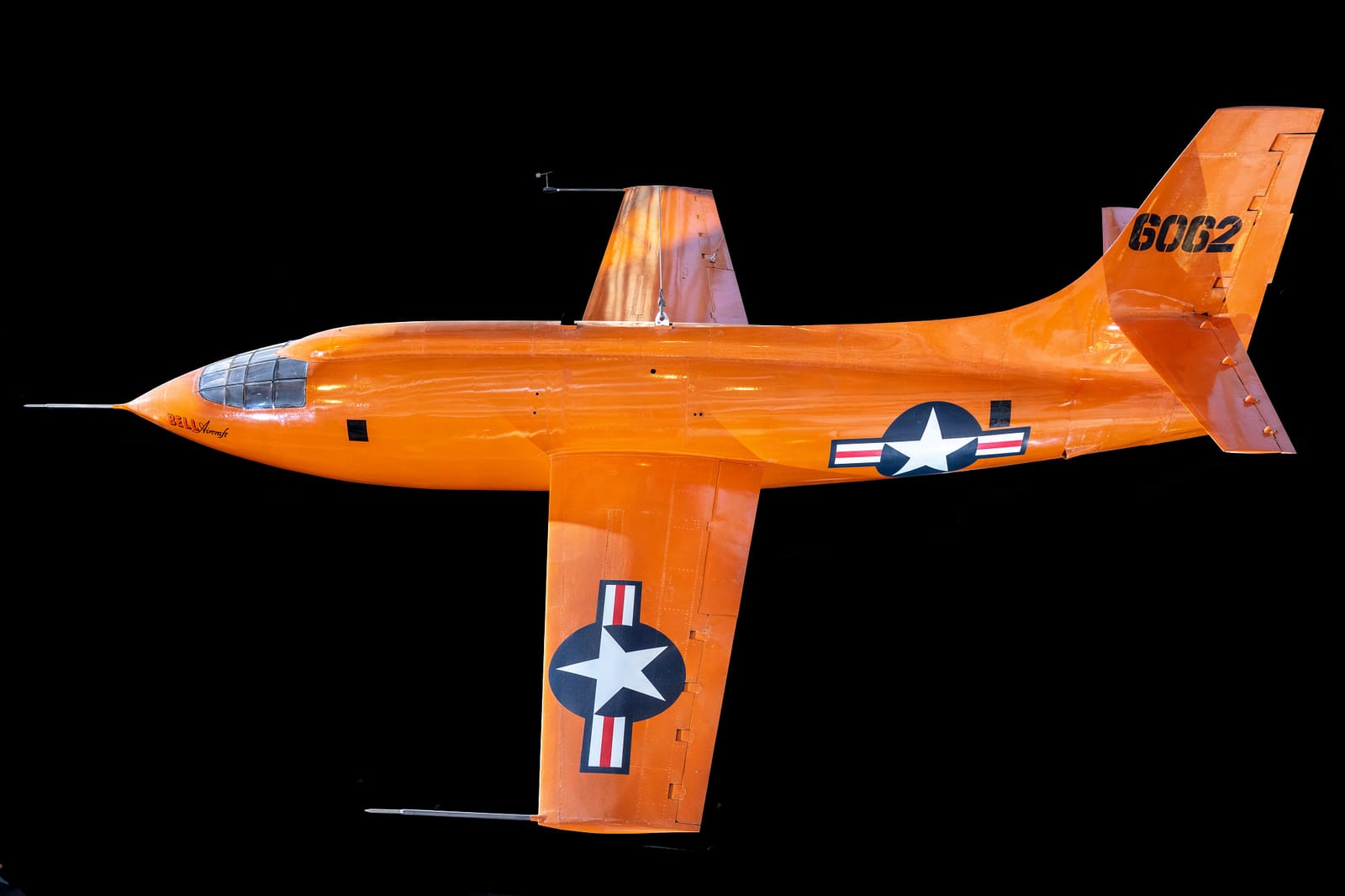
Stop 2 of 5 · Boeing Milestones of Flight Hall, gallery 100, first floor
Bell X-1 Glamorous Glennis
Bell Aircraft Corporation, Buffalo, New York, for the US Army Air Forces and NACA · 1946 · Aluminium fuselage, steel propellant tanks, rocket engine; wingspan 8.5 m, length 9.4 m
Look for
- The nose. The whole fuselage copies a .50-calibre machine-gun bullet, a shape already known to stay stable faster than sound.
- The wings, far thinner than you expect, built that way to cope with the forces near Mach 1.
- The digits 6062 on the tail, the end of serial 46-062: this is X-1 number one, the one that did it.
Transcript (2:29)
It is small, and it is very orange. International orange, in the museum's own description, and on a machine this size it looks almost like a toy. Then look at the shape. The nose and the whole body copy a point-fifty-calibre machine-gun bullet, because in the nineteen-forties engineers knew one thing for sure about going faster than sound: bullets of that shape stayed stable when they did it. Nobody yet knew whether a person could.
Many people at the time believed in a sound barrier, an invisible wall near Mach one where the air would shake an aircraft apart. The X-1 was built to find out. In 1944 the Army Air Forces and NACA, the government research agency that later became NASA, started a programme for piloted research aircraft that could reach and pass the speed of sound, and Bell Aircraft of Buffalo, New York, built three of them. This is number one, serial 46-062. The last four digits are on the tail.
On its record flights it never took off from a runway. On the fourteenth of October 1947 a Boeing B-29 bomber carried it up in its bomb bay for half an hour and let it drop. The pilot was Captain Chuck Yeager, a Second World War ace from West Virginia and the Air Force's most experienced test pilot. Earlier attempts had run into violent buffeting as they approached Mach one, and the engineers had just upgraded the adjustable horizontal stabiliser so Yeager could change its angle in tiny steps. This time the ride was smooth. On the ninth powered flight of the X-1 the Mach meter jumped from point nine six five to one point oh six: seven hundred miles an hour at forty-three thousand feet above the Mojave Desert. He flew under rocket power for twenty seconds, shut the engine down and glided to the dry lakebed. From release to landing, fourteen minutes.
He had named the plane Glamorous Glennis, after his wife. His own verdict on the day was almost an anticlimax: the real barrier, he said later, was not in the sky but in our knowledge and experience of supersonic flight.
Look at the wings, which are startlingly thin. Inside that bullet of a fuselage the designers packed two propellant tanks, twelve nitrogen spheres, a pressurised cockpit and more than five hundred pounds of instruments. It flew seventy-eight times. In March 1948 Yeager took it to Mach 1.45. In January 1949 it did something it had long since stopped being asked to do, and took off from the ground under its own power. Not every X-1 was so lucky. The third one blew up on the ground in 1951, and two of the later models were lost to explosions as well.
In 1950 it was flown to Washington slung beneath a B-29 and handed to the Smithsonian. General Hoyt Vandenberg, the Air Force chief of staff, said that in a few moments the subsonic period became history and the supersonic period was born. Those few moments belong to the orange airplane in front of you.
Photo: National Air and Space Museum, Smithsonian Institution, CC0, via Wikimedia Commons. Photo: National Air and Space Museum, Smithsonian Institution
.jpg)
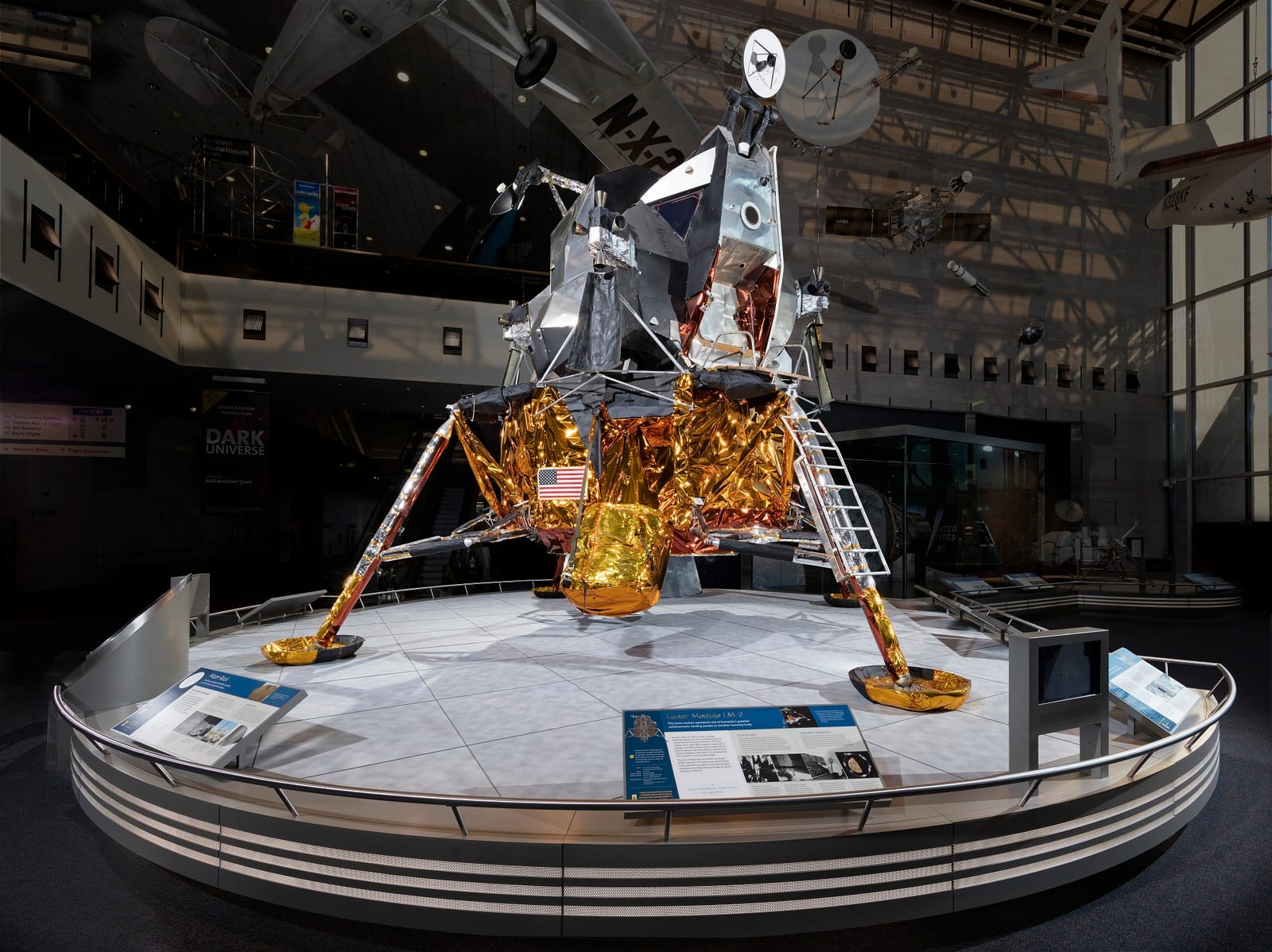
Stop 3 of 5 · Boeing Milestones of Flight Hall, gallery 100, first floor
Lunar Module LM-2
Grumman Aircraft Engineering Corporation, Bethpage, New York, for NASA · Built 1966; configured as Apollo 11's Eagle · Aluminium and titanium, aluminized Mylar and Kapton blankets; 6.54 m across
Look for
- The seam between the two stages: the grey crew cabin on top, which alone would lift off again, and the gold landing stage below, which stays behind.
- The gold and silver wrapping. It is blanket, aluminized Mylar and Kapton, not metal plate.
- The ladder on the front leg and the flag on the landing stage, as on Eagle.
Transcript (2:16)
Gold foil, spindly legs, and a grey cabin on top that looks as if it was folded rather than built. If it reminds you of the photographs of Eagle on the Moon, that is exactly the intention. But the label beside it is honest about the twist: this lunar module has never been to space.
Grumman built it at Bethpage, on Long Island. By the end of 1966 it and its twin, LM-1, were almost finished, meant for uncrewed test flights in Earth orbit. Then came the tragic Apollo 1 fire in January 1967, and the safety rules for any spacecraft that would carry astronauts were rewritten. Rather than rebuild two nearly completed landers, NASA kept them for uncrewed missions only. LM-1 flew on Apollo 5 in January 1968 and did well enough that a second test was judged unnecessary. LM-2's delivery to the launch site was delayed, then cancelled.
So it went to work on the ground. In April 1968 the uncrewed Apollo 6 launch showed that the Saturn V rocket could shudder violently up and down, an effect engineers called pogo, and in May LM-2 became part of the test system built on the ground to study it. Then it was dropped, again and again, to prove its electronics and mechanics would survive a jarring touchdown. The fifth and final drop test was on the seventh of May 1969, less than three months before Neil Armstrong and Buzz Aldrin walked on the Moon.
Next came a detour to Japan. At Expo 70 in Osaka the American pavilion wanted a real lunar module, and the real Eagle was not available: its lower half is still sitting on the Sea of Tranquility. So Grumman paired LM-2's cabin with a test landing stage and dressed it to look as if it had just touched down. Afterwards it came to the Smithsonian, and from July 1976 until late 2015 it stood on an imitation lunar surface at the far east end of this building.
Now look at the two halves. Up top is the ascent stage, the pressurised cabin with its own rocket engine, the only part that would have left the Moon. Below it is the descent stage with the legs, the landing engine and the surface experiments, wrapped in gold and silver blankets of aluminized Mylar and Kapton. When the museum moved it into this hall, the team took it apart and set out to make it match Eagle in virtually every detail, and every scrap of material they removed was photographed, documented and kept. Even the ladder on the front leg is there, as on Eagle.
Between 1969 and 1972, six lunar modules identical to this one set twelve American astronauts down on the Moon. This one never flew at all, and that is precisely why it is here for you to stand beside.
Photo: National Air and Space Museum, Smithsonian Institution, CC0, via Wikimedia Commons. Photo: National Air and Space Museum, Smithsonian Institution
.jpg)
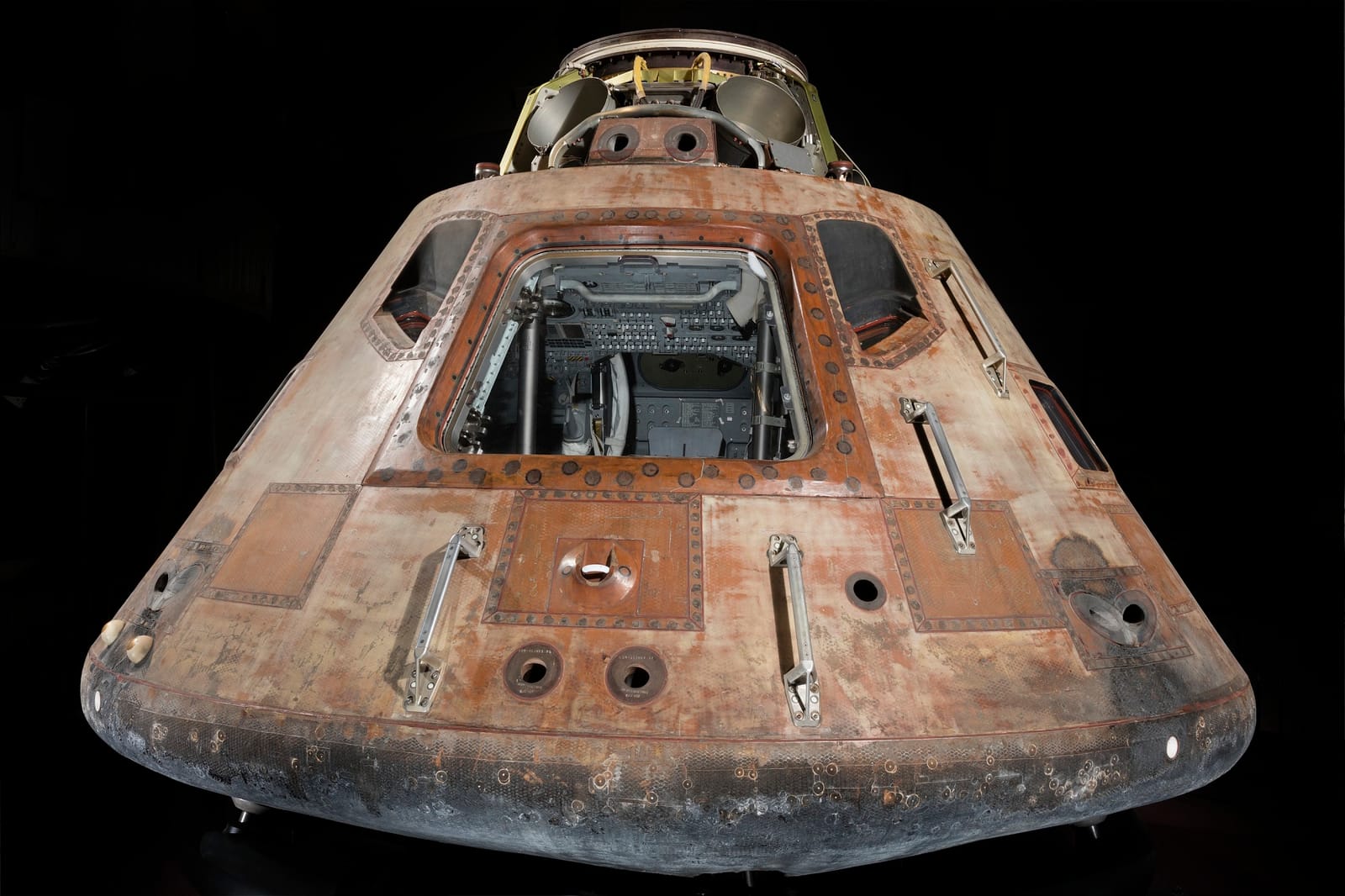
Stop 4 of 5 · Destination Moon, gallery 206, second floor
Apollo 11 Command Module Columbia
North American Rockwell, for NASA · 1969 · Aluminium alloy, stainless steel and titanium; 3.91 m wide at the base
Look for
- The scorched, streaked skin. Conservators have kept it the way it looked when it came back through the atmosphere on 24 July 1969.
- The size. Under four metres across the base, and it was the crew's living quarters for most of the eight-day mission.
- Neil Armstrong's Apollo 11 spacesuit, shown in this same gallery.
Transcript (2:30)
Walk all the way round it first. The outside is scorched and streaked, brown where you might expect silver, and the museum's conservators have worked hard to keep it exactly like that, because this is how Columbia looked when it came back to Earth on the twenty-fourth of July 1969. It is 3.91 metres across at the base. For most of eight days, this was home for three men.
They left on the sixteenth of July, from Cape Kennedy, on top of a Saturn V: Neil Armstrong, Buzz Aldrin and Michael Collins. Columbia was one of three parts of the spacecraft. The service module behind it held the main engine and supplies, and the lunar module Eagle took two of the crew down to the surface. Of the three, only this one came home. Collins, who circled the Moon alone while the others walked on it, described the cabin to the listening world as our happy little home.
He was also the one with doubts about the name. Julian Scheer, in charge of public affairs at NASA, mentioned Columbia to him in passing on the phone, and Collins thought it a bit pompous. He came round, partly because it echoed the Columbiad, the giant gun that fires travellers at the Moon in Jules Verne's novel From the Earth to the Moon.
The best stories are on the inside walls. When the Smithsonian made a detailed three-dimensional scan of the cabin, curators found writing that had been out of sight for more than forty years. Beside the navigation station, columns of numbers copied from Houston: the coordinates Collins was given while he hunted with the telescope for Eagle on the surface below, without success. A handwritten note on locker R5, which had been turned into the store for used urine bags, and was clearly meant to stay shut. And a small hand-drawn calendar, the days of the mission crossed off one by one, with only the twenty-fourth of July, splashdown day, left uncrossed.
Then there is the note historians have always known about. Heading for Hawaii aboard the recovery ship, the USS Hornet, Collins crawled back inside and wrote on an equipment bay panel: Spacecraft 107, alias Apollo 11, alias Columbia. The best ship to come down the line. God bless her.
Before it came to the Smithsonian, NASA took it on the road. It went to forty-nine state capitals, plus the District of Columbia and Anchorage, travelling nearly twenty-six thousand miles and spending close to a month at sea for each of the Hawaii and Alaska legs. About three and a quarter million people came to see it, and Hawaii drew the biggest crowd, a hundred and thirty-five thousand. When it finally moved into this gallery, it made the thirty-mile trip from the Udvar-Hazy Center in Virginia on a tractor trailer, wrapped in so many protective layers that it looked like a giant Hershey's Kiss.
If you started this walk downstairs, here is the last connection. Pieces of the 1903 Wright Flyer went to the Moon in Neil Armstrong's personal kit on this mission, and they splashed down in the Pacific inside this capsule.
Photo: National Air and Space Museum, Smithsonian Institution, CC0, via Wikimedia Commons. Photo: National Air and Space Museum, Smithsonian Institution
.jpg)
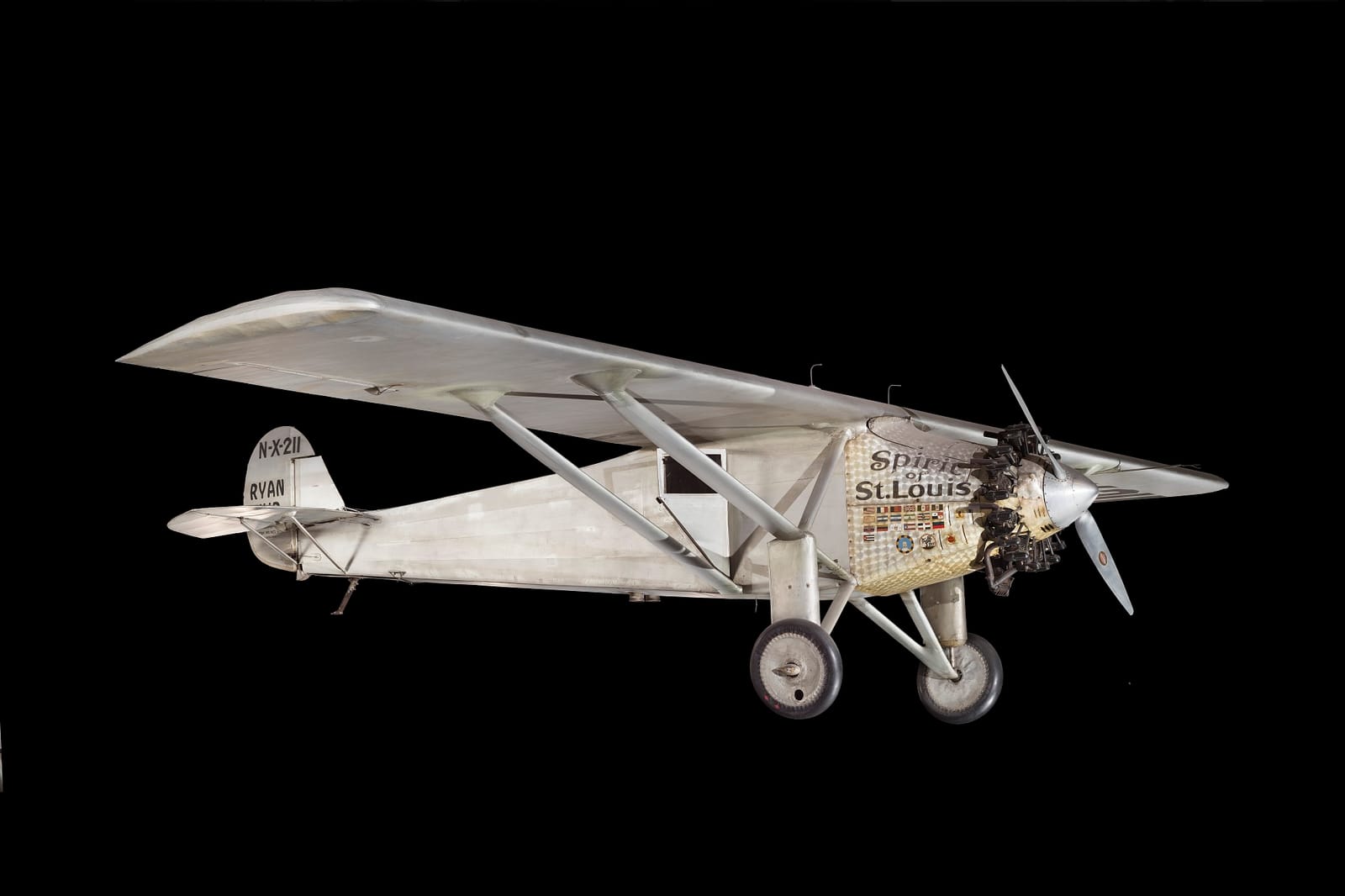
Stop 5 of 5 · Barron Hilton Pioneers of Flight, gallery 208, second floor
Spirit of St. Louis
Ryan Airlines, San Diego; designed by Donald A. Hall for Charles A. Lindbergh · 1927 · Wooden wings, welded steel-tube fuselage, cotton fabric with aluminium-coloured dope; wingspan 14 m, length 8.4 m
Look for
- No windscreen. The fuel tanks sit where it should be; Lindbergh looked ahead through a small periscope on the left side.
- The flags painted on the nose, one for each country of his 1927–28 tour. The Puerto Rican flag is wrong: it should have five stripes.
- The rudder. A winged R on the left side, a blank patch on the right, where a souvenir hunter in Paris cut the fabric away.
- The open door, left that way at Lindbergh's own request.
Transcript (2:15)
Look at the front of it and try to find where the pilot looked out. You will not find it, and neither could he. There is no windscreen. The fuel tanks sit ahead of the cockpit, and Charles Lindbergh crossed the Atlantic seeing forward only through a small periscope on the left side, or by swinging the plane round to peer out of a side window.
In 1919 a man named Raymond Orteig offered twenty-five thousand dollars to the first pilot to fly nonstop between New York City and Paris. Lindbergh was a former barnstormer who had become an airmail pilot on the run between Saint Louis and Chicago, and in February 1927, with money from a group of backers in Saint Louis, he ordered an aeroplane from Ryan Airlines in San Diego. They built it in two months. It started as an ordinary Ryan M-2 and was stretched to carry fuel: ten more feet of wing, two more feet of fuselage, the engine pushed forward and the cockpit pushed back, so that the tank sat at the centre of gravity and the pilot sat behind it, where he would be safer in a crash.
He flew it east to New York first, with a single stop in Saint Louis, and set a transcontinental record on the way, twenty-one hours and forty minutes. Then, on the morning of the twentieth of May 1927, he took off alone for Paris. Thirty-three and a half hours and 3,610 miles later he came down at Le Bourget, and a crowd of a hundred thousand people was waiting for him. There are pencil tallies inside the cockpit showing how he did it: he kept count of the fuel he drew from each tank, switching between them to keep the plane in balance.
The crowd in Paris wanted souvenirs, and took them. Look at the rudder. On the left side there is a winged letter R. On the right side there is only a blank patch, because somebody cut the fabric away.
Now look at the nose. Those flags are the countries of the tour he flew afterwards, from Washington to Mexico City and on through Central America, Colombia, Venezuela and the Caribbean. The Puerto Rican one is wrong, by the way: it should have five stripes. The two tubes under the fuselage were added for that tour, to drop flares so he could see to land at night. And the cowling is covered in signatures, pencilled or scratched with penknives by the guards and mechanics who watched over the plane wherever it went.
President Calvin Coolidge called Lindbergh a messenger of peace and goodwill who had broken down another barrier of time and space, and the museum reckons that nothing in aviation stirred the whole world as much again until Apollo 11, whose capsule you have just left. On the thirtieth of April 1928 Lindbergh flew the Spirit one last time, from Saint Louis to Washington, and gave it to the Smithsonian. Its door stands open, and it has stayed that way because he asked for it.
Independent guide · Chiaro
Point Chiaro at anything in the National Air and Space Museum.
Lindbergh's plane is the fifth stop, and most of what hangs from the ceilings here is not on our list. Photograph John Glenn's Friendship 7 capsule, Amelia Earhart's red Vega or a propeller nobody around you can name, and the app works out what it is, tells you its story and takes your questions out loud, on the spot.
Before you go
Getting there
650 Jefferson Drive SW, Washington, DC 20560, on the National Mall between the National Museum of the American Indian and the Hirshhorn. Everyone goes in through the doors on Jefferson Drive, the Mall side, where ramps on the east and west of the entrance vestibule make it step-free; the museum map marks the exit on Independence Avenue. For a taxi or rideshare, the museum suggests giving the driver 601 Independence Ave SW.
The museum sends Metrorail riders to L'Enfant Plaza, Exit A, on the Blue, Yellow, Orange, Silver and Green lines, and puts the walk from there at about ten minutes. Virginia Railway Express trains stop at L'Enfant Plaza too; MARC and Amtrak arrive at Union Station. There is no museum parking, but bike racks stand by the Jefferson Drive doors.
Tickets
- Entry costs nothing, but nobody gets in without a free timed-entry pass, children included. One person can reserve up to nine, and each month's passes go online at noon Eastern on the first day of the month two months earlier: passes for April, for example, are released on 1 February.
- The time on your pass is the earliest you can walk in, not a slot you can miss: arrive any time later that day and stay as long as you like. Leaving ends the visit, though, and coming back in needs another pass.
- Open every day from 10 am to 5:30 pm. The one day of the year it shuts is 25 December.
- Allow about 25 minutes for pass scanning and the security check. Arriving a little after the hour rather than on it tends to mean a shorter line.
- Leave selfie sticks and tripods behind. Food can come in sealed but not be eaten in the galleries; the Mars Café on the lower level serves from 11 am to 5 pm.
- The Udvar-Hazy Center in Chantilly, Virginia, home of the Enola Gay and Space Shuttle Discovery, is a separate building 40 to 90 minutes away by car, and there is no shuttle between the two.
The official audio guide
The museum's own guided option is a free highlights tour led by volunteer docents; the Welcome Center on the first floor has the day's times, along with maps. The five recordings here run whenever you press play, and for any other airframe or capsule under this roof, the Chiaro app is the one to ask.
Official site →Questions
Is there a free National Air and Space Museum audio guide?
Yes. The Wright Flyer, the X-1, the lunar module, Columbia and Lindbergh's plane each have a free recording above, which plays in any phone browser with its script printed underneath; there is nothing to install. Everything else across the eighteen open galleries is Chiaro's job: photograph a craft with the app and it names it and explains it.
How much is the official National Air and Space Museum audio guide?
What the museum offers in person is its volunteer docents, and they cost nothing: their highlights tours are free, with the day's times posted at the Welcome Center on the first floor. Getting in is free as well, with a timed-entry pass booked online, and our five recordings will not cost you anything either.
Where is the Wright Flyer in the National Air and Space Museum?
On the first floor, in The Wright Brothers & The Invention of the Aerial Age, gallery 107, which opens off the Boeing Milestones of Flight Hall you enter from Jefferson Drive. It is the original 1903 aircraft, not a replica; its fabric was renewed in 1985, cut to a pattern taken from a large piece of the 1903 covering.
Is the National Air and Space Museum closed on any day?
Just one day a year, 25 December. Every other day it runs from 10 am to 5:30 pm, and each of those days needs a free timed-entry pass, so check pass availability before anything else.
Do I need a ticket for the National Air and Space Museum?
Not a paid one, but every visitor, whatever their age, needs a free timed-entry pass for the Washington building. One person can reserve up to nine. New passes are released at noon Eastern on the first of each month, two months ahead, and extra ones can turn up later if you keep checking.
Is the Udvar-Hazy Center part of the same museum?
Same museum, different building. The Steven F. Udvar-Hazy Center is in Chantilly, Virginia, and it is where the Enola Gay and Space Shuttle Discovery are shown. No shuttle links the two; the museum puts the drive at 40 to 90 minutes and public transit at 90 to 120. This guide covers the Mall building only.
More audio guides
Made by Chiaro. Not affiliated with the National Air and Space Museum.