
Château Royal d'Amboise · Amboise · Independent guide
Château Royal d'Amboise audio guide,
five stops, free.
Perched 40 metres above the Loire where French kings brought the Italian Renaissance north — five stops stream in this tab, and Chiaro narrates any crest or carving from a photo.
Made by Chiaro. Not affiliated with the Château Royal d'Amboise.
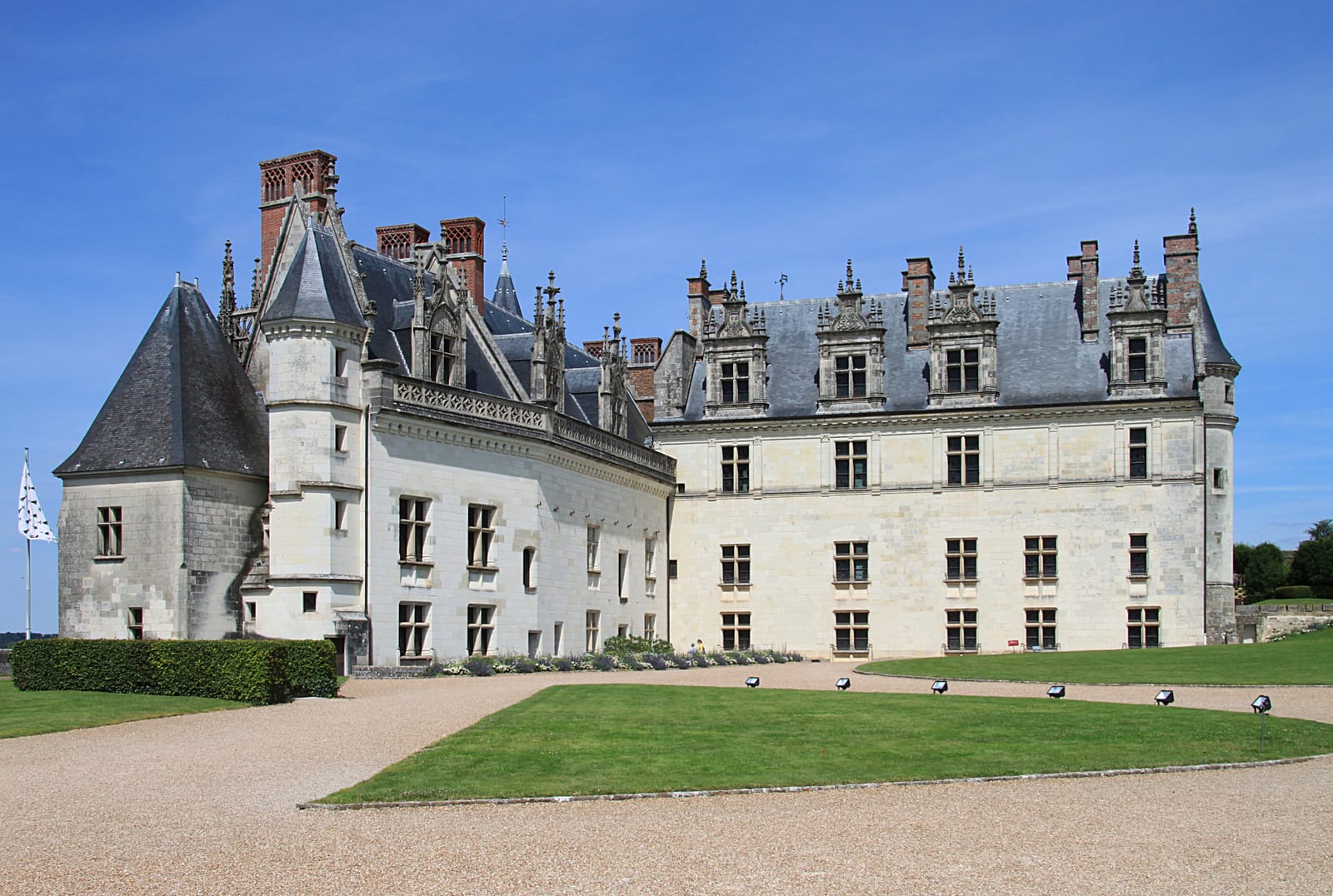
The Loire front and the river ramparts
Château Royal d'Amboise
That was the free part
Chiaro narrates anything at the Château Royal d'Amboise from a photo.
The five stops · 10 minutes of audio
Five places, one walk,
in the order you will walk them.
Our self-guided Château Royal d'Amboise audio guide starts down by the river before you buy a ticket and climbs the cliff in the order the royal fortress unfolds. Begin on the quayside or bridge looking up at the 40-metre bastion wall, walk up the sloping entrance ramp to the Chapel of Saint-Hubert and Leonardo da Vinci's tomb slab, step inside the first-floor Council Chamber of the Royal Lodge, climb to the Tour des Minimes parapet before descending its spiral horse ramp, and finish out on the two-hectare upper terrace beside the Naples garden. Audio runs to roughly ten minutes across a ninety-minute walk.
Every historical claim and practical detail here rests on documents published by the Fondation Saint-Louis at chateau-amboise.com paired with a second public reference. Rampart conservation and seasonal ticket-office schedules shift during the year: whenever a posted notice at the gate disagrees with these notes, go by the notice on site and drop us word so we can update.

Stop 1 of 5 · Riverbank and Pont du Maréchal Leclerc or Place Michel Debré below the northern ramparts, facing the cliff face before the Montée de l'Émir Abd-el-Kader entrance ramp; public and free
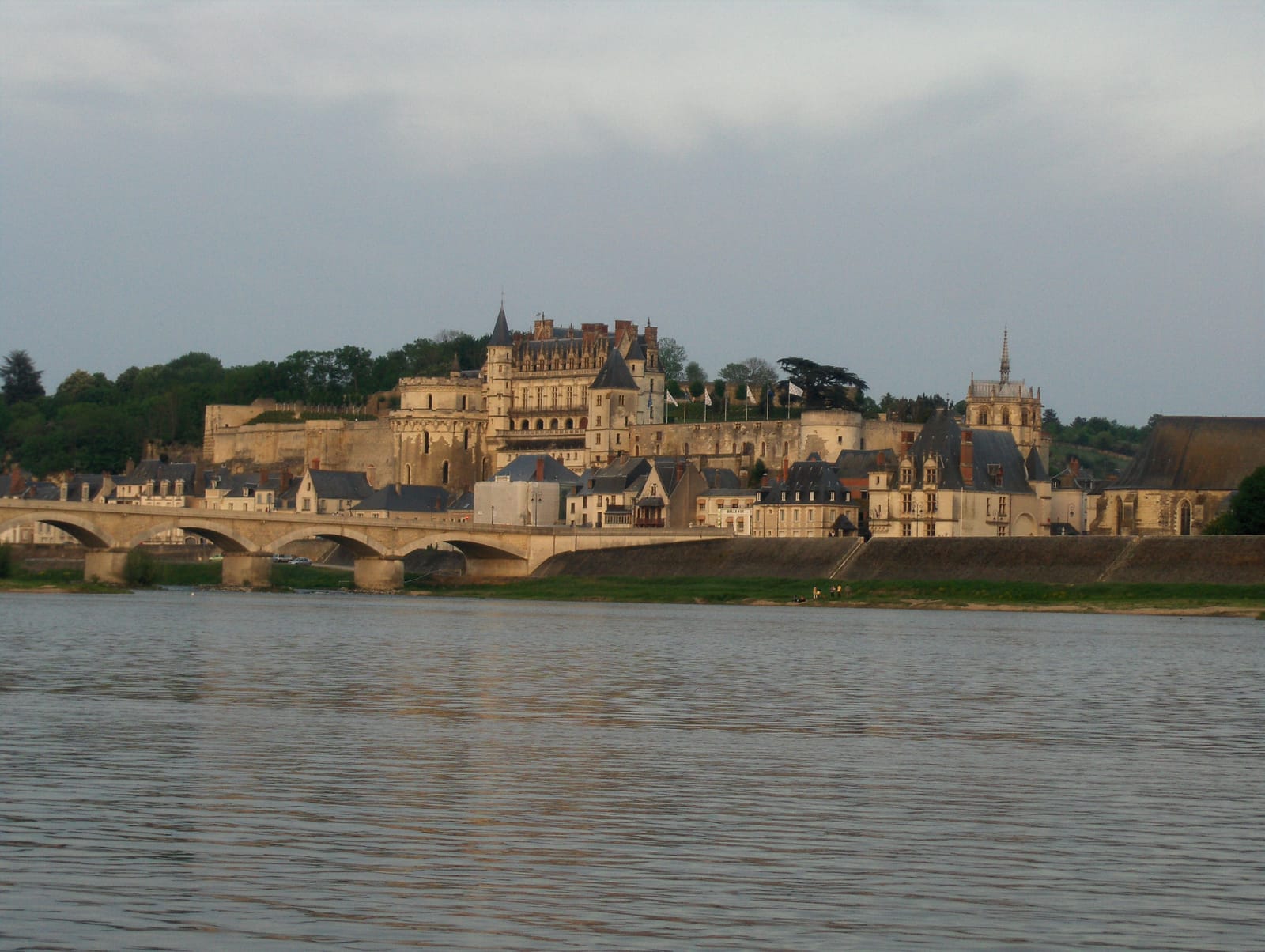
The Loire front and the river ramparts
Rebuilt for King Charles VIII (1470–1498) under bailli Raymond de Dezest and master masons Colin Biard (d. 1525), Guillaume Senault and Louis Armangeart; enlarged under Louis XII and Francis I; restored by Victor Ruprich-Robert (1820–1887) · Fortified spur from the 4th century; royal reconstruction from 1492; two-thirds demolished 1806–1810 · White Loire tuffeau limestone and brick over a rocky spur rising 40 metres above the river; surviving Royal Lodge accompanied by ramparts where two-thirds of the wider castle complex was demolished in 1806–1810
Look for
- The sheer 40-metre wall of pale tuffeau stone rising straight out of the town — cleared of 46 clinging houses by King Louis-Philippe after 1821.
- The wrought-iron balcony across the upper river front of the Royal Lodge, where Protestant conspirators were hanged in March 1560.
- Far to the right along the curtain wall, the small Chapel of Saint-Hubert thrust out on tall stone buttresses high above the slate roofs.
Transcript (2:13)
Stand by the river parapet or at the foot of the town square before climbing the ramp, and tip your head back at forty metres of pale limestone rising straight above the Loire. What looks from down here like a complete fairytale castle is actually the surviving heart of a much larger royal citadel that once covered this entire rocky spur with up to two hundred and twenty chambers.
People fortified this bluff long before French kings existed. Celtic Turones held an oppidum up there, fourth-century Romans cut defensive ditches across the neck of the cliff, and out on the island in the river behind you, the Île d'Or, Frankish king Clovis met Visigothic king Alaric the Second in 503. Amboise passed to the French Crown in 1434 after its lord, Louis d'Amboise, was caught plotting against King Charles the Seventh's court favourite and traded his castle to save his neck.
Charles the Eighth was born up on this rock in 1470. Twenty-one years later he married Duchess Anne of Brittany, decided to turn his childhood fortress into a palace worthy of Europe's greatest monarchy, and hired more than two hundred and fifty masons who worked right through winter nights by torchlight. Then, in 1494, Charles marched thirty thousand soldiers into Italy to claim the Kingdom of Naples. Militarily the campaign achieved almost nothing; culturally it changed France forever. Returning to Amboise in 1496, the young king brought Italian architects, sculptors, scholars, and gardeners up onto this terrace. Two years after that, on the seventh of April 1498, twenty-seven-year-old Charles walked with Anne to watch a game of real tennis in the castle ditch, cracked his forehead against a low stone lintel, and died within hours.
Now find the long iron balcony stretching across the river face of the main wing. In March 1560, Protestant nobles tried to kidnap sixteen-year-old King Francis the Second and his young wife Mary, Queen of Scots out of the hands of the Catholic Guise faction. The plot leaked. Captured riders were hanged straight from those iron bars over the river as a warning to the kingdom.
Why did so much of the wider fortress vanish? Napoleon handed the run-down estate to former consul Pierre-Roger Ducos, who could not afford to roof the sprawling complex and tore down two-thirds of the castle buildings for stone between 1806 and 1810 — though modern archaeological surveys show three-quarters of Charles the Eighth's core riverside residence still stands above you. Its crisp silhouette owes just as much to King Louis-Philippe, who bought and demolished forty-six town houses pressed against the cliff base after 1821 so the Valois ramparts could breathe again.

Stop 2 of 5 · Upper terrace, immediately opposite the top of the entrance ramp, cantilevered out from the southern curtain wall
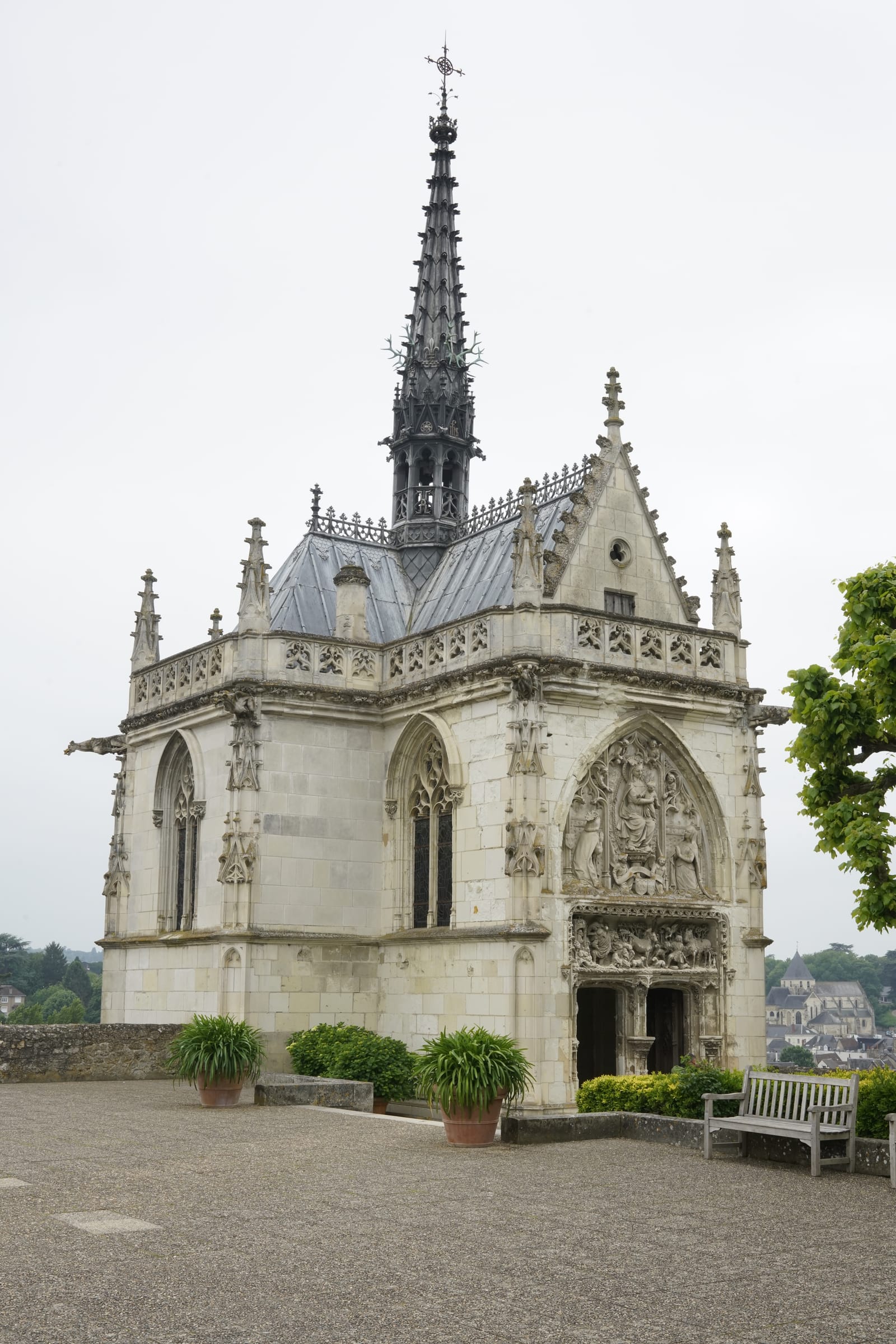
The Chapel of Saint-Hubert and Leonardo da Vinci's tomb
Built for Charles VIII (1470–1498) by Flemish sculptors and Touraine masons; 19th-century tympanum under Louis-Philippe and restoration by Victor Ruprich-Robert (1820–1887) · 1491–1496; Leonardo reburied here 1874; restored 2021–2024 · Flamboyant Gothic white tuffeau limestone with a gilded lead spire crowned by bronze stag antlers; 15 tonnes of roof lead restored in 2024
Look for
- Over the twin doors, the deeply undercut 15th-century stone lintel showing Saint Hubert dismounting before a stag carrying Christ on the cross between its antlers.
- High on the regilded lead spire, bronze stag antlers branching straight out from the Gothic metalwork.
- Inside the north arm on the left, the limestone floor slab and bronze portrait medallion marking the reburied bones attributed to Leonardo da Vinci.
Transcript (2:13)
Come out at the top of the stone ramp and stop before the small chapel balanced on the southern wall. Built between 1491 and 1496 as a private royal oratory for Charles the Eighth and Anne of Brittany, it sits half on the rock and half on tall stone piers rising from the street below. In the spring of 2024 it emerged from a two-and-a-half-year restoration that replaced nearly two thousand weathered blocks and put fresh gold leaf back onto its lead spire — look right up at that spire and you will spot a pair of bronze stag antlers glinting against the sky.
Step closer to the carved lintel over the double doorway before going in. Flemish sculptors worked the soft local chalk-stone until it looked like bone ivory. On the left, Saint Hubert, patron saint of hunters, drops to his knees beside his horse and hounds as a wild stag turns on a rocky ledge with a crucifix shining between its horns.
Inside the left transept arm lies the floor slab most visitors cross France to see: Leonardo da Vinci. Invited here in 1516 at sixty-four by young King Francis the First — who gave him the red-brick manor of Clos Lucé four hundred metres up the lane, seven hundred gold crowns a year, and the title First Painter, Engineer, and Architect to the King — Leonardo arrived on muleback with three panels in his luggage, the Mona Lisa among them. He spent his final three years drawing canal plans, staging mechanical pageants for royal weddings here at the castle in 1518, and talking philosophy with the king.
Now separate two famous myths from the archive record. Despite the nineteenth-century paintings showing Leonardo breathing his last in Francis the First's arms on the second of May 1519, royal decrees signed at Saint-Germain-en-Laye near Paris show the king was days away when his friend died. Nor was there ever a secret tunnel running from Clos Lucé straight into this fortress — archaeologists checked.
Even the grave beneath your shoes carries a detective story. Following his own will, Leonardo was buried in 1519 not in this tiny chapel, but in the larger Collegiate Church of Saint-Florentin a hundred metres across the lawn. When Senator Ducos demolished Saint-Florentin around 1807, graves were scattered and headstones sold off. In 1863 the writer Arsène Houssaye dug through the church foundations, uncovered a large skull and skeleton beside stone fragments bearing letters from Leonardus Vincius and silver coins of Francis the First, and in 1874 reburied those bones under this stone — honestly labelled as his presumed remains.

Stop 3 of 5 · Royal Lodge, first floor of the Gothic wing overlooking the Loire, entered from the Drummers' Room
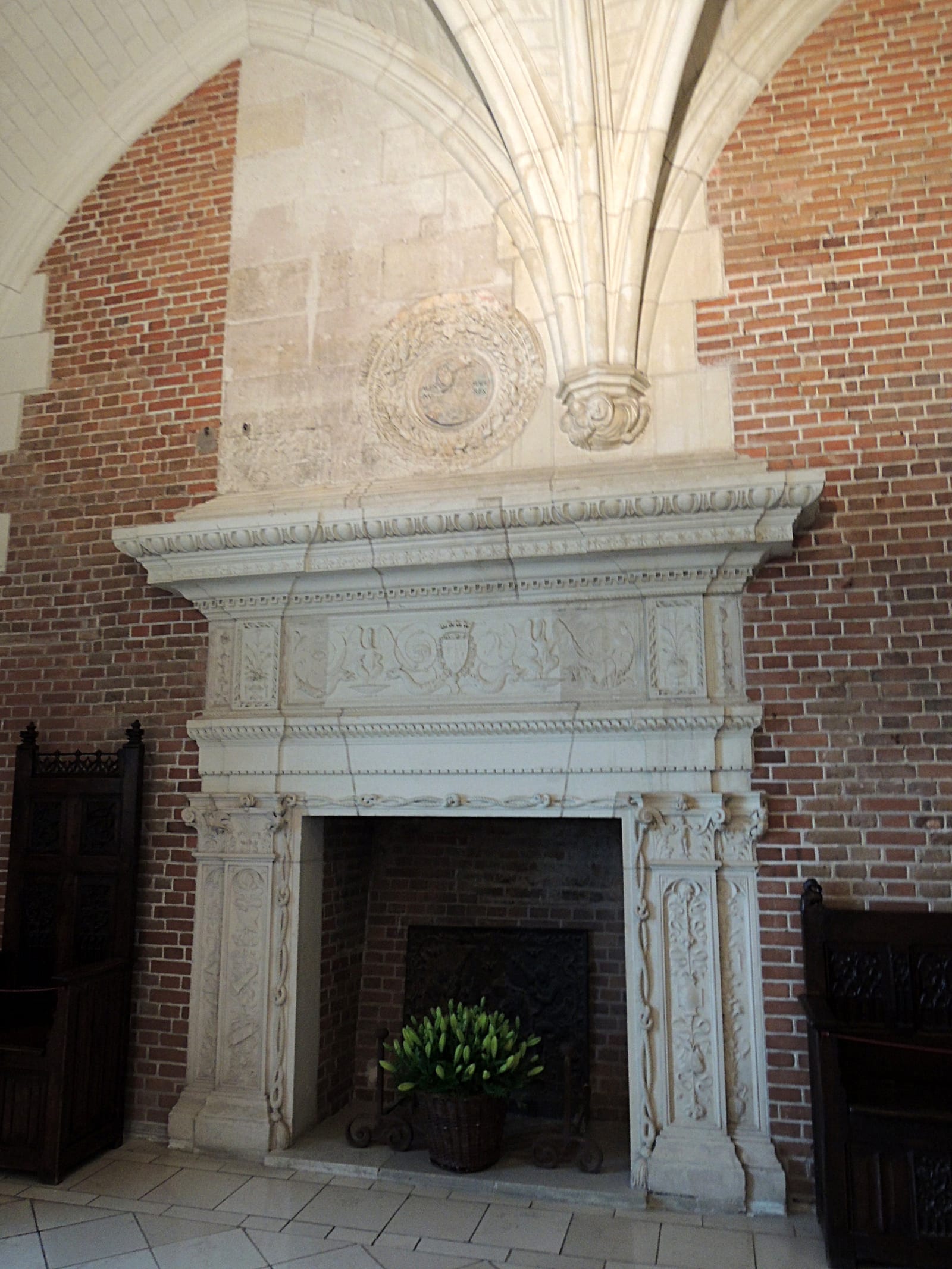
The Council Chamber
Colin Biard (d. 1525) and royal Touraine masons for Charles VIII and Anne of Brittany; Renaissance fireplace added under Louis XII and Francis I; restored under Victor Ruprich-Robert (1820–1887) · 1492–1515; restored late 19th century · Two-aisled vaulted hall of tuffeau stone and red brick carried on central carved pillars, spanning the full riverfront width of Charles VIII's Gothic wing
Look for
- The two fireplaces facing each other from opposite ends: a steep trapezoidal Gothic hood at the south-west end, and a flat Italian Renaissance entablature with Francis I's salamander medallion at the north-east end.
- The central stone columns carved in alternating vertical rows of French royal fleurs-de-lis and Anne of Brittany's ermine tails.
- Vault keystones overhead carrying intertwined C and A initials, and tall oak wall benches carved with Gothic linenfold panels.
Transcript (2:05)
Walk into the great vaulted hall on the first floor of the Royal Lodge and stand beside the central row of stone pillars. Every window on the river wall opens straight out over forty metres of air above the Loire, flooding red brick and pale limestone with reflected water light. This was the nerve centre of Valois government and ceremony, and if you turn your head from one end of the room to the other you can watch the Middle Ages hand France over to the Renaissance inside a single space.
Look first at the fireplace at the south-west end. Its tall, sloping trapezoidal hood still belongs wholly to Gothic France, carved with angels bearing the royal shield alongside Charles the Eighth's emblem of a flaming sword. Now turn round and face the fireplace at the far north-east end. The sloped Gothic chimney hood has vanished. In its place sits a crisp horizontal Italian cornice of classical mouldings and pilasters, topped by a carved round medallion holding the fire-breathing salamander of Francis the First.
Step up to the stone columns dividing the room down its spine. Each shaft is diapered from base to capital with two alternating symbols: the three-petalled fleur-de-lis of the Kingdom of France, and the stylized black-tipped ermine tail of the independent Duchy of Brittany. Overhead on the vault bosses, Charles's letter C twines with Anne of Brittany's crowned A. Keeping Brittany tied to France was the obsession of two reigns: when Charles died after hitting his head in 1498 without a surviving child, twenty-one-year-old Anne was bound by her marriage treaty to wed his cousin and successor, Louis the Twelfth, right away.
Anne transformed life in halls like this one. Where medieval kings had travelled with male households while noblewomen stayed on distant estates, Anne gathered roughly a hundred ladies from great families permanently around her, turning the royal court into a mixed society of music, politics, and patronage.
Darker politics walked through these doors a generation later. On the night of the seventeenth of October 1534, Protestant broadsheets attacking the Catholic Mass were pinned across France — including straight onto the door of King Francis the First's bedchamber here at Amboise. Outraged, the king abandoned religious compromise. Twenty-six years later those tensions erupted in the failed Protestant raid outside these windows, and three years after that, in March 1563, Queen Mother Catherine de' Medici sat at Amboise to sign a fragile truce ending the first War of Religion.

Stop 4 of 5 · North-west corner of the Royal Lodge: entered at the panoramic roof terrace 40 metres above the Loire, then walked downwards along the spiral horse ramp to the exit
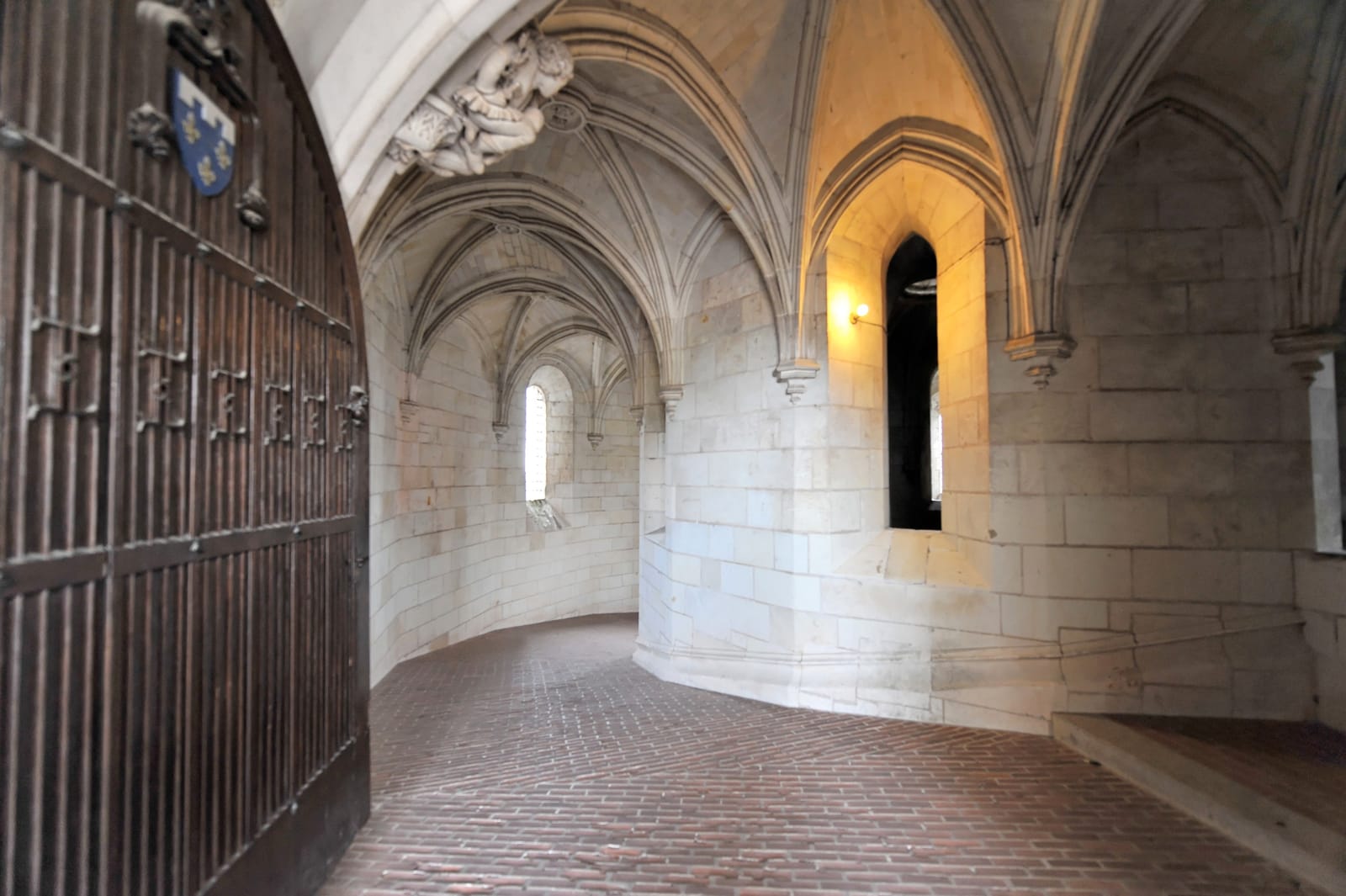
The Tour des Minimes and its horse ramp
Colin Biard (d. 1525), Guillaume Senault and Louis Armangeart under Raymond de Dezest for Charles VIII; upper parapet restored late 19th century by Victor Ruprich-Robert (1820–1887) · Begun c. 1493–1498; upper terrace restored late 19th century · Cylindrical tuffeau limestone cavalier tower roughly 21 metres in diameter rising 40 metres from the foot of the river cliff, enclosing a brick-paved helical ramp under Gothic rib vaults
Look for
- From the open roof platform before descending, the 360-degree view 40 metres straight above the Loire, the Île d'Or, and the slate roofs of Amboise.
- Underfoot inside the spiral tunnel, red bricks laid on edge in a herringbone pattern so iron horseshoes could grip the slope.
- Carved stone corbels along the outer wall where Touraine masons tucked grotesques and figures under the springing of the Gothic vault ribs.
Transcript (2:02)
Step out onto the circular stone roof of the Tour des Minimes for the widest river view in Amboise, forty metres straight above the Loire, and then head down into the dim, echoing tube underneath your feet. There are no steps here. You are walking down a road coiled inside a tower twenty-one metres wide.
When Charles the Eighth set out to rebuild Amboise in the 1490s, his architects faced an awkward problem: the palace sat atop a sheer cliff, cut off from the streets and river wharves below. Their solution — built twice, here on the river front and even wider at twenty-four metres in the Heurtault Tower across the garden — astonished every foreign ambassador who visited. Around a thick hollow core of dressed limestone, masons vaulted a gentle spiral ramp paved with red bricks set on edge in herringbone rows so horses' hooves and heavy supply carts would not skid.
In December 1539, Francis the First decided to show off that engineering by leading his rival, Holy Roman Emperor Charles the Fifth, up the sister horse tower at night between double ranks of torchbearers. Halfway up the spiral, a careless flame caught the rich wall hangings draped along the masonry. Smoke choked the chimney-like shaft, horses panicked, and the most powerful ruler in Christendom very nearly suffocated before scrambling onto the terrace.
Centuries later, long after the Valois court had moved to Paris, the roof platform you just stood on witnessed a very different scene. Between 1848 and 1852, Amboise served as the prison of Emir Abd el-Kader, the scholar and commander who had led Algerian resistance for fifteen years before surrendering on a French promise of passage to the East — a promise Paris broke, locking him up here with nearly a hundred relatives and companions through four damp winters that killed twenty-five of his household.
On the sixteenth of October 1852, Prince-President Louis-Napoléon Bonaparte — weeks away from proclaiming himself Emperor Napoleon the Third — climbed into a glazed saloon that then crowned this very tower and told Abd el-Kader face to face that France would honour its word and set him free. Eight years later in Damascus, when sectarian mobs attacked the city's Christian quarter in July 1860, the exiled Emir sheltered thousands of Christians inside his own compound, turning his former captors into lifelong admirers and leaving his name on the street ramp outside this castle.

Stop 5 of 5 · Upper terrace lawn east of the Royal Logis, looking back at the junction of the Gothic and Renaissance wings beside the Terrasse de Naples
The two wings of the Royal Logis and the Naples Terrace
Gothic wing by Colin Biard (d. 1525) for Charles VIII; Renaissance wing begun under Louis XII and raised under Francis I with Domenico da Cortona (c. 1465–1549); gardens first laid out by Dom Pacello da Mercogliano (c. 1453–1534) and reshaped under the Duc de Penthièvre and Louis-Philippe · Logis wings 1492–c. 1520; Naples garden from 1496; landscape park 18th–19th centuries · Tuffeau stone L-shaped palace facade facing just over 2 hectares of walled upper-terrace gardens perched above the Loire and the town
Look for
- Compare the dormer windows along the two joined wings of the Royal Lodge: lacy Gothic pinnacles on the left wing, flat Italian Renaissance pilasters and shell pediments on the right.
- Along the northern river parapet of the Terrasse de Naples, the stone belvedere bays opened toward the Loire landscape at the end of the fifteenth century.
- Across the two-hectare lawns to the south, the massive round drum of the Heurtault Tower and the distant silhouette of the 18th-century Pagoda of Chanteloup above the forest.
Transcript (1:56)
Walk out onto the gravel paths facing the courtyard side of the palace and look north toward the L-shaped front of the Royal Lodge. From this lawn, two hectares of sky-high garden open around you, and the two stone wings meeting at right angles in front of you read like an open textbook of French architecture.
Look at the left-hand wing first, running parallel to the river. Charles the Eighth raised it in the 1490s, and its steeply pitched slate roof still bristles with Flamboyant Gothic dormers, spiky stone crockets, and openwork tracery. Now shift your eyes right, to the perpendicular wing begun by his cousin Louis the Twelfth and heightened after 1515 by young Francis the First, who had grown up here from the age of four under his mother Louise of Savoy. Gone are the vertical Gothic needles. The dormers sit framed between classical pilasters and shell-like Italian pediments, among the earliest built anywhere in the Loire Valley.
Step toward the river wall along the cliff edge, signed as the Naples Terrace. Among the Italian specialists Charles the Eighth brought north from Naples in 1496 was a Benedictine monk and master gardener named Dom Pacello da Mercogliano. Medieval castle gardens had always turned inward behind blind walls to shut out a dangerous world. Pacello did the opposite: he laid out geometric beds of herbs and trained fruit trees right along the cliff top and cut three stone belvedere openings into the parapet so courtiers strolling after dinner could gaze straight out across the Loire.
Across this broad plateau in the spring of 1518, Francis the First staged weeks of jousts, masquerades, and a mock battle around a timber fortress for thousands of guests celebrating a Medici wedding, with Leonardo da Vinci engineering theatrical devices for the court. Almost all of the surrounding buildings that framed those tournaments — Henry the Second's outer wing, the Queens' Lodge of the Seven Virtues to the south, and the Collegiate Church of Saint-Florentin where Leonardo was first laid to rest in 1519 — vanished under First Empire demolition picks.
What replaced them, shaped under the eighteenth-century Duke of Penthièvre and King Louis-Philippe and cared for since 1975 by the Fondation Saint-Louis, is the quiet park of clipped boxwood domes, cedars, and holm oaks around you: a suspended balcony between river and sky.
Independent guide · Chiaro
Point Chiaro at anything at the Château Royal d'Amboise.
Five stops trace the main spine from the river wall to the Naples Terrace, leaving carved salamanders, royal coats of arms, and three levels of furnished Valois and Orléans chambers along the way. Aim your phone camera at any fireplace crest, tapestry, or tower bastion and Chiaro explains who put it there and answers your questions aloud.
Before you go
Getting there
Montée de l'Émir Abd-el-Kader, 37400 Amboise. Pedestrian entry climbs the sloping walkway starting on Place Michel Debré in the town centre, directly opposite Pâtisserie Bigot (our first stop works from the riverfront and square below before you climb). Visitors with reduced mobility or wheelchairs must instead enter by car via the dedicated private gate at the end of Rue Augustin Thierry, accompanied by an able-bodied companion and official disability documentation (that gate cannot be reached on foot).
Amboise railway station sits on the north bank, a flat 10-minute walk across the Loire bridges from the entrance ramp, with direct regional trains from Paris Austerlitz, Orléans, and Tours. High-speed TGV trains from Paris Montparnasse stop at Tours–Saint-Pierre-des-Corps, 20 kilometres west, with connecting TER shuttles to Amboise.
Tickets and entry
- The château opens every day of the year except 25 December and 1 January, with continuous hours in spring, summer (9 am to 7 pm from 3 July to 31 August), and Christmas school holidays, and a midday ticket-office break from 12:30 pm to 2 pm in November, early December, January, and early February; published closing times apply to the ticket desk, and the grounds stay open 45 minutes longer.
- One standard ticket (17.30 euros adult in 2026, 14.40 euros student, 11.00 euros ages 7 to 18, free under 7) covers the Royal Lodge, the restored Chapel of Saint-Hubert, and the gardens. Keep your train or coach stub: presenting an SNCF train or Rémi coach ticket dated within the past 3 days qualifies for a reduced rate at the ticket desk, while combined passes with Clos Lucé or Chenonceau must be bought online in advance.
- Paid lockers for suitcases, backpacks, and e-bike batteries sit on the approach ramp at 9 Montée de l'Émir Abd-el-Kader before the ticket office, and pushchairs must be parked on the ground-floor Guards' Walk rather than carried upstairs.
- Inside the upper terrace (reached by car via the Rue Augustin Thierry PRM gate with disability proof and an able-bodied companion), the ground and first floors of the Royal Lodge, the Chapel of Saint-Hubert, and the main gardens are wheelchair accessible, while the second-floor 19th-century rooms are stairs-only and the south-eastern Oriental Garden is closed during rampart stabilization works.
The official audio guide
Amboise includes both its 16-language printed visitor booklet and a 12-language HistoPad tablet (with 90-minute Classic and 45-minute Express circuits for adults and children over 7) at no extra charge inside the admission ticket, though busy afternoons can limit distribution to one tablet per family. This page gives you five narrated stops on your own phone — starting down by the river before the ticket desk — with full written scripts beneath every player.
Official site →Questions
Is there a free Château Royal d'Amboise audio guide?
Yes — the five stops on this page play free in any mobile browser with full text scripts underneath and no app or registration required. Inside the monument, the Fondation Saint-Louis also includes a free 12-language HistoPad tablet and a 16-language printed guide with every admission ticket, while the Chiaro app can narrate any other carving or portrait from a photo.
Can I listen to the Château Royal d'Amboise audio guide without a ticket?
Our opening stop is designed for the public riverfront, the Marshal Leclerc bridge, and Place Michel Debré at the foot of the cliff before you climb to the ticket desk. Reaching the Chapel of Saint-Hubert, the Council Chamber, the Tour des Minimes ramp, and the upper gardens requires a standard admission ticket.
How much is the official Château Royal d'Amboise audio guide?
Nothing extra: the HistoPad tablet (offering a 90-minute Classic route and a 45-minute Express route in 12 languages for adults and children over 7) is included in the standard 17.30-euro adult ticket. On peak crowd days the desk may hand out one tablet per family.
Where is Leonardo da Vinci's tomb at Amboise?
Inside the north arm of the Flamboyant Gothic Chapel of Saint-Hubert, perched on the southern rampart directly opposite the top of the entrance walkway and reopened in spring 2024 after major restoration. Leonardo was buried in 1519 in the castle's Collegiate Church of Saint-Florentin; after that church was demolished in the early nineteenth century, excavated remains attributed to him were reburied here in 1874.
When is the Château Royal d'Amboise closed?
Only two days a year: 25 December and 1 January. Outside Christmas school holidays, winter schedules in November, early December, January, and early February close the ticket office over lunch between 12:30 pm and 2 pm, whereas spring and summer hours run continuously; check chateau-amboise.com for your exact date, and remember the grounds clear 45 minutes after the ticket desk shuts.
More audio guides
Made by Chiaro. Not affiliated with the Château Royal d'Amboise.