
Musée Jacquemart-André · Paris · Independent guide
Musée Jacquemart-André audio guide,
five stops, free.
Five recordings, from the Library to the Italian Museum, playing in this tab. Everything else the Andrés packed into their house on the Boulevard Haussmann, Chiaro can narrate from a photo.
Made by Chiaro. Not affiliated with the Musée Jacquemart-André.
The Supper at Emmaus
Musée Jacquemart-André, Paris
That was the free part
Chiaro narrates any work in the Musée Jacquemart-André from a photo.
The five stops · 9 minutes of audio
Five stops, one walk,
in the order you will walk them.
The double spiral staircase is the hinge of this Musée Jacquemart-André audio guide, five works in one mansion. You start in the Library with Rembrandt, climb the staircase to Tiepolo's fresco at the top and Bernini's bronze pope in the Musicians' Gallery, then cross the Italian Museum from Uccello in the Florentine Gallery to Mantegna in the Venetian Gallery, its last room. All told, the audio lasts about nine minutes. Rooms here sit close together, so the legs do little work; give the five stops some forty minutes if you like to linger.
Each claim below comes from the notes the museum publishes on its own works, read alongside a second reference wherever one exists, and where the two disagree we went with the evidence; the rooms were confirmed on 25 September 2026. Nélie Jacquemart's will fixed where each work should hang, but pictures still travel for exhibitions: if the room tells a different story, the room is right, and a line to us fixes the page.

Stop 1 of 5 · The Library, wall in front when entering
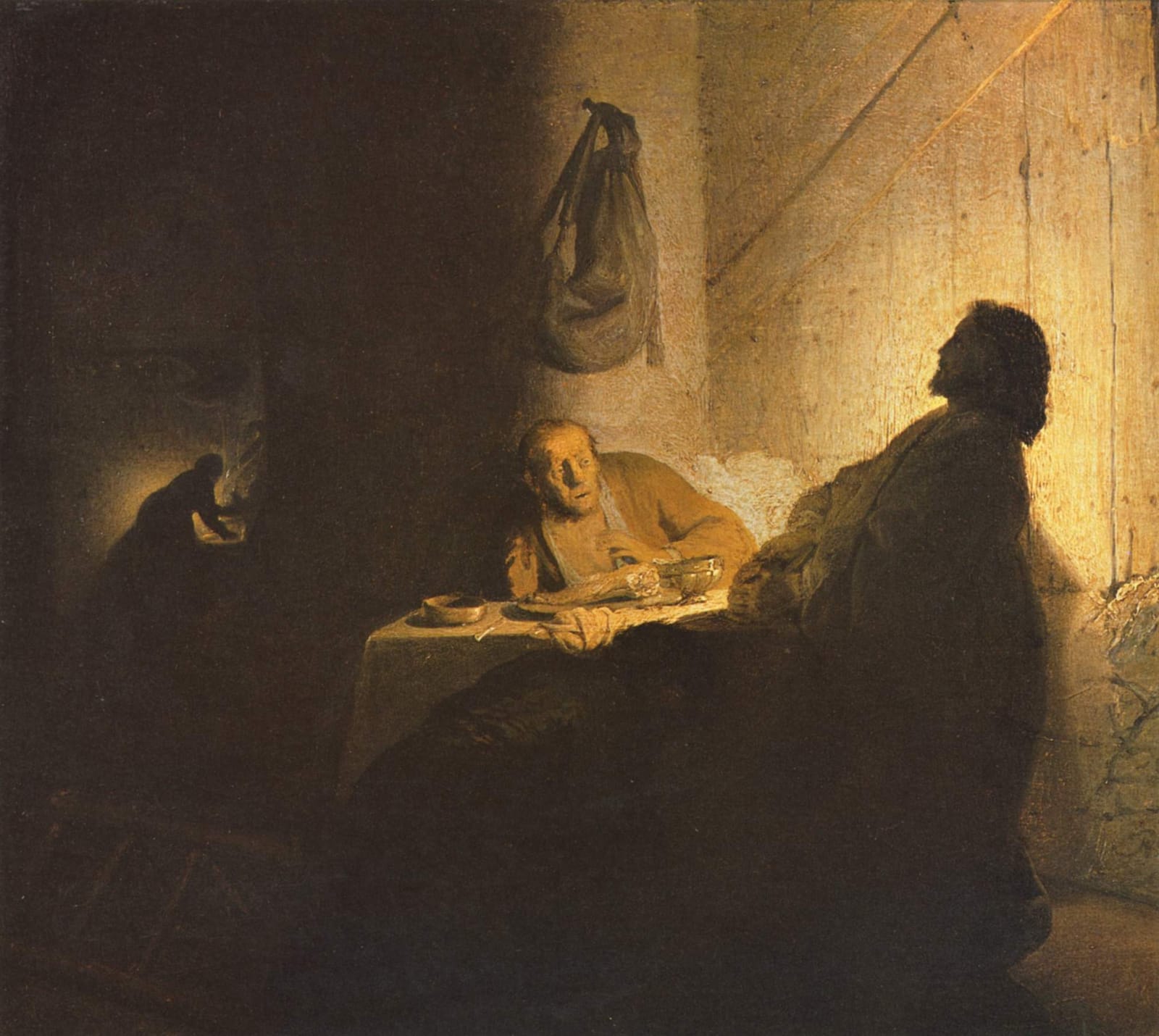
The Supper at Emmaus
Rembrandt · About 1628 · Oil on wood panel, 39 × 42 cm
Look for
- Christ himself, a dark profile on the right. The light source is hidden behind him, so the most important figure in the picture is a shadow.
- The second disciple, easy to miss: he has knocked his chair over and dropped to his knees at Christ's feet, almost lost in the dark.
- The servant at the back on the left, busy with her own small light. Take away the miracle and this is an evening in an inn.
- The size. Thirty-nine by forty-two centimetres; the Andrés' most precious Rembrandt is a small panel.
Transcript (2:14)
You are in the most private room of the house. Before it held books, this was Nélie Jacquemart's bedroom, and later she and her husband Edouard André came in here to go through auction catalogues and decide what to buy next. Of everything on these walls, the museum calls the little panel in front of you truly priceless. It is thirty-nine centimetres by forty-two. You could carry it under one arm.
The story comes from the Gospel of Luke. After the crucifixion, two disciples on the road to Emmaus fall in with a stranger and ask him to eat with them. At the table they suddenly recognise him as the risen Christ, and then he vanishes from their sight. Painters had shown that supper many times. Rembrandt, around 1628, when he was about twenty-two, found a new way to do it.
Look at the right side of the panel. Christ is there, in the foreground, and you cannot see his face. The light source is hidden behind him, so he becomes a dark profile against a glowing wall, and the light seems to come out of him rather than fall on him. The museum connects the effect to Caravaggio and his followers, chiaroscuro pushed as far as it will go. The daring part is letting the central figure of the story be a shadow.
Now the two disciples. One sits at the table staring at him, lit full in the face, frightened. The other you may miss altogether. He has knocked his chair over and dropped to his knees at Christ's feet, and the dark has almost swallowed him. Then look to the far left, into the back room. A servant is busy by her own small light, getting on with her work. Take the miracle away and this is an ordinary evening at an inn, which is how the museum describes it too.
Rembrandt came back to this subject again and again. The Louvre owns another Supper at Emmaus by him, calm and symmetrical, built around a central axis like a history painting. The museum's verdict is that no other version reached the perfection of this early one.
It came here by a long road. Willem Six owned it in Amsterdam until 1734; after him came collectors in Brussels, Paris and Vienna, until the dealer Charles Sedelmeyer sold it to Edouard André. It was not the first Rembrandt the Andrés owned: Edouard had bought a portrait by him, of a Doctor Tholinx, back in 1865, and this small scene joined it later. In 2019 it travelled to Milan and hung at the Brera beside Caravaggio's own Supper at Emmaus, the painter whose light it had borrowed. Then it came back here, to the room where the Andrés sat reading sale catalogues.

Stop 2 of 5 · The Staircase
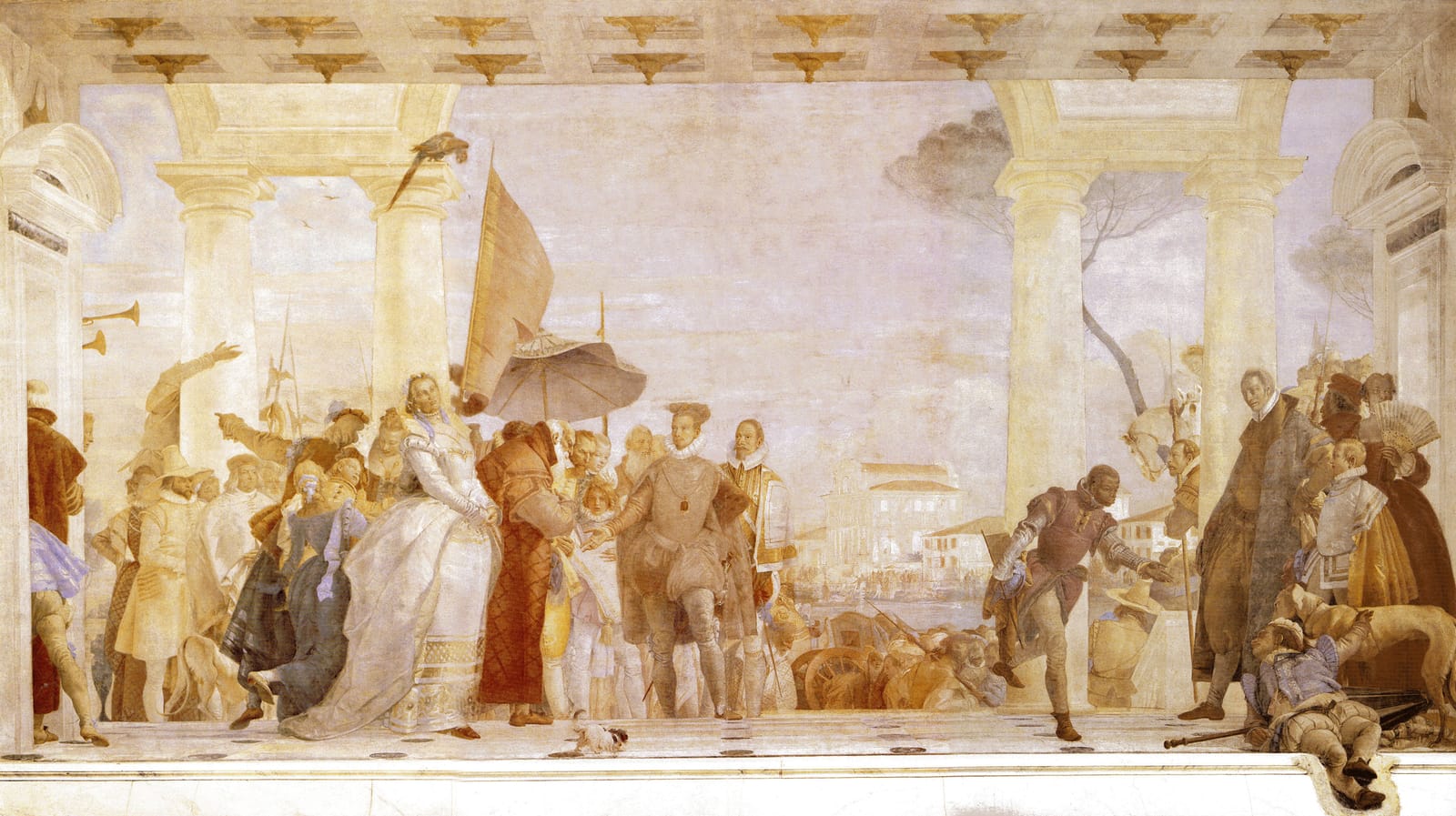
Henri III Being Welcomed to the Contarini Villa
Giambattista Tiepolo · About 1745 · Fresco mounted on canvas, 7.29 × 4.02 m
Look for
- The young man in the foreground, thrown back, with his legs hanging out over the painted frame. It is Tiepolo's trompe-l'oeil trick to push the scene into your space.
- The painted architecture: arcades and columns of an open gallery that the wall does not really have.
- The steps. The fresco shows a French king climbing up to a villa, which is why the Andrés put it at the top of a staircase.
Transcript (1:58)
Stop at the top of the stairs and turn to the wall. The staircase you have just climbed is the architectural surprise of the house: a double spiral of marble, stone, iron and bronze, and it sits at the far end of the apartments instead of in the middle, where you would expect it. The painting above it was chosen for this exact spot.
Giambattista Tiepolo painted it for the Villa Contarini, a country house in the Veneto, around 1745 by the museum's dating. It records a real visit, in 1574. Henri the Third, son of Catherine de' Medici, was on his way back from Poland to succeed his brother Charles the Ninth as king of France, and on the road to Paris he stopped at the villa of the Contarini family on his way into Venice. Tiepolo sets the meeting in a spacious gallery of painted arcades and columns, with the household of the villa pressing forward to greet the king and his retinue.
Now find the young man in the foreground. He is thrown back, and his legs hang out over the edge of the painted frame, into the space where you are standing. That is Tiepolo enjoying himself, a trompe-l'oeil joke that turns a flat wall into a balcony.
Edouard André and Nélie Jacquemart found the fresco in 1893, on one of their trips to Italy, and bought it together with a painted ceiling from the same villa. Taking a fresco off a wall in the Veneto and putting it back up on a wall in Paris is slow work. Removing, moving and reinstalling the two took eight months, from May 1893 to January 1894. Edouard died in 1894, soon after it was finished.
They put it at the top of the stairway for a reason you can see: the fresco shows a French king walking up the steps of a villa, and you have just walked up these. In 1896 the Gazette des Beaux-Arts said that no Tiepolo could be closer to French hearts, the last great Venetian painter on an episode of French history. The ceiling that came with it went into the dining room, which is now the restaurant, so lunch there is served under the other half of the purchase.
The colours are fresher than they were a few years ago. From the autumn of 2023, a year of works restored this fresco along with the marble and the bronze of the staircase you have just come up.
Sailko, CC BY 3.0, via Wikimedia Commons. Photo: Sailko
_01.jpg)
Stop 3 of 5 · Musicians' Gallery, street side
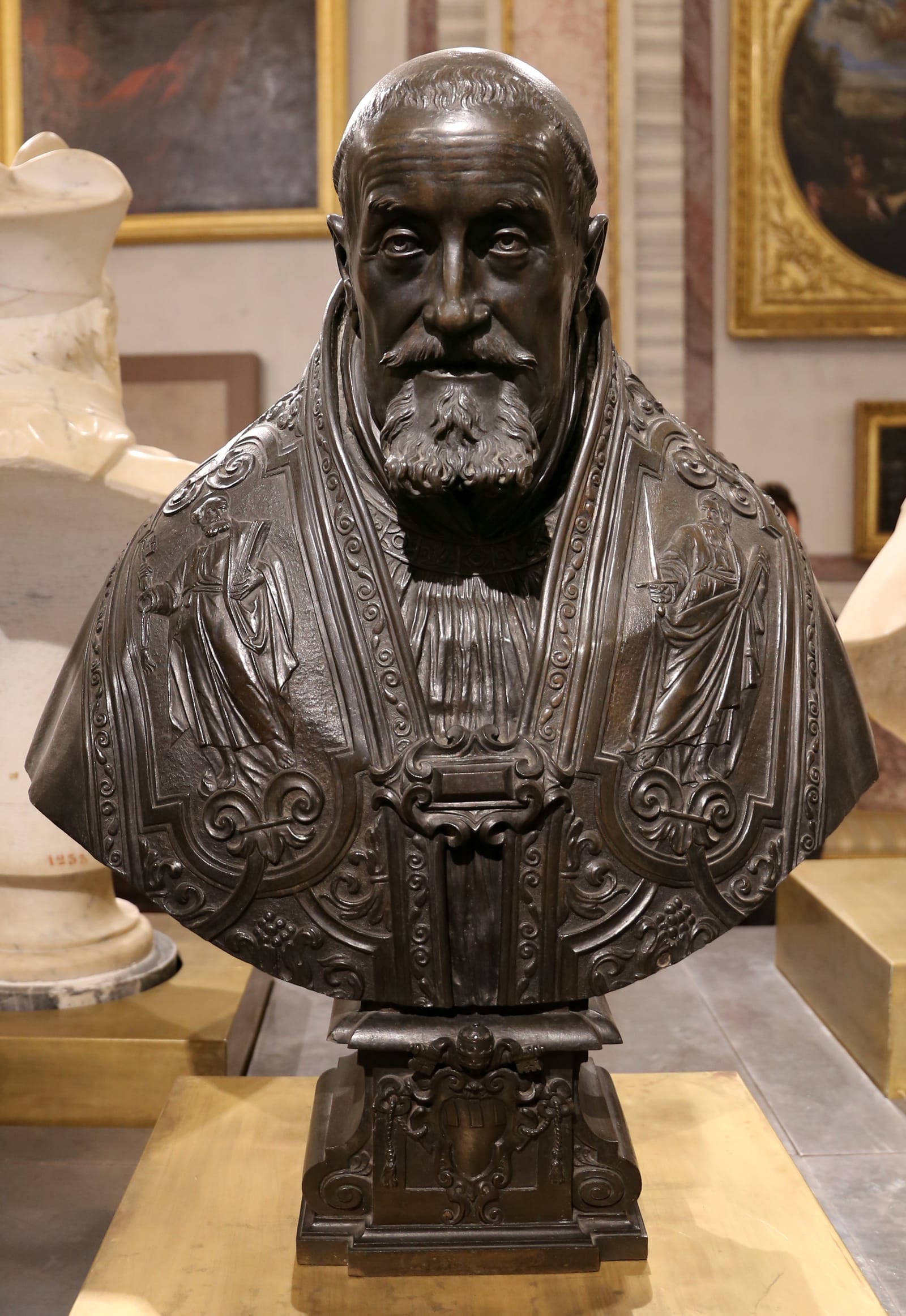
Bust of Pope Gregory XV
Gian Lorenzo Bernini · 1622 · Bronze, 78 × 66 cm
Look for
- The base. Of all the casts of this bust, this is the only one whose socle carries coats of arms.
- Saint Peter and Saint Paul, one on each side of the cope, the pope's protectors worked into the embroidery.
- The head sunk low in the collar, so that the whole bust makes a triangle: an old man weighed down by his own vestments.
Transcript (1:49)
Few people come to the Boulevard Haussmann expecting Bernini, the man his own century thought its greatest artist, who worked in Rome for one pope after another. Yet here he is, in bronze. The man is Pope Gregory the Fifteenth, and the bust is one of the rare seventeenth-century pieces that Nélie Jacquemart ever bought. Her heart was in the Renaissance, but she knew quality when she met it, and in 1899 she bought this at a Stefano Bardini auction in London.
Gregory the Fifteenth was born Alessandro Ludovisi, in Bologna, and he was pope for barely two and a half years, from February 1621 until he died in July 1623. Bernini started a marble portrait of him straight after the election and had it finished by September. Bronze casts followed. The marble is in Toronto now, at the Art Gallery of Ontario. What you are looking at is a cast after it, and for a long time that made it look like a lesser thing. The museum says recent research has turned that round: this may be the very first cast, finished with Bernini's own chisel for an important Roman collector, and it now counts as a major work.
He worked fast because he recycled. The cope, the heavy ceremonial cloak, is borrowed almost whole from a bust he had made in 1618 of the previous pope, Paul the Fifth. He changed the clasp, and he changed the two little figures on either side. Look at them now: Saint Peter on one flank, Saint Paul on the other, the pope's protectors, set into the embroidery. Then look at the head, sunk low into the collar, so the whole bust becomes a triangle. It is a sickly man of sixty-seven, bowed under the weight of his office, with eyes that are still wide awake.
The portrait paid off handsomely. On the thirtieth of June 1621 this pope made Bernini a knight of the Order of Christ, with a salary for life. He was twenty-two. From then on Rome called him Il Cavaliere, the Knight.
Before you move on, look down at the base. Of all the casts of this bust, this is the only one whose socle carries coats of arms.

Stop 4 of 5 · The Florentine Gallery, right wall when entering
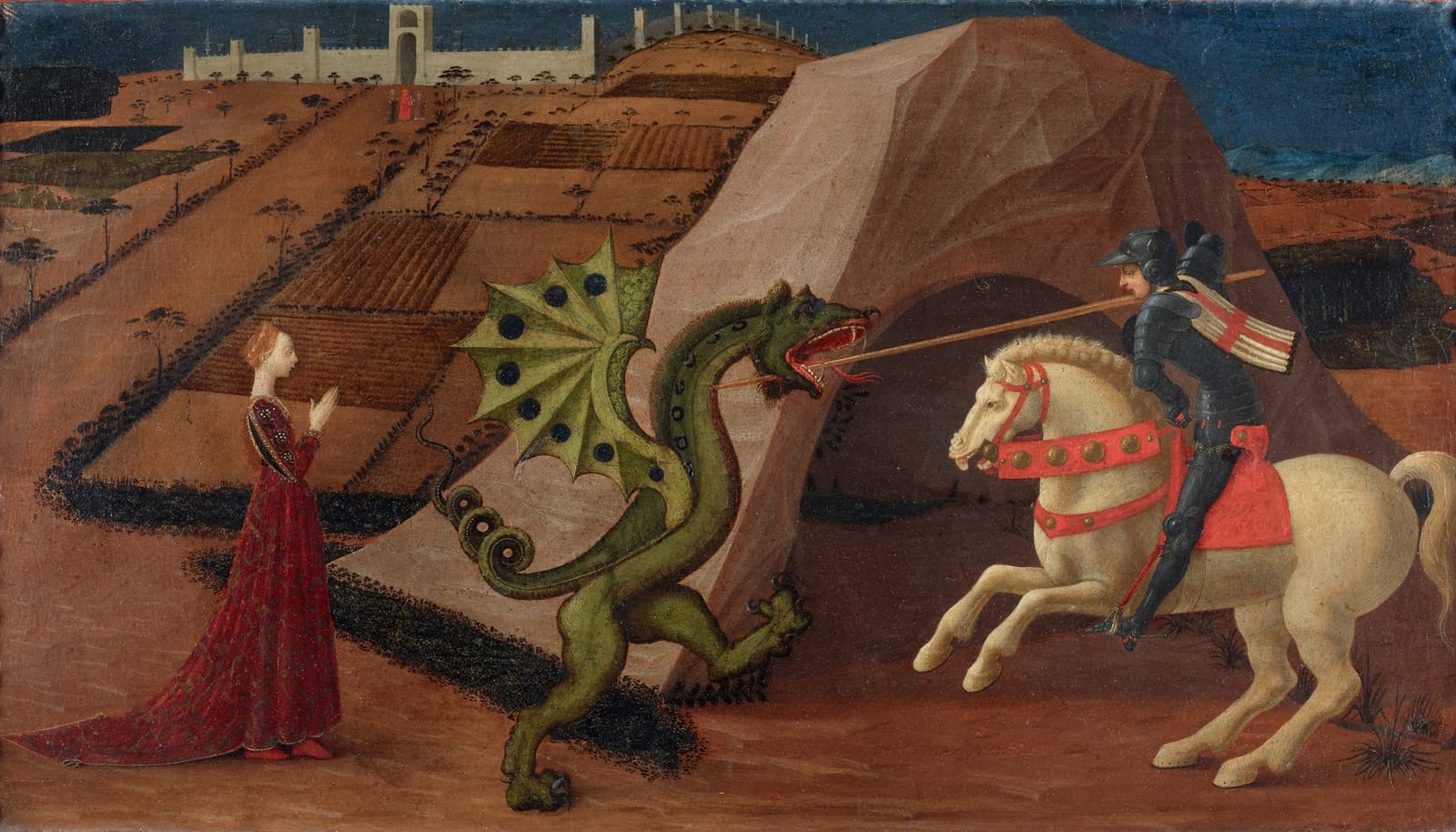
Saint George and the Dragon
Paolo Uccello · 1430–1435 · Painted wood panel
Look for
- The cave in the middle. It splits the landscape in two, and each half has its own vanishing point.
- The dragon, green and curling, drawn like a creature off a Gothic coat of arms.
- The princess on the left, a flat outline in red, like a figure on a medallion, against fields laid out in perspective behind her.
Transcript (1:43)
Nélie Jacquemart arranged this room as a private chapel of sorts, with choir stalls, an altarpiece and a funerary monument, and hung it with the Florentine paintings she loved most, Virgins by Botticelli and by Perugino among them. The museum is still clear about which picture here matters most. On the right wall as you come in is the painting it has long called the rarest work in its Italian collection, and its masterpiece.
Paolo Uccello painted it between 1430 and 1435. The subject is the old legend. A dragon is about to devour a king's daughter, and Saint George rides in and runs it through with his lance. The story came from the East, and Christians took it over as an image of the Church set free from paganism.
What makes this panel strange is that it is two pictures at once. The figures belong to the Gothic world of banners and heraldry. The princess on the left is a flat outline, like a figure stamped on a medallion. The dragon, green and coiling, looks as though it has climbed down off a coat of arms. But look behind them. The fields and hills are laid out in perspective, the modern half of the picture. And the great cave in the middle splits that landscape in two, each half with its own vanishing point and its own distance. The museum calls that complexity typical of Uccello: an old story staged in front of a very new way of building space.
If you know the Saint George in the National Gallery in London, this one came first. The London picture was painted around 1470, and this is the earlier and quieter of the two.
Nélie Jacquemart first saw it in Florence, in the palace of her favourite antiques dealer. She wanted it, and she could not have it, because the painting was not allowed to leave Italy. So she waited. It came up at auction in London in 1899, and she bought it there, the same year and in the same city where she bought the Bernini you have just passed. The museum's masterpiece reached Paris by way of a London saleroom.
.jpg)
Stop 5 of 5 · The Venetian Gallery, left wall when entering
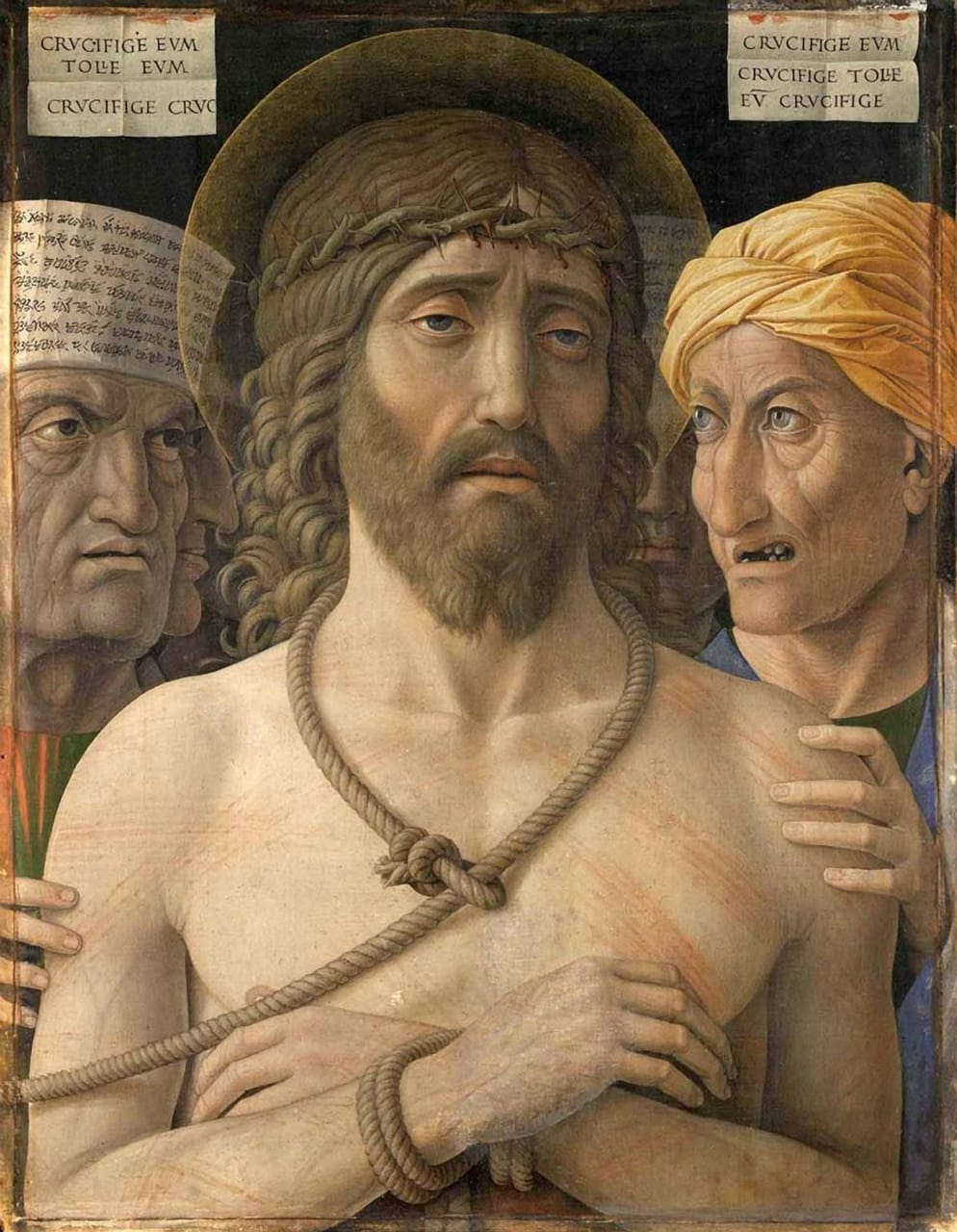
Ecce Homo
Andrea Mantegna · About 1500 · Oil on canvas, 54 × 42 cm
Look for
- The two paper labels at the top corners, painted as if pinned up: Crucifige eum, tolle eum. Crucify him, take him away.
- The halo. It is transparent; you can see the dark background straight through it.
- The rope looped round his neck and knotted at the front, and the tied wrists crossed over his chest.
- The old face in the orange turban on the right, mouth open, one hand gripping his shoulder.
Transcript (1:47)
This is the last room of the Italian Museum, and the one that owes most to Edouard André's own taste. When every collector around him wanted Florence, he wanted Venice and the north of Italy, and the room is full of it: Bellini, Crivelli, Carpaccio. On the left wall as you come in hangs a small, hard painting by Andrea Mantegna.
Ecce Homo means Behold the man. They are Pilate's words as he shows the tortured Christ to the crowd. Mantegna painted this around 1500, late in his life; he died in 1506. Look how close he brings you. Christ fills the canvas, half-length and naked, which the museum points out is extremely unusual for this subject. The whip has marked his body. His wrists are tied, and a rope is looped round his neck and knotted at the front, like a leash. His halo is transparent; you can see straight through it.
Then the faces crowding at his shoulders. Two of the men lay a hand on him to hold him captive. On the right, under an orange turban, an old face with an open mouth, said to be an old woman. On the left, a man whose headdress is covered in writing that looks like Hebrew and is not. Behind them, more faces in the half-dark. The museum says no painter before Mantegna had drawn faces so close to caricature to show rage and the wish to kill, and standing this near, you feel the room go tight.
Now read the two paper labels at the top corners, painted as if they were pinned up. Crucifige eum, tolle eum. Crucify him, take him away.
The colour is almost grisaille, greys and pale flesh worked thinly, so the figures look carved, like ancient sculpture. For a long time that intensity counted against the painting, and people doubted it could be Mantegna at all. It took two exhibitions, one at the Louvre and one at the Metropolitan Museum in New York, before it was accepted as his. It seems to be on its original support, and it carries no varnish, so the surface is close to the one Mantegna left: the rope, the see-through halo and two scraps of painted paper still shouting the same thing.
Independent guide · Chiaro
Point Chiaro at anything in the Jacquemart-André.
Five works is a sliver of what the Andrés bought. Aim your phone at a Chardin in the Picture Gallery, a Houdon bust in the Grand Salon or a Botticelli Virgin in the Florentine Gallery: the app identifies the piece, tells the story of how it reached the Boulevard Haussmann, and keeps talking as long as your questions last, right there in the room.
Before you go
Getting there
158 boulevard Haussmann, 75008 Paris, a short walk from the Champs-Élysées and the big department stores. The mansion stands back from the boulevard rather than on the building line, so watch for the gap in the row of façades.
On the métro, lines 9 and 13 serve the three nearest stations: Miromesnil, Saint-Philippe du Roule and Saint-Augustin. Coming by RER A, get off at Charles de Gaulle–Étoile and walk. Buses 22, 28, 43, 52, 54, 80, 83, 84 and 93 all pass nearby, and drivers can use the Haussmann-Berri car park at the museum's door, open around the clock.
Tickets
- No day off here: the museum opens every day of the year, public holidays included, from 10am. It closes at 6pm Monday to Thursday, 10pm on Fridays and 7pm on weekends, and the last visitors go in 30 minutes before closing.
- Do not plan on a free first Sunday. A private company runs the museum and it stays out of that scheme; children under seven and a few listed groups get in free with proof.
- During an exhibition the same ticket covers the house and the show, and tickets bought online come with a 15-minute entry slot. Booking is optional, but walk-ups may wait at the ticket office.
- Suitcases are refused at the door and there is nowhere to store them; the coded lockers, 45 × 28 × 28 cm, take a daypack. Photos without flash are fine throughout.
The official audio guide
At the desk, 5 euros buys the museum's own audio guide: ten languages and roughly ninety minutes of commentary on the permanent collection, and it can be added to an online booking. The museum's visit app, with a tour of the house presented by Franck Ferrand, costs nothing. With that app and this five-stop page both free, the paid guide earns its price mainly if you want the full hour and a half; for any single piece beyond our five, the Chiaro app answers from a photo.
Official site →Questions
Is there a free Musée Jacquemart-André audio guide?
The museum's own visit app is free, and so is this page: five recordings that play in your browser, the text printed under each. For any other painting, bust or cabinet in the house, take a photo and let the Chiaro app tell you about it.
How much is the official Musée Jacquemart-André audio guide?
It costs 5 euros. For the permanent collection it offers about an hour and a half of listening in ten languages, among them English, Japanese and Chinese; the exhibition commentary is in French and English only. It can be added to an online booking.
Where is Rembrandt's Supper at Emmaus in the Musée Jacquemart-André?
In the Library, on the wall facing you as you walk in. The room was Nélie Jacquemart's bedroom before it became a library, and on the route it comes before the great staircase and the Italian Museum.
Is the Musée Jacquemart-André open on Mondays?
Yes, Monday is an ordinary opening day. The doors open at 10am every day of the year, holidays included, and on Monday they close at 6pm, as they do through Thursday; Fridays run to 10pm and weekends to 7pm. On Christmas Day 2026 and New Year's Day 2027, both Fridays, it shuts at 6pm.
Is the Musée Jacquemart-André free on the first Sunday of the month?
No. The museum is managed by a private company, Culturespaces, on behalf of the Institut de France, and it does not join the first-Sunday free entry that many Paris museums offer. Admission is free for children under seven, disabled visitors with a companion, and a handful of professional card holders.
How long does the Musée Jacquemart-André take?
The five stops here take about forty minutes with looking, nine of them listening. The museum's own estimate for the whole permanent collection is an hour and a half, plus about 45 minutes for the temporary exhibition.
More audio guides
Made by Chiaro. Not affiliated with the Musée Jacquemart-André.