
Statue of Liberty · New York · Independent guide
Statue of Liberty audio guide,
five stops, free.
All five stream in this tab, with nothing to install. Then let Chiaro narrate the rest of the 305 feet from the ground to the tip of the flame, from a photo.
Made by Chiaro. Not affiliated with the Statue of Liberty.
The Battery, and the crossing to Liberty Island
Statue of Liberty, New York
That was the free part
Chiaro narrates anything at the Statue of Liberty from a photo.
The five stops · 11 minutes of audio
Five places, one walk,
in the order you will walk them.
You can start this Statue of Liberty audio guide before you ever set foot on a boat: the first of its five stops plays on the Battery waterfront beside Castle Clinton, where the ferry security screening is, needs no ticket at all, and keeps going on the crossing. The ferry from New York lands behind the statue, so the second stop is the flagpole, straight ahead from the dock, looking at her back; then round the promenade to the south side of the island for the face, the crown and the tablet; then back to the star-shaped walls of Fort Wood and Hunt's pedestal; and last the top of the pedestal, under Eiffel's framework, which needs a Pedestal Reserve ticket. Played end to end, the five come to about ten minutes. The four island stops are a short walk apart on a 14-acre island.
Every visit fact on this page was checked against the National Park Service's own pages for the Statue of Liberty National Monument and those of Statue City Cruises, the park's only authorized ferry, on 23 September 2026, and each one is filed with the sentence it came from, so we hear about it when something changes. Ferry schedules vary by season, so check the official schedule for the day you are going. On the day itself, the rangers and the posted signs on Liberty Island have the last word, and anything they tell you that this page does not is something we want to hear about.
Jakub Hałun, CC BY 4.0, via Wikimedia Commons. Photo: Jakub Hałun

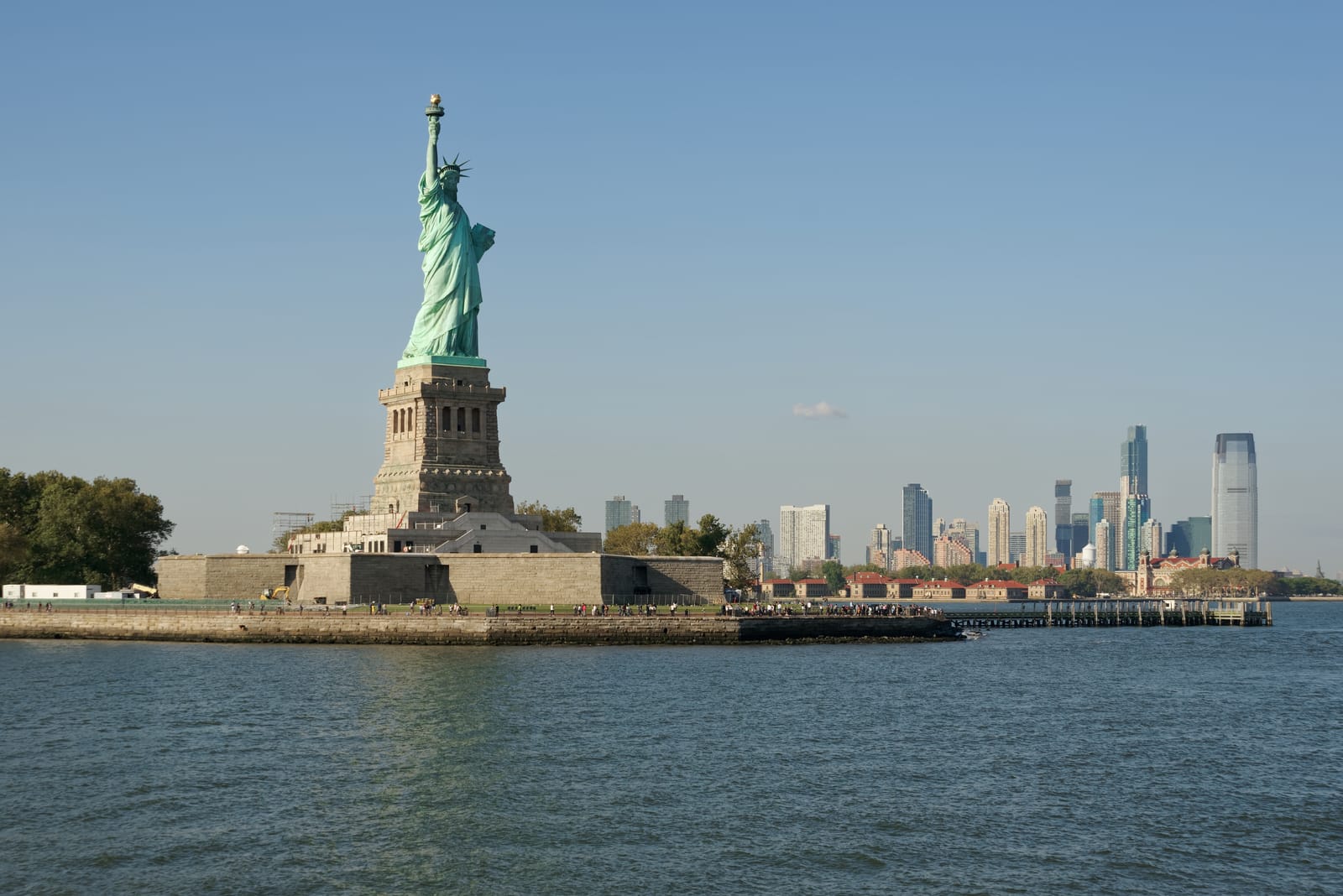
Stop 1 of 5 · The Battery, on the waterfront beside Castle Clinton where the ferry security screening is, outside any gate; then the outer decks of the ferry
The Battery, and the crossing to Liberty Island
Frédéric-Auguste Bartholdi (1834–1904), sculptor, who chose the site in 1871; iron framework by Gustave Eiffel (1832–1923) · Built in Paris 1876–1884; dedicated 28 October 1886 · Copper on an iron and stainless-steel frame; 305 feet 1 inch, about 93 m, from the ground to the tip of the flame
Look for
- Castle Clinton's round sandstone walls beside the queue. It is a harbour fort of the same generation as Fort Wood, the star fort the statue stands in.
- The statue side-on. She faces southeast, out to the harbour mouth, so from Manhattan you see her in profile, not face to face.
- Ellis Island, the red-roofed buildings to the right of Liberty Island from here: the ferry's second stop from New York.
Transcript (2:12)
Look out past the railings, across the water, and find the small green figure on the low island. From here she is side-on to you. The statue faces southeast, lined up with the old fort she stands in and with the way ships came in from the open sea. Manhattan gets her profile. The harbour mouth gets her face.
Frédéric-Auguste Bartholdi chose the spot himself, on a trip across the Atlantic in 1871, when the island was still called Bedloe's Island. It was small, but every ship entering New York Harbor had to pass it, and he called it the gateway to America. It was federal land, too, which he called land common to all the states.
The round sandstone walls beside you are Castle Clinton. It began as the Southwest Battery, one of a ring of harbour forts built or refitted around 1808 to defend New York, and took the name Castle Clinton in 1817, and the star-shaped fort under the statue, Fort Wood, came out of the same programme. So you are standing by one old fort, waiting to visit a statue that stands inside another.
She arrived in pieces. On the seventeenth of June 1885 the French navy ship Isère sailed in with the statue taken apart in its hold, to a naval parade, and then she spent a year in storage, because the Americans had not finished the pedestal.
Dedication day was the twenty-eighth of October 1886, and the weather was dreadful. New York held its first ticker-tape parade, from Madison Square down to the Battery, where you are now. Over a million people turned out. On the water about 300 vessels paraded past the statue in fog and rain, with less than a quarter of a mile of visibility. The New York State Woman Suffrage Association could not get tickets to the ceremony, as unaccompanied women, so they chartered a boat and watched a colossal woman called Liberty unveiled from the water.
In 1886 she was the tallest structure in New York City: 305 feet and 1 inch from the ground to the tip of the flame, about 93 metres. Her official name is Liberty Enlightening the World, and enlightenment was the idea. It is not how she was read. Between 1886 and 1924 almost 14 million immigrants came into the United States through New York, and to them the raised torch did not mean enlightenment. It meant welcome.
When the ferry pulls out, watch the red roofs to the right of her island. That is Ellis Island, where about 12 million people passed through the halls between 1892 and 1954.
L E X commons, CC0, via Wikimedia Commons. Photo: L E X commons

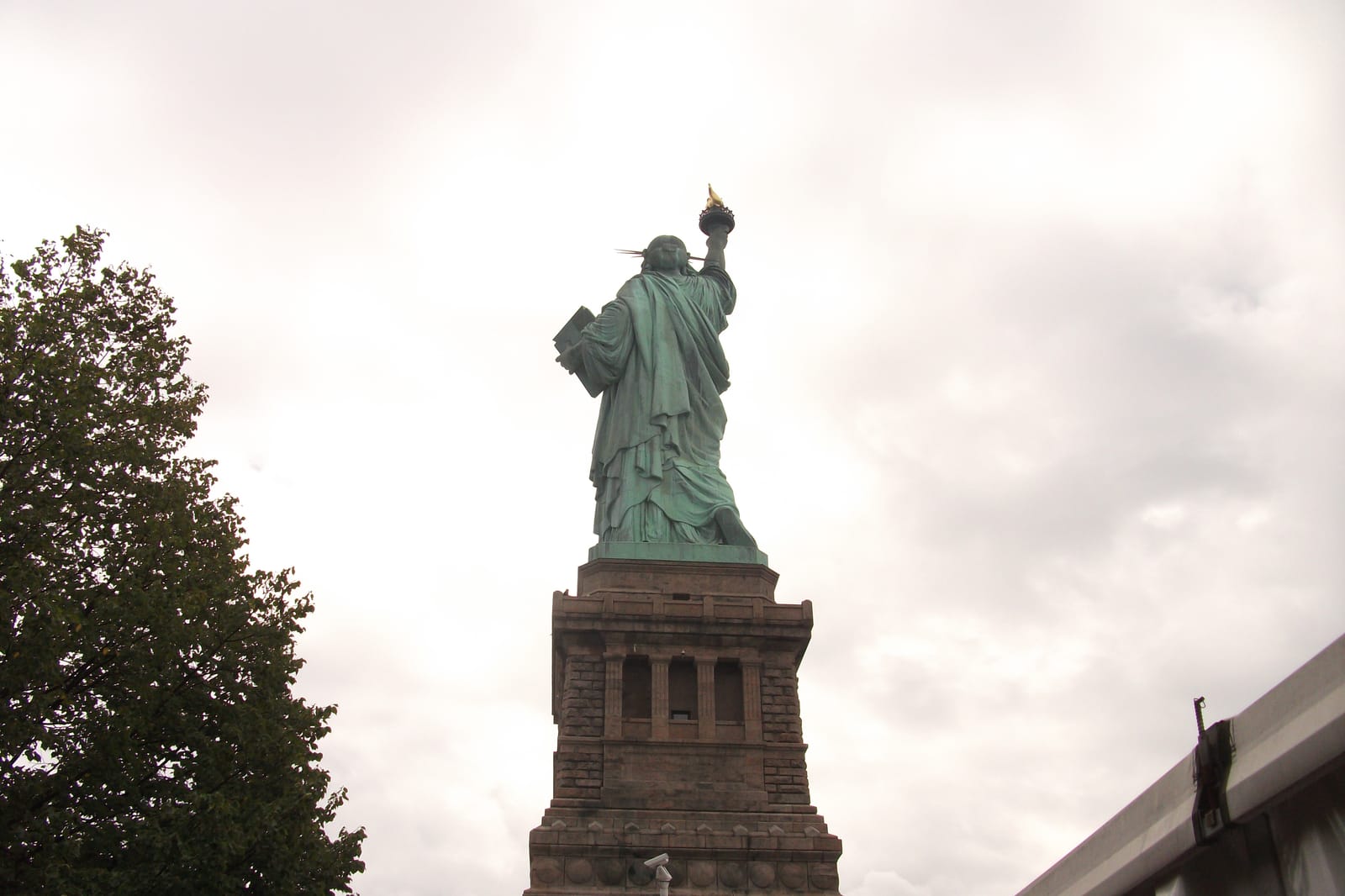
Stop 2 of 5 · Liberty Island, at the flagpole, straight ahead from the ferry dock, facing the back of the statue
The flagpole, and the back of the statue
Frédéric-Auguste Bartholdi (1834–1904), built at the Gaget, Gauthier & Co. workshop in Paris; internal structure by Gustave Eiffel (1832–1923), succeeding Eugène Viollet-le-Duc · Built 1876–1884 in Paris; reassembled on the island in 1886 · Copper sheets 3/32 inch (about 2.5 mm) thick, hammered by repoussé; 46.05 m from the top of the base to the torch, the right arm 12.80 m long
Look for
- The raised right arm, 12.80 metres long, and how slim it is from behind. There was room inside it for only a single ladder to the torch.
- The robe's folds. The whole skin is lightweight copper sheet hammered into shape over wooden forms, the repoussé technique, then fitted piece by piece to Eiffel's frame.
- The gold flame. The 1986 torch is covered in 24-karat gold leaf, as Bartholdi wanted, which is why it catches the sun.
- The flagpole itself. The National Park Service's ranger tours start here.
Transcript (2:11)
You have walked straight up from the ferry dock to the flagpole, and the statue has her back to you. Nearly everyone photographs the other side. From behind, she stops being a symbol and turns into something people built.
Start with the arm. It is 12.80 metres long, and from here you can see how slim it is: there was only ever room inside for a single ladder, forty feet of it, up to the torch. That arm was also the first part of her the public ever saw. It was finished in 1876 and shown at the Centennial Exposition in Philadelphia, where visitors climbed up to the balcony of the torch to look at the fairgrounds, and then it stood in Madison Square in Manhattan until 1882.
Now the robe. The whole skin is copper sheet hammered into shape, a technique called repoussé, and it is 3/32 of an inch thick, about two and a half millimetres, the thickness of two American pennies pressed together. The first engineer, Eugène Viollet-le-Duc, died unexpectedly in 1879, and Bartholdi hired Gustave Eiffel. Eiffel kept the hammered copper and threw out the plan for the inside. Instead of relying on weight, he built a central iron pylon, 28 metres tall, and hung the skin off it on flat metal bars that behave like springs. She is meant to move. She can sway up to three inches, the torch up to six.
When she was new she was not this colour. She was brown, like a penny, and it took years for the copper to turn green; by the early 1900s she was the colour you see now. Congress took the green for corrosion and voted money to paint her inside and out. After a public outcry the Army engineers found the patina was protecting the copper, and she was painted only on the inside.
On the island in 1886 she went back together without scaffolding. Eiffel's frame went up first, and many of the men doing the work were new immigrants. General Charles Stone claimed on dedication day that no one had died building her. It was not true. Francis Longo, a 39-year-old Italian labourer, was killed when an old wall fell on him.
Last, look up at the flame. It went up in 1986, during the great restoration, when engineers found the arm had been badly attached and was swaying in strong winds, the head was two feet off centre, and one of the crown's rays had been wearing a hole in the arm. The torch she held for her first century came down in 1984. The one you are looking at was made to the exact specifications Bartholdi wanted, and covered in 24-karat gold leaf.
AskALotl, CC0, via Wikimedia Commons. Photo: AskALotl
.jpg)
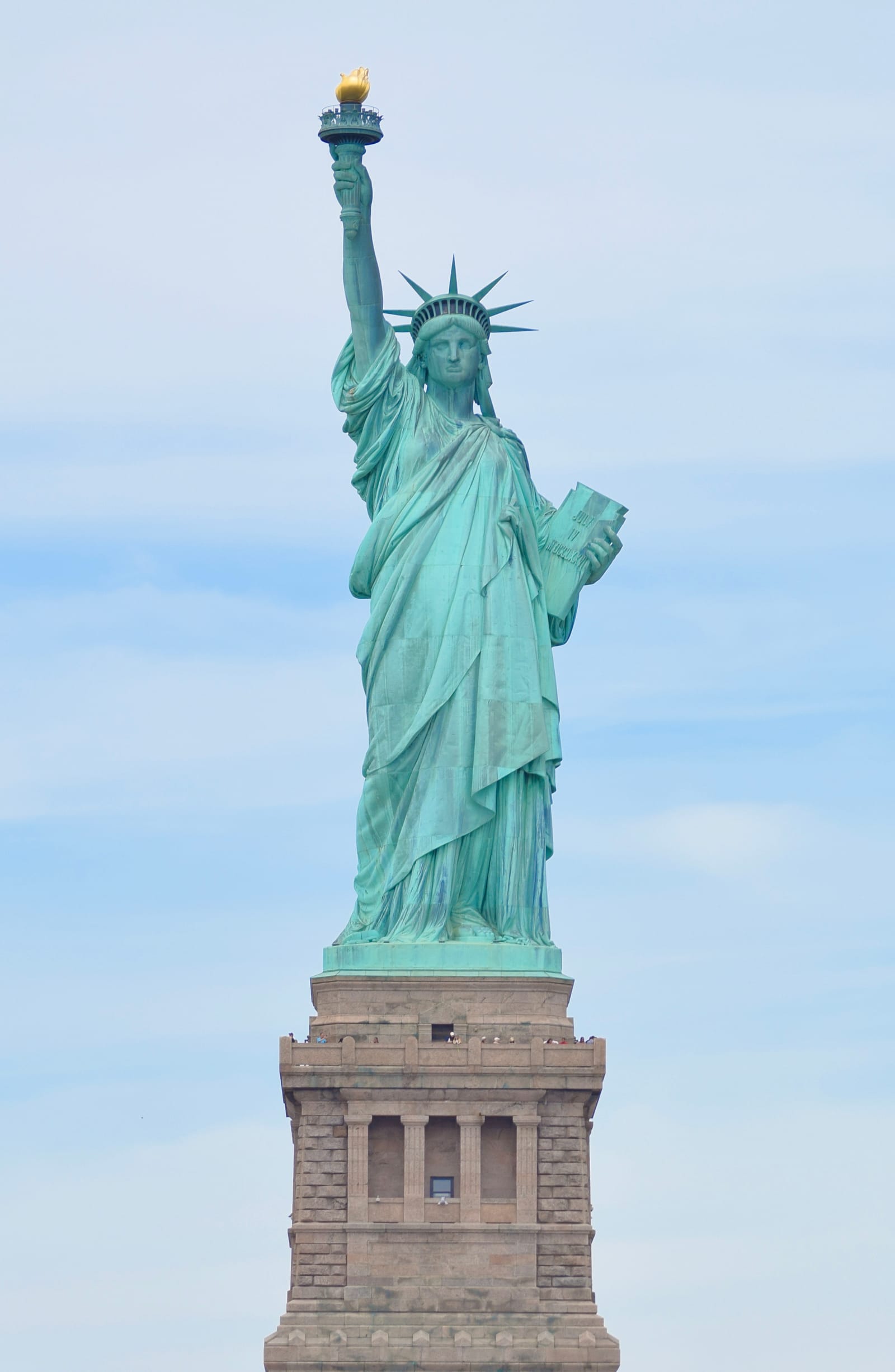
Stop 3 of 5 · Liberty Island promenade, on the south side of the island, facing the front of the statue, which looks southeast over the harbour
The front: the face, the crown and the tablet
Frédéric-Auguste Bartholdi (1834–1904), for the Franco-American Union of Édouard de Laboulaye · Modelled from 1870; plaster model approved 1875; dedicated 28 October 1886 · Copper; the head 5.26 m from chin to cranium, the tablet 7.19 m long; a crown of 25 windows and seven rays
Look for
- The tablet. JULY IV MDCCLXXVI is legible from the promenade: the date of the Declaration of Independence in Roman numerals.
- The seven rays of the crown, and the row of 25 windows beneath them where crown visitors stand.
- Her right foot, heel lifted under the hem. She is mid-stride, carrying the torch forward.
- Where the chains are. Broken shackles and chains lie at her feet, hidden from anywhere on the ground by the height of the pedestal.
Transcript (2:37)
Keep walking round the promenade to the south side of the island until she is looking straight over your head, out towards the harbour mouth. This is the face everyone knows, and at this size it is enormous: the nose is 1.37 metres long, each eye 76 centimetres wide, the mouth 91 centimetres. From chin to the top of the head is 5.26 metres.
You will hear that Bartholdi gave her his mother's face. The curator of the Bartholdi Museum says there is no basis for that. What there is, is an earlier woman with a lamp. Years before this commission, Bartholdi had pitched a colossal lighthouse for the Suez Canal: a robed woman holding a light aloft, to be called Egypt Carrying the Light to Asia. The khedive turned it down. It is hard not to see her standing here.
Read the crown next. Seven rays, and under them a row of 25 windows, which is where crown visitors look out. The National Park Service describes the rays as light, like a halo. You will often be told they stand for the seven seas and the seven continents, and that is the reading most people carry home.
In her left arm is the tablet, 7.19 metres long, and you can read it from here: JULY IV MDCCLXXVI. The fourth of July, 1776, the date of the Declaration of Independence.
Now look down to her feet. Her right foot is raised, heel lifted, mid-stride: she is carrying the torch forward, not standing guard. And at her feet, out of sight from anywhere you can stand, lie broken shackles and chains. Bartholdi thought about putting a broken chain in her hand, and decided that would be too divisive so soon after the Civil War. So it went on the ground, under the robe, where almost nobody sees it.
That chain is the reason she exists. The man who first proposed a gift from France, in 1865, was Édouard de Laboulaye, an abolitionist and president of the French Anti-Slavery Society. He wanted to honour the Union's victory and the end of slavery. But liberty was a dangerous word in nineteenth-century France. It suggested revolution. So Laboulaye and Bartholdi agreed their figure would not lead an uprising. She would light the way, peacefully and lawfully. Hence the name: Liberty Enlightening the World.
The promise under the robe was not yet true for everyone who sailed past. For African Americans in 1886 the broken shackle described a freedom that had not arrived, and W.E.B. Du Bois wrote that, sailing past her on his way home from Europe, he could not feel the hope he imagined immigrants felt.
On the day she was unveiled, the twenty-eighth of October 1886, her face was covered by a French tricolour, due to drop at the end of a speech. Bartholdi mistook a pause for the ending and let it fall early. The guns went off and the crowd cheered. Asked what he thought of the finished statue, he told a reporter: my dream has been realized. I can only say that I am enchanted.
Ron Cogswell from Arlington, Virginia, USA, CC BY 2.0, via Wikimedia Commons. Photo: Ron Cogswell from Arlington, Virginia, USA
_April_2016_(26952943150).jpg)
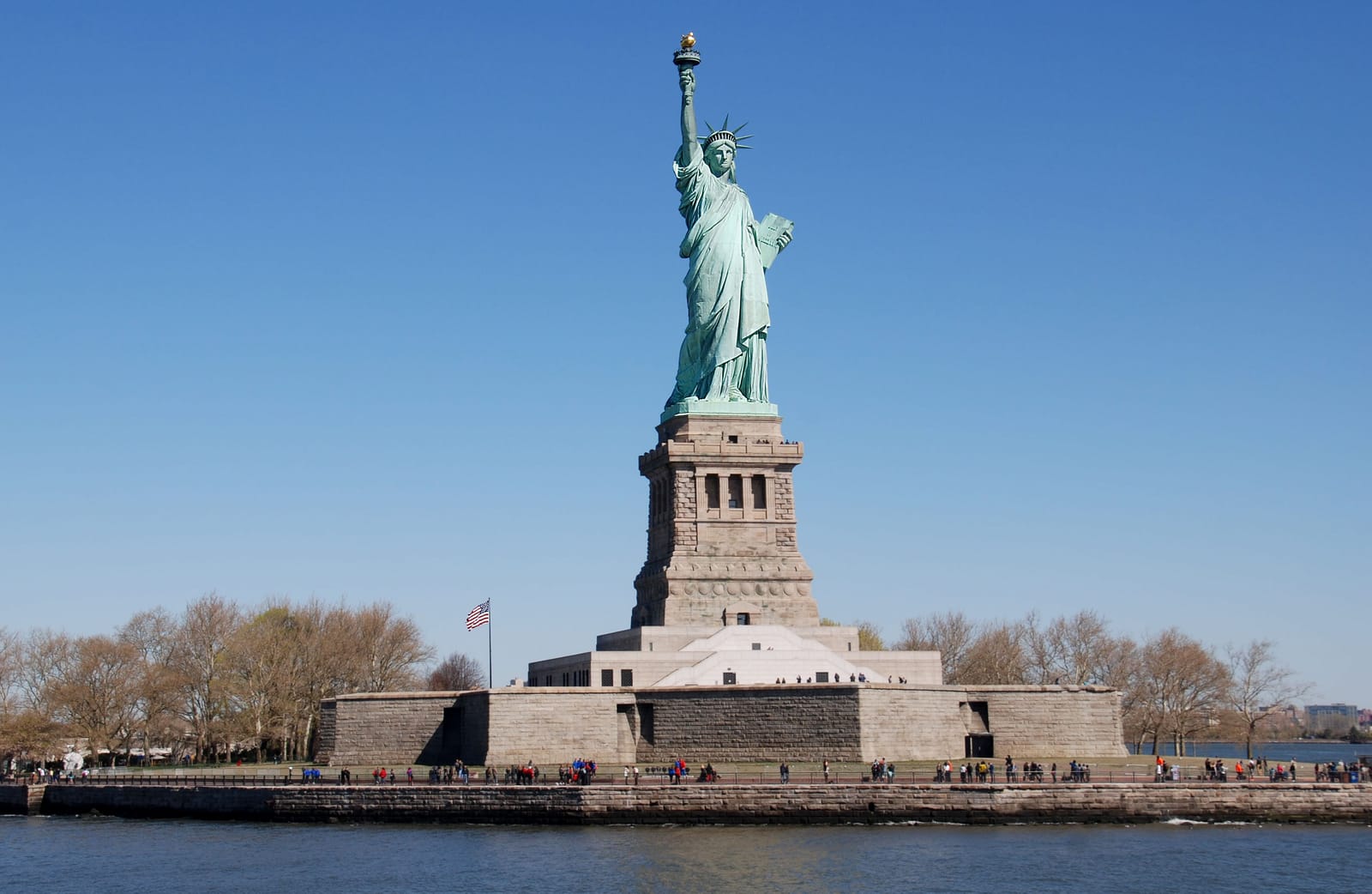
Stop 4 of 5 · Liberty Island grounds, at the foot of the granite walls of Fort Wood, by the pedestal entrance
Fort Wood's star walls and Hunt's pedestal
Pedestal by Richard Morris Hunt (died 1895), built under General Charles P. Stone as chief engineer; Fort Wood by the United States Army · Fort Wood 1808–1811; pedestal foundation begun 1883, cornerstone 1884, completed 1886 · Poured concrete walls up to 20 feet thick, faced with granite; 154 feet, 46.93 m, from the ground to the top of the pedestal, inside an eleven-point star fort
Look for
- The points of the star. Walk along the fort wall and the angles jut out and fall back, eleven of them round the pedestal.
- The ten round discs above the pedestal's doors, left blank. They were meant for the coats of arms of the states.
- The granite facing. It clads concrete walls up to 20 feet thick, the largest pour of concrete of its day.
Transcript (2:15)
The granite walls you are walking beside are older than the statue by three quarters of a century. This is Fort Wood, begun in 1808 as the Works on Bedloe's Island and finished in 1811. Its plan is an eleven-point star: follow the wall and the angles jut out and fall back. It is named after Eleazer D. Wood, an army hero killed at Fort Erie. When the statue came, nobody knocked it down. The star became part of the base, and the pedestal rises from inside its walls.
The pedestal is by Richard Morris Hunt, the first American to study at the École des Beaux-Arts in Paris. One early design, Pharos, borrowed from the ancient lighthouse at Alexandria and stood 114 feet tall. The budget cut it to 87. Hunt was paid a thousand dollars for his work, and gave it back to the committee.
Money is the whole story of this pedestal. The French would pay for the statue, the Americans for the pedestal, and the Americans very nearly didn't. In 1884, as governor of New York, Grover Cleveland vetoed a bill to give the project fifty thousand dollars. That year the money ran out and work stopped. Joseph Pulitzer's newspaper, the New York World, rescued it. Between March and August 1885 he raised more than a hundred thousand dollars from roughly 125,000 people, most of them giving a dollar or less, and he printed the name of every one. A group of children sent a dollar: the money we saved to go to the circus with. Two years after his veto, Cleveland, by then president, accepted the statue.
Look at the granite. It faces concrete walls up to twenty feet thick on a foundation fifteen feet deep, and that concrete was the largest mass poured anywhere at the time. Above the doors on each side is a row of ten round discs. Bartholdi wanted the coats of arms of the states on them. They are still blank.
The pedestal also carries a poem. For an art auction in aid of the pedestal fund, Emma Lazarus wrote a sonnet on the second of November 1883, The New Colossus: give me your tired, your poor, your huddled masses yearning to breathe free. It was soon forgotten. In 1901 her friend Georgina Schuyler found it in a bookshop, and in 1903 the words went onto a plaque on the inner wall of the pedestal. Much of what she means now, the Mother of Exiles, comes from that plaque.
The chief engineer was General Charles P. Stone. When he finished, people said the island would have to be turned over to shake her loose. He died of pneumonia a few months after the unveiling.
Rob Young from United Kingdom, CC BY 2.0, via Wikimedia Commons. Photo: Rob Young from United Kingdom
.jpg)
Stop 5 of 5 · Top of the pedestal, looking up into the statue, and the observation balcony around it; needs a Pedestal Reserve ticket
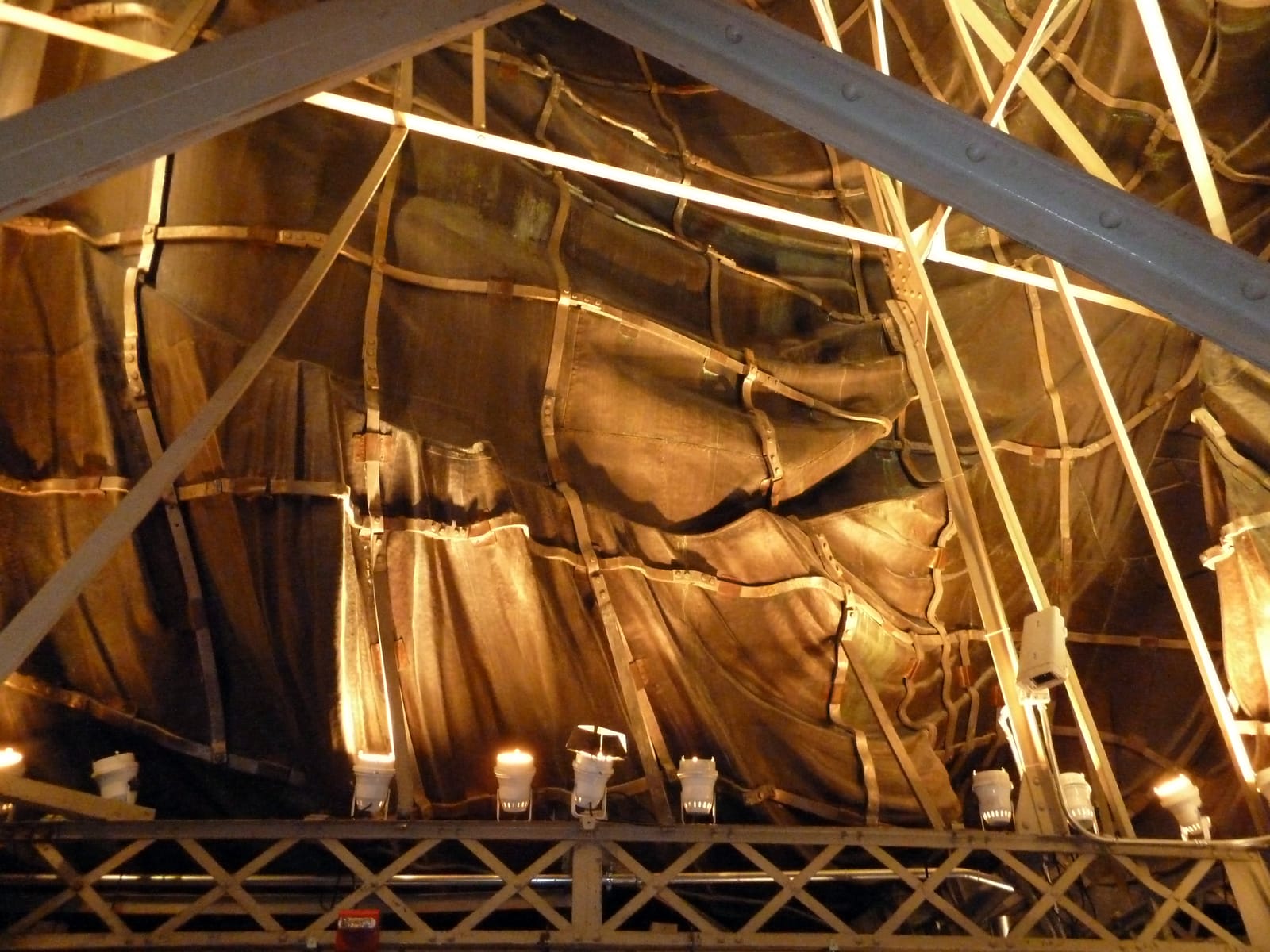
The top of the pedestal, under Eiffel's framework
Gustave Eiffel (1832–1923), internal framework; copper skin from Bartholdi's workshop; armature renewed in the 1984–1986 restoration · Framework designed 1880, completed in Paris late 1883; armature bars replaced 1984–1986 · Iron central pylon of 28 m (92 feet) with stainless-steel armature bars holding the copper skin; 215 steps, or an elevator, to the top of the pedestal
Look for
- The flat bars following the folds of the robe from the inside, each bolted to the copper and shaped to its fold. They are the springs that let the statue move.
- The heavier girders crossing the space: Eiffel's truss, the thing that actually holds the statue up.
- The inside of the skin, bare copper. The 1980s restorers stripped away the layers of paint that had built up in here over a century.
- From the balcony, the harbour all round. The pedestal is roughly half the monument's height.
Transcript (1:55)
You are at the top of Hunt's pedestal, and the statue begins directly above your head. Look up. This is the view that explains everything you saw from the lawn.
That brown, folded surface is the inside of the copper skin, the back of the robe you walked around. Crossing it are two kinds of metal. The heavy girders are Gustave Eiffel's framework: a central pylon, 28 metres tall, with a truss of lighter, asymmetrical girders branching off it to follow the shape of the body. The thin flat bars, bolted to the copper and bent to follow each fold, are what tie the skin to that frame, and they are springs. Eiffel did not want a rigid statue. He built one that gives a little in the wind.
It was one of the earliest examples of what architects now call curtain wall construction, where the outer surface carries no load and simply hangs from a frame inside. Eiffel finished this in Paris in late 1883. A few years later he began his tower.
Not all of it is as he left it. He tried to stop the copper and the iron corroding each other with a layer of asbestos soaked in shellac, and by the 1980s it was clear that had not worked. The great restoration replaced the rusting iron bars with stainless steel. Inside the skin the restorers found a century of paint, took it off with liquid nitrogen, and then blasted away two layers of coal tar with baking soda, which does not damage copper. Where the skin needed patching, the new copper came from a roof at Bell Labs, because its patina already matched.
Above you the stairs keep going. The double spiral staircase inside the statue was added in 1888, and from her feet it is 162 steps to the crown; from the ground, 377. The torch is further still, reached by a narrow forty-foot ladder inside the arm, and it has been closed to the public since 1916.
Now go out onto the balcony. The pedestal is roughly half the height of the whole monument, and from up here the harbour opens all the way round, the water every one of those ships came in on. In October 2012 Hurricane Sandy put three quarters of the island below you under water, and it stayed closed until the fourth of July 2013.
Independent guide · Chiaro
Point Chiaro at anything at the Statue of Liberty.
Past the fifth stop the harbour still has plenty to ask about: why a crown needs 25 windows, which tower is which on the skyline from the ferry rail, what an eleven-point fort is doing under your feet. Hold your phone up to a seam in the copper, a building across the water or the date on her tablet, and Chiaro names it, gives you its story and takes your follow-up questions on the spot.
Before you go
Getting there
Liberty Island is reached only by ferry. From Manhattan, go to The Battery (GPS address 1 Battery Place, New York, NY 10004): the ticket office is inside Castle Clinton, and the security screening and ferry are on the Battery waterfront beside it. From New Jersey, ferries leave Liberty State Park (1 Audrey Zapp Drive, Jersey City, NJ 07305), with the ticket office in the Central Railroad of New Jersey Terminal. Boats from New York stop at Liberty Island first, then Ellis Island.
Subway to The Battery: the 4 and 5 to Bowling Green, the R to Whitehall Street, or the 1 to South Ferry. Buses M5, M15 and M20 stop at South Ferry. In New Jersey, the Hudson-Bergen Light Rail has a station at Liberty State Park, about a mile's walk from the ferry.
Tickets and entry
- Buy only from Statue City Cruises, the one ferry the National Park Service authorizes to land on Liberty and Ellis Islands, online or at its ticket office inside Castle Clinton. The Park Service warns that other vendors sell tickets at higher prices or for boats that do not land on the islands. There is no entrance fee on top: on the Park Service's fee table the ferry ticket is $26.00 for an adult, $23.00 for a senior 62 and over, $17.00 for a child of 4 to 12, and free under 4, and National Park passes do not apply.
- The time on your ticket is when you join the security screening queue, not a ferry departure, and you cannot arrive more than 30 minutes before it. Screening is airport-style; suitcases and large bags are not allowed on the ferry or the islands, and there are no lockers at the screening facilities.
- A General Admission ticket covers both islands and both museums but not the inside of the statue or the pedestal. The last stop on this page needs a Pedestal Reserve ticket (+$0.30 on the fee table), which is limited, sells out in advance and is not sold on the island; it reaches the top of the pedestal by 215 steps or an elevator, through a second security check. The crown is a separate Crown Reserve ticket: 162 more steps in a tight helix with no elevator, a ten-minute visit, one ticket per person in any six months, children at least 42 inches tall, usually booked three to four months ahead.
- The ferry runs every day except Thanksgiving Day and Christmas Day, and schedules vary by season. Statue City Cruises says an entry after 2pm does not leave enough time to visit both islands.
The official audio guide
The park's own audio tour is free with your ferry ticket: it is included in the price, in twelve languages (English, Spanish, French, Italian, German, Mandarin, Russian, Arabic, Hindi, Korean, Portuguese and Japanese), with a family version for children aged 6 to 10, a descriptive tour for blind and low-vision visitors, and American Sign Language tours. It covers a walk round the outside of the island, the museum, and the statue's framework at the top of the pedestal. National Park Service rangers also lead free tours of the grounds, starting at the flagpole and lasting about 35 minutes; they cannot be reserved. Ours is a third option, independent of the park: it begins on the Battery before you board, and each stop's text sits in full below its player, so you can read along or read instead.
Official site →Questions
Is there a free Statue of Liberty audio guide?
Yes, two. The park's own audio tour comes with every ferry ticket at no extra cost, in twelve languages, and covers the island, the museum and the statue's framework at the top of the pedestal. The second is the one you are reading: a self-guided walk in five stops that begins on the Battery waterfront before you board and ends at the top of the pedestal, streamed straight from the page with nothing to download.
Do I need a ticket to listen?
Not for the first stop, which is on the Battery waterfront beside Castle Clinton, outside any gate. Stops two to four are on Liberty Island, which you reach only on a Statue City Cruises ferry ticket. The fifth, the top of the pedestal, needs a Pedestal Reserve ticket bought in advance.
How much is the official Statue of Liberty audio guide?
Nothing extra. The National Park Service's fee table lists audio tours as included in the ferry ticket, and ranger tours as free. The ferry ticket itself is $26.00 for an adult on the same table, and there is no separate entrance fee.
Can I go inside the statue?
Only with a reservation. A General Admission ticket does not include the inside of the statue or the pedestal. A Pedestal Reserve ticket takes you to the top of the pedestal by 215 steps or an elevator; a Crown Reserve ticket adds 162 steps up a narrow helix with no elevator, for a ten-minute visit. Both are limited and sold in advance by Statue City Cruises. The torch has been closed to the public since 1916.
Which ferry is the official one?
Statue City Cruises, the only ferry the National Park Service authorizes to dock at Liberty and Ellis Islands. It leaves from The Battery in Manhattan and from Liberty State Park in Jersey City, and in Manhattan its only on-site ticket office is inside Castle Clinton. Other boats sold near the Battery may not land on the islands at all.
Is the Statue of Liberty ever closed?
The ferry runs every day except Thanksgiving Day and Christmas Day. Schedules vary by season, so check the official ferry schedule for your date rather than relying on a fixed time.
More audio guides
Made by Chiaro. Not affiliated with the Statue of Liberty.