
The Met Cloisters · New York · Independent guide
The Met Cloisters audio guide,
five stops, free.
Five medieval masterpieces to hear right here, with nothing to install. The rest of a collection of some 5,000 works, from stained glass to tomb effigies, Chiaro narrates from a photo.
Made by Chiaro. Not affiliated with the Met Cloisters.
Annunciation Triptych (Merode Altarpiece)
The Met Cloisters, New York
That was the free part
Chiaro narrates any work in the Met Cloisters from a photo.
The five stops · 11 minutes of audio
Five stops, one walk,
in the order you will walk them.
Think of The Met Cloisters audio guide below as one loop through a hilltop building above the Hudson: four rooms on the main floor, then one a flight down. You begin in the Merode Room, Gallery 19, with a painting made for a family to pray before at home, then move to the seven hunting tapestries in Gallery 17, leave through the Nine Heroes hall into the pink arcades of the Cuxa Cloister, Gallery 07, cross to the Spanish apse in the Fuentidueña Chapel, Gallery 02, and finish one flight down in the Treasury, Gallery 14, with a cross carved from walrus ivory. Listening takes roughly ten minutes in all; the walking between stops takes under ten, so allow an hour and a half once you add time to look.
For each work we read the Met's online collection record first and then an independent reference, and we checked every gallery number against the museum's website on 25 September 2026. The Cloisters lends pieces and moves them for conservation like any museum, so if a gallery sign and this page disagree, go with the sign, and drop us a note about the change.
Stop 1 of 5 · Gallery 19, Merode Room, Floor 1
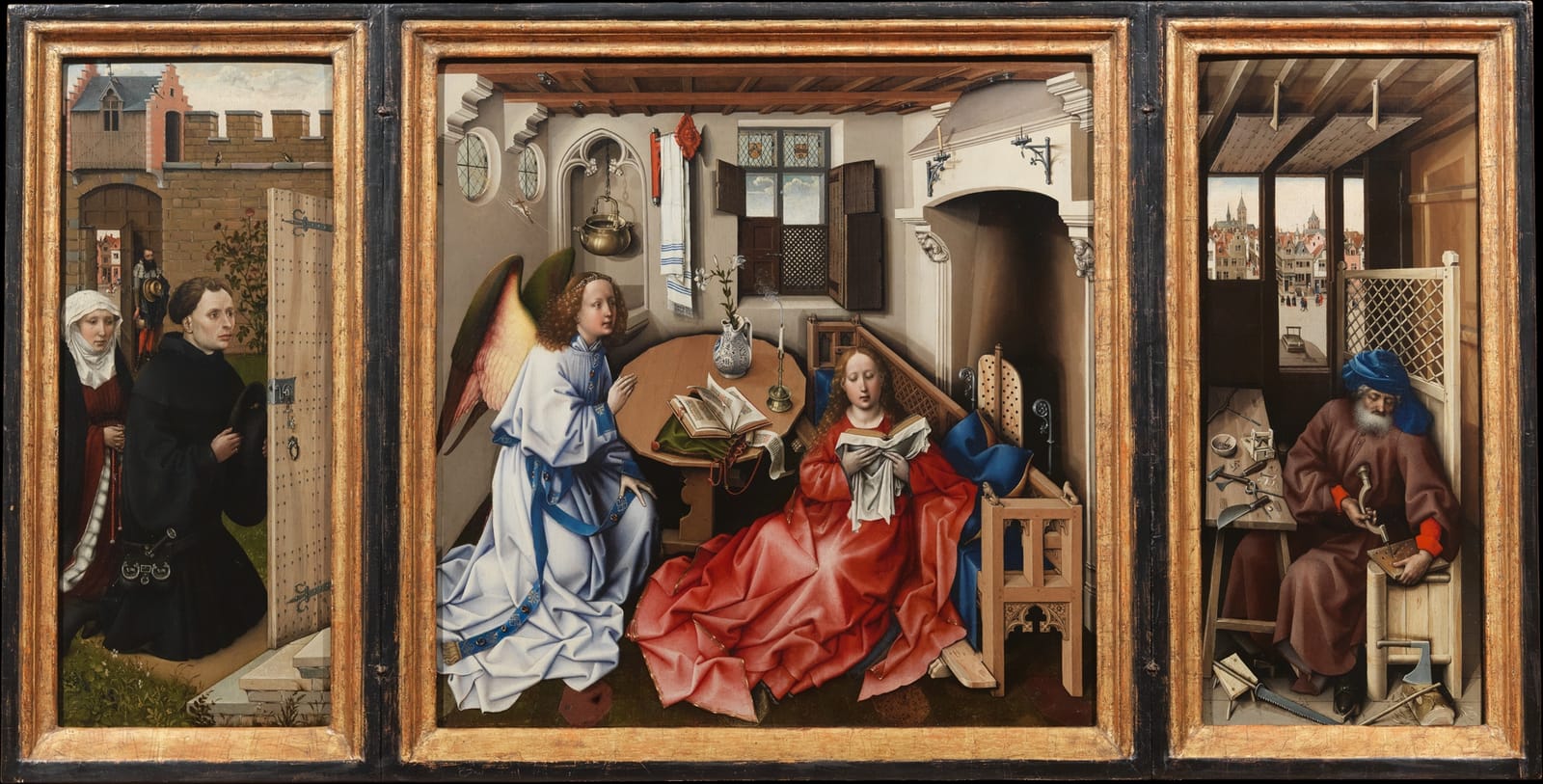
Annunciation Triptych (Merode Altarpiece)
Workshop of Robert Campin · ca. 1427–32 · Oil on oak, 64.5 × 117.8 cm open
Look for
- The tiny figure carrying a cross, sliding down the golden rays from the round window at the upper left of the centre panel. The dove you expect is not there; this is how the painter shows the conception.
- Two mousetraps in Joseph's workshop: one on his bench, one set out in the window onto the street. Saint Augustine called the cross the devil's mousetrap.
- The candle on the table, blown out a second ago, with a thread of smoke still curling up from the wick.
- The blue sky in the windows behind Mary. It was painted over the original gold leaf, one of several changes made after the first version.
Transcript (2:25)
Bend a little closer than feels polite. The whole altarpiece, open, is about a metre and seventeen centimetres wide, and the middle panel is barely sixty-four centimetres square. It was never meant for a church. It was made for a fifteenth-century family to pray in front of at home, and the late medieval furniture around you was chosen to echo the objects in the picture.
The centre panel is the Annunciation, set not in a temple but in a comfortable house of the painter's own day. Mary sits on the floor in a red gown, lost in her book. The angel Gabriel has just come in and is about to speak, and she has not noticed him yet. Now look at the round window at the upper left. Golden rays come through it, and riding down them is a miniature figure carrying a cross. That is the Christ Child, on his way. On the table, a candle has just gone out. The wick is still glowing and a curl of smoke is rising from it. A lily stands in a jug beside it.
On the right wing is Joseph, a carpenter, drilling holes in a board. On his bench sits a mousetrap, and there is another set out in his shop window facing the street. It is a joke with a theological point. Saint Augustine wrote that the cross was the devil's mousetrap, baited with the death of Christ. In 1966 a scholar argued that the thing on the bench was really a carpenter's plane. That same year a museum man in Liverpool, John Jacob, had the trap built from the painting and caught a mouse with it.
On the left wing, the man who paid for all this kneels in the garden, peering through the open door at the miracle as if he had been let in by accident. His wife kneels behind him. She was not in the first version. The Met's reading is that the centre panel came first, probably painted without a commission, that the donor then ordered the wings, and that in the 1430s, presumably after he married, his wife and the messenger at the gate were added. Even the sky behind Mary is a revision. Those windows were gold leaf until someone painted them blue.
The painting comes from the workshop of Robert Campin in Tournai, sometimes called the Master of Flémalle. Documents say he hired at least two assistants, and one of them was the young Rogier van der Weyden. An earlier, damaged version of the centre panel survives in Brussels and may be Campin's own.
It takes its name from the Mérode family, Belgian aristocrats who owned it in the nineteenth century. It spent generations in private hands, seen by almost no one, until 1956, when John D. Rockefeller Junior funded its purchase for this building. People called it a major event in the history of collecting in America. The Met calls it one of the most celebrated early Netherlandish paintings, and part of the reason is simply condition. After six hundred years, that curl of candle smoke is still sharp enough to see.
Stop 2 of 5 · Gallery 17, Unicorn Tapestries Room, Floor 1
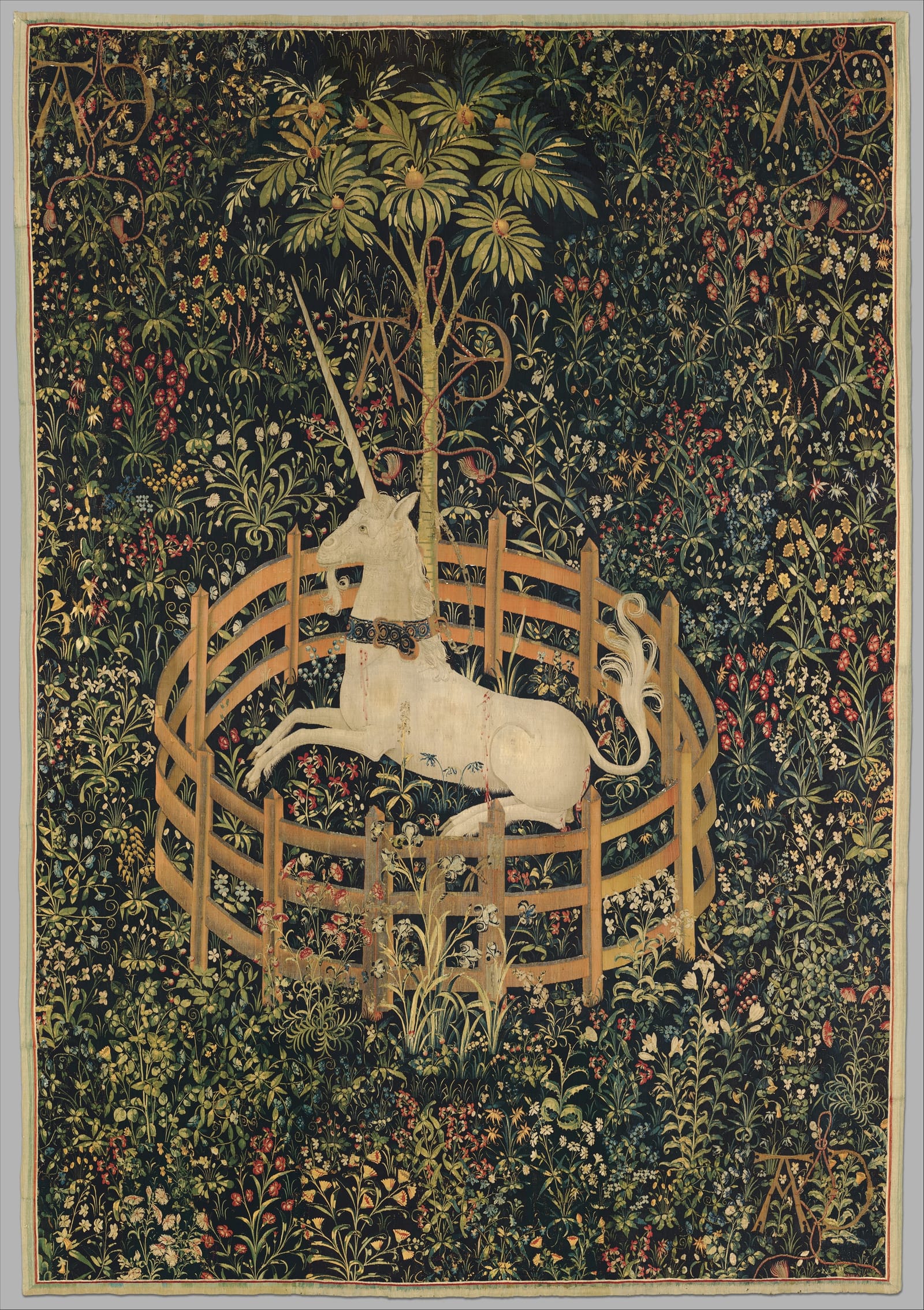
The Unicorn Rests in a Garden (The Unicorn in Captivity)
Designed in France, woven in the Southern Netherlands · 1495–1505 · Wool warp with wool, silk, silver, and gilt wefts, 368 × 251.5 cm
Look for
- The red drops running down the unicorn's white flank. There are no wounds; the Met reads them as juice from the bursting pomegranates overhead.
- The frog among the violets at the lower right, put there, medieval writers would have said, for its noisy mating.
- The chain and the fence. The chain is not properly fastened and the fence is low enough to jump. He stays because he wants to.
- The letters A and E, knotted into a monogram on the tree and in the corners. They turn up in every hanging in the room, and nobody knows whose they are.
Transcript (1:59)
Seven hangings share this room, and only one of them is calm. The others tell a hunt: noblemen and dogs chasing a unicorn through the woods, cornering it at a fountain, spearing it, and carrying its body back to a castle. And then there is this one, where the unicorn is alive again, lying in a garden inside a little round fence, white against a dark green field of flowers. The Met thinks it may have been made as a single picture, not as the last chapter of the hunt.
Look at the red on his flank. It looks like blood, and some people still read it that way. But there are no wounds on this unicorn, not like the gashes in the hunting scenes. Look up into the tree. Those are pomegranates, ripe and split open, and the red is their juice dripping down. In the Middle Ages the pomegranate stood for fertility and marriage, and the Met's reading of this tapestry is a love story. The unicorn is the beloved, tamed. He is chained to the tree, but the chain is not secure, and the fence is low enough to jump over. He could leave. He does not want to.
Now look down at the flowers. Wild orchid, bistort, thistle, all praised by medieval herbalists as aids to having children. And at the bottom right, among the violets, a small frog, which medieval writers mentioned for the noise it makes when it mates. Across the whole set there are more than a hundred plants, and botanists have put a name to eighty-five of them.
Then there are the letters, an A and an E, knotted together and hung from the tree, and repeated in the corners. They appear in every tapestry here, and nobody knows whose initials they are. A 1942 theory that they stood for Anne of Brittany has since been rejected. The Met still describes the patron as unknown.
The La Rochefoucauld family of France owned them for centuries. During the Revolution they were looted from the family château and, the story goes, used to cover potatoes. They were back with the family in the nineteenth century, and in 1922 John D. Rockefeller Junior bought them for about a million dollars. He gave them to the Met in 1937, a year before this building opened.
In 1998 the set came off the walls to be cleaned, and when conservators removed the linen lining, they found that the colours on the back had survived even better than the ones on the front, the side you are looking at, which is still this bright.
Stop 3 of 5 · Gallery 07, Cuxa Cloister and Judy Black Garden, Floor 1
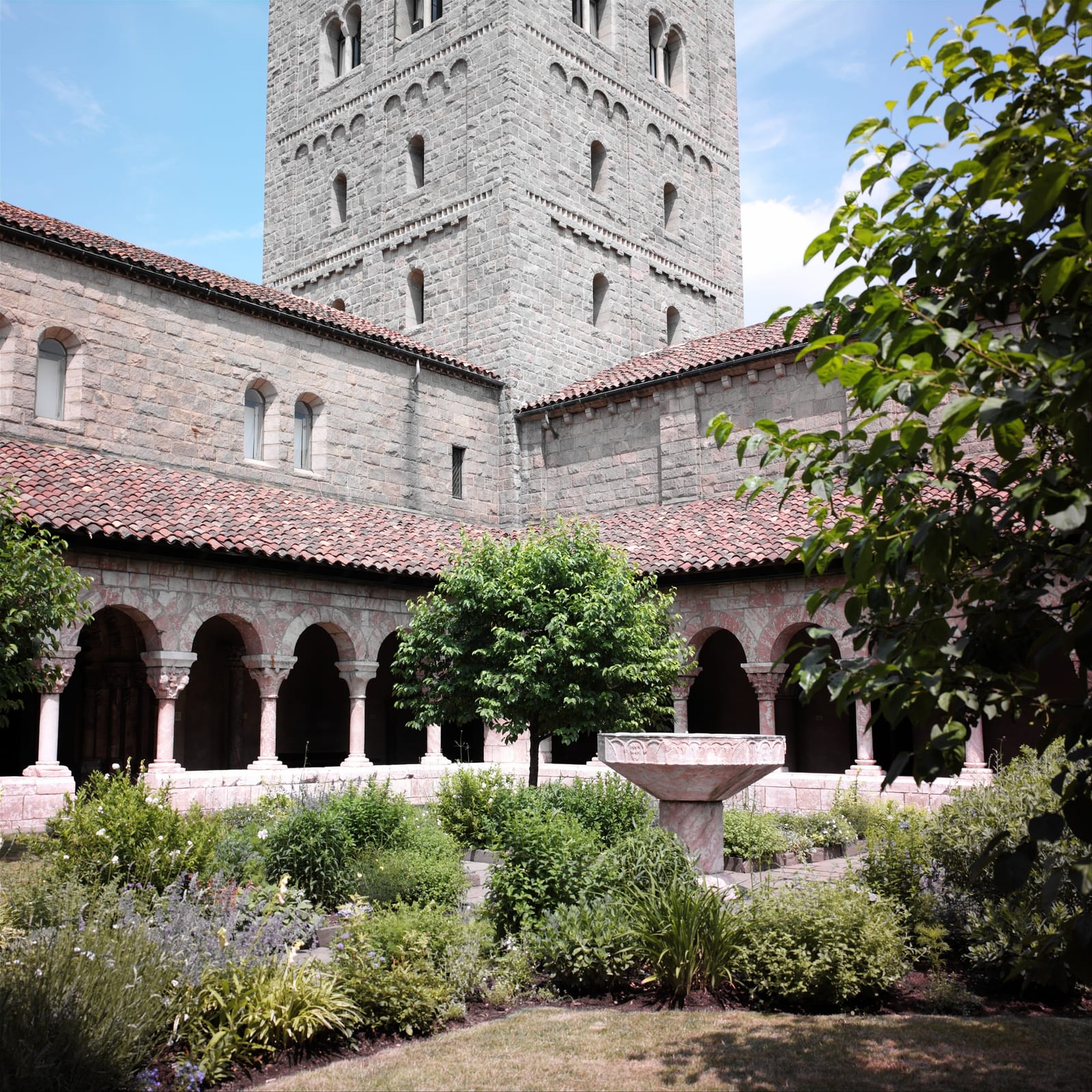
Cuxa Cloister
Catalan, from the Benedictine abbey of Saint-Michel-de-Cuxa · ca. 1130–40 · Marble, about 27.4 × 23.8 m
Look for
- The small diagrams at the corners of the walkway. They mark which stones are twelfth-century and which were cut in the twentieth, because the colour will not tell you.
- A corner capital where two animals share a single head, a trick the carvers used to turn a corner.
- The mermaid holding her own tail, and the lions chewing on their own front legs.
- The fountain where the two garden paths cross, the centre of the whole plan.
Transcript (2:07)
Stand under the arcade for a moment and look at the colour of the stone. Pink, streaked with white, warm even on a grey day. This is the heart of the building, and it was meant to be. A cloister was the heart of a monastery too: a covered walk around an open garden, with a door to everything else. Monks walked it in procession, read aloud in it, meditated in it, and did their washing here, clothes and themselves.
These capitals come from the Benedictine abbey of Saint-Michel-de-Cuxa, at the foot of Mount Canigou in the Pyrenees, founded in 878. In 1791, in the wake of the French Revolution, the monks left, and the stones were carried off and scattered. The original cloister was about twice the size of this one. George Grey Barnard, an American sculptor who collected medieval stone in France, bought what he could find, reportedly for a hundred thousand dollars, and brought it to New York. Part of the cloister is still in France, and so, again, are monks. There is a community living at Cuxa today.
Here is the surprise. Not everything you see is medieval. The Met counts some four hundred and sixty original fragments, including thirty-six capitals but only twelve of the shafts that hold them up. Everything missing was cut new, in the same pink Languedoc marble, from a quarry near Cuxa that was reopened in the early twentieth century for exactly this purpose. Old and new are the same stone, so your eye cannot sort them. Look for the little diagrams at the corners of the walkway; they show you which is which. The low wall under the columns and some of the arches above are the reconstruction. The carved tops are the real thing.
So walk around and read the capitals. Some are plain blocks. Others are thick with scrolling leaves and pinecones, with lions eating people or gnawing their own front legs, and a mermaid holding up her tail. At the corners, look for animals with two bodies and one shared head, a design worked out to wrap round the edge of the block. Nobody knows the order the capitals stood in at Cuxa, so there is no story to follow from one to the next, and the Met suggests the carvers cared less about meaning than about energy, the tension of bodies pressed into stone.
In the garden the paths cross at a fountain, the typical plan of a cloister garden. In spring and summer it is full of flowers and the air smells of lavender, which is exactly the effect the people who built this place were after.
Sharon Mollerus, CC BY 2.0, via Wikimedia Commons. Photo: Sharon Mollerus
.jpg)
Stop 4 of 5 · Gallery 02, Fuentidueña Chapel, Floor 1
Apse from San Martín at Fuentidueña
Spanish, from the church of San Martín at Fuentidueña, Segovia · ca. 1175–1200 · Limestone; apse interior 919.5 × 749.3 × 843.3 cm
Look for
- The two big figures on the piers at the mouth of the apse: Saint Martin, the patron of the church, on the left, and Gabriel greeting the Virgin on the right.
- Daniel in the lions' den on the large capital at the right of the great arch, facing the Adoration of the Magi on the left.
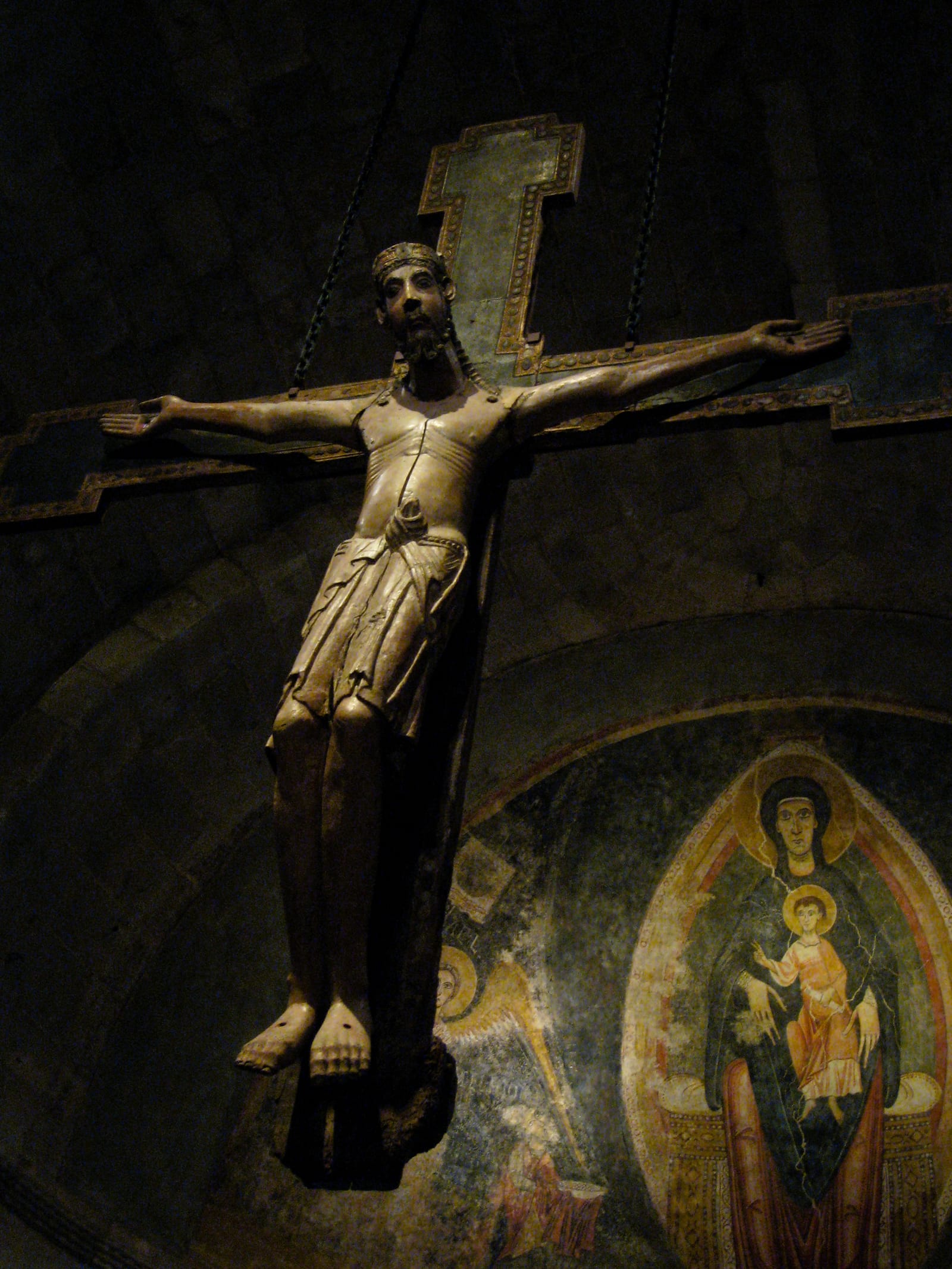
- The crucified Christ with his eyes wide open and a gold crown on his head: alive on the cross, not dead on it.
- The small niches in the wall, which probably held the bread and wine during Mass.
Transcript (2:07)
Walk the full length of this room before you look at anything closely. It is the largest space in the museum, and it is built to give you the scale and the sound of a twelfth-century church. At the far end is the one part that is original. The apse, the rounded end where the altar stood, is real Spanish stone, built around 1175 to 1200 for the church of San Martín at Fuentidueña, in the province of Segovia.
It was probably the chapel of a castle next door. Everything about it is Romanesque: thick walls, round arches, and only three small windows. But look at how carefully those windows are dressed, with little columns and carved capitals and a textured moulding round each one, and at how neatly the blocks are cut and fitted.
Now look at the piers where the apse opens. The figures carved on them are unusually big. On the left is Saint Martin, the patron of the church. On the right, the angel Gabriel brings his news to the Virgin, and on a capital just above them is the Nativity. Higher up, the two large capitals holding the great arch show the Adoration of the Magi on the left and Daniel among the lions on the right. The niches in the wall probably held the bread and wine for Mass.
This apse does not belong to the Met. The label says Exchange Loan from the Government of Spain. Spain agreed, more than fifty years ago, to lend it permanently, and it came apart stone by stone, almost three thousand three hundred blocks shipped across the Atlantic in eight hundred and thirty-nine crates. The chapel opened to the public in 1961. Part of the bargain was that six frescoes from the Spanish chapel of San Baudelio de Berlanga went to the Prado in Madrid, on an equally long loan.
Two things here came from elsewhere. The painting in the half-dome, the Virgin and Child enthroned, with the Magi approaching and archangels at her side, is a fresco of around 1100 attributed to the Master of Pedret. It comes from a church high in the Pyrenees near Tredòs, which in the twelfth century was controlled by the Knights Templar. That church was sacked in 1936, during the Spanish Civil War, and its frescoes ended up with museums and private collectors. And the great crucifix hanging in front of it, a painted oak figure on a softwood cross, made in Castile around 1150 to 1200, shows Christ with his eyes wide open and a gold crown on his head. He is not dying. He has already won, and a remarkable amount of his twelfth-century paint is still on him.
Stop 5 of 5 · Gallery 14, Treasury, Ground Floor
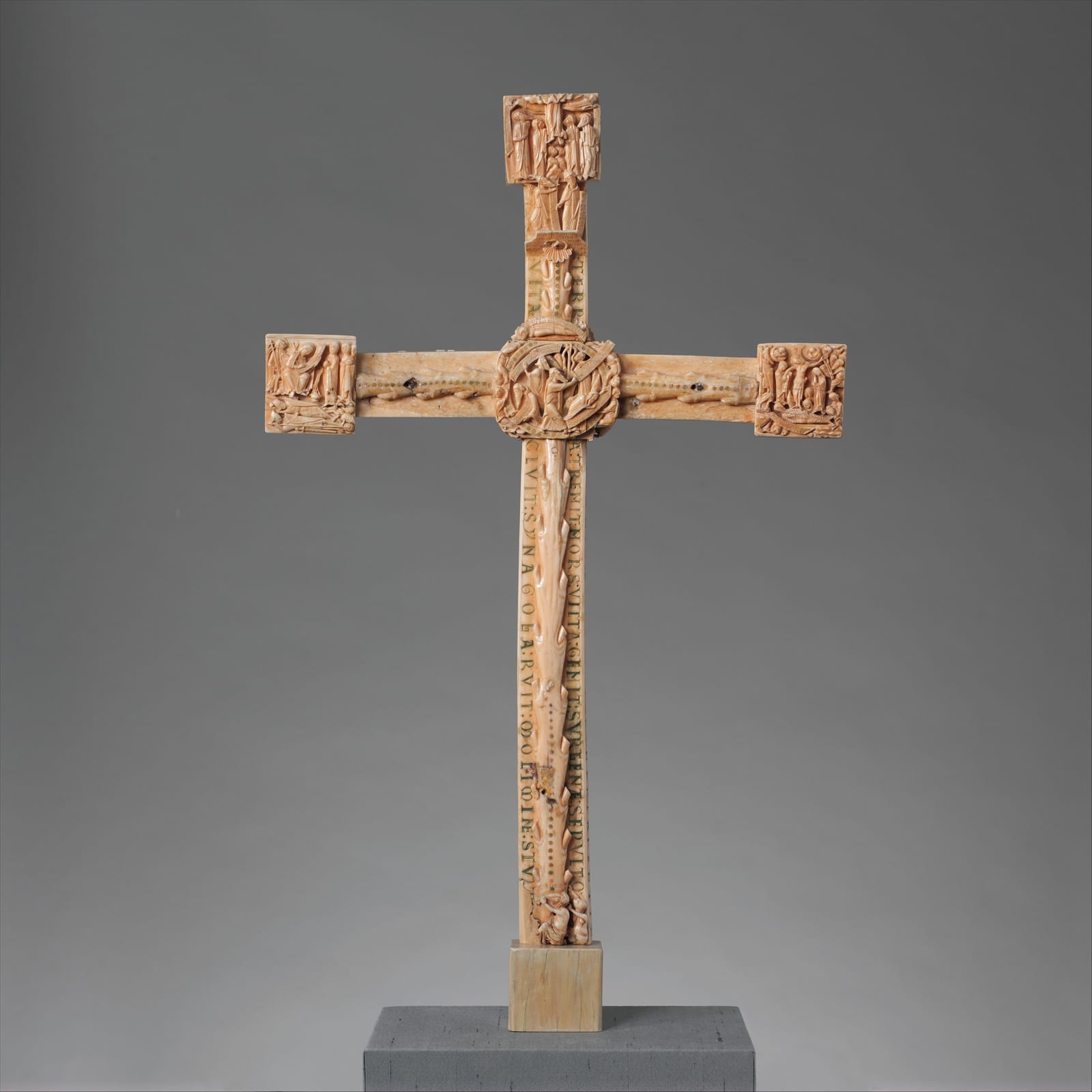
The Cloisters Cross
British, possibly from the abbey of Bury Saint Edmunds · ca. 1150–60 · Walrus ivory, 57.5 × 36.2 cm
Look for
- The stylised tree trunk running up the shaft on the front: the cross shown as a living tree.
- The lines of tiny Latin lettering along the edges of the shaft and arms, part of ninety-eight inscriptions on the two faces.
- The empty place at the foot. The bottom plaque, which carried Saint Matthew's angel, has been lost.
- How small the figures are: about a centimetre high, and there are ninety-two of them.
Transcript (1:54)
After the tapestries and the stone, this will feel tiny. The Cloisters Cross is fifty-seven and a half centimetres tall, carved from walrus ivory, and it carries ninety-two figures and ninety-eight inscriptions across its two faces. The figures are about a centimetre high. The Met calls its programme of images unrivalled in Christian art, and it is worth getting as close to the glass as you can.
On the front, the shaft is carved as the trunk of a tree laid over the cross, so that the cross becomes a living thing. The square plaques at the ends show scenes of the death and resurrection of Jesus. On the back, Hebrew prophets hold scrolls with their own words written on them, around a central medallion of the Lamb of God, which appears to be pierced by a figure personifying the Synagogue. The ends of the back carry the symbols of the Gospel writers: the lion of Mark on the left, the ox of Luke on the right, the eagle of John at the top. The bottom, where the angel of Matthew belonged, has been lost.
The cross is usually called English, carved around 1150 to 1160, and it has often been linked to the abbey of Bury Saint Edmunds in Suffolk, though some scholars think it more likely came from central Europe. Its inscriptions are the uncomfortable part, and the Met does not hide them. Several are strong attacks on Jews. The ivory figure of Christ that once hung on it is lost, but the sign at the top of the cross survives, and where the Gospels have it read King of the Jews, it has been changed to King of the Confessors. The museum's own reading is that the cross reflects the hostility to Jews widespread in England at the time; by the end of the thirteenth century they had been expelled from the country.
How it got here is a thriller. Nothing is known of it before it surfaced with Ante Topić Mimara, a Croatian collector. The British Museum wanted it but held back because he could not prove he had full title to sell it. Thomas Hoving, then associate curator here, reportedly sat up drinking coffee with Mimara until the British Museum's option ran out at midnight, and bought it on the spot for six hundred thousand dollars. It entered the collection in 1963. For an object that came down to a midnight deadline between two of the world's great museums, it is small enough to hold in two hands.
Independent guide · Chiaro
Point Chiaro at anything in The Met Cloisters.
The Treasury is the last room on our walk, not the last room with a story. Take a photo of a capital in the Saint-Guilhem Cloister, a stained-glass roundel in the Glass Gallery or a knight's tomb in the Gothic Chapel, and the app tells you what it is, where it came from, and answers the question you ask it next, out loud, on the spot.
Before you go
Getting there
99 Margaret Corbin Drive, New York, NY 10040, inside Fort Tryon Park in northern Manhattan. The main entrance has cobblestones on the approach and about 60 stairs inside before you reach the admissions desk. Visitors who need step-free access can take a free shuttle from a stop near the main entrance, and cars can drop passengers at the step-free courtyard entrance.
Ride the A train uptown to 190th Street and take the station elevator up to Fort Washington Avenue. From there you can walk the marked path through Fort Tryon Park or catch the M4 bus for one stop to the museum. The M4 also runs all the way from near Penn Station up Madison Avenue to the door, but it is a long ride, so leave extra time.
Tickets
- Closed every Wednesday, and on Thanksgiving Day, 25 December and 1 January. The doors open at 10 am; from November to February they close at 4.30 pm rather than 5.
- Adults pay $30, visitors 65 and over pay $22, students $17, and children 12 and under go free. You do not have to book, but an online ticket lets you skip the desk and walk straight to a gallery entrance.
- Your ticket also gets you into The Met Fifth Avenue, on the same day only, the one printed on it. The Cloisters sits at the far northern end of the island, so leave a generous gap between the two, more still if you go by bus.
- Anyone living in New York State pays what they like, as do students from the tri-state area, with a floor of one cent. Online, that price needs a New York State billing address; New Jersey and Connecticut students buy at the desk with their student ID.
- Take photos for your own use, without flash, but leave pens, video cameras and selfie sticks outside the galleries.
- From April to October the Trie Café serves sandwiches and drinks under the arcades of the Trie Cloister, 11 am to 4 pm.
The official audio guide
The Met publishes its own digital guide to the Cloisters at no charge, with audio tours, object notes, plant lists and video. It runs in a free app you install on your phone, and the audio can also be played in a browser at metmuseum.org/audio over the museum's free Wi-Fi. Ours cost nothing either; point the Chiaro app at whatever the Met's own tour passes by.
Official site →Questions
Is there a free Met Cloisters audio guide?
Yes, and there are two. Ours are the five above: each plays in any phone browser, with the words written out beneath it. The Met also offers its own digital guide at no cost. Stand in front of anything else, from a capital to a tomb effigy, take a photo, and the Chiaro app tells you about it.
How much is the official Met Cloisters audio guide?
Nothing. The Met's guide to the Cloisters comes in a free app, and its audio also plays at metmuseum.org/audio in your browser, over free Wi-Fi in the building.
Where are the Unicorn Tapestries in The Met Cloisters?
In Gallery 17, the Unicorn Tapestries Room, on the main floor. All seven tapestries hang there together; one of them, The Unicorn Surrenders to a Maiden, survives only as two fragments. The Merode Altarpiece is close by, in Gallery 19, the Merode Room.
Is The Met Cloisters closed on Wednesdays?
Yes. It opens six days a week and shuts every Wednesday, as well as on Thanksgiving Day, 25 December and 1 January. On open days the hours start at 10 am, with a 5 pm close from March to October and 4.30 pm in winter.
Does a Met Cloisters ticket include The Met Fifth Avenue?
Yes, but only for one day. Every ticket, the Met says, covers exhibitions and same-day entry to both of its locations on the date printed on it. Come back the next day and you need a new ticket.
How do I get to The Met Cloisters by subway?
Take the uptown A train to 190th Street and use the elevator to reach Fort Washington Avenue. Then either walk the route through Fort Tryon Park or take the M4 bus one stop to the museum's door.
More audio guides
Made by Chiaro. Not affiliated with the Met Cloisters.