
Pena Palace · Sintra · Independent guide
Pena Palace audio guide,
five stops, free.
A monastery of 1503 with a king's fantasy palace built onto it in the 1840s, inside a park of 85 hectares: hear five parts of it here, then ask Chiaro about whatever else catches your eye.
Made by Chiaro. Not affiliated with Pena Palace.
The first sight from the Main Entrance
Pena Palace, Sintra
That was the free part
Chiaro narrates anything at Pena Palace from a photo.
The five stops · 9 minutes of audio
Five places, one walk,
in the order you will walk them.
The Pena Palace audio guide here is self-guided and stays mostly out of doors, because the place repays listening less for its furniture than for its walls. You begin on the road outside the Main Entrance, where the red clock tower shows above the trees to the west, then climb the steep way up to the Monumental Gate and its drawbridge. From there the walk runs to the Triton on the terrace at the door of the New Palace, into the chapel off the Courtyard of Arches, and out along the Sentry Walk on the walls for the view north. The recordings run nine minutes or so. Allow fifteen to twenty minutes on foot for the climb, which is our own estimate, and a few minutes between each stop after that.
Dates, names and ticket details here follow Parques de Sintra, the company that runs the park and palace, at parquesdesintra.pt, with Wikipedia behind the history. Those sources sometimes differ, on what the 1755 earthquake did to the monastery for one, and the first stop says so. Should a member of staff at the gate tell you something different about access on the day, go with them rather than with your phone.

Stop 1 of 5 · Outside the Main Entrance to the Park of Pena, on the road, looking west and up over the trees
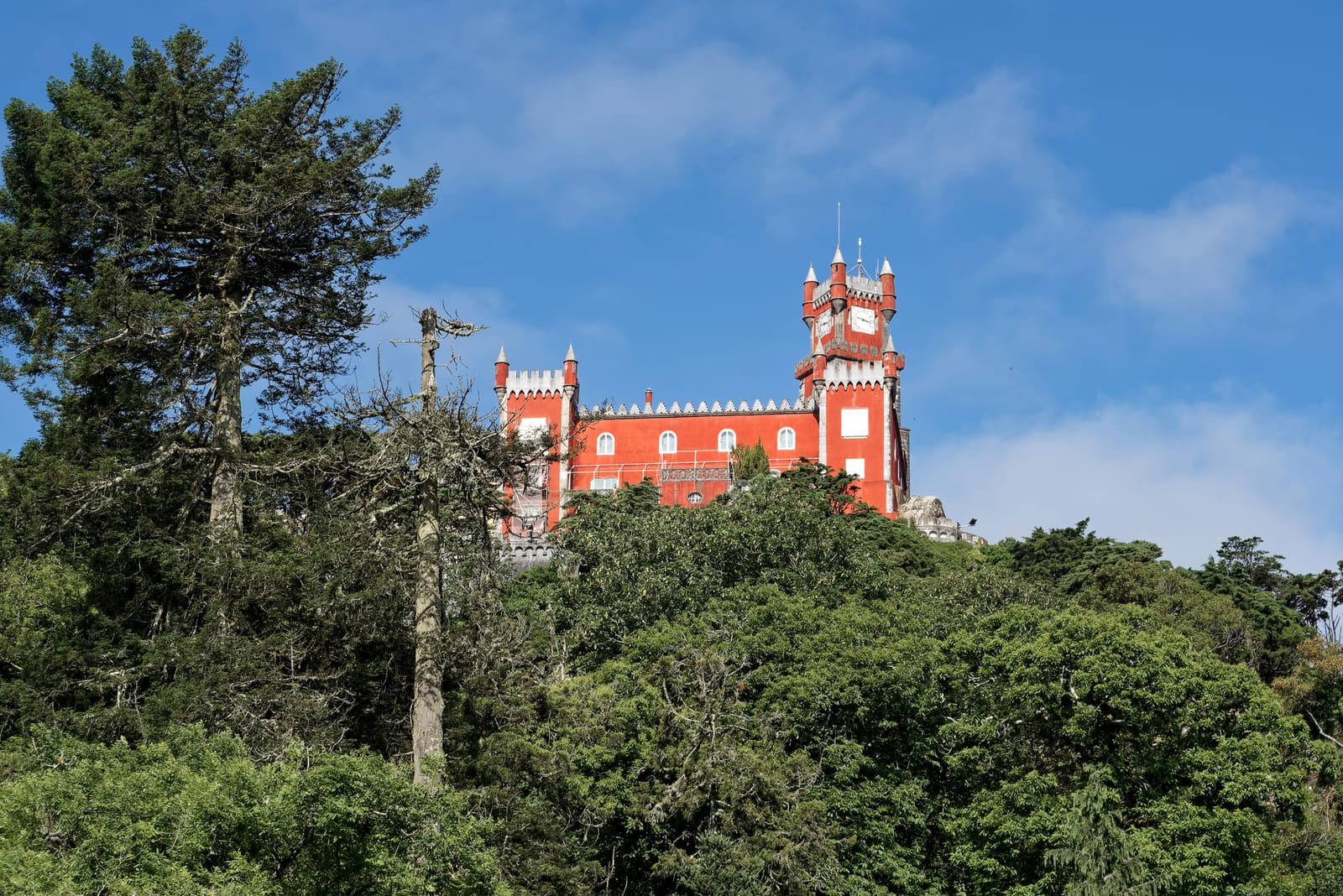
The first sight from the Main Entrance
Monastery founded by Manuel I; rebuilt for Ferdinand II (1816–1885) under Baron Wilhelm Ludwig von Eschwege (1777–1855) · Old Palace: sixteenth-century monastery, restored in the 1840s; clock tower 1843 · Painted masonry: one red wing with white battlements and a clock tower at its end
Look for
- The strip of red above the trees, with white battlements along its top. This is the old monastery wing, and the operator says the palace's outline still shows its two building phases.
- The clock tower at one end of the red wing, finished in 1843, when most of what you are about to walk through did not yet exist.
- The woods on the slope below it. They look wild and they are not: Ferdinand laid out these paths himself and planted trees from every continent.
Transcript (1:42)
Before you have gone through a single gate, the palace has already shown itself. Look west and up, over the treetops, and you should find a strip of strong red with white battlements along the top and a clock tower at one end. The trees hide nearly everything else. That is a fair introduction, because this red wing is the old part of the story, not the new one.
It was a monastery. People were climbing this hill long before there was any palace: a chapel stood up there by the twelfth century, after reports that Our Lady had appeared on the summit. In 1493 King John the Second came up with his wife Leonor to fulfil a vow, and in 1503 Manuel the First ordered a monastery on the spot, which went to the Order of Saint Jerome. It stayed tiny, with eighteen monks at the very most.
Then the bad luck began. Lightning did serious damage in the eighteenth century, and after that came the Lisbon earthquake of 1755. How bad that was depends on who you ask. The company that runs the palace today says the earthquake damaged the building without destroying it, and other accounts say it left ruins. Everybody agrees on the ending. The religious orders were dissolved in 1834, the monks left, and four years later a ruin on a crag was bought, with his own money, by a Vienna-born prince in his early twenties. He was Ferdinand of Saxe-Coburg and Gotha, husband of Queen Maria the Second of Portugal, and what you can see above those trees is what he did next.
He bought the hillside too, and the woods in front of you are his as well. They look as if they simply grew here. In fact he drew these twisting paths and planted trees from every continent, across 85 hectares.
Do not trust old photographs of the colour. The red and yellow faded over the years until the palace was known as a grey building, and the colours came back only with a repainting late in the twentieth century. On a clear day the palace can be seen from Lisbon. From where you are it is only a few hundred metres off, nearly all of them uphill.

Stop 2 of 5 · Monumental Gate, at the top of the climb from the Main Entrance
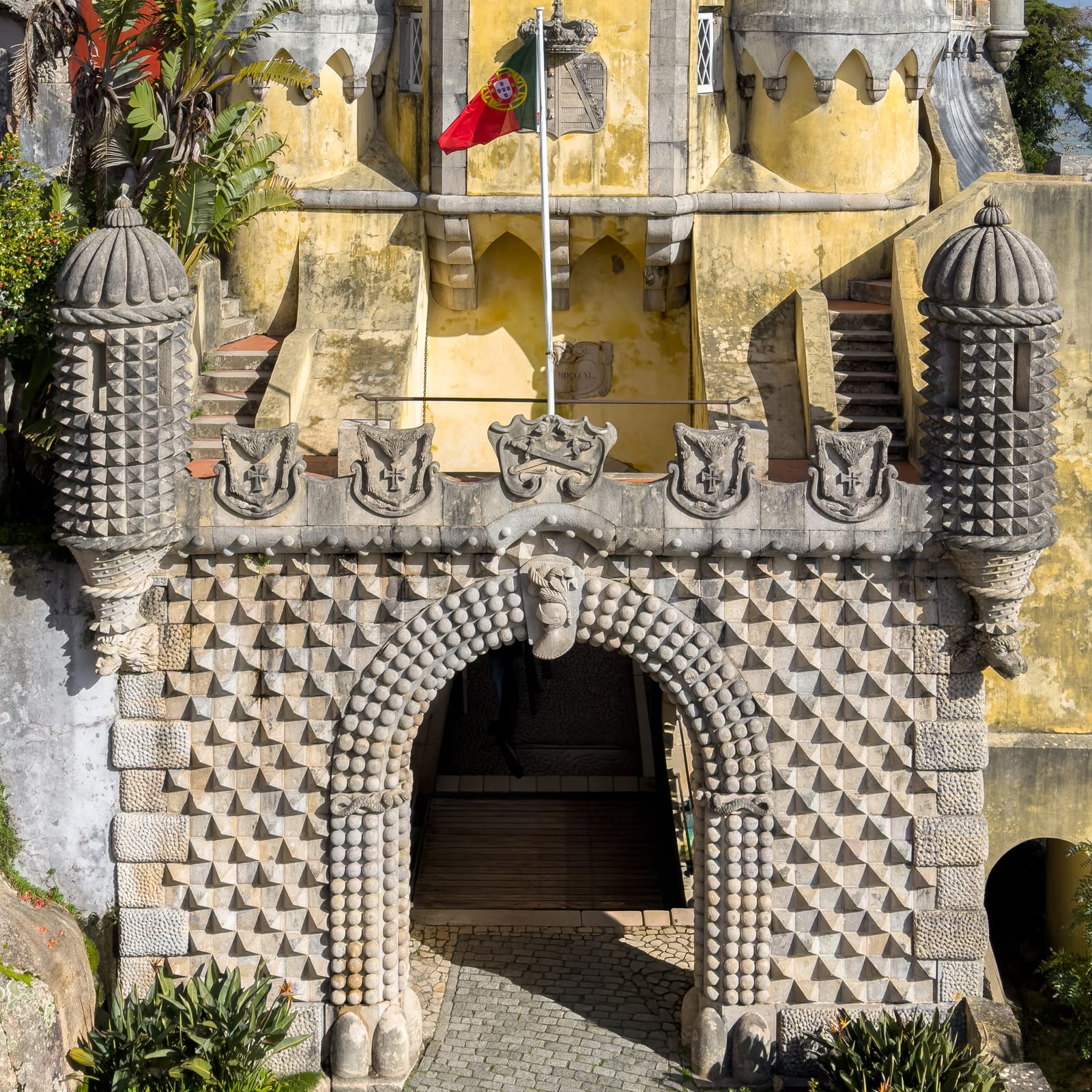
The Monumental Gate and drawbridge
Built under the supervision of Baron Wilhelm Ludwig von Eschwege (1777–1855) for Ferdinand II (1816–1885) · Mid-nineteenth century, in the manner of the sixteenth · Carved stone: one arch, two sentry boxes and five shields along the top
Look for
- The wall of diamond points around the arch, copied from the Casa dos Bicos in Lisbon.
- The rows of stone spheres framing the opening, a quotation from the Cunhal das Bolas in Lisbon's Bairro Alto.
- The two domed sentry boxes at the corners, modelled on those of the Tower of Belém.
- The snarling beast's head carved under the sentry box, one of the many creatures that guard nothing here.
Transcript (1:45)
Get your breath back and take a proper look at this gate, because it is a joke with a very straight face. It is built like the way into a fortress, and it has never kept anybody out. The man who paid for it was a musician and a draughtsman, and the man who ran the building work was a mineralogist and mining engineer called Baron von Eschwege, an amateur architect who had travelled widely. Neither of them was defending anything.
The gate is a collection of quotations, and once you know that it reads almost like a scrapbook of Portugal's sixteenth century, the same century as the monastery behind it. Start with the wall around the arch, all those diamond-shaped points. They imitate the Casa dos Bicos in Lisbon. Next, the bands of stone balls running round the opening: those come from the Cunhal das Bolas, a house in Lisbon's Bairro Alto. Now the two little domed sentry boxes at the corners. Anyone who has been to Belém has seen them already, because they are modelled on the ones on the Tower of Belém. Look along the arch itself as well, where the operator points out a design of interlacing serpents.
What Ferdinand was doing here matters. He had a Germanic education, and his architect probably knew the castles of the Rhine, but the details on this gate are insistently Portuguese. A foreign consort was building himself a castle in the local language.
The original plan was only to restore the monastery as a summer house. Enthusiasm took over. So the old building acquired parapet walks, lookout towers, an access tunnel and this drawbridge, which you can walk onto straight after the arch. There is a real question in that. Why would a holiday home need a drawbridge? The answer, on the operator's own account, is that nothing here had a military purpose at all, and the whole palace was built for pleasure.
Higher up you will pass one more borrowing, a horseshoe arch with tiles inspired by the Gate of Justice at the Alhambra in Granada. But first the drawbridge, and then a tunnel that carries you up to the patios, so that you arrive at this fantasy from underneath, like an actor coming up through a stage.

Stop 3 of 5 · Triton's Terrace, at the entrance to the New Palace wing, facing the arch
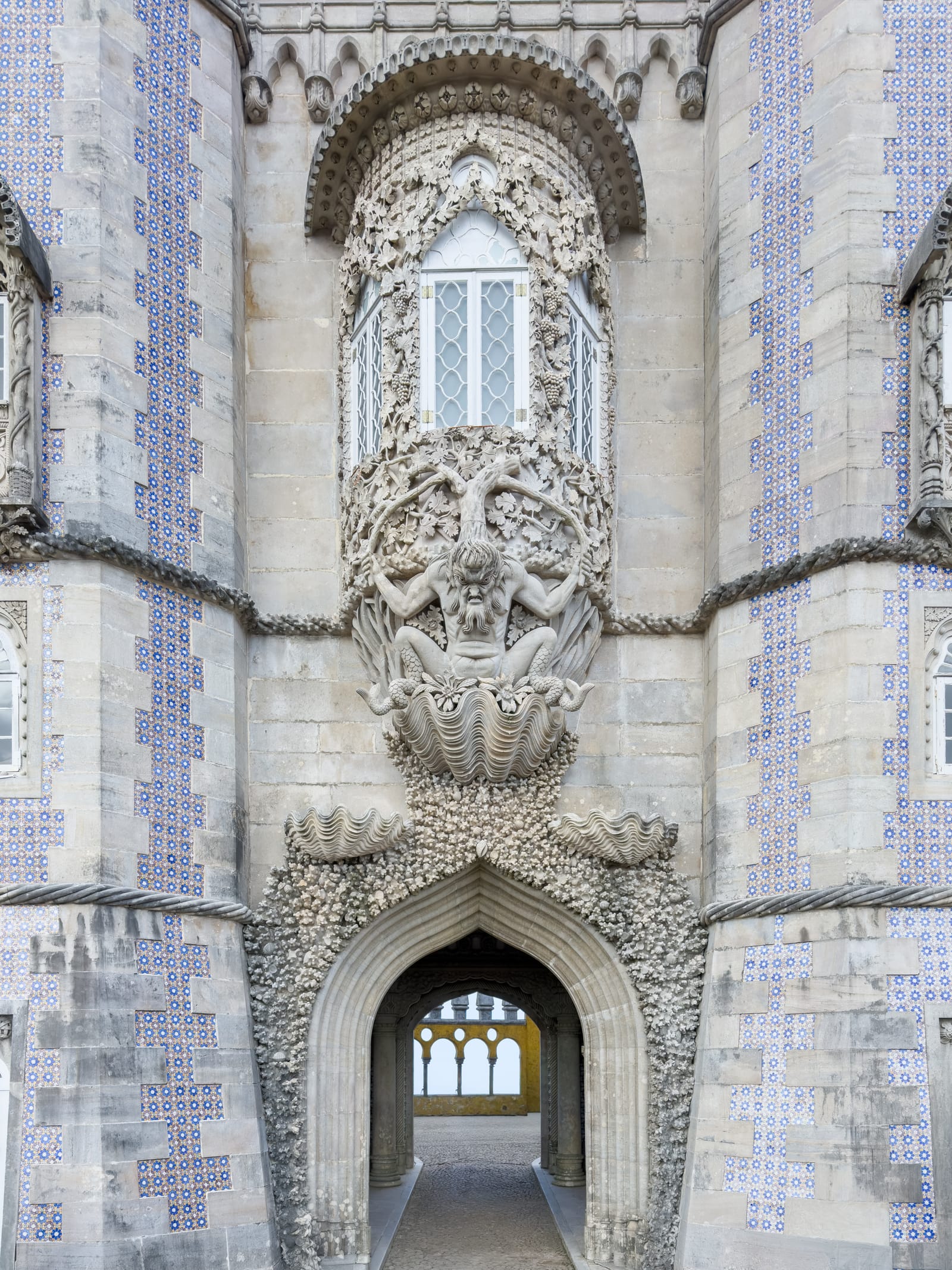
The Triton on Triton's Terrace
Designed by Ferdinand II (1816–1885), the carver unrecorded · Within the New Palace works of 1842 to 1854; the palace was largely complete by 1847 · Carved stone: three shells on a coral arch, a bay window above, framed by patterned tile
Look for
- The lower half: a pointed arch crusted with coral, holding up three shells, with the Triton sitting on the middle one.
- The tree growing straight out of the top of his head, which turns into the vines covering the window above. That is the moment sea becomes land.
- His beard and hair. A passage in Camões describes a sea creature with a beard that never knew a comb, and the operator suggests the carving may recall it.
- The yellow arches showing through the tunnel at the bottom. That is the Courtyard of Arches, and the next stop.
Transcript (1:43)
You have seen this on a thousand postcards, and it still manages to be odder than they suggest. Stand back far enough to get the whole gateway in, because it needs reading from the bottom up.
The arch at the bottom is Gothic in shape, but the stone around it has been crusted over with coral, as if the building had spent some time on the sea bed. On top of the coral sit three great shells. On the middle one crouches the Triton, half man and half fish, with scaled legs and a furious beard, and his arms are raised to hold up the entire window above him.
Now look at his head. A tree grows straight out of it. The trunk divides, the branches spread, and they turn into grape vines that wrap the window. Below the waist you are under water, and above the head you are on land. The operator reads the gateway exactly that way, as divided between the aquatic world and the terrestrial one. Ferdinand's own name for it, according to Portuguese accounts, was an allegorical portico of the creation of the world, and he designed it himself. I would take that at his word. This was a man trained from childhood in drawing, whom the country came to call the Artist King, and this is the place in the whole palace where you can see him enjoying himself most.
He was also quoting again. The bearded figure is a deliberate echo of the man carved beneath the great window at the Convent of Christ in Tomar, famous across Portugal, except that here the bearded man of Tomar has become a monster. Ferdinand sent an artist called Nicolau Pires to Tomar to draw that window, and a freer copy of it sits on the far side of this same block. You will see it from the courtyard, and the operator credits it with launching the Neo-Manueline style in Portugal.
There may be a literary source as well. In the sixth canto of The Lusiads, Camões describes a sea god with a bushy beard and hair that never knew the smoothing comb, with seaweed dangling round his shoulders. Nobody can prove that is who this is. But look at that beard once more, then walk underneath him, through the tunnel he is sitting on.

Stop 4 of 5 · The Chapel, opening off the Courtyard of Arches, facing the main altar
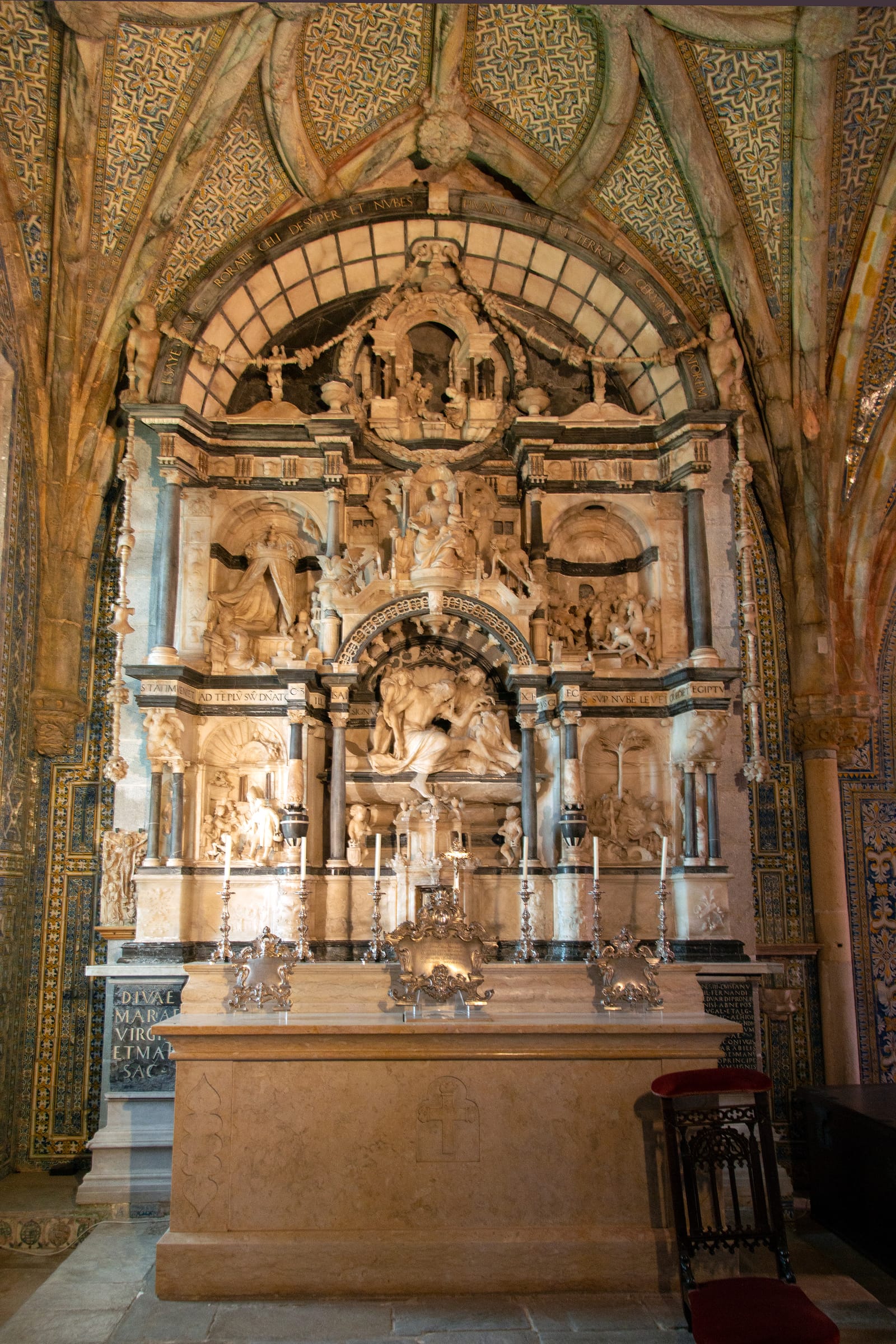
The Courtyard of Arches and the chapel altarpiece
Nicolas Chanterene (about 1485–1551), for John III; window by the Kellner workshop of Nuremberg, for Ferdinand II · Altarpiece 1529–1532; window 1840 · Alabaster and limestone from the Sintra region, carved in tiers of small scenes
Look for
- The altarpiece itself, pale stone carved in tiers of small scenes, far finer work than a monastery this size had any right to.
- The stained-glass window behind you, on the wall opposite the altar. Ferdinand put it in, and the operator dates it to 1840 and says it expresses the political legitimacy the palace rests on.
- The patterned tile lining the walls, which turns the chapel into a kind of richly decorated box.
Transcript (1:48)
Out in the courtyard nearly everything dates from the 1840s. In here, for the first time on this walk, you are inside the real thing. This room was the church of the monastery, the part of the old building that Ferdinand adapted and kept. Look towards the altar, because the reason to come in is at the far end.
That pale carved wall is the altarpiece, in alabaster and in limestone from these same Sintra hills. It was worked on between 1529 and 1532 by Nicolas Chanterene, a sculptor of French origin who made his career in Portugal, on a commission from King John the Third, the son of the king who founded this house. Think about how odd that is. This was a remote hilltop community of eighteen monks at the most, and the king himself commissioned its altarpiece. Tier upon tier of little scenes are cut into it, and the longer you look, the more small figures turn up.
This church was open to outsiders as well as to the monks. The faithful came up by the Pilgrims Way, even though it was never a parish church, until the religious orders were abolished. When you go back outside, look through the arches of the courtyard and down: the old Pilgrims Way can still be made out below them.
Accounts of the 1755 earthquake differ over how much of this chapel it spared, though they agree on the altar end, and the altarpiece is certainly still here. Ferdinand understood what he had inherited. Now turn around and look at the wall behind you, at the stained glass. The operator dates it to 1840, as his work on the hill was beginning, and names the Kellner workshop in Nuremberg as its maker. It also says plainly that this glass expresses the political legitimacy the palace rests on. You can see the same idea in a piece of Kellner glass at Pena dated 1841. It shows King Manuel the First, founder of the monastery, in gilded armour, with what looks like a little model of the monastery in his left hand. So a foreign prince, more than three centuries after the founding, was ordering the founder in coloured glass, holding the building.

Stop 5 of 5 · Sentry Walk, on the palace walls, looking north towards the Moorish Castle
The view from the Sentry Walk
Built under the supervision of Baron von Eschwege for Ferdinand II; the Moorish Castle opposite founded under Islamic rule · Mid-nineteenth century · Stone parapet path with battlements, running around the palace walls
Look for
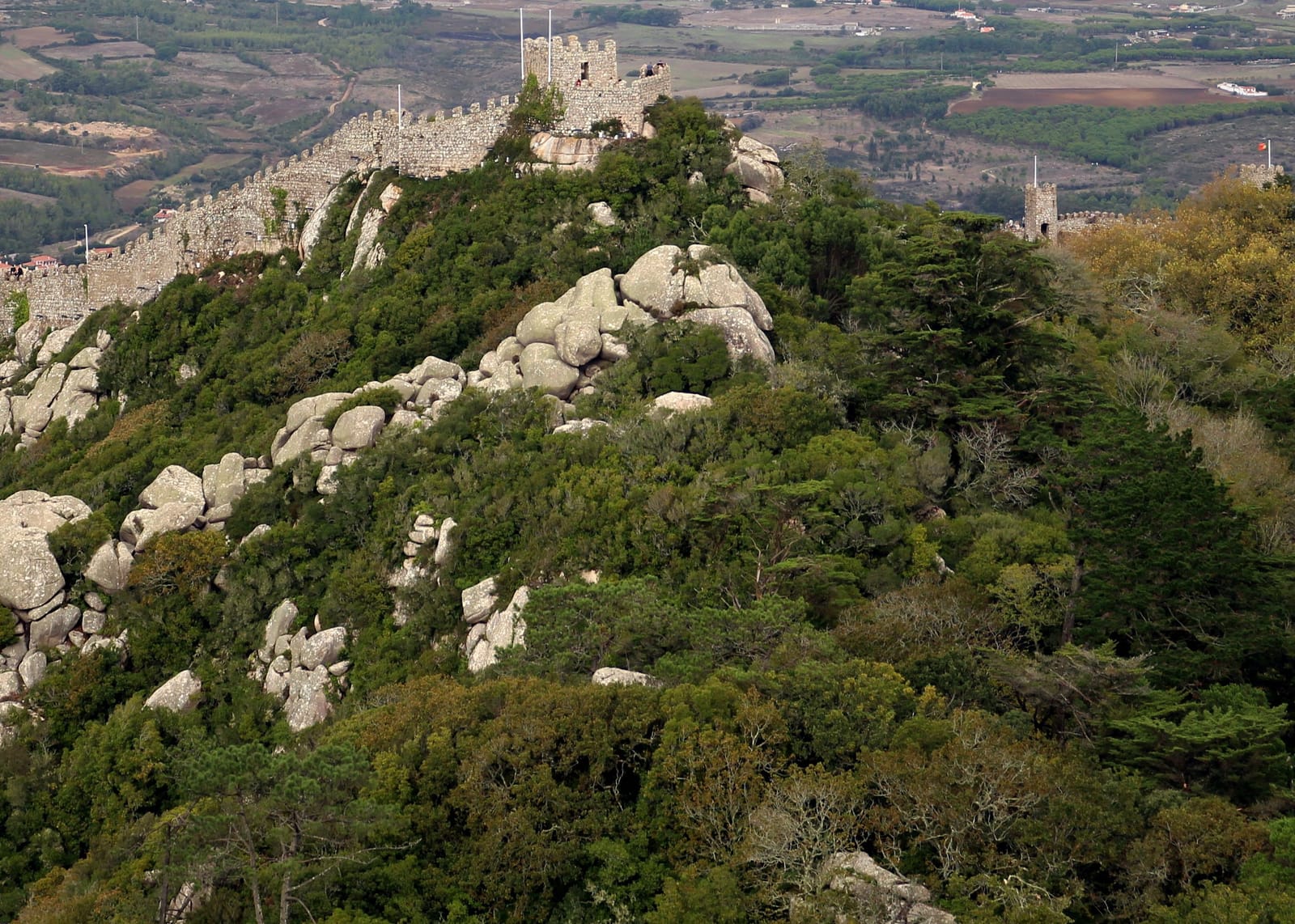
- The Moorish Castle's walls running along the next ridge to the north. Ferdinand bought those too, in 1838, and later had them restored.
- The Convent of Mafra, far off to the north. Queen Amelia left for it on 5 October 1910.
- The line of the coast and the beaches of Sintra and Ericeira. On very clear days the view carries as far as the Berlengas Islands.
Transcript (1:41)
Every proper castle has one of these: a path around the top of the walls, so that the garrison can watch the country in all directions. This castle never had a garrison. The Sentry Walk had no military purpose whatever, and on the operator's own account its true function, like that of the whole palace, was pleasure. So walk it the way it was meant to be walked, slowly, looking at what the king wanted you to look at.
Start to the north, with the long line of medieval wall on the next ridge. That is the Moorish Castle, built under Islamic rule more than a thousand years ago and already a ruin when Ferdinand bought it along with this hill in 1838. He went on to restore it as well, so even the view from his fake castle is partly his own work on a real one. Beyond it the land drops away to farmland, and on a good day you can follow it out to the Convent of Mafra in the north, and to the beaches of Sintra and Ericeira along the coast. On very clear days the view runs as far as the Berlengas Islands, out in the Atlantic.
Keep those two names in mind, Mafra and Ericeira, because the palace's last royal story runs straight across this view.
Queen Amelia loved Pena, and it became her favourite of all the palaces. After her husband King Carlos and their elder son were murdered in Lisbon in 1908, she withdrew here more and more, with her friends and her dogs. When revolution broke out in October 1910, she climbed to the palace terraces with her party, looking for signs of the fighting in Lisbon. On the fifth of October the news reached her here that a republic had been declared. She left for Mafra, to join her mother-in-law and her son, the young King Manuel. From there they went to Ericeira, boarded the royal yacht and sailed for Gibraltar. The monarchy of Portugal, in other words, left by the route your eye has just followed.
She did come back, in 1945, as a visitor. She asked to be alone in the palace for a few minutes.
Independent guide · Chiaro
Point Chiaro at anything at the Pena Palace.
Ferdinand's hill is full of things our five stops walk past: the stags' heads with real antlers, a sundial wired to fire a cannon at noon, tree ferns from the far side of the world in the Queen's valley. Out on the terraces or in the park, hold your phone up to a tile, a gargoyle or a tree you cannot place, and Chiaro names it, says whose idea it was, and keeps answering for as long as the climb back down can wait.
Before you go
Getting there
Park of Pena, in the hills above Sintra. There are two ways in. The Main Entrance, where this walk starts, is at GPS 38º 47' 16.45" N, 9º 23' 15.35" W, and the Lakes Entrance is at 38° 47' 21.4" N, 9° 23' 31.9" W.
From Lisbon, take the Sintra Line train from Oriente, Rossio or Entrecampos to Sintra, then Scotturb bus 434 from the station or the Lourel car park up to Pena. Private vehicles may not drive to the palace, so if you come by car, leave it in Sintra's historic centre or a peripheral car park. Marked walking trails also climb from the town.
Tickets and entry
- Four tickets matter. The park ticket, 12 euros for an adult, covers the park and the Palace Terraces, with the kitchen and the chapel, and that reaches every stop on this page. The Essential Visit, 20 euros, adds the New Palace rooms. The Complete Visit, 45 euros, adds the Private Apartments, including the Manueline Cloister. The guided visit covers the same palace areas with a guide.
- A palace ticket is sold for a set date and a set time, and it gives one entry. Entry to the palace is at your scheduled time only. A park ticket has a date but no time slot. The operator does not allow image capture inside the palace, so save the camera for the terraces and the park.
- The operator gives the park as open 09:00 to 19:00, last admission 18:00, and the palace as 09:30 to 18:30, last ticket 17:30 and last admission 18:00. Look at parquesdesintra.pt/en/plan-your-visit/opening-times-and-prices/ for your date.
- The way up from the Main Entrance is steep. A small transfer runs between the entrance and the palace at 4.50 euros return. It is sold as an add-on with an entry ticket, or on the transfer itself, where cash is not accepted. The park ticket page lists only the park's hop-on circuit as a supplement, so with that ticket plan to pay on board.
The official audio guide
Parques de Sintra has its own audio guide, Zoomguide, which runs on your phone at zoomguide.app in Portuguese, English, Spanish and French, with content by its researchers and curators, and it covers the palace and the Chalet of the Countess of Edla. The operator lists it among free digital resources on its Complete Visit page, and advises downloading the content before you go. It also sells a 90-minute guided visit, at 75 euros for an adult. Our five recordings do a smaller job: the outside of the building, what the king meant by it, and a printed transcript beneath each player.
Official site →Questions
Is there a free Pena Palace audio guide?
Yes, right here: five recordings on the palace's outside and its chapel, with no download. The operator's Zoomguide is another, running on your phone, listed among its free digital resources, and covering the palace and the Chalet of the Countess of Edla.
Can I listen to the Pena Palace audio guide without a ticket?
Nothing stops you playing them at home, and stop one belongs on the road outside the Main Entrance, before any ticket. The other four are inside the park, so you need at least the park ticket to stand in front of them.
How much is the official Pena Palace audio guide?
The operator prints no price for Zoomguide and lists it under free digital resources on its Complete Visit page. Its human alternative, the 90-minute guided visit with a cultural mediator, costs 75 euros for an adult and includes the transfer up to the palace.
Does the cheapest Pena ticket get me inside the palace?
Only partly. The 12 euro park ticket reaches the terraces, the Sentry Walk, the kitchen and the chapel, but not the state rooms. For those you need the Essential Visit at 20 euros, which comes with a set entry time, and the private apartments and Manueline Cloister need the Complete Visit at 45 euros.
Where should I start at Pena, and can I drive up?
Start at the Main Entrance to the park, which bus 434 serves from Sintra station. You cannot drive up, because private vehicles are not allowed to the palace. From the entrance the road is steep, so walk it or pay for the small transfer.
Is Pena Palace ever closed?
Christmas Eve, Christmas Day, New Year's Eve and New Year's Day are the regular closures here. The operator warns of occasional closures for State events, fire risk in the hills or extreme weather, so a windy or very dry day is worth a look at its site.
More audio guides
Made by Chiaro. Not affiliated with Pena Palace.