
Jerónimos Monastery · Lisbon · Independent guide
Jerónimos Monastery audio guide,
five stops, free.
A side door 32 metres high and a cloister 55 metres square, walked in an order that reaches the timed cloister ticket only at the fourth stop; photograph whatever this page skips and the Chiaro app explains it.
Made by Chiaro. Not affiliated with the Jerónimos Monastery.
The south portal, from Praça do Império
Jerónimos Monastery, Lisbon
That was the free part
Chiaro narrates anything at the Jerónimos Monastery from a photo.
The five stops · 10 minutes of audio
Five places, one walk,
in the order you will walk them.
Three stops of this Jerónimos Monastery audio guide cost nothing, because the monument splits in two: the church is free and only the cloister is ticketed. So this self-guided walk starts outside on the Praça do Império side, facing north at the south portal; goes round to the church's west end, in under the upper choir, for Vasco da Gama and Camões; continues east up the central aisle beneath the single vault as far as the High Chapel and its elephants; and then goes back to the reception, on a ticket with a set entry time that is best bought in advance, for the cloister's ground floor, followed by its first floor, the place to finish. Allow about ten minutes of listening; the walking barely adds to that, since all five sit in one long building.
The history comes from the account the monastery's management publishes at mosteirojeronimos.torrebelem.gov.pt, with Wikipedia behind it; where they differ on a date or a count, this page goes with the monastery. Two sets of hours apply and the monument can shut for occasions of the Portuguese State, so look at that site's visit page before you cross Lisbon. A notice on the door beats this page; please write and say what it told you.

Stop 1 of 5 · Outside, on the Praça do Império side, in front of the south wall of the church, facing north
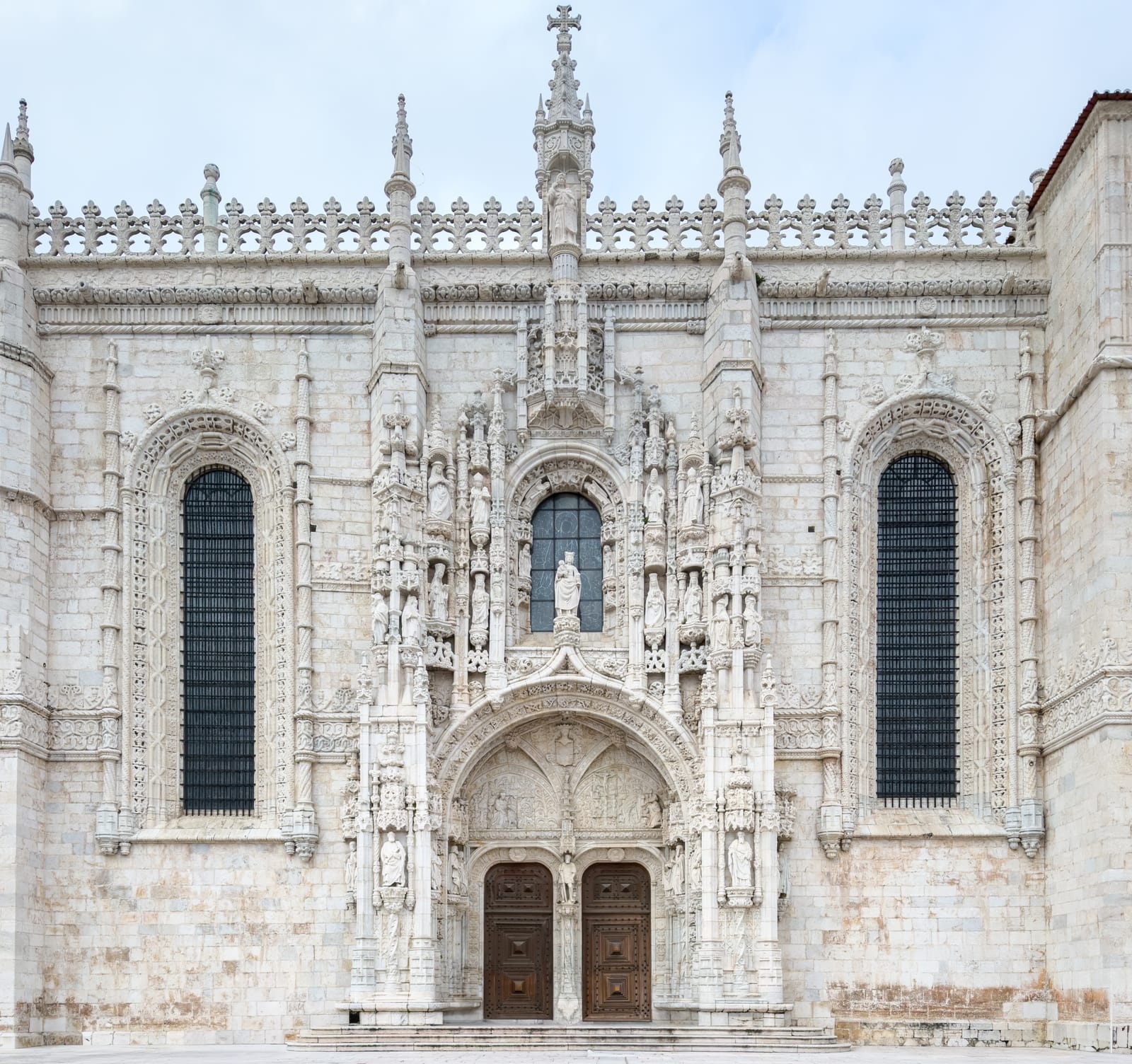
The south portal, from Praça do Império
João de Castilho (c. 1470–1552), for King Manuel I · 1517–1518 · Lioz limestone, 32 metres high and 12 metres wide
Look for
- Prince Henry the Navigator on his pedestal between the two doors. In 1459 he ordered the enlargement of the small chapel that stood on this ground.
- The left-hand scene over the doors: Saint Jerome taking the thorn from the lion's paw. The Order of Saint Jerome is the reason for the name Jerónimos.
- The stone itself, once you are close enough. It is lioz, a pale local limestone known for how many fossils it holds.
- The long wing to your left. Its look is largely nineteenth-century, and its central section fell in 1878 while it was being built.
Transcript (1:50)
Stay out here for a few minutes, with the gardens at your back and the river somewhere behind them. You are facing north, and what rises ahead is the south side of a church. The carved panel in the middle of it stands 32 metres high and 12 metres across, and it is a side door. The front of this church is round the corner on your left, at the west end, and it is smaller.
João de Castilho put this up between 1517 and 1518. He came from Cantabria in the north of Spain, and he took over the works from the first architect, Diogo de Boitaca, whose name at that point simply disappears from the documents.
Read it from the top down. Saint Michael the Archangel stands at the summit. Over the arch, in front of the window, Our Lady of Belém holds the Child, with prophets, apostles, Doctors of the Church, virgins and sibyls packed in around her. Belém is the Portuguese for Bethlehem, and that is the whole idea of the place. The foundation stone was laid on the sixth of January, in either 1501 or 1502, the feast of the Three Wise Men, who came from different parts of the world carrying gifts. Between the two doors stands Prince Henry the Navigator, who in 1459 ordered the enlargement of a small chapel on this spot. Above the left-hand door Saint Jerome pulls the thorn from the lion's paw; above the right, he is alone in the desert.
That old chapel is why any of this is here. Vasco da Gama kept vigil in it on the seventh of July 1497, on the eve of sailing for India. Then the voyages started paying. King Manuel the First funded this building from a five percent tax on trade from Africa and the Orient, equal to about 70 kilograms of gold a year.
Now look left, along the long pale wing running west. Much of its face is nineteenth-century work, given a new appearance by two men born in Italy, Rambois and Cinatti, who were set designers at the São Carlos Theatre. In 1878, while it was still being built, the central section collapsed and killed ten workers. The gap they left in that long front was filled in, and you are looking at the repair.

Stop 2 of 5 · Church, west end, under the upper choir: Camões on the right as you come in, Vasco da Gama on the left
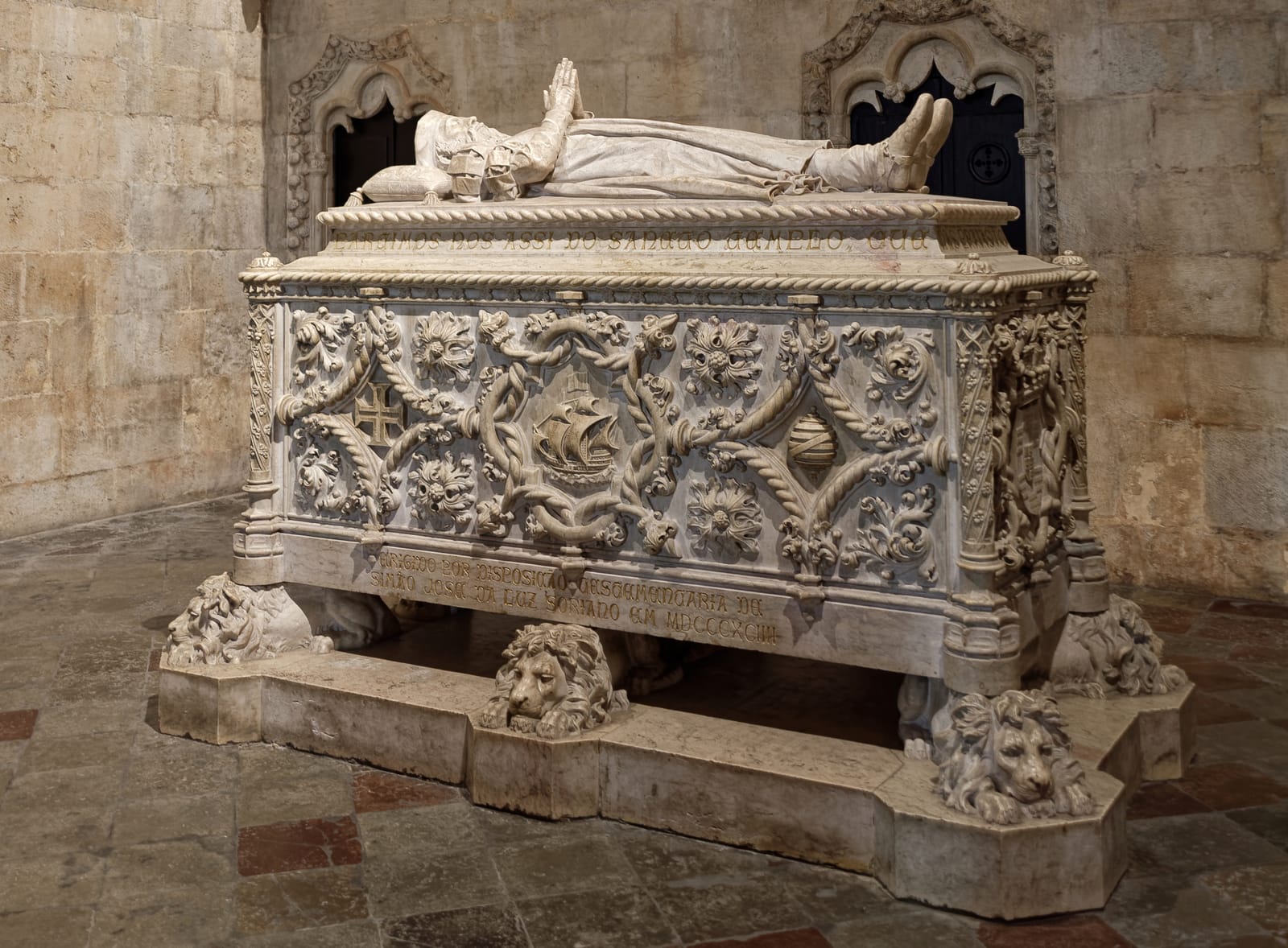
The tombs of Vasco da Gama and Camões, under the upper choir
António Augusto da Costa Motta the elder (1862–1930) · Remains brought to the church in 1880; da Gama's chest inscribed 1894; moved here around 1940 · Carved stone tomb chests with recumbent effigies, da Gama's carried on crouching lions, either side of a church 19 metres wide
Look for
- The gold lettering along the lid of da Gama's tomb: Partimos nos assi do sancto templo. It is a line from Os Lusíadas about leaving this very shore.
- The ship in the middle of da Gama's chest, between the Cross of the Order of Christ and an armillary sphere.
- The plinth inscription naming Simão José da Luz Soriano, whose will had the tomb put up, with the date 1894 in Roman numerals.
Transcript (2:07)
The ceiling is low here because you are standing underneath the monks' upper choir, at the west end of the church. As you come in, Luís de Camões lies on your right and Vasco da Gama on your left, in two carved chests that have been in this corner only since around 1940. Before that they stood out at the crossing. The doorway at this end of the building, by the way, is the work of Nicolau Chanterene, from 1517, and it is considered the first work of the Renaissance in Portugal.
Go to da Gama first. On the side of the chest, the ship sits in the middle, with the Cross of the Order of Christ on one side and an armillary sphere on the other. Then read the gold letters running along the lid: Partimos nos assi do sancto templo. That line is by the man across the aisle. It comes from the fourth canto of Os Lusíadas, Camões's epic of 1572, and in it da Gama describes his fleet leaving the holy temple on the shore, named for the land where God came into the world. Which means this place. The poet's words sit on the sailor's tomb, in the church that replaced the chapel they describe.
Now the awkward part. Da Gama was buried first at Saint Francis Church in Kochi, and his remains came home in 1539 to Vidigueira, in a casket decorated with gold and jewels. In 1880, for the three hundredth anniversary of Camões's death, what were believed to be da Gama's bones were brought here. By 1884 one of the men who had campaigned for the move, Teixeira de Aragão, found documents suggesting the wrong remains had been dug up. Only in May 1898 were the remains from the other tomb in that chapel at Vidigueira brought to this monastery as well.
Camões is harder still. He lost an eye at Ceuta and, as tradition says, survived a shipwreck near the Mekong, saving only himself and his manuscript. He died in Lisbon on the tenth of June 1580, which Portugal now keeps as its national day. His burial was a poor one, and after the earthquake of 1755 the searches for him found nothing. The monastery's own account says his remains rest in this chest. Others are far less sure: in the words of one account, the bones of 1880 are in all probability someone else's.
Before you leave, look low on da Gama's plinth for the second inscription. It names Simão José da Luz Soriano, whose will had the tomb put up, and it ends in Roman numerals that read 1894.

Stop 3 of 5 · Church, the central aisle, walking east from under the upper choir to the High Chapel
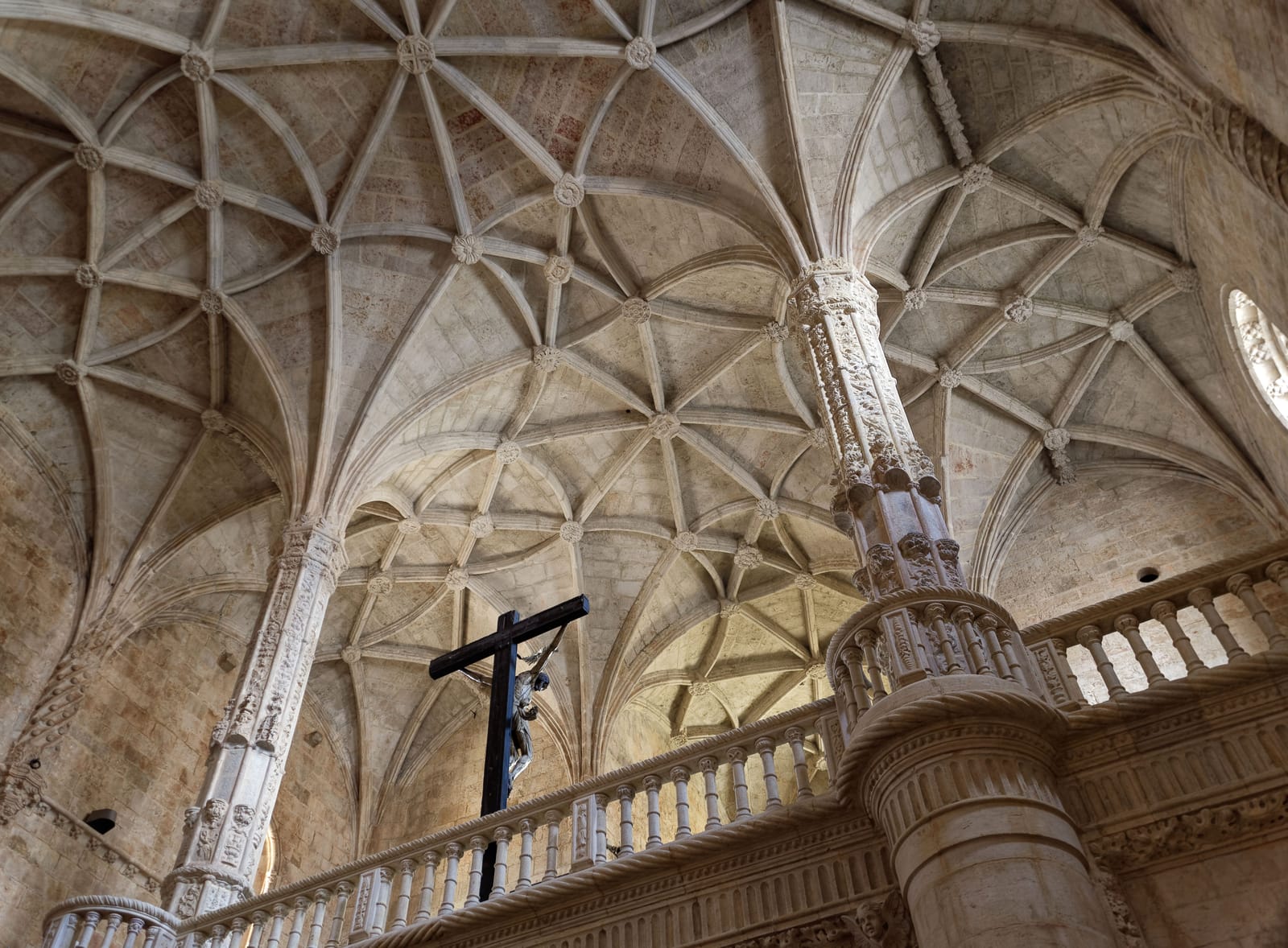
The nave and its single vault
Diogo de Boitaca (died 1528) and João de Castilho (c. 1470–1552); High Chapel by Jerónimo de Ruão (died 1601) for Queen Catherine · Church from 1502; vault after 1517; High Chapel after 1557, complete by about 1572 · Lioz limestone vault 19 metres wide on octagonal piers 25 metres high; High Chapel in Estremoz marble
Look for
- The ribs of the vault, running without a break over all three aisles. That single roof is what sets this church apart.
- The medallion on the northern pier nearest the crossing, possibly a portrait of one of the two architects.
- The marble elephants under the royal tombs in the High Chapel, for the power and the Indian empire of that reign.
- The crucifix on the upper choir when you turn back west, carved by Philippe de Vries in 1551.
Transcript (2:09)
Walk out from under the choir and the roof goes away. Stop in the central aisle, face east towards the distant altar, and tip your head back.
That is a single vault overhead. There are three aisles down here, but they are all the same height, and one low net of stone ribs runs across all three without a break, 19 metres from wall to wall, carried on octagonal piers that rise 25 metres. The monastery's own history says that no other European church of the sixteenth century reached this kind of uniformity within this type of building, and from where you stand you can see why it says so. Diogo de Boitaca began the church and took its walls as far as the cornice. João de Castilho closed it, and he is the one who covered those piers in carved plants and grotesques, thin enough to look like they should not be holding anything.
They held. The earthquake of 1755 destroyed most of Lisbon, and here it took the balustrade and part of the upper choir, which were soon repaired.
Keep walking to where the aisles end. The crossing is the boldest thing in the building: a vault about 30 metres across, with no supports in between. Boitaca had planned three bays here, and Castilho's design of 1522 did without them, which is why it looks as if it has been left hanging. On the northern pier nearest this crossing, your left as you face the altar, look for a carved medallion. It may be a portrait of one of the two architects, and nobody can say which.
Now the altar end, and a change of taste. Queen Catherine had the High Chapel rebuilt after 1557, complete by about 1572, in Estremoz marble rather than the local stone, to a design by Jerónimo de Ruão that breaks completely with everything you have just walked through. It is plain, cool and classical. Along its sides lie King Manuel the First, Maria of Aragon, King John the Third and Catherine herself, every tomb carried on the backs of marble elephants, the animals of the Indian empire that paid for the roof above them.
Another pair of elephants waits in the chapel at the south end of the transept, on your right. They hold up the tomb of King Sebastian, who was killed at twenty-four at Alcácer Quibir in Morocco on the fourth of August 1578. Philip the Second of Spain had the remains brought here in 1582. It made no difference. People went on believing for centuries that the king had not died at all, and that he would come back on a foggy morning to save Portugal.

Stop 4 of 5 · Cloister, ground floor, beyond the reception; begin in the gallery along the church wall
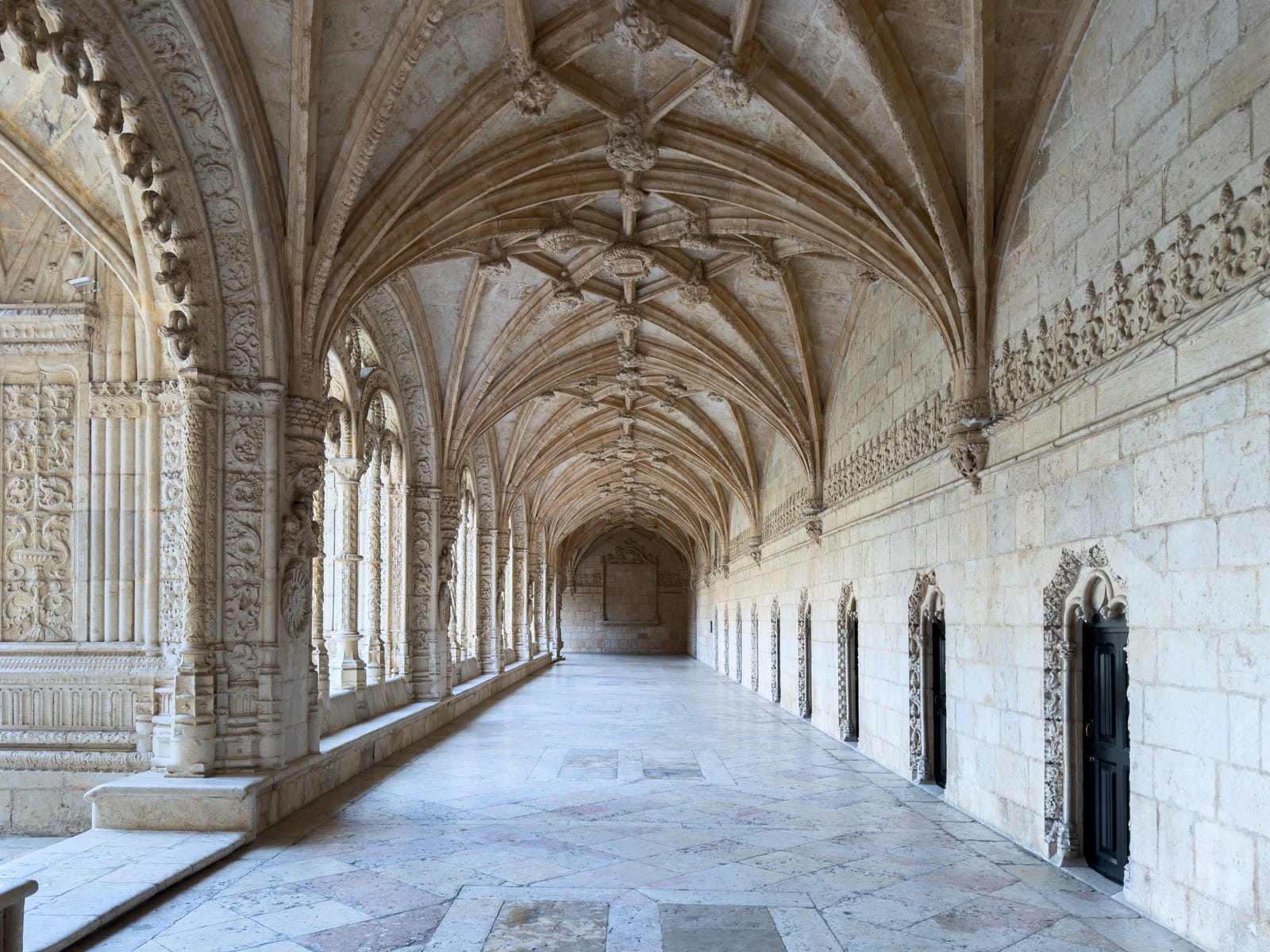
The cloister's ground-floor gallery
Planned and begun by Diogo de Boitaca (died 1528), carried on by João de Castilho (c. 1470–1552) · From about 1502; restored in the nineteenth century · Lioz limestone tracery vaults around a square of 55 by 55 metres, with the inner corners cut off
Look for
- The ten small carved doors in the church wall. Each opened on a confessional, with the monk on this side and the penitent on the other.
- Armillary spheres and the Cross of the Order of Christ on the piers, the royal emblems that the carvers actually chose.
- The cut corners of the court, which give the whole square its near-octagonal shape.
Transcript (2:02)
Find the gallery that runs along the church wall, with the arches open to the garden on one side and a row of small carved doors on the other. Count the doors if you like. There are ten you can see out of twelve; the Chapel of the Lord of the Passion hides the other two.
They are confessionals, and they are the cleverest piece of planning in the monastery. The monk came in from this side. The penitent came in from the church, on the far side of the wall, often a sailor or a pilgrim, and an iron grille stood between them. So a sailor could make his confession to a Hieronymite without either of them breaking the line between the enclosure and the outside world. Hearing those sailors was part of what this house was for, along with praying without end for the soul of King Manuel. The monks doing it wore a white habit with a brown scapular and hood, and you should picture them here, in all this pale stone, walking in silence.
Look up at the vault, and then at the piers on your other side. Diogo de Boitaca planned this cloister, and he finished only this lower level. The square measures 55 metres a side, with six bays on each wing, and the inside corners are cut off, which is what turns a plain square into something close to an octagon. Now look for what the carvers actually chose. There are armillary spheres, the Cross of the Order of Christ, the royal arms, plants, sacred figures and grotesques.
Here is the thing most visitors come in looking for: ropes, fish, anchors and ships, the sea carved in stone. This style is sold everywhere as the architecture of the sea. Yet the monastery's own history says that most of the maritime decoration you can see today sits in the parts restored in the nineteenth century, when a romantic revival went looking for exactly this story. Some of what you came to see is a nineteenth-century idea of the age of the Discoveries, and a very handsome one.
Those restorers inherited a neglected house. The monastery was secularised at the end of 1833, and from 1834 until 1940 Casa Pia, a welfare institution for orphans and the poor, occupied these buildings. In 1985, on the fiftieth anniversary of his death, the remains of the poet Fernando Pessoa were brought to the north wing of this level. Children, then, and a poet with several names, in a house built so that monks could pray for a king.

Stop 5 of 5 · Cloister, first floor, by the monumental staircase; not wheelchair accessible
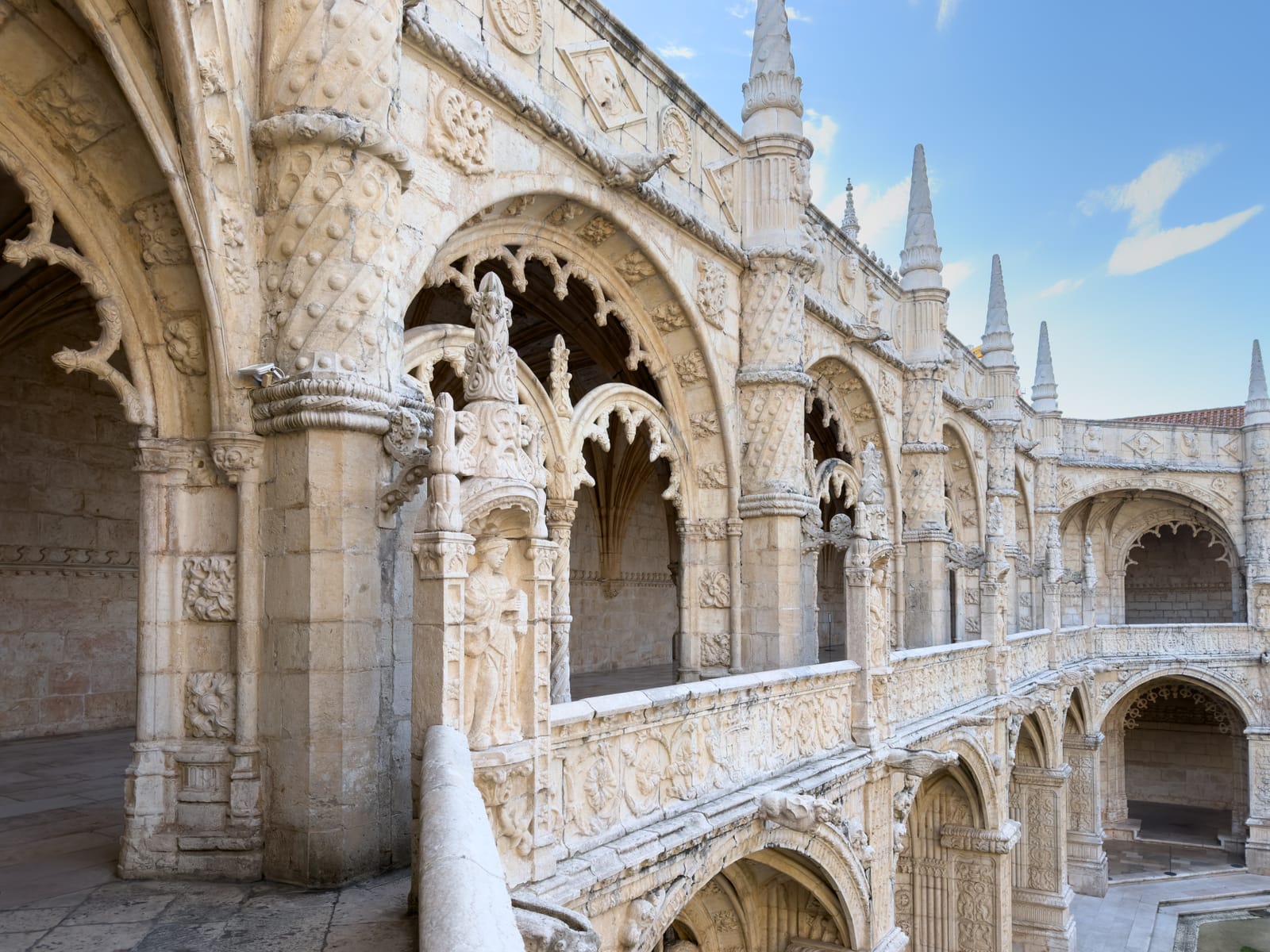
The cloister's upper gallery
João de Castilho (c. 1470–1552) and Diogo de Torralva (died 1566) · 1540–1541; restored in 1886 · Lioz limestone arcade around a court 55 metres square, with twenty niches of life-size statues
Look for
- Torralva's parapet of Roman-style medallions, the later taste sitting right on top of the older arches.
- The statues in their niches, twenty of them at life size, an arrangement unusual in Portuguese building.
- The mitre-shaped cap of the bell tower above the range nearest the church, which replaced a pyramid roof in 1867 and 1868.
Transcript (1:59)
Come to the balustrade and look across. From up here the cut corners finally make sense: the square below turns its angles into diagonals, and that octagon carries up through both vaulted levels. The monastery's own history uses the words theatrical and palatial for this space, which is unusual language for a place built for prayer and meditation.
This floor is younger than the one you have just left, and it had to wait. João de Castilho was called away to the Convent of Christ at Tomar from 1528, and the works here lost their momentum. They picked up again only in 1540, under Diogo de Torralva, and this level was closed between 1540 and 1541. So look at the top of the wall opposite, above the arches. That parapet with its row of Roman-style medallions is Torralva's, and it belongs to a later taste entirely. Under it are the traceried Manueline openings of the older style. Two generations of fashion sit one on top of the other here, and nobody tried to blend them.
Now walk the gallery slowly and look into the niches. There are twenty of them, with statues at life size, and that arrangement is rare in Portuguese building. The monastery's history says it reveals intriguing foreign influences, and leaves the question of whose open.
Do not get too attached to the crispness, though. The stone facing you had a hard nineteenth century. In 1886 this upper floor was restored, including the tops of the niches, the flying buttresses, the gargoyles, and the little columns dividing the arches. Look up over the range nearest the church, too, at the bell tower. Its mitre-shaped cap dates only from 1867 and 1868, when those same set designers from the São Carlos Theatre took off the old pyramid roof.
By 1601, when Jerónimo de Ruão died, about a century after the first stone, the monastery was practically complete. Its later life has been political. In 1985 the ceremonies for Portugal's entry into the European Economic Community were held in this cloister, and on the thirteenth of December 2007 the Treaty of Lisbon was signed at the monastery. Take one last look at that parapet before you go back down: a row of Roman-style medallions, carved for monks, above a court that has since housed orphans and hosted a continent's paperwork.
Independent guide · Chiaro
Point Chiaro at anything at the Jerónimos Monastery.
These tracks cover a side door, two tombs, one roof and a cloister, and leave out hundreds of carved figures. The sibyl on the portal, a boss on the vault, the pier that may hold an architect's face: photograph it, and Chiaro says who it shows and why the carvers put it there, and you can go on asking as you move on towards the Tower of Belém.
Before you go
Getting there
Mosteiro dos Jerónimos, Praça do Império, 1400-206 Lisboa. There are two ways in. The church is entered at its west end, under the upper choir, and needs no ticket. The cloister has its own reception. If signs on the day point to another door, go by the signs. Physical tickets come from a kiosk in the area opposite the monument.
Tram 15 runs from Praça da Figueira in the centre of Lisbon out to Belém and on to Algés. The other direct route is the train: Belém station is on the Cascais line, which starts at Cais do Sodré.
Tickets and entry
- Mind the two timetables. The cloister runs Tuesday through Sunday between 9.30 am and 5.30 pm, with admission ending at 5.00 pm. Church hours are shorter: from Tuesday to Saturday it opens at 10.30 am, on Sundays and religious holidays only at 2.00 pm, and it always closes at 5.00 pm, so a Sunday morning reaches the cloister but not the tombs or the nave.
- The ticket costs 18 euros and covers the last two stops; the church needs none. Over-65s and visitors aged 13 to 24 pay half, family tickets are half price at the on-site office only, and children up to and including 12 go free. So do Portuguese nationals and residents of Portugal on any day, EU-resident unemployed visitors with proof, higher-education lecturers and students on a study visit, and visitors with a proven disability of 60 per cent or more plus one companion; the visit page lists further groups. Tickets are for a set day and entry time, and the monument asks you to buy online if you can, because they often sell out and then cannot be bought on the day. Ticket offices close at 4.30 pm.
- Everything is closed on Mondays, on 1 January, Easter Sunday, 1 May, 13 June and 25 December, and the monument may shut for occasions of the Portuguese State.
- The church and the cloister's ground floor are fully accessible, with wheelchairs available, but the cloister's first floor is not wheelchair accessible, so the fifth stop is the one to skip. Large bags and backpacks are refused at the door. No flash, tripods or selfie sticks, no stepping out of the galleries into the centre of the cloister, and the church is still open for worship.
The official audio guide
There is no official audio guide here, in any form, and the monument says so outright: it provides no audio guides or audio systems. Its educational service runs guided visits for schools and booked groups, but for the general public only the occasional thematic visit, announced ahead and with registration. That leaves your own phone, and these five tracks, with the words printed under each one for when a service is going on in the church.
Official site →Questions
Is there a free Jerónimos Monastery audio guide?
The monument itself offers none, so this page is the one to use: five tracks, nothing to pay, and each one printed beneath its player. It runs in your phone's browser. For anything on the walls it passes over, point Chiaro at it for a narration of its own.
Can I listen to the Jerónimos Monastery audio guide without buying a ticket?
Yes, as far as the High Chapel. The south portal is outdoors on the Praça do Império side, and entry to the church, where the tombs and the nave are, is free during its opening hours; the management may limit numbers if crowds become extraordinary. Both levels of the cloister need the monastery ticket.
How much is the official Jerónimos Monastery audio guide?
It does not exist, so there is no price: the monument's visit page says that it provides no audio guides or audio systems. The ticket for the cloister is 18 euros. Half price applies to over-65s and to ages 13 to 24.
Is the church free, and what does the 18-euro ticket buy?
The church is free under the monument's own regulations, including the tombs of Vasco da Gama and Camões and the kings' tombs in the High Chapel. The ticket is for the cloister, on both of its levels, and it comes with a set day and entry time. Buy it online if you can, because the monument warns that tickets often sell out.
Which day is the Jerónimos Monastery closed?
Monday, every week, and also 1 January, Easter Sunday, 1 May, 13 June and 25 December. The church waits until 2.00 pm on Sundays and religious holidays, closing at 5.00 pm as usual, while the cloister keeps its normal 9.30 am start and 5.30 pm close. The monument may also close for occasions of the Portuguese State.
Where is Vasco da Gama buried in the Jerónimos Monastery?
Just inside the church's west end, under the upper choir, with da Gama to the left of the way in and Luís de Camões to the right. There is a question over the bones in both chests, and the second stop tells that story. Neither tomb needs a ticket.
More audio guides
Made by Chiaro. Not affiliated with the Jerónimos Monastery.