
Topkapı Palace · Istanbul · Independent guide
Topkapı Palace audio guide,
five stops, free.
Four courtyards of stories, streamed from this page with nothing to install. Photograph anything else here, from a kitchen chimney to a Chinese celadon dish, and Chiaro tells you what you are looking at.
Made by Chiaro. Not affiliated with Topkapı Palace.
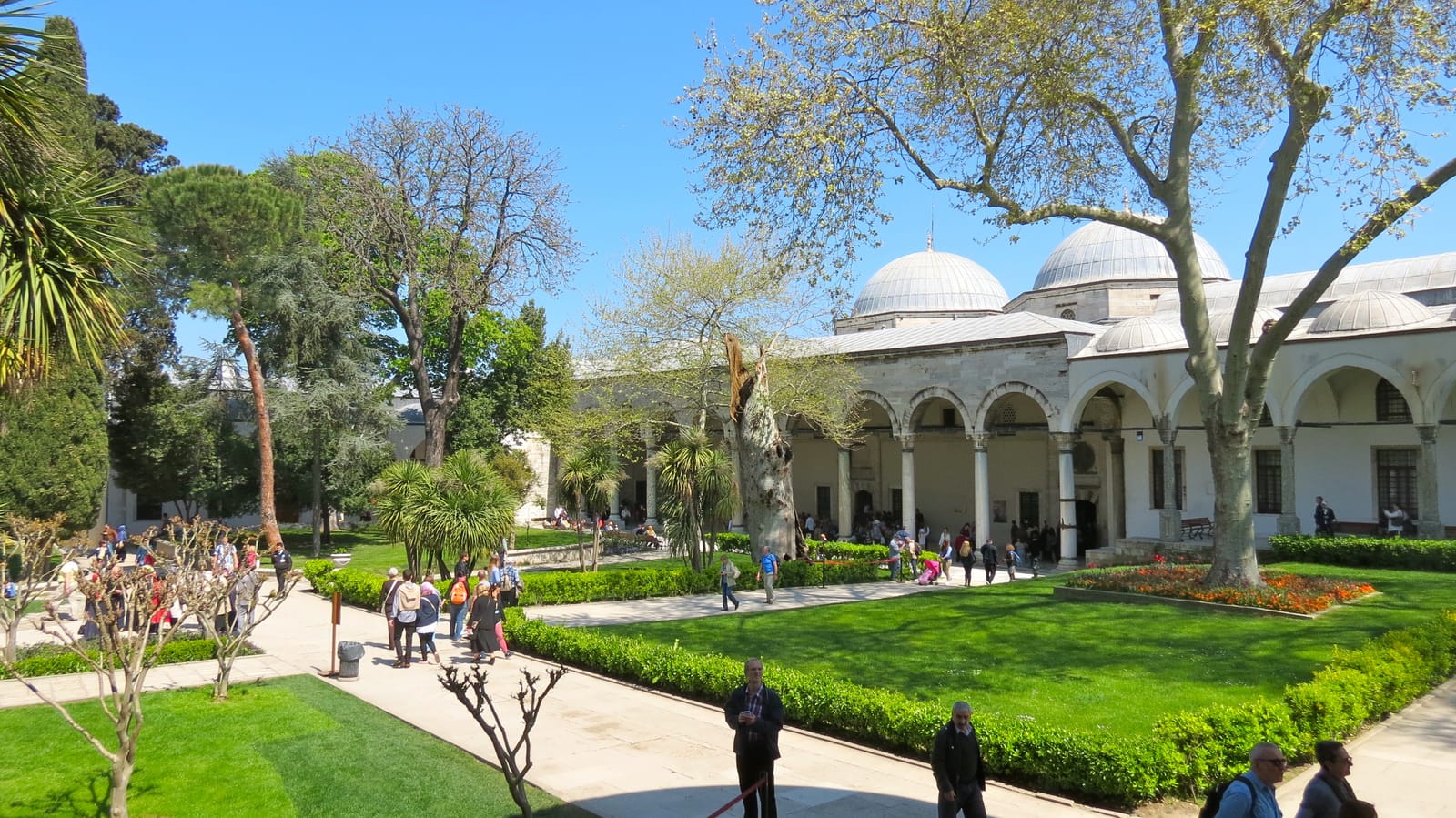
The Gate of Salutation and the Second Courtyard
Topkapı Palace, Istanbul
That was the free part
Chiaro narrates any work in Topkapı Palace from a photo.
The five stops · 11 minutes of audio
Five stops, one walk,
in the order you will walk them.
Four courtyards, five stops, one combined ticket, and the Harem left to your own decision. The walk starts at the Gate of Salutation, where the ticketed visit begins, crosses the Second Court to the Imperial Council under the Tower of Justice, passes through the Gate of Felicity to the Audience Chamber, climbs to the marble terrace of the Fourth Court for the Baghdad Kiosk and the view over the Golden Horn, and ends where every visitor comes back through anyway: the Imperial Treasury in the Conqueror's Pavilion, on the east side of the Third Court. About eleven minutes of listening, around half a kilometre of walking between the stops, and several hours in the palace once the queues are counted.
On 18 September 2026 we took the opening times, prices and building names from three places, the operator's site at millisaraylar.gov.tr, the ministry's muze.gen.tr and one independent source, and we record which sentence backs each of them so a change at the palace does not slip past us. Prices in Turkish lira move often, and the operator's own Turkish and English pages disagree about New Year's Day. A notice at the ticket office outranks anything on this page; if the two part ways, a message to us would help.
Julien Maury, Public domain, via Wikimedia Commons. Photo: Julien Maury
.jpg)
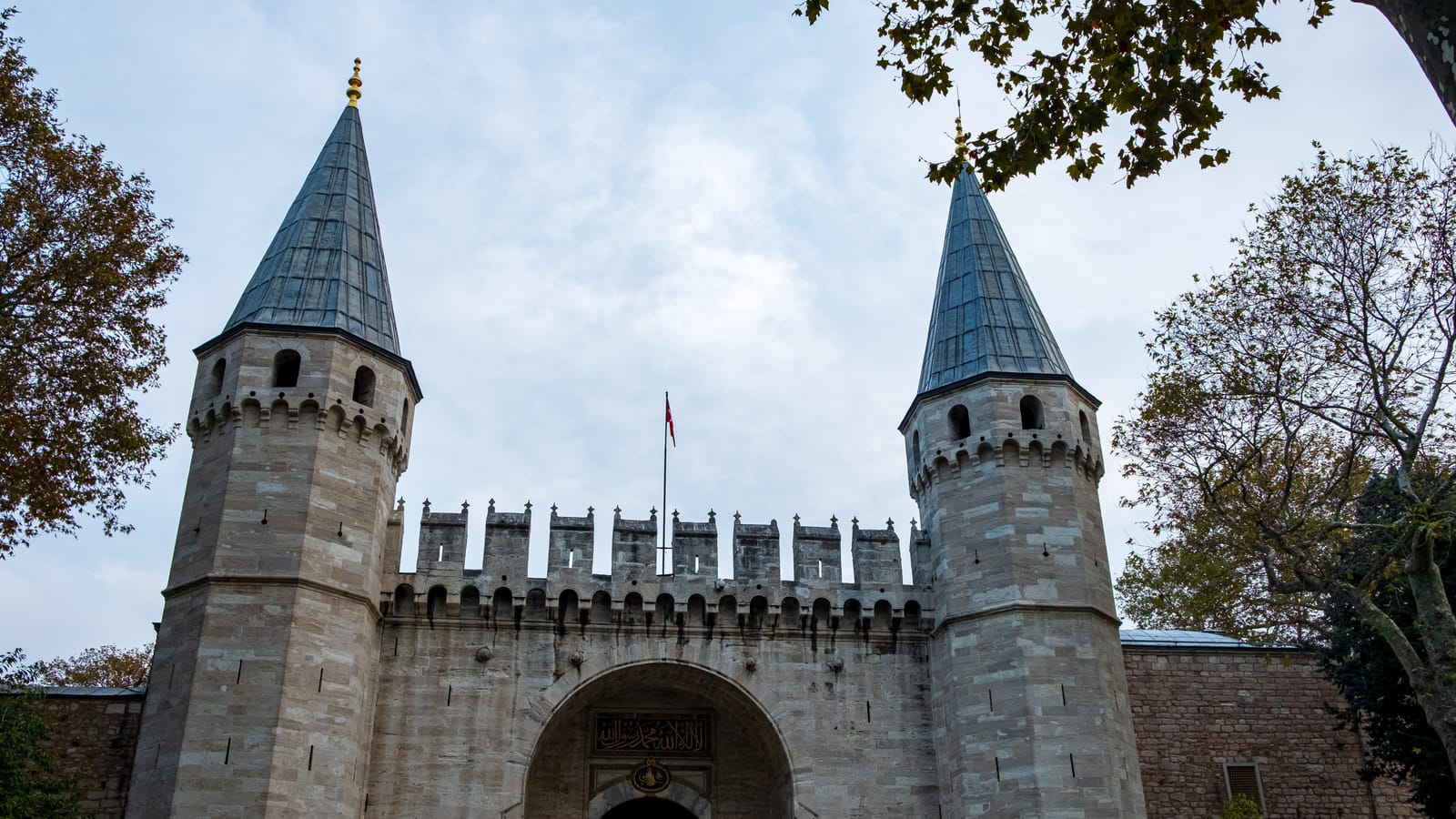
Stop 1 of 5 · Second court, known as Divan Square or Justice Square, entered from the First Court through the Gate of Salutation; the Palace Kitchens along its right-hand (east) side
The Gate of Salutation and the Second Courtyard
Mehmed II's palace; the gate given its twin towers under Süleyman the Magnificent; the kitchens rebuilt by Mimar Sinan after the fire of 1574 · Courtyard c. 1465, final form 1525–1529; gate towers 16th century; kitchens rebuilt after 1574 · Crenellated stone gate with two pointed octagonal towers; the kitchen block 17 × 95 m in ten domed units under two rows of chimneys
Look for
- The two octagonal towers with their pointed caps and the battlements between them. They were added under Süleyman in the sixteenth century, for show rather than defence.
- The Executioner's Fountain, to the right of the gate before you go through. Whether it was really used for washing the sword is disputed; the name has stuck anyway.
- The kitchen chimneys over the right-hand colonnade, Sinan's addition after the fire of 1574, and the Byzantine sarcophagi laid out in front of them, dug up on this site.
- The plane trees. Several have been hollowed out by fungus over the centuries and are still standing and still alive.
Transcript (2:12)
Stop for a moment before you walk through, because this is where the palace proper begins. Two octagonal towers with pointed caps, a line of battlements between them, and a gilded inscription over the arch. The Turks call it Bâb-üs Selâm, the Gate of Salutation, or simply the Middle Gate. It looks like a castle gate and was never meant to be one: the towers were added under Süleyman the Magnificent in the sixteenth century to say something about the man inside, not to keep an army out.
Everyone who came this way had to get off their horse here. Grand viziers, ambassadors, generals: everyone dismounted. Only the sultan rode through. Inside the towers were the rooms of the chief gatekeeper, where foreign envoys waited until word came that they could enter. To your right, before you go in, is a small fountain that guides call the Executioner's Fountain, where the executioner is said to have washed his hands and his sword. Historians are not sure he ever did, but the story has outlived the doubt.
Now go through. The court in front of you is the Divan Square, the operator also calls it Justice Square, laid out around 1465 and finished in the 1520s. It was the working heart of the state, and the strangest thing about it, for a place of government, was the quiet. Silence was the rule in the inner courts. Gazelles and peacocks wandered the lawns while the council sat, and on feast days the sultan received homage here on a throne plated with gold. Under your feet is a Byzantine cistern; the stone sarcophagi laid out along the right-hand side were dug up on this site. Look at the big plane trees, too: several have been hollowed out by fungus and are still alive.
Then turn to the right, towards the row of chimneys above the colonnade. Those are the Palace Kitchens, the largest in the empire, rebuilt by Mimar Sinan after a fire in 1574. The kitchen block runs ninety-five metres, with ten domed units, and it fed about four thousand people a day with a staff of more than eight hundred. Inside now are the cauldrons and, in the rooms beyond, a selection from the palace's 10,700 pieces of Chinese porcelain, from the Song dynasty to the Qing, one of the finest collections anywhere. The sultans prized the green celadon in particular, and not only for its colour: it was believed to change colour if it touched poisoned food. By the eighteenth century the palace owned more than sixteen thousand Chinese pieces, up from four hundred two centuries before. Somebody in this courtyard was ordering porcelain for three hundred years.
Joseolgon, CC BY 4.0, via Wikimedia Commons. Photo: Joseolgon

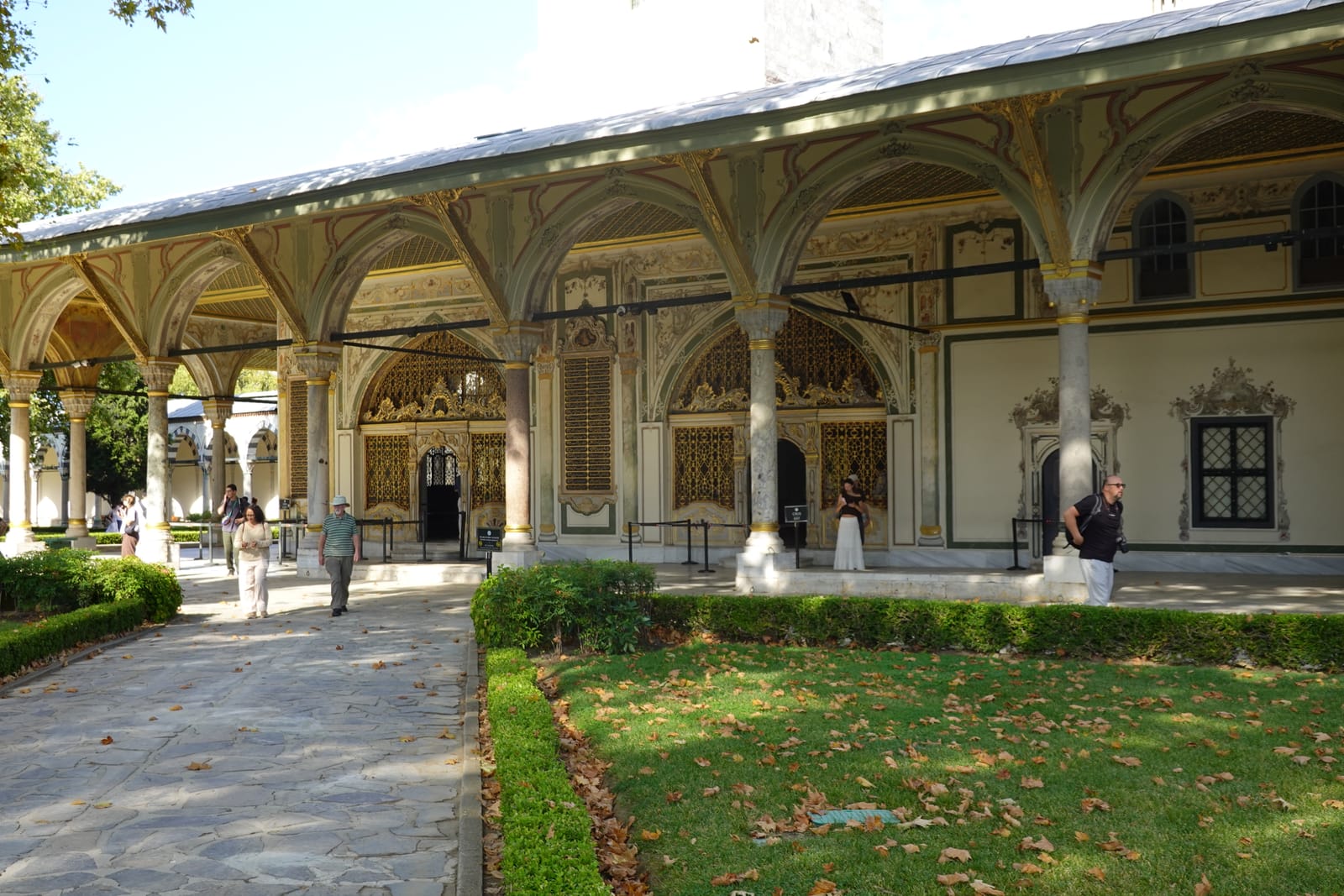
Stop 2 of 5 · Second court (Divan Square), north-west corner, with the Tower of Justice behind and the entrance to the Harem next to it
The Imperial Council and the Tower of Justice
Rebuilt for Süleyman the Magnificent by the chief architect Alaeddin under Grand Vizier Pargalı Ibrahim Pasha; rococo façade from the restorations of Selim III and Mahmud II · 1527–1529; restored 1792 and 1819; tower lantern rebuilt 1825 · Three domed chambers of stone and marble behind a porch of marble and porphyry columns, with gilded grilles and Kütahya tiles; the Tower of Justice is the tallest structure in the palace
Look for
- The window with the golden grille high in the wall of the council chamber. The sultan watched from behind it, unseen, from the tower.
- The porch: marble and porphyry columns from Süleyman's rebuilding of 1527 to 1529, under painted rococo decoration from the restorations of 1792 and 1819 that the two façade inscriptions record.
- The Tower of Justice rising behind the chamber. Its lantern, with tall windows and little pediments, is Mahmud II's work of 1825.
- The door beneath the tower, next to the council chamber: the entrance to the Harem, covered by the combined ticket or 1050 lira on its own.
Transcript (2:11)
The building with the gilded grilles on the far left of the courtyard is where the Ottoman Empire was actually run. Walk up under the porch first. The columns are marble and porphyry and they are sixteenth century; the painted decoration over your head, green and white and gold, and the rococo curls around the doors are from two restorations, in 1792 and 1819, and the two inscriptions on the front record them. So you are looking at Süleyman's building in Mahmud the Second's clothes.
Inside are three domed rooms. The first is the Kubbealtı, which means under the dome, and this is where the Imperial Council met: the grand vizier and the other ministers, sitting on the divans around the walls. By the sixteenth century they sat four days a week, Saturday to Tuesday. The second room was for the secretaries and the third, the Defterhane, was where the clerks kept the records. The chief architect Alaeddin rebuilt all of this for Süleyman the Magnificent in 1527 to 1529, and it was patched again after the great Harem fire of 1665.
Now look up at the wall of the first room and find the window with the golden grille. That is the point of the whole building. The sultan did not sit in council. Mehmed the Second's law code had him watch from behind a screen, and Süleyman stopped coming altogether. Instead he could climb into the tower behind you, take his seat at that grille, and follow everything without being seen. A court writer described it in 1527 as a veiled window overlooking the council hall, from which his majesty sometimes watched the events of the divan, checking the truth of affairs. It is said that when he disliked a decision he rapped on the bars, or drew a red curtain across, and the meeting was over. Nobody down here ever knew for certain whether he was there.
After a session three tables were laid in this room and the council ate together, and then the grand vizier went to report to the sultan in person. The marriages of the sultans' daughters were contracted in here too.
Step back out and look up. The Tower of Justice above you is the tallest thing in the palace, a landmark from the Bosphorus. Süleyman enlarged it; the lantern at the top, with its tall windows and little pediments, is Mahmud the Second's work from 1825. And the door beneath the tower, next to the council chamber, is the entrance to the Harem. Power on one side of the wall, family on the other, and one man with a window into both.
Julian Lupyan, CC0, via Wikimedia Commons. Photo: Julian Lupyan

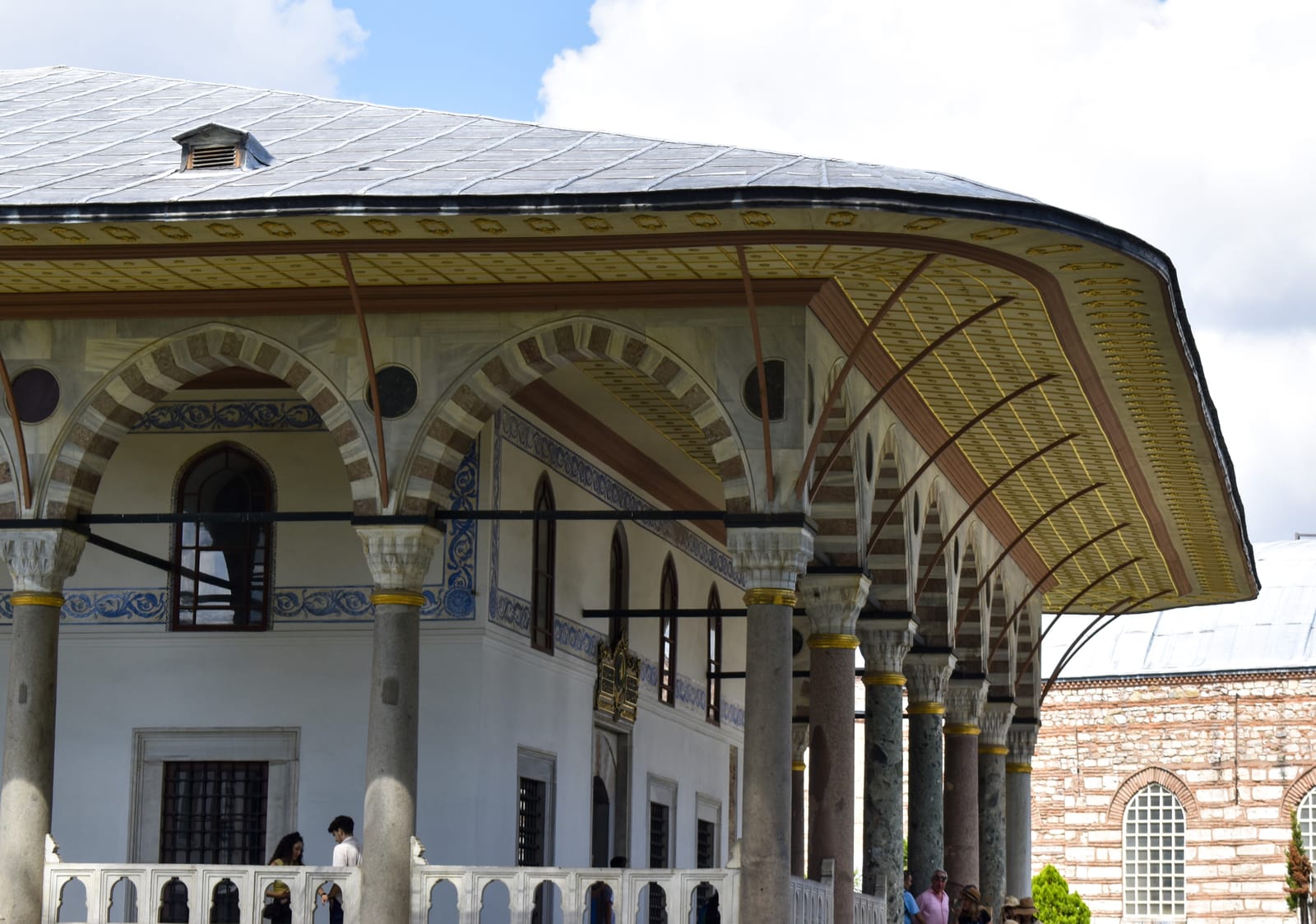
Stop 3 of 5 · Between the second court and the third or Enderun Court; the Audience Chamber (Arz Odası) stands directly behind the gate
The Gate of Felicity and the Audience Chamber
Gate from Mehmed II's palace, redecorated in rococo under Mustafa III (1774) and Mahmud II; Audience Chamber rebuilt for Süleyman the Magnificent, its throne for Mehmed III, the building rebuilt after the fire of 1856 under Abdülmecid I · Gate 15th century, redecorated 1774; Audience Chamber 1526–1528, throne 1597–1598, rebuilt after 1856 · Domed gate on slender marble columns with a gilded ceiling; a square kiosk ringed by 22 columns under deep eaves, tiled inside, with a jewelled baldachin throne
Look for
- The golden ball hanging from the middle of the gate's painted and gilded ceiling.
- The small indented stone in the pavement in front of the gate. It marks where the banner of the Prophet was unfurled and handed to a commander leaving for war.
- The Audience Chamber's twenty-two columns and deep eaves, and the large grilled window between its two doors, where ambassadors' gifts were laid out.
- The little fountain beside the door, from Süleyman's time; its Persian inscription calls the sultan the fountainhead of generosity.
Transcript (2:08)
You are at the threshold the whole palace was built around. The Gate of Felicity, Bâbüssaâde, is a dome on slender marble columns with a painted and gilded ceiling, and if you look up into it you will find a golden ball hanging from the centre. It is not much of a wall, and it did not have to be: this gate stood for the sultan's presence in the palace, and nobody passed it without his permission. Even the grand vizier came through only on set days and under set conditions. Beyond it was the Enderûn, the inner court, the sultan's household and school, guarded by white eunuchs.
What happened in front of the gate mattered as much as what lay behind it. On religious feast days and at an accession the sultan sat here on the Bayram throne, and the whole court paid homage standing. Sultans' funerals were held here. Look down at the pavement. There is a small indented stone in front of the gate, and it marks the place where the banner of the Prophet was unfurled and handed to the grand vizier or the commander going to war. A painting in the palace's own portrait collection shows the enthronement of Selim the Third in 1789 on exactly this spot. Most of the rococo painting around you dates from a redecoration of 1774, under Mustafa the Third.
Walk through, and the building right in front of you is the Audience Chamber, the Arz Odası. It is a square kiosk ringed by twenty-two columns under eaves so deep they almost meet you. This is where the empire met the outside world. The grand vizier came here in the afternoon, after the council, to report. Ambassadors were brought here, and their gifts were carried to the big grilled window between the two doors, where the sultan could inspect them as they passed. The door on the left is still called the gift door.
Inside, the sultan received them enthroned. An envoy who came in 1533 wrote that the throne was covered in gold cloth strewn with precious stones, the walls spangled with azure and gold, and that from a fountain water gushed forth from a wall. The throne you see today, shaped like a canopy bed, is later, made for Mehmed the Third in the 1590s. The fountain is still there, beside the door, with a Persian inscription that calls the sultan the fountainhead of generosity, justice and the sea of beneficence. The chamber burned in 1856 and was rebuilt, but the plan is Süleyman's, from 1526 to 1528, and directly behind it, in the middle of the court, stands the small marble library that Ahmed the Third built in 1719.
Joseolgon, CC BY 4.0, via Wikimedia Commons. Photo: Joseolgon

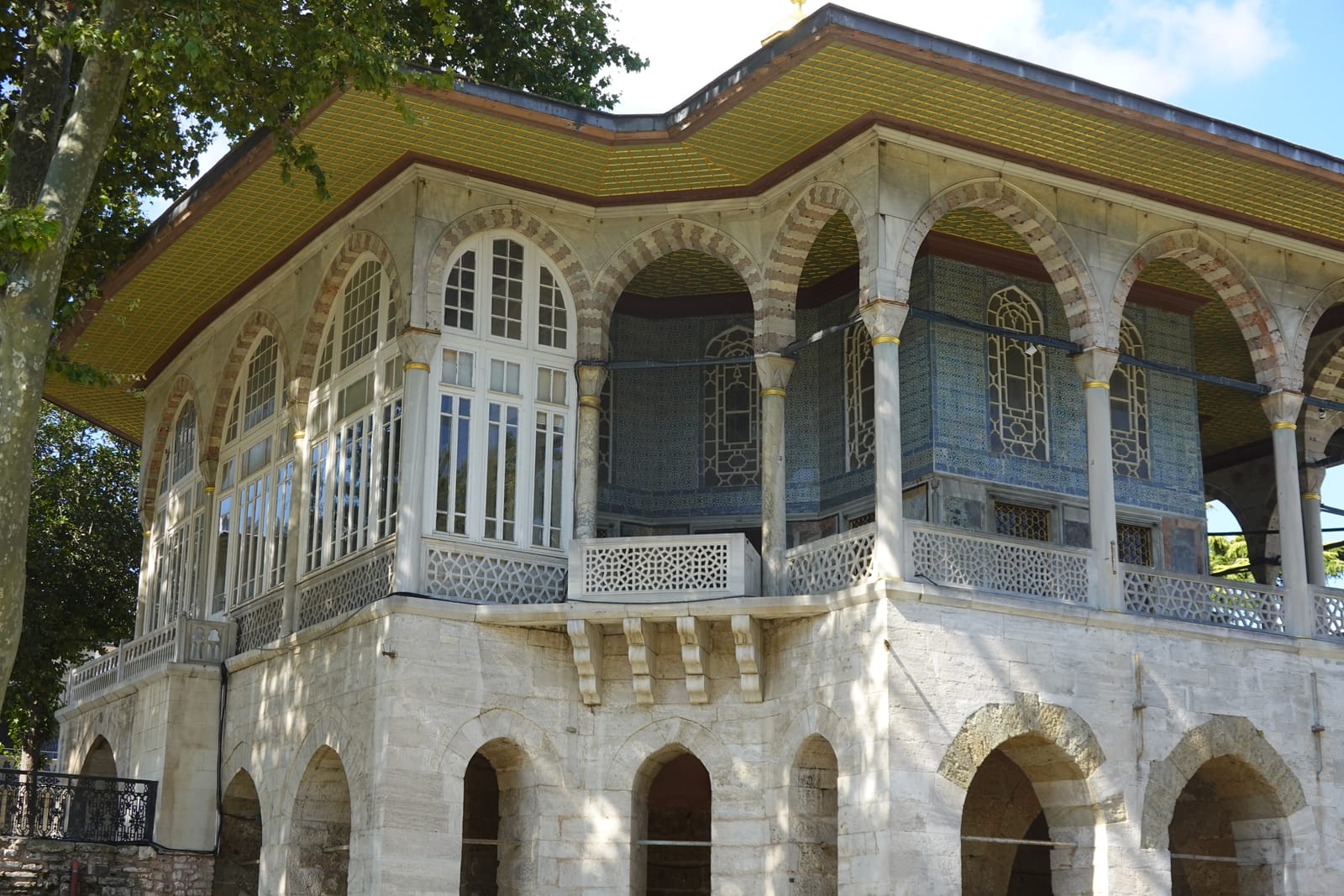
Stop 4 of 5 · Fourth court, on the marble terrace with the pool and the gilded İftar bower, overlooking the Golden Horn
The Baghdad Kiosk and the Fourth Courtyard terrace
Built for Murad IV by the royal architect Hasan Ağa, to mark the Baghdad campaign of 1638 · 1638–1639 · Domed kiosk on a stone base, faced in marble with strips of porphyry and verd antique; İznik-style tiles, mother-of-pearl and tortoiseshell inlay; a silver brazier given by Louis XIV
Look for
- The blue-and-white tiles on the walls, then the same pattern on the Circumcision Room across the terrace. Those are the originals, dated 1529; these are the copies.
- The doors and cupboards, inlaid with mother-of-pearl and tortoiseshell.
- The silver brazier in the middle of the room, a present from Louis XIV of France.
- The gilded İftar bower at the edge of the terrace, and the Golden Horn below it. Its ridged gilt roof was a first in Ottoman architecture.
Transcript (2:09)
Come out onto the marble, past the pool, and the building at the far end of the terrace is the reason the fourth court exists. This is the Baghdad Kiosk, and it is a war memorial that looks like a summerhouse. Murad the Fourth marched on Baghdad in 1638, and as he set out his architect Hasan Ağa began this pavilion to mark the victory. It was finished in 1639, and the decoration inside went on for a while after Murad himself was dead.
Walk round it first. The outside is marble, with strips of porphyry and dark green verd antique, and the panelling of the porch is done in the style of Mamluk Cairo, another conquered capital quoted in stone. Then step inside, and you are in what historians call the ideal Ottoman room: a dome, four bays with low sofas under the windows, a fireplace on the right with a gilded hood, and every wall covered in tiles. Look closely at the blue-and-white ones. They are copies. The originals are across the terrace on the Circumcision Room, panels dated 1529 that were moved there out of reverence for Süleyman's golden age, and the kiosk was tiled to match. The cupboards recessed into the walls are older still, faced with green, yellow and blue tiles from the early sixteenth century, and their doors are inlaid with mother-of-pearl and tortoiseshell.
In the middle of the floor is a silver brazier, a mangal, and it was a gift from Louis the Fourteenth of France. So the room was heated, on winter mornings, by the Sun King. It was here, in daily life, that the sultan drank his coffee after the dawn prayer, and from the middle of the eighteenth century the kiosk served as the library of the Privy Chamber. Later sultans glazed in the arcades; the glass came out in 1912, went back in iron frames in 1939, and came out for good in 1972, which is why you can see straight through it today.
Now turn to the edge of the terrace. The little gilded canopy is the İftar bower, and its ridged golden roof was something nobody had built in Ottoman architecture before, with echoes of China and India. In Ramadan the sultan is said to have broken his fast under it after sunset, and on some evenings gold coins were showered from here on his officials. The terrace itself took this shape under Ibrahim, between 1640 and 1648. Below you is the Golden Horn, and this kiosk was one of the first six rooms the new Republic opened to the public when the palace became a museum on the ninth of October 1924.
Erik Cleves Kristensen, CC BY 2.0, via Wikimedia Commons. Photo: Erik Cleves Kristensen
.jpg)
Stop 5 of 5 · Third or Enderun Court, east side, beyond the dormitories to the right of the Gate of Felicity; the operator calls it the Pavilion of the Conqueror
The Imperial Treasury in the Conqueror's Pavilion
Built for Mehmed II the Conqueror as reception rooms; the treasury of the Egyptian revenues under Selim I; on show since the palace became a museum in 1924 · c. 1460 · Two-storey stone pavilion on a terrace above the Sea of Marmara, four domed halls behind a colonnaded arcade; the collection includes the 86-carat Spoonmaker's Diamond and the 35 cm Topkapı Dagger
Look for
- From the arcade, the Sea of Marmara. The pavilion was put on the tip of the promontory for this view, around 1460.
- The double ring of forty-nine diamonds around the Spoonmaker's Diamond, in its case on the wall.
- The emerald lid on the pommel of the Topkapı Dagger. It lifts to show a watch.
- The two gold candleholders made for the Kaaba, each 48 kilograms and set with 6,666 diamonds.
Transcript (2:46)
Before you join the queue, walk to the arcade and look out. The Sea of Marmara is below you, and that view is why this building is here. Mehmed the Conqueror put this pavilion on the highest point of the promontory around 1460, when the palace was new, as a place to receive people: two floors on a terrace, four domed rooms upstairs behind a loggia, all of them opening onto the garden through the arcade you are standing in. Under Selim the First it became the strongroom for the revenues of Egypt, and it has been the Treasury ever since. The rooms were shut for restoration from 2014 until the operator reopened them in 2023, with the display spread across this pavilion and two neighbouring buildings.
The display was rearranged for the reopening, so take the old room order that follows as a guide, not a map. The first holds the mail armour of Mustafa the Third, worked with gold and jewels, and the ebony throne of Murad the Fourth inlaid with ivory and mother-of-pearl. The second is the one most people have come for. Look for a curved dagger with three large emeralds down the hilt and a fourth emerald at the pommel that lifts to reveal a small English watch. This is the Topkapı Dagger. Mahmud the First had it made in 1746 as a peace offering for Nader Shah of Persia, and sent it east with an embassy of a thousand men. On the road they heard the Shah had been murdered, on the twentieth of June 1747, so they turned round and brought it home. It has never been given to anyone. In 1964 Jules Dassin made a film about stealing it, called Topkapi, which is how many visitors first heard of this palace. In the same room stands the walnut throne of Ahmed the First, inlaid with tortoiseshell and mother-of-pearl by Sedefkar Mehmed Ağa, the architect of the Blue Mosque.
Then the diamond. The Spoonmaker's Diamond, Kaşıkçı in Turkish, is eighty-six carats, pear-shaped, set in silver and ringed by two rows of forty-nine smaller diamonds, and it hangs in a glass case on the wall. Nobody knows where it came from. One story says a fisherman found it on the shore and traded it to a jeweller for three spoons. Another says it belonged to Ali Pasha of Tepelena, the near-independent governor of Albania and Greece, and came to the sultan when he was executed and his goods confiscated. A third has Napoleon's mother sending it to ransom a lover. The museum's own records mention a ring stone of the same name under Mehmed the Fourth, but it was far smaller than this one. The honest answer is that the most valuable object in the palace has no provenance at all.
In the same room are two solid gold candleholders, each weighing forty-eight kilograms and set with six thousand six hundred and sixty-six diamonds. Abdülmecid the First sent them to the Kaaba in Mecca, and they were brought back to Istanbul shortly before the empire lost the city. Beside them is the Bayram throne, gold set with tourmalines, made in 1585 for Murad the Third; it is the throne that was carried out and set up in front of the Gate of Felicity on feast days, the one you heard about two stops ago. A throne of a different kind is here too, Indian in style, gold over wood with pearls and emeralds: Nader Shah's gift to Mahmud the First. The dagger was meant to be the answer to it, and never arrived.
Independent guide · Chiaro
Point Chiaro at anything in Topkapı Palace.
Five stops, and there are four courtyards, a Harem of some four hundred rooms and a collection of 10,700 Chinese porcelains, part of it shown in the kitchens. Snap a tile panel, a kaftan in a case or a fountain whose inscription you cannot read, and Chiaro works out what the object is and whose work it was, then stays on hand for more questions while you are in the courtyard.
Before you go
Getting there
Cankurtaran Mah. Babı Hümayun Cad. No: 1, 34122 Sultanahmet/Fatih, Istanbul. Enter through the Imperial Gate (Bâb-ı Hümâyun) from the cobbled square behind Hagia Sophia, by the Fountain of Ahmed III; the main ticket office is in the First Court, just before the Gate of Salutation.
Tram T1 to Sultanahmet, about 650 metres on foot; the Gülhane stop on the same line serves the park side of the palace. Marmaray trains stop at Sirkeci. Do not travel to the stop called Topkapı: it is a district 10 kilometres west by the city walls, nowhere near the palace.
Tickets
- The palace is closed on Tuesdays and on the first day of Ramazan Bayramı. The operator's Turkish page lists 1 January as closed and its English page as open, so check before going on New Year's Day.
- Ticket offices open at 9am and close at 5pm; the ministry's page gives the palace closing time as 6pm. Tickets are sold at the office in the First Court: on 18 September 2026 the operator's online shop did not list Topkapı at all.
- Foreign visitors pay 2750 lira for the combined ticket covering the palace, the Harem and Hagia Irene; the Harem alone is 1050 lira and so is Hagia Irene. The combined ticket is valid for one day. Children up to six go free; students aged 7 to 25 with ID get the discounted rate, foreign students at twice the discounted price.
- The ministry's Museum Pass İstanbul lists Topkapı among the museums it covers. The operator says the Turkish Müzekart is not valid for the Harem or Hagia Irene sections.
- Reckon on several hours. The five stops are about half a kilometre apart end to end. The museum kiosk is in the kitchen section on the right-hand side of the Second Court, and the toilets are there too.
The official audio guide
The ministry's page for the palace links the ministry's own museum app as the audio guide, and its Museum Pass site says the pass does not include audioguides, so budget for it separately; no price is published on either page. This guide sits apart from both: five stops with no download and no code to scan, and the text of each printed beneath its player for courtyards too noisy to listen in.
Official site →Questions
Is there a free Topkapı Palace audio guide?
This is one. Its five stops run in your web browser with the full script under each, nothing to install and no ticket to scan. The ministry's own audio guide runs through the ministry's own museum app. The rest of the palace is covered by the Chiaro app, which narrates whatever you take a photo of.
How much is the official Topkapı Palace audio guide?
The ministry's page links the ministry's own museum app under 'Audio Guide' and does not publish a price; its Museum Pass page says the pass does not cover audioguides. Expect it to cost extra on top of admission.
Where is the Spoonmaker's Diamond in Topkapı Palace?
In the Imperial Treasury, in the Conqueror's Pavilion on the east side of the Third Court, to the right beyond the Gate of Felicity. It hangs in a glass case on the wall, with the Topkapı Dagger nearby. The Treasury was closed for restoration from 2014 and reopened in 2023, rearranged across the pavilion and two neighbouring buildings.
Is Topkapı Palace closed on Tuesdays?
Yes, every Tuesday, and on the first day of Ramazan Bayramı. Ticket offices open at 9am and close at 5pm. The operator's Turkish and English pages disagree about 1 January, so check that one before you go.
Is the Harem included in the Topkapı Palace ticket?
Yes, if you buy the combined ticket: 2750 lira for foreign visitors, covering the palace, the Harem and Hagia Irene. The operator lists no palace-only ticket for foreign visitors; the Harem on its own is 1050 lira. The route through the Harem changes as rooms close for restoration, and the entrance is beneath the Tower of Justice on the west side of the Second Court.
How long does Topkapı Palace take?
These five stops are about eleven minutes of audio and around half a kilometre of walking, but our advice is to reckon on several hours. The palace covers 700,000 square metres.
More audio guides
Made by Chiaro. Not affiliated with Topkapı Palace.