
Tower of London · London · Independent guide
Tower of London audio guide,
five stops, free.
Almost twelve acres inside two rings of wall and a moat, around a keep begun about 1078 — all five stops stream in this tab, and Chiaro narrates the other nine hundred and fifty years from a photo.
Made by Chiaro. Not affiliated with the Tower of London.
The moat and the western entrance
Tower of London, London
That was the free part
Chiaro narrates anything at the Tower of London from a photo.
The five stops · 11 minutes of audio
Five places, one walk,
in the order you will walk them.
Five stops, four of them on one standard ticket, and the walk starts before the gate. The first is on Tower Hill, on the pavement west of the moat, where the Tower's own map says Enter here and where you need nothing but a view of the walls. Then in through the West Gate to Water Lane and Traitors' Gate on the south side; north into the inner ward for Tower Green and the carved walls of the Beauchamp Tower; into the middle of the castle for the White Tower and the Norman chapel inside it; and up onto the east wall walk, the Battlements, for the Thames and the way out. About eleven minutes of listening, roughly half a kilometre of walking, and the Tower's own British Sign Language highlights route over the same ground is timed at about ninety minutes.
Names, dates and measurements come from the visitor documents Historic Royal Palaces publishes for the Tower, cross-checked on 21 September 2026 against one more independent source and stored alongside the line that supports them, which is how a change on their side reaches us. Opening times, prices and the Christmas closures change more often than anything else here, and hrp.org.uk is where to confirm them for your visit. Should the Tower's own signage contradict this page, believe the signage, then write and tell us.
Tim Sheerman-Chase, CC BY 2.0, via Wikimedia Commons. Photo: Tim Sheerman-Chase

Stop 1 of 5 · Tower Hill, west side, outside the moat and the West Gate, where the Tower's own visitor map marks Enter here
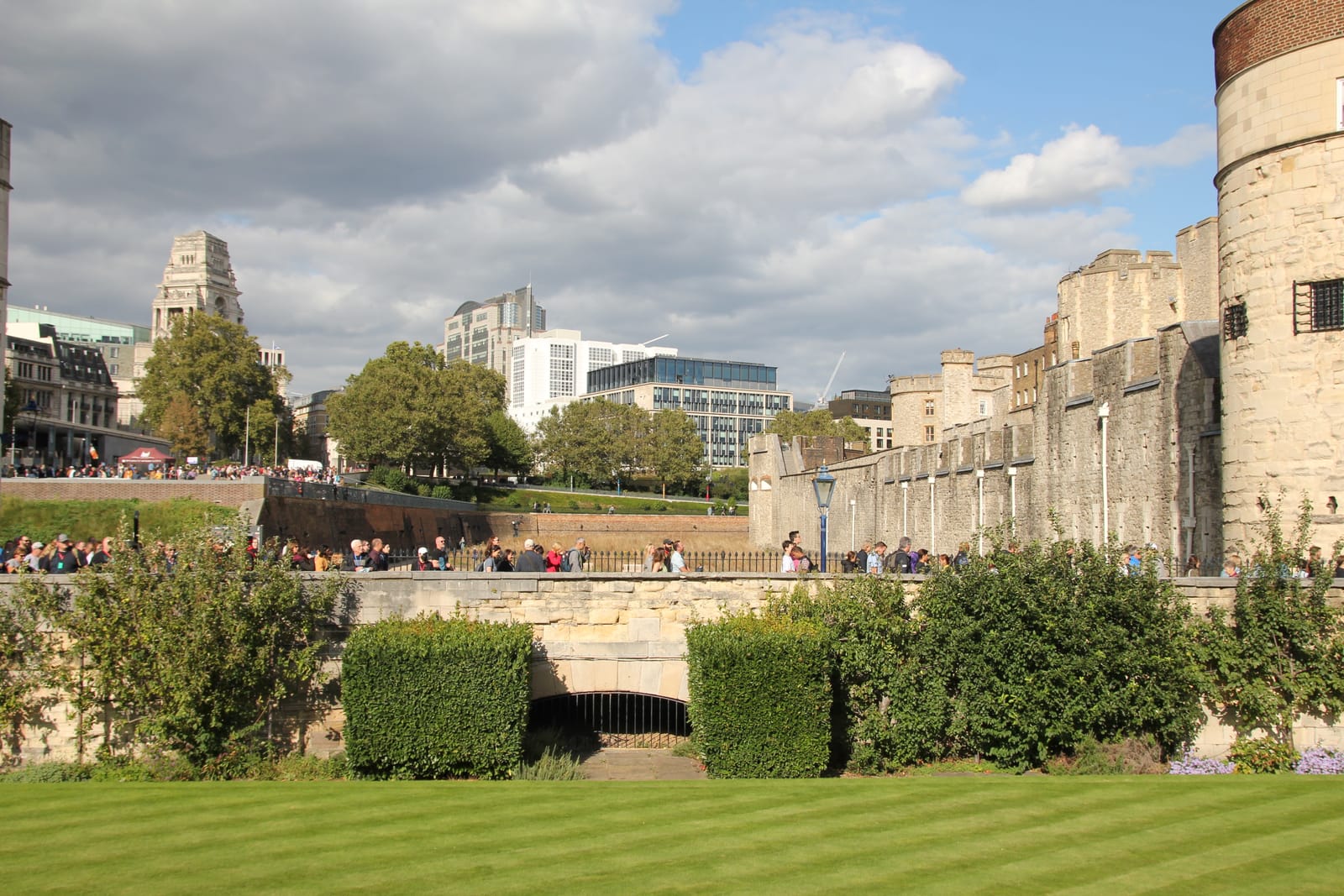
The moat and the western entrance
Edward I's masons, on the line of Henry III's earlier ditch; drained on the orders of the Duke of Wellington as Constable of the Tower · Moat and outer curtain wall 1275–1285; moat drained 1843–1845 · Kentish ragstone curtain wall and a dry moat 50 metres wide, once 4.5 metres deeper in the middle than it is today
Look for
- The moat itself: fifty metres wide, and once four and a half metres deeper in the middle than the lawn you are looking down at. It was drained in the 1840s on the Duke of Wellington's orders, after disease broke out in the garrison.
- Two walls, not one. The lower one across the moat is Edward the First's outer curtain, 1275 to 1285. The taller wall behind it is the inner ward, enclosed in Richard the First's reign and its western face rebuilt by Edward in the same campaign; Henry the Third's work is the east and north walls you walk on at the last stop.
- Legge's Mount, the bastion at the north-west corner. The blocked crenellations on its south face are the only medieval battlements left anywhere at the Tower; every other notch is a Victorian replacement.
- The White Tower's four turrets over the top of the walls. The keep stands twenty-seven metres to its southern battlements, on ground higher than the pavement you are on.
Transcript (2:02)
The green strip in front of you is a moat. Fifty metres wide, and in the middle it was once four and a half metres deeper than the grass you are looking down at. It has been dry for less than two hundred years, and not for effect. In 1830 the Constable of the Tower, the Duke of Wellington, had several feet of silt dug out of it. That did not solve the problem: in 1841 disease broke out in the garrison and killed several men, so the order went out to drain the ditch and fill it with earth. The work started in 1843 and was mostly finished two years later.
Now count the walls, because there are two of them. The lower one immediately across the moat is Edward the First's outer curtain, built between 1275 and 1285. The taller wall behind it is the inner ward, enclosed a century earlier in Richard the First's reign, and Edward rebuilt its western face in the same campaign, so nearly everything you can see from this side is his. Henry the Third's work is the east and north walls, which you can walk along at the end of this route. Edward spent twenty-one thousand pounds here in ten years, more than double what Henry the Third spent on the castle in his entire reign, and this outer ring is what the money bought: he filled in the old moat, ran a new curtain wall along its line, and dug the new moat in front of it. The shape of the castle has not changed since he finished in 1285.
Edward's new wall left the old main entrance useless, so a new one was cut at this western corner, with two gatehouses and a barbican in front of them. The barbican ended up with a name that tells you what it held. It became the Lion Tower, because from at least the thirteen-thirties the animals of the Royal Menagerie lived in it, immediately west of the gate you are about to walk through. Records from 1335 include the purchase of a lock and key for the lions and leopards. The Lion Tower itself is gone. But in 2008 two skulls came out of the moat area: male Barbary lions, a subspecies now extinct in the wild, radiocarbon dated to between 1280 and 1385, and between 1420 and 1480.
One last thing before you cross. Look at the low round bastion at the far corner on your left. That is Legge's Mount, and the blocked crenellations on its south face are the only medieval battlements left anywhere at the Tower. Every other notch you will see today is a Victorian replacement.
Matt Brown, CC BY 4.0, via Wikimedia Commons. Photo: Matt Brown

Stop 2 of 5 · Outer ward, south side, on Water Lane a few metres inside the West Gate; the Tower's own map names it Traitor's Gate, with St Thomas's Tower directly above
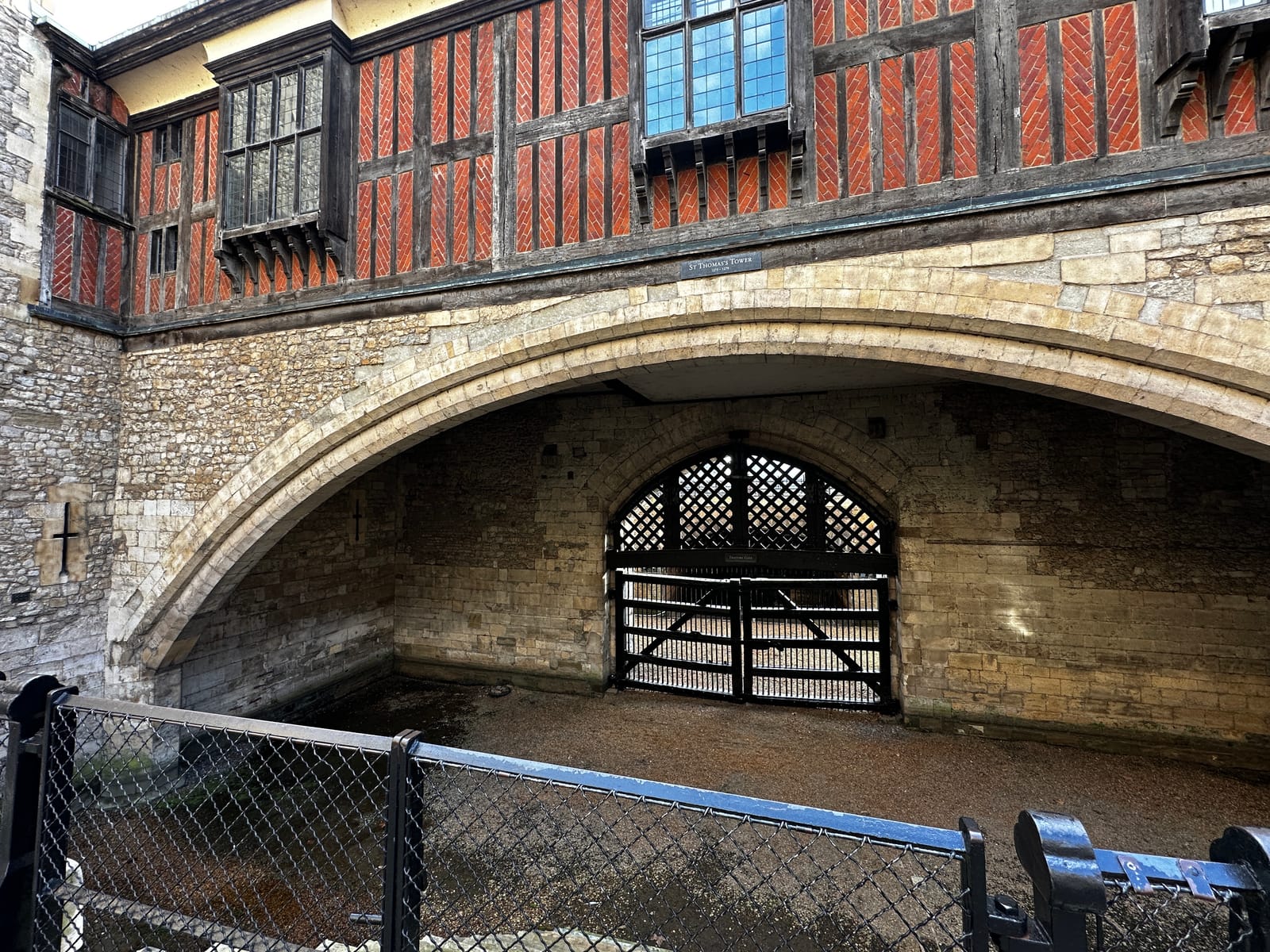
Traitors' Gate, from Water Lane
Built for Edward I as St Thomas's Tower; the timber-framed range above the arch is later work over Edward's first-floor lodging, restored for the medieval palace display · 1275–1279; the name Traitors' Gate already in use by 1543 · Stone water-gate under a wide segmental arch, with a portcullis and arrowslits, carrying a timber-framed royal lodging on the floor above
Look for
- The arrowslits in the walls of the dock, small crosses cut into the stone. They face inwards, at whatever has just come through the gate.
- How low the arch sits. The water came up to it: Edward the First built this wall out onto ground that had been the bed of the Thames.
- The half-timbered front hanging over the arch. It is later work, sitting over the floor where Edward the First built his royal lodging, and this tower and the Wakefield Tower beside it are the only two palace buildings at the Tower that survived.
- The dry basin under the arch. An engine stood in that pool for centuries, lifting river water to a cistern on the roof of the White Tower, and between 1724 and 1726 it was adapted to bore gun barrels as well.
Transcript (1:59)
Stand at the rail and look at how low that arch sits. The water used to come up to it. Edward the First pushed the south wall of the castle out onto ground that had been the bed of the Thames, and built this into the new wall between 1275 and 1279. It replaced the Bloody Tower as the castle's water-gate, and there is nothing else like it in England. The closest parallel was the water-gate at the Louvre in Paris, and that was demolished long ago.
Find the arrowslits in the walls of the dock, small crosses cut into the stone. They point inwards, at whatever has just come through the gate. A water-gate is a hole in a castle and Edward's masons knew it, so they made the dock a trap: arrowslits on the sides, and a portcullis across the entrance to control who came in.
The name is older than most people expect. Traitors' Gate was already in use by 1543, when the name appears on Anton van den Wyngaerde's panorama of London. Prisoners came up the river by barge, passing under London Bridge on the way, where the heads of the recently executed were set on spikes. Sir Thomas More came in through here.
And now the correction, because this is the most misreported spot at the Tower. Anne Boleyn is constantly said to have been brought through Traitors' Gate after her arrest. The contemporary chronicler Charles Wriothesley says she was not: she passed through a court gate in the Byward Tower, which you walked under a minute ago. Elizabeth, brought here on the eighteenth of March 1554 after Wyatt's Rebellion, has been given the same treatment by history. John Foxe described her arrival at length and never mentions this gate at all.
Then look up, at the half-timbered front hanging over the arch. The timber itself is later work, but it sits on the floor where Edward built comfortable royal quarters, and of the whole palace that the Tudors and Stuarts allowed to fall down, only this building and the Wakefield Tower beside it survived. What is left of those apartments has been open to visitors since 2006.
One more thing, in the empty basin under the arch. For centuries an engine stood in that pool, lifting river water up to a cistern on the roof of the White Tower. It ran first on the force of the tide, then on horsepower, then on steam, and between 1724 and 1726 somebody adapted it to drive machinery for boring gun barrels. It was taken out in the early months of 1866.
-JvL-, CC BY 2.0, via Wikimedia Commons. Photo: -JvL-

Stop 3 of 5 · Inner ward, west side, on Tower Green south of the Chapel Royal of St Peter ad Vincula; the carvings are inside the Beauchamp Tower on the Green
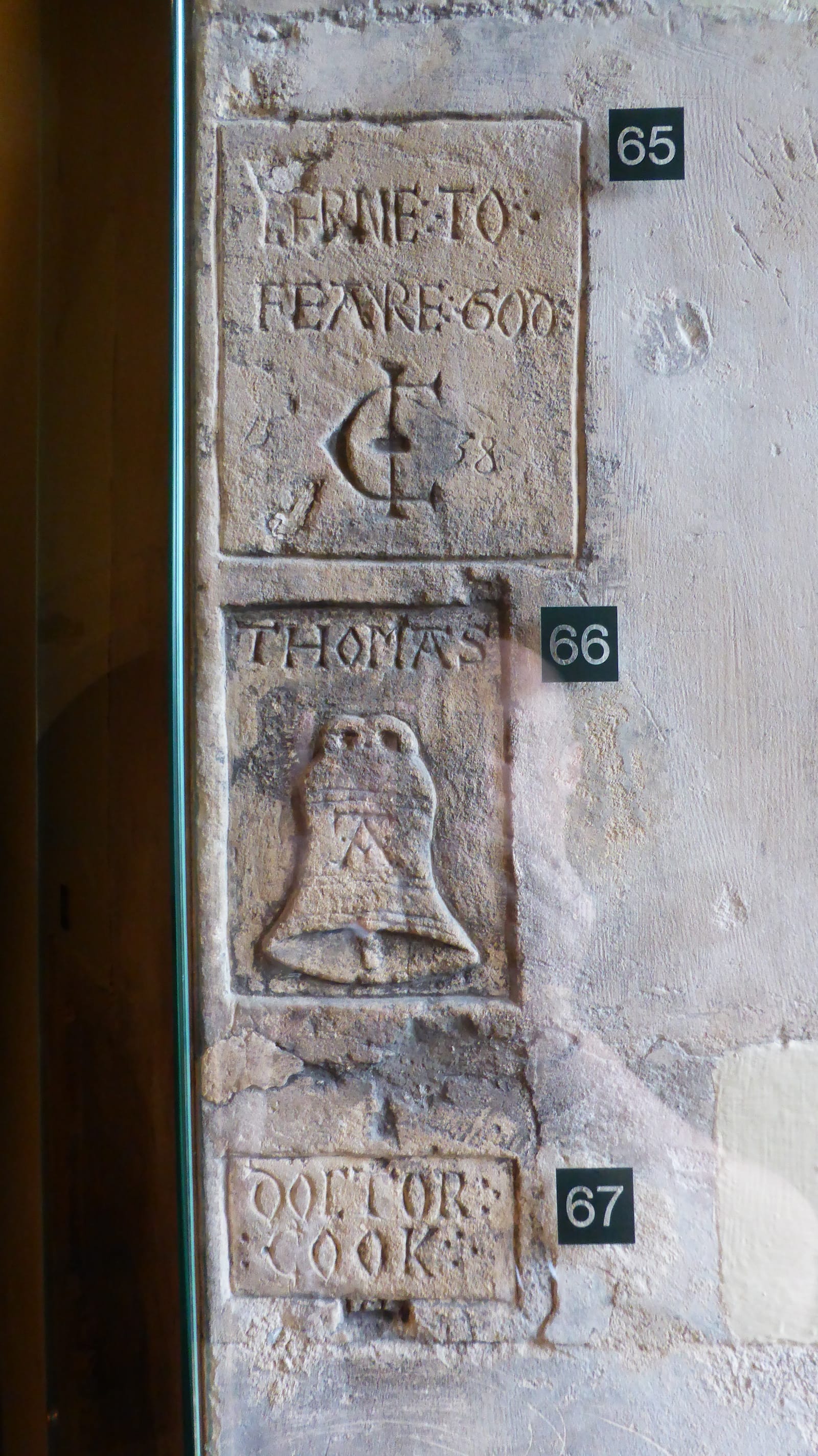
Tower Green and the Beauchamp Tower
The Beauchamp Tower built for Edward I on the site of the castle's old gatehouse; the inscriptions cut by the prisoners themselves; the chamber opened to visitors on the novelist William Harrison Ainsworth's suggestion and refitted by Anthony Salvin · Tower 1275–1285; inscriptions 16th and 17th centuries; opened to visitors in the mid-19th century · Stone and brick, the first large-scale use of brick in Britain since the Romans left; one of the thirteen towers on the inner curtain wall, its prison chamber carrying inscriptions numbered at least to 67
Look for
- The carved inscriptions on the wall of the prison chamber, each with its own number beside it. Names, dates, coats of arms, a bell, and the words IANE and DOCTOR COOK, cut by prisoners in the sixteenth and seventeenth centuries.
- The brickwork of the tower. The Beauchamp Tower is the first large-scale use of brick in Britain since the Romans left in the fifth century.
- The small square of granite paving in the middle of the Green. Queen Victoria had it laid to mark the scaffold site, and historians are not convinced she was shown the right patch of grass.
- The chapel on the north side of the Green, Saint Peter ad Vincula. Anne Boleyn, Catherine Howard, Lady Jane Grey and Thomas More are all buried in it.
Transcript (2:24)
Two things share this patch of grass, and the famous one is the smaller story.
Being beheaded in here was a privilege. Almost every execution connected with the Tower happened outside the walls, up on Tower Hill, where a hundred and twelve people were put to death over four hundred years. Inside the castle, before the twentieth century, there were seven. Dying in here meant no jeering crowd for you and no bad publicity for the monarch. The seven were Lord Hastings in 1483; Queen Anne Boleyn on the nineteenth of May 1536; Margaret, Countess of Salisbury, the last of the Plantagenets, in May 1541; Queen Catherine Howard and Jane Boleyn, Viscountess Rochford, both on the thirteenth of February 1542; Lady Jane Grey on the twelfth of February 1554; and the Earl of Essex in February 1601. All by axe, except Anne Boleyn, beheaded with a sword. Three more names belong to another century entirely: Malcolm Macpherson, Samuel Macpherson and Farquhar Shaw, Black Watch soldiers shot on this Green on the nineteenth of July 1743 by a firing squad of their own comrades.
Nobody is certain they died on this exact grass. Queen Victoria asked to be shown the spot and had granite paving laid on it; one account says a Yeoman Warder who did not know simply pointed, and other sources put the scaffold on the parade ground between the White Tower and the Waterloo Block. What is certain is that this was a burial ground in the Middle Ages, and that when the Victorian setts were relaid the foundations of a vanished building turned up underneath: probably the guardhouse, demolished in 1684, where the private beheadings were carried out indoors.
The second thing is the Beauchamp Tower on the west side of the Green. The walls of its prison chamber are covered in inscriptions cut by prisoners in the sixteenth and seventeenth centuries: names, dates, coats of arms, a bell, the word IANE, the words DOCTOR COOK.
You can read them because of a novelist. William Harrison Ainsworth had given the English public its mental picture of this castle as a warren of underground torture chambers, which was fiction: there was never a permanent torture chamber here. Then he suggested this chamber be opened so people could see the carvings, and Anthony Salvin refitted it at Prince Albert's request.
Before you go in, look for the birds. At least six ravens are kept here at all times, and there were eight of them in 2025, on the belief that if they go the kingdom falls. The Tower's own historian calls that a Victorian invention: the earliest known reference to captive ravens here is an illustration from 1883.
Matt Brown, CC BY 4.0, via Wikimedia Commons. Photo: Matt Brown

Stop 4 of 5 · Innermost ward, the middle of the castle, at the foot of the wooden staircase on the south face; the Tower's own guide calls this stop the White Tower and Saint John's Chapel
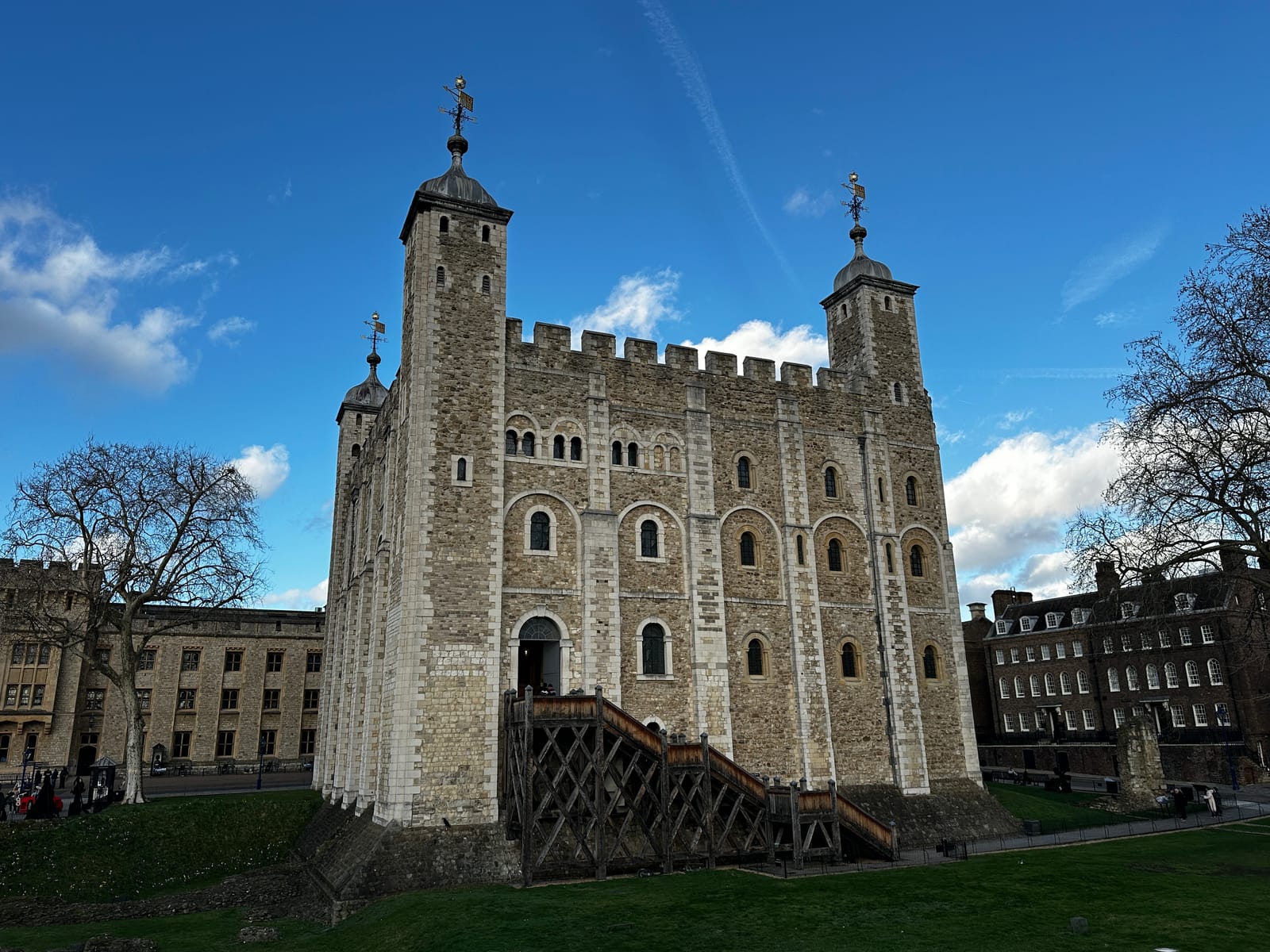
The White Tower
Built for William the Conqueror under Gundulf, Bishop of Rochester; possibly enlarged by William Rufus after 1090, on Geoffrey Parnell's reading; whitewashed on Henry III's order; the Caen stone dressings replaced with Portland stone across the 17th and 18th centuries, begun under Inigo Jones, with the outside recased in 1639–1640 · Begun about 1078, probably complete by 1100; top floor and present roof added in the 1490s; whitewashed from 1240 · Kentish ragstone with Caen and Reigate stone dressings, later replaced in Portland stone; 36 by 32 metres at the base excluding its projecting corner towers, and 27 metres to the southern battlements
Look for
- The wooden staircase on the south face. It stands where the removable Norman stair stood, and the doorway at the top of it was walled up in the seventeenth century and not opened again until 1973.
- The round bulge at the south-east corner, unlike the three square corner towers. That is the apse of Saint John's Chapel, built after the basement walls were already standing.
- The windows. Nearly all were enlarged in the eighteenth century, late in a recasing that had begun a century earlier: the outside was stripped and much of its facing replaced in 1639 and 1640. Only two Norman originals survive, both restored, in the south wall at the level of the wall gallery.
- Saint John's Chapel itself, up on the upper floor: bare Norman stone, round arches on heavy short columns, and the closest thing at the Tower to a space that has not changed in nine hundred years.
Transcript (2:57)
Nine hundred and fifty years, thirty-six metres by thirty-two at the base without counting the corner towers, twenty-seven metres to the battlements over your head, and it was very nearly two-thirds this size.
Start with the wooden staircase in front of you. The entrance to a Norman keep sits above ground on purpose, reached by a timber stair that could be pulled away if the castle was attacked. A stone forebuilding Henry the Second probably added over it is long gone. The doorway itself was walled up in the seventeenth century and stayed shut until 1973, when this staircase went back and the entrance reopened.
The keep is traditionally dated to 1078, on the strength of the Textus Roffensis, which records that Gundulf, Bishop of Rochester, oversaw the work on William the Conqueror's instruction. Tree-ring dating narrows the start to between 1075 and 1079. It is the earliest stone keep in England. But in 1995 the historian Geoffrey Parnell found evidence inside one of these walls suggesting it was first completed at two-thirds its present size, with a pitched roof, and only pushed up to what you see now by William Rufus, after a hurricane in 1090.
The name is paint. Henry the Third ordered the keep whitewashed in 1240, and the instruction to the Keeper of the Works was to have the Great Tower whitened both inside and out. Later that year he wrote again, telling the Keeper to extend the lead guttering so the newly whitened wall would not perish through the trickling of the rain. A king worrying about his gutters.
Now the corners. Three are square towers. The fourth, at the south-east, bulges outwards in a half-circle, and that bulge is the apse of a chapel: Saint John's Chapel, which was not in the original plan, because the projection was built after the basement walls were already up. The only other keep in England with anything like it is at Colchester. Go up and find that chapel: it is the one place at the Tower that has barely changed. Bare Norman stone, round arches on heavy short columns, no decoration. Henry the Third had it painted with a gold cross and glazed with the Virgin Mary and the Holy Trinity; by the thirteen-twenties it was being used to store paperwork.
Two stories from this south side. In 1381, during the Peasants' Revolt, the Tower was besieged with the king inside, and when Richard the Second rode out to meet Wat Tyler a crowd walked into the castle without meeting any resistance. The Archbishop of Canterbury, Simon Sudbury, hid in Saint John's Chapel hoping the mob would respect sanctuary. They took him out and beheaded him on Tower Hill. And on the seventeenth of June 1674, while the old forebuilding at this entrance was being demolished, workmen found the bones of two children underneath its stairs. They were assumed to be the princes, Edward the Fifth and his brother Richard, last seen in public in June 1483, and they were reburied in Westminster Abbey. The depth those bones came from, about three metres, matches a Roman graveyard found in 2011 just north of here.
Look at the windows before you climb. Nearly every one was enlarged in the eighteenth century, at the late end of a recasing that had been swapping the Caen stone dressings for Portland since the sixteen-hundreds. Only two Norman originals survive, both restored, in the south wall at the level of the wall gallery: two small openings in a building that has otherwise been rebuilt around itself for nine centuries.
Matt Brown, CC BY 4.0, via Wikimedia Commons. Photo: Matt Brown

Stop 5 of 5 · Inner ward, east side, up on the wall walk between the Salt Tower and the northern corner; the Tower's own visitor map lists it as Battlements
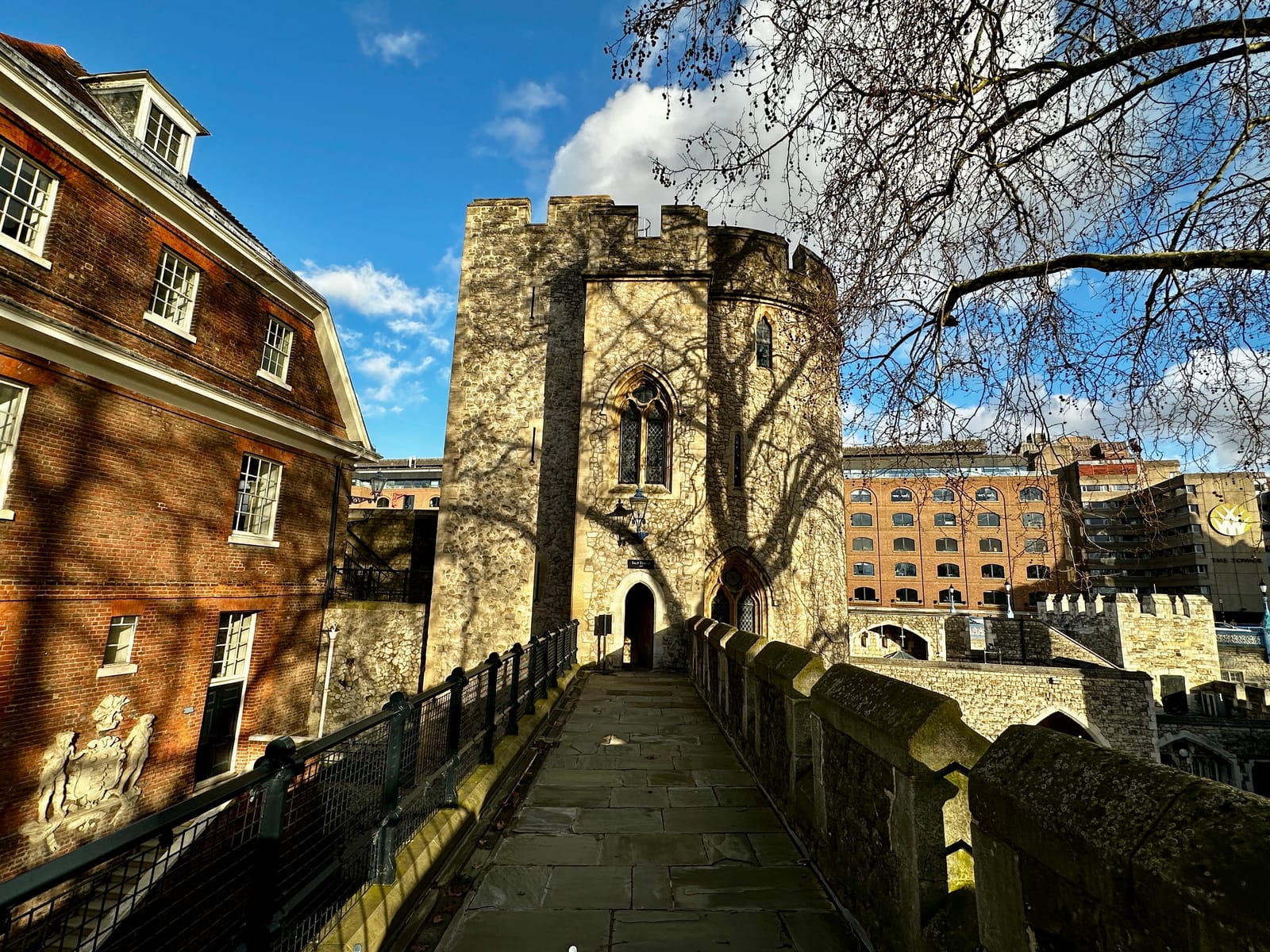
The Battlements, on the east wall walk
Henry III's masons on the east and north walls, with Edward I's rebuilding to the west; the crenellations you walk behind are Victorian replacements · Wall and towers from about 1238 into Edward I's reign; the outer curtain's three east towers dismantled in 1843 · Inner curtain wall studded with thirteen towers and walked at parapet level, enclosing a castle of almost 12 acres, 4.9 hectares, with the Salt Tower at the south-east corner
Look for
- The crenellations you are walking behind. They are Victorian replacements; the only medieval battlements left are the blocked ones on Legge's Mount, which you could see from the pavement before you came in.
- The Salt Tower at the south-east corner of the walk, and the outer ward below it, where the Royal Mint stood in a building near this tower by 1560.
- The outer curtain below you on the east side. Three rectangular towers stood along it, fifteen metres apart, until they were dismantled in 1843.
- The White Tower from up here. This is the only point on the standard route where you are level with the keep's lower windows instead of looking up at them.
Transcript (2:05)
You are standing on top of Henry the Third's wall, the one place on the standard route where you are above the castle rather than inside it, and the first thing to do is turn outwards and look over the parapet.
Below you on this side is the outer ward, a narrow strip between the two walls, and beyond it the City. Those office towers are the reason this place has been pushed towards UNESCO's list of World Heritage in Danger. The Tower went onto the World Heritage list in 1988.
Now look down at the stone you are leaning on. Henry the Third built this east wall and the north wall from about 1238, and the dimensions of the ward have not changed since. Most of his work survives; of the nine towers he put up, only two have been completely rebuilt. Thirteen towers stud this curtain wall, and clockwise from the south-west corner they are the Bell, Beauchamp, Devereux, Flint, Bowyer, Brick, Martin, Constable, Broad Arrow, Salt, Lanthorn, Wakefield and Bloody Towers. Each had a job. The Bell Tower held the bell that raised the alarm if the castle was attacked. The royal bow-maker, who made longbows, crossbows and catapults, had his workshop in the Bowyer Tower.
The crenellations you are walking behind are not medieval. Almost every notch at the Tower is a Victorian replacement, and the only medieval battlements left are the blocked ones on the south face of Legge's Mount, the bastion at the north-west corner.
This wall is also the part of the castle that did the work it was built for. The Tower was besieged in October 1191, when William Longchamp handed it to Prince John after three days. Again in 1214, when Robert Fitzwalter led an army into London and the siege lifted only because King John signed Magna Carta. And in April 1267, when Gilbert de Clare, Earl of Hertford, brought a large army and siege engines against it, declared that custody of the Tower was not a post to be trusted to a foreigner, and could not take it.
Look down into the outer ward before you come down yourself. Three rectangular towers stood along the outer curtain on that side, fifteen metres apart, until they were pulled down in 1843, and the Royal Mint worked in the same strip: Edward the First moved it inside these walls, in 1279 the country's mints were centralised here, and by 1560 the Mint filled a building down there beside the Salt Tower. Gun salutes are still fired from this castle several times a year by the Honourable Artillery Company: sixty-two rounds for a royal occasion, forty-one for everything else.
Independent guide · Chiaro
Point Chiaro at anything at the Tower of London.
Five stops, and the castle is twelve acres with thirteen towers on the inner wall alone. A carved inscription, a coat of arms over a doorway, a bastion nobody has labelled: frame any of them in your phone and Chiaro explains what it is and who was responsible for it, and it keeps going as long as you have questions.
Before you go
Getting there
Tower Hill, London EC3N 4AB. Go to the western end, beside the moat: the Tower's own visitor map marks Enter here and Exit here at that corner, and its access documents call it the West Gate. The first stop on this page is on the pavement outside it.
Tower Hill, on the Circle and District lines, is the nearest Underground station and is in fare zone 1, a few minutes on foot from the west entrance. Tower Gateway on the Docklands Light Railway and Fenchurch Street for National Rail are both a short walk, and Tower Millennium Pier, for river boats, sits off the south-west corner of the castle. The Tower's own map marks a bus stop and a coach park at the Tower Hill end.
Tickets and entry
- Book online before you travel, for the date and entry time you want. This is the ninth most visited attraction in the country, with 2,817,852 people through it in 2025, and the Tower's own map marks one way in, at the western end.
- One standard adult ticket covers this whole walk, and the Yeoman Warder tours with it. There is no separate booking for the White Tower, the Beauchamp Tower or the wall walk.
- Photography is not allowed everywhere. The Tower's own visitor map carries a no-photography symbol, and the places it applies to are signposted on the ground.
- Opening times change with the season, and the Tower closes over Christmas and on New Year's Day. Check hrp.org.uk for the hours and the exact closure dates before you travel.
The official audio guide
The Tower's own official guide is a person, not a device. The Yeoman Warders, who have been the Royal Bodyguard since at least 1509, give the guided tours round the castle, a Warder tour is part of ordinary admission rather than a paid extra, and the Tower's own visitor map lists Meet the Yeoman Warders among the ten things to see and do. Separately, the Tower offers a multimedia guide as a paid extra, collected on site, with its own pick-up point marked on that same map; its price is on hrp.org.uk. Chiaro's page adds a third choice: five stops running in your phone's browser, with no handset to collect and no app to install, and each script written out below its player for stretches of wall too windy to hear.
Official site →Questions
Is there a free Tower of London audio guide?
This is one. Its five stops play from an ordinary web page, the transcript sits under every player, and there is neither an app to install nor a handset to collect. The Tower's own guided tours, given by the Yeoman Warders, are also included in the price of admission. Anything neither of those reaches, and there are hundreds of such things, the Chiaro app will narrate from a photo you take.
Do I need a ticket to listen?
Not for the first stop. It stands on the pavement on Tower Hill, west of the moat and outside the gate, and needs nothing but a view of the walls. The other four are inside: Traitors' Gate on Water Lane, Tower Green and the Beauchamp Tower, the White Tower, and the east wall walk. All four are covered by one standard adult ticket, with no extra booking.
How much is the official Tower of London audio guide?
The Tower's official guide is the Yeoman Warders, and their tours cost nothing on top of your ticket: a Warder tour is part of ordinary admission, and the Tower's own visitor map lists it among the ten things to see and do. The Tower also offers a multimedia guide as a paid extra, which you collect on site and can add when you book. Its price is on hrp.org.uk.
Where do I start?
On Tower Hill, on the pavement west of the moat, looking across at the outer wall. The Tower's own visitor map marks Enter here and Exit here at that western corner, and its access documents call it the West Gate. Play the first stop before you go in; the walk then runs east along Water Lane and finishes up on the wall walk, which brings you back down inside the walls.
Is the Tower of London closed on any day?
It closes over Christmas and on New Year's Day, and it is open the rest of the year. The hours are seasonal, and the Tower's own site gives them for each day. The first stop on this page works whatever the gate is doing: it stands on the pavement on Tower Hill, west of the moat and outside the walls.
Where is the White Tower at the Tower of London?
In the middle of the castle, in the innermost ward, and you enter it by the wooden staircase on its south face. It is the keep William the Conqueror began about 1078, thirty-six metres by thirty-two at the base and twenty-seven metres high at its southern battlements, and the whole fortress is named after it. Saint John's Chapel is on the upper floor inside.
More audio guides
Made by Chiaro. Not affiliated with the Tower of London.