
Tower Bridge · London · Independent guide
Tower Bridge audio guide,
five stops, free.
A steel skeleton in Gothic stone, opened in 1894, its walkways 43.5 metres above the Thames at high tide. Hear it from the riverbank to the steam engines, then photograph any rivet, crest or passing ship and ask Chiaro what you are looking at.
Made by Chiaro. Not affiliated with Tower Bridge.
The whole bridge from Tower Wharf
Tower Bridge, London
That was the free part
Chiaro narrates anything at Tower Bridge from a photo.
The five stops · 11 minutes of audio
Five places, one walk,
in the order you will walk them.
Tower Bridge makes most sense from the water's edge, so this self-guided audio guide begins on the riverside walk below the Tower of London, west of the bridge, where the whole structure fits in one view and nobody asks for a ticket. The second stop is up on the northern approach, on the public pavement among the lampposts. The paid part then follows the bridge's own route: in at the Ticket Office on the west side of the North Tower, up the tower's 206 steps or its lift, across the West Walkway high over the river, down the South Tower and along the Blue Line to the Victorian steam engines under the southern approach, where the visit lets out. About ten minutes of listening in total, and apart from the climb the walking never leaves the bridge and its two approaches.
Every opening time, price and access rule on this page was read off towerbridge.org.uk, the site of the charity that owns the bridge, City Bridge Foundation, on 26 September 2026, and each date and measurement in the recordings was set against a second, independent source. This is a working bridge: a ship can lift the road while you are in the queue, and a lift can be out of service at short notice. If a Welcome Host in a blue uniform tells you something different on the day, their word beats ours.
7777777kz, CC BY 3.0, via Wikimedia Commons, cropped. Photo: 7777777kz
.jpg)
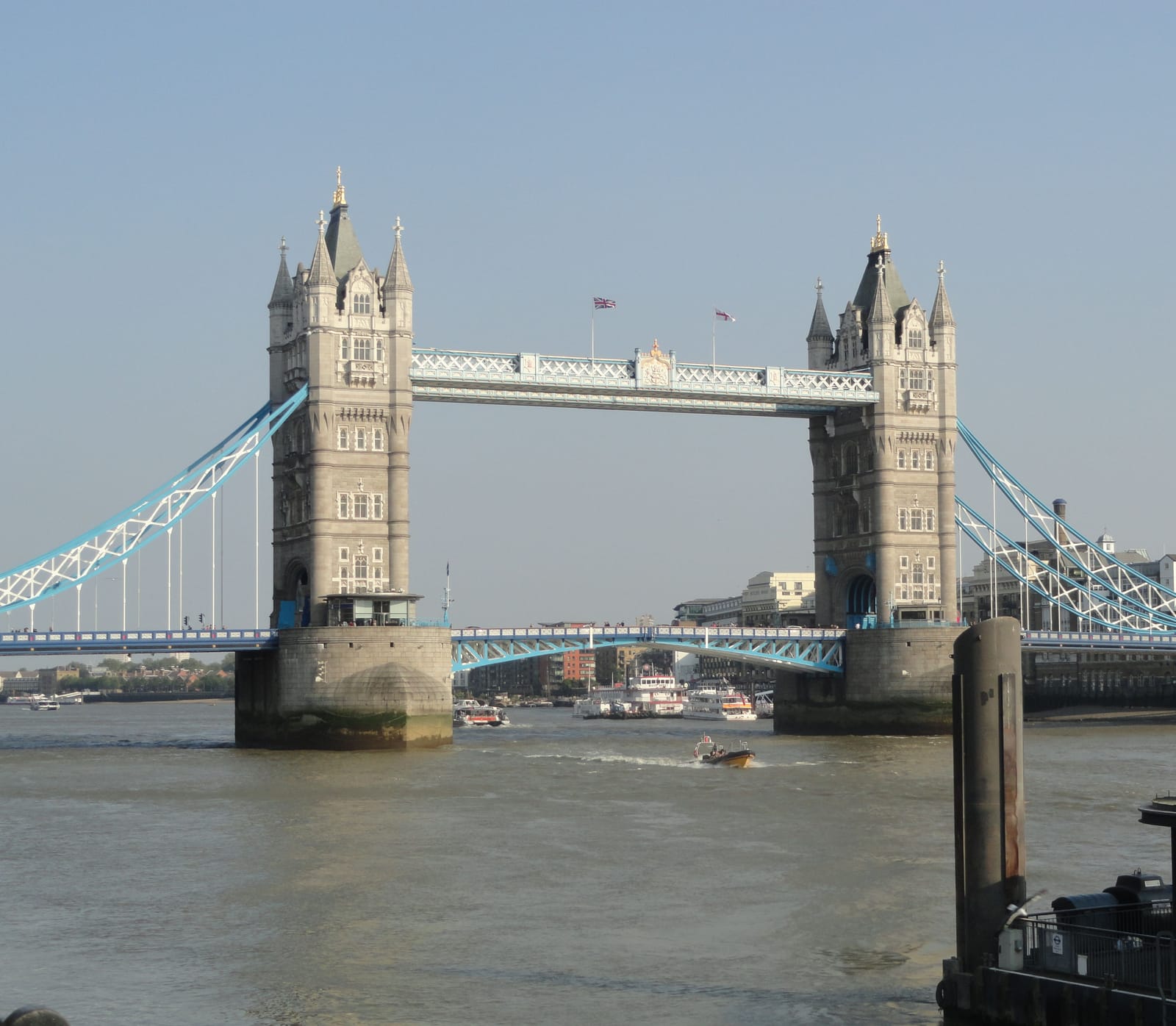
Stop 1 of 5 · North bank, on the riverside walk below the Tower of London, west of the bridge; public ground, before any ticket
The whole bridge from Tower Wharf
Horace Jones (1819–1887), City architect, and John Wolfe Barry (1836–1918), engineer, for the Bridge House Estates · Built 22 April 1886 to 1894; opened 30 June 1894 · Steel frame clad in Cornish granite and Portland stone; 290 metres long including the abutments, the towers 65 metres high
Look for
- The small blue boxes on each tower just above the sides of the road arch. They look like bird boxes and cover the ends of the quadrants inside, which would otherwise stick out when the bridge is closed.
- The pale blue chains dipping from the towers to each shore. Those outer stretches are suspension bridges holding up the road; only the middle lifts.
- The crests on the tower tops, almost sixty-three metres above the road and gilded with gold.
- Two walkways, not one, strung between the tower tops: you will cross the western one later.
Transcript (2:13)
Keep the old stone of the Tower of London at your back, face downstream, and you have the whole machine in one frame: two towers standing in the water, a pair of walkways strung between their tops, and on either side a pale blue chain swooping down to the shore. Everything on the rest of this walk is in front of you now, so give it a minute.
First, the costume. Those towers look like masonry, and they are not. Under the Cornish granite and the Portland stone is a steel skeleton, and in the bridge's own words the stone went on to protect the steelwork and to give the bridge a more pleasing appearance. The disguise was a condition of the job. The Act of Parliament of 1885 said the design should accord with the architecture of the Tower of London, the fortress behind you, and the bridge's own history says the Gothic dress answered Queen Victoria's objection to any bridge this close to it.
The man who drew it never saw it finished. Building began on the twenty-second of April 1886, and the City architect, Horace Jones, died in May 1887. His partner, the engineer John Wolfe Barry, carried it through, and Barry's architectural assistant, Mr Stevenson, swapped Jones's plainer brick front for the ornate Victorian Gothic you are looking at.
Now read the structure, because this is three bridges, not one. The chains dipping to each shore hold up suspension spans. The road between the two towers is the part that lifts, the bascules. And the walkways at the top were built as cantilevers reaching out from each tower, until cables were added in 1960 and turned them into suspension bridges too.
The colour has changed more than the shape. When the bridge opened in 1894 its ironwork was a bright chocolate brown. It went battleship grey before the Second World War, and in 1977 it was painted red, white and blue for the Queen's Silver Jubilee. The blue and white you see now comes from a repaint that began in 2008, with the old paint stripped back to bare metal.
Not everyone was charmed. In 1894 the Pall Mall Gazette called it our ugliest public work, and the architect Henry Heathcote Statham accused it of tawdriness and of falsifying the facts of its own structure. He had a point about the falsifying. He lost the argument anyway.
One last thing before you walk up to it. Find the small blue boxes on each tower, just above the sides of the road arch. They cover the ends of the quadrants inside, which would otherwise stick out when the bridge is closed. And above everything, almost sixty-three metres over the road, the crests on the tower tops are gilded with gold.
Matt Brown, CC BY 2.0, via Wikimedia Commons, cropped. Photo: Matt Brown

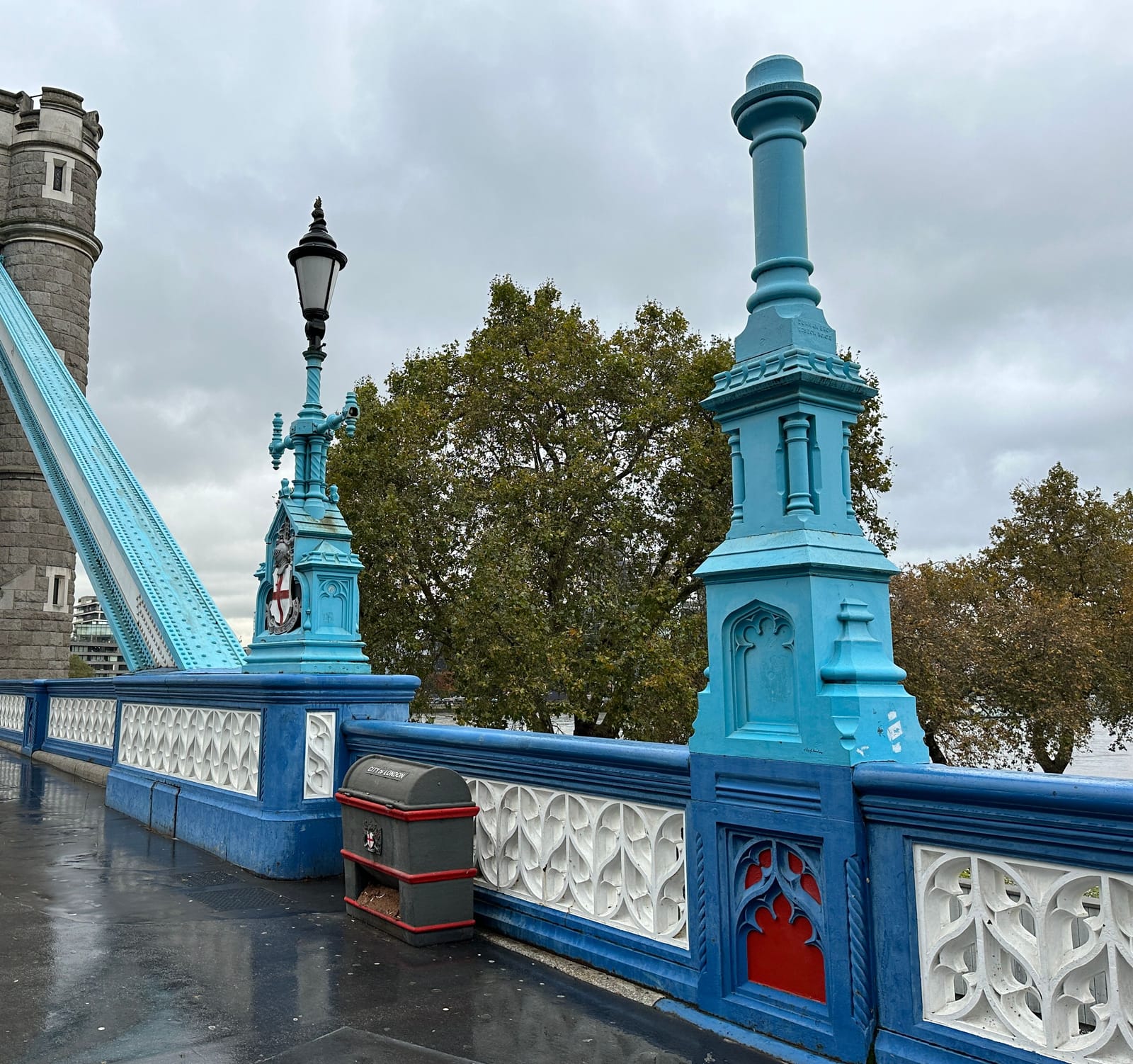
Stop 2 of 5 · Northern approach, on the pavement among the lampposts before the North Tower; public roadway, free
The chimney disguised as a lamppost
Horace Jones and John Wolfe Barry's design; the northern approach built under John Jackson's contract · Northern approach begun February 1887; bridge opened 1894 · Painted cast iron among the approach lampposts; the northern approach is 1,260 feet long and 60 feet wide between the parapets
Look for
- The one tall blue post among the lampposts with no lantern on top. That is the chimney, for the guardrooms in the arches under your feet.
- The suspension chain running down beside the road: the stretch from the shore to the tower hangs from it.
- Through the arch of the North Tower, the road between the towers. Those are the two bascules, the only part of the bridge that lifts.
Transcript (2:07)
You are on the northern approach, the road climbing from Tower Hill onto the bridge, and this pavement is public: nobody checks anything here. Look at the lampposts. Most of them carry a lantern. One tall blue post among them does not, and it never needed one. It is a chimney.
Under the road here are arches, and in the arches were guardrooms for the Royal Fusiliers, the soldiers of the Tower of London next door. The rooms needed heating, the smoke had to go somewhere, and a plain Victorian flue would have spoiled a Gothic bridge. So the chimney was dressed as street furniture. The bridge's own history calls it hidden in plain sight.
The soldiers were not an afterthought. The Act that authorised the bridge in 1885 gave the senior officer commanding in the Tower the right to occupy the bridge at all times, and Wolfe Barry recorded that there had once been a plan to make the works fit for mounting guns. The guns were mostly dropped; the chimney was not.
Now look ahead, through the arch of the North Tower, at the road between the two towers. That stretch is the bascules, from the French for seesaw. Each leaf turns on an off-centre pivot, with a counterweight of more than four hundred tons on the short end, hidden inside the pier, and the balance is set to favour the river side by just five to seven tons so the driver keeps control. Eight cogs, each about a metre across, do the turning.
The same Act says river traffic comes first. A registered vessel with a mast or superstructure of thirty feet or more gets the road raised for it, free of charge, day or night, on twenty-four hours' notice. In the first year that meant more than six thousand openings. Today it averages two or three a day. When maintenance cuts the headroom, the law still requires a bundle of hay to be hung from the bridge as a warning to ships.
Once, it went wrong. On the thirtieth of December 1952 a driver called Albert Gunter was taking a number 78 bus south across the bridge, towards Dulwich, when the road in front of him began to rise. The watchman should have rung the bell and closed the gates, and had not, and a relief man was working the bascules. Gunter put his foot down. At about twelve miles an hour the bus cleared the gap and dropped roughly three feet onto the far leaf, which had not yet moved. He was given a day off and ten pounds. Asked how he would spend it, he said: five for me, and five for the missus.
Matt Brown, CC BY 2.0, via Wikimedia Commons. Photo: Matt Brown

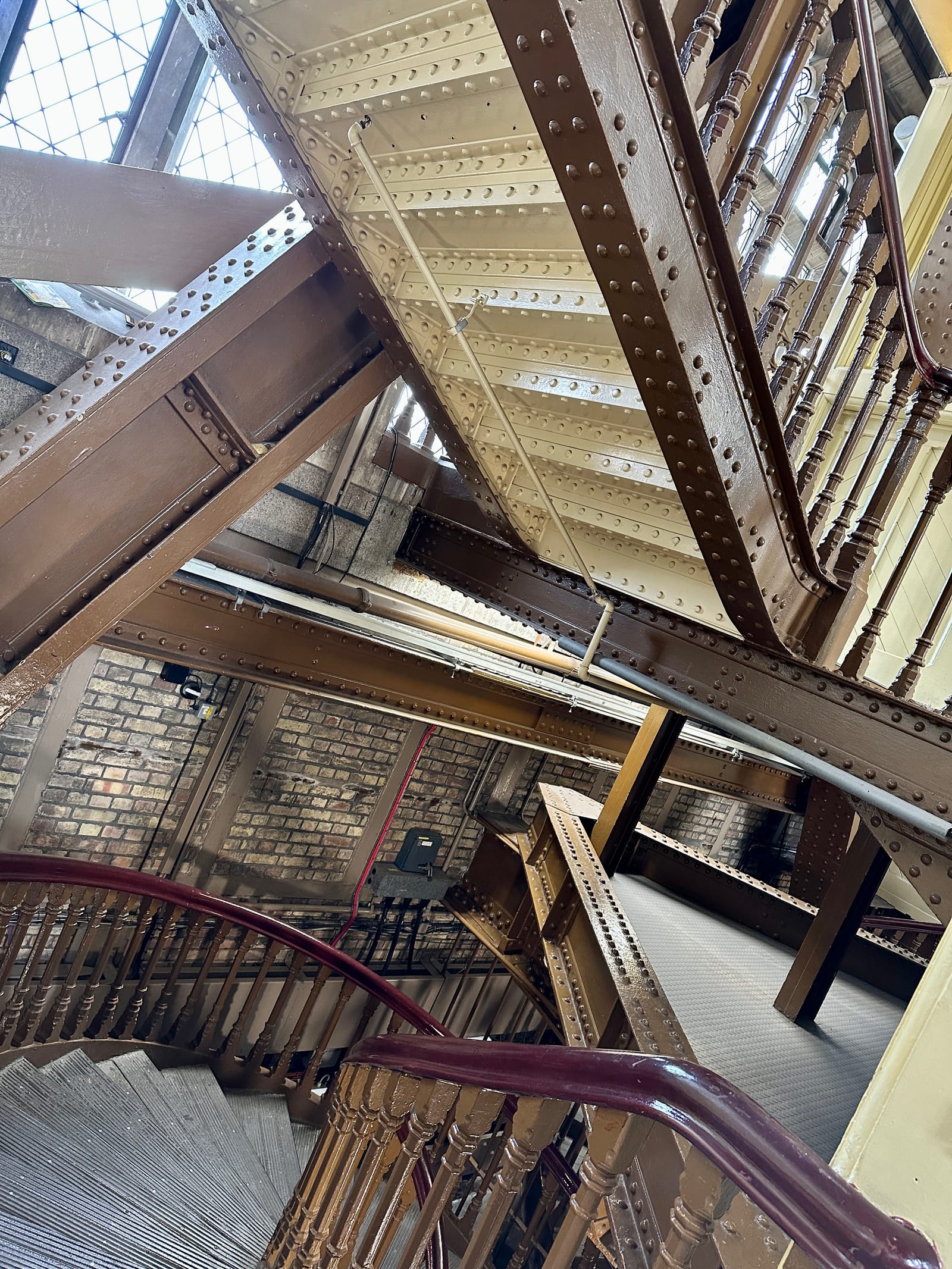
Stop 3 of 5 · North Tower, the staircase up from the Ticket Office on the west side to the High-Level Walkways, with a lift alongside
The North Tower stairs and the steel skeleton
Sir William Arrol & Co. (steelwork contract, May 1889) to John Wolfe Barry's design, with Henry Marc Brunel as assistant engineer and Edward Cruttwell as resident engineer · Steelwork 1889–1894; internal stairs completed April 1894 · Riveted steel in the original brown paint, inside a granite and Portland stone facing backed with brick; 206 steps to the top of the North Tower
Look for
- The rows of rivet heads on every girder. There are more than thirteen million in the bridge.
- The brown paint on the stair ironwork: the bridge's original 1894 colour, still here though the outside has changed three times.
- Yellow brick behind the steel. The granite you saw from the river is only a facing, backed with brick on the inside.
Transcript (2:10)
You have come in on the west side of the North Tower, and from here the visit goes up: two hundred and six steps to the top of this tower. Whether you take them or the lift, stop on a landing and look at what is actually holding the building up.
It is not the stone. From the river this tower looks like a castle keep. In here you can see what the granite hides: riveted steel girders, with yellow brick behind them. The towers were built as a skeleton of steelwork, faced outside with granite and Portland stone and backed with brickwork on the inside. At each corner of each tower stands an octagonal steel column more than a hundred and nineteen feet long.
Now the colour. The stair ironwork around you is brown, and that is not a restorer's whim. It is the bridge's original paint, a bright chocolate brown, on stairs finished in April 1894, and it is said to have been Queen Victoria's favourite colour. Outside, the bridge has since been grey, then red, white and blue, and now blue and white. In here the brown never left.
Count rivets if you like; you will not finish. There are more than thirteen million in the bridge, driven by squads of riveters as the towers rose. The steel came from William Arrol's company, which won the contract in May 1889 for eleven thousand tons of steel and twelve hundred tons of ornamental cast iron, about eight kilometres of metal in all. Arrol had started work in a cotton mill at the age of nine. By the time he took this job his firm was also rebuilding the Tay railway bridge, which had collapsed in 1879, and building the Forth Bridge. The Tay disaster is in this tower as well: the design had to withstand a wind pressure of fifty-six pounds per square foot, a rule brought in after it.
The chief engineer was John Wolfe Barry, with Henry Marc Brunel, the second son of Isambard Kingdom Brunel, as his assistant, and Edward Cruttwell as resident engineer. It took eight years, five major contractors and four hundred and thirty-two workers on site each day, some of them divers digging out the foundations inside iron caissons, the first sunk almost eight metres under the riverbed. Around thirty-one million bricks went in. Cruttwell recorded that there were only ten fatal accidents, and he meant the word only as praise.
When the two halves of the steelwork finally met over the river, Barry wrote in his diary that the last rivets slotted in perfectly. That join is still there inside the bridge. Keep climbing towards it.
Arpingstone, Public domain, via Wikimedia Commons. Photo: Arpingstone

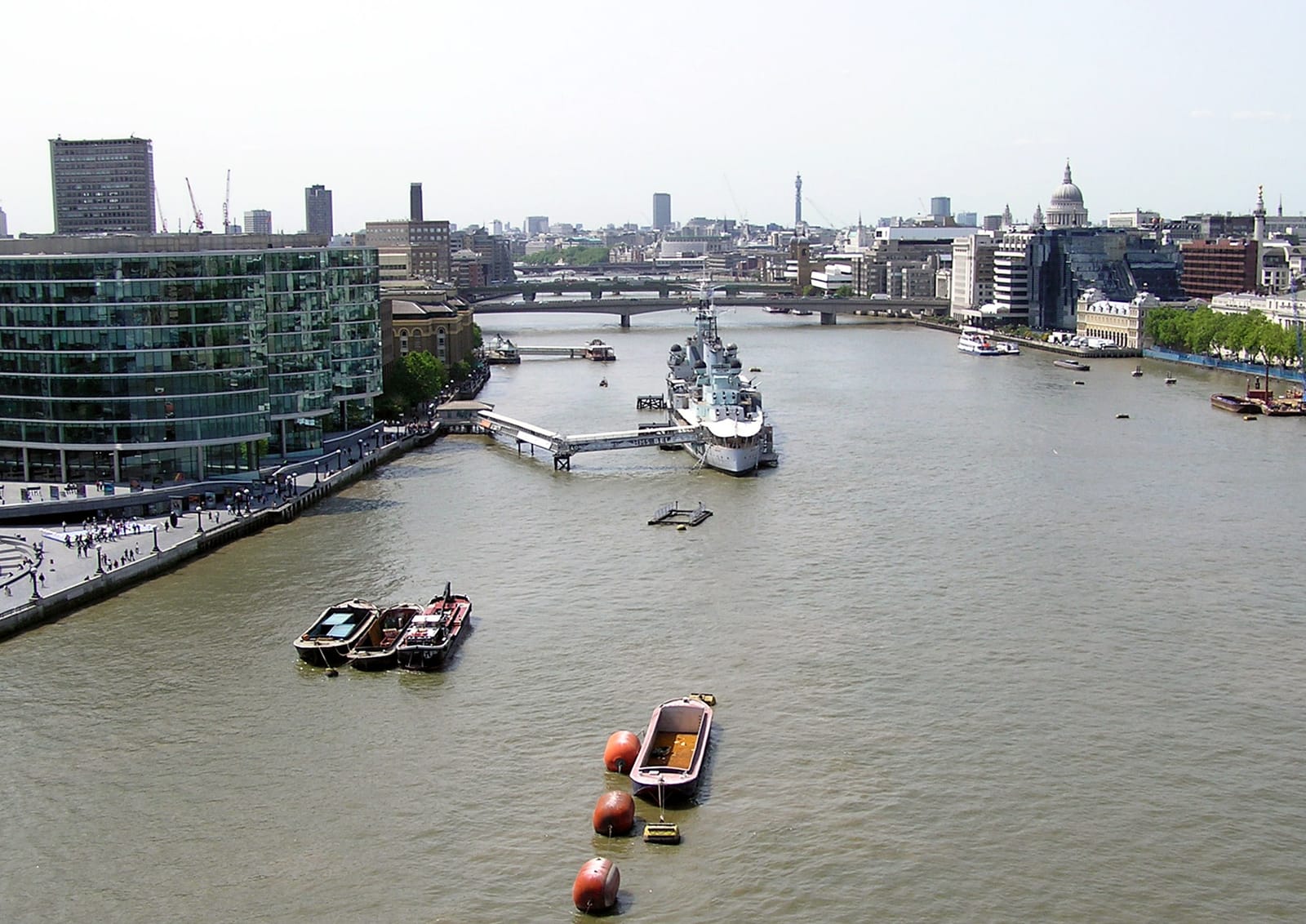
Stop 4 of 5 · High-Level Walkways, the West Walkway, facing upriver towards the Tower of London and St Paul's
The West Walkway, looking upriver
Horace Jones and John Wolfe Barry; girders by Sir William Arrol & Co.; suspension cables added in 1960 · Completed June 1894; closed 1910; reopened 1982; Glass Floors added 2014 · Steel lattice girders, 43.5 metres above the Thames at high tide and 33.5 metres above the road
Look for
- Saint Paul's dome on the skyline, and the Monument's gilded top to its right.
- HMS Belfast moored in the Pool, with London Bridge beyond her: the stretch of river this bridge was built to keep open.
- The small camera windows set into the walkway, put there for exactly this view.
Transcript (2:04)
You are forty-three and a half metres above the Thames at high tide, thirty-three and a half above the road, in the West Walkway, and the view in front of you is the reason this bridge opens at all. Look upriver.
The water between here and London Bridge, the next bridge upstream, is the Upper Pool of London. When this crossing was planned, the Act that authorised it listed eleven working docks, quays and wharves on the north bank of that stretch and twenty wharves on the south. A fixed bridge low enough for carts would have cut them off from the sea. So the road had to lift, and people on foot needed a way over while it was up. That is what you are standing in. HMS Belfast is moored in the Pool below you now.
Follow the skyline from left to right. The dome is Saint Paul's. The column with the gilded top, to its right, is the Monument to the Great Fire. The tall chimney across the river is Tate Modern, and the needle further off is the BT Tower. The Tower of London sits low on your right.
These walkways had an awkward first life. They opened in 1894 and closed in 1910 for lack of use: given the choice between climbing all those stairs and waiting at street level for the bascules to come down, Londoners waited. What use the walkways did get earned them a reputation for pickpockets and prostitutes. They stayed shut for seventy-two years and reopened in 1982, when the bridge became a visitor attraction.
The shape of this walkway is a compromise. Horace Jones first drew a great arch between the tower tops, and objections that ships' masts and rigging could hit it sent Wolfe Barry, in 1885, to a level underside instead. It was built as two cantilevers reaching out from the towers, and in 1960 suspension cables were added to strengthen it, turning it into a suspension bridge. The walkways also carry the cable that supports the whole length of the bridge beneath you.
Two stories about the gap below. Under the original rules, a black ball hanging from the middle of each walkway told a ship's master that the bridge could not open for him. And on the tenth of August 1912 the pilot Francis McClean flew his floatplane straight through, between the bascules and these walkways, and became a celebrity overnight.
Since 2014 part of this floor has been glass, and each panel is rated to carry an elephant or two London black cabs. Stand on it if you dare, and the road you walked up from is thirty-three and a half metres below your shoes.
www.mgaylard.co.uk and thanks for looking, CC BY 2.0, via Wikimedia Commons. Photo: www.mgaylard.co.uk and thanks for looking

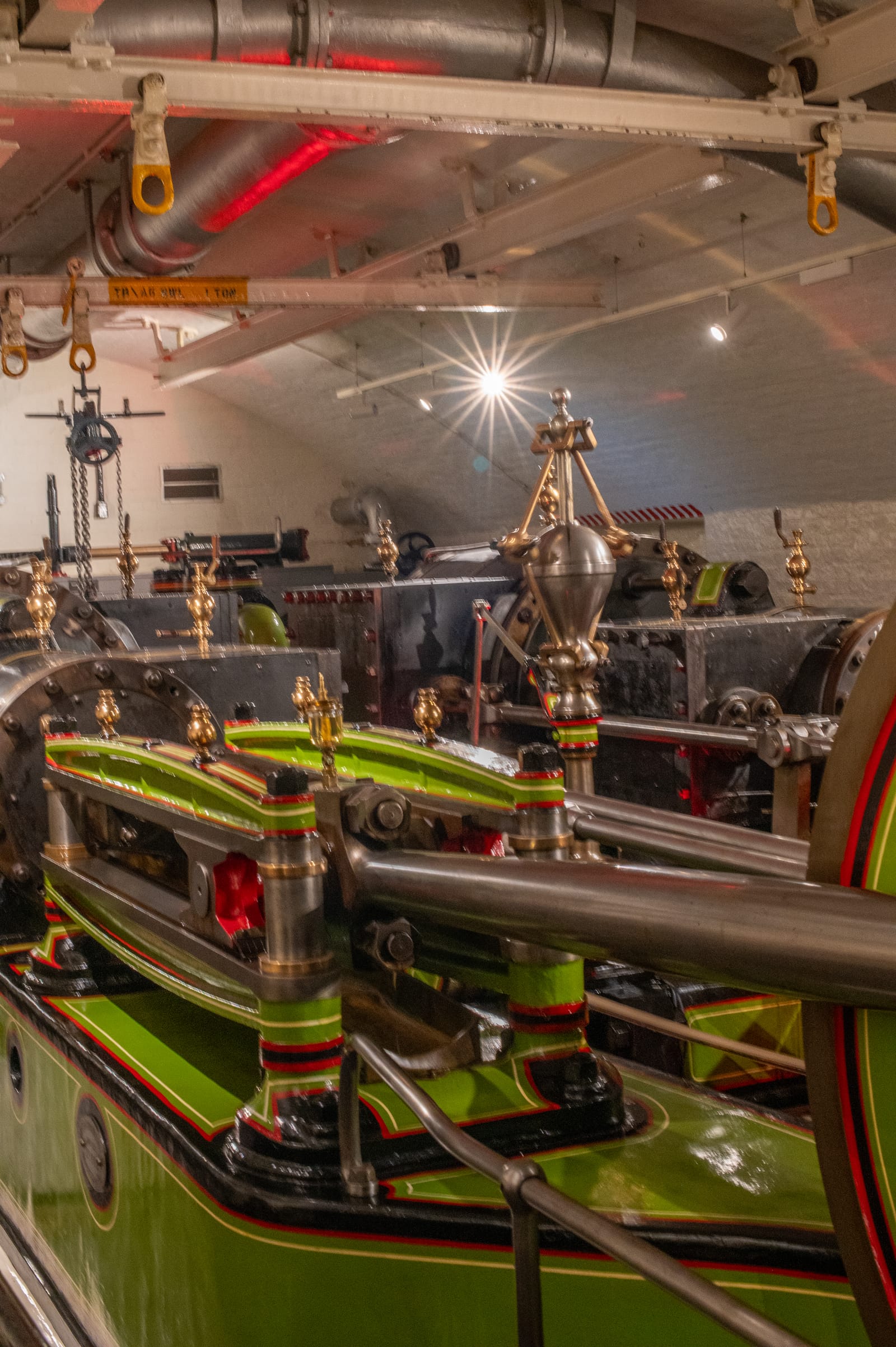
Stop 5 of 5 · Engine Rooms, beneath the southern approach, reached along the Blue Line from the South Tower exit; the Gift Shop is the way out
The Victorian Engine Rooms
Sir W. G. Armstrong, Mitchell & Co. of Elswick, designed with John Wolfe Barry and installed under Hamilton Rendel and Samuel Homfrey · Contract December 1887; lifted the bridge from 1894 to 1976 · Coal-fired boilers, steam pumping engines and six hydraulic accumulators weighted at about 100 tons each, holding water at 750 pounds per square inch
Look for
- The green flywheel lined in red and cream. The colour was William Armstrong's own choice, from his family crest.
- The accumulators overhead: weights of about a hundred tons each, which stored the power to lift the road.
Transcript (2:10)
You came down the South Tower and out along the Blue Line on the pavement, which names people who worked on this bridge, among them Hannah Griggs, a cook, and John Chalk, a rivet boy who started at fourteen. Now you are under the southern approach, among the machines that lifted the road for eighty-two years.
Start with the green flywheel. That colour, lined out in red and cream, was William Armstrong's own choice, taken from his family crest. Armstrong spent eleven years as a solicitor before he gave in to engineering, and by 1842 he had invented the device that makes sense of this whole place: the hydraulic accumulator. His firm, Sir W. G. Armstrong, Mitchell and Company of Elswick, signed the contract for this machinery in December 1887, for eighty-five thousand two hundred and thirty-two pounds. People called him the Magician of the North.
Here is how the magic worked. Next door, coal fires in the boilers turned water into steam. The steam drove these pumping engines; their pistons turned the flywheel and worked pumps that forced water into six accumulators, weighted cylinders that held it at seven hundred and fifty pounds per square inch. They were batteries made of water. When the bridge had to open, the stored water was released into the drive engines, which turned the cogs, which pushed on the racks at the back of the bascules, and the road went up. Look up for the accumulators: the weights are about a hundred tons each.
Nothing was trusted to a single engine. There were two pairs of engines on each pier, and the machinery was built to twice the Board of Trade's requirements, standards already tightened after the Tay Bridge disaster. It needed feeding, too. The stokers shovelled more than twenty tonnes of coal a week, and more than eighty people were needed to keep the engines running and the bridge lifting. Until the early nineteen-eighties there were cats living down here as well.
The war reached these rooms. In April 1941 a parachute mine exploded close to the bridge and seriously damaged a bascule, the towers and the engine room, and a third engine was installed during the war in case these were knocked out. It now stands in a steam museum in Norfolk.
From 1974 a new electro-hydraulic system, running on oil, was installed alongside the steam plant while the bridge kept opening, and in 1976 the old system was disconnected. By then these engines had raised the bascules more than four hundred thousand times. They have been still ever since, and they still wear Armstrong's green.
Independent guide · Chiaro
Point Chiaro at anything at Tower Bridge.
Five stops, and the bridge is thick with things nobody has labelled: a coat of arms on a lamp base, a sailing barge waiting downstream for the road to go up, a spire on the skyline through a walkway window, a gauge on a boiler. Photograph any of them and Chiaro names it, says who put it there and what it has to do with this crossing, then carries on answering while the river traffic goes by.
Before you go
Getting there
Tower Bridge carries the road between Tower Bridge Approach on the north bank and Tower Bridge Road on the south. The Ticket Office and entrance is on the west side of the North Tower, on the northwest side of the bridge, and everyone queues outside there. The visit finishes under the southern approach at the Engine Rooms and the Gift Shop, and an external lift on the southeast side links that level with the roadway.
The closest Underground stop is Tower Hill (District and Circle lines), a seven-minute walk and about 500 metres from the Ticket Office, with step-free access from platform to street. London Bridge station, on the Northern and Jubilee lines, is about a kilometre from the Engine Rooms end. Fenchurch Street and London Bridge are the nearest National Rail stations and Tower Gateway the nearest on the DLR. Bus routes 15, 42, 78, 100 and 343 run to the bridge, and riverboats call at Tower Pier on the north side and London Bridge City Pier on the south.
Tickets and entry
- The bridge is open 09:30 to 18:00 daily, last entry 17:00, except on the second Saturday of each month: from 09:30 to 11:30 that morning is Relaxed Opening, a low-capacity session for neurodivergent visitors and their families, friends and carers, and the general public is admitted after it. The bridge shuts over Christmas, from 24 to 26 December, and opens late, at 10:00, on New Year's Day.
- One entry ticket covers everything on this walk that needs one: the North and South Towers, the High-Level Walkways with their Glass Floors, and the Engine Rooms. An adult ticket is £18.00 and a child's (5 to 15) £9.00, and under-fives go free. Tickets can be booked up to eight weeks ahead for the entry time you want, but a booked ticket is not fast-track: the queue is outside on the bridge, and a bridge lift can hold it up.
- Bags are searched at the entrance, and tickets and bags are checked again at the Engine Rooms door. Shoulder bags and backpacks have to fit within 45 x 35 x 20 cm; suitcases and wheeled bags are not allowed. There is no café, restaurant or water dispenser on site.
- Each tower has a lift up to the walkways, and an external lift on the southeast side reaches the Engine Rooms; the bridge warns that lifts can be out of order at short notice.
The official audio guide
The bridge's own audio tours cost nothing beyond the entry ticket. There are three: a Highlights Tour in English, Arabic, Mandarin, German, Italian, French and Spanish, a Sensory Tour, and a tour in British Sign Language, each played on your own phone from QR codes inside the towers or from a free app, and lasting around 45 minutes. No headphones are handed out, so bring a pair. For a person rather than a recording, the bridge runs Guided Tours in English on selected dates, an hour and a half long at £35.00 for an adult, which must be booked ahead. This page covers the ground before the queue as well as after it: two stops on the riverside and the public pavement, three inside, with every word printed beneath its player.
Official site →Questions
Is there a free Tower Bridge audio guide?
Yes, and it runs on both sides of the queue: this page's five narrated stops play in your phone's browser, two of them on public ground before the Ticket Office and three inside. The bridge's own three audio tours are free as well, included with an entry ticket and played on your own phone and headphones. For whatever neither of them mentions, from a barge in the Pool to a crest on a lamppost, the Chiaro app narrates it from a photo.
Can I listen to the Tower Bridge audio guide without a ticket?
The first two stops, yes: the view from the riverside walk below the Tower of London and the disguised chimney on the northern approach are both on public ground, because the roadway and its pavements are free to cross. The North Tower stairs, the West Walkway and the Engine Rooms are inside the paid attraction, and all three are on one entry ticket.
How much is the official Tower Bridge audio guide?
Nothing on top of admission. The bridge's audio tours are included in the entry ticket, run for around 45 minutes, and play through QR codes or a free app on your own phone, so bring headphones. The paid option is a staff-led Guided Tour at £35.00 for an adult, an hour and a half long, in English only, on selected dates.
Where does a Tower Bridge visit start, and which days is it closed?
At the Ticket Office on the west side of the North Tower, on the northwest side of the bridge; this page starts a few minutes earlier, on the riverside walk below the Tower of London. The attraction opens daily apart from a three-day Christmas closure, from Christmas Eve to Boxing Day. It opens later on New Year's Day, at 10:00, and on the second Saturday of each month, when the public is let in after the 09:30 to 11:30 Relaxed Opening session.
Will a bridge lift stop me getting in?
It can slow you down. This is still a working bridge that opens for tall ships, on average two or three times a day, and the bridge itself warns that a lift may delay your entry; it publishes the times of planned lifts on its own Bridge Lifts page.
More audio guides
Made by Chiaro. Not affiliated with Tower Bridge.