
Städel Museum · Frankfurt · Independent guide
Städel Museum audio guide,
five stops, free.
Five recordings that play right here, nothing to install. The Städel spans more than 700 years of art, and Chiaro will talk you through any of it from a photo.
Made by Chiaro. Not affiliated with the Städel Museum.
Goethe in the Roman Campagna
Städel Museum, Frankfurt
That was the free part
Chiaro narrates any work in the Städel Museum from a photo.
The five stops · 9 minutes of audio
Five stops, one walk,
in the order you will walk them.
This Städel Museum audio guide covers two floors and five pictures, with Goethe first. The route opens on the 1st upper level in room 1 of the Modern Art galleries, climbs one flight to the Old Masters for Grünewald's grey saints in room 2, Bosch in room 5 and Botticelli's Medici beauty in room 13, and saves Vermeer's Geographer in room 7 for the end. Roughly nine minutes of listening in all; the museum's own Highlight Tour in its app runs to 45 minutes, so this is the short version.
We built every line from the Städel's Digital Collection, which posts the current room of each painting, plus one outside reference per work. Paintings get rehung, and some go abroad on loan. So if room 7 turns out to hold something other than a Vermeer on the day you come, the museum's own label is the authority, and an email from you puts this page right.

Stop 1 of 5 · 1st upper level, Modern Art, room 1
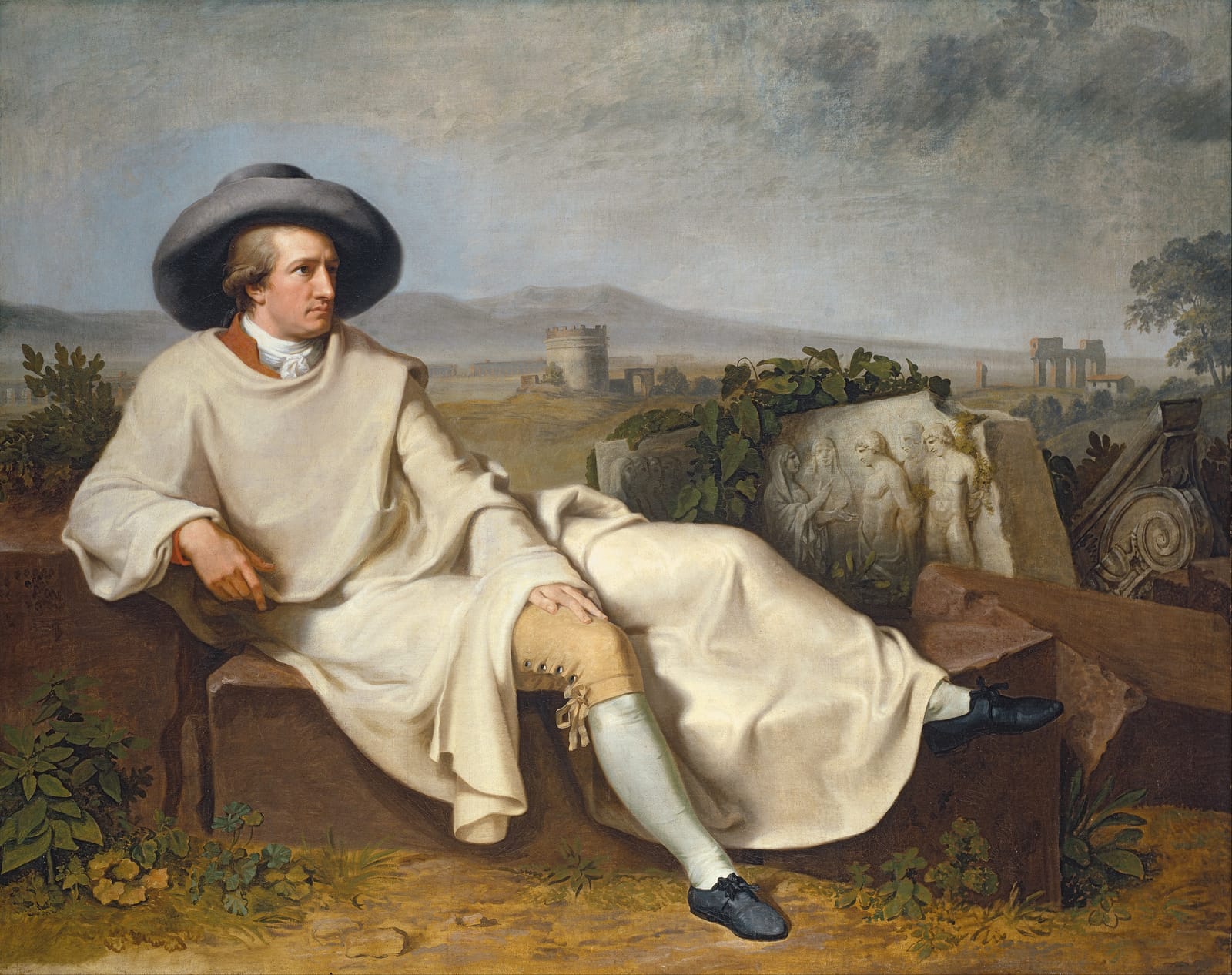
Goethe in the Roman Campagna
Johann Heinrich Wilhelm Tischbein · 1787 · Oil on canvas, 166 × 210.3 cm
Look for
- His feet. The leg stretched along the stone ends in a shoe that looks like a second left one; the museum itself calls it an unexplained oddity.
- The carved relief behind his shoulder: Iphigenia meeting Orestes and Pylades, the story of the play Goethe was turning into verse in Rome.
- The round tower tomb of Caecilia Metella on the horizon, and the arches of a Roman aqueduct at the right.
- The wide grey hat and pale cloak, the dress German artists wore in Rome at the time.
Transcript (1:56)
He is lounging. That is the first thing to notice about the most famous portrait of Germany's most famous writer. Goethe is not standing on a pedestal. He is stretched out on blocks of fallen granite in the open country south-east of Rome, wrapped in a pale traveller's cloak, under a grey hat with an enormous brim, looking past you at something only he can see.
The man who painted him was his friend and his host. Goethe set off for Italy in September 1786 travelling incognito, because The Sorrows of Young Werther had made him too famous to move about under his own name, and he signed himself Filippo Miller. In Rome he stayed with the painter Johann Heinrich Wilhelm Tischbein, and the two of them made an excursion out to the ancient tombs of the Campagna, the countryside around the city. This canvas, dated 1787, is Tischbein's version of that day, and of how he saw his friend: a modern man sitting among the ruins of antiquity, halfway between their world and his.
Look at what Tischbein arranged around him. On the horizon, the round tower is the tomb of Caecilia Metella. At the far right are the arches of a Roman aqueduct. Just behind Goethe's shoulder is a carved relief with three figures. It shows Iphigenia meeting her brother Orestes and his friend Pylades, which is the subject of Iphigenia in Tauris, the play Goethe was reworking into verse and reading aloud to Tischbein.
Now look down at his feet. The leg laid along the stone ends in a shoe that seems to belong on the other foot. The Städel itself calls it a still unexplained oddity: it looks as if Goethe had two left feet. Once you have seen it, you will not be able to stop seeing it.
The friendship was shorter than the painting's fame. After about three months the two men went separate ways in Naples. The canvas travelled on. The Rothschild family acquired it in Italy in the 1840s and hung it for a while at their manor of Günthersburg outside Frankfurt, which is a public park today. In 1887 Baroness Adèle von Rothschild gave it to the Städel, in Goethe's home town, just as the new German Empire was hunting for national heroes. The museum says no other portrait has shaped our picture of Goethe as much as this one. So this is the face the country settled on for him: relaxed, thoughtful, and very slightly wrong at the ankles.

Stop 2 of 5 · 2nd upper level, Old Masters, room 2
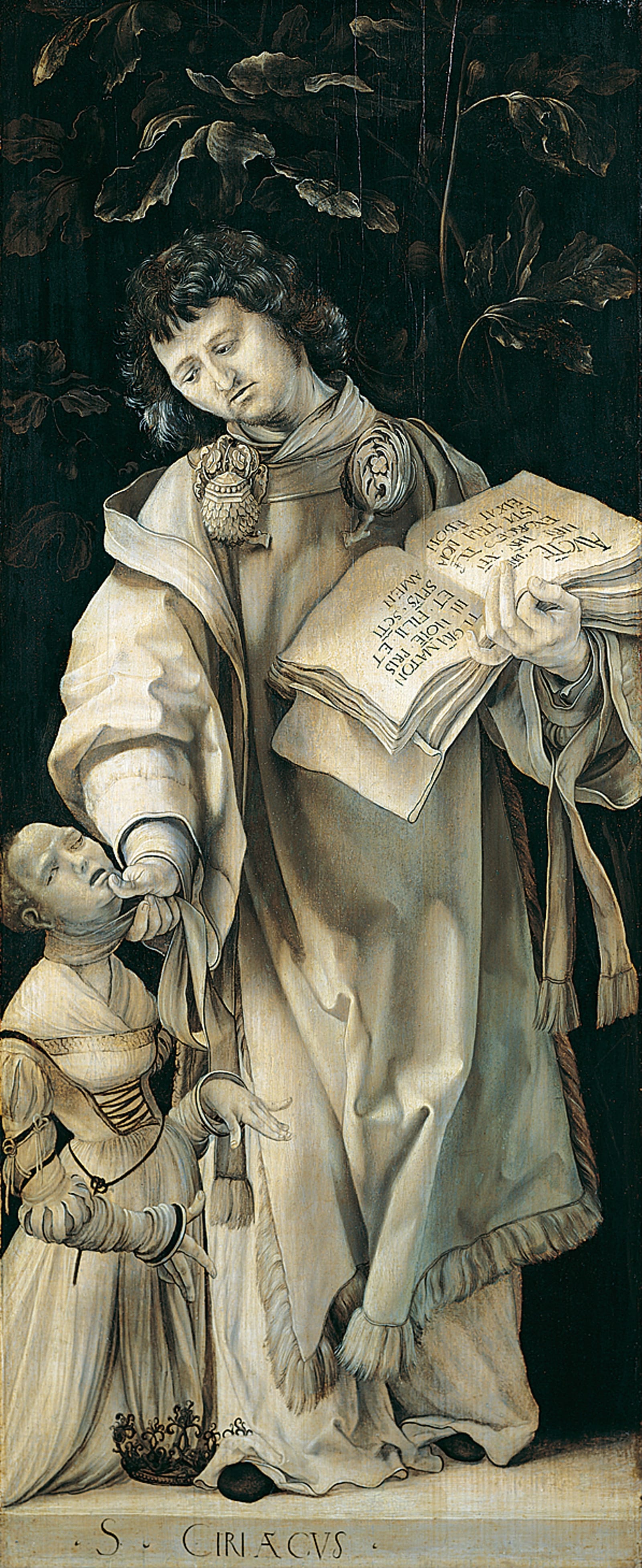
Saints Lawrence and Cyriacus from the Heller Altarpiece
Matthias Grünewald · c. 1509–1510 · Mixed technique on fir, two panels, each about 99 × 43 cm
Look for
- Cyriacus holding the princess by the chin as her eyes roll back, with her crown lying on the floor at her feet.
- The open book in his hand. Grünewald wrote the Latin words of the exorcism across its pages.
- The grid in Lawrence's hand, the gridiron he was burnt on, and the letters MGN, Grünewald's monogram, at the lower right of his panel.
- The names painted along the bases like carved inscriptions: S. LAVRENCIVS and S. CIRIACVS.
Transcript (1:47)
Step close and these two figures stop looking painted. They are grey, white and cream, like carved stone figures set against a dark ground of leaves. The technique is called grisaille, painting in shades of grey to imitate sculpture, and the Städel describes these panels as masterpieces of it, pictures that leave you asking whether you are looking at a painting, a statue, or nature itself.
They are what survives in Frankfurt of one of the great commissions of the German Renaissance. In 1507 a Frankfurt merchant, Jakob Heller, asked Albrecht Dürer to paint an altarpiece for the Dominican church here in the city. Dürer took on the central panel and the movable wings. These two panels, the fixed wings of the same altarpiece, went to another painter, Mathis Gothart Nithart, the man we know as Grünewald, who painted them around 1509 and 1510.
The saint holding the grid is Lawrence, a deacon, and the grid is the one on which he was burnt to death. Look at the lower right of his panel for the letters MGN, Grünewald's monogram. The other deacon is Cyriacus, an exorcist. He has a young woman by the chin while her eyes roll back in her head. She is Artemia, a daughter of the Roman emperor Diocletian, and a demon is being driven out of her. Her crown has fallen to the floor beside her. The book in his other hand is not a decorative prop, either. Grünewald lettered the Latin words of the exorcism across its open pages, ending in the name of the Father, the Son and the Holy Spirit.
Here is the twist. The centre of this altarpiece, Dürer's own panel, no longer exists. It was sold in 1615 to Maximilian the First of Bavaria and destroyed by a fire in Munich in 1729. If you know the famous drawing of two praying hands in the Albertina in Vienna, you know a study for one of its apostles. So the most celebrated name on the commission is now remembered here mostly through a sketch kept in another city, and the two grey saints from the outside of the altarpiece are what Frankfurt still has. They belong to the city's Historisches Museum, and they have been on permanent loan to the Städel since 1922.

Stop 3 of 5 · 2nd upper level, Old Masters, room 5
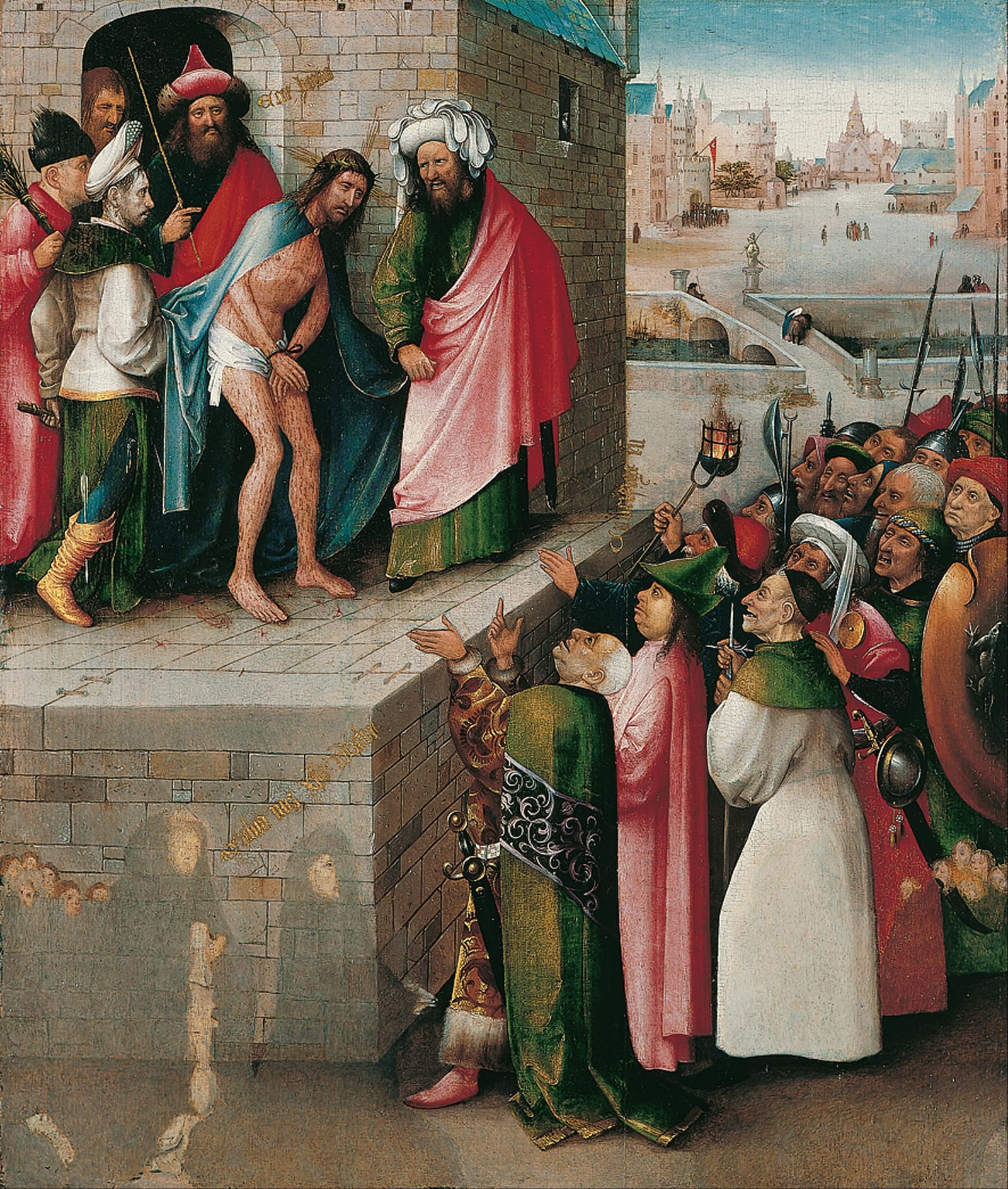
Ecce Homo
Hieronymus Bosch · c. 1490 · Mixed technique on oak, 71.1 × 60.5 cm
Look for
- The pale, half-dissolved figures in the lower left corner. They are the family who paid for the picture, painted over early and uncovered only recently.
- The gold Gothic words floating near the mouths, Ecce homo from Pilate and Crucifige eum from the crowd, read like speech balloons.
- The toad on a soldier's shield at the right edge, one of Bosch's emblems of evil.
- The calm, nearly empty town square in the top right corner, Jerusalem drawn as a Netherlandish town.
Transcript (1:51)
Look first at the bottom left corner, because it is the strangest part of the picture. There are faces there that seem half dissolved into the stone: pale grey ghosts, one figure with a monk's tonsure, a row of tiny heads beside him. They are not a mistake, and they are not unfinished. They are the family who paid for this painting, and for most of its life nobody could see them.
Hieronymus Bosch painted this Ecce Homo around 1490, though the tree rings of the oak panel point to somewhere between 1475 and 1485. The title is Pontius Pilate's line from the Gospel of John, Behold the man, spoken as he shows Jesus to the crowd after the scourging. Bosch writes the words into the picture. Find the gold Gothic letters near Pilate, Ecce homo, and the answer rising out of the mob, Crucifige eum, Crucify him. They work almost like the speech balloons of a comic strip.
The donors had a line of their own. Their figures in the lower corners were damaged and painted over at an early date. An X-ray in 1983 found them underneath, and the remnants you see now were uncovered only a few years ago. Their sizes are a ranking of the household. The children are much smaller than the father and one of the sons, the monk, and it is the monk who speaks the family's prayer: Salva nos Christe redemptor, Redeem us, Christ, Saviour.
The painting had been altered in another way before it reached Frankfurt. The Städelscher Museums-Verein bought it in 1917, in the middle of the First World War, at the auction of the Berlin collector Richard von Kaufmann. By then someone had covered Christ, who Bosch painted in nothing but a loincloth, with a robe down to the floor. The museum removed it before the picture was first put on show.
Now let your eye find Bosch's usual company. An owl perches above Pilate, and a large toad sits on a soldier's shield at the right, two old emblems of evil. Then look up to the top right corner, well away from the shouting. There is a wide, quiet town square with a few figures crossing it: Jerusalem, dressed up as a late Gothic Netherlandish town, carrying on as if nothing were happening.

Stop 4 of 5 · 2nd upper level, Old Masters, room 13
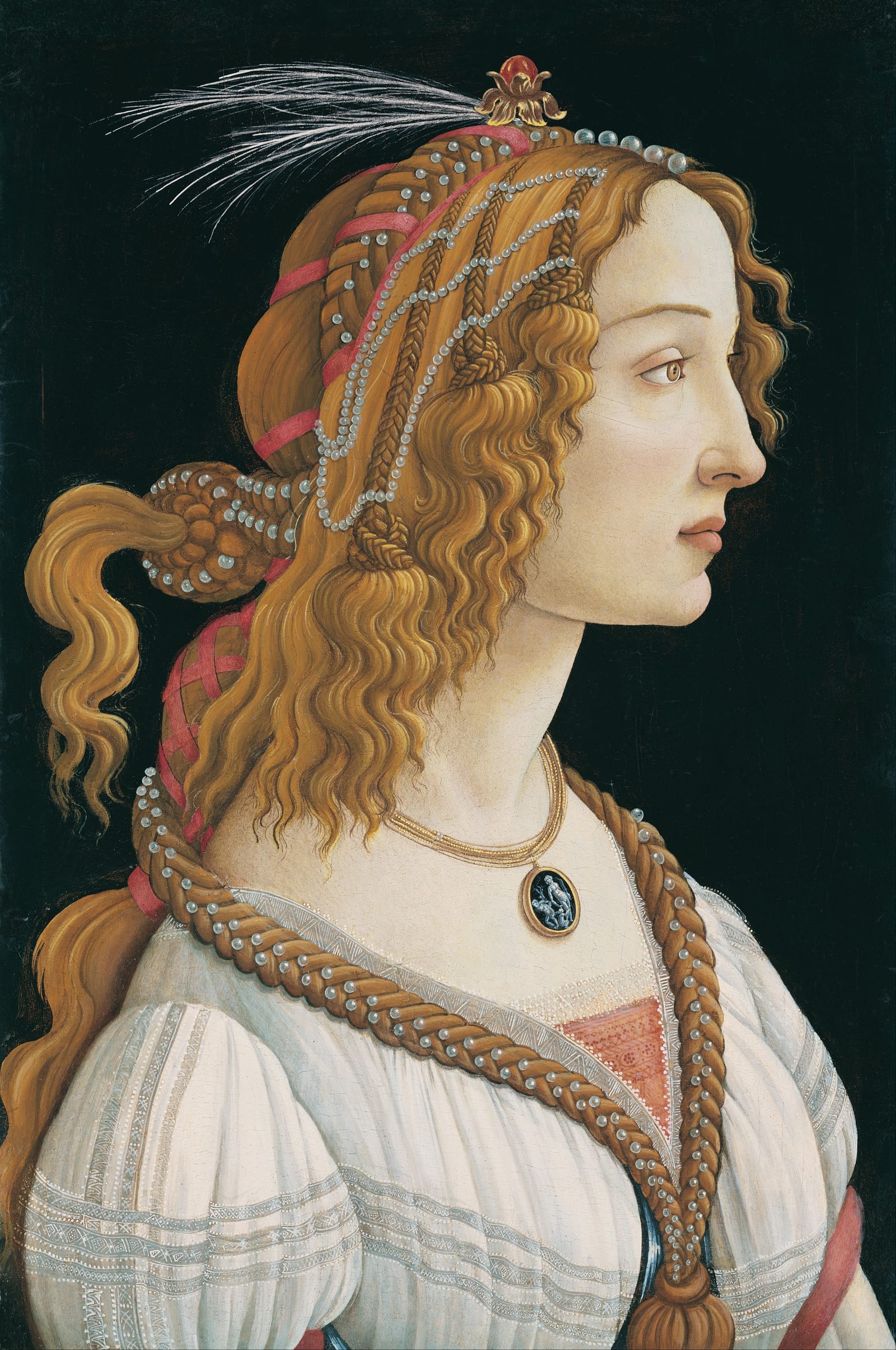
Idealised Portrait of a Lady (Portrait of Simonetta Vespucci as Nymph)
Sandro Botticelli · c. 1480–1485 · Mixed technique on poplar, 81.3 × 54 cm
Look for
- The cameo on her necklace. It copies Nero's Seal, an ancient carnelian of Apollo and Marsyas owned by Lorenzo de' Medici.
- The three loose tassels of hair at the centre, which one scholar reads as flames turned downwards.
- Her head in strict profile while her shoulders turn towards you, so the pendant can be seen.
Transcript (1:47)
She is bigger than you expect. The museum describes this half-length as larger than life, and from across the room the profile reads like a portrait on a coin: the straight nose, the long neck, one calm eye looking out of the picture to the right and never at you.
Then the hair takes over. Braids wound with strings of pearls, a red ribbon criss-crossing the crown, a spray of white feathers, a long plait thrown over the shoulder, and right in the middle of it all three loose tassels hanging free. No respectable woman in Florence sat for her portrait looking like this, and that is the point. The Städel calls the picture an ideal portrait, not a likeness in the strict sense: a young woman cast as a nymph from mythology.
The face, though, has a name attached to it. The art historian Aby Warburg was the first to suggest that she is Simonetta Vespucci, the mistress of Giuliano de' Medici, who died young, and the museum's own title carries her name in brackets. A more recent scholar, Emanuele Lugli, has argued that those three tassels in the centre are flames turned downwards, because in the Renaissance hair was believed to inflame desire. Look again and you may never see them as hair again.
Now look at her necklace. The oval pendant is a cameo, and it is a portrait of a real object. It copies Nero's Seal, an ancient carnelian engraved with Apollo and Marsyas that belonged to Lorenzo de' Medici, shown here in reverse. Her shoulders turn towards you while her head stays in profile precisely so that you can see it. That small stone places the woman squarely inside the Medici household.
The panel is poplar, painted around 1480 to 1485. Not everyone is sure the hand is Botticelli's; some specialists give it to Jacopo del Sellaio instead. The Städel has owned it since 1849 and hangs it under Botticelli's name. Whoever held the brush, this is the Florence that most people carry in their heads: pearls, a perfect profile, and a gem from the Medici collection resting on her collarbone.

Stop 5 of 5 · 2nd upper level, Old Masters, room 7
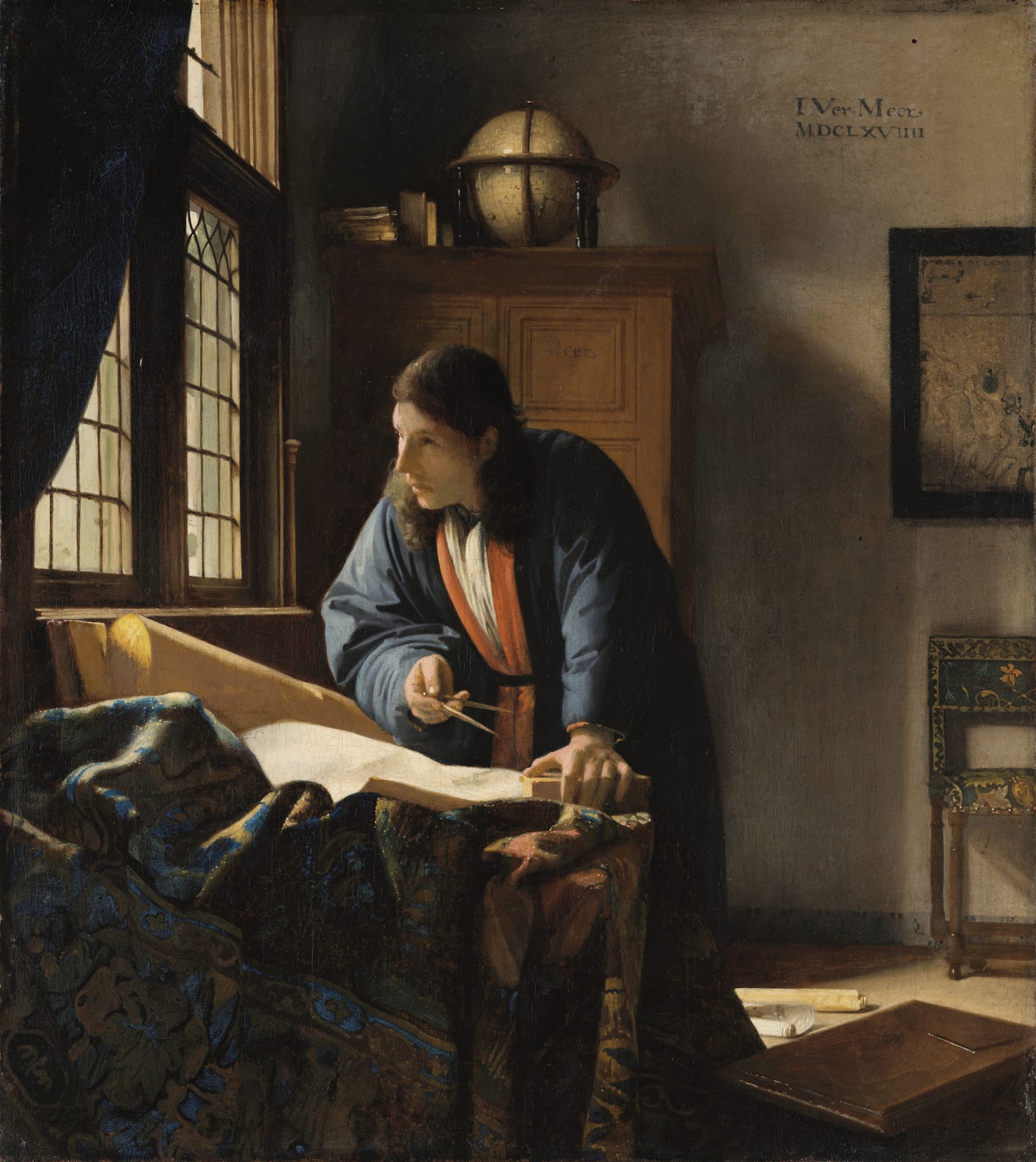
The Geographer
Johannes Vermeer · 1669 · Oil on canvas, 51.6 × 45.4 cm
Look for
- The signature and date in Roman numerals high on the back wall at the right, I. Ver-Meer, MDCLXVIIII.
- The dividers in his right hand, held level. Vermeer first painted them upright.
- The globe on top of the cupboard, turned towards the Indian Ocean.
- His face, slightly soft and the eyes narrowed, as if he moved just as the picture was taken.
Transcript (2:02)
A man leans over a table by a window with a pair of dividers in his right hand, and stops. He has been measuring distances on a chart, and now he has looked up and out at the light, as if the answer has just arrived. That pause is the whole subject. The Städel puts it plainly: the picture is neither a portrait nor a story. Vermeer was trying to paint the moment a man surveys the world in his head.
Everything around him is the latest in Dutch science, and the Netherlands led the world in map-making. On top of the cupboard stands a globe that has been identified as one published in Amsterdam in 1618 by Jodocus Hondius. It is turned towards the Indian Ocean, where the Dutch East India Company was trading. On the back wall hangs a chart of the coasts of Europe. Vermeer clearly had someone at hand who knew how these instruments were really used.
Now look high on the wall at the right. In neat capitals it carries his name, I. Ver-Meer, and the year in Roman numerals, 1669. There is a second signature on the cupboard door. That matters, because this is one of only three paintings Vermeer ever both signed and dated. The others are The Procuress and The Astronomer.
The Astronomer is this picture's twin. It is in the Louvre now, with the same young man in the same robe in the same kind of room. In 2017 a study of the canvas weave showed that the two pictures were cut from the same bolt of cloth. They stayed together through most of the eighteenth century, were sold apart in 1797, and met again only in 1997, in an exhibition that opened at the Louvre and then came here to Frankfurt.
Who was the model? Some scholars propose Antonie van Leeuwenhoek, the Delft microscopist, who was later named a trustee of Vermeer's estate. No document has been found to show that the two men knew each other while Vermeer was alive, so treat it as a good guess.
Vermeer changed his mind as he worked. The head was once further to the left, and the dividers were first painted upright rather than level. Look at the face, too. It is very slightly blurred, the eyes narrowed against the light, as though he moved while you were watching. The Städel bought the painting in 1885. Before you go, look once more at that hand: the dividers held still in mid-air, the head half turned, a scientist one second after he has had an idea.
Independent guide · Chiaro
Point Chiaro at anything in the Städel.
Johann Friedrich Städel's will of 1815 founded a collection that now runs from Cranach and Dürer to Maria Sibylla Merian, Max Beckmann and Gerhard Richter. Only five of its pictures fit on this page. For the others, hold your phone up to the painting in the gallery: Chiaro names the work, talks you through it, and keeps going if you have a follow-up question.
Before you go
Getting there
Schaumainkai 63, 60596 Frankfurt am Main, on the Sachsenhausen bank of the Main. Go in through the main entrance on Schaumainkai, which has a lift; every floor can be reached by lift.
U-Bahn lines U1, U2, U3 and U8 stop at Schweizer Platz, and trams 15 and 16 at Otto-Hahn-Platz. From the central railway station it is about ten minutes on foot across the Holbeinsteg footbridge.
Tickets
- Closed on Mondays, though the museum adds extra Monday openings over Christmas and New Year, so check the calendar on its website. Thursdays run until 9 pm; Tuesday, Wednesday, Friday, Saturday and Sunday close at 6 pm.
- A ticket is €19, or €17 reduced, and online tickets come with a timed entry slot. On Tuesdays from 3 to 6 pm the Tuesday Special costs €10 and includes the special exhibitions.
- Children under 12 go free, and under-18s go free with an adult holding an online ticket. The family ticket is sold only at the museum's ticket office.
- Over the holidays the museum is closed on 24 and 31 December 2026 and opens at 11 am on 1 January 2027.
The official audio guide
The museum's guide is its Städel Collection App, which costs nothing on Apple or Android phones and speaks English or German. It holds audio and images for more than 100 works, a 45-minute Highlight Tour and floor plans, with no in-app purchases, and the Staedel_WiFi network in the building is free with no password. These five stops are an independent extra, free as well, and Chiaro covers whatever else catches your eye.
Official site →Questions
Is there a free Städel Museum audio guide?
Yes, and there are two. The Städel's own Collection App is free and covers more than 100 works in English or German. This page is the other: an independent guide of five stops, from Tischbein's Goethe to Vermeer's Geographer, that plays straight from the browser with the text under each track. Chiaro handles any painting beyond those five.
How much is the official Städel Museum audio guide?
Nothing. The guide is the Städel Collection App, a free download for Android and Apple in English and German with no in-app purchases. You pay only for admission, €19 or €17 reduced, and the building has free WiFi.
Where is The Geographer in the Städel Museum?
On the 2nd upper level, in room 7 of the Old Masters galleries. Bosch's Ecce Homo (room 5) and the Botticelli (room 13) are on the same floor. The museum's app has floor plans with each work's current position.
Is the Städel Museum closed on Mondays?
Usually, yes. Monday is the closed day, but the museum adds extra Monday openings over Christmas and New Year, so check its calendar before you go. Thursday is the late day, 10 am until 9 pm; on the other open days the doors close at 6 pm after a 10 am start. The museum also stays shut on 24 and 31 December 2026.
Can I see the Städel's prints and drawings?
Not in the galleries. Works on paper would be damaged by long exposure to light, so they are kept in storage and shown in changing exhibitions or, on request, in the Study Room of the Department of Prints and Drawings. It opens Wednesday and Friday 2 to 5 pm and Thursday 2 to 7 pm, and asks you to register in advance.
How long does the Städel Museum take?
Our five stops come to about nine minutes of audio across two floors. The Highlight Tour in the museum's app takes 45 minutes, and the collection covers more than 700 years of art, so allow longer if you want more than the highlights.
More audio guides
Made by Chiaro. Not affiliated with the Städel Museum.