NGV International · Melbourne · Independent guide
National Gallery of Victoria audio guide,
five stops, free.
Listen in the browser, then walk in without a ticket: the NGV is two buildings and a collection of more than 76,000 works, and Chiaro will narrate whichever one you photograph next.
Made by Chiaro. Not affiliated with the National Gallery of Victoria.
The Banquet of Cleopatra
National Gallery of Victoria, Melbourne
That was the free part
Chiaro narrates any work in the National Gallery of Victoria from a photo.
The five stops · 10 minutes of audio
Five stops, one walk,
in the order you will walk them.
Five paintings, one floor, one building. This route is NGV International on St Kilda Road, not the Australian collection at Federation Square, and everything is on Level 2. It opens in the 17th to 18th Century European Paintings Gallery with Tiepolo's Banquet of Cleopatra and Poussin's Crossing of the Red Sea, takes in Rembrandt's Two old men disputing in the 17th Century and Flemish Paintings Gallery, and ends in the 19th Century European Paintings Gallery with Waterhouse's Ulysses and the Sirens and Hare's Victory of Faith. About ten minutes of listening, and perhaps ten minutes on foot once the escalator has brought you up from the ground floor.
Gallery names, dates and dimensions here were read from the NGV's Collection Online records on 18 September 2026, hours and prices from ngv.vic.gov.au the same day, and each was checked against a second source. The NGV is closing selected gallery spaces at NGV International between 7 September and 13 December 2026, so if a wall label or a barrier disagrees with us, the building is right and we would like to hear about it.

Stop 1 of 5 · 17th to 18th Century European Paintings Gallery, Level 2, NGV International
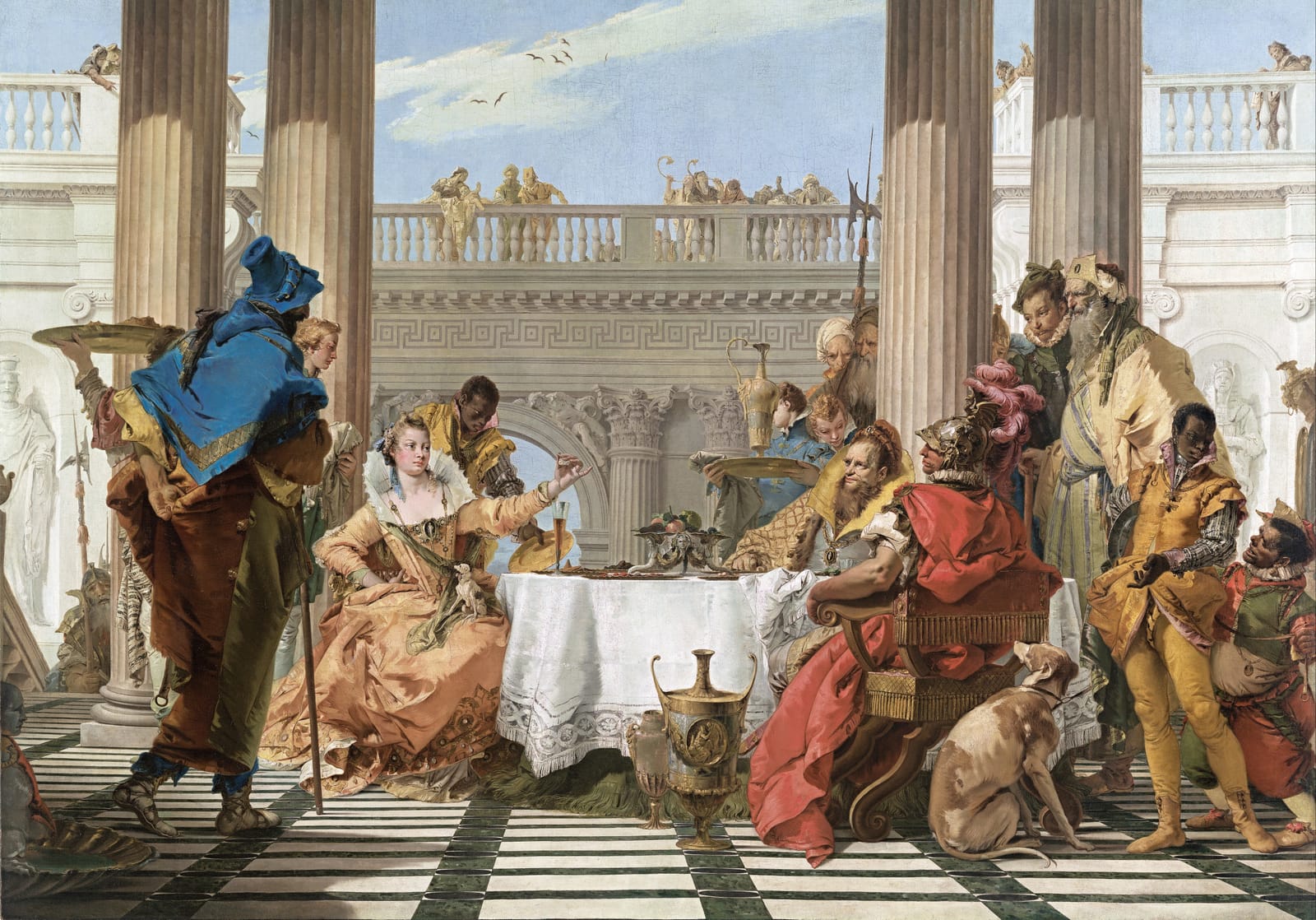
The Banquet of Cleopatra
Giambattista Tiepolo · 1743–1744 · Oil on canvas, 250.3 × 357.0 cm
Look for
- Cleopatra's raised right hand. The pearl is between her fingers, over the glass, and the whole bet turns on the next second.
- The tablecloth. It is the only true white in the picture, and until the 2003 cleaning a yellowed varnish had flattened it into the background.
- The greyhound by Antony's chair. X-rays show Tiepolo tried two other positions for its tail before tucking it against the back leg.
- The figure in the blue cape at the left, painted with Prussian blue glazed over ultramarine, the darkest corner of the canvas.
Transcript (2:33)
Three and a half metres of white marble, gold, silk and a blue Venetian sky, and in the middle of it all a woman holding something very small between two fingers. That is the whole story. The woman is Cleopatra, the man in the red cloak and helmet is Mark Antony, and the small thing is a pearl.
The tale comes from Pliny's Natural History. Cleopatra bet Antony that she could stage a feast more extravagant than anything Rome had seen. He laughed at the first course, so she called for a glass of vinegar, took one of her two pearl earrings, dropped the pearl in, and drank it. Lucius Plancus, the umpire, put his hand over the second pearl before she could do it again and declared Antony the loser. The NGV's own essay on the picture adds the detail nobody at the table mentioned: no vinegar dissolves a pearl. She simply swallowed it, and presumably got it back.
Tiepolo painted this in Venice in 1743 and 1744, borrowing the staging from Veronese's great feast pictures of the previous century, and it is the first of three versions he made. It was probably ordered by Joseph Smith, the British consul in Venice. Before it was finished, Count Francesco Algarotti walked into the studio, shopping for Augustus the Third of Saxony, and talked Tiepolo into finishing it for Dresden instead. On the fifth of March 1744 the painter was paid three hundred zecchini, and the canvas left for Germany.
It kept moving. Twenty-two years near Dresden, thirty-five in private hands after an auction in Amsterdam, and then a hundred and thirty-one years in the Russian imperial collection in Saint Petersburg, where for a while it was nailed to a ceiling. In 1932 the Soviet government sold it, an English dealer bought it, and the Felton Bequest brought it to Melbourne, where it has been the centre of the collection ever since. Before it sailed, it was propped against a wall in a shabby exhibition room in South Kensington, and a London paper called it dirty and unkempt.
In 1955 it went back to London by ship to be cleaned by Horace Buttery, the restorer to the Royal Collection, who worked on it for three months in a room at the Victoria and Albert Museum. The gilded frame in front of you was carved that same year by Frederick Pollak for three hundred and fifty pounds. A Melbourne newspaper reported that the National Gallery in London was interested in swapping a great Rembrandt and a Turner for it. It stayed, and it has not left Australia since.
Now look at the tablecloth. It is the only pure white in the whole painting, and Tiepolo used it to pull your eye straight to the glass. For decades a yellowing varnish had dulled it, until conservators spent twelve months on the canvas in 2002 and 2003 while this building was closed for rebuilding. Their X-rays turned up a small confession: the greyhound beside Antony's chair is copied from a Veronese in Florence whose dog has no tail, so Tiepolo had to invent one, and he tried two positions before settling on the tail you see, pulled up beside the dog's back leg.

Stop 2 of 5 · 17th to 18th Century European Paintings Gallery, Level 2, NGV International
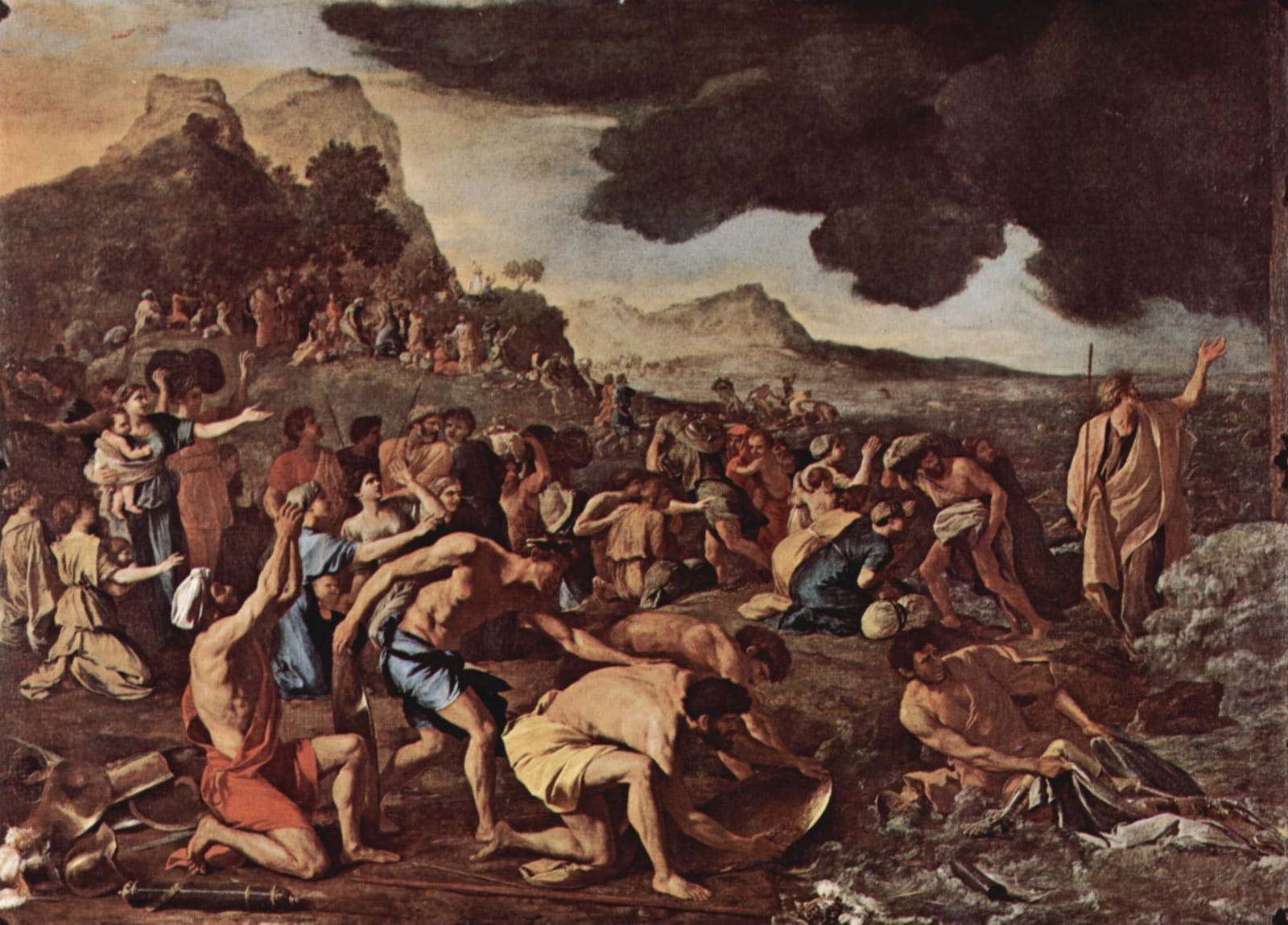
The Crossing of the Red Sea
Nicolas Poussin · 1632–1634 · Oil on canvas, 155.6 × 215.3 cm
Look for
- Moses at the far right with his arm raised. The sea has just closed behind him; the drama is already over.
- The man crouching in the foreground to pull a shield from the water. The frame's central ornament lines up exactly with him.
- The frame. Solid oak under six layers of gesso and gold leaf, with cross-hatching and punchwork cut into the plaster, and it weighs over 140 kilograms.
- The sky. Parts of it were reinstated in 2011 from a rediscovered copy, after earlier cleanings had scrubbed them away.
Transcript (2:04)
Most painters of this story show the wall of water. Poussin shows the moment after. The sea has already closed over the Egyptian army, and what you are looking at is a crowd of people on a beach realising they are alive, picking armour out of the shallows, holding up their children, turning to the one figure at the far right with his arm still raised. That is Moses. Everyone else is busy being human.
Nicolas Poussin was a Frenchman working in Rome, and he painted this in the early 1630s for a collector in Turin, Amedeo dal Pozzo, as one of a pair. Its partner, The Adoration of the Golden Calf, hangs in the National Gallery in London. The two stayed together for more than three hundred years, through a Paris townhouse and then Longford Castle in England, where the Earls of Radnor kept them until 1945. London bought the Golden Calf. Three years later Melbourne bought this one through the Felton Bequest, with Kenneth Clark advising, and the pair have been on opposite sides of the world since.
Before you look harder at the painting, look at the frame, because the NGV regards it as a work of art in its own right. It was made in Paris around 1710 for the then owner, a man named Bretonvilliers, as one of a matching pair; the other still surrounds the London picture. It is solid oak under six layers of gesso, gilded and then worked with cross-hatching and punchwork so the plaster reads as chased gold. It weighs more than a hundred and forty kilograms. Its centre ornaments were designed to line up with the painting: the crouching man pulling a shield from the water sits on the frame's central vertical. For years the gallery left it in storage and hung the canvas in a plain moulding, because the frame competes with the picture. Judge for yourself.
In 2010 the painting came down, and stayed down far longer than planned. The conservator Carl Villis found that the upper half had been over-cleaned in the past and had lost detail, particularly in the sky. Then luck intervened: a copy painted about fifty years after the original, lost for generations, had resurfaced in 2009, and it showed how Poussin's sky once looked. Villis used it as a guide to bring back what was missing. The gallery published the whole process as an online diary, and on the third of May 2012, after nearly two years off the wall, the painting went back up with its sky returned to something like the colour Poussin gave it.

Stop 3 of 5 · 17th Century & Flemish Paintings Gallery, Level 2, NGV International
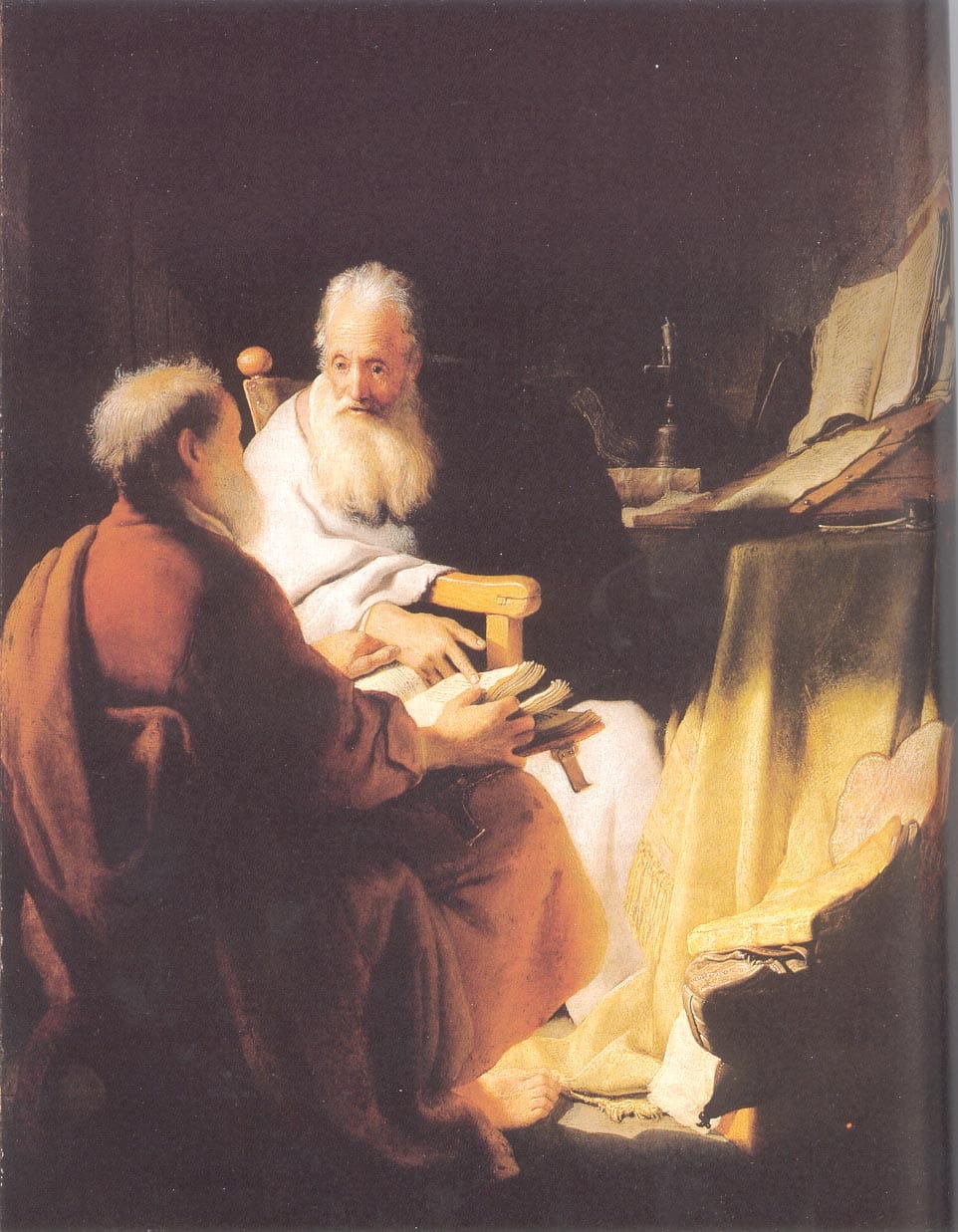
Two old men disputing
Rembrandt Harmensz. van Rijn · 1628 · Oil on wood panel, 72.4 × 59.7 cm
Look for
- The light. One shaft of light from the right lands on the white-bearded man and the open book, and everything else is allowed to disappear.
- The books, quills and globe on the table, the furniture of learning that gives the scholars their meaning.
- The black box frame. It is a 2005 reproduction of a Dutch frame from 1618, chosen because the box shape pulls you into the room.
- The grey letters RE at lower left. The rest of the signature is gone.
Transcript (1:50)
Two men, one book, and a single beam of sunlight. The old man in white has turned to make a point, the man in red has his finger on the page, and the light from the right picks out a face, a beard and an open book while the rest of the room falls into brown shadow. This is how Rembrandt painted at twenty-two, in his home town of Leiden, three years before he moved to Amsterdam and became famous. The habit of lighting one thing and hiding everything else stayed with him for the rest of his life.
Nobody is sure who the men are. They might be philosophers, perhaps Hippocrates and Democritus. In 1969 the scholar Christian Tümpel argued they are the apostles Peter and Paul, and the Rembrandt Research Project accepts that reading. But the earliest record we have is blunter. In 1641 the painting turned up in the will of Rembrandt's friend Jacques de Gheyn the Third, described simply as two little old men who are seated and disputing. That is the title the NGV has kept, and it is hard to improve on.
Look at the table. Books, quills, a globe. The gallery reads them as an essay on the wisdom of age, and there is something touching about a young man in his early twenties painting old men and their learning with such attention: the wrinkled skin, the white beard, the pages of the book catching the sun.
The frame has its own small drama. When the panel was bought for Melbourne through the Felton Bequest, the dealer sold it with what he called the antique seventeenth-century frame he had found in Paris. It turned out to be a later French frame cut down from something bigger. In 2005 the gallery replaced it with what you see now, a reproduction of a plain black Dutch box frame from 1618, ten years older than the painting, chosen because the box shape leads your eye into the room the two men sit in. The painting itself was cleaned and restored in 2017, so the beam of light is as bright as it has been in a long while.
Before you move on, find the lower left corner. There, in grey paint, are the letters R E and then nothing legible. It is what remains of the signature of a twenty-two-year-old who did not yet know he would become Rembrandt.

Stop 4 of 5 · 19th Century European Paintings Gallery, Level 2, NGV International
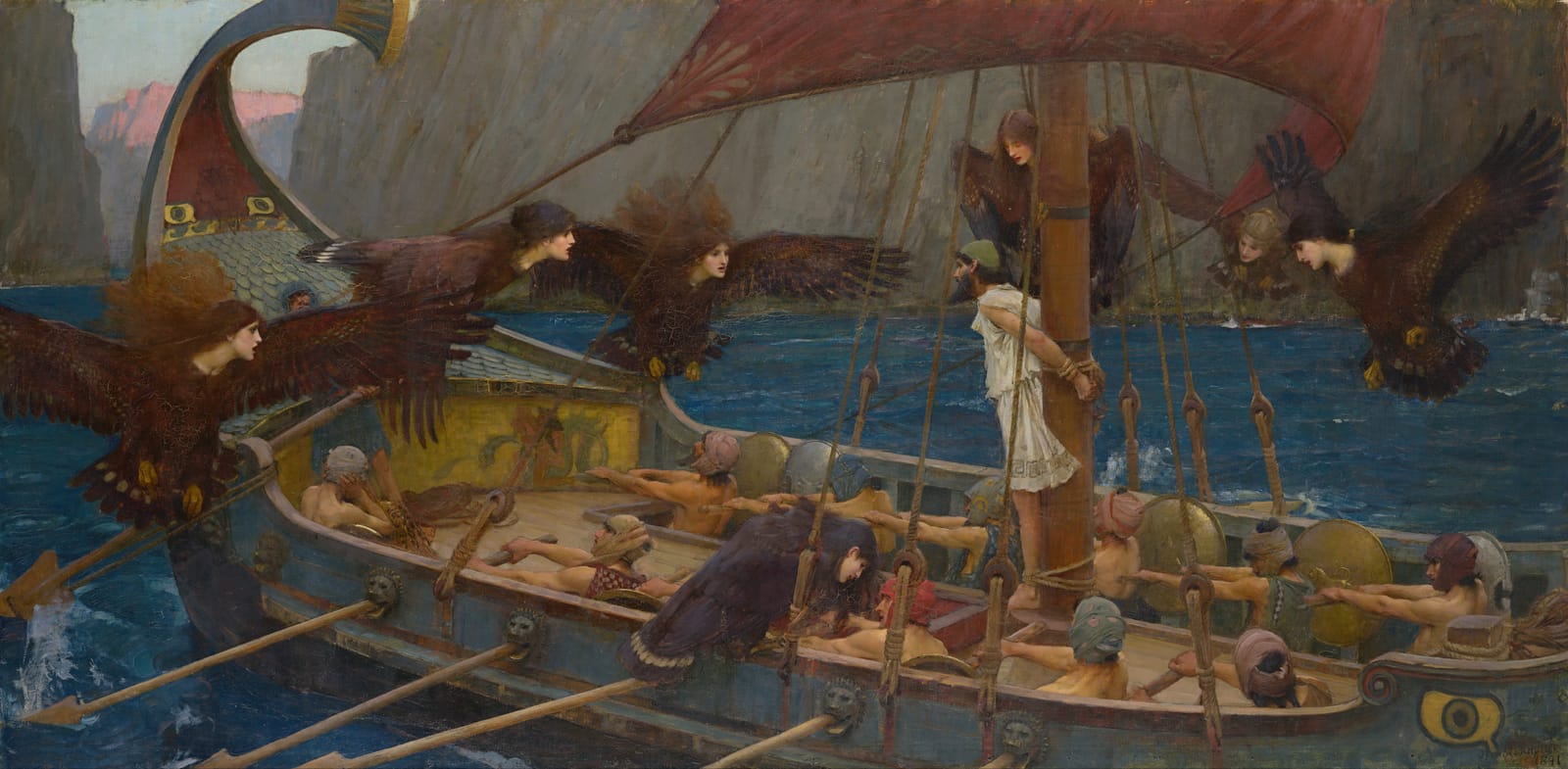
Ulysses and the Sirens
John William Waterhouse · 1891 · Oil on canvas, 100.6 × 202.0 cm
Look for
- Count the sirens. There are seven. Homer has two.
- The claws. Critics in 1891 called them vulture claws and argued that no such bird could sing.
- The signature and date in black paint at the lower right: J. W. Waterhouse, 1891.
- The round shields lying on the deck. One London critic complained they should hang outside the hull, the way Roman designs show them.
Transcript (1:58)
The first thing most people do in front of this painting is count. Homer gives Ulysses two Sirens. Waterhouse gives him seven, and not one of them is a mermaid. They are big brown birds with the faces of young women, wheeling around the mast where Ulysses is roped, while his crew row with their ears stopped with wax. Book twelve of the Odyssey: the hero who wants to hear the deadliest song in the world and survive it.
The birds are the point, and they were the scandal. Victorian audiences expected Sirens to be beautiful women on a rock. Waterhouse went back to a Greek vase in the British Museum, made in the fifth century BC, where the Sirens are exactly this, bird bodies with women's heads. Some London critics loved it. The Magazine of Art called the picture a very startling triumph, a carnival of colour. The Times said they were not Sirens but harpies, birds of prey with women's faces, and that nothing in the painting made you believe they could sing.
It was shown at the Royal Academy in London in the summer of 1891, and in June the NGV's adviser in London, Sir Hubert von Herkomer, bought it straight from the artist for twelve hundred pounds. When it arrived in Melbourne at the end of the year the letters page of the Argus caught fire. One correspondent wrote that Ulysses looked like a criminal tied to a mast. Another insisted that vulture claws ruled out any chance of dulcet strains of music. Underneath the classical quibbling was the real grievance: twelve hundred pounds of public money spent on a foreign painting while Melbourne's own artists went unbought. Herkomer defended himself the next year, pointing to the Greek vase, to the debt to Japanese art, and to the way Waterhouse might repaint a passage twenty times and have it complete each time.
He was right to hold his nerve. The picture has hung here for more than a hundred and thirty years and is now one of the most looked-at works in the building. Look at the water, dark blue and green in the shadow of the cliffs and lit at the far end where the open sea begins, and at the frame, which is the one it came in from the Royal Academy in 1891, water-gilded and left matte. Then look down at the deck, where the crew's round shields lie in the boat. A critic in the Athenaeum spent a paragraph objecting that they should have hung outside the hull. The rest, he admitted, was well told.

Stop 5 of 5 · 19th Century European Paintings Gallery, Level 2, NGV International
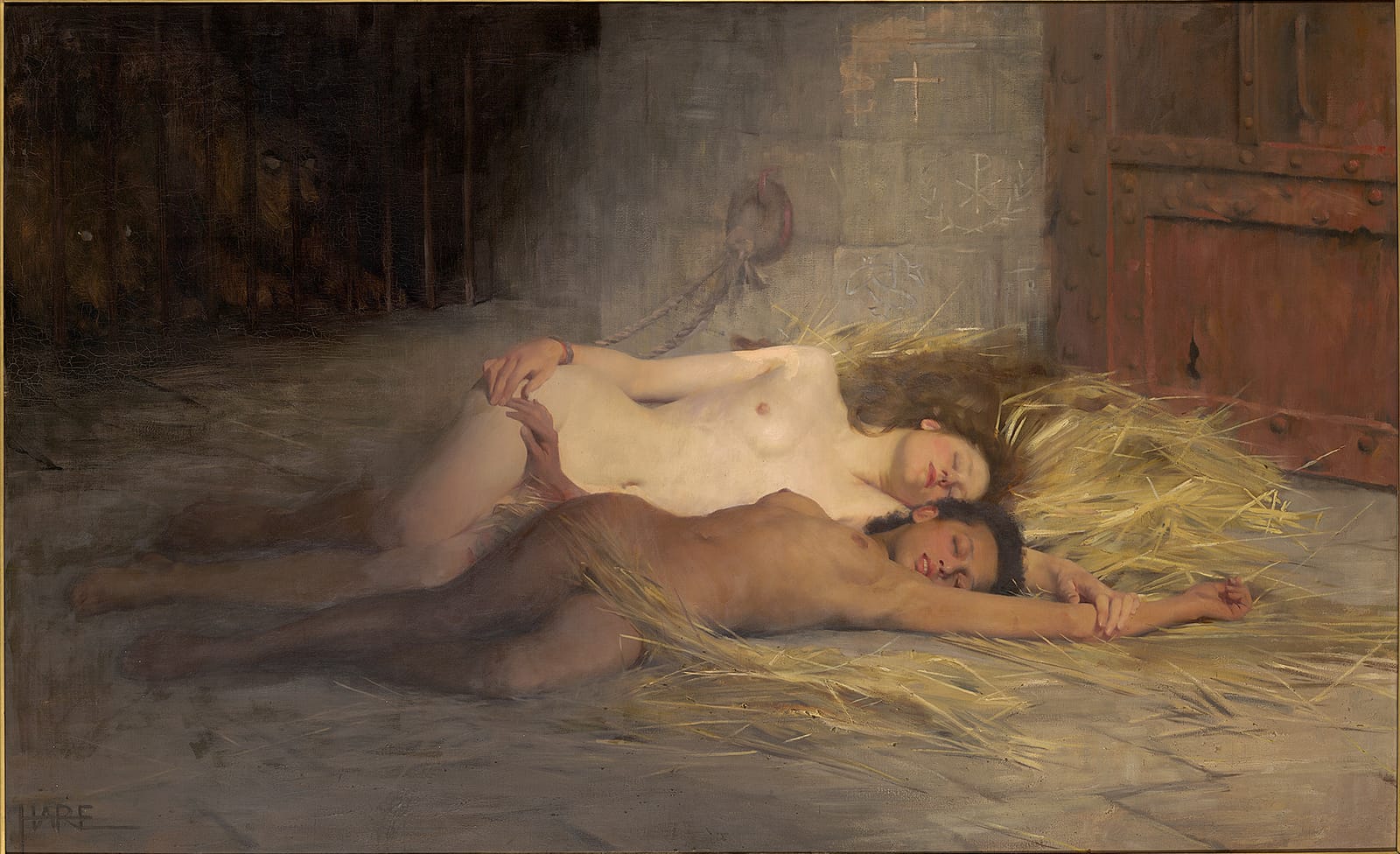
The victory of faith
St George Hare · c. 1890–1891 · Oil on canvas, 123.3 × 200.0 cm
Look for
- The shackle and chain fixed to the wall above the women. It tells you where they are before anything else does.
- The signature HARE at the lower left, with a line painted through it.
- The straw. It is the only warm light in a cold stone cell.
- The frame, the original by Chapman Brothers of London, finer than the Melbourne versions of the same shape on Frederick McCubbin's pictures.
Transcript (1:54)
Two women asleep on straw in a stone cell, one pale, one dark, one of them chained. A shackle hangs from the wall above them, and there is a heavy door to the right. Nothing else. The title tells you how to read it: this is the night before a Roman execution, and the sleepers are Christian martyrs who will be sent to the wild beasts in the morning. Their faith, the title says, has already won.
The painter, Saint George Hare, was Irish, born in Limerick in 1857, and he had a taste for exactly this kind of subject: undressed women, chains, a soft light, a title that made it all respectable. He showed this one at the Royal Academy in London in 1891, then sent it to the World's Fair in Chicago in 1893 and to the Paris Salon in 1894. He kept it for thirteen years. In 1903 it went back to the Royal Academy under a new title, Miserere Domine, Lord have mercy, and in 1904 it hung in an exhibition of Irish painters at the Guildhall in London. The next year someone gave it to Melbourne. The NGV has never named the donor, and after a hundred and twenty years that anonymity has become part of the picture.
People have never agreed on what they are looking at. In 1894 an American religious magazine praised it as an impressive depiction of Christian faith and steadfastness and described the two women in a sisterly embrace. A century later the art historian Kobena Mercer read the same embrace as an interracial lesbian couple, and set the painting beside Jules Robert Auguste's Les Amies. Both readings are in the room with you. Hare, who knew what sold at the Academy, probably intended the ambiguity.
Look at the lower left corner. The signature reads HARE, and there is a line painted straight through it. Then step back and look at the frame, which is the original, made by Chapman Brothers in London. Its profile was popular for twenty years on both sides of the world, and the Melbourne framer John Thallon used the same basic form, more roughly, for Frederick McCubbin's paintings, which now hang in the other NGV building at Federation Square, though the NGV notes this frame arrived too late to have been his model. The gallery's own note is dry about it: the London frame is more carefully made than the Melbourne ones.
Independent guide · Chiaro
Point Chiaro at anything in the NGV.
Five paintings on one floor of one building, and the NGV has a second building across the river. Raise the camera to a Tiepolo two frames along, a Chinese bronze downstairs, a McCubbin at Federation Square, and Chiaro tells you what it is and how it reached Melbourne, then answers whatever you ask next, out loud, while you stand there.
Before you go
Getting there
NGV International, 180 St Kilda Road, Melbourne. The entrance is on street level with an automatic door, and there is a lift up from the Arts Centre Melbourne car park. The Australian collection is in a different building, The Ian Potter Centre: NGV Australia at Federation Square, corner of Flinders and Russell Streets; these five stops are all on St Kilda Road.
Tram routes 1, 3, 5, 6, 16, 64, 67 and 72 stop at the Arts Precinct stop directly outside the entrance on St Kilda Road. Flinders Street Station is a 500 metre walk across Princes Bridge past the Arts Centre, or one tram stop. Taxis and rideshares drop off outside Arts Centre Melbourne, 110 metres away.
Tickets
- Entry to the collection costs nothing, and there is nothing to book in advance. Special exhibitions are ticketed separately.
- Open daily 10am to 5pm. The only published closing day is Christmas Day, and on ANZAC Day, 25 April, the doors open at 1pm.
- Selected gallery spaces at NGV International are closed from 7 September to 13 December 2026. On 18 September the NGV's records listed all five of these paintings as on display, but check ngv.vic.gov.au or ask at the desk if one matters to you.
- Backpacks, large bags and umbrellas have to go to the free cloakroom before you enter the galleries. Photos without flash are fine in most rooms.
The official audio guide
The NGV charges nothing for its collection and runs regular free public tours with no booking needed. Its paid option is the Best of NGV Experience, a one-hour guided tour of NGV International on Thursdays at 2.30pm for $35 a person, with audio headsets so you can hear the guide. The NGV has also described its own NGV App, with audio tours of each gallery and floor narrated by curators, artists and public figures; the gallery publishes no price for it, and its download link currently sends you to the NGV homepage, so look for it in your app store before you arrive. This page is free, covers five works and needs nothing installed; the Chiaro app covers the rest.
Official site →Questions
Is there a free National Gallery of Victoria audio guide?
This one. Five works at NGV International you can play in your browser with transcripts, and nothing to download. In the building, the Chiaro app takes over: photograph any work and it narrates that one.
How much is the official NGV audio guide?
The NGV publishes no price for its NGV App, which it describes as audio tours of each gallery and floor narrated by curators, artists and public figures; its download link currently redirects to the NGV homepage. The regular public tours are free with no booking, and the paid Best of NGV Experience, a one-hour guided tour with audio headsets, is $35 a person on Thursday afternoons.
Where is The Banquet of Cleopatra in the NGV?
NGV International, 180 St Kilda Road, Level 2, in the 17th to 18th Century European Paintings Gallery, hanging near Poussin's Crossing of the Red Sea. It is not at Federation Square; that building holds the Australian collection.
Is the NGV closed on Mondays?
No. NGV International is open every day from 10am to 5pm. The only published closing day is Christmas Day, 25 December, and on ANZAC Day it opens at 1pm instead of 10am.
Is the NGV free?
Yes. Entry to the NGV Collection in both buildings is free and needs no ticket. Special exhibitions are ticketed separately.
Which NGV building is this guide for?
NGV International on St Kilda Road, which holds the European, Asian and other international collections. Shearing the Rams, The Pioneer and the rest of the Australian collection are at The Ian Potter Centre: NGV Australia, a separate building at Federation Square on the other side of Princes Bridge; both are a short walk from Flinders Street Station, and both are free.
More audio guides
Made by Chiaro. Not affiliated with the National Gallery of Victoria.