
Art Gallery of New South Wales · Sydney · Independent guide
Art Gallery of New South Wales audio guide,
five stops, free.
Nothing to install and nothing to pay at the door: the Gallery is free, these five recordings play from this page, and the Chiaro app takes the other 1,500-odd works on display from a photo.
Made by Chiaro. Not affiliated with the Art Gallery of New South Wales.
Requiescat
Art Gallery of New South Wales, Sydney
That was the free part
Chiaro narrates any work in the Art Gallery of New South Wales from a photo.
The five stops · 10 minutes of audio
Five stops, one walk,
in the order you will walk them.
Everything on this page hangs in the Grand Courts of Naala Nura, the Gallery's original sandstone building on the south of the site, so this is less a walk than a slow circuit of one suite of top-lit rooms. The Gallery's database gives the same location for all five, so the order here is ours: the knight and his bloodhound first, then the two enormous academic machines, the Queen of Sheba, and out through Gruner's frosty paddock. About ten minutes of listening, and you can do the whole circuit in under a quarter of an hour without stopping to look, which you will.
Catalogue lines, dates and dimensions come from the Gallery's collection database at artgallery.nsw.gov.au, each cross-checked with another source, and on 18 September 2026 all five works were confirmed as hanging. The Grand Courts were rehung in 2021 and pictures still travel, so where the wall text and this page differ, go with the wall text and let us know.

Stop 1 of 5 · Naala Nura, ground level, Grand Courts
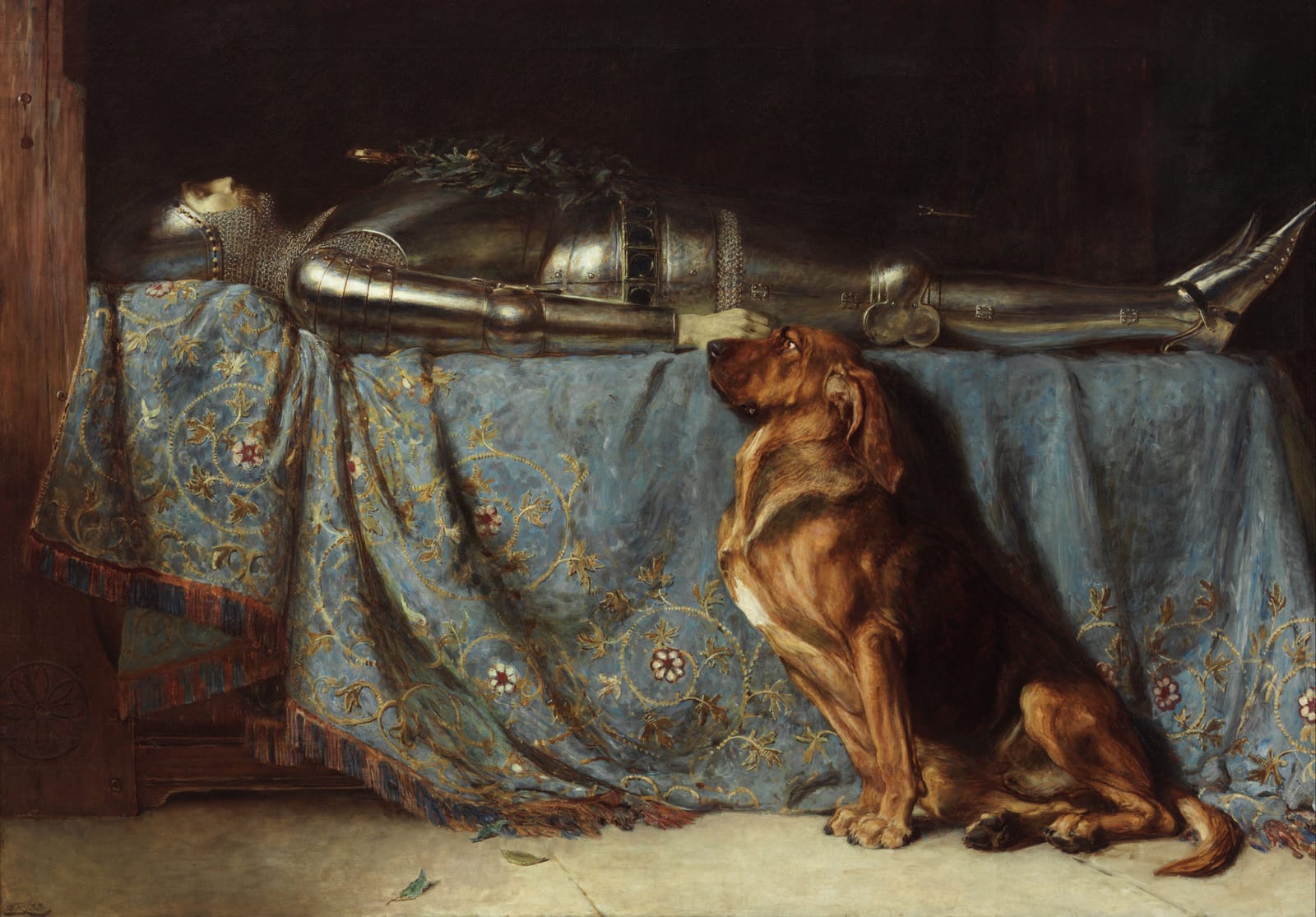
Requiescat
Briton Rivière · 1888 · Oil on canvas, 158.7 × 225.0 cm
Look for
- The wreath laid across the knight's breastplate, and his bare head in its mail coif. That is how you know he is dead and not asleep.
- The knight's bare hand over the edge of the bed, just above the dog's muzzle, and the dog's eyes on his face. Nothing else in the picture moves.
- The signature in the lower left corner, in black: '18 BR 88', the date split around the initials.
- Compulsory education, Rivière's painting from 1887, hangs in the same courts. Find it afterwards.
Transcript (2:04)
Most people notice the dog before the knight, and that is the point. A bloodhound sits upright on the floor beside a low bed, both forepaws on the stone floor and its whole attention on the face above it, while the knight's bare hand hangs over the edge of the bed just above its muzzle. The man in armour lies flat under a blue coverlet embroidered with flowers, and across his breastplate someone has laid a wreath. That wreath is the only thing telling you he is dead. Without it this would be a dog waiting for its master to wake up. With it, the dog is keeping vigil, and the title tells you the rest. Requiescat is Latin, the start of a prayer for the dead: may he rest.
Briton Rivière painted it in 1888 and signed it in black in the lower left corner, with the date split around his initials, 18 BR 88. He had started out at the Royal Academy in London painting history subjects, the Spanish Armada, Romeo and Juliet, and then in 1865 he painted a sleeping deerhound and more or less never went back. Animals occupied the rest of his life. He said you could never paint a dog unless you were fond of it, though he admitted he had grown tired of having them about the house. He never worked without a man who knew animals standing by, and he drew dead ones too, in the dissecting rooms of the Zoological Gardens, so that the anatomy under the fur would be right. Look at the hound's back legs and the hang of its ears and you can see the homework.
The painting travelled a long way before it got here. It hung at the Royal Academy in 1888, then crossed to the World's Columbian Exposition in Chicago in 1893, came south to the Tasmanian International Exhibition in Hobart in 1894, and went to Berlin in 1896. Two years later the Gallery bought it directly from the artist, and the credit line still reads Purchased 1897 to 98. Around the same time Rivière stood for President of the Royal Academy and was narrowly defeated. He went back to his dogs.
It is, by a wide margin, the picture people look up most from this collection, and standing here you can see why. There is no story to decode, no mythology to know. A dog is waiting for someone who is not coming back.
Before you move on, the Gallery owns his small oil study for this very dog, and a second Rivière hangs in these same courts, a painting from the year before called Compulsory education. The title alone tells you it has a dog in it.

Stop 2 of 5 · Naala Nura, ground level, Grand Courts
Vive l'Empereur!
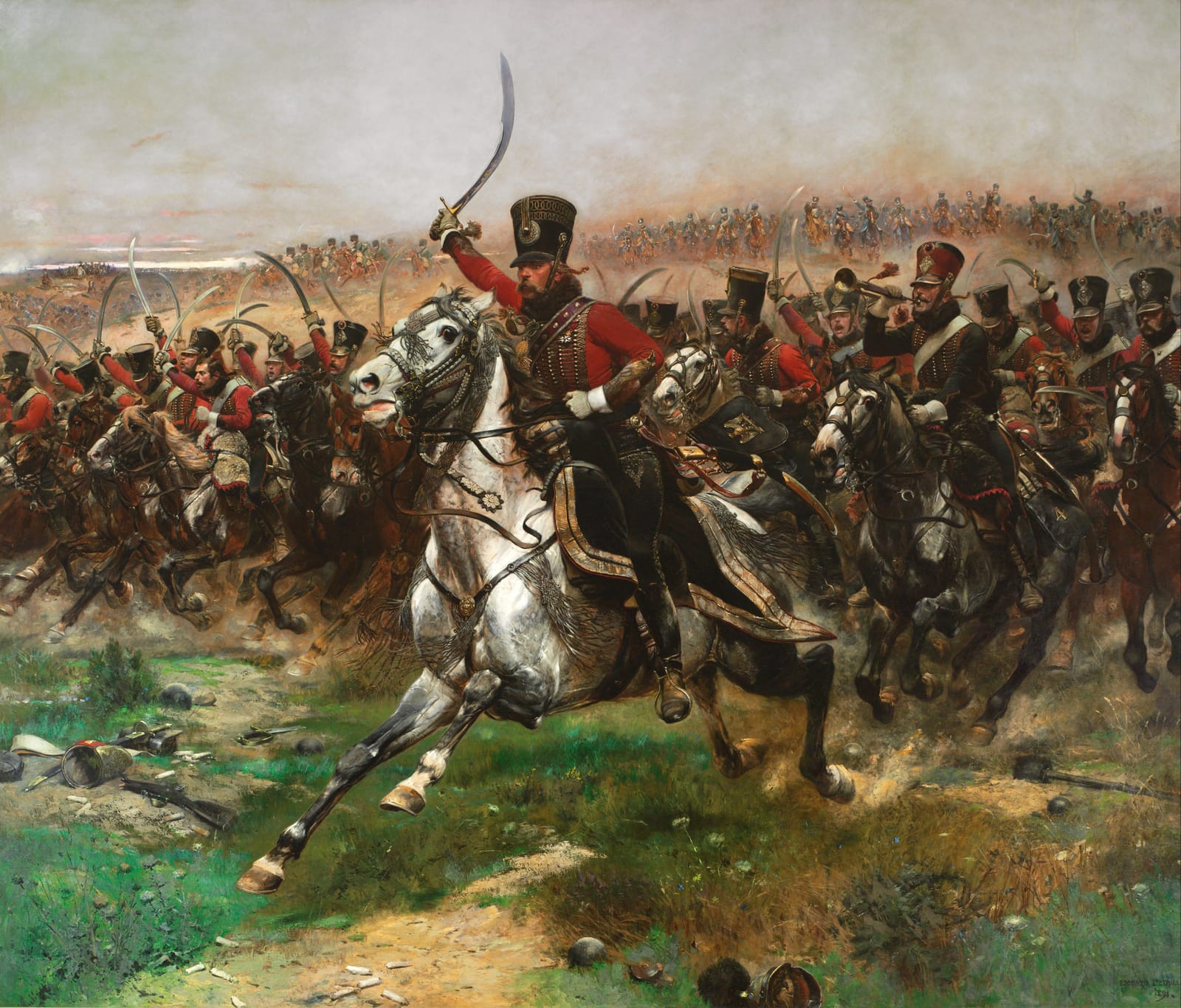
Édouard Detaille · 1891 · Oil on canvas, 376.0 × 445.0 cm
Look for
- The officer in the red pelisse on the grey horse, dead centre, sabre up, looking straight past you at something you cannot see.
- The ground in front of the horses: dropped shakos, a musket, a drum, cannonballs in the grass. The charge is riding over the last one.
- The signature and date, Edouard Detaille 1891, in the lower right corner.
Transcript (1:55)
Stand back, because you cannot take this in from close up. The canvas is nearly four metres high and almost four and a half wide, and the hussars are riding straight at you. In the centre an officer in a red pelisse stands in his stirrups on a grey horse with his sabre raised, and behind him the whole regiment comes over the rise in a wall of shakos and blades and open mouths. Look down at the grass in front of the hooves: fallen shakos, a musket, a drum, cannonballs. The charge is going over the wreckage of the last one.
Édouard Detaille painted it in 1891 and signed it in the lower right. The Gallery's alternative title is Charge of the 4th Hussars at the battle of Friedland, 14 June 1807, which is a battle fought forty-one years before Detaille was born, and the Gallery's own text is careful to say that the scene does not represent any specific battle. It is a reconstruction of a feeling. Detaille put it this way himself: I sought to render the effect of a cavalry charge under the eyes of the Emperor, and reconstruct the physiognomy of those men who were going to their deaths covered with gold embroidery.
He knew what he was talking about. He came from a military family whose grandfather had supplied arms to Napoleon, he trained from the age of seventeen under the military painter Meissonier, and he served in the Franco-Prussian War of 1870, which made him the semi-official artist of the French army. In 1912 he designed new uniforms for that army, and although they were never adopted, their blue-grey greatcoats and their helmet fed into what French soldiers wore in the First World War. He left his collection of uniforms to the Musée de l'Armée in Paris.
The Gallery bought this in Paris in 1893, and spent four-fifths of its entire acquisition budget for that year on it. It has been one of the most popular things in the building ever since, popular enough that in 2014 the Gallery bought a second painting just to explain this one: Basile Lemeunier's portrait of Detaille at work on this very canvas, perched at the top of a wooden ladder with a lit cigarette in his mouth.
One more thing, which you cannot see and which is the reason you can see anything at all. In 1959 the canvas was severely damaged by water. It took a restoration in the 2000s to bring it back to this.

Stop 3 of 5 · Naala Nura, ground level, Grand Courts
Cymon and Iphigenia
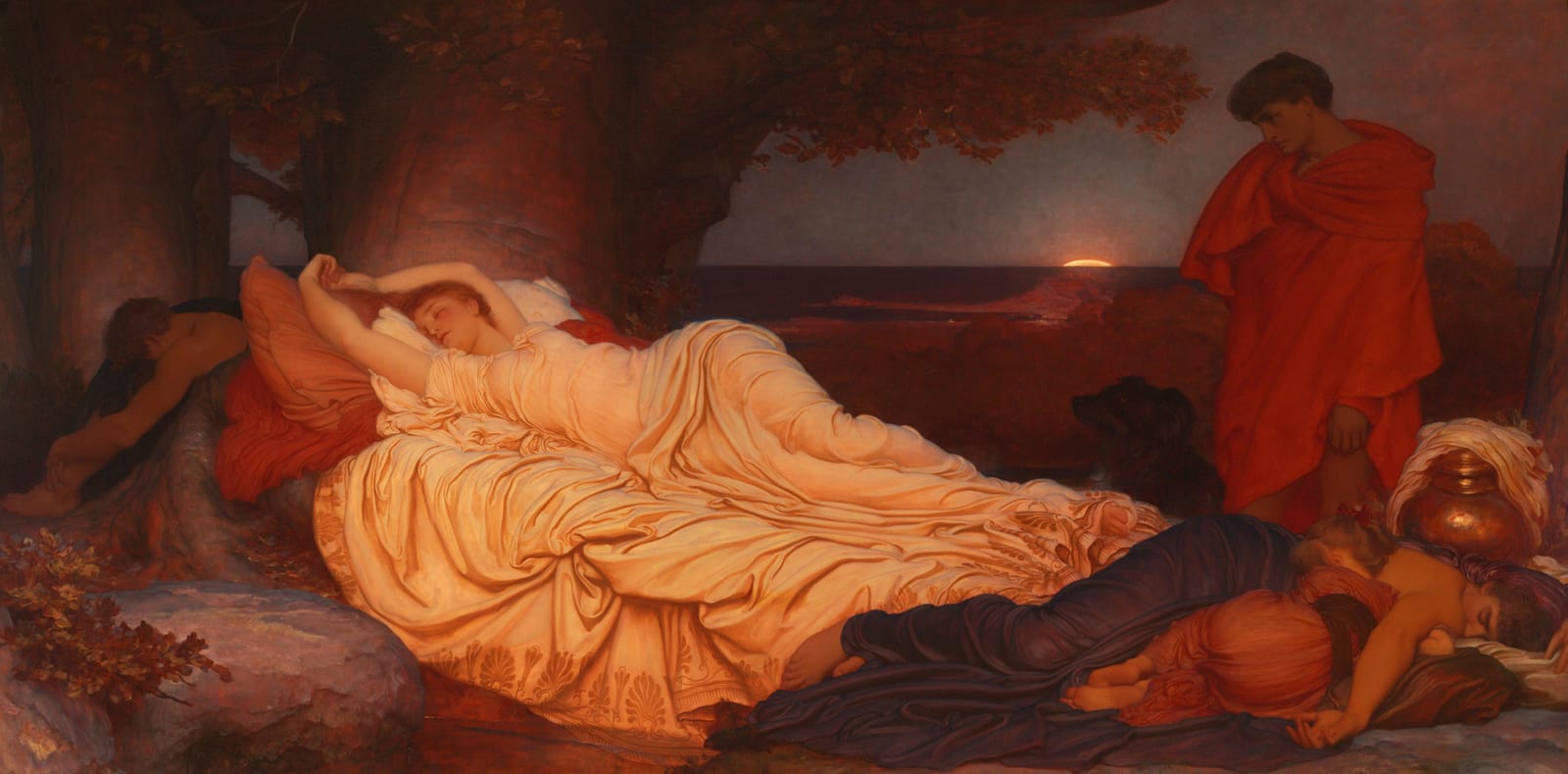
Frederic, Lord Leighton · 1884 · Oil on canvas, 163.0 × 328.0 cm
Look for
- The sliver of moon on the horizon, between the tree trunk and the man in red, just above the darkening sea.
- Cymon, in red at the far right, is the only figure awake. Everyone else, including the dog, is asleep.
- The sleeping child in the lower right. Her model was the younger sister of the woman in the centre.
- No signature anywhere. The Gallery records the painting as not signed and not dated.
Transcript (2:08)
The light is the first thing. The sun has already gone down behind you, and everything in this three-metre canvas is lit by its afterglow: the copper-coloured drapery, the bark of the tree, the woman's hair. Look at the horizon, between the trunk and the man in red. There is the merest lip of a moon coming up over the sea. Leighton chose that moment on purpose. Boccaccio, whose story this is, set it in spring, in the afternoon. Leighton moved it to an autumn dusk, because he wanted the drowsiness of the end of a long hot day, and he wanted the whole picture to feel like the minute before sleep.
The story comes from the Decameron. A well-born young man is so brutish that people call him Cymon, which means beast. One day he comes upon Iphigenia asleep in the woods, and the sight of her transforms him. He falls in love, and becomes a devotee of beauty and philosophy. So the young man in red at the far right is not admiring her. He is being changed by her, and he is the only person awake. Her servants are asleep, the child is asleep, even the dog is asleep.
The woman is Dorothy Dene, born Ada Alice Pullen, an actress who became Leighton's favourite model and sat for Flaming June among many others. A story that went around in 1897 says he spent six months searching Europe for a face to match his idea of Iphigenia and finally found her in a London theatre. His biographer tells a duller version, that he spotted her on the doorstep of a neighbouring studio. Either way, her younger sister Lena is here too: she is the sleeping child in the lower right. When Leighton died he left Dene five thousand pounds, and another five thousand in trust for her and her sisters, the largest bequest he made. People have speculated that Bernard Shaw had the two of them in mind when he wrote Pygmalion.
The picture took eight months, and about fifty-six preparatory drawings survive. It was shown at the Royal Academy in 1884, then in Berlin, Dresden and Vienna, and passed through a series of English collectors before the Gallery bought it at Christie's in London on 13 February 1976. Leighton himself was President of the Royal Academy for eighteen years and the first painter ever made a peer. The patent creating him Baron Leighton was issued on 24 January 1896. He died the next day, and the peerage died with him: it lasted one day, the shortest in history.
He never signed this painting. Look for a name in the corners and you will not find one.

Stop 4 of 5 · Naala Nura, ground level, Grand Courts
The visit of the Queen of Sheba to King Solomon
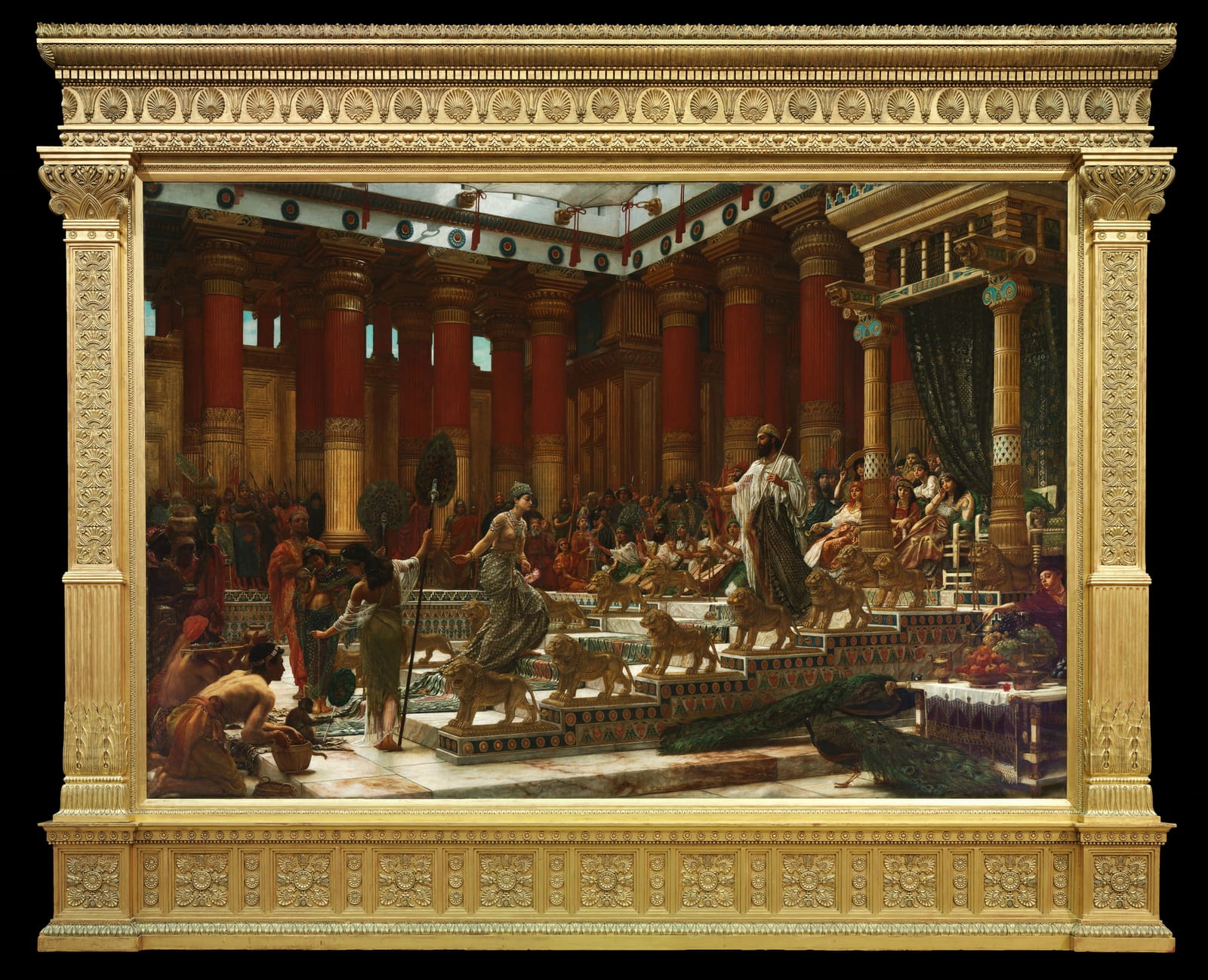
Sir Edward John Poynter · 1881–1890 · Oil on canvas, 234.5 × 350.5 cm
Look for
- The frame. Its columns and cornice repeat the temple architecture inside the picture, so the building seems to continue out into the room.
- The golden lions on the steps of the throne, one at each end of every step, and the peacocks at the right.
- The monogram EJP in the lower right, with the date split around it: 18 on one side, 90 on the other.
- Belachew Yimer's Ethiopian painting of the same meeting, hung nearby. Same story, fifty years later, from the other side.
Transcript (2:03)
Look at the frame before you look at the picture. Those gilded columns and that heavy cornice repeat the architecture of Solomon's temple inside the painting, so the building carries on out of the canvas and into the room where you are standing. The Gallery's own text puts it precisely: the temple is reprised in the frame, and it calls that architecture a wildly composite system, which is a polite way of saying Poynter assembled it from bits of everything.
The scene is the Queen of Sheba arriving at Solomon's court, and the two of them are small figures on a staircase in the middle of a vast red-and-gold hall. Count the golden lions on the steps of the throne, one at each end of every step. Find the peacocks on the right. Look at the ranks of courtiers, the inlaid floors, the painted ceiling beams. Poynter spent nine years on this, from 1881 to 1890, and signed it in the lower right with his monogram, EJP, with the date split around it, eighteen on one side and ninety on the other.
The Gallery groups him with the painters known as the Victorian Olympians, academic artists who turned away from industrial Britain to a distant past of vanished perfection, and it points out something worth remembering in front of any of these pictures: the British Museum had become a reference library for them, and Egypt and the Middle East had replaced Greece and Italy as the fashionable place to set a story. Critics praised this one for its archaeological accuracy. The Gallery's own verdict is drier. Poynter was so obsessed with getting the details right that the figures came out, in its words, somewhat doll-like.
Poynter himself was about as establishment as a painter could be. He trained in Paris alongside Whistler, became the first Slade Professor, ran the National Gallery in London for ten years, opening the Tate while he was at it, and was President of the Royal Academy from 1896. His wife Agnes MacDonald was the aunt of Rudyard Kipling and of the future prime minister Stanley Baldwin, and her sister married Burne-Jones.
The painting went from Poynter's studio to the London dealer Thomas McLean in 1890, who showed it on its own as a one-picture exhibition, and the Gallery bought it from McLean in 1892. In the current hang it does not stand alone. Nearby is a painting of the same meeting by the Ethiopian artist Belachew Yimer, made fifty years later, and a 2012 sculpture by the Cameroonian Pascale Marthine Tayou. Same meeting, told from the other end of the journey, in the same room.

Stop 5 of 5 · Naala Nura, ground level, Grand Courts
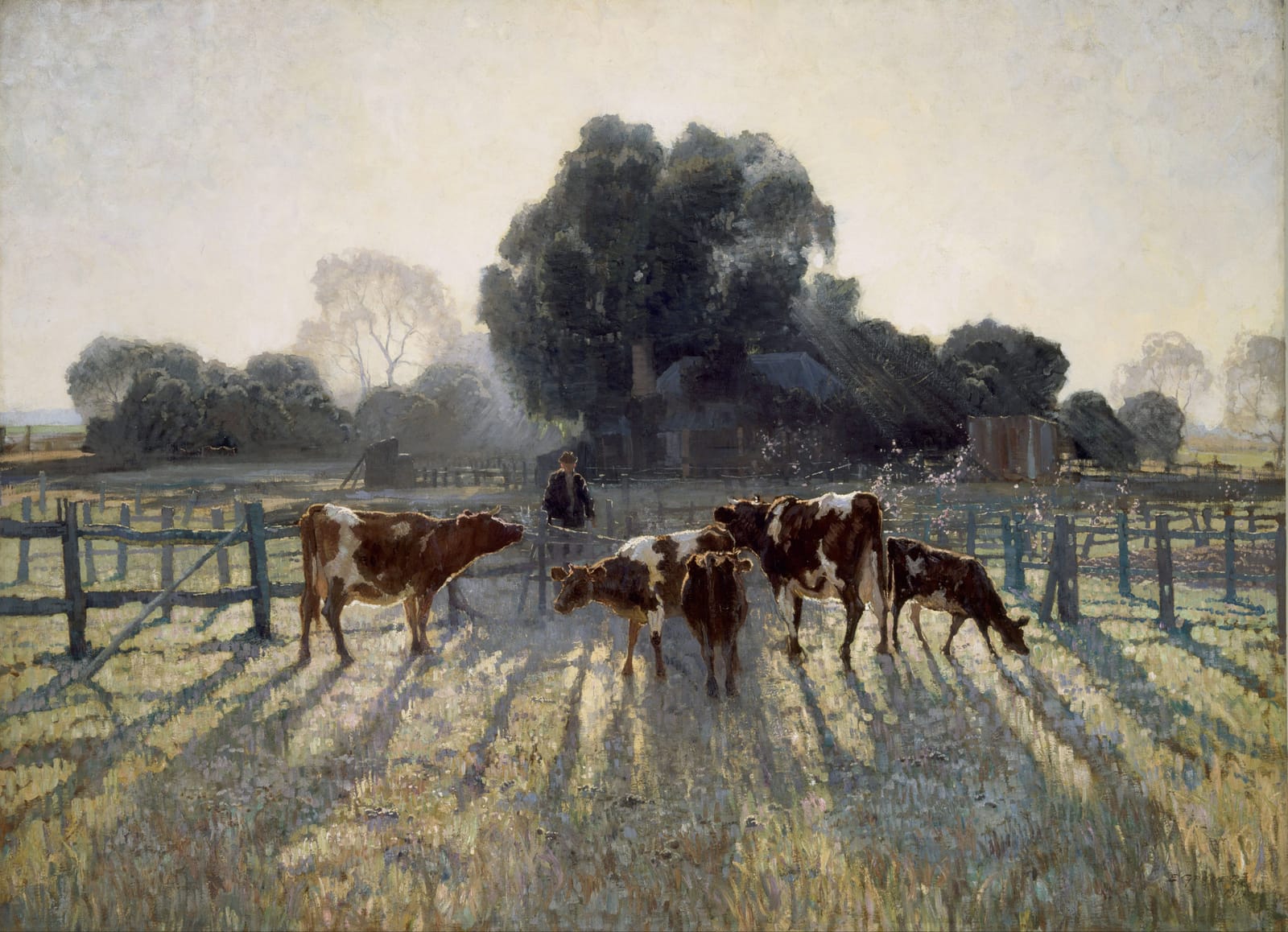
Spring frost
Elioth Gruner · 1919 · Oil on canvas, 131.0 × 178.7 cm
Look for
- The long blue shadows of the cows, running towards you across the frosted grass in short daubs of paint.
- The farmer's ears. The sun is directly behind him and they glow pink.
- The thin line of white and gold along the back of each cow where the light catches it.
- The signature in black in the lower right: E GRUNER, 1919.
Transcript (1:56)
You are looking into the sun. It is just up, somewhere behind the big tree and the farmhouse, and it is throwing the shadows of a handful of cows and a man straight at your feet across a paddock white with frost. The Gallery's own curators call this perhaps the most loved Australian landscape painting in the building, and the reason is standing right here in the foreground: that light.
This is a dairy farm at Emu Plains, west of Sydney. The farm belonged to Isaac Innes and then to his son Jim, and the man opening the gate is Jim Innes with his own cattle. Elioth Gruner had been coming out here since 1915 to paint the early morning, and he had already won the Wynne Prize in 1916 with a picture of the same farm called Morning light. This one won it again in 1919.
He painted it outdoors, mostly, in the cold, and at a size he almost never worked at. He built a shelter on the spot to keep the weather off the canvas and wrapped his legs in chaff bags against frostbite. The Gallery thinks he finished parts of it later in his studio in the city.
Now get close. The frost and the grass are not painted so much as dabbed, short strokes of paint that turn into long blue shadows when you step back. Each cow has a thin outline of white and gold where the sun catches its back. And look at the farmer's ears. The light is coming straight through them, and Gruner has painted them translucent pink. That is the whole picture in two small brushstrokes: a man with the sun behind him on a cold morning.
Gruner had no business being a painter at all. He was born in Gisborne, New Zealand, in 1882 and brought to Sydney before he was a year old. At fourteen, after his father died, he went to work as a draper's assistant, twelve-hour days, and took Julian Ashton's art classes at night. He did not give up the drapery business until he was thirty. He went on to win the Wynne Prize seven times, more than anyone except Hans Heysen, and Norman Lindsay said he painted the purest light that had ever been seen on a bit of canvas.
The painting came to the Gallery as a gift from F G White in 1939, the year Gruner died. He signed it in black in the lower right corner, E Gruner, 1919. It weighs thirty-six kilograms in its frame, which is a lot of weight for a picture of frost.
Independent guide · Chiaro
Point Chiaro at anything in the Art Gallery of New South Wales.
Five paintings from one suite of rooms, and the rest of the Grand Courts is still around you: a Bronzino, a Cézanne, a case of Jingdezhen porcelain, a Mackennal bronze with a two-line label. Take a photo of any of them, or of anything across the garden in Naala Badu, and the app names it, explains why it ended up in Sydney's collection, and keeps replying aloud as long as you linger.
Before you go
Getting there
Art Gallery Road, The Domain, Sydney NSW 2000, on the east side of the city centre next to the Royal Botanic Gardens, about five minutes' walk from Macquarie Street or Hyde Park across the Domain. Use the Naala Nura entrance, the sandstone portico on Art Gallery Road: the Grand Courts, the welcome desk and free cloaking are all on its ground level.
St James and Martin Place stations are both about ten minutes' walk. Bus 441 leaves from Stand D on the York Street side of the Queen Victoria Building and drops off near the Gallery. On Wednesday nights a courtesy bus runs from Art Gallery Road to Town Hall every twenty minutes from 7pm to 10pm.
Tickets
- General admission is free, with no reservation required. Only some special exhibitions are ticketed, and those are sometimes timed.
- The Gallery has no weekly closing day. The Gallery closes only on Christmas Day and Good Friday.
- Wednesday is the late night: open until 10pm, with Art After Hours programs and 2-for-1 exhibition tickets after 5pm.
- All five stops are in Naala Nura, the original south building. Naala Badu, the new building across the Art Garden, is mostly contemporary art.
The official audio guide
The Gallery's own audio guide is Dora, and it is free: it runs in the browser of your own phone at agnsw.art/dora over the Gallery's public WiFi, following numbers and QR codes on selected labels, so bring headphones. There is also a free guided Highlights of the Grand Courts tour daily at 2.30pm. This page adds five works at no cost, and from a single photo the Chiaro app handles anything else in the building.
Official site →Questions
Is there a free Art Gallery of New South Wales audio guide?
Two, in fact. The first is this page: five recorded stops, transcripts alongside, running in your browser without a download. The Gallery's own guide, Dora, is also free and runs on your phone at agnsw.art/dora. Beyond these five, aim the Chiaro app at any artwork in either building and it will narrate that piece.
How much is the official Art Gallery of New South Wales audio guide?
Nothing. Dora is a free audio guide you open in your phone's browser at agnsw.art/dora, using the Gallery's public WiFi. It follows numbers and QR codes on selected labels and includes audio descriptions of some works. Bring your own headphones or earbuds.
Where is Requiescat in the Art Gallery of New South Wales?
In the Grand Courts on the ground level of Naala Nura, the original sandstone building you enter from Art Gallery Road. All five works on this page hang in the same suite of courts; the Gallery's database does not name the individual court, so follow the labels.
Is the Art Gallery of New South Wales free?
Yes. General entry is free and needs no ticket. Fees apply only to some special exhibitions, which can be booked online, and those tickets are 2-for-1 after 5pm on Wednesdays.
When is the Art Gallery of New South Wales closed?
Only on Christmas Day and Good Friday. Otherwise it is open daily from 10am to 5pm, and until 10pm on Wednesdays.
Can I use this inside the Gallery?
Yes. The audio streams over mobile data or the Gallery's free public WiFi. Pack headphones, and keep the sound low in the courts. The five stops are all on one level, a few minutes' walk apart.
More audio guides
Made by Chiaro. Not affiliated with the Art Gallery of New South Wales.