Musée Gustave Moreau · Paris · Independent guide
Musée Gustave Moreau audio guide,
five stops, free.
Listen to five tracks right on this page, then photograph any of the house's 1,300 paintings and watercolours or 5,000 drawings for Chiaro to narrate.
Made by Chiaro. Not affiliated with the Musée Gustave Moreau.
The Chimeras
Musée Gustave Moreau, Paris
That was the free part
Chiaro narrates any work in the Musée Gustave Moreau from a photo.
The five stops · 10 minutes of audio
Five stops, one walk,
in the order you will walk them.
Gustave Moreau designed his own posthumous museum above his family's quarters in Nouvelle Athènes, and this Musée Gustave Moreau audio guide follows the route up through the two vast glazed studios that every ticket guarantees. Start in the second-floor studio before the unfinished cliff of The Chimeras, step across the floorboards to Albert Lafon's wrought-iron Spiral Staircase, climb into the third-floor studio's second room for the oil canvas of The Apparition and the medieval island of The Unicorns, and finish in the third-floor first room beneath Jupiter and Semele. Playback runs to roughly ten minutes; with time to pull open the pivoting drawing shutters, give the studios forty-five minutes to an hour, or ninety minutes on quiet days when the first-floor apartment and ground-floor rooms open too.
Every detail here draws on the Musée Gustave Moreau's own published collection notices and visitor trail alongside a second public reference. Although Henri Rupp's 1903 frame-to-frame hang stays remarkably constant, individual canvases still travel on loan to exhibitions abroad: whenever a wall placard inside the studio differs from these notes, trust the placard in front of you and send us word.

Stop 1 of 5 · Second-floor studio
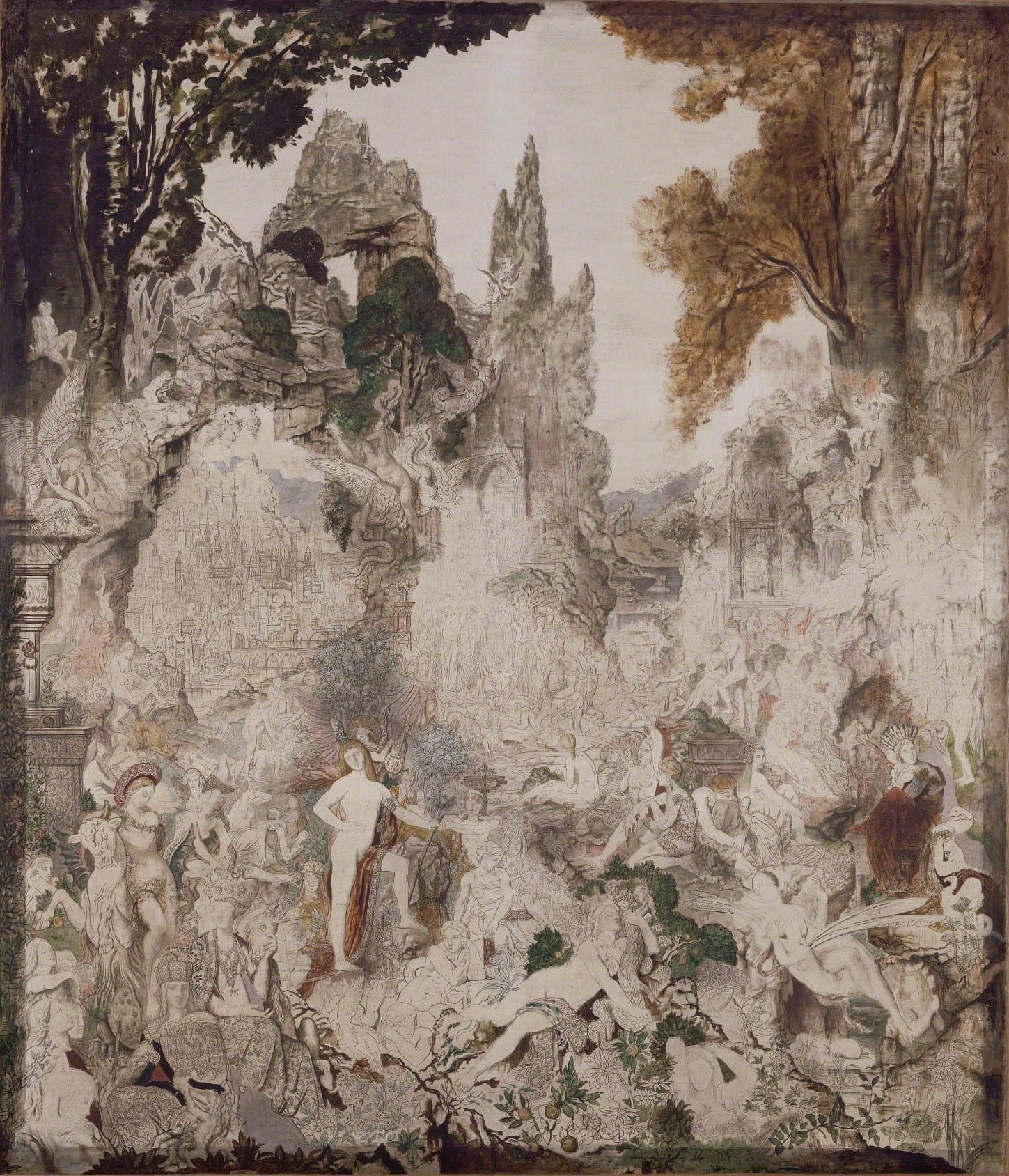
The Chimeras
Gustave Moreau · 1884 · Oil on canvas, 236 × 204 cm
Look for
- The pale, unpainted passages across the middle of the cliff, where figures remain pure brown outlines on light ground and look almost like carved marble.
- At the centre, an allegory of Lust mounted on a goat above an Eve-like figure embracing a serpent with a human head.
- In the lower left, a richly dressed woman stroking a unicorn borrowed from the medieval Cluny tapestries, beside a woman on a winged bull and a pilgrim with a staff listening to an angel's music.
- A tiny cross barely visible at the summit of the highest crag, marking redemption at the top of the spiritual climb.
Transcript (2:03)
Stand back a couple of paces in this vast north-lit studio on the second floor, right beside the foot of the spiral stair, and you might mistake the giant square canvas in front of you for a faded medieval wall hanging. Two metres thirty-six high, more than two metres wide, and drained of heavy varnish or dark shadow. That pale, chalky glow happens because you are looking straight into Gustave Moreau's underdrawing.
Most of the monumental canvases around you in this room were laboured over for decades, enlarged with extra strips of linen in the 1880s and 1890s so they could hold their own on these tall red walls. The Chimeras was different. Moreau started planning it around 1880 and carried the huge composition forward in a burst of roughly four months. Then, in 1884, his mother Pauline died at eighty-two. Grief stopped him cold. He signed and dated the canvas at the lower right in 1884, set his brushes down, and never touched it again, turning instead to the sombre nine-panel altarpiece of human sorrow upstairs.
In French, une chimère means two things at once: the hybrid monster of Greek myth, and a waking daydream or obsession that will not let a person go. Moreau subtitled this work Satanic Decameron and packed a steep, craggy island with dozens of women, each accompanied by the creature born of her own longing. For the crowded, climbing cliff face, he borrowed the structure of Vittore Carpaccio's Martyrdom of the Ten Thousand Christians, a Venetian painting he had copied as a young man at the Accademia between 1857 and 1859.
Read the crowd from the centre outward. Near the middle rises Lust astride a goat, and just below her a woman coils around a human-headed serpent. Look down to the left and you will spot a woman seated on a winged bull, another in brocade caressing a unicorn after the medieval tapestries the Musée de Cluny had bought two years earlier, and a half-draped traveller leaning on a staff while an angel pours music into her ear. Now lift your eyes to the very tip of the highest rock peak. Almost lost against the pale sky stands a tiny cross, Moreau's quiet sign of refuge above the storm of desire.
Before you leave this wall, glance under the studio windows at the wooden cabinets with pivoting glass shutters. Nearly four thousand eight hundred and thirty of Moreau's preparatory drawings sit inside them across these two studio floors, arranged to be leafed through like the pages of an immense sketchbook.

Stop 2 of 5 · Second-floor studio, rising to the third-floor studio
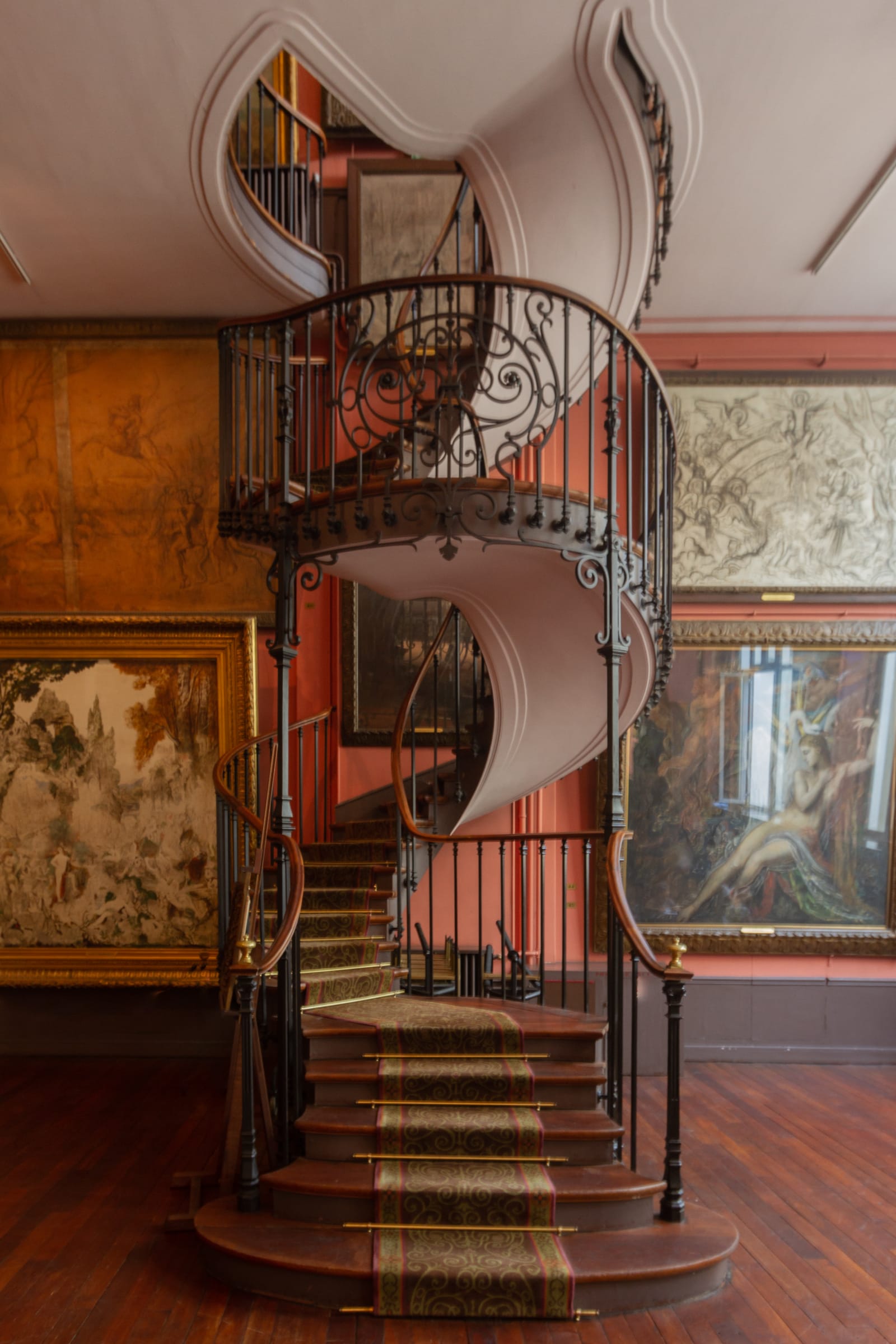
The Spiral Staircase
Albert Lafon · 1895 · Wrought iron and wood
Look for
- Stand at the bottom step and look straight up through the open stairwell: there is no central column, only a ribbon of forged iron coiling into the ceiling cut-out.
- The foliate iron scrollwork along the curved landing balcony, open enough to let the north skylight pass unhindered onto the canvases behind it.
- The dense frame-to-frame hang on the terracotta walls around the stair, preserved just as Moreau's friend Henri Rupp arranged it for the January 1903 opening.
Transcript (2:00)
Walk over to the wooden bottom step in the corner of the studio and tilt your head straight up. Above you, a dark ribbon of forged wrought iron and polished wood coils through a scalloped opening in the ceiling, without a central pillar anywhere in sight. It feels less like a staircase in a Parisian townhouse and more like a piece of jewellery scaled up to carry human footsteps.
When Gustave Moreau's father, the city architect Louis Moreau, bought 14 rue de La Rochefoucauld for his twenty-six-year-old son in July 1852, this building was a modest family house in Nouvelle Athènes with a cramped attic studio at the top. As early as Christmas Eve 1862, Moreau scribbled on a sketch that separated, his works would perish, whereas kept together they would show the world in which he liked to dream. One by one, the people he loved died: his father in 1862, his mother in 1884, and in 1890 Alexandrine Dureux, his close companion of thirty years. Alone in the house, the sixty-nine-year-old painter decided in April 1895 to turn his home into a permanent museum.
He hired the architect Albert Lafon, who kept the first-floor rooms intact as a private memorial apartment filled with family portraits and gifts from Edgar Degas and Théodore Chassériau, then tore out the upper storeys to build two vast north-facing glazed studios of a hundred and seventy-two square metres each. Lafon faced a practical puzzle: a grand straight staircase would have eaten up precious wall space needed for four-metre canvases. His answer is the open-well helix in front of you, tucked neatly into the studio corner so giant frames — The Chimeras on one side, Leda on the other — can hang right up to its iron balusters.
Moreau signed his will on the tenth of September 1897, leaving the house and fifty years of work to France on the condition that the collection never be broken up, and died seven months later on the eighteenth of April 1898. His devoted friend and executor Henri Rupp spent years cataloguing thousands of sheets and hanging these terracotta walls frame to frame. When the doors opened on the fourteenth of January 1903, Moreau's favourite pupil from the École des Beaux-Arts, the painter Georges Rouault, stood here as the museum's first curator.

Stop 3 of 5 · Third-floor studio, second room
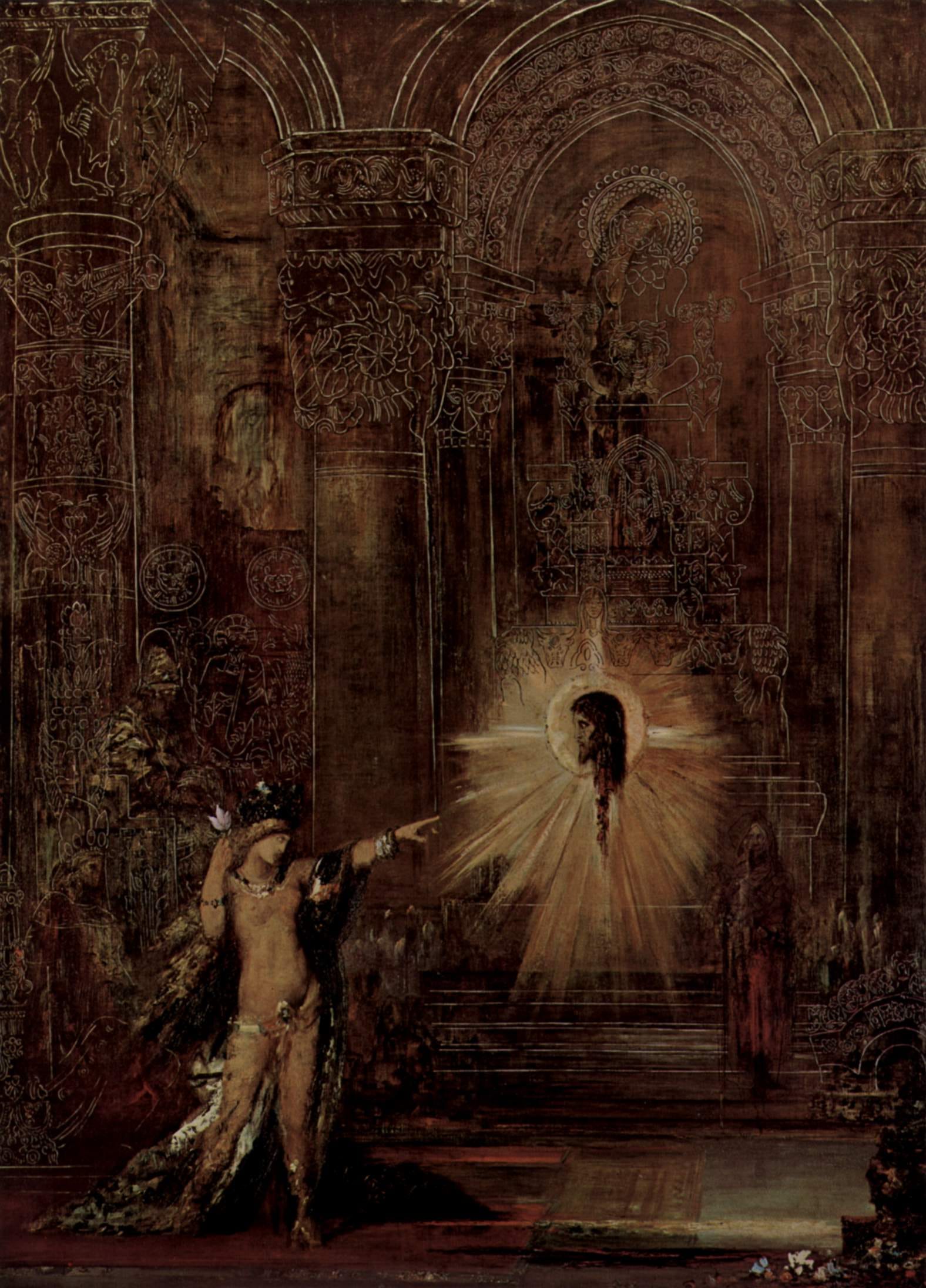
The Apparition
Gustave Moreau · c. 1875 · Oil on canvas, 142 × 103 cm
Look for
- Salome's rigid outstretched left arm pointing directly at the severed, haloed head of John the Baptist suspended in mid-air.
- King Herod seated high on his throne at the left and the executioner leaning on his sword at the right: neither reacts, as if Salome alone sees the vision.
- The web of pale incised lines cut into the dark brown architecture behind the figures, blending pagan idols with medieval capitals.
- Nearby in this same room, Dancing Salome ('Tattooed Salome') and the four-sided revolving cabinet holding 264 watercolours behind protective shutters.
Transcript (1:58)
Climb the iron spiral to the third floor, pass into the second room of the upper studio, and stop before the dark canvas where a severed head blazes like a sun in mid-air. First, clear up a confusion that catches almost everyone who knows this image from books. In 1876 Moreau exhibited a jewel-bright watercolour of The Apparition at the Paris Salon; that watercolour now belongs to the Musée d'Orsay and rests in the print vaults of the Louvre. What hangs in front of you is Moreau's larger oil-on-canvas version, a metre forty-two high, which he kept here in his studio until the day he died.
The story comes from the fourteenth chapter of the Gospel of Matthew. Imprisoned for denouncing King Herod's marriage to Herodias, John the Baptist pays with his life after young Salome dances for the king and, prompted by her mother, asks for the prophet's head on a charger. Dozens of nineteenth-century painters turned Salome into a seductive Orientalist cliché. Moreau did something nobody had seen before: he interrupted the dance with a hallucination.
Look at Salome in the lower left foreground, half-draped in jewelled veils, a lotus blossom in her raised right hand, her left arm locked straight out as she recoils. Floating above the palace steps in a burst of golden rays is the Baptist's head, blood streaming from the neck, eyes fixed directly on hers. Now look at everyone else in the hall. On the left, Herod sits stiff as an idol on his throne beside Herodias. On the right, the executioner stands calm and motionless beside his long sword. None of them flinches. The museum calls this painting an image of thought persisting beyond physical death: conscience made visible to the one person standing in the spotlight.
Step closer to the dark columns behind the halo. Instead of building solid stone, Moreau drew a delicate lattice of pale lines directly over the brown oil ground, tangling Hindu-looking deities with Romanesque arches so the room belongs to no real century on earth. In 1884 the novelist Joris-Karl Huysmans devoted famous pages of his novel Against Nature to Moreau's Salome pictures, making this haunted princess the emblem of Symbolist art. Before you move on, glance across this same room at her sister canvas, the Tattooed Salome, where Moreau inked mysterious ornamental patterns straight across her skin.

Stop 4 of 5 · Third-floor studio, second room
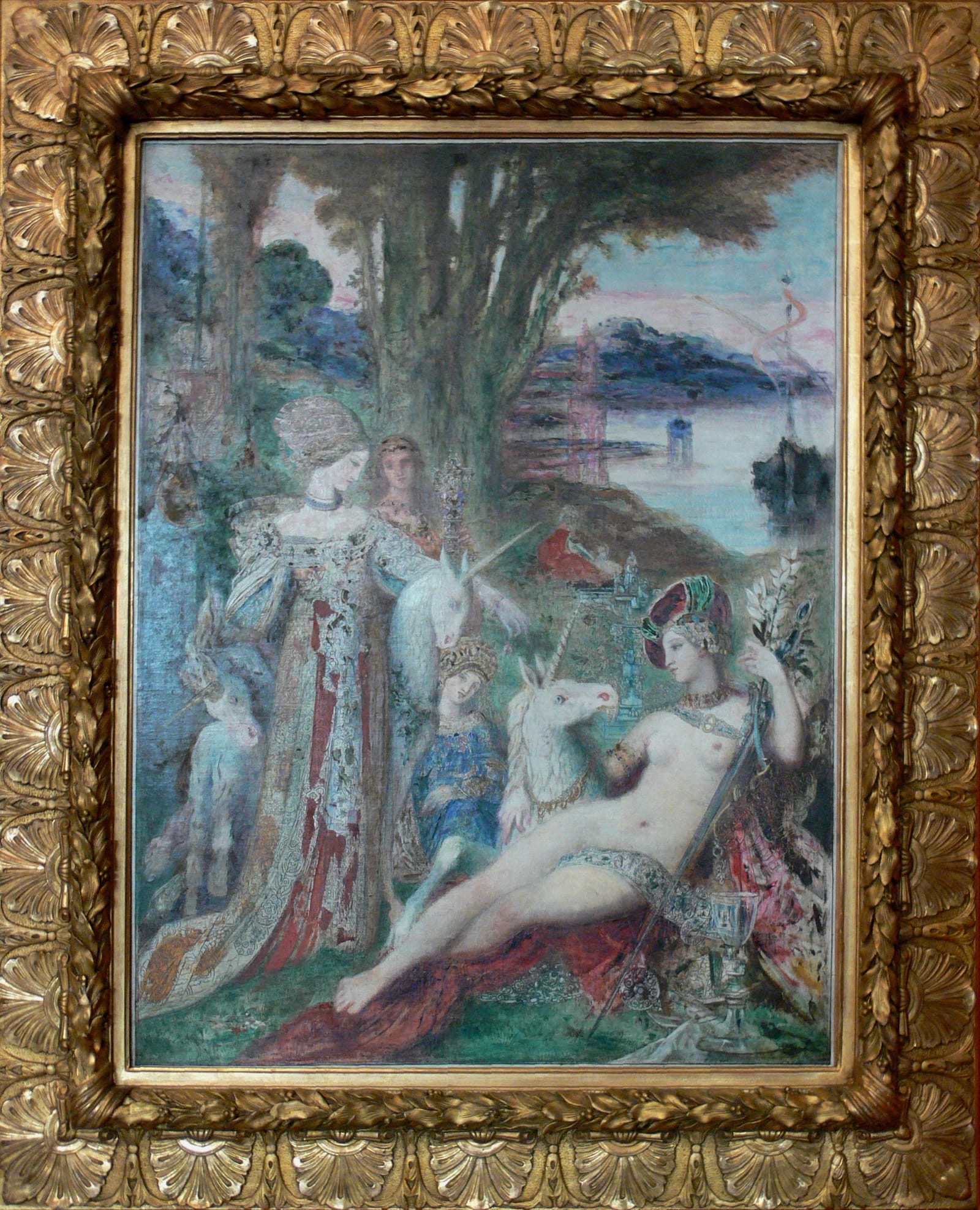
The Unicorns
Gustave Moreau · c. 1888 · Oil on canvas, 115 × 90 cm
Look for
- The two white unicorns resting calmly against the women at the centre — according to medieval lore, wild beasts that let only virgins approach them.
- On the right, a reclining woman holding a white lily and a jewelled sword, with a mysterious golden chalice standing at her feet in the lower corner.
- The miniature line drawings of Saint George and fabulous beasts traced directly over shimmering patches of colour on the standing princess's brocade.
- High on the right horizon, the tiny dark silhouette of the sailing ship that carried these women to their island.
Transcript (1:43)
Stay in the second room of the third-floor studio and turn to the carved gold frame where five women and two white unicorns gather beside a turquoise sea. On the fourteenth of July 1887, the Parisian collector Émile Straus walked down from this studio and wrote that he had just seen one of the most beautiful things of his entire life.
A wealthier collector disagreed, and that quarrel is the reason this painting still hangs in Paris rather than in a private drawing room. The banker Baron Edmond de Rothschild had commissioned The Unicorns from Moreau. Yet when Rothschild visited the studio and hinted that the artist ought to push the surface to a smoother, more conventional polish, Moreau dug his heels in. He refused to part with the canvas, painted Rothschild an impeccably finished watercolour of David Dancing before the Ark as a substitute, and let fly in a private studio note against pompous collectors whose grasp of art, he fumed, barely rose above a concierge or a pork butcher.
Step up to the frame and you can see immediately what startled Rothschild and thrilled later painters. Moreau pulled colour and line apart. Beneath the figures, washes of rose, sea-blue, emerald, and gold shimmer like crushed opal without obeying strict edges. Over the top of those glowing patches, Moreau traced crisp, intricate line work with a fine point: Renaissance headdresses, a white lily, a jewelled sword, a golden Grail-like chalice tucked into the lower right corner, and even tiny scenes of Saint George fighting the dragon embroidered onto a skirt.
Do not hunt for a dramatic plot here, because Moreau deliberately left none. Inspired by the six medieval Lady and the Unicorn tapestries that the Musée de Cluny had acquired in 1882, he described this canvas simply as an enchanted island populated solely by women, a pure pretext for colour and ornament. Out on the pale water at the upper right sits the small dark ship that brought these princesses ashore, moored forever off a coast that exists nowhere outside this room.

Stop 5 of 5 · Third-floor studio, first room
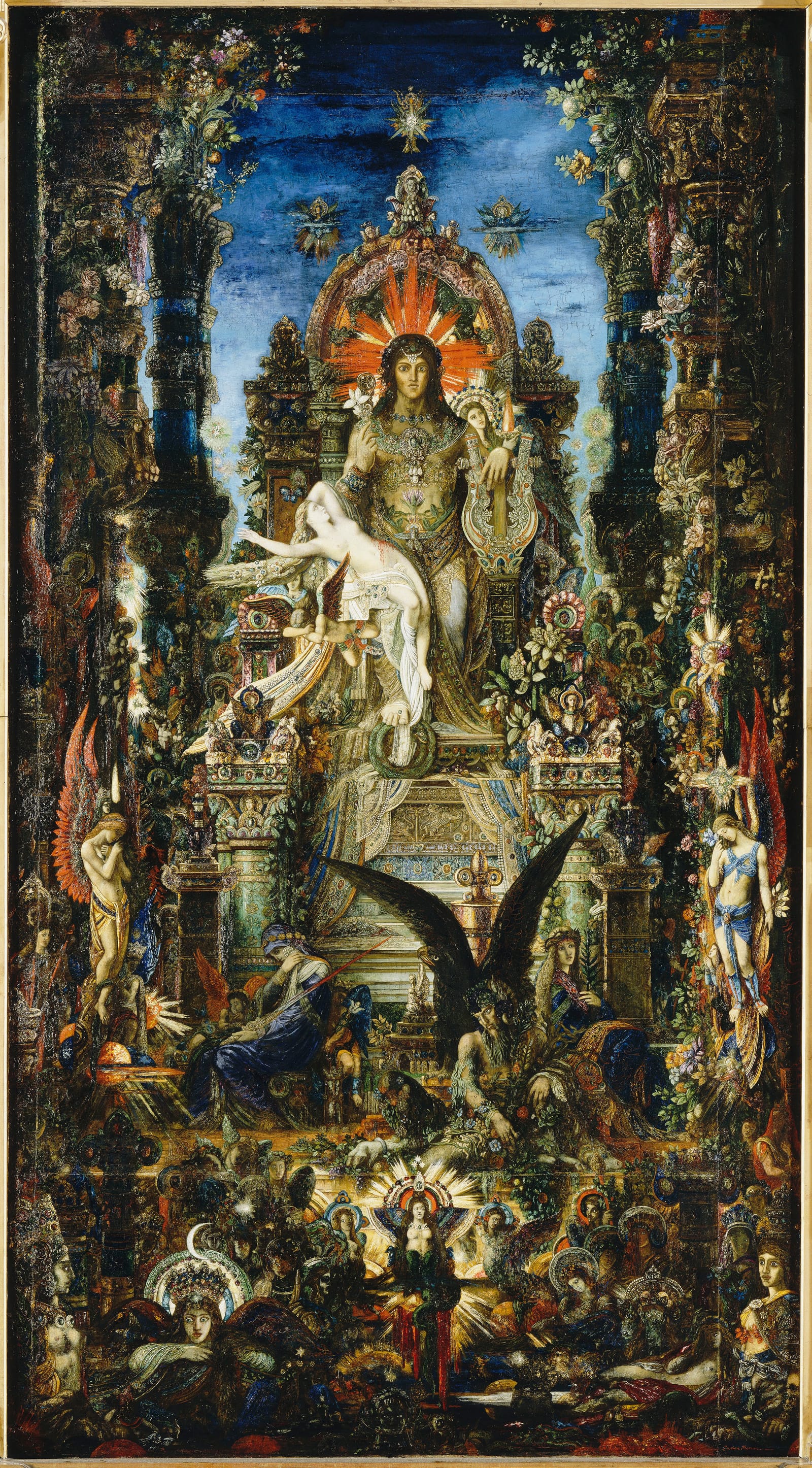
Jupiter and Semele
Gustave Moreau · 1889–1895 · Oil on canvas, 212 × 118 cm
Look for
- Pale, blood-streaked Semele flung across Jupiter's giant right thigh, and below her the winged goat-hoofed spirit hiding its eyes from the god's radiance.
- Jupiter's beardless, wide-eyed face framed by a fiery halo, holding a white lotus sceptre in one hand and Apollo's winged lyre in the other, with his right foot on a coiled snake biting its tail.
- At the foot of the throne, veiled Death holding a bloodied red sword on the left and Sorrow wearing a Christian crown of thorns on the right, flanking Jupiter's black eagle and goat-horned Pan.
- Along the bottom edge, Hecate crowned with a silver crescent moon at the lower left and two guardian sphinxes watching over the shadowy monsters of night.
Transcript (2:40)
Step back into the first room of the third-floor studio and stand before the tall gilded frame that rules the room. Two metres twelve high, encrusted like an altarpiece carved out of lapis lazuli, ruby, and green enamel, Jupiter and Semele is the summit of Gustave Moreau's career. He sketched it in 1889 and finished it in 1895, the very year he summoned his architect to turn this house into a museum, telling his pupil Ary Renan that the canvas expressed the last of his dreams. The collector who commissioned it, Léopold Goldschmidt, understood where it belonged: when the museum opened in 1903, he gave it back so it would hang here permanently.
The myth comes from the third book of Ovid's Metamorphoses. Semele, mortal princess of Thebes, is loved by Jupiter, king of the gods. Jealous Juno disguises herself as Semele's old nurse and whispers a fatal trap into her ear: make your lover swear to appear to you in his full heavenly glory, just as he appears on Olympus. Bound by his oath, Jupiter unveils himself, and no mortal body can survive that fire.
Look at how Moreau stages the instant of revelation. Instead of the bearded patriarch of classical sculpture, Jupiter stares straight past you, young and beardless like Apollo, cradling a golden lyre that turns the lord of thunder into a god of poetry and music. Across his colossal right thigh, tiny white Semele arches backward, struck by divine lightning, blood trickling down her side. Just beneath her, a small winged figure with goat hooves shields its eyes — for Moreau, the spirit of earthly love dying in the blaze, though many viewers also think of infant Bacchus, rescued from his mother's womb.
Now read the painting from the bottom edge upward, because Moreau built the whole two-metre canvas as a ladder of the soul climbing out of darkness. Down in the black depths at the lower left sits Hecate, goddess of night, crowned with a silver crescent moon, surrounded by shadowy hybrid creatures and two sphinxes guarding the past and the future. One tier higher, goat-footed Pan bows his head under the spread black wings of Jupiter's eagle, linking earth to heaven. Beside them sit two solemn figures Moreau called the tragic basis of human life: on the left, veiled Death holding a bloodied sword; on the right, Sorrow wearing Christ's crown of thorns. Above them all, Jupiter's foot rests on a serpent biting its own tail, emblem of eternity, while blue vaults open to a star-lit sky.
Stand close enough to see the thick, jewel-hard ridges of pigment — blues and greens that recall the Renaissance ceramics Moreau's parents collected downstairs. Three years before finishing this canvas, Moreau became a professor at the École des Beaux-Arts, welcoming young Henri Matisse, Albert Marquet, and Georges Rouault to this house on Sundays and urging them to paint from inner vision rather than copy nature. Modern French colour began in studios like this one, right under Jupiter's wide, unblinking eyes.
Independent guide · Chiaro
Point Chiaro at anything in the Musée Gustave Moreau.
These five stops barely scratch walls hung frame to frame from floor to cornice. Snap a canvas high on the studio tier, a sheet inside the pivoting drawing cabinets, or a family portrait in the first-floor apartment: Chiaro identifies the piece, unpacks Moreau's myth, and answers follow-up questions aloud while you stand there.
Before you go
Getting there
14, rue de La Rochefoucauld (officially rue Catherine-de-La Rochefoucauld), 75009 Paris, in the Nouvelle Athènes quarter south of Pigalle. Entry is through the single townhouse doorway, with bag screening at reception.
Métro line 12 stops closest at Trinité – d'Estienne d'Orves and Saint-Georges, while Pigalle serves lines 2 and 12. Buses 21, 26, 40, 43, 68, and 74 run nearby, and the nearest car park is Parc Trinité d'Estienne d'Orves at 10–12 rue Jean-Baptiste Pigalle.
Tickets
- Closed every Tuesday, plus 1 January, 1 May, and 25 December. Open Monday and Wednesday to Sunday from 10 am to 6 pm, with last admission at 5:30 pm and galleries clearing 15 minutes before closing (early 4:30 pm closing on Christmas Eve; check holiday and same-day strike updates on musee-moreau.fr before setting out).
- Standard self-guided tickets cost 8 euros (6 euros reduced) at reception and guarantee entry to the 2nd- and 3rd-floor studios; the 1st-floor apartment and ground floor open only when attendance and staffing allow. Keep your stub: the joint ticket includes entry to the Musée Jean-Jacques Henner for 3 months, plus reduced-rate entry within 8 days at the Musée Guimet and Musée d'Orsay, within 15 days at the Musée de la Vie Romantique and Musée d'art et d'histoire du Judaïsme, and within 30 days at Citéco.
- Entry is free with ID for Paris Museum Pass holders, under-18s, and EEA residents under 26, and free to all on the first Sunday of every month. Online self-guided ticket sales on billetterie.musee-moreau.fr are currently unavailable (buy self-guided tickets directly at reception, and check billetterie.musee-moreau.fr ahead of first Sundays in case online slots reopen).
- Leave suitcases and bulky bags behind: the museum accepts no luggage and has no storage lockers. Because the historic house has three staircases and no lift, upper floors are not wheelchair accessible and strollers stay at reception; flashless photos and visitor Wi-Fi (MOREAU VISITEUR) are available throughout.
The official audio guide
The Musée Gustave Moreau does not rent an audio-guide handset or publish a mobile app; reception hands out a free Visitor Trail leaflet, while scheduled lecturer-led guided tours in French and English require a separate 10-euro ticket (8 euros reduced, museum entry included) on billetterie.musee-moreau.fr. Our five browser tracks here cost nothing, and the Chiaro app can narrate any other painting, watercolour, or drawing in the house from a photograph.
Official site →Questions
Is there a free Musée Gustave Moreau audio guide?
Yes — the five audio tracks on this page stream free in your phone's browser, with full transcripts underneath and nothing to install. To hear the story behind any other canvas or drawing on the studio walls, snap a photo in the Chiaro app.
How much is the official Musée Gustave Moreau audio guide?
There isn't one: the museum neither rents audio handsets nor offers its own visitor app. Reception provides a free printed or downloadable Visitor Trail leaflet, while scheduled lecturer-led guided tours in French and English cost 10 euros full rate or 8 euros reduced (including museum entry) via billetterie.musee-moreau.fr.
Where is Jupiter and Semele in the Musée Gustave Moreau?
It dominates the first room of the third-floor studio, reached by climbing Albert Lafon's wrought-iron spiral staircase from the second-floor studio. Every admission ticket covers the second- and third-floor studios.
Is the Musée Gustave Moreau closed on Tuesdays?
Yes, the house closes every Tuesday as well as on 1 January, 1 May, and 25 December. On all other days it opens from 10 am to 6 pm with last entry at 5:30 pm, though visitors should glance at musee-moreau.fr before setting out in case unscheduled strike closures apply.
Does the Paris Museum Pass cover the Musée Gustave Moreau?
Yes, a valid Paris Museum Pass grants free admission, as do proofs of age for visitors under 18 and EEA residents under 26. Otherwise, self-guided tickets are sold directly at the reception desk for 8 euros full price or 6 euros reduced (online self-guided booking on billetterie.musee-moreau.fr is currently paused), and everyone enters free on the first Sunday of the month.
How long does a visit to the Musée Gustave Moreau take?
Plan on forty-five minutes to an hour for the five stops in the second- and third-floor studios, including ten minutes of audio and time to leaf through the pivoting drawing cabinets. When the first-floor memorial apartment and ground-floor rooms are also open, ninety minutes lets you see all four levels unhurriedly.
More audio guides
Made by Chiaro. Not affiliated with the Musée Gustave Moreau.