
Musée des Arts Décoratifs · Paris · Independent guide
Musée des Arts Décoratifs audio guide,
five stops, free.
Stream five gallery tracks right on this page, then photograph any of the 6,000 objects across seven floors and let Chiaro tell its story.
Made by Chiaro. Not affiliated with the Musée des Arts Décoratifs.
The Meeting of Jason and Medea
Musée des Arts Décoratifs, Paris
That was the free part
Chiaro narrates any work in the Musée des Arts Décoratifs from a photo.
The five stops · 10 minutes of audio
Five stops, one walk,
in the order you will walk them.
Tucked inside the northwest wings of the Louvre palace at 107 rue de Rivoli, this Musée des Arts Décoratifs audio guide follows the chronological route across Levels 3 and 4. Ride the Lefuel lift to Level 3 to start in Room 6 with a Florentine wedding panel from the 1480s, then head up to Level 4 for an eighteenth-century Place Vendôme boudoir in Room 23, Louis-Léopold Boilly's view inside Houdon's sculpture studio in Room 29, the gilded bronze bed of Valtesse de la Bigne in Room 40, and Eugène Grasset's Art Nouveau stained glass in Room 44. Listening takes roughly ten minutes; allow about ninety minutes with the walk between wings.
Every room number, inventory code and historical detail below rests on the museum's online collections portal alongside an independent reference such as Wikidata or Wikipedia. Furniture and fragile panels occasionally shift galleries or leave on loan, so let the wall plaque in front of you break any tie and send us a note if a piece has moved.

Stop 1 of 5 · Level 3, Room 6 (The Early Italian Renaissance)
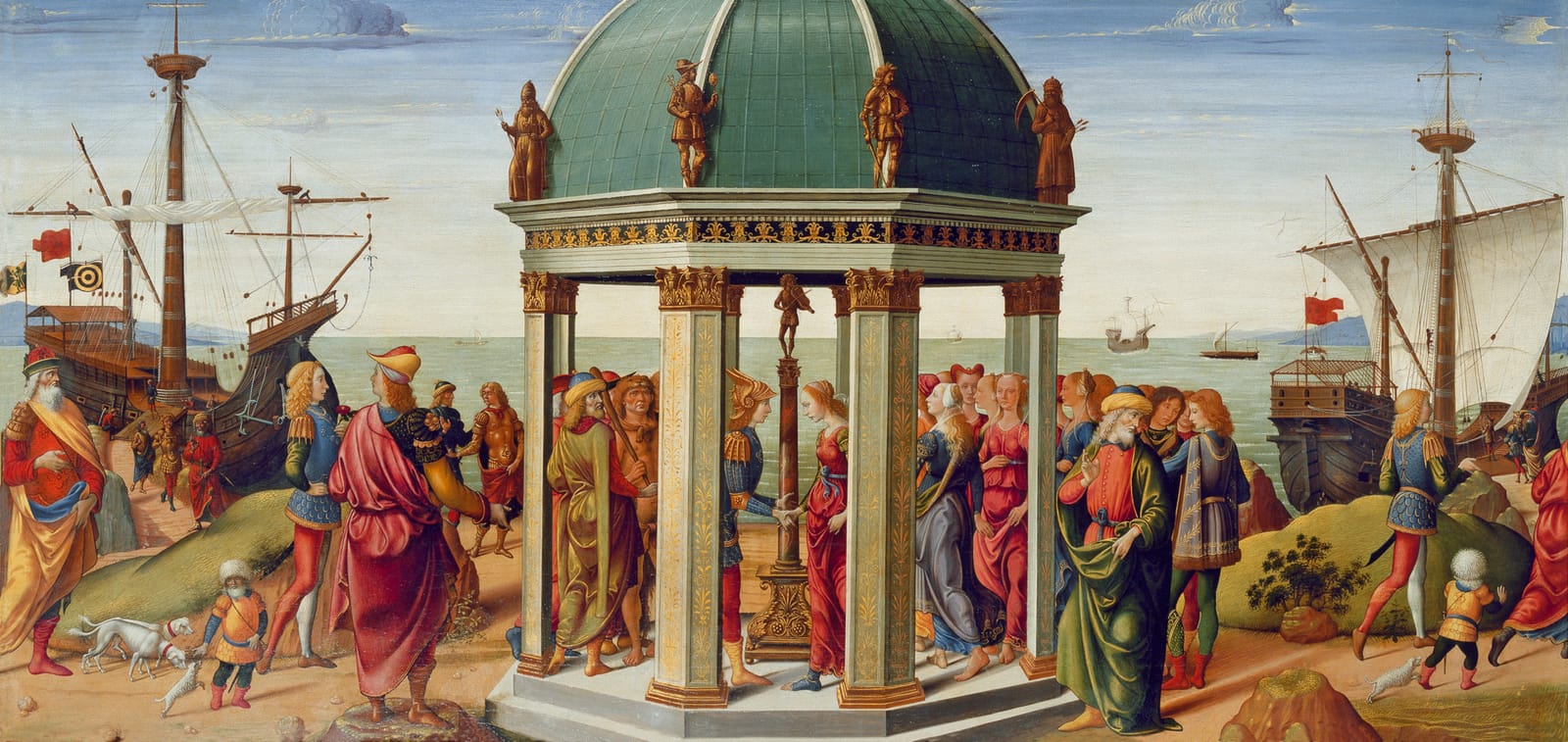
The Meeting of Jason and Medea
Attributed to Biagio d'Antonio (1446–1516) · c. 1486 · Oil on wood (cassone panel), 54 × 131 cm
Look for
- The black flag with concentric gold rings flying at the stern of the left-hand ship: the coat of arms of the Albizzi banking dynasty, paired with the Tornabuoni arms to date a 1486 Florentine wedding.
- Jason in his winged gold helmet and Medea in crimson clasping right hands inside the eight-sided temple, directly under a tiny bronze statue of Apollo.
- The long, low shape of the board, 54 by 131 centimetres: painted not for a church altar, but to be set into marriage-chamber furniture.
Transcript (1:56)
Notice the shape of this painting before you start reading the crowd inside it. At 54 centimetres tall and more than twice as wide, this long horizontal panel was never meant to hang above a church altar. In fifteenth-century Florence, wealthy families hired serious painters to decorate the woodwork of a newlywed couple's bedroom: marriage chests called cassoni, wainscoting at shoulder height, and carved bedsteads. You are looking at domestic luxury from the Italian Renaissance, which is why it lives in a decorative arts museum.
Look up at the two tall ships anchored on either side of the bay, and spot the heraldic banners above their sterns. On the left, concentric gold rings on a black ground mark the Albizzi family. Paired with the arms of the Tornabuoni, another Florentine banking house, those tiny flags pin this panel to a celebrated society wedding of 1486: the marriage of Lorenzo Tornabuoni and Giovanna degli Albizzi. Several painters collaborated on a whole suite of panels telling the Greek myth of Jason and the Argonauts for the young couple's chamber, and this scene went to Biagio d'Antonio.
Biagio, born in Florence in 1446 as the son of an embroiderer, trained with Cosimo Rosselli, worked in Andrea del Verrocchio's shop, and helped paint the walls of the Sistine Chapel in Rome before returning to the narrative furniture panels he did best. For centuries art historians forgot his real name, parceling his work out to painters from Faenza or to Benedetto Ghirlandaio until tax records published in 1935 gave Biagio d'Antonio Tucci his career back.
Follow the clean geometry of the octagonal temple at dead centre. Beneath its green dome and gilded frieze, Jason in armour and a winged helmet takes the hand of the princess Medea in crimson, pledging marriage before a miniature statue of Apollo. Courtiers in bright hose, greyhounds, and two small pages frame the shore while the ship Argo waits on calm water.
Of course, anyone in Florence who knew Ovid knew how catastrophically Jason and Medea's marriage ended, yet Renaissance patrons loved the splendour of the courtship anyway. The Parisian architect and collector Émile Peyre bequeathed the panel to this museum in 1905, its gold highlights still gleaming after five centuries.

Stop 2 of 5 · Level 4, Room 23 (The Cabinet des Fables)
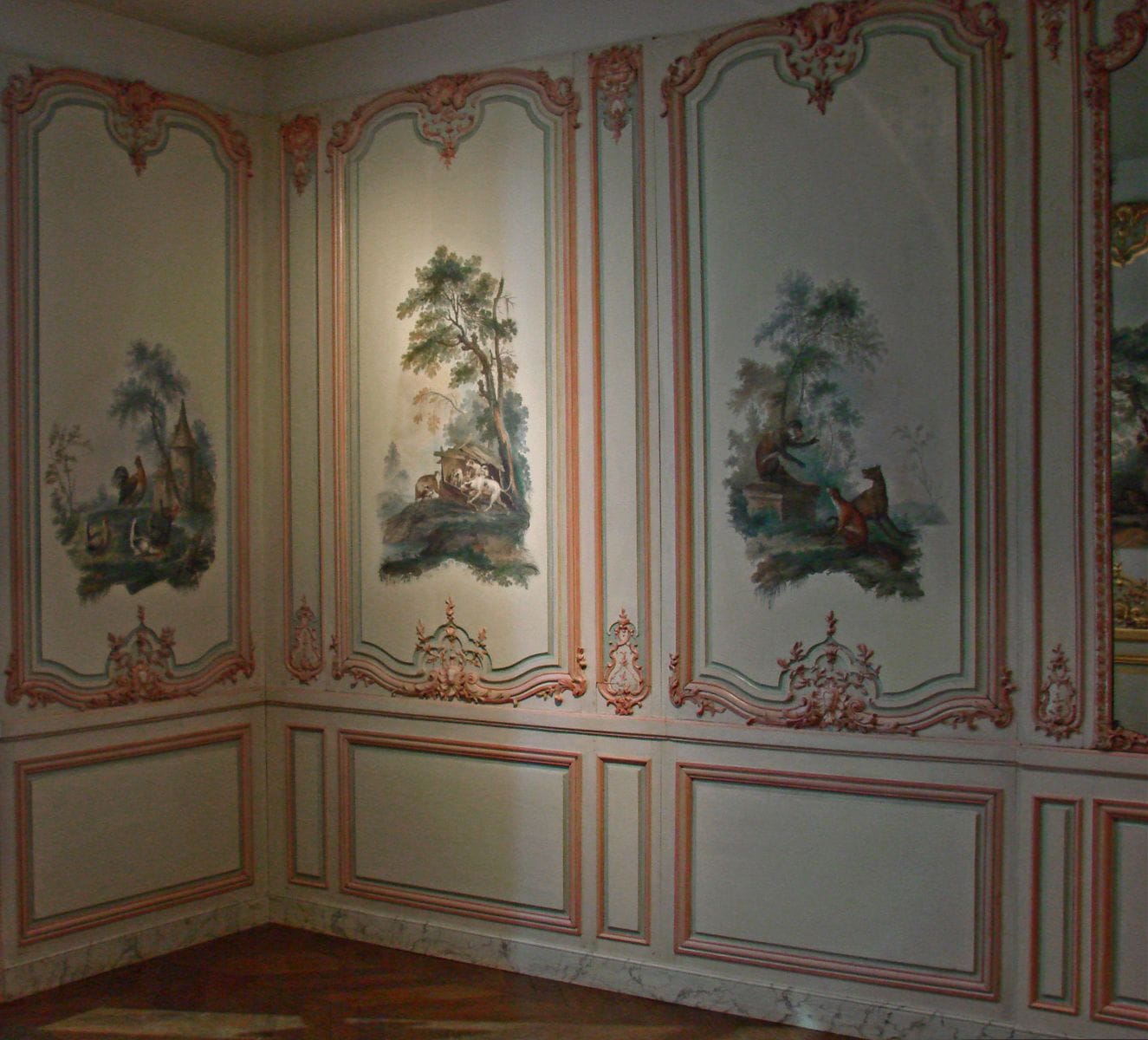
The Cabinet des Fables
Parisian woodcarvers and painters for François-Balthazar Dangé · c. 1750–1755 (redecorated c. 1853) · Moulded, carved, painted and oil-gilt oak panelling, eleven panels of La Fontaine's Fables
Look for
- The deliberate split in the restoration: two-thirds of the carved oak wears Madame Dangé's 1750s rose-pink and pale green, while one-third keeps the heavy gold leaf applied for the army around 1853.
- The painted animal courtroom in The Wolf Accusing the Fox before the Monkey, where a monkey judge sits on a stone block listening to two rogues argue under a tree.
- The low ceiling and compact footprint, built as a private boudoir overlooking Place Vendôme rather than a grand reception hall.
Transcript (1:52)
Stand inside this small oak-panelled room and look all the way around the walls before settling on a single painting. Two-thirds of the room is dressed in soft rose-pink and pale green, light as pastry icing. The remaining third gleams with heavy, solemn nineteenth-century gold. That sharp divide is not an unfinished job. It is two rival centuries of Parisian life sharing the same four walls.
In 1750 a rich tax farmer named François-Balthazar Dangé bought a grand stone townhouse at 9 Place Vendôme, a short walk north of this building, and hired Parisian carvers and painters to refit it. At the far end of his wife's first-floor apartment, looking out onto the square, they tucked this low-ceilinged boudoir. Instead of pompous gods or battlefields, Madame Dangé surrounded herself with eleven painted scenes from the Fables of Jean de La Fontaine, set inside Rococo shells and scrolling frames picked out in pink and green.
Find the panel where a monkey perches on a stone pedestal under a feathery tree while a wolf and a fox plead below him. That is La Fontaine's tale of the wolf accusing the fox of theft before a monkey judge, who listens to both sides and fines them both because neither has a clean conscience. In an Ancien Régime financier's house, wit beat grandeur.
A century later the house changed tenants completely. After 1849 the mansion at 9 Place Vendôme was handed to the army as headquarters of the First Military Division, and in 1870 it became the residence of the military governor of Paris. Generals had little patience for pastel pink. Around 1853 the woodwork was repainted and heavily gilded, turning a woman's playful retreat into an austere Second Empire salon.
When the army moved out in 1898 the eleven panels were taken down, and in 1912 the Louvre placed them here on long-term deposit. Faced with two genuine histories, the museum's restorers uncovered Madame Dangé's eighteenth-century colours across two-thirds of the room and preserved the military gilding on the last third, leaving a century of changing taste visible at the seam.

Stop 3 of 5 · Level 4, Room 29 (The Talairac drawing room)
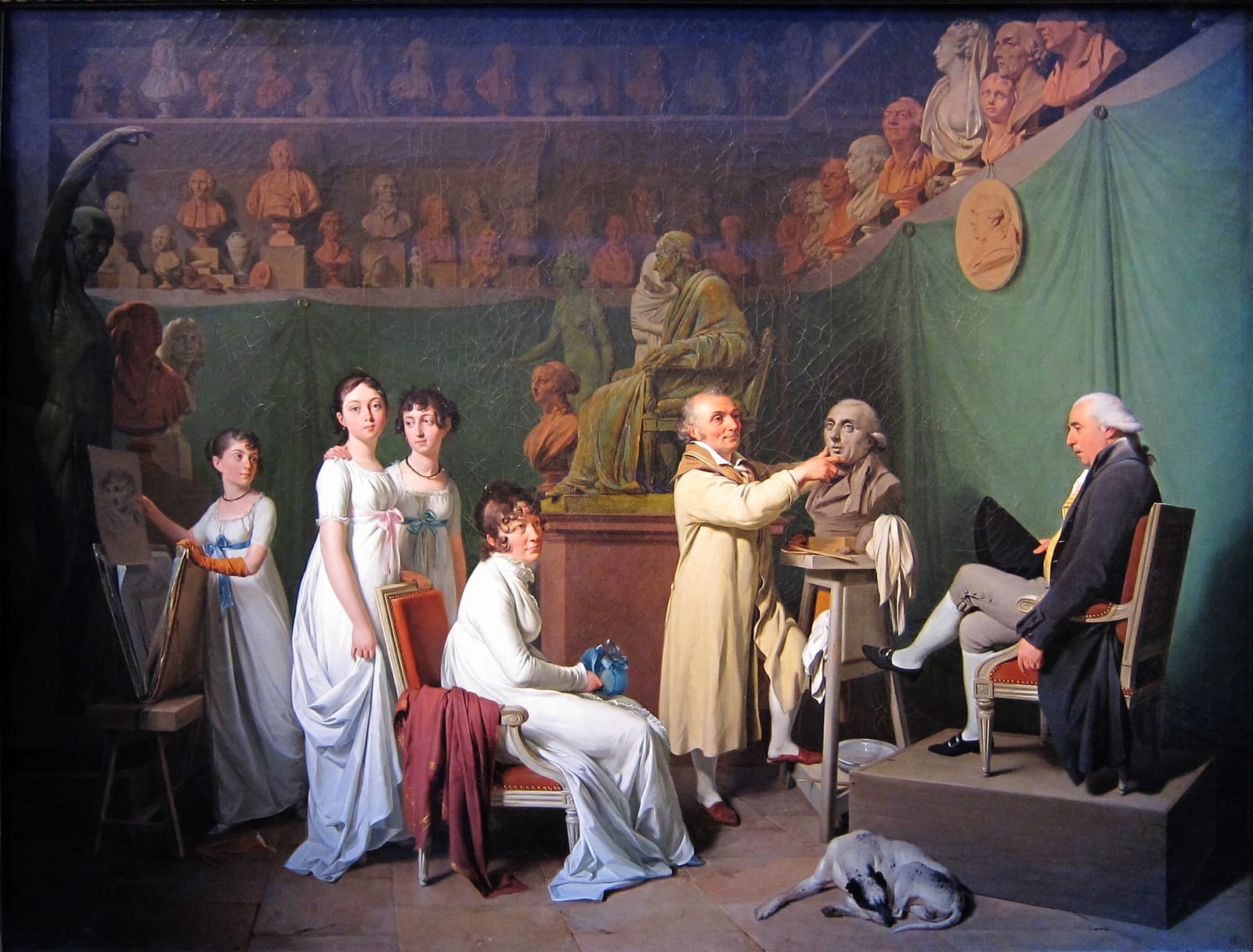
The Studio of Jean-Antoine Houdon
Louis-Léopold Boilly (1761–1845) · c. 1804 · Oil on canvas, 88 × 115 cm
Look for
- Houdon's real 1804 plaster bust of the mathematician Pierre-Simon de Laplace displayed right beside the painting: the very head Houdon is modelling with his fingers on the canvas.
- Laplace posing on the wooden platform at right in an old-fashioned powdered wig tied at the nape and a high-collared dark coat.
- The packed shelves above the green studio curtain, where Houdon's seated Voltaire and dozens of plaster busts look down on his wife, three daughters, and a sleeping dog.
Transcript (1:50)
Look at the clay head under the sculptor's fingers in the middle of this canvas, and then glance right beside the frame. Sitting in the gallery next to Louis-Léopold Boilly's painting is the real 1804 plaster bust of the astronomer and mathematician Pierre-Simon de Laplace, 61 centimetres tall, shaped by Jean-Antoine Houdon himself. Both the painting and the bust belonged to the collector Émile Peyre, and his 1905 bequest lets the museum stage one of the neatest double takes in Paris.
Boilly showed this canvas at the Salon of 1804 and walked away with a gold medal. He takes us inside the ground-floor workspace Houdon occupied across the Seine at the former Collège des Quatre-Nations, today the Institut de France. At sixty-three, Houdon was the most celebrated portrait sculptor alive, the man who had carved Voltaire, Diderot, George Washington, and Thomas Jefferson.
In an early sketch Boilly placed a bust of Napoleon on the modelling stand. For the finished Salon picture he swapped the emperor for France's greatest living scientist: Laplace, whom contemporaries called the French Newton for his work on celestial mechanics. Look at Laplace perched on the wooden dais on the right. While younger men wore cropped Romantic hair, Laplace insisted on a conservative powdered wig tied at the neck and a high-collared coat.
Boilly turns a working sitting into three pictures at once. On the right it is a lesson in how sculpture gets made, with Houdon in his pale smock measuring living bone against wet clay while a dog sleeps at the base of the stand. On the left it is a tender family portrait: Houdon's wife sits in a white Empire gown with their three daughters, Sabine, Anne-Ange, and Claudine, one of them leafing through drawings at an easel.
And behind the green cloth divider rises Houdon's whole career in miniature: his seated statue of Voltaire, a tall flayed anatomical figure raising one arm at the far left, and high dusty shelves crowded with every famous head of the Enlightenment.

Stop 4 of 5 · Level 4, Rohan wing, Room 40 (The splendours of courtesans)
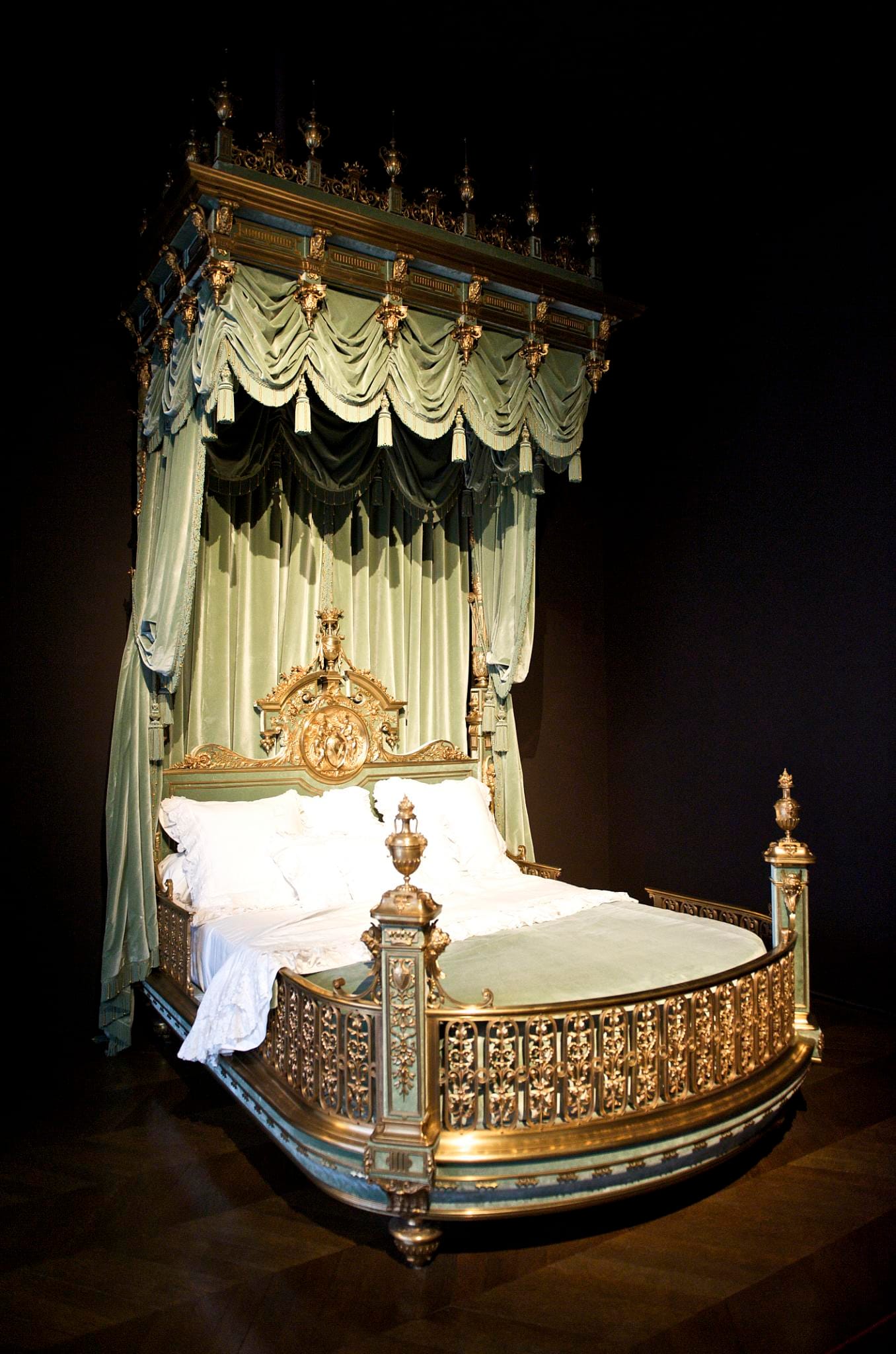
State Bed of Valtesse de la Bigne
Édouard Lièvre (1828–1886) · c. 1875 · Beechwood frame, chased, patinated and gilt bronze, green silk velvet, 410 × 260 × 200 cm
Look for
- Two plump gilt-bronze cupids on the headboard holding up an oval shield with a crowned initial V, inventing royal rank for a self-made courtesan.
- Grinning bronze faun masks along the top cornice of the canopy and in profile beside the headboard crest, whom Valtesse affectionately called her clever little gods.
- The curved gilt-bronze railing bolted straight onto the foot of the bed, topped at its front posts by two flaming bronze incense burners.
Transcript (2:21)
Towering more than four metres toward the ceiling in gilt bronze and pale green silk, this object looks less like bedroom furniture than an altar built for a queen. That was the joke, and nobody in Paris was more in on it than the woman who paid for it.
She was born Émilie-Louise Delabigne in a poor Paris neighbourhood in 1848, the daughter of a Normandy linen maid. At ten she was working in a dressmaking shop; in her teens she posed for painters and entered the risky world of Second Empire prostitution. Then she reinvented herself from scratch. She coined the stage-worthy title Valtesse de la Bigne because Valtesse sounded in French almost exactly like Votre Altesse, Your Highness. Courted by bankers, aristocrats, and painters, she accumulated a fortune and a private mansion at 98 boulevard Malesherbes, a gift from the Prince de Sagan.
Around 1875 she hired the ornamental designer Édouard Lièvre, who had just finished decorating the bedroom of her friend the painter Édouard Detaille, to build her a lit de parade, a ceremonial state bed. At Versailles under Louis the Fourteenth, a state bed stood behind a wooden balustrade that kept courtiers at a respectful distance while the king held morning audiences. Look at what Lièvre did with that royal railing here. Instead of fencing visitors out across the floor, he bolted a sweeping gilt-bronze balustrade directly onto the frame of the bed itself and planted two flaming bronze incense burners on the corner posts, turning court protocol into an unabashed stage for pleasure.
Now look at the headboard and the high cornice. Two chubby bronze cupids hold up a shield bearing a crowned letter V. Above the green silk curtains, leering faun masks grin down from the canopy; Valtesse liked to call them her clever little gods. When the novelist Émile Zola was granted a tour of her Boulevard Malesherbes bedroom, he took notes and transformed this very piece into the scandalous gold-and-silver throne-bed at the climax of his 1880 novel Nana.
Hidden inside the frame are the signatures of the workmen who actually wrestled all that bronze together: pencil notes on the back of the right rail and behind the crest name the mounters Legros and Lazard and the chasers Brown and Dumont in 1880 and 1881, along with the workshop that moved the bed to Valtesse's country house at Ville-d'Avray in December 1902.
Most courtesans' mansions were auctioned off and scattered the moment their owners died. Valtesse outsmarted posterity one last time. Before her death in 1910 she wrote this bed into her will, leaving it straight to the Musée des Arts Décoratifs in 1911 so her bronze throne would sit permanently inside the palace of the kings of France.

Stop 5 of 5 · Level 4, Room 44 (Art Nouveau and Interior Decoration)
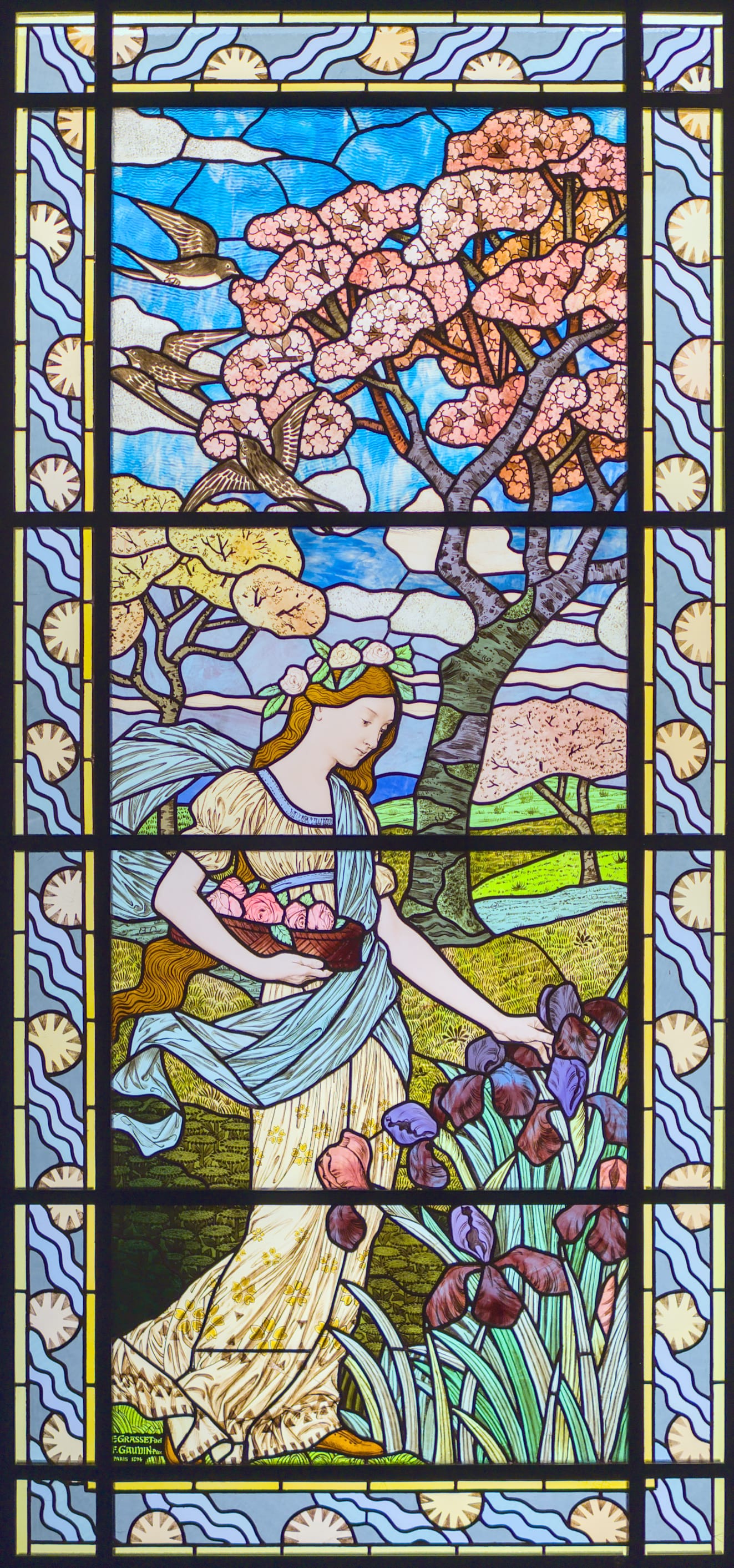
Spring (La Matinée de printemps)
Eugène Grasset (1845–1917), cartoon; Félix Gaudin (1851–1930), master glazier · 1894 · Stained glass and lead, 298 × 136 cm
Look for
- The joint signature in the bottom-left pane, reading E. GRASSET del and F. GAUDIN pinx, PARIS 1894: designer and master glazier signing side by side.
- The heavy black lead strips outlining flat planes of sky blue, blossom pink, and deep purple iris just like ink lines on a street poster.
- Three swallows wheeling past pink-flowering branches at the top, enclosed by a geometric frame of golden half-suns and blue waves.
Transcript (2:01)
Stand back far enough to take in the whole three-metre height of this glowing window, and notice what holds the picture together. Every lock of auburn hair, every fold of the pale blue scarf, and every purple iris petal is locked inside a bold black contour. If it reminds you of a Belle Époque Paris poster, you have spotted Eugène Grasset's secret at first glance.
Born in Lausanne in 1845, the son of a Swiss cabinetmaker, Grasset moved to Paris in 1871 convinced that the wall between fine art and everyday objects ought to come down. He designed furniture, typefaces, stamps, jewellery for the House of Vever, and 129 lithographic posters preserved in this museum, plus a drawing every French schoolchild still recognises: the 1890 Larousse dictionary emblem of a woman scattering dandelion seeds to the wind.
When Grasset designed this window and its companion, Autumn Afternoon, for the architecture section of the 1894 Salon du Champ-de-Mars, he carried the lessons of Japanese woodblock prints and colour lithography straight into glass. In a poster, black ink outlines separate flat, luminous fields of colour. Here, real strips of dark lead do the exact same work while daylight pours through behind them.
To turn his full-scale cartoon into nearly three metres of glass, Grasset partnered with Félix Gaudin, a former French artillery officer who had bought a historic glassmaking studio in Clermont-Ferrand in 1879. Look down into the bottom-left corner of the window, right under the hem of the woman's patterned gown: both men signed the glass together in 1894, Grasset for the drawing and Gaudin for the glasswork.
Look at the plants around her. Crowned with white roses and carrying a basket of pink blooms, she reaches down toward tall bearded irises while three swallows bank through blossoming trees overhead, all framed by stylized golden suns and rippling blue waves. Two years later, in 1896, Grasset published his landmark handbook on plants and ornament, arguing that glass, wood, and iron should never slavishly copy a flower, because the limits of the material are what give ornament its strength. The museum agreed early: it bought this window straight from Gaudin in 1894, the year the solder cooled.
Independent guide · Chiaro
Point Chiaro at anything in the Musée des Arts Décoratifs.
Five stops barely scratch seven floors of carved wood, porcelain, stained glass and period rooms. Aim your camera at any sideboard, tapestry or vitrine object along the route: Chiaro explains its craft and history on the spot, then chats back aloud whenever you ask more.
Before you go
Getting there
107 rue de Rivoli, 75001 Paris, in the Rohan and Marsan wings of the Louvre palace. Individual ticket-holders use 107 rue de Rivoli; booked groups enter from the Carrousel Garden, and the library has a separate door at 111 rue de Rivoli.
Métro Palais Royal–Musée du Louvre (lines 1 and 7), Tuileries (line 1), and Pyramides (lines 7 and 14) all leave you within a short walk; RER C stops across the river at Musée d'Orsay, and buses 21, 27, 39, 68, 69, 72, and 95 stop along Rue de Rivoli or Rue des Pyramides.
Tickets
- Doors open at 11 am and close at 6 pm Tuesday through Sunday, with ticket sales ending at 5.15 pm; every Monday is closed, alongside May Day, Christmas Day, and New Year's Day (5 pm early close on 24 and 31 December).
- Thursday evenings until 9 pm cover temporary exhibitions only — the permanent galleries on Levels 3 and 4 close at 6 pm every open day.
- Full admission is 15 euros for the permanent collections alone or 18 euros with temporary exhibitions; visitors under 18, EEA residents aged 18 to 25 (permanent collections ticket), and Paris Museum Pass holders enter free, with advance booking on billetterie.madparis.fr strongly advised on weekends.
- Leave suitcases and bulky rucksacks behind, as large bags are refused at security; cloakrooms, folding stools, and baby carriers sit on Level -1, and note that the Marsan Pavilion is scheduled to close for works from 4 January to 1 May 2027.
The official audio guide
The museum makes audioguides available where the permanent route starts on Level 3 (included with its annual membership passes; check the desk or madparis.fr for single-visit terms) and also publishes a free digital guide through a third-party app on your phone. Our five recordings run right inside this web page without an account, while the Chiaro camera app covers the rest of the building.
Official site →Questions
Is there a free Musée des Arts Décoratifs audio guide?
Yes — play all five commentaries directly on this web page at zero cost, with word-for-word scripts printed beneath each player and nothing to sign up for. Whenever another piece in the rooms catches your eye, photograph it in Chiaro for a spoken story.
How much is the official Musée des Arts Décoratifs audio guide?
The museum makes audioguides available at the start of the permanent itinerary on Level 3 and includes them in its annual membership cards, alongside a free digital guide offered via a third-party phone app. Check madparis.fr or the reception desk on arrival for current device availability.
Where is Valtesse de la Bigne's bed in the Musée des Arts Décoratifs?
Édouard Lièvre's bronze and green-velvet state bed stands on Level 4 in the Rohan wing, inside Room 40, titled The splendours of courtesans. Take the Lefuel lift to Level 3 for the start of the historical route, then continue up to Level 4.
Is the Musée des Arts Décoratifs closed on Mondays?
Yes, every Monday, along with December 25, January 1, and May 1 each year, while December 24 and 31 shut early at 5 pm. Tuesday through Sunday, permanent galleries run 11 am through 6 pm; Thursday late openings until 9 pm apply solely to temporary shows.
Does a Louvre ticket include the Musée des Arts Décoratifs?
No. Although the Musée des Arts Décoratifs occupies the northwest Rohan and Marsan wings of the Louvre palace, it is an independent institution with its own street entrance at 107 rue de Rivoli and a separate ticket (15 euros for the permanent collections, or 18 euros including temporary exhibitions).
More audio guides
Made by Chiaro. Not affiliated with the Musée des Arts Décoratifs.