
Notre-Dame de Paris · Paris · Independent guide
Notre-Dame de Paris audio guide,
five stops, free.
All five stream in this tab, with nothing to install. Then let Chiaro narrate the rest of a cathedral begun in 1163, 127 metres long, from a photo.
Made by Chiaro. Not affiliated with Notre-Dame de Paris.
The west front, from the parvis
Notre-Dame de Paris, Paris
That was the free part
Chiaro narrates anything at Notre-Dame de Paris from a photo.
The five stops · 11 minutes of audio
Five places, one walk,
in the order you will walk them.
Two of the five stops in this self-guided Notre-Dame de Paris audio guide come before you are through the door, two are inside, and the last looks back from across the Seine. Start out on the parvis in front of the west front, then look up at the Portal of the Last Judgment, which is the way in. Inside, go up the north side and round the ambulatory behind the choir to the carved and painted choir screen, then back along the south side of the choir to the Virgin of Paris, on the pillar at the corner of the south transept. Come out, cross the Pont au Double to the left bank and turn round for the last stop, the spire. About eleven minutes of listening, and an hour or so on foot; without a reservation the wait at the door can be longer. The cathedral asks for silence inside, so bring earphones, or play the two indoor stops on the parvis before you go in.
We checked every fact here against the cathedral's own site, notredamedeparis.fr, and against Wikipedia on 23 September 2026, and stored each one beside the line of source text it rests on, so a change on the cathedral's side reaches us. Opening times are set by the cathedral and it publishes them on its own page, so check that page for the day you are going. A working cathedral can change its day around a service, so if the people on duty at the portal tell you something this page does not, take their word for it, and write to us so the next reader gets it right.
Wyslijp16, CC BY 4.0, via Wikimedia Commons, cropped. Photo: Wyslijp16

Stop 1 of 5 · The parvis, the square in front of the west front; free, outside the entry queue
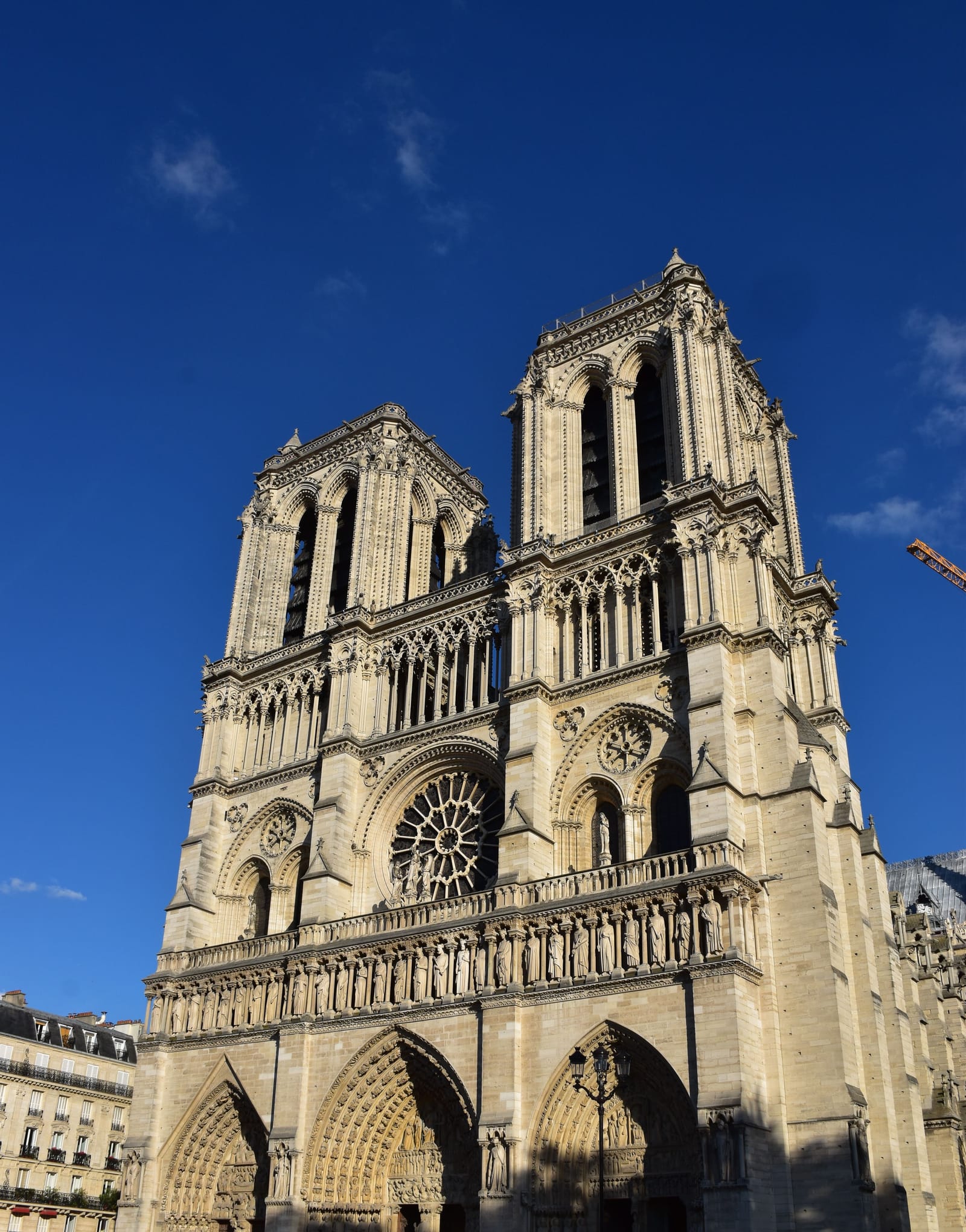
The west front, from the parvis
Master builders of bishops Eudes de Sully and Guillaume d'Auvergne, names lost; restored 1844–1864 by Jean-Baptiste Lassus (1807–1857) and Eugène Viollet-le-Duc (1814–1879) · Begun 1200; south tower about 1220–1240, north tower 1235–1250 · Paris limestone; the two towers 69 m high, the west rose 9.6 m across
Look for
- The row of twenty-eight crowned kings of Judah above the three doors, twenty metres up. All of them are nineteenth-century replacements, and one has Viollet-le-Duc's face.
- The towers are not twins. The north tower, on your left, is slightly larger, and so is its buttress.
- Adam and Eve on either side of the west rose, and the Virgin between two angels standing in front of it.
- The kilometre zero marker set into the paving of the parvis, the point from which the roads out of Paris are measured.
Transcript (3:07)
Stand back on the parvis far enough to take in the whole front: one flat, calm, nearly square face, sixty-nine metres to the tops of the towers. Le Corbusier called it a pure creation of the spirit, governed by the square and the circle. Find the circle first. It is the west rose, 9.6 metres across, dead centre, made around 1225.
Now look for the thing that is not symmetrical. The two towers look like twins and are not. The one on your left, the north tower, is slightly larger, and so is its buttress. The south tower went up first, from around 1220, and the north one between 1235 and 1250. Spires were considered for both in the thirteenth century and never built, which is why they stop flat.
The front was begun in 1200 under bishop Eudes de Sully, carried on under Guillaume d'Auvergne, confessor to Saint Louis, and finished in about fifty years by a succession of master builders whose names are lost.
Drop your eyes to the long row of crowned figures above the three doors, twenty metres up. That is the Gallery of Kings: twenty-eight of them, for the twenty-eight generations of the kings of Judah before Christ. During the Revolution they were taken for kings of France and destroyed or mutilated. Not one of them up there now is medieval. They were carved again in the nineteenth century by the workshops of Adolphe-Victor Geoffroy-Dechaume, and the restorers allowed themselves a joke. In 1860 the sculptor Chenillon left inscriptions on some of the new kings, naming the faces: the architect Eugène Viollet-le-Duc is up there with the features of King Ela, his colleague Lassus as Amaziah.
The real heads turned up in 1977, twenty-one of them, dug out during building work on the rue de la Chaussée-d'Antin in the ninth arrondissement. They are in the Musée de Cluny now, and they still carry traces of paint, which is the proof that parts of this front were once coloured.
Above the kings, the Virgin between two angels in front of the rose is Viollet-le-Duc's commission too, made by Geoffroy-Dechaume in 1854, and Viollet-le-Duc again set Adam on one side of the rose and Eve on the other.
Viollet-le-Duc is the name you will keep hearing today, and there is a reason. By the 1830s this building was in such a state that Paris officials considered pulling it down. Victor Hugo's novel of 1831 made the city look at it again, and in 1844 Lassus and Viollet-le-Duc were appointed to restore it. The pale colour came later still: from 1963 the culture minister André Malraux had the front cleaned of centuries of soot.
High in the south tower, on your right, hangs Emmanuel, the great bell, cast in 1683 and named by Louis XIV: thirteen tonnes, with a clapper of five hundred kilos, ringing in F sharp. It is the only bell here the Revolution did not melt down.
On the night of the fire in April 2019 the flames reached the north tower, where eight bells hung. The fear was that if the bells fell they would wreck the tower and endanger the other one, and the whole cathedral with it. A team of firefighters climbed the south tower, crossed over, and fought the fire underneath the bells. The front you are looking at is the one they saved.
Before you join the queue, look down. Somewhere in the paving of this square is a small marker, kilometre zero, the point from which the roads of France are measured out of Paris.
Gary Todd from Xinzheng, China, CC0, via Wikimedia Commons. Photo: Gary Todd from Xinzheng, China
.jpg)
Stop 2 of 5 · West front, central portal: the cathedral's entrance, seen from the parvis and the entry queue
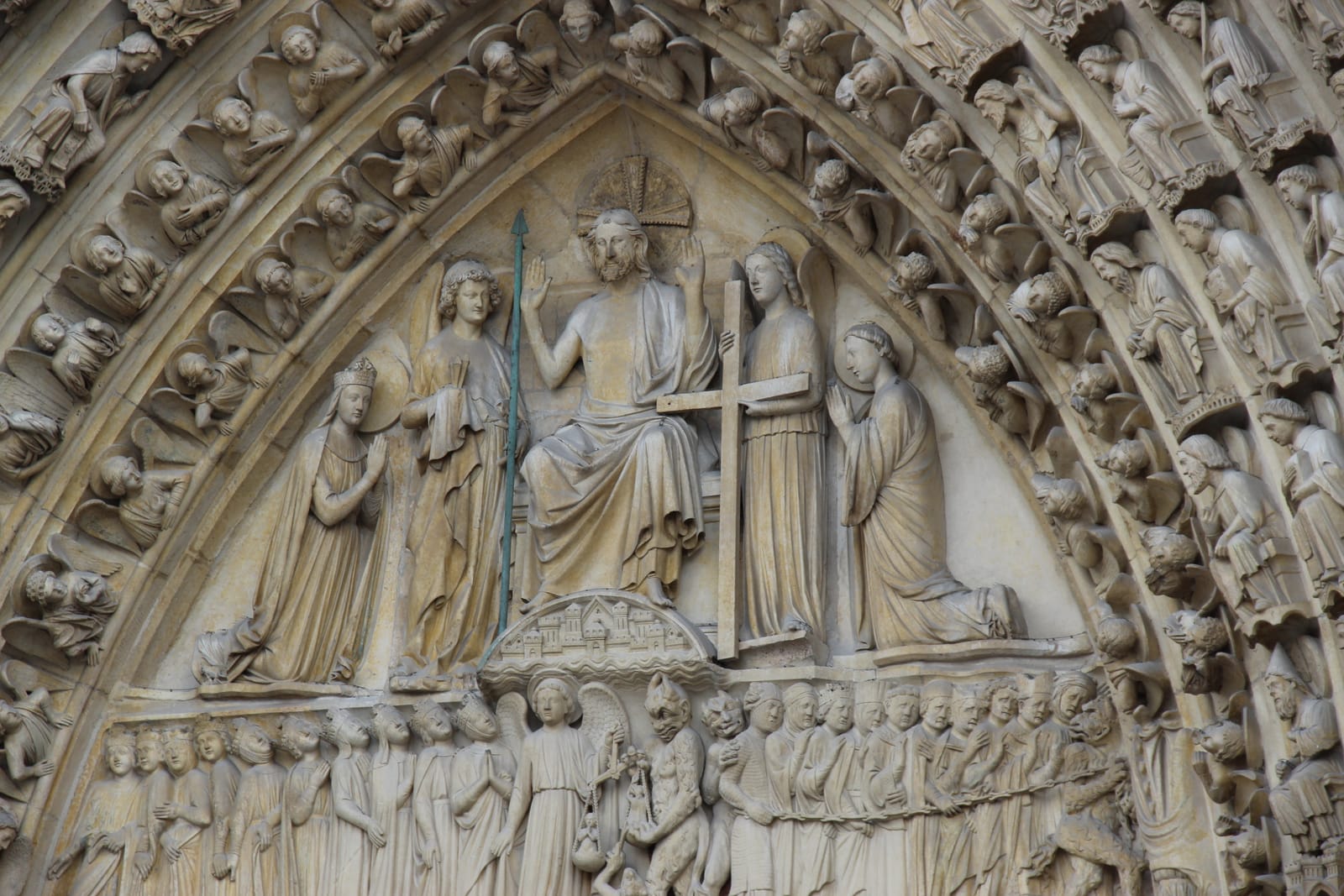
The Portal of the Last Judgment
Anonymous sculptors of the 1220s; trumeau, lower lintel, the wise and foolish virgins and the twelve apostles remade under Eugène Viollet-le-Duc (1814–1879) · Installed 1220–1230; cut open by Germain Soufflot in 1771; restored in the nineteenth century · Carved limestone; the central and largest of the three west portals, with twelve apostles in the jambs, six a side
Look for
- The scales on the upper band: the Archangel Michael on one side, a demon pressing down on the other to tip the weighing.
- The dead climbing out of their tombs on the lowest band, a pope and a king among them.
- The angel at Christ's side holding the cross, and the one opposite with the lance and the nails.
- The twelve apostles in the door jambs as you walk in: Viollet-le-Duc's replacements for the statues smashed in 1792.
Transcript (1:56)
This is the door you will walk through, so give it a minute while you are still outside it. The central portal is the largest of the three, and it was the last of them to go in, between 1220 and 1230. Its subject is the end of the world, and it reads from the bottom up.
On the lowest band, just above the doors, the dead are climbing out of their tombs while angels sound the trumpet. The cathedral points out who is among them: a pope, a king, women, warriors and an African man, which in the thirteenth century was a way of saying that judgment, and salvation, are for everyone.
One band up is the scene to find. The Archangel Michael holds a pair of scales, weighing a soul, and on the other side a demon leans on the pan, trying to cheat. To one side of the scales the saved walk freely towards Christ. On the other the damned go off holding on to their own chains, and the cathedral's reading is that nobody forces them: they will not let go. Follow the arches up on that right-hand side and hell fills them. The people who first looked at this mostly could not read. This was the book.
At the top Christ sits in judgment, showing the wounds in his hands and side. An angel beside him carries the lance and the nails, another carries the cross, and Mary and Saint John kneel at the ends. In the arches around him, on his right, the wise virgins hold their lamps lit; the foolish virgins, on his left, hold theirs put out.
Now the part nobody warns you about. In 1771 the architect Germain Soufflot cut the middle out of this portal. He removed the central pillar and the centre of both lintels so the archbishop's canopy could pass through in processions, and filled the hole with a wooden arch. The apostles in the door jambs had been smashed by 1792. What stands in all those places now is Viollet-le-Duc's: he put the portal back as it had been, rebuilding the pillar with Christ the Teacher standing on it, the virgins, and all twelve apostles.
So the upper tympanum above you is thirteenth-century stone and much of what is at head height is nineteenth-century.
All of it was once painted and gilded. As you pass under the arch, look at the apostles to either side of you. Peter is among the six on the left, and Paul is among the six on the right.
Mbzt, CC BY 4.0, via Wikimedia Commons. Photo: Mbzt

Stop 3 of 5 · The ambulatory behind the choir: the north wall on the way in, the south wall on the way back towards the south transept
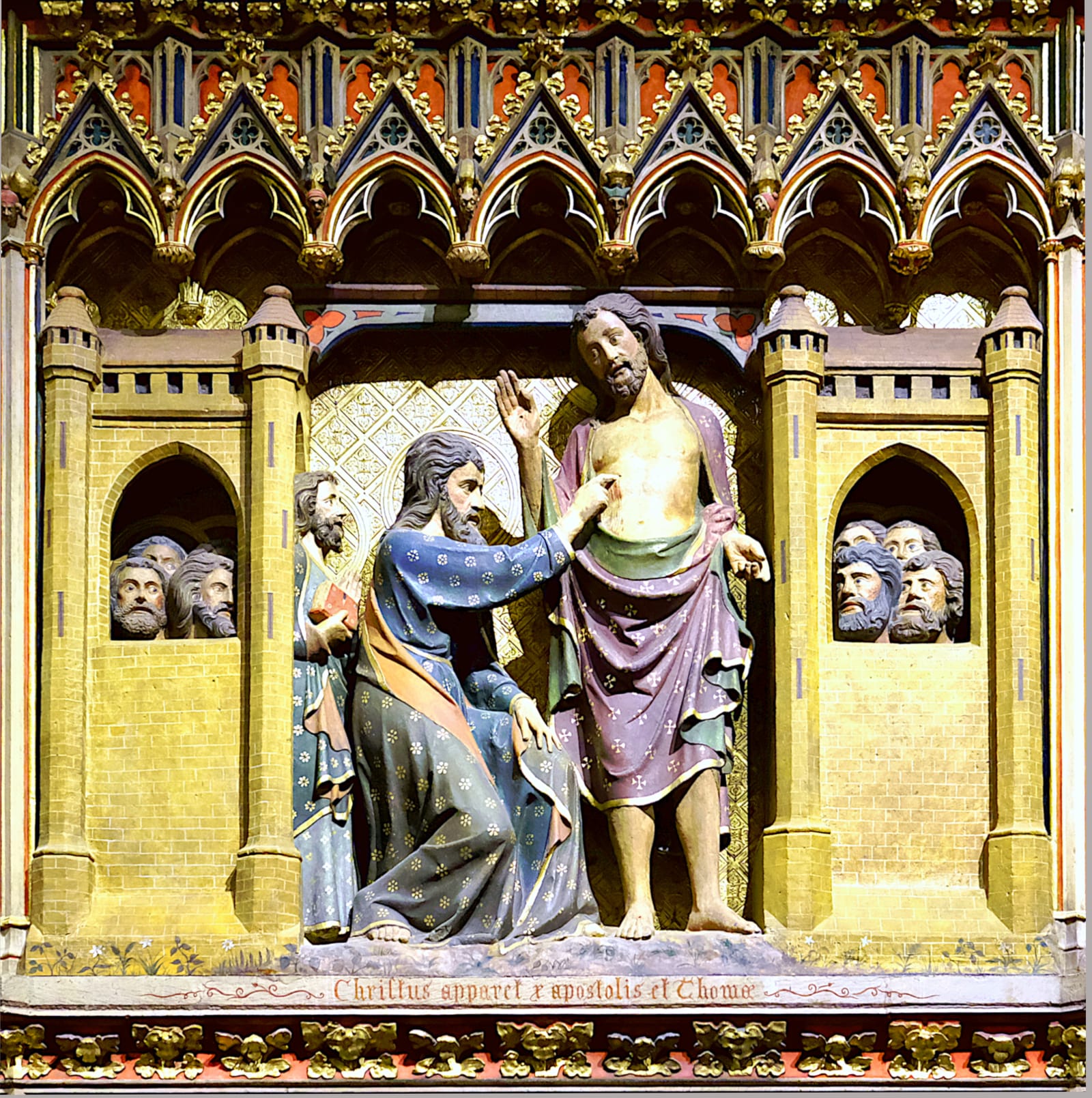
The choir screen, from the ambulatory
Pierre de Chelles (north wall), then Jean Ravy, master of works 1318–1344 (south wall), finished by his nephew Jean le Bouteiller in 1351 · Fourteenth century, completed 1351 · Carved, painted and gilded stone: fourteen scenes on the north wall in high relief, nine on the south wall carved in the round
Look for
- Thomas kneeling in a blue robe with his finger in the wound in Christ's side, the other apostles watching from the windows of two little towers.
- The Latin line under each scene. Under Thomas it reads Christ appears to the ten apostles and to Thomas.
- The change of style between the walls: calm high relief on the north side, busier figures carved fully in the round on the south.
- Christ dressed as a gardener, appearing to Mary Magdalene, the first scene of the south wall.
Transcript (2:06)
You are in the ambulatory now, the walkway that runs right round behind the choir, and the wall of carved and painted scenes at your shoulder is what is left of a fourteenth-century screen. Its job was silence: it gave the canons at prayer inside the choir a screen against everything happening out here.
If you came up the north side, you have passed the first half: the life of Christ from the Visitation to the Garden of Olives, fourteen scenes that run into one another without a break. It was carved under the architect Pierre de Chelles, who designed the choir's decoration and then, in 1316, left to work on Chartres.
This south side is different, and it is worth comparing. Jean Ravy took over as master of works, and for twenty-six years this was his. The subject is what happened after the Resurrection: Christ appearing to Mary Magdalene in the garden, dressed as a gardener, then to the holy women, to Peter, to the two disciples at Emmaus, to Thomas, to the apostles together. Nine scenes, each boxed off by its own small columns. The cathedral calls a cycle this complete rare in medieval sculpture. Look at the carving itself. The north wall is high relief, calm and clear. Here the figures stand fully in the round, the folds are stiffer, and every scene is crowded with detail.
Find Thomas. He kneels in a blue robe and puts his finger into the wound in Christ's side, and the other apostles watch from the windows of little towers on either side. The Latin underneath says it plainly: Christ appears to the ten apostles and to Thomas.
Ravy put himself into this wall, kneeling at its edge. He died in 1344 and his nephew Jean le Bouteiller finished the work in 1351. The man who paid for it, a canon called Pierre de Fayel, had himself carved kneeling at the end as well, and that figure is in the Louvre now.
What you see is only the sides. The screen once ran right round the choir; in the eighteenth century its east end was cut away for classical marble and its west end, a rood screen closing off the nave, came down.
The colour is not a modern idea. In the nineteenth-century restoration a restorer named Caudron set out to preserve the original paint rather than strip it off, and it has been renewed since, in the nineteenth and twentieth centuries. Before you walk on, look back along this wall once more: blue robes, red borders, a gold ground, restored paint on the medieval scheme, on stone carved nearly seven hundred years ago.
Ibex73, CC BY 4.0, via Wikimedia Commons. Photo: Ibex73
.jpg)
Stop 4 of 5 · South transept, facing north across the crossing: the statue is on the pillar to your right where the choir begins, the north rose straight ahead
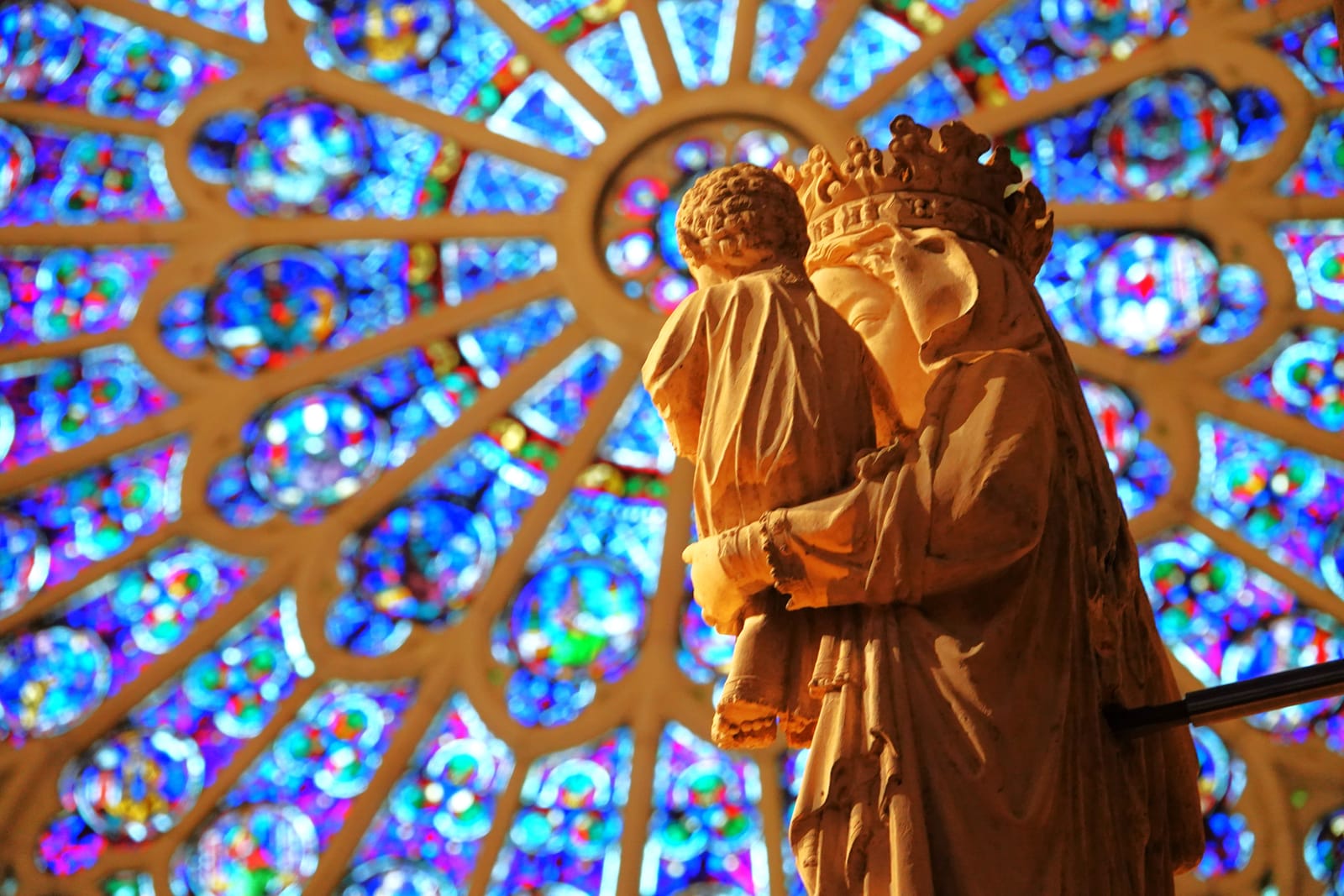
The Virgin of Paris, at the south-east pillar of the crossing
Anonymous Paris sculptor of the fourteenth century; set on this pillar by Eugène Viollet-le-Duc (1814–1879) in 1855 · Fourteenth century; brought to Notre-Dame in 1818, to this pillar in 1855 · Stone, 1.8 m tall
Look for
- The Child's hand pulling at the edge of his mother's veil, and the ball, the world, in his other hand.
- The sway of her body: hip out, a long S-curve, the signature of the Gothic Madonna.
- Her crown and royal dress, as Queen of Heaven.
- The north rose across the crossing: the Virgin again at its centre, in glass that has been there since about 1250.
Transcript (2:02)
Stand in the south transept and face north, across the crossing, towards the great blue rose. On the corner pillar to your right, where the choir begins, is the statue that has carried the cathedral's name since Viollet-le-Duc set her here: Notre-Dame de Paris, Our Lady of Paris, a stone Virgin, crowned, 1.8 metres tall, holding her son on her arm.
She was not made for this building. She was carved in the fourteenth century for the chapel of Saint-Aignan, in the canons' cloister on the island. The Revolution destroyed the thirteenth-century Virgin that stood on the central pillar of the Portal of the Virgin outside, and in 1818 this one was brought over to take its place. In 1855 Viollet-le-Duc moved her in here, to a pillar where an altar to Mary had stood since the twelfth century.
Look at the way she stands: hip out, the body one long, slow S, the signature of the Gothic Madonnas, pushed hard here for elegance rather than movement. Then look at the Child. He holds a ball that stands for the world, but the sculptor gave him one real infant gesture: he is tugging at the edge of his mother's veil.
The novelist Joris-Karl Huysmans, writing about this cathedral in 1898, thought her mouth was contracting into a pout that predicts tears, as if the sculptor had put the joy of the birth and the sorrow still to come into one face.
On Christmas Day 1886, at Vespers, the poet Paul Claudel was standing in the crowd near the second pillar at the entrance to the choir, on the right. In his own words, in an instant his heart was touched, and he believed, and nothing afterwards was able to shake it.
She came through the fire of 2019.
Now the rose behind her. The north rose was built around 1250 under Jean de Chelles, and its glass is, almost all of it, the glass of the thirteenth century. In 1756 the canons decided the building was too dark and had the medieval stained glass destroyed and replaced with plain white glass. They spared the roses. At the centre of this one is the Virgin again, surrounded by the judges, kings, high priests and prophets of the Old Testament. The south rose above and behind you was the gift of Saint Louis, but it was largely restored in the eighteenth and nineteenth centuries, so it is the north rose that still shows you the light of 1250.
The statue at the pillar and the woman at the centre of the rose are the same person, one in stone and one in glass, with the whole crossing between them.
Image by Renée Kools via Wikimedia Commons, CC BY 4.0, cropped. Photo: Renée Kools

Stop 5 of 5 · Pont au Double and the Quai de Montebello, on the left bank, looking north-east across the Seine at the south side; public street, no ticket
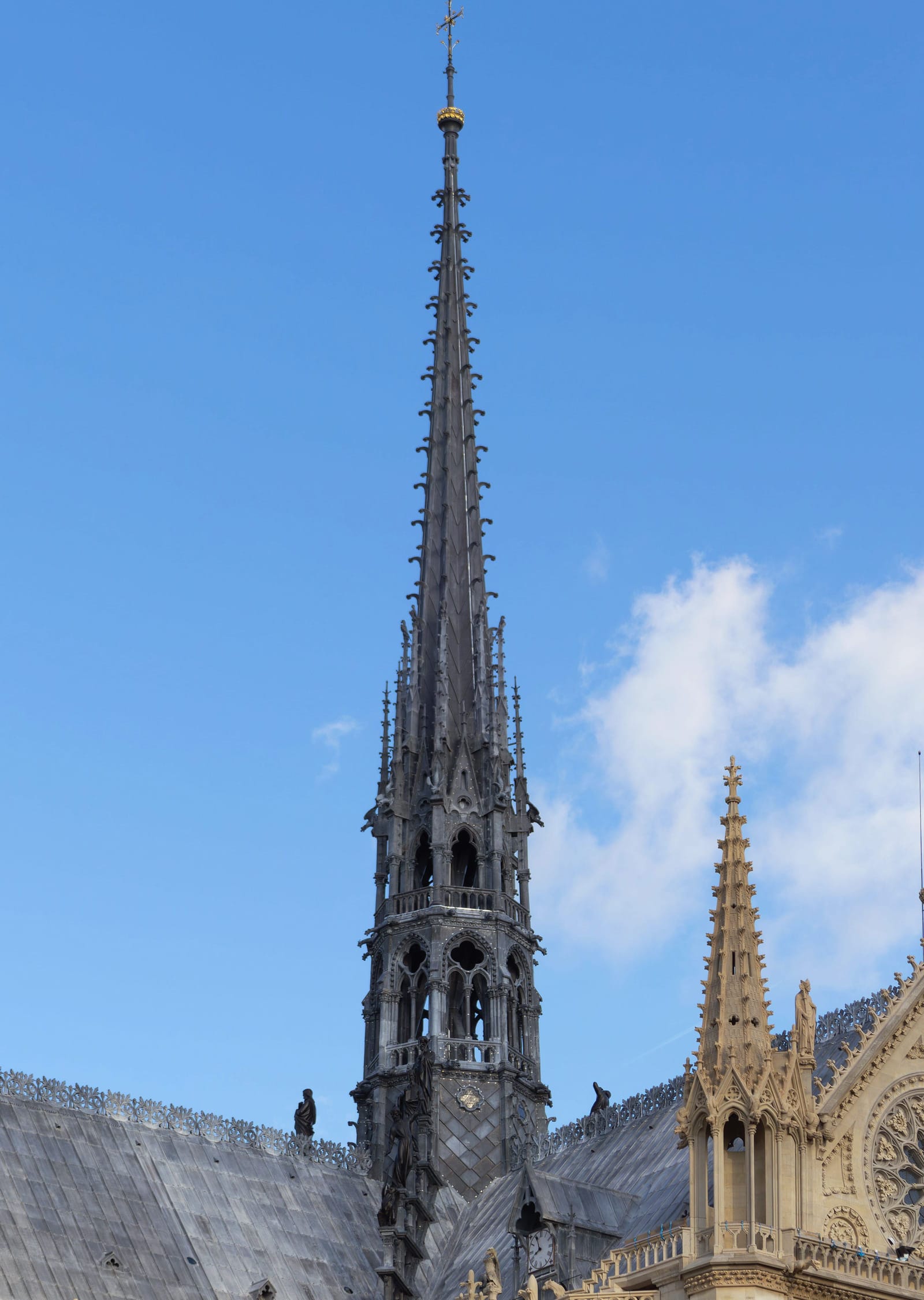
The spire, from the Pont au Double
Designed by Eugène Viollet-le-Duc (1814–1879), continuing a project begun by Jean-Baptiste Lassus (1807–1857); oak frame by the carpenter Auguste Bellu; rebuilt to the same plans after the 2019 fire · 1859; destroyed 15 April 2019; rebuilt and unveiled in February 2024 · Oak clad in lead, 96 m high
Look for
- The spire standing exactly over the crossing, where the transept meets the nave.
- The flying buttresses along the south side, each a single leap of stone over the side aisles.
- The south transept front and its rose, begun in 1258 by Jean de Chelles and finished by Pierre de Montreuil.
- The gargoyles at the ends of the buttresses: rain spouts first, throwing the water clear of the walls.
Transcript (2:18)
Cross the Pont au Double to the left bank and turn round. From here you get the long south side of the cathedral: the nave with its flying buttresses, the south transept front with its rose, and over the crossing, where the arms of the cross meet, the spire.
It is not the first spire here. The original went up between 1220 and 1230; five centuries of wind bent and weakened it, and it came down from 1786. Jean-Baptiste Lassus began a new one, and after his death in 1857 Viollet-le-Duc took it over, basing the design on the spire of Orléans Cathedral. The one he finished in August 1859 was ninety-six metres high, eighteen more than the original: an oak frame from Champagne, built by the carpenter Auguste Bellu, under about two hundred and fifty tonnes of lead.
Round its base he set sixteen copper statues by Geoffroy-Dechaume: the twelve apostles, three to each side, each group led by one of the four symbols of the evangelists, an ox, a lion, an eagle and an angel. The apostles all looked out over Paris except one. Saint Thomas, patron saint of architects, turned back to look up at the spire, and he had Viollet-le-Duc's face.
A restoration of the spire began on the eleventh of April 2019, and the sixteen figures were lifted off by crane for repair. Four days later the roof caught fire. The spire burned, and when it fell it brought down seven hundred and fifty tonnes of stone and lead and broke through part of the vaults. The cockerel from the top, which held a fragment of the Crown of Thorns that Viollet-le-Duc had put there himself, was thought lost. It was found in the rubble the next day, damaged but mostly whole.
The government announced a competition for a new design, and the ideas included a carbon-fibre spire covered in gold leaf. In July 2020 the decision went the other way: rebuild Viollet-le-Duc's spire exactly, to the same plans. A new cockerel went on top on the sixteenth of December 2023, carrying the same relics and the names of two thousand people who worked on the rebuilding, and when the six-hundred-tonne scaffold came down in February 2024, this was underneath.
So what you are looking at is new oak and new lead, and a design from 1859.
Before you go, look along the flank below it, where the flying buttresses leap over the side aisles in a single span. Further east, round the choir, Jean Ravy built fourteenth-century buttresses that span fifteen metres each, the same Ravy whose south wall of the choir screen you saw inside.
Independent guide · Chiaro
Point Chiaro at anything at Notre-Dame de Paris.
The five stops leave most of the cathedral for you to find on your own: three portals, twenty-nine chapels, a choir screen carved in twenty-three scenes, twenty-eight kings along the front and flying buttresses lined with gargoyles. When a carved face, a pane of glass or a tomb you cannot place catches your eye, take a photo of it, and Chiaro tells you what you are seeing and whose hands shaped it; the questions can keep coming all the way round the ambulatory.
Before you go
Getting there
6 Parvis Notre-Dame – Place Jean-Paul II, 75004 Paris, on the Île de la Cité. The way in is from the parvis through the central door of the west front, the Portal of the Last Judgment, after a security check. Wheelchair users have a fast-track access at the same portal, with no reservation needed, and a lifting platform in the north transept reaches the ambulatory.
Metro line 4 to Cité or Saint-Michel is the closest. Lines 1 and 11 stop at Hôtel de Ville, line 10 at Maubert-Mutualité or Cluny – La Sorbonne, and lines 7, 11 and 14 at Châtelet. RER B and C stop at Saint-Michel – Notre-Dame. Buses 47 (Cité or Saint-Michel), 72 and 87 (Hôtel de Ville) and 75 (Maubert-Mutualité or Cluny – La Sorbonne).
Tickets and entry
- Entry is free. A free timed reservation on the cathedral's own site or app is optional: it only shortens the wait, and without one you can still get in. Bookings open only a few hours ahead, not days in advance. No other website is allowed to sell entry, so a paid 'ticket' from anyone else is worthless.
- The cathedral's own page gives the hours as Monday to Friday 7:50 AM – 7:00 PM, closing at 10:00 PM on Thursdays, and Saturday and Sunday 8:15 AM – 7:30 PM, with last entry 30 minutes before closing. It is open daily at those hours, but it closes to visitors for major ceremonies and official events (it was closed all day on 13 December 2025 for a beatification, for example), so check the cathedral's own site for the day you plan to come.
- Inside, silence is asked for and phone calls are not allowed; the cathedral asks visitors not to use their phones inside. Its own app is meant for earphones, and so is this page, or listen to stops 3 and 4 before you go in. Non-flash photography is allowed in most of the building.
- Everyone goes through a security check: no luggage or large bags, and backpacks up to 20 litres. Dress as for a place of worship, with shoulders, stomach and thighs covered; men take off hats. The towers are a separate booking on their own official website, and the Treasury charges a fee.
The official audio guide
The cathedral has three of its own. A free official app for Android and iPhone, in French, English or Spanish, with tours for individual visitors, families and pilgrims; the cathedral asks you to bring your own earphones to use it. Audioguides for hire at the reception desk, 6 euros, in French, English, Spanish, German, Portuguese and Italian. And free visits led by volunteers of CASA Notre-Dame, a group of at most twenty, who meet in the rue du Cloître-Notre-Dame at the corner of the rue d'Arcole, next to the north tower. A fourth, independent of the cathedral, is this page: free, with no handset to collect at the desk, and with each stop's narration set out in full below its player, which helps in a nave where silence is asked for.
Official site →Questions
Is there a free Notre-Dame de Paris audio guide?
Yes: the cathedral's official app and this page both cost nothing. The app runs on Android and iPhone, with guided tours in French, English or Spanish. This page needs no app at all: its five stops play on the web page itself, each with every word of its narration set out beneath it. Bring earphones for either. The only one that costs money is the audioguide handset hired at the reception desk.
Does this Notre-Dame audio guide cost anything, or need a ticket?
No. Entry to the cathedral is free, and three of the five stops are outdoors on public ground: the parvis, the entrance portal and the Pont au Double. The other two are inside. A free timed reservation is optional and only shortens the wait at the door.
How much is the official Notre-Dame de Paris audio guide?
The audioguide handsets at the reception desk cost 6 euros and come in French, English, Spanish, German, Portuguese and Italian. The cathedral's official app is free, in French, English or Spanish, with tours for individual visitors, families and pilgrims.
Do I have to book to get into Notre-Dame?
No. The cathedral says reservation is entirely optional and only there to speed up entry; without one you can still get in, with a longer wait at busy times. Free time slots open only a few hours ahead on the cathedral's own site or app, and no other platform is allowed to sell them. No reservation is needed to attend Mass: a separate queue opens 20 minutes before each service.
Is Notre-Dame de Paris ever closed?
Sometimes. It is open daily at the hours its own page gives, Monday to Friday 7:50 AM – 7:00 PM, closing at 10:00 PM on Thursdays, and Saturday and Sunday 8:15 AM – 7:30 PM, with last entry 30 minutes before closing. But it closes to visitors for major ceremonies and official events: it was closed all day on 13 December 2025 for a beatification, for example. Check the cathedral's own site for the day you plan to come.
Can I climb the towers?
Not on the cathedral's free entry. The towers are run separately by the Centre des monuments nationaux and are booked only on their own official website, which has the prices, visiting times, dates and closures. None of the five stops on this page needs them.
More audio guides
Made by Chiaro. Not affiliated with Notre-Dame de Paris.