
Galata Tower · Istanbul · Independent guide
Galata Tower audio guide,
five stops, free.
A Genoese tower of 1348, 62.59 metres to the tip of its roof. All five stops play in this tab, and Chiaro tells the rest of its nearly seven centuries from a photo.
Made by Chiaro. Not affiliated with the Galata Tower.
The tower from the square
Galata Tower, Istanbul
That was the free part
Chiaro narrates anything at the Galata Tower from a photo.
The five stops · 11 minutes of audio
Five places, one walk,
in the order you will walk them.
This self-guided Galata Tower audio guide follows the ministry's own way through the building: two stops outside, one on the climb, two at the top. Begin in the open square at the foot of the tower, where the ticket booth stands; walk round to the south face and the marble steps up to the door; ride the lift to the sixth floor and carry on by stair past the arched windows of the seventh; then step out onto the eighth-floor balcony, first facing south-west over the Golden Horn and the old city, then south-east to Seraglio Point and the Asian shore. About eleven minutes of listening, plus the short walk round the base before you go in.
Two ministry sites lie behind this tower's practical details: muze.gov.tr, with the museum page and the printed visitor brochure, and galatakulesi.gov.tr, with a long history of the building. Between them they give the days of opening, the ticket and the order of the floors, and each date in the stories is backed by a second, independent reference. The evening closing time is the one detail here liable to change, so check it for your date before you set out. Should a guard on the marble steps send you a different way from the one described here, go the guard's way, and a message from you afterwards lets us mend the page for whoever climbs next.

Stop 1 of 5 · The square outside the tower, by the ticket booth, on open public ground before any ticket
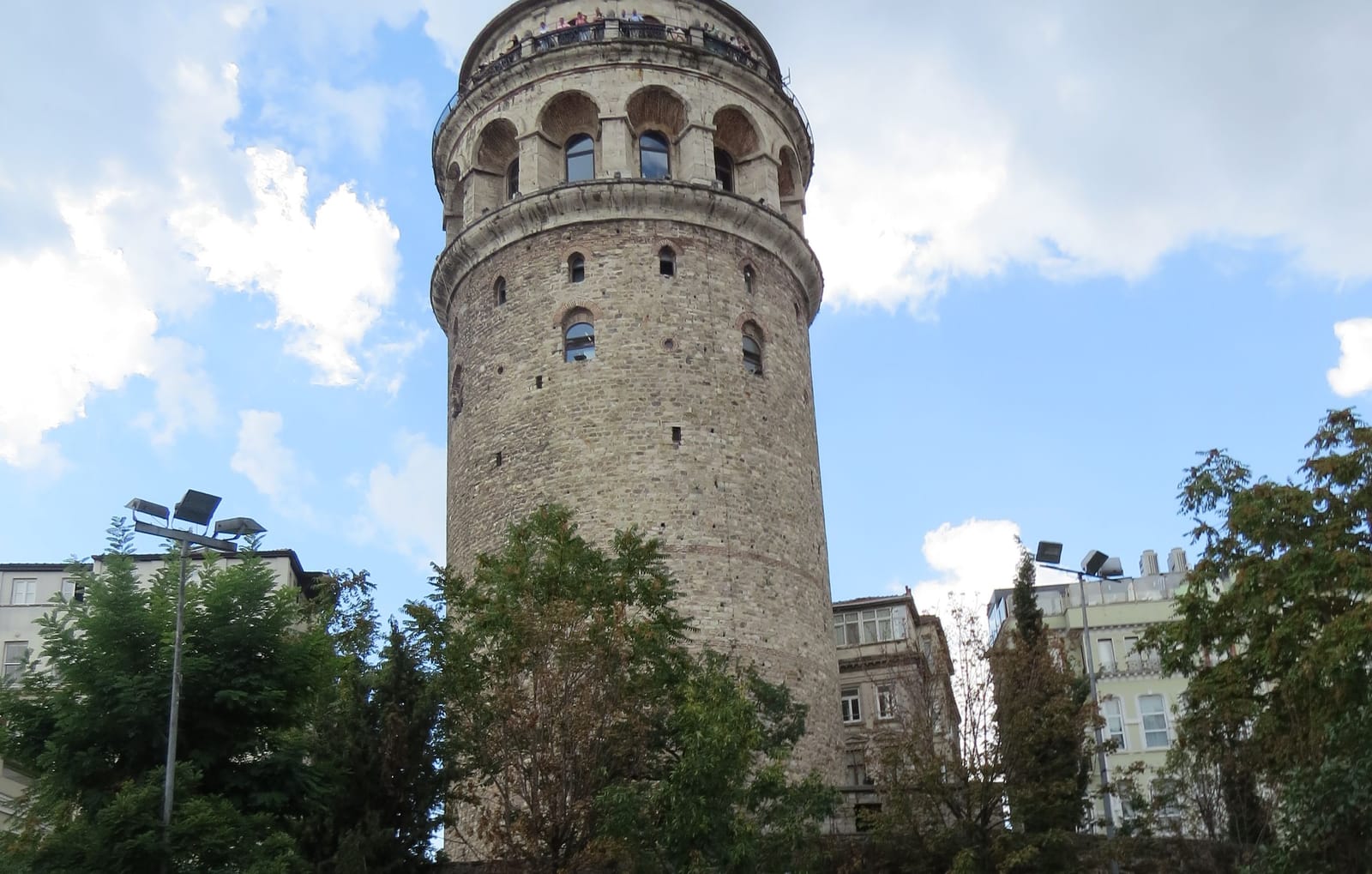
The tower from the square
Genoese builders of the colony of Pera; rebuilt above the second floor after 1509 by Murad bin Hayreddin, architect to Bayezid II; top storeys rebuilt for Mahmud II after 1831 · 1348; repaired 1510; upper storeys 1832; cone rebuilt 1965–1967 · Stone, cylindrical, 62.59 m to the tip of the roof and 16.45 m across outside at ground level
Look for
- The tower in layers: a plain stone shaft, then a cornice, then a ring of arches under the balcony railing. The shaft is the old tower; the storeys above the cornice were rebuilt after a fire in 1831.
- People leaning on the railing near the top, for scale. That balcony is where this walk ends.
- The surviving stretches of Genoese wall beside the tower, with the Bereketzade Fountain set against them since 1957.
Transcript (2:12)
Stand back far enough to get the whole thing in one look, because from underneath it hides its height: 62.59 metres from the pavement to the tip of the finial, on a hill that already lifts its foot 35 metres.
Read it from the bottom up. The plain stone cylinder is the old tower, 16.45 metres across at ground level. Then a cornice, a ring of arched openings, the railing of the balcony where this walk ends, and the grey cone. Those top storeys are not medieval. They were rebuilt for Sultan Mahmud the Second after a fire in 1831. The cone is younger again. It went up between 1965 and 1967, a new roof of reinforced concrete clad in lead. Its shape recalls the cone the tower wore from 1832 until a storm blew that roof away in 1875, only a little less pointed, but it is a new design, not a copy.
The shaft is Genoese, and dated 1348. Genoa had kept a trading colony on this side of the Golden Horn since 1267, called Pera, as an ally of Byzantium, and its people kept pushing their walls up this hill without asking. This was the principal tower of those defences. Four lines of wall met here, the main gate into Pera stood at its foot, and the Genoese called it the Tower of the Holy Cross, after the cross on its summit. In August 1348 Byzantines and Genoese went to war; the following year the emperor John the Sixth signed the hill over to Genoa all the same.
A century later the colony surrendered to Mehmed the Second without a fight. Men were already knocking the top off the tower when an edict from the sultan stopped them; it was built back up, and the cross came down for an Ottoman flag. Then the tower started changing jobs. In the sixteenth century it locked up Christian prisoners of war who worked in the shipyards at Kasımpaşa. From the eighteenth it was a fire lookout, and from 1717 a watchman up there beat a great drum whenever he saw smoke over the roofs.
Most of what once surrounded you is gone. From 1863 the courtyard, the gates and the walls running down to the shore were pulled down for a new municipal building, and the moats were filled in. Look for the stretches of Genoese wall that did survive, beside the tower, with the Bereketzade Fountain set against them in 1957.
In 1877 the Italian writer Edmondo De Amicis looked across at Galata and saw an open fan, with this tower as its handle. One German town liked the handle enough to copy it: the water tower at Niederlehme, in Brandenburg, finished in 1902, was designed after the tower in front of you.

Stop 2 of 5 · The south face, at the foot of the marble steps up to the entrance door, outside the ticket control
The south face and its two brick bands
Genoese masons below the first band; Ottoman rebuilding above it after the earthquake of 1509; door inscription verses by Pertev Pasha, carved by Nuri Dede · 1348; rebuilt from the second floor up after 1509; door inscription 1831–1832; plaque 1953 · Rubble stone with two brick bands at 13.20 m and 17.17 m; walls 3.75 m thick up to the fourth floor
Look for
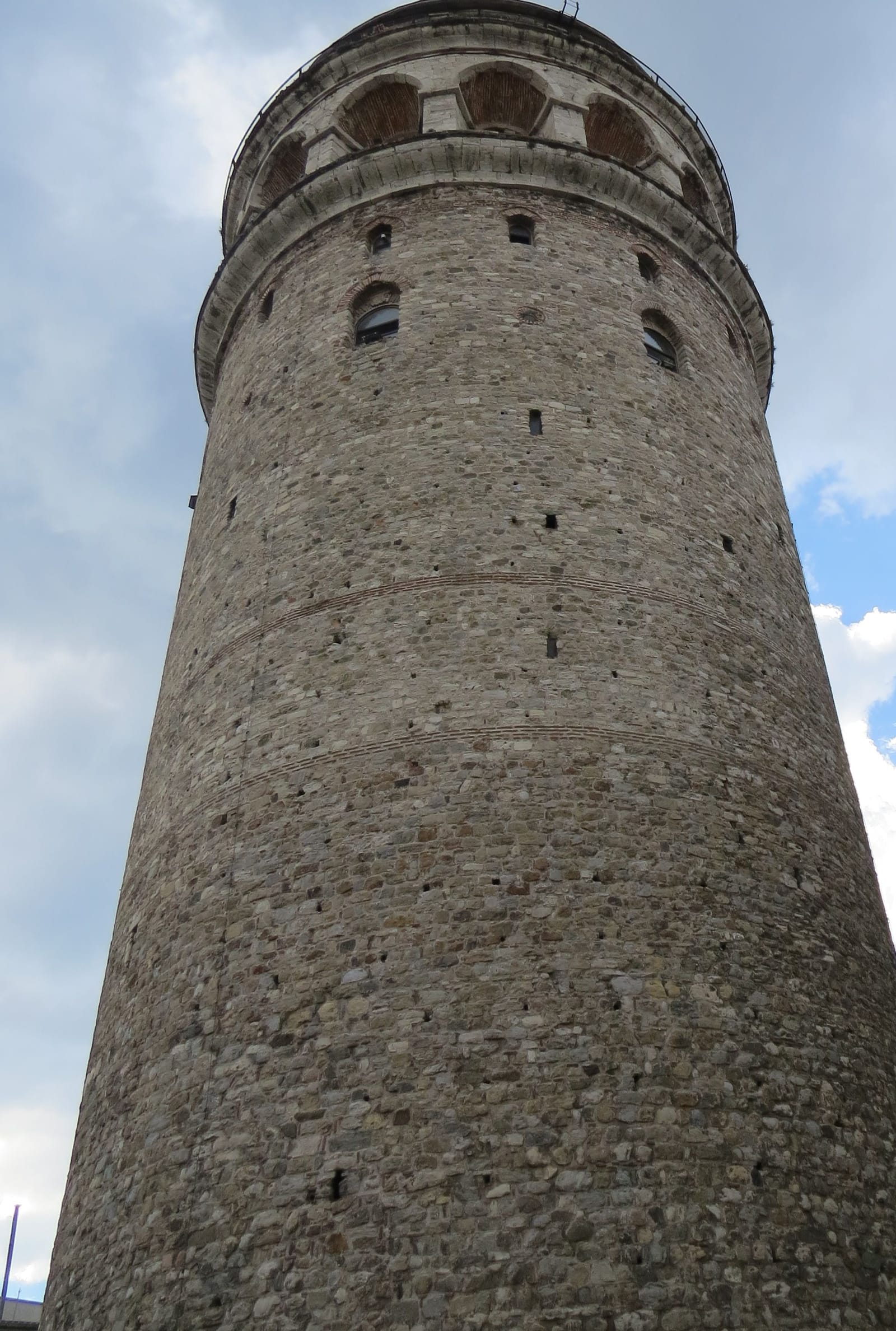
- Two thin red lines circling the shaft, one above the other: brick bands at 13.20 and 17.17 metres, the seam between Genoese and Ottoman work.
- The change in the stone at the lower band. Rough, mixed blocks with brick chips below it; smaller, neater, more regular stones above.
- The marble door set high above the ground, the twin flights of steps, and the four-panel verse inscription over it, with the bare patch where a sultan's monogram was cut away.
- The 1953 plaque at ground level on this face, recording the day in 1453 when Galata handed over its keys.
Transcript (2:15)
You are on the south side, where twin flights of marble steps climb to a door set well above the ground. Before you go up, find the two thin red lines that run right round the shaft, one above the other. They are bands of brick, at 13.20 metres and 17.17 metres where the second and third floors begin, and they are the most argued-over lines in the building.
Below the lower band the stone is rough: squared blocks in dark yellow, light brown, grey and a dark bluish colour, laid irregularly, with brick chips in the joints. Above it the stones are smaller, better dressed and laid in rows, mostly limestone, and the brick chips stop. Something happened at that line. In 1509 an earthquake that Istanbul remembers as the little apocalypse brought much of the tower down, and the ministry's own history says Bayezid the Second's architect, Murad bin Hayreddin, rebuilt it from the 13.20 metre level up.
How much he rebuilt is where scholars part company. Köksal Anadol and Ersin Arıoğlu read the bands as the levels the rebuilding started from. Semavi Eyice thought the lower one was a surface patch and everything above the upper one Ottoman. The most recent reading, by Sağlam, says the collapse was never level, and the thick inner shaft survived largely intact up to the fourth floor. One clue is in front of you: on this side the upper band carries an Ottoman pattern laid in brick.
The walls are 3.75 metres thick as far as the fourth floor and 3 metres above it, because the tower narrows as it rises.
Now the door. The marble frame in the Empire style and the inscription above it come from the repairs of 1831 and 1832: sixteen verses by the poet Pertev Pasha, set out in four lines across four panels and carved in relief by Nuri Dede, in a flowing ta'liq hand. Over them, three small ovals read Ya Hafiz, Maşallah and Ya Rafi. Mahmud the Second's tughra, his royal monogram, was on it too, until it was chiselled off after the republic was proclaimed.
At ground level on this face is a plainer plaque from 1953, the five hundredth anniversary of the conquest. It says that on the morning of Tuesday the twenty-ninth of May 1453 the Genoese colony of Galata presented its keys to Mehmed the Conqueror, and that the surrender was complete on Friday the first of June.
The wall has tenants too. Swifts nest in it from May to August, and in 2020 the outside was left unrestored so as not to wreck their nests. In the later work the scaffolding came down before the birds returned.

Stop 3 of 5 · Seventh floor, the lookout hall, at the arched windows, on the stairs up from the lift at the sixth floor to the balcony
The arched windows of the lookout storey
Built for Mahmud II after the fire of 1831, in the Empire style; refitted in 1965–1967 and stripped back in 2020 · 1832 · Fourteen arched windows set between masonry piers, each pier 120 by 225 cm in section; floor at 32.60 m
Look for
- How deep each window bay is: the masonry pier on either side measures 120 by 225 centimetres in section.
- The round heads of the arches. This ring is Mahmud the Second's lookout of 1832, in the Empire style of its day.
- The steel stair you climb next. It replaced an old wooden staircase in the middle of this floor during the 1960s works.
Transcript (2:15)
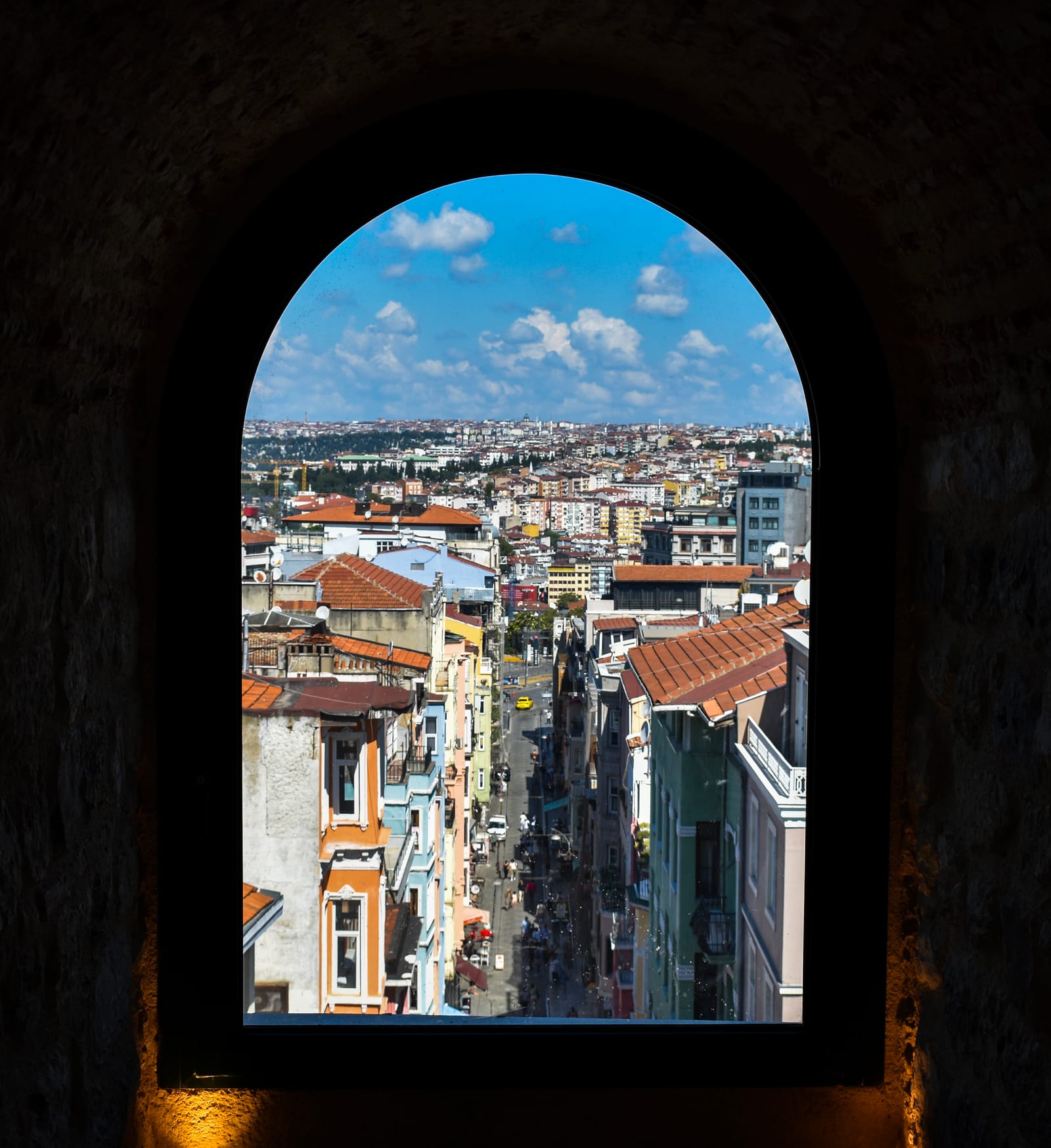
The lift stops at the sixth floor and the rest of the way is on foot, up a steel stair. Pause on the seventh floor and look at the window bays rather than out of them. Each opening sits between two masonry piers, 120 by 225 centimetres in section and a metre and a half apart, joined overhead by round arches. Fourteen of these openings run right round the tower, and the lookout hall they make begins at 32.60 metres.
None of this is Genoese. It is Sultan Mahmud the Second's work, in the Empire style of the 1830s, and it is here because of fire. The top of the tower burned in 1794. Selim the Third's repair gave the lookout floor four projecting bay windows, three rooms and a hall, which is how the palace architect Antoine Ignace Melling engraved it; the upper floor became a coffeehouse, a big drum was hung to sound the alarm for fires, and the attic was given over to pigeons. That arrangement lasted thirty-eight years. After the fire of 1831 Mahmud had everything above 32.60 metres taken down and built this ring of fourteen arches, a storey above it at 40.04 metres, and a wooden cone on top.
The cone blew off in a storm in 1875. What replaced it were two octagonal observation storeys that, in the ministry's own words, did not suit the tower at all, with a terrace at 51.65 metres. From up there the fire brigade watched the city and the navy kept a signal post, and in March 1930 a time ball was fixed on the summit. In the winter of 1959 to 1960 the rotted wooden rooms at the top collapsed, and by the ministry's account the tower kept that look until 1964.
This height has had quieter work as well. The ministry's history says that under Murad the Third the tower served for a time as an observatory, and the astronomer Taqi al-Din did some of his work here before he built his own.
In the 1960s this floor was a restaurant and the one above it a nightclub. The old wooden staircase in the middle came out, replaced by the steel one you are about to climb, with wooden handrails and steps in Empire proportions, and the window frames were simplified to show more glass. In 2020 the later concrete fittings and the café were stripped out again.
Keep one thing for the way down. When you leave, the lower floors are connected by stairs built inside the wall itself, under brick vaults, and those bricks match the ones in other fourteenth-century fortifications in Galata. Up here you are standing in 1832; down there you will be walking through 1348.

Stop 4 of 5 · Eighth floor, the panoramic balcony, on its south-west side, looking across the Golden Horn
The balcony, facing the Golden Horn and the old city
Balcony and railing from Mahmud II's rebuilding after the fire of 1831; on the skyline, Mimar Sinan's Süleymaniye and Senekerim Balyan's Beyazıt fire tower · Balcony 1832; Süleymaniye 1550–1557; Beyazıt Tower 1828 · Open balcony 1.20 m wide round the eighth floor, at 40.04 m, behind iron railings 110 cm high between 14 stone posts
Look for
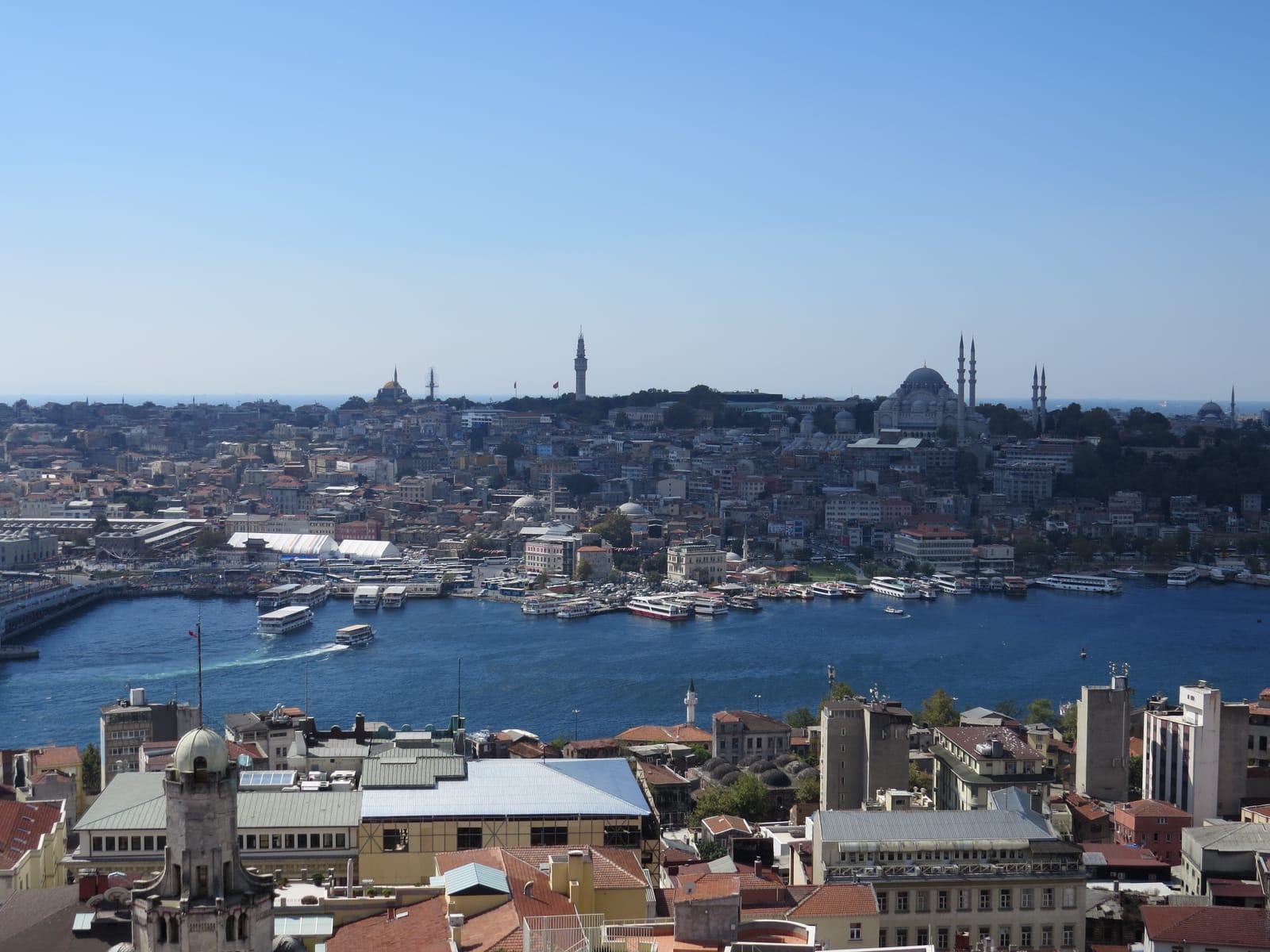
- The Süleymaniye Mosque on the skyline across the water: one great dome and four minarets on the Third Hill.
- The slim pale tower on the same ridge to its left, the Beyazıt fire tower of 1828, which kept the fire watch on the far side of the water.
- The Galata Bridge crossing the Horn from Karaköy, below you, to Eminönü.
- The stone balls on the posts of the railing beside you, 35 centimetres across and anchored so they cannot fall.
Transcript (2:06)
Out on the balcony the railing is iron, 110 centimetres high, strung between fourteen stone posts, and each post carries a stone ball 35 centimetres across, anchored so that it cannot fall. The walkway is just 1.20 metres wide and about forty metres up, on top of a hill. Work your way round until the water is in front of you and a long ridge of domes and minarets lies across it. You are facing south-west, over the Golden Horn.
The Golden Horn is the inlet that made this city: a sheltered harbour between the old peninsula opposite and Galata beneath your feet. In Byzantine times a great chain could be hauled across its mouth, from the city to an older tower of Galata, to keep hostile ships out. During the Fourth Crusade the Venetians broke it with a ram. In 1453 Mehmed the Second failed to break it and went round it instead. He had his ships dragged overland across Galata, on greased logs, and slid them into the Horn behind the defenders. This tower, already more than a century old, had the best seat in the house for that.
Now follow the near shore of the old city to the left until you meet the bridge. That is the Galata Bridge, the fifth on this spot, built in 1994. In 1502 Bayezid the Second asked for designs for a bridge here, and Leonardo da Vinci drew him one, a single span that would have been the longest bridge span in the world. It was never built.
Then the skyline. On the right, the great dome with four minarets is the Süleymaniye Mosque, on the Third Hill, designed by Mimar Sinan for Suleiman the Magnificent; its inscription gives 1550 for the foundation and 1557 for the opening. To its left, on the same ridge, the slim pale shaft is the Beyazıt Tower, and it is this tower's colleague. It is a fire tower too, built in stone in 1828 for Mahmud the Second by Senekerim Balyan, after the wooden tower before it went up in the great fire of 1756 and its replacement was destroyed in the riots of 1826. Between them, these two kept watch over both sides of the water.
Galata announced its fires with flags, and two Ottoman poets, Rezmî and Gelibolulu Mustafa Ali, turned those flags into couplets about lovers burning for their beloved. Beyazıt still signals, though now with coloured light: blue for clear weather, green for rain, yellow for fog and red for snow.

Stop 5 of 5 · Eighth floor, the panoramic balcony, on its south-east side, looking over Seraglio Point and the Bosphorus
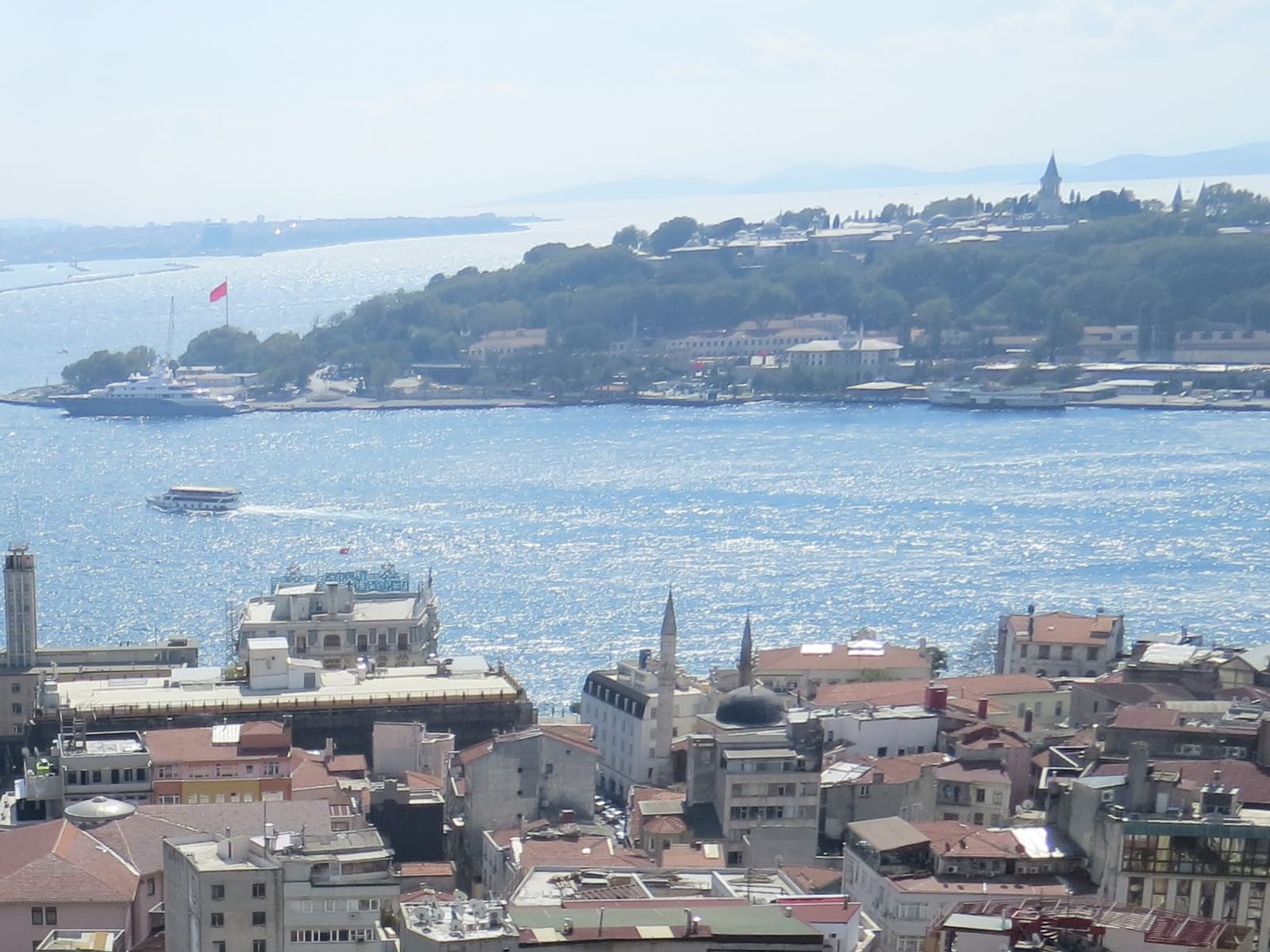
The balcony, facing Seraglio Point and the Asian shore
Balcony from Mahmud II's rebuilding after 1831; Topkapı Palace begun for Mehmed II in 1459 · Balcony 1832; Topkapı from 1459 · The same balcony, 1.20 m wide at 40.04 m, facing the meeting of the Golden Horn, the Bosphorus and the Sea of Marmara
Look for
- Seraglio Point across the mouth of the Horn, with the trees and buildings of Topkapı Palace on the tip of the old peninsula.
- The Asian shore beyond the water, Üsküdar and Kadıköy. By the only account there is, that is where Hezârfen Ahmed Çelebi came down.
- Ferries cutting across the water where the Golden Horn meets the Bosphorus, at the point where the strait opens into the Sea of Marmara.
Transcript (2:08)
Keep walking round the balcony until the water opens out wide and the far shore becomes another continent. You are now facing south-east, towards the place where the Golden Horn runs into the Bosphorus, just where the strait opens into the Sea of Marmara.
The wooded point across the mouth of the Horn is Sarayburnu, Seraglio Point, the tip of the old peninsula. Topkapı Palace sits among those trees, begun for Mehmed the Second in 1459, six years after the conquest, and the seat of Ottoman government and home of the sultans until they moved to the new Dolmabahçe Palace in the 1850s. Legend puts the founding of Byzantium itself on that point, by Greek settlers under King Byzas, in the year 667 before Christ. They were not the first: settlers from the same Greek city, Megara, had founded Chalcedon on the Asian shore eighteen years earlier, at what is now Kadıköy.
Now the best story this tower owns, and you are standing near its starting line. The traveller Evliya Çelebi wrote that in the reign of Murad the Fourth a man called Hezârfen Ahmed Çelebi, Ahmed of a thousand sciences, strapped on wings like an eagle's, launched himself from the very top of this tower, and rode a south-west wind clean across the Bosphorus to land in Doğancılar Square in Üsküdar, on the Asian shore over there. The sultan watched from a mansion at Sarayburnu, the point in front of you. He rewarded the flier with a sack of gold, and then banished him to Algeria, saying that a man who could do whatever he wished was not someone to keep around. The usual date given is 1632. The ministry's own history says simply that the tower witnessed the flight. Evliya is the only source for Hezârfen's whole life, so believe as much of it as you like, but the distance is real, and you can measure it with your eyes from here.
Somewhere off the Üsküdar shore, at the southern entrance of the Bosphorus, a third tower stands alone on a tiny island: the Maiden's Tower. In 1110 the emperor Alexius Comnenus built a tower there and ran another chain from it across to the European shore. The poet Sezai Karakoç turned the two towers into a conversation. In his poem the Maiden's Tower sends its light over the water to Galata, morning after morning, to drive off the Genoese darkness and the Byzantine darkness that hang around it.
The Bosphorus on your left is one of the lines between Europe and Asia. From this railing you can see both, and the stretch of water a man is said to have flown across, from the stone under your feet to the far side.
Independent guide · Chiaro
Point Chiaro at anything at the Galata Tower.
One slow lap of this railing takes in two continents and three stretches of water, and five stops can point at only a few of the things along the way. For everything else, hold up your phone: a minaret on the far ridge, a ferry pulling away from Eminönü, the carved verses over the door. Chiaro answers with a name, a builder and a date. Take a few more steps, aim again, and the city changes subject with you.
Before you go
Getting there
Bereketzade, Galata Kulesi, 34421 Beyoğlu, Istanbul: building number 2 on Büyük Hendek Street, at the top of the old Genoese quarter above Karaköy. Tickets are sold at a booth in the square outside, styled like one of the old Taksim–Tünel tramcars. The door is up the marble steps on the south side, with the ticket check just inside, and you leave down a separate part of the same steps.
Karaköy is a stop on tram line T1, and the Tünel, the old underground funicular, runs between Karaköy and Beyoğlu with just two stations. Metro line M2 stops at Şişhane, under Meşrutiyet Street in Beyoğlu. The tower stands on the hill at the top of the old Genoese quarter, so from the Karaköy waterfront it is an uphill walk.
Tickets and entry
- The tower opens every day of the week at half past eight in the morning, with no weekly closing day. Closing time and last entry vary, so check the museum's page on muze.gov.tr for the date of your visit.
- The ministry lists entry at 30 euros. Its e-ticket shop on muze.gov.tr sells Galata Tower tickets online, and the booth in the square sells them on the spot.
- Children under 18 must visit with their parents: the ministry makes that a condition of entry.
- The lift goes only as far as the sixth floor. The seventh floor and the balcony on the eighth are reached by stairs, and the way back down through the lower floors is by stairs built into the walls.
The official audio guide
The ministry's page for the museum says it has an audio guide service of its own, but publishes no price, language list or format for it; ask at the booth if you want it. Ours runs the other way round: it begins out in the square, before anything is paid, and follows the tower floor by floor to the railing, free, with every word printed under its player in case the wind at the top carries the sound off.
Official site →Questions
Is there a free Galata Tower audio guide?
Yes, on this page. Its five stops start in the square, before you have bought anything, and each one has its full text under the player. The museum also offers an audio guide of its own, for which the ministry does not publish a price. For the hundreds of roofs and domes that these five stops leave out, snap whichever one you are curious about and the Chiaro app will tell its story.
Can I listen to the Galata Tower audio guide without a ticket?
The first two stops, yes. Both are outdoors: the square where the ticket booth stands, and the south face at the foot of the marble steps, before the ticket check inside the door. The last three, the seventh floor and the two views from the eighth-floor balcony, need the museum ticket, which the ministry lists at 30 euros.
How much is the official Galata Tower audio guide?
The ministry's page confirms the museum has an audio guide service but gives no price for it and does not say whether it is a handset or an app, so ask at the booth in the square. The guide on this page costs nothing and needs no download.
Is the Galata Tower open every day?
Yes, seven days a week, and by the ministry's account the doors open at half past eight each morning. When they shut, and when the last visitors are let in, varies, so look up your date on muze.gov.tr. Stop one, out in the square, can be heard whether or not you go inside.
Is there a lift to the top of the Galata Tower?
As far as the sixth floor. From there steel stairs climb past the seventh floor to the eighth-floor balcony, which runs right round the tower, 1.20 metres wide behind an iron railing. On the way out you walk down through the lower floors on stairs built inside the walls.
More audio guides
Made by Chiaro. Not affiliated with the Galata Tower.