
Park Güell · Barcelona · Independent guide
Park Güell audio guide,
five stops, free.
Twelve hectares of hillside that Gaudí began laying out in October 1900, told in five recordings with a written script under each. For any other tile on the site, point Chiaro's camera at it and ask.
Made by Chiaro. Not affiliated with Park Güell.
The Carrer d'Olot wall and the porter's lodge pavilions
Park Güell, Barcelona
That was the free part
Chiaro narrates anything at Park Güell from a photo.
The five stops · 10 minutes of audio
Five places, one walk,
in the order you will walk them.
The Park Güell audio guide below is free and self-guided, and it runs from a public pavement to a wave of leaning stone, by way of the park's most famous bench. Play the first stop on Carrer d'Olot, outside the main gate on the south side, with no ticket needed. Then go in at the Carrer de Larrard entrance, reached from the side lane at the Carrer d'Olot and Carrer Marianao end, and make your way to the foot of the monumental stairway just inside the main gate for the dragon. Climb to the forest of columns at the head of the stairway, then up again onto Nature Square, stop at the bench on the city side of the square for the view, and finish by going through the iron gate on the side towards the old Casa Larrard into the leaning stone portico. The distances are short but steep, and while the recordings last roughly ten minutes, the park's own figure for an average visit is about an hour.
Ticket rules, prices and time bands on this page are taken from parkguell.barcelona, the park's official website, run for Barcelona City Council, as it read on 26 September 2026, and the history is checked against the park's own heritage pages and against Wikipedia. Entrances and paths here move with the building works, so on the day the park's stewards and the notices on the paths have the final say; where they disagree with what is written here, send us a note and the page gets corrected.
Richard Mortel from Riyadh, Saudi Arabia, CC BY 2.0, via Wikimedia Commons. Photo: Richard Mortel from Riyadh, Saudi Arabia
_(30408637984).jpg)
Stop 1 of 5 · Carrer d'Olot, on the pavement outside the main gate on the south side of the park, facing in; a public street, no ticket needed
The Carrer d'Olot wall and the porter's lodge pavilions
Antoni Gaudí (1852–1926), for the industrialist Eusebi Güell (1846–1918) · 1900–1903 · Rustic stone wall capped with tile, 210 m long and 2 to 4 m high, with fifteen trencadís medallions 1.4 m across; two stone pavilions under tile-shard roofs
Look for
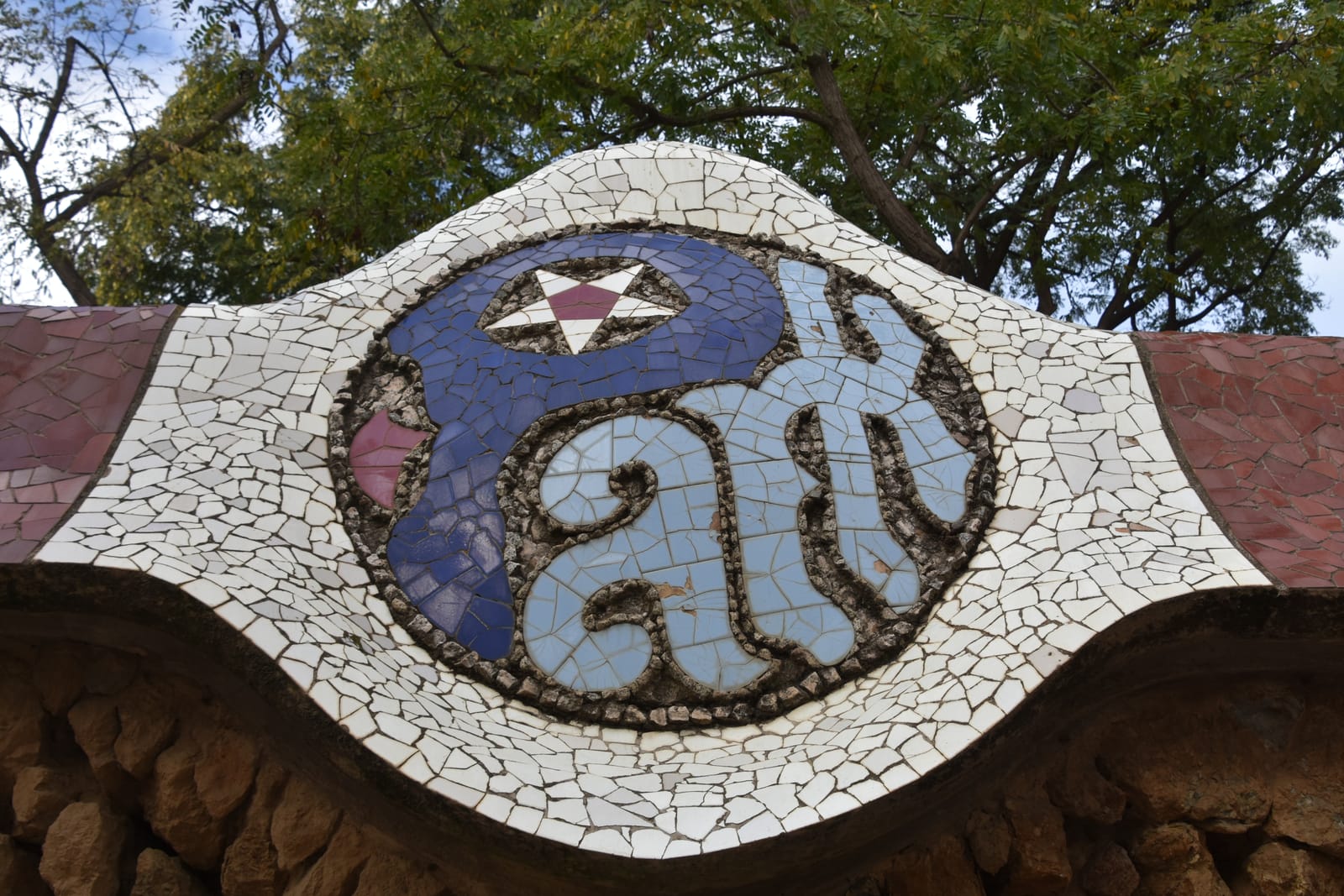
- The medallions set into the top of the wall, fifteen of them, alternating two words: Park and Güell. The first is in English because Güell wanted a British-style residential park.
- Over the gate, the left-hand pavilion's blue-and-white chequered tower and its four-armed cross, which was destroyed in 1936 and put back after the Civil War.
- The right-hand pavilion's mushroom cupola, probably a fly agaric. The ribs under its cap are coffee cups set upside down.
- The palm-leaf iron gate. It is Gaudí's, but it came from Casa Vicens, one of his first houses, and was fitted here in 1965.
Transcript (2:06)
Stand on the pavement of Carrer d'Olot and face the wall. It is rough stone from this hillside, 210 metres of it, between two and four metres high, capped with tile in white and red bands. Set into that capping are the medallions, fifteen of them, each 1.4 metres across, spelling out two words over and over: Park, and Güell.
That first word is English on purpose. Eusebi Güell, the industrialist who paid for all this, wanted to recreate the British residential parks, and he named the place to say so. What you are standing outside was never meant to be a public park. It was a private housing estate for well-off families, some sixty triangular plots on a bare, rocky slope that people called the Muntanya Pelada, the bald mountain. The rules were strict. Only a sixth of any plot could be built on, and every house had to sit where it would not block a neighbour's sunlight or view of the sea. Güell gave the job to Antoni Gaudí, and work began in October 1900.
Now look over the gate at the two pavilions. This was the estate's porter's lodge, and it was among the first things finished: a description published on the fourth of January 1903 already lists both pavilions, the outer wall and the great stairway behind them as built. The one on the left was the lodge proper, with a waiting room and a telephone booth. Its tower is the chequered one in blue and white, crowned by the four-armed cross Gaudí liked to aim at the points of the compass. That cross was destroyed in 1936 and put back after the Civil War. The pavilion on the right was the porter's own house, the Casa del Guarda, and the cupola on its roof is a mushroom, most likely a fly agaric. The ribs under the cap are coffee cups, set upside down among the tiles.
That is the method of the whole park, and it has a name: trencadís, Catalan for broken up. Much of it was factory rejects and broken cups and plates.
Then the gate, its ironwork shaped like palm leaves. It is Gaudí's, but it came from Casa Vicens, one of his earliest houses, and was fitted in 1965. His own plan for this entrance was stranger: a monumental gate with a pair of mechanical gazelles that would swing open with the doors. They were never built.
Nor was most of the estate. Buyers did not come, and in 1914 the works stopped with two houses standing out of sixty. Everything past this gate was built for residents who never arrived.
Imelenchon, Public domain, via Wikimedia Commons. Photo: Imelenchon

Stop 2 of 5 · Just inside the main gate, at the foot of the monumental stairway, looking up towards the columns of the Hypostyle Room
The Dragon Stairway
Antoni Gaudí (1852–1926) · 1900–1903 · Stone and trencadís; a twin flight of 45 steps, 20 m long and 8.1 m wide; the dragon 2.4 m long, of thin brick covered in tile shards
Look for
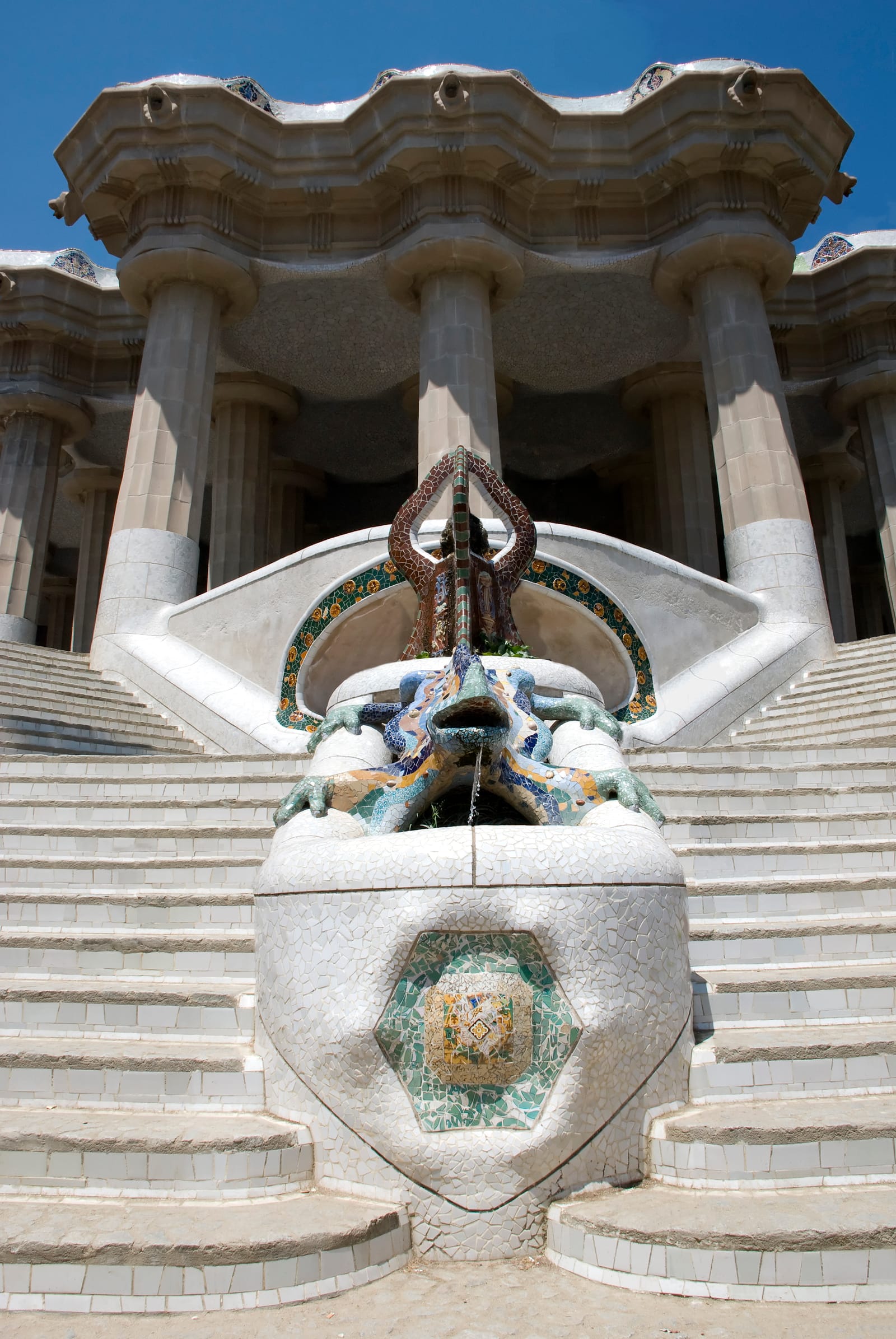
- The dragon's open mouth. It is not decoration but an overflow pipe: when the rainwater tank under the square is full, the surplus comes out here.
- In the fountain halfway up, below the dragon, the arms of Catalonia with a snake across them, one of several nods to Catalan identity on this stairway.
- The small tripod rising out of the dragon's fountain, a reference to the tripod of the oracle at Delphi.
- At the head of the last flight, tucked under the columns, the curved odeon bench, set so that it takes the sun in winter and the shade in summer.
Transcript (2:07)
Stop at the foot of the steps and look straight up the middle. Two flights climb on either side of a chain of fountains, forty-five steps in all, twenty metres from bottom to top, and waiting at the head of them are the columns of the covered hall that holds up the square. The park's own description of this entrance promises exactly this view, the stairway with the hall above it, and it is the whole composition in one look.
The side walls are two ellipses of ceramic, white convex plates alternating with coloured concave ones, many of them designed by Pau Pujol of the Pujol i Bausis tile works, and they are finished with battlements. Under the terraces those walls hold up are two grottoes. The one on your right was built as a waiting shelter, and inside its vault rests on a single conical column that looks like an elephant's leg.
Now climb with your eyes. The first fountain is all false rock and stalactites, with odd, goblin-like shapes, and hidden in it is a circle for the world and a compass for the architect. Halfway up is a medallion with the arms of Catalonia and a snake across it. Then, above that, the dragon.
It is 2.4 metres long, made of thin brick and covered in tile shards, and the park's own site says, without exaggeration, that it has become the most popular image of the park. Nobody agrees on what it is. It may be the alchemists' salamander, the creature of fire. It may be Python, the serpent of the temple at Delphi; above it sits a little tripod like the one the oracle sat on, and there are scholars who think Güell and Gaudí modelled the whole park on that temple. Or it may be the crocodile on the coat of arms of Nîmes, the French city where Güell grew up.
What it certainly is, is a drain. Rain falling on the square above soaks through into an underground tank that holds 1,200 cubic metres. When the tank passes its limit, the surplus has one way out, and it is the dragon's mouth. Gaudí made the park's most famous animal the overflow of his cistern.
It has taken some wear for that fame. The park's conservation programme lists the restoration of the dragon's front right foot among its projects, so fame has a maintenance bill here like anywhere else.
One more thing before you climb. At the top of the last flight, sheltered under the columns, there is a curved bench shaped like a small Greek theatre, an odeon. It is placed to catch the sun in winter and to sit in shade in summer.
Bautsch, Public domain, via Wikimedia Commons. Photo: Bautsch

Stop 3 of 5 · At the head of the Dragon Stairway, in the covered colonnade under Nature Square
The Hypostyle Room and Jujol's ceiling
Antoni Gaudí (1852–1926); ceiling mosaics by Josep Maria Jujol (1879–1949) · c. 1907–1909 · 86 fluted columns of mortar and rubble, each 6.16 m tall and 1.2 m across, under shallow trencadís domes; four ceiling medallions 3 m across
Look for
- The outer columns, which lean in. Classical rules say a column stands upright; these tilt to show the load they are taking.
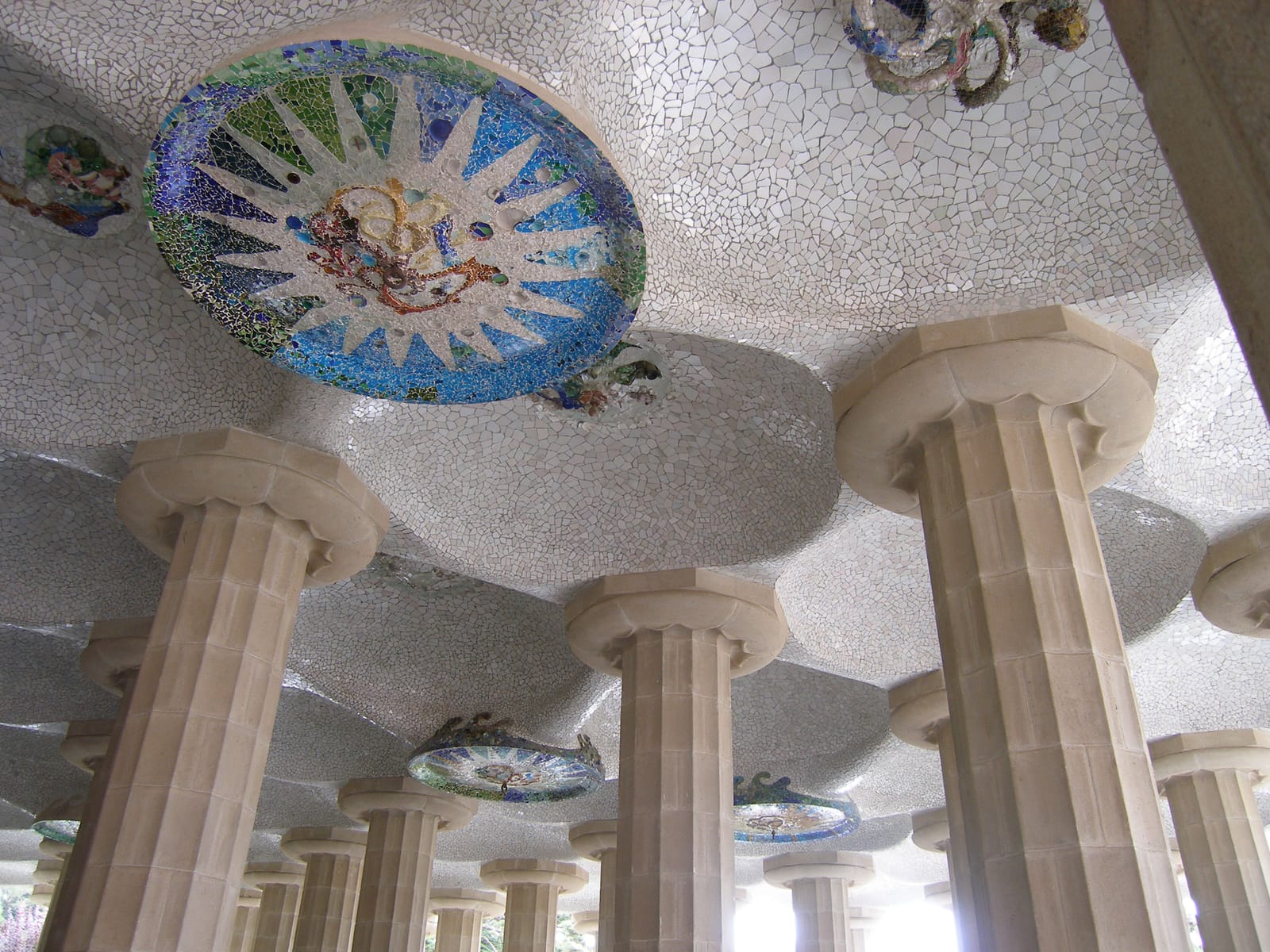
- The four big sun medallions, three metres across, each in a gap where Gaudí left out a column. They stand for the four seasons.
- The smaller roundels in the centres of the vaults, fourteen of them, in whirls and spirals: the phases of the moon.
- The top of any column: the block under the ceiling is octagonal, not square as a proper Doric column would have it.
Transcript (2:10)
Step in among the columns and give yourself a moment in the shade. You are inside the thing that holds up the square: eighty-six fluted columns, each 6.16 metres tall and 1.2 metres thick, carrying a ceiling of shallow white domes. The room was meant to be the estate's market, a covered place for the residents to shop. When the estate failed, the market idea was dropped.
The columns are Doric, or they pretend to be. Look at the block on top of any one of them. On a proper Doric column it is square; here it is octagonal. And look at the outer ring, the columns nearest the stairway. They lean. Classical architecture would call that a mistake. The park's own description puts it better: the tilt runs against the rules of classical composition while making you feel the weight they carry. They are not marble, either. They are mortar and rubble made to look like it, with a skin of broken tile up to 1.8 metres.
They are also drainpipes. The square above you is left unpaved on purpose, so rain soaks straight through it, and inside the colonnade a conduit gathers the water and sends it down to a tank under your feet. That is the tank whose overflow you just saw coming out of the dragon.
Now look up. The plan called for ninety columns. Gaudí left four out, and in the four holes in the ceiling he put four great round medallions, three metres across. They are suns with twenty points, and they stand for the seasons. Around them, in the centres of the smaller vaults, are fourteen roundels about a metre across, full of whirls, helices and spirals. Those are the phases of the moon. Where columns are missing, the space opens into what reads as three naves, like a church.
The man who made that ceiling was Josep Maria Jujol, born in Tarragona in 1879, twenty-seven years younger than Gaudí, and the most inventive of all his collaborators. He worked with him on Casa Batlló and Casa Milà as well. Up there he worked in ceramic shards and plain waste material. If you want a single place in the park where you can see one assistant's imagination running loose inside his master's structure, it is this ceiling.
The park's own history dates it early: by 1907 the square above was already being used for events, which it takes to mean this hall had its roof by then. The medallions have needed care since, and they appear on the park's own list of conservation projects. Stand under the nearest sun for a moment before you go on. Somebody chose every one of those shards.
Leandro Neumann Ciuffo, CC BY 2.0, via Wikimedia Commons, cropped. Photo: Leandro Neumann Ciuffo
.jpg)
Stop 4 of 5 · Nature Square, at the bench on the stairway side, looking out over the entrance pavilions to the city and the sea
Nature Square and the serpentine bench
Antoni Gaudí (1852–1926); the bench by Josep Maria Jujol (1879–1949) · Square in use by 1907; bench built 1909–1914 · Esplanade 86 by 43 m, part cut into the rock and part carried on the Hypostyle Room; trencadís bench 110 m long
Look for
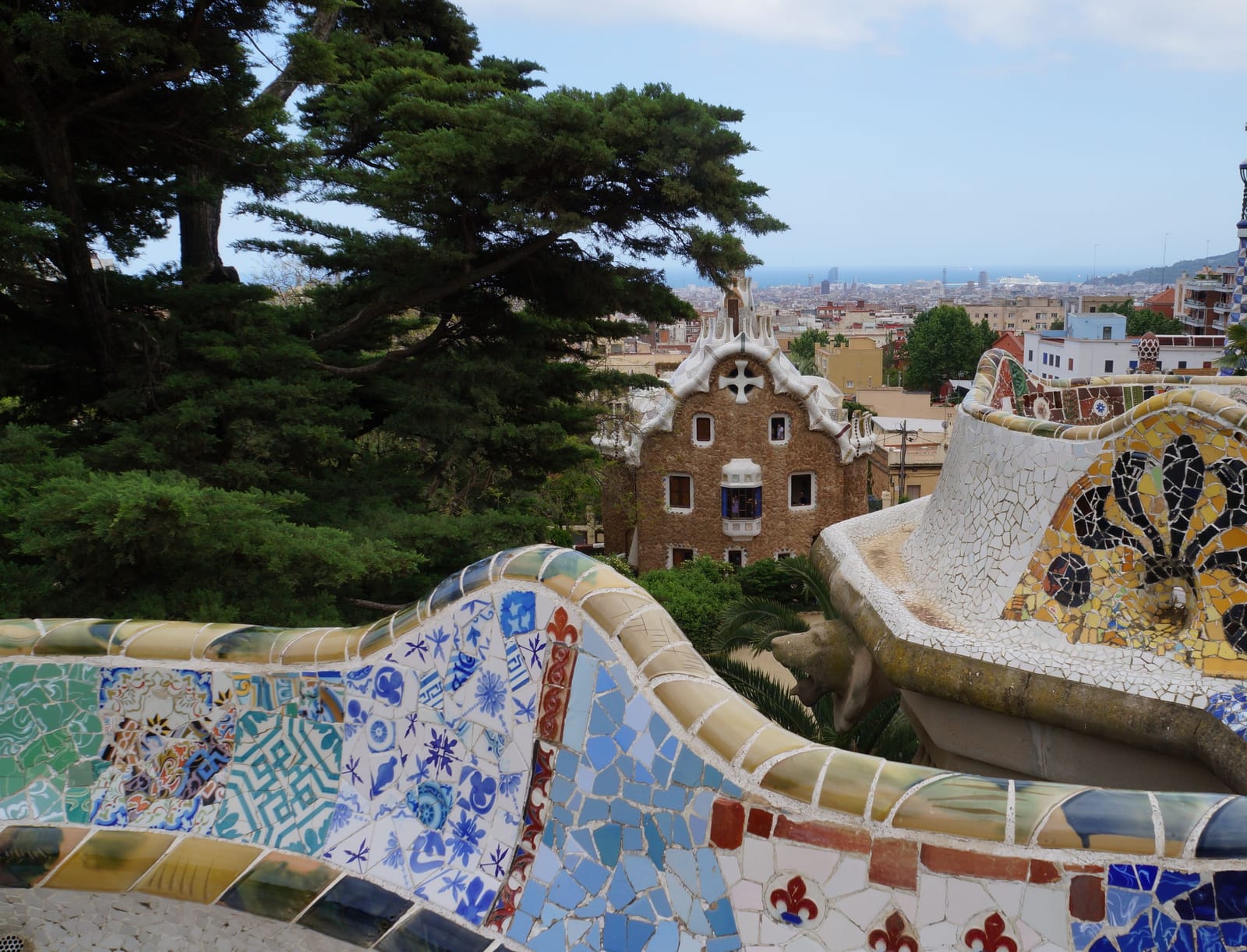
- The small pictures and words pressed into the bench among the abstract patterns: zodiac signs, stars, flowers, fish, crabs, and Jujol's phrases to the Virgin in Catalan and Latin.
- The rhythm of the bench: concave and convex bays about a metre and a half long, so that people end up sitting in small groups facing each other.
- Straight down over the rail: the stairway, the two pavilions from the first stop, and beyond them the city and the sea the estate was sold on.
- The ground you are standing on, left unpaved on purpose so the rain drains through to the tank under the columns.
Transcript (2:12)
Come to the rail of the bench on the city side and look down. Directly below is the stairway you climbed, then the two pavilions with their mushroom and their cross, and beyond them the whole of Barcelona running down to the sea. That view is what Güell was selling. The park's own history says he chose this hill for its healthy setting and its splendid views over the sea and the plain.
The ground under you is not ground. The original plans called this the Greek Theatre, a stage for big open-air shows watched from the terraces around it, and it is artificial: part of it is cut into the rock of the mountain, and the rest sits on top of the columns you just walked through. It is 86 metres long and 43 wide, and it is left unpaved on purpose, so the rain goes through it to the tank below. Today it is called Nature Square.
Now the bench. It runs for 110 metres, and it is the work of Josep Maria Jujol, built between 1909 and 1914. Sit down for a moment and notice what happens to your back: the seat is made of concave and convex bays about a metre and a half long, shaped to fit a body, and the curves turn people towards one another in small groups. It was designed for conversation as much as for resting.
Then look closely at the surface. It is broken tile, bottles and bits of crockery, most of it abstract, but not all. Hunt along it and you will find signs of the zodiac, stars, flowers, fish and crabs. Jujol also worked in roses, crosses and phrases in Catalan and Latin in praise of the Virgin Mary, and here and there the letter J, for Jujol. It is less a bench than a hundred-metre scrapbook.
The square was never empty for long. Even while Güell was alive the park was one of the city's great sights, and he let this esplanade for Catalan patriotic gatherings and for sardana dancing, the traditional dance of Catalonia. In 1906 the park hosted the garden party of the First International Congress of the Catalan Language.
Güell died in 1918. His heirs offered the park to the city, the City Council agreed to buy it on the twenty-sixth of May 1922, and it opened as a public park in 1926, the year Gaudí died. Gaudí had lived here himself for almost twenty years, in the estate's show house, from 1906 until 1925. The houses never came. What came instead was you, and the view down over the pavilions to the water, which is the same one the sixty plots were drawn to share.
Ronny Siegel, CC BY 4.0, via Wikimedia Commons, cropped. Photo: Ronny Siegel

Stop 5 of 5 · Off Nature Square through an original iron gate, on the side of the square towards the old Casa Larrard, now a school
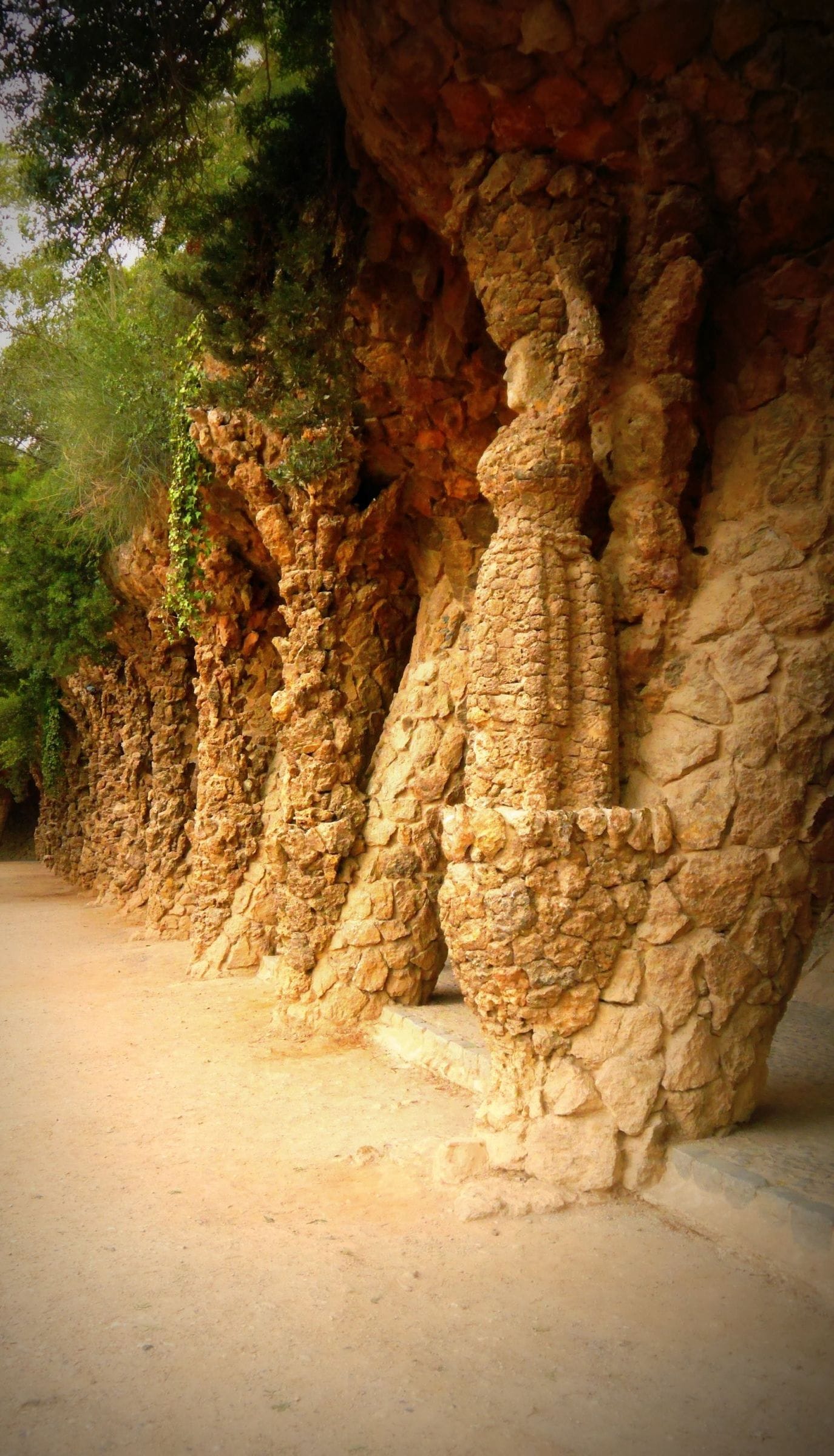
The Laundry Room Portico
Antoni Gaudí (1852–1926) · Built during the estate works of 1900 to 1914 · Unworked stone from the site: a gallery 83 m long on a double colonnade whose inner columns lean against the slope, backed by a retaining wall
Look for
- The washerwoman: one column carved as a woman carrying a bundle, the tools of her trade. The whole portico is named after her.
- The lean of the inner columns against the slope. They are buttresses as much as supports, holding the hillside back.
- The stone itself, left rough and unworked, like the viaducts Gaudí built from rock taken out of this hill.
- The iron gate you came through, which Salvador Dalí compared to calf's livers.
Transcript (1:52)
You have left the bright square behind through an iron gate, and the light changes at once. Salvador Dalí said the ironwork of that gate looked like calf's livers. Keep that in mind and look back at it later.
In front of you is a gallery of rough stone that curls over your head like a wave about to break. It runs for 83 metres against a retaining wall, and it is held up by a double colonnade whose inner columns lean against the slope. The park itself calls it one of the finest examples of Gaudí's organic architecture, and the point is that the lean is doing work. These columns are buttresses. They hold the hillside back. Some writers see a Romanesque cloister in it, perhaps modelled on the one at Elne cathedral; here, though, the portico's own curved inner wall leans to follow the natural slope of the ground.
The stone is left unworked, just as on the viaducts that carry the roads around the park, which Gaudí built of rock taken from the site itself. That is why the whole thing seems to have grown here rather than been built. He kept to that idea wherever he could: the trees already on the land, the carobs and olives, were left standing, and what he planted new were Mediterranean species that needed little water.
Now find the figure. Among the columns, one is carved as a woman with a bundle on her head, a washerwoman carrying the tools of her trade. The portico is named after her. Her model is argued over. Some scholars think Gaudí was quoting a famous ancient Egyptian statuette in the Louvre, the Offering Bearer. Standing here, you can see why.
Now look where the path leads. It runs above the old gardens of Casa Larrard, the country house that stood on this land before the park and that Güell took as his own home in 1907. He lived there until he died in 1918, and since 1931 it has been a school. At the far end the portico turns into a spiral ramp on twisted columns that winds down towards the house, the same structural idea wound into a corkscrew.
Stand close to the washerwoman and look up past her head. She is carrying the same weight as every other column in the row.
Independent guide · Chiaro
Point Chiaro at anything at Park Güell.
Five stops cover the bones of the place; the skin is countless tile fragments, lion-head spouts, viaduct columns and roofs on the skyline, and each has a maker and a story. Aim the Chiaro app at a patch of the bench or a pillar on the path to the Three Crosses and it names what is in front of you, who built it and when, and it goes on taking your questions until you walk on.
Before you go
Getting there
Carrer d'Olot, Barcelona, is the main entrance, on the south side of the park, and the first stop is heard from the pavement there. For going in, the park points ticket holders to three entrances: Carrer de Larrard, reached from the side lane at the Carrer d'Olot and Carrer Marianao end, on the same side of the park as this walk's first stop; Carretera del Carmel 23, the one it recommends for visitors with reduced mobility; and Avinguda del Santuari de Sant Josep de la Muntanya, where an escalator takes you up.
Metro line L3, the green line, to Lesseps or Vallcarca, each about twenty minutes on foot; from Lesseps the park suggests the escalator entrance on Avinguda del Santuari de Sant Josep de la Muntanya. For now it advises against Vallcarca, because the escalators on Baixada de la Glòria are out of service. Buses H6 and D40 stop on Travessera de Dalt, about ten minutes' walk away, with the Santuari escalator or Carrer de Larrard as the suggested way in.
Tickets and entry
- Everything past the gate is ticketed now: the ticket covers all twelve hectares, woods and viewpoints included, and only the street outside is free. Tickets are for a time slot, you have thirty minutes after its start to get in, and once you leave you cannot come back in. The dragon, the columns, the portico and the square also sit behind a second control point, on a one-way route.
- Buy on the park's own website. Tickets carry your name, which must match your identity document, and it can be checked at the entrance; booking opens three months ahead, up to seven tickets at a time, and a booking can be moved up to the day before but not cancelled or refunded. The general ticket is 18 euros, 13.50 for children aged seven to twelve and for visitors over sixty-five; children up to six go free but still need a ticket of their own.
- The park is open every day of the year. Visitor time bands start at 9.30 am and the last one begins at 7.30 pm; from 7 am until then, and again from 8 pm, the park belongs to local residents and there are no tourist visits. The official prices-and-times page has the bands for your date.
- Two things the standard ticket does not get you: the Gaudí House Museum, which needs a combined ticket, and, for the moment, the Casa del Guarda pavilion by the main gate, which is normally included but is temporarily closed for maintenance. Just outside the main gate the Jardins de la Font del Carbó are being restored until about January 2028.
The official audio guide
Download the park's free app before you come and it shows which parts of the park are most accessible and how to reach them. The park also runs its own guided tours: about fifty minutes in Catalan, Spanish, English or French for 17 euros a head on top of the entry ticket, a longer tour at 29 euros and private tours at 40 euros per person, each again on top of the ticket. The five stops you are reading need neither a download nor a booking, print their script under each player, and start on the street before the ticket check.
Official site →Questions
Is there a free Park Güell audio guide?
Two free options exist. The five stops above cost nothing and run in any browser, no install. The park's official app is free too, though it has to be installed first. Past the fifth stop, photograph anything else, from a single tile to a viaduct, and Chiaro tells its story.
Can I hear the Park Güell audio guide before I go in?
On Carrer d'Olot, yes: the first stop is written to be heard on the public pavement outside the main gate. The other four are inside, and because the ticket now covers the whole twelve hectares, woods included, all four need one.
How much is the official Park Güell audio guide?
The park's own app costs nothing to download. What the park charges for is a person: its guided tour is 17 euros a head on top of the entry ticket and lasts about fifty minutes, in Catalan, Spanish, English or French. A longer tour costs 29 euros and a private one 40 euros per person, both on top of the ticket.
Which Park Güell entrance should I use for this walk?
Start on Carrer d'Olot, on the south side, where the first stop plays outside the main gate. From there, the way in on the same side is Carrer de Larrard, entered from the side lane at the Carrer d'Olot and Carrer Marianao end. With reduced mobility the park recommends Carretera del Carmel instead, and from Lesseps metro it suggests the escalator entrance on Avinguda del Santuari de Sant Josep de la Muntanya.
Is Park Güell open every day?
Yes, all year round, with no closing day. Visitor tickets are sold for time bands between 9.30 in the morning and 7.30 in the evening; the hours either side belong to local residents. You get thirty minutes after your slot begins to go in, and once inside you can stay as long as you like.
Is Gaudí's house included in the Park Güell ticket?
No. The Gaudí House Museum, where he lived from 1906 to 1925, needs a combined ticket. The Casa del Guarda, the pavilion beside the main gate, is normally included, but it is temporarily closed for maintenance.
More audio guides
Made by Chiaro. Not affiliated with Park Güell.