
Hofburg · Vienna · Independent guide
Hofburg audio guide,
five stops, free.
Eighteen wings, nineteen courtyards and 2,600 rooms, added to by the Habsburgs for more than six centuries: walk five of those places from Michaelerplatz to Heldenplatz, and ask Chiaro about any of the others from a photo.
Made by Chiaro. Not affiliated with Hofburg.
The Michaeler front and its domes, from Michaelerplatz
Hofburg, Vienna
The five stops · 10 minutes of audio
Five places, one walk,
in the order you will walk them.
Start this Hofburg audio guide on Michaelerplatz, outside the palace, and it takes you self-guided through the Habsburgs' winter residence in the order you actually move through it. Stop one faces the curved Michaeler front from the square. Stop two is under the great copper dome behind the central gate, where the entrance to the Imperial Apartments is. Stop three is in the inner courtyard, In der Burg, facing the Swiss Gate on its south-east side, near the ticket office to the left of the Kaisertor. From there you go back under the dome and up the Emperor's Staircase to stop four, Franz Joseph's bedroom; the operator puts the visit at about 60 minutes. The route lets you out on Ballhausplatz, and stop five is a short walk south, at the rearing horse on Heldenplatz. Four of the five are on public ground. Played end to end, the recordings last just under ten minutes.
We checked the names, dates and measurements here on 1 October 2026 against the operator's site, sisimuseum-hofburg.at, and against Wikipedia and the City of Vienna's history wiki, and every opening hour and price is filed with the sentence it was taken from, so a change on the official site shows up. This autumn's refurbishment changes the hours from 6 October to 18 November, and prices change again from 19 November, so open the official page for your date. Once you are there, the turnstile staff and the notices in the palace outrank this page; if they disagree with it, write to us and we will put it right.
Michielverbeek, CC BY 4.0, via Wikimedia Commons, cropped. Photo: Michielverbeek

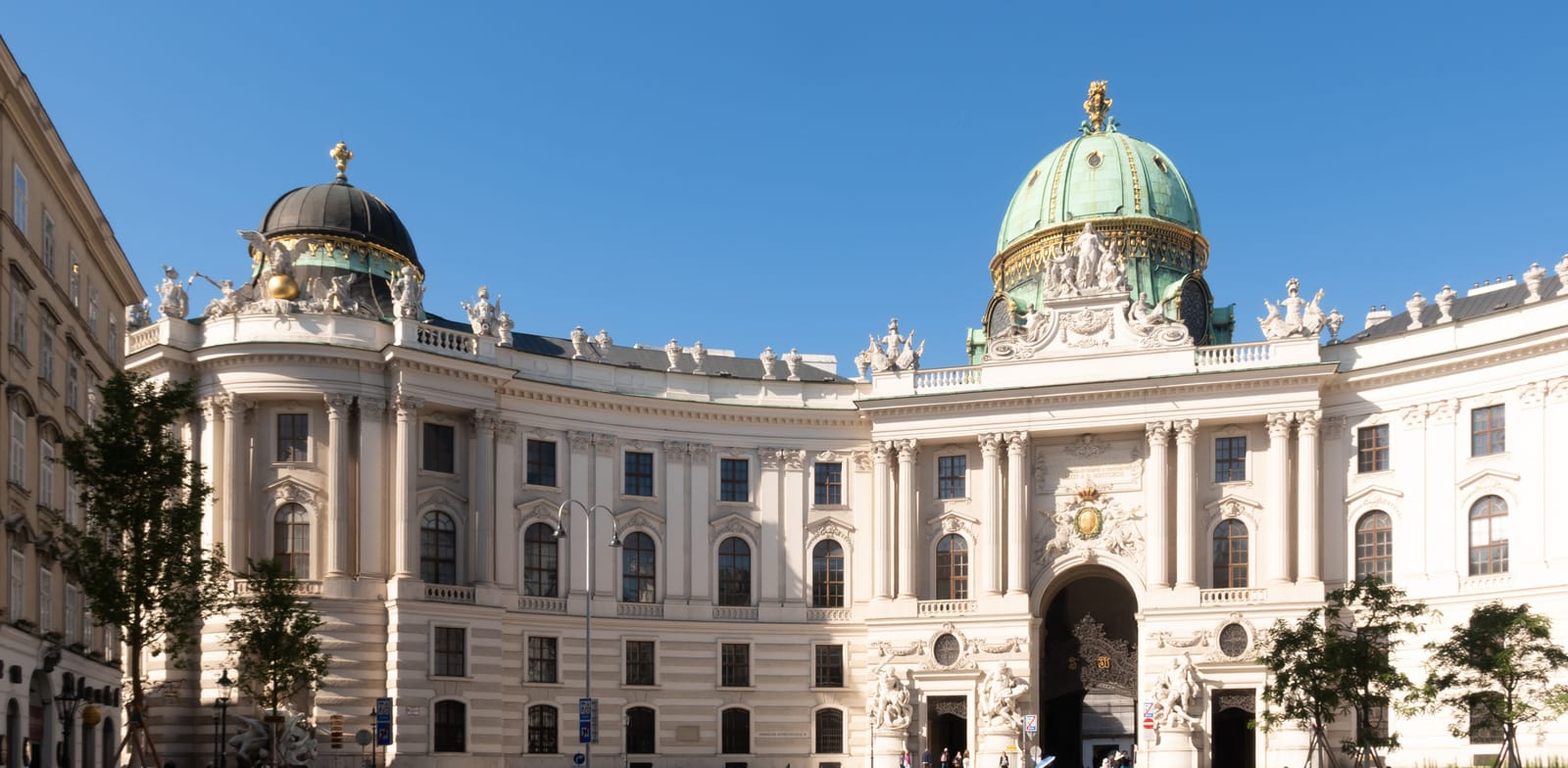
Stop 1 of 5 · Michaelerplatz, in front of the Michaelertrakt, facing south-west towards the gate; public square, before any ticket
The Michaeler front and its domes, from Michaelerplatz
Designed by Joseph Emanuel Fischer von Erlach (1693–1742) in 1726; built by the court architect Ferdinand Kirschner (1821–1896); fountains by Rudolf Weyr (1847–1914) and Edmund Hellmer (1850–1935) · Designed 1726; begun in the 1730s; completed 1889–1893 · Kaiserstein base and dressings, figures in Zogelsdorf stone; four Hercules groups, each cut from a 25-tonne block
Look for
- The two wall fountains at the ends: Power at Sea by Rudolf Weyr on the left, signed WEYR 1895 on the bow, and Power on Land by Edmund Hellmer on the right, figures in Laas marble over basins of red Swedish granite.
- The four Hercules groups beside the three gates, each hewn from a single 25-tonne block of Zogelsdorf stone.
- The two domes: the low dark one over the Winter Riding School end, and the raised central one over the gate that Hasenauer insisted on.
- The inscription above the imperial arms over the main gate, composed in 1892 by the archaeologist Friedrich Kenner.
Transcript (2:14)
Stand in the square with the Kohlmarkt at your back and look south-west. The curved white front ahead of you, with a green copper dome over the gateway, is the Michaelertrakt, the side of the Hofburg that faces the old city. The drawing is from 1726. The building is from the 1890s.
Joseph Emanuel Fischer von Erlach designed this front in the reign of Charles the Sixth: a sweeping curve that would carve a proper square out of what was then just a crossroads. Work began around 1730, the Winter Riding School end on your left was finished, the round hall behind the gate was half built, and then the emperor died and nothing more happened. From 1742 Maria Theresa's court theatre, a converted ballhouse, stood in the gap, and it stayed there for almost a century and a half. Only when the new Burgtheater on the Ring was ready in 1888 could the old one come down. The court architect Ferdinand Kirschner then built Fischer's plan, lightly altered, between 1889 and 1893, and the wing opened on the eighth of September 1893.
Now compare the two domes. Fischer's engraved design showed no domes at all. The low dark one on the left sits on the old riding-school end; the architect Carl von Hasenauer argued that a low side dome demanded a raised one in the middle, and Kirschner had to give way. The operator puts that central dome at fifty metres.
Then drop your eyes to the ground floor. Either side of the three gates stand four groups of Hercules, each cut from a single twenty-five-tonne block of stone: Hercules killing the Hydra, freeing Hesione, unchaining Prometheus, and hauling Cerberus up from the underworld. They were made to match an older set of Hercules groups inside the courtyard. In the curved pavilions at either end are two great wall fountains. On the left, Power at Sea by Rudolf Weyr, signed on the ship's bow: WEYR 1895. The Neptune in it is said to have the face of Friedrich Uhl, editor of the Wiener Zeitung, who was also the sculptor's father-in-law. On the right, Power on Land by Edmund Hellmer, unveiled two years later, and unsigned.
Two more surprises. This design was built long before Vienna got it: in Berlin, between 1775 and 1780, Frederick the Great had it used for his Royal Library. And under the middle of the square lie the remains of four Roman houses from the second to the fifth century, part of the civilian settlement outside the legionary camp of Vindobona. The palace wing in front of you had to be founded sixteen metres deep.
Jean-Frédéric, CC0, via Wikimedia Commons. Photo: Jean-Frédéric

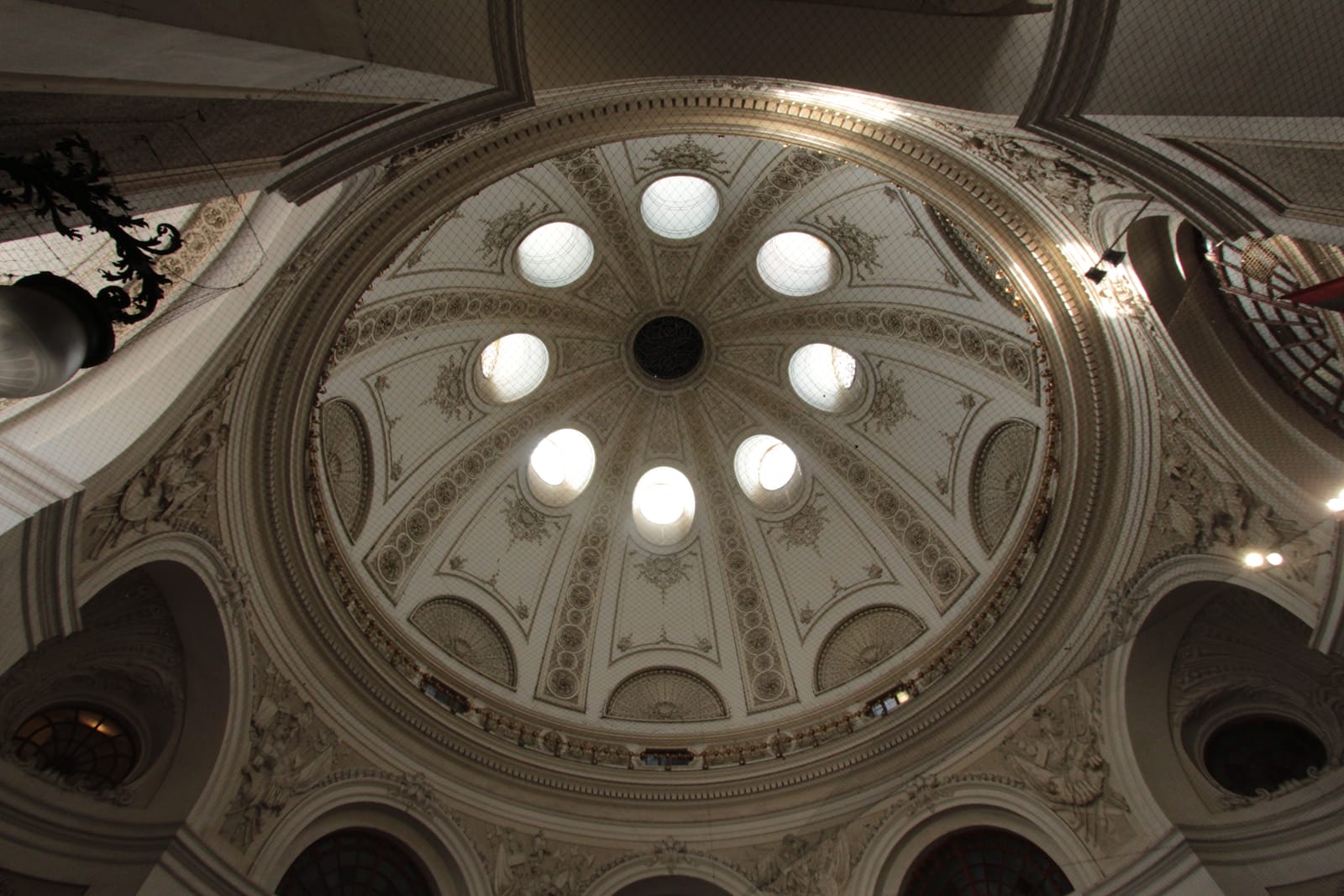
Stop 2 of 5 · The rotunda under the Michaelerkuppel, the public passage between Michaelerplatz and In der Burg; the ticket entrance is here; no ticket needed to stand in it
Under the Michaeler Dome
Joseph Emanuel Fischer von Erlach (1693–1742), begun in the 1730s; completed by Ferdinand Kirschner (1821–1896); figure programme by the archaeologist Friedrich Kenner (1834–1922) · Begun 1729–1735; left half-built; completed 1889–1893 · Masonry and stucco rotunda under a copper-clad dome that the operator gives as 50 metres high
Look for
- The ring of oval lights round the open eye at the top of the dome.
- The figures round the hall, in a softer sandstone than the statues outside because the roof shelters them.
- The door to the Emperor's Staircase off the hall, the way Franz Joseph went up to his rooms and the way into the Imperial Apartments today.
Transcript (1:25)
Stop in the middle of the round hall and look straight up. A ring of oval lights circles an open eye at the top, with ribs of white stucco running down between them. You are standing inside the dome you saw from the square, at the hinge of the whole palace: the city behind you, the old courtyard ahead through the far arch.
This hall is older and younger than it looks. Fischer von Erlach began it with the riding school in the years around 1730, and when the work stopped only half of it stood. Before that, until 1726, an older gate stood here, the Matthias Gate, first recorded in 1608. So for a century and a half the way into the imperial palace from the city ran past a half-finished rotunda and the wall of a theatre. Kirschner closed the circle in the 1890s.
Look round the foot of the dome at the figures. They are carved in a softer sandstone than the statues outside, from quarries at Loretto and Stotzing, because under a roof they never have to face the weather. Everything you see here and on the facade follows a single programme of meanings, drawn up not by an artist but by an archaeologist, Friedrich Kenner, who also composed the inscription over the gate outside. The hard white stone of the base and the great slabs of the passage are Kaiserstein, from Kaisersteinbruch, the one quarry of the day that could cut pieces that large.
This passage was built as a stage. The operator still shows a wood engraving of 1900 of the emperor's arrival here in the Michaeler dome. And Franz Joseph had his own way up from this hall to his rooms, the Emperor's Staircase: a private door into a palace that each emperor had extended in turn, over six hundred years, until it ran to eighteen wings and nineteen courtyards.
Simon Matzinger, CC BY 4.0, via Wikimedia Commons. Photo: Simon Matzinger

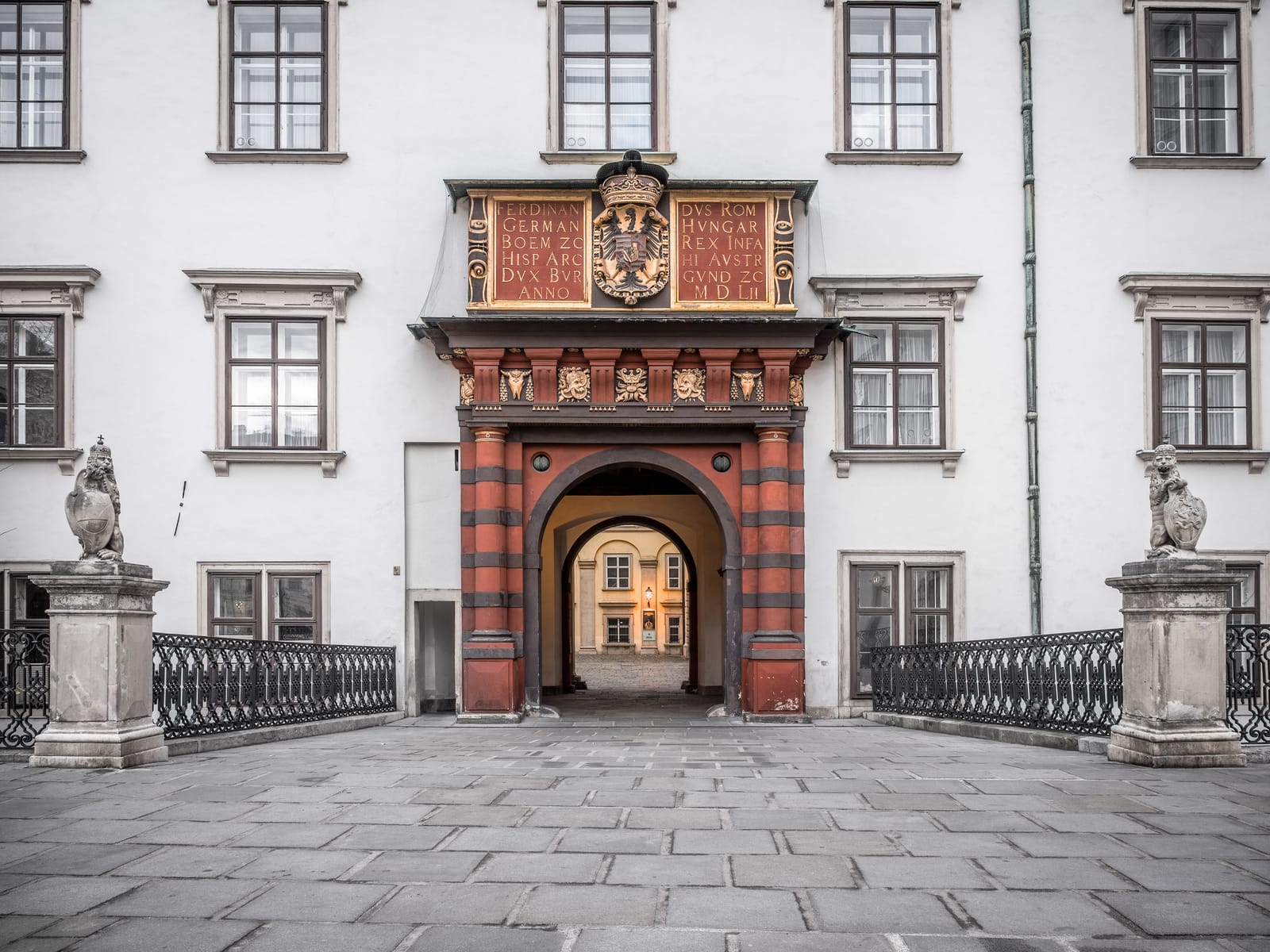
Stop 3 of 5 · In der Burg, the inner palace courtyard, on its south-east side, facing the gate across the old moat bridge; public, no ticket
The Swiss Gate, from In der Burg
Francesco de Pozzo, Pietro Ferrabosco (about 1512–after 1588) and Johann Tscherte, for Ferdinand I · 1552–1553; repainted red and grey 1927; lettering completed 1949 · Stone portal with Doric half-columns, painted red and grey, inscription in gilded bronze letters; its date appears twice, 1552 outside and 1553 on the courtyard side
Look for
- Ferdinand I's titles in gilded letters either side of his crowned arms, ending in the date MDLII; three letters were only restored in 1949.
- The frieze of painted stone rosettes and ox skulls between the Doric half-columns.
- The old moat under the bridge railings: this gate once had a drawbridge.
- Inside the passage, the painted coats of arms on the vault, and the scratched Latin line of 1660 about 70 centimetres up the inner arch.
Transcript (2:14)
You are in In der Burg, the inner courtyard. The red and grey gate on its south-east side is the oldest face the Hofburg shows you. Stand back by the bridge railings and look at it square on.
Behind that plain wall is the core of the medieval castle, the Alte Burg. Its four corner towers are gone, and most of its moat and the drawbridge went too, but not here. When Ferdinand the First rebuilt this entrance wing between 1551 and 1554, he kept the ditch and gave his new gate a drawbridge, on purpose: a portal modelled on a Roman triumphal arch that still behaved like a fortress. The lifting gear was still recorded in 1770. The railings stand on the masonry bridge that replaced it.
The gate dates from 1552, the year spelled out at the end of the inscription: M D L I I. Read the gilded letters either side of the crowned arms and you have Ferdinand's titles: king of the Romans, of Germany, Hungary and Bohemia, Infante of Spain, Archduke of Austria, Duke of Burgundy. Three of those letters are not old. The N in Germany, and the R in Hungary and in Austria, were only put back in the restoration of 1949. The colours are not the first ones either. The gate began in blue-grey, gold and red; at some point between 1763 and 1830 it was painted red and grey, in 1853 plain grey, and in 1927 red and grey again, which is what you see now. The man paid for the painting in the sixteenth century was Pietro Ferrabosco, who spent forty years building fortresses and palaces for the Habsburgs.
The name is younger: it comes from the Swiss Guard, who kept watch here from 1745 to 1767.
If you walk into the passage, look up at the painted vault, with the arms of Austria, Styria, Carniola, Carinthia and Upper Austria. Then look low on the base of the inner arch, about seventy centimetres up, for a line of Latin dated 1660: if God is for us, who can be against us. Legend says Leopold the First scratched it there himself. Beyond lies the Schweizerhof, with the palace chapel of 1449 and the Imperial Treasury, keeper of the regalia of the Holy Roman Empire.
Now turn to your left, to the north-east side of the courtyard. That long front with the Kaisertor in its centre, Lorenzo Mattielli's Labours of Hercules on its portals and the shield of Charles the Sixth rising from its roof edge is the Imperial Chancellery Wing. The Hercules groups on Michaelerplatz were made to match these. And behind those windows is where Franz Joseph lived.
VasuVR, CC BY 4.0, via Wikimedia Commons, cropped. Photo: VasuVR

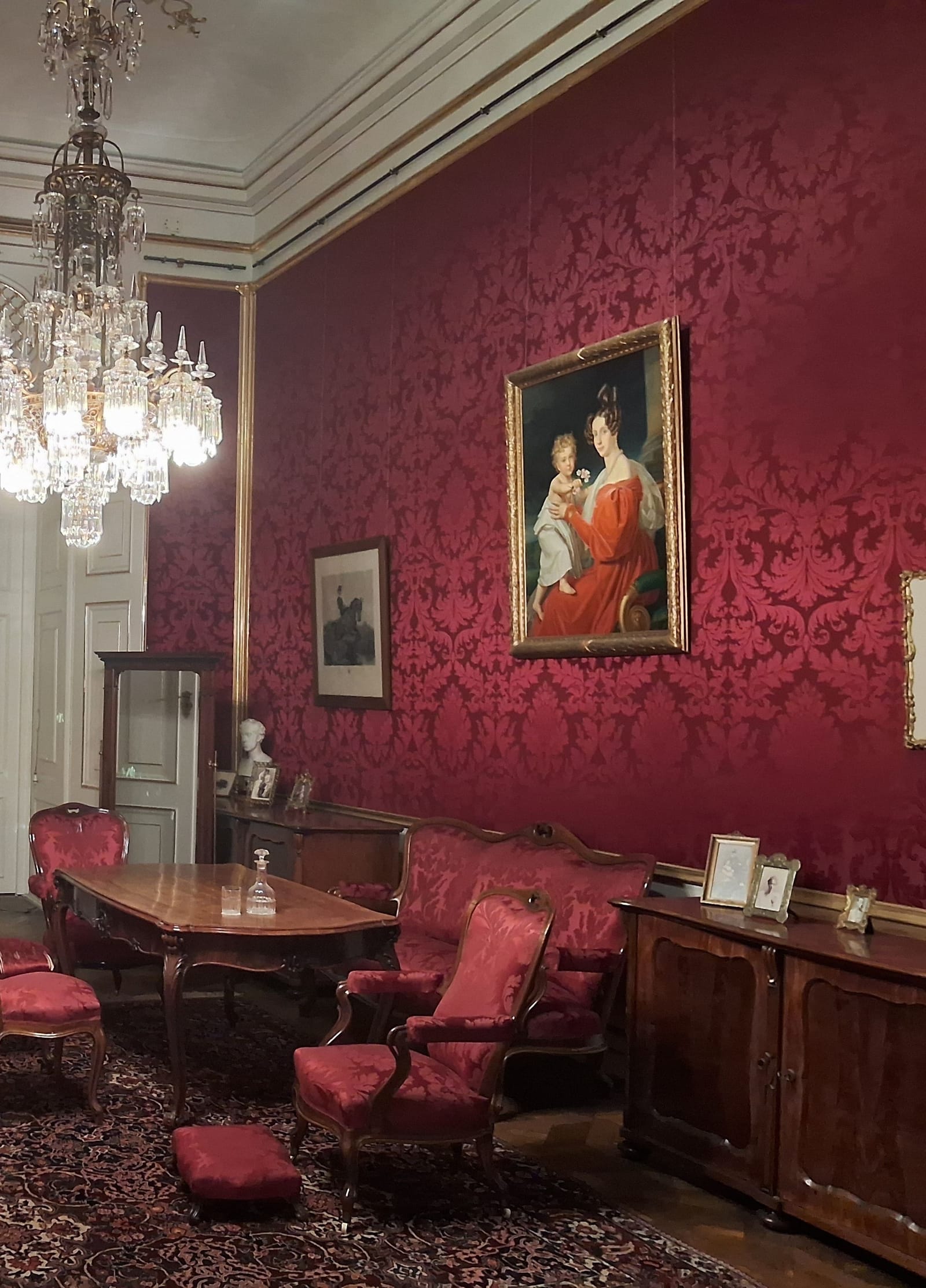
Stop 4 of 5 · Imperial Apartments, Franz Joseph's apartment in the Imperial Chancellery Wing, between the Study and the Large Salon; on the Day ticket Sisi Museum route
Franz Joseph's bedroom
Wing by Joseph Emanuel Fischer von Erlach (1693–1742) after Johann Lucas von Hildebrandt (1668–1745); furnished for Franz Joseph I; portrait of Archduchess Sophie by Joseph Karl Stieler (1781–1858) · Wing 1723–1730s; Franz Joseph's separate bedroom from 1870 · Walls hung with red damask, dark wood furniture and a portable iron bedstead; one of the 24 rooms of the Imperial Apartments
Look for
- Joseph Karl Stieler's portrait above the sofa: Archduchess Sophie with the two-year-old Franz Joseph on her lap.
- The portable iron bedstead, the kind he also set up at Schönbrunn, Budapest and Bad Ischl.
- The prie-dieu, the kneeling stool for his morning and evening prayers.
- The family photographs on the furniture, as in the study next door, which was his drawing room too.
Transcript (2:03)
This is the room where the emperor's day began, and for Franz Joseph the day began at half past three in the morning.
His study is next door. In here his valet woke him at that hour, every day. A bathing assistant then came in and set up a rubber tub for his morning wash, and as soon as he was dressed he went straight next door to the files waiting on his desk. By four he was at work. At six his breakfast was brought to him there, at the desk, with the signed papers on the right and the ones still waiting for him on the left.
Look at how little there is in the room. Red damask on the walls, plain dark wood furniture, and for a bed a portable iron bedstead, painted brown, the same kind he had set up at Schönbrunn, in Budapest, at Laxenburg, Bad Ischl and Gödöllő. A plain folding toilet table completed it. The operator calls it of a piece with his modest way of life, and it is hard to argue.
He did not always sleep here. At first he and Elisabeth shared a bedroom in the Amalia wing. In 1870 he moved into a separate bedroom, here in the Imperial Chancellery Wing.
Now find the large portrait above the sofa. A young woman in a red dress holds a small boy on her lap: Archduchess Sophie, painted by Joseph Karl Stieler, with Franz Joseph aged two. His mother, in other words, on the wall of the room where he woke up.
Elisabeth is here too, in a replica of a portrait of her on horseback at fifteen, already engaged, in front of Schloss Possenhofen. Her father, Duke Max in Bavaria, gave the original to his future son-in-law as a Christmas present. It stayed in private Habsburg ownership until 2017, when it came up at auction and sold for several times its estimate, more than the operator could pay, so a copy hangs in its place.
Look too for the prie-dieu, the kneeling stool on which he said his prayers every morning and every evening.
Set it against the audience chamber in the same apartment, where over his long reign he received around 260,000 people, both of them standing, each audience kept to a few minutes. "Yesterday I had 127, today I will be giving 108 audiences," he wrote to Katharina Schratt. This is where all of that was slept off: in a brown iron camp bed, until half past three.
Michielverbeek, CC BY 4.0, via Wikimedia Commons. Photo: Michielverbeek

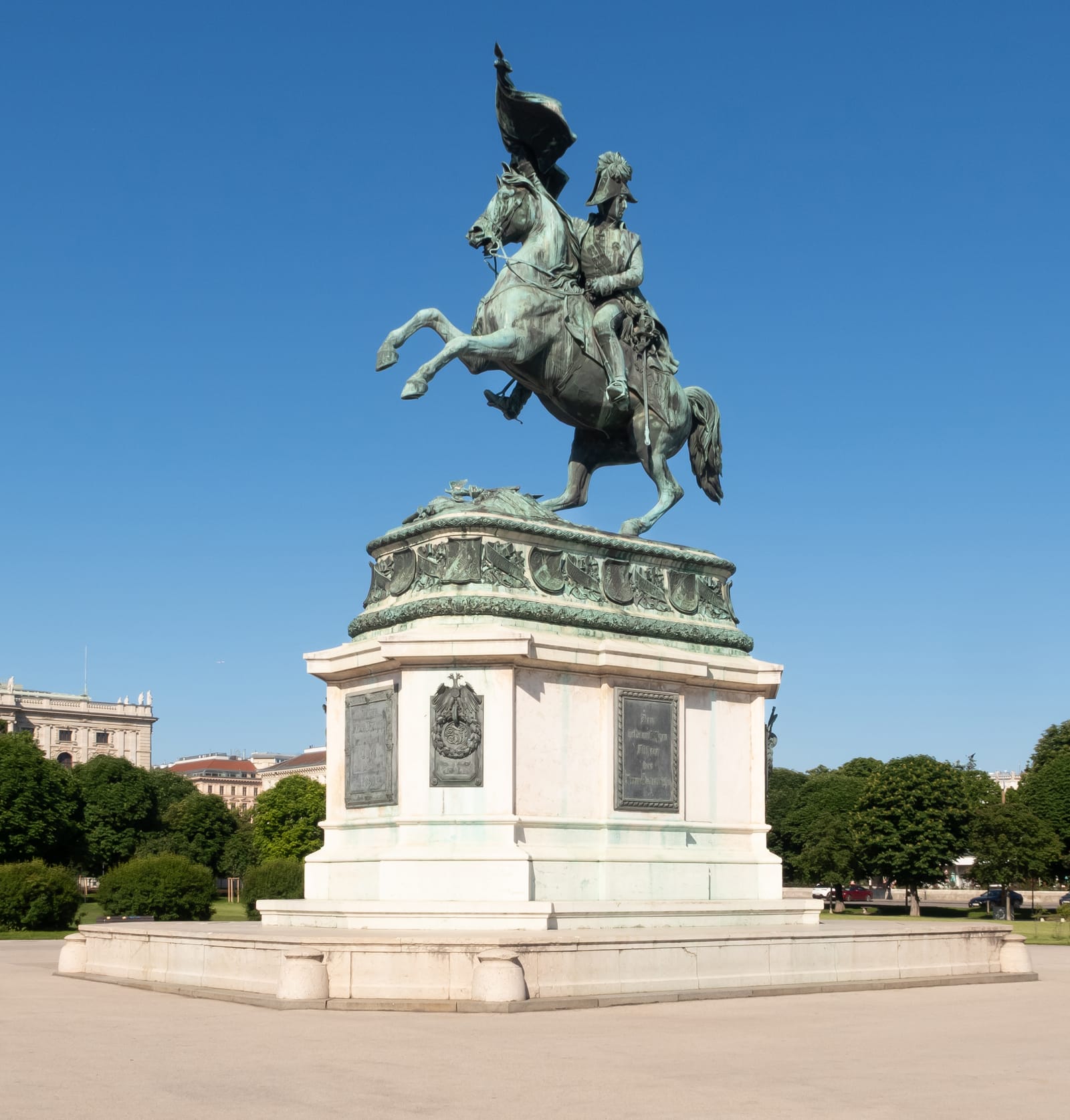
Stop 5 of 5 · Heldenplatz, at the Archduke Charles monument, the rider nearer the Volksgarten, facing south-east across the square to the Neue Burg; public, no ticket; a short walk south of the Ballhausplatz exit
Heldenplatz and the rearing horse of Archduke Charles
Anton Dominik Fernkorn (1813–1878), cast by Franz Pönninger; pedestal by Eduard van der Nüll (1812–1868); commissioned by Franz Joseph I · Modelled 1847; made 1853–1859; unveiled 22 May 1860 · Bronze, cast in eight pieces, on a stone pedestal
Look for
- The horse's two hind legs: the whole statue rests on them. Compare Prince Eugene across the square, whose horse's tail touches the base.
- The bronze plaques on the pedestal, with inscriptions by Theodor von Karajan.
- To the south-east, the curve of the Neue Burg and its balcony.
- To the north-west, the open side of the square and, beyond the Ring, the Parliament, the City Hall and the Burgtheater.
Transcript (2:09)
Out on Ballhausplatz, walk south onto the great open square, Heldenplatz, and stop by the rider nearer the Volksgarten. Look at the horse before the man, because the point of this statue is underneath it.
The horse is rearing, and it stands on its two hind legs alone. For a bronze of this size that is a feat of balance, and Anton Dominik Fernkorn, sculptor and bronze founder, managed it exactly once. Look across the square at the other rider, Prince Eugene: there the horse's tail comes down to touch the pedestal. Fernkorn could not repeat the trick. By the time Prince Eugene was unveiled in 1865, illness had ended his working life and his pupils had finished it for him, and a popular view at the time held that the failure itself had broken him.
The man on this horse is Archduke Charles, who beat Napoleon at Aspern on the twenty-first and twenty-second of May 1809. The pose, flag in hand, is modelled on a famous painting by Johann Peter Krafft. Fernkorn made a bronze model in 1847, Franz Joseph confirmed the commission in 1853, and the statue was cast in eight pieces. Read the plaques on the pedestal. The words are by Theodor von Karajan, approved in 1858 on the recommendation of the poet Grillparzer. The dedication says 1859, because the unveiling was planned for the fiftieth anniversary of Aspern. Then came the military setbacks in northern Italy that year, and the ceremony was put off until the twenty-second of May 1860.
Now turn to the south-east. The great curved wing with its colonnade is the Neue Burg, finished in 1913, one half of an imperial forum that was never completed. Its twin was meant to rise on the Volksgarten side, and never did. That gap is why, if you turn north-west, the square stays open to the Ring, with the Parliament, the City Hall and the Burgtheater in view. It was from the balcony of the Neue Burg that Adolf Hitler proclaimed the Anschluss of Austria to the crowd on this square, on the fifteenth of March 1938.
To the south stands the Outer Castle Gate, put up in 1824 in honour of the veterans of the Napoleonic Wars, and rebuilt as a war memorial in 1933 and 1934.
The square only took its name, Heldenplatz, the Heroes' Square, in 1878, from the two commanders on horseback. Before you go, look up at this one once more: eight pieces of bronze, one field marshal, and all of it resting on two hind legs.
Independent guide · Chiaro
Point Chiaro at anything at the Hofburg.
Five places out of 2,600 rooms is a sampler, not a tour. Aim your camera at a Hercules on the Michaeler front, a coat of arms in the Swiss Gate's vault or a portrait in the apartments that has no label near it, and Chiaro identifies it, names the maker or the patron, explains why it is there, and takes your follow-up questions all the way out to Heldenplatz.
Before you go
Getting there
Hofburg, Michaelerkuppel, 1010 Vienna. Stops one to three are on public ground: Michaelerplatz, the hall under the Michaeler dome and the courtyard In der Burg. With a ticket you go in directly below the dome; if you still need one, individual tickets are sold in In der Burg, to the left of the Kaisertor. The way out is on Ballhausplatz, not where you came in.
Underground line U3 (orange) to Herrengasse. Trams 1, 2, D and 71 to Burgring; buses 1A and 2A to Hofburg. From Westbahnhof, about 15 minutes on the eastbound U3; from Meidling, about 25 minutes, taking the U6 to Westbahnhof and changing to the eastbound U3; from the airport, about an hour, by the S7 to Wien Mitte and then the westbound U3.
Tickets and entry
- Admission is by fixed time slot, and the operator guarantees entry only with an online ticket for a booked slot. Genuine tickets are sold online only at imperialtickets.com; the operator warns about fake ticket sites. The Day ticket Sisi Museum covers the Sisi Museum and the Imperial Apartments, about 60 minutes, and costs 20 euros for an adult, 12 for a child from 6 to 18 and 18 for a student from 19 to 25; with a guided tour it is 25 and 17. The operator announces seasonal price changes from 19 November 2026.
- From 6 October to 18 November 2026 the museum section of the Sisi Museum is shut for the last phase of its refurbishment, while the Imperial Apartments stay open; hours are then 10 am to 4.30 pm, the ticket office closes at 4 pm, and the standard ticket is 25 per cent cheaper. Outside that period it opens daily, holidays too, 9 am to 5.30 pm, with last admission at 4.30 pm. The Silver Collection has been closed since 1 April 2023 until further notice.
- Leave suitcases, large bags and scooters behind: bulky items are not allowed in, and because the exit is elsewhere there is no cloakroom or left-luggage. Photography for personal use is allowed, without tripods, selfie sticks or flash. There is a lift at the entrance and at the exit, and wheelchairs can be borrowed free at the turnstile against an ID.
The official audio guide
The operator's own audio guide is free of charge, in 14 languages, for the Sisi Museum and the Imperial Apartments, and guided tours in German and English run every day as the Day ticket with guided tour. Both begin once you are through the entrance under the dome. This independent page begins earlier, on the square outside, carries on after the exit on Ballhausplatz, and prints the words of every stop under its player, so it works as well read as heard.
Official site →Questions
Is there a free Hofburg audio guide?
There are two, and they cover different ground. Inside, the operator's own audio guide is free of charge in 14 languages for the Sisi Museum and the Imperial Apartments. Outside, before and after, there is this page: five recorded stops from Michaelerplatz to Heldenplatz, four of them on public ground, each with its full text under the player. Aim the Chiaro app at a statue, portrait or gateway that neither of them covers, and it will narrate that too.
Can I listen to the Hofburg audio guide without a ticket?
Yes, for all but one stop. Michaelerplatz, the hall under the Michaeler dome, the courtyard In der Burg and Heldenplatz are all public. Only Franz Joseph's bedroom is inside the Imperial Apartments, which need the Day ticket Sisi Museum with a fixed admission time.
How much is the official Hofburg audio guide?
Nothing: the operator offers it free of charge in 14 languages. Admission is the only cost: 20 euros for an adult Day ticket Sisi Museum, or 25 with a guided tour. From 6 October to 18 November 2026 the standard ticket is 25 per cent cheaper. The operator announces seasonal price changes from 19 November 2026.
Where is the Hofburg entrance, and where do I come out?
You go in directly below the great copper dome on Michaelerplatz, where the second stop is played. Tickets for individual visitors are sold in the inner courtyard, In der Burg, to the left of the Kaisertor. The exit is on Ballhausplatz, and Heldenplatz, the fifth stop, is a short walk south of it.
Is the Hofburg open every day?
Yes, daily and on public holidays, 9 am to 5.30 pm, with last admission at 4.30 pm. From 6 October to 18 November 2026 the hours are 10 am to 4.30 pm and the ticket office closes at 4 pm; in that period the museum section of the Sisi Museum is closed but the Imperial Apartments stay open.
Is the Silver Collection open?
No. It has been closed since 1 April 2023 until further notice. The operator is expanding the exhibition rooms and creating a new tour across the Sisi Museum, the Imperial Apartments and the Silver Collection, and says visitor access to the Sisi Museum and the Imperial Apartments continues as normal while that happens.
More audio guides
Made by Chiaro. Not affiliated with Hofburg.