
St Stephen's Cathedral · Vienna · Independent guide
St Stephen's Cathedral audio guide,
five stops, free.
A Romanesque doorway of about 1230 under a South Tower 136.4 metres tall and finished in 1433: hear five places in Vienna's cathedral here, then hold Chiaro's camera up to any carving, tomb or altar in between and ask what it is.
Made by Chiaro. Not affiliated with St Stephen's Cathedral.
The Giant's Door and the Heathen Towers
St Stephen's Cathedral, Vienna
That was the free part
Chiaro narrates anything at St Stephen's Cathedral from a photo.
The five stops · 11 minutes of audio
Five places, one walk,
in the order you will walk them.
Vienna's cathedral lets you walk in for nothing and charges for most of what lies beyond the door, so this self-guided St Stephen's Cathedral audio guide is laid out around that line. Stop one is on Stephansplatz, facing the Giant's Door at the centre of the west front. Stop two is just inside that door, in the free area at the back of the church, looking east down the nave. The third, the pulpit on the second pillar on the left, is in the part of the nave the cathedral's sightseeing ticket covers. The North Tower lift, stop four, leaves from inside the church on the north side and has a ticket of its own; the South Tower, stop five, is climbed from a separate door outside on the south side, on another ticket. Heard one after another, the five narrations fill about ten minutes, and on foot the whole route is a few hundred metres on the level, plus a lift ride and 343 steps.
What this page tells you about hours, tickets and doors was taken from stephanskirche.at, the cathedral administration's own visitor site, on 27 September 2026, while the history in the recordings, each date and each measurement, was checked against a second, independent source. St Stephen's is a working cathedral where services come first, so sightseeing can stop at short notice: when the staff at the door or a sign in the church tells you something this page does not, go by them, and send us a note so we can put it right.
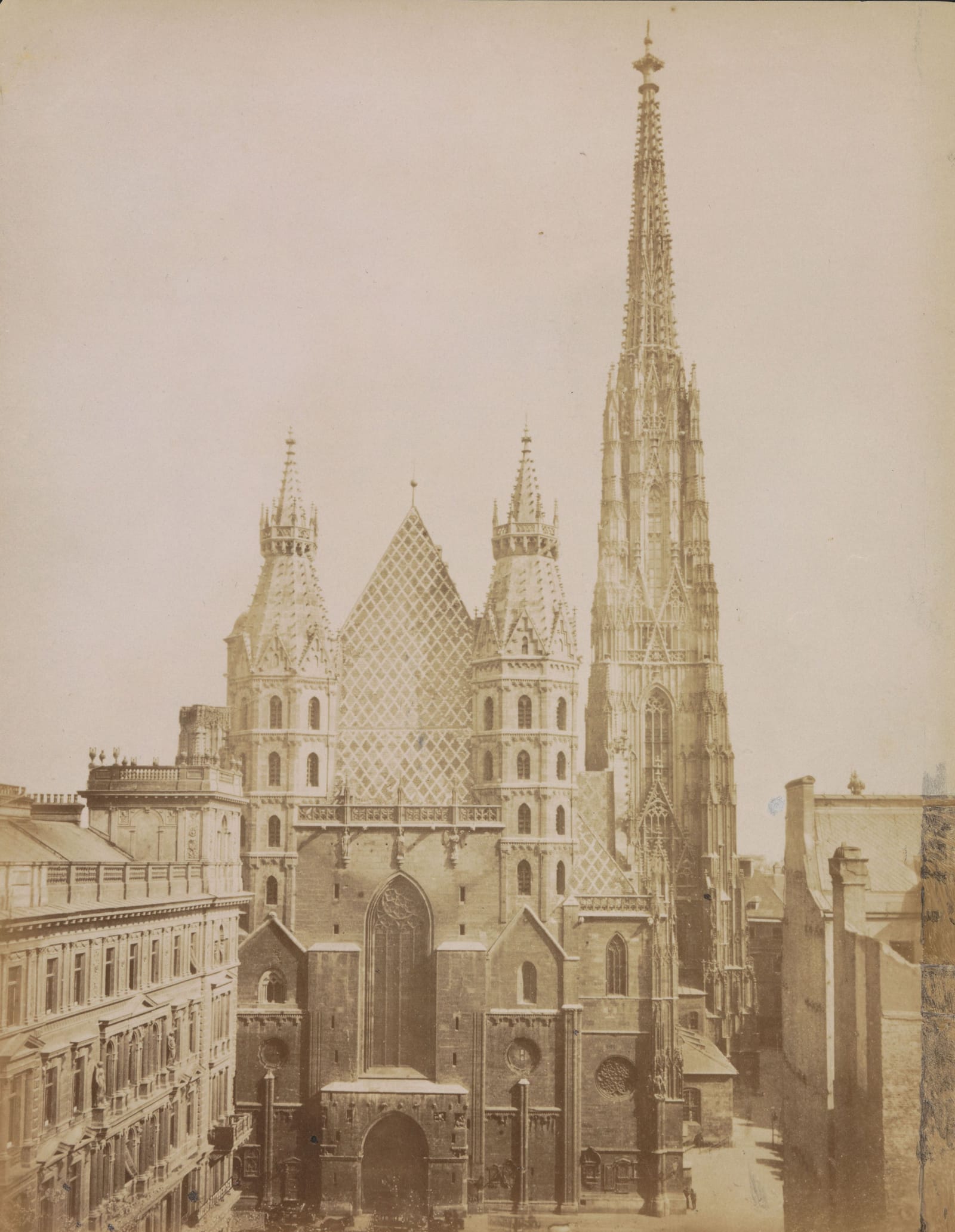
Rijksmuseum, CC0, via Wikimedia Commons. Photo: Rijksmuseum

Stop 1 of 5 · Stephansplatz, west side, facing the Riesentor, the main portal, opposite the U-Bahn exit
The Giant's Door and the Heathen Towers
Anonymous Romanesque masons of the second parish church, about 1230–1250; the Gothic west window added about 1420 · Portal and towers 1230–1250; west window broken through about 1420 · Limestone; a funnel-shaped Romanesque portal with a clear opening of 2.4 metres, between two Heathen Towers of 65.3 and 66.3 metres
Look for
- The two iron bars set into the wall to the left of the door: the Viennese linen and cloth ells, 89.6 and 77.6 centimetres, where anyone could check a merchant's measure.
- Christ enthroned in the tympanum over the door, an angel on either side, with one knee bare, a detail nobody has explained.
- The two Heathen Towers either side of the portal: 65.3 and 66.3 metres high and a metre different in width, not quite a pair.
- The carved sign O5 on the west side, the mark of the Austrian resistance of 1938 to 1945, first painted and later cut into the stone.
Transcript (2:05)
Stand far enough back on the square to take in the whole west front, and you will see it is not one building but several, stacked. The dark wall around the doorway and the two slim towers either side of it are the oldest things you will see today: Romanesque work of about 1230 to 1250, from the church that stood here before the Gothic cathedral grew up around it and swallowed it. The tall pointed window above the door was only broken through that old wall around 1420. And the great tower rising behind on your right, the Steffl, belongs to the Gothic church.
The doorway is the Riesentor, the Giant's Door. The colourful explanation is a bone. In the fifteenth century, while the foundations of the North Tower were being dug, workmen found an enormous thighbone, in fact a mammoth's, and since it could only have come from a giant, it was hung up in the porch. The dull explanation, which the cathedral's own support association prefers, is the Middle High German word risen, to sink or to fall, because the portal funnels inwards, each arch set deeper than the last.
The opening is only 2.4 metres wide. In November 1711, when the old Pummerin bell was hauled here from the foundry, it would not go through: the door posts had to come out, and a square was cut from the bottom of the carved tympanum and put back afterwards. In October 1957 the new Pummerin came in the same way, and again stones had to be removed.
Look up into that tympanum. Christ sits in an almond-shaped frame as ruler of the world, an angel either side, and one of his knees is bare. Nobody knows why; one theory links it to initiation rites in the medieval masons' lodges. Below him dragons, lions and basilisks crawl through the frieze, the powers of evil kept outside the door, and the carved interlace on the columns was meant to bind them there.
The two towers are the Heidentürme, the Heathen Towers, probably because they were built with stone from an old Roman wall, heathen work to a medieval Christian. They are 65.3 and 66.3 metres high and a metre different in width.
Before you go in, look at the wall to the left of the door. Two iron bars are set into the stone: the Viennese ells, the city's legal lengths for linen and for cloth, 89.6 and 77.6 centimetres, where anyone could check a merchant's measure. The round hollow above them is said to show the size a loaf of bread had to be. It is only a worn fitting for the door.
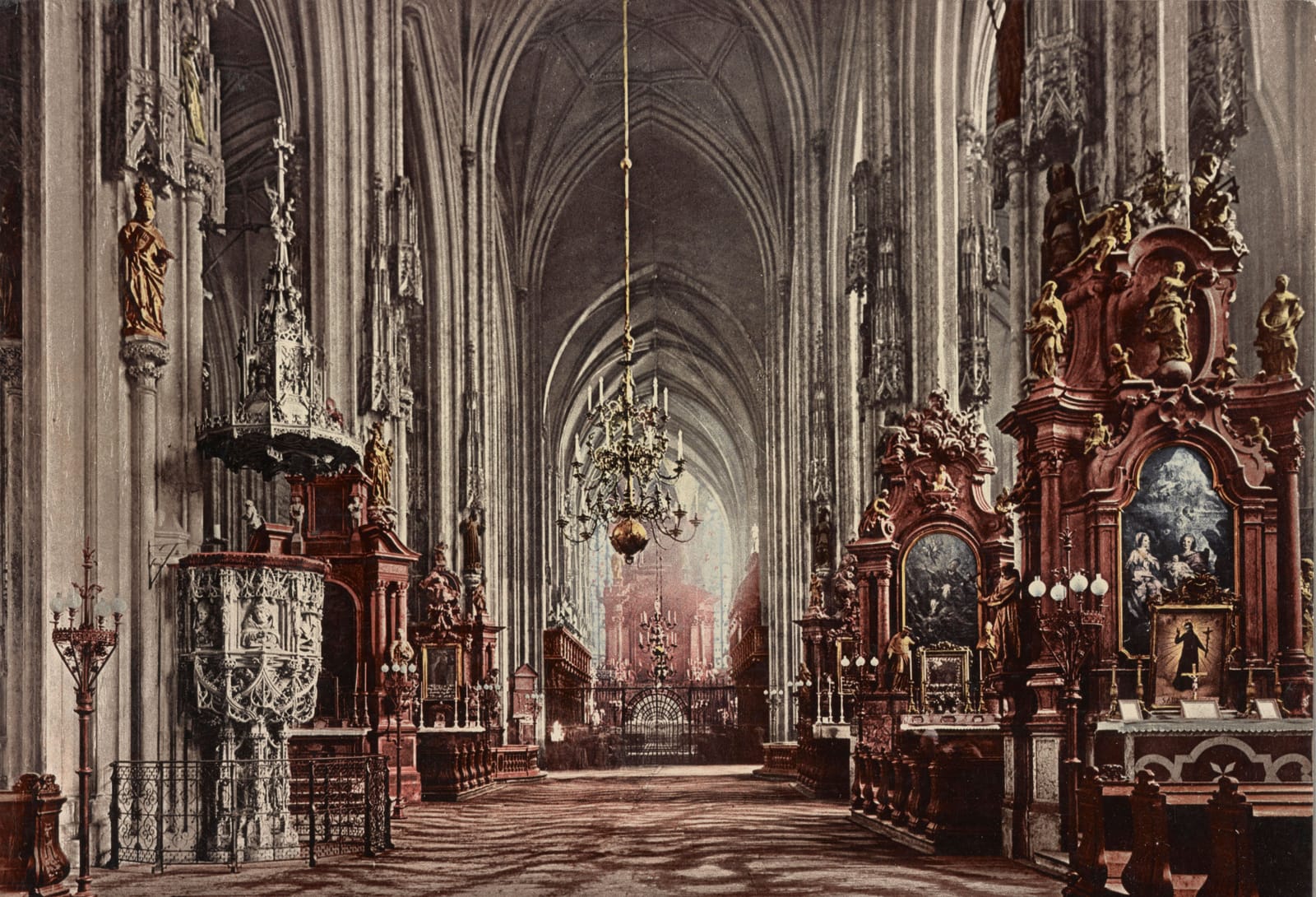
Photoglob Co., publisher, Public domain, via Wikimedia Commons. Photo: Photoglob Co., publisher

Stop 2 of 5 · Just inside the Riesentor, in the free area at the back of the church, facing east down the nave
The nave, from the free area inside the Giant's Door
Hans Puchsbaum and the cathedral lodge for the Gothic nave; the high altar at the far end by the brothers Johann Jakob and Tobias Pock for Bishop Philipp Friedrich Graf Breuner · Nave walls from 1359, vaulted 1446–1474; high altar 1641–1647; rebuilt after the fire of 12 April 1945 and reopened on 26 April 1952 · Limestone hall church, 107 metres long and 40 metres wide, under a steel roof frame of about 600 tonnes that replaced the burnt larch-wood truss
Look for
- The high altar at the far end, black marble almost to the top of the choir, with the stoning of Saint Stephen as its altarpiece: the Pock brothers' work of 1641 to 1647.
- The figures on the pillars, standing in groups under stone canopies all the way down the nave: seventy-seven of them, given by Viennese citizens.
- The pulpit on the second pillar on your left, its stair winding round the pier; it survived 1945 inside a brick shell.
Transcript (2:08)
You are inside now, just past the Giant's Door, at the back of the church. Stand still for a moment and let your eyes go where the builders meant them to: straight down the whole length of the nave to the high altar at the far end.
That altar is marble, mostly black Polish marble, and it rises almost the full height of the Gothic choir. The brothers Johann Jakob and Tobias Pock built it between 1641 and 1647 for Bishop Philipp Friedrich Graf Breuner, and the painting at its centre is the stoning of Saint Stephen, the patron of this church, with heaven opening above him and Christ waiting. Every twenty-sixth of December, his feast day, the midday sun reaches his image on that altar.
Now look at the pillars nearer to you. Each one carries figures standing in groups under stone canopies, seventy-seven of them along the nave, and they were given by the citizens of Vienna, a procession in stone leading your eye to the altar. The vault above them was begun in the 1440s, when Hans Puchsbaum was master of the works, and closed in 1474.
Everything above that vault, the whole roof, dates from 1950. In the night to the twelfth of April 1945, in the last days of the fighting for Vienna, fire reached the cathedral's roof from burning buildings around the square. For decades people said the Russians had shot it into flames, or the Germans had; eyewitnesses tell a plainer story, of looters setting fire to the neighbouring houses, and sparks drifting in through holes the battle had already torn in the roof. The medieval roof frame, two thousand cubic metres of larch, burned out. A supporting wall in the roof space crashed through the vaults of the choir, and the bells, the organ and the carved Gothic choir stalls were lost.
It could have been worse. Two days earlier, when a white flag was raised on the tower, the city commandant, Sepp Dietrich, ordered the cathedral reduced to rubble with a hundred shells. A Wehrmacht captain, Gerhard Klinkicht, refused, and a plaque on the cathedral remembers him for it. And the most precious things in here had been walled into brick shells, which is why the pulpit on the second pillar to your left came through.
The rebuilding took seven years. The new roof frame is steel, 605 tonnes of it, built to the old height and the old pitch, and the Austrian federal states helped pay for it. On the twenty-sixth of April 1952 the cathedral reopened, and the same day a new great bell rolled into Stephansplatz to a cheering crowd.
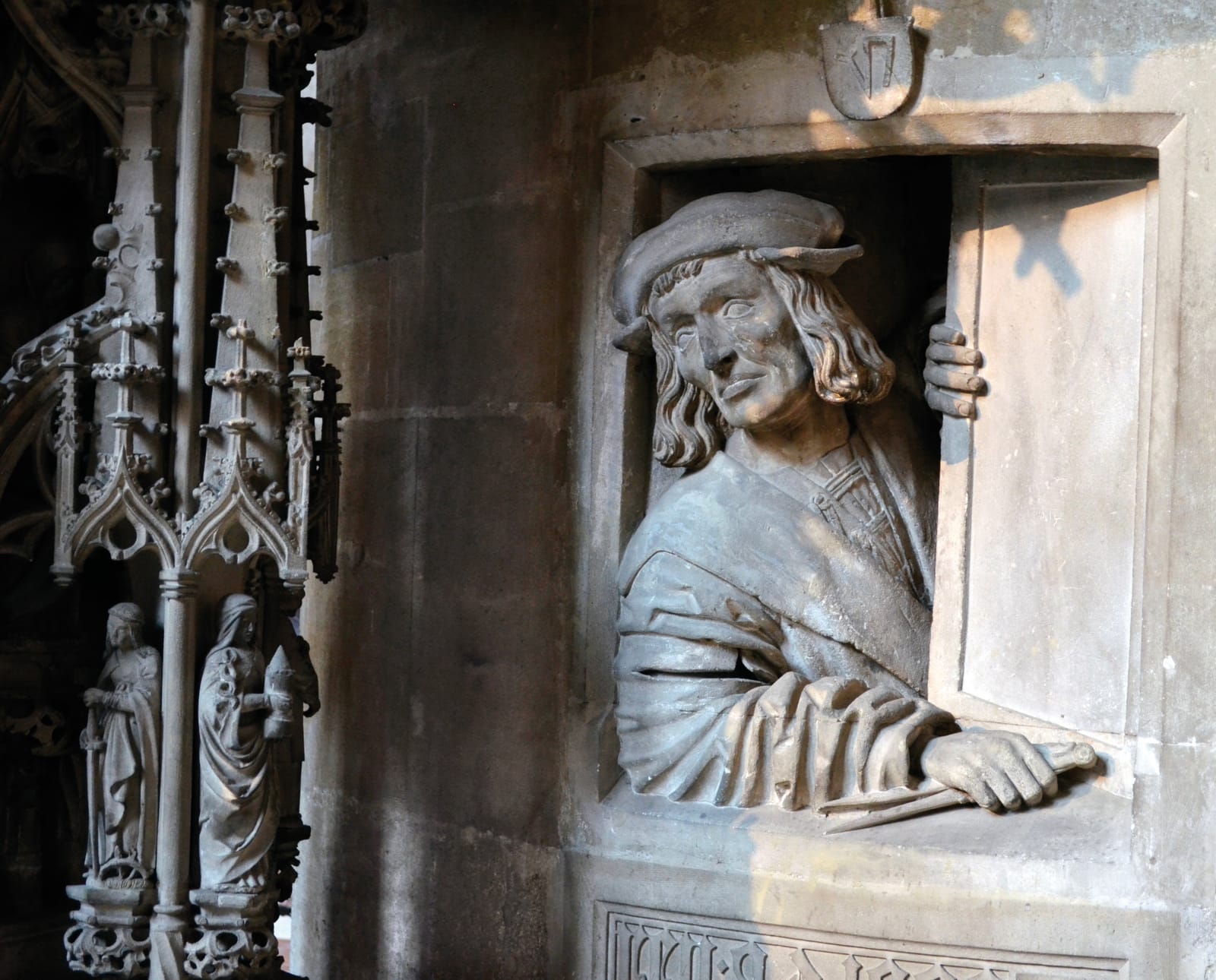
Jim.kovic, CC0, via Wikimedia Commons. Photo: Jim.kovic

Stop 3 of 5 · Nave, second pier of the northern row counting from the Riesentor, inside the ticketed part of the nave; the Fenstergucker is at the foot of the stair on the north-aisle side
The pulpit, and the man at the window beneath it
Long attributed to the cathedral master Anton Pilgram (about 1460–1515), now more often to a master following Niclaes Gerhaert van Leyden; the attribution is still debated. Restored 1878–1880 under Friedrich von Schmidt · About 1510–1515 (some date it about 1500) · Breitenbrunn sandstone, the foot cut from three blocks; a stair of 15 steps winds round the pier to the pulpit
Look for
- The Fenstergucker at the foot of the stair, leaning out of a stone window with a pair of compasses in his hand, a mason's mark on the shield above him.
- The frogs and lizards fighting their way up the stair rail, and the small stone dog waiting at the top.
- The four Fathers of the Church on the basket, each a different temperament; Gregory the Great holds a magnifying glass.
- The letters REN. A. D. 1880 under the window-gazer, the signature of the nineteenth-century restorers.
Transcript (2:08)
Walk up to the second pillar on the left and look for the stone flower. It is the best description anyone has found for this pulpit: the basket where the preacher stood bursts out of its stem like a blossom, carved from a fine, pale sandstone from Breitenbrunn, between about 1510 and 1515.
It stands out here in the nave, against a pillar, instead of up at the front, for a practical reason. Sermons were preached in the language of the congregation, and before microphones the preacher had to be among the people to be heard at all.
Four faces look out from the basket: the four Fathers of the Latin Church, and each one is also one of the four temperaments and one of the four ages of life. From the left, Augustine with his inkwell is the melancholic; Pope Gregory the Great, holding a magnifying glass, the phlegmatic; Jerome in his cardinal's hat, the choleric; Ambrose, the sanguine.
Now follow the stair as it winds round the pillar. The handrail is alive. Frogs and lizards crawl up it, biting one another: the lizards, who come out into the sun, stand for good, and the frogs, who keep to the swamp, for evil. At the top, where the preacher stepped in, sits a small stone dog, the little dog without fear, there to make sure none of them gets any further.
Then look down to the foot of the stair, and find the man at the window. He leans out of a stone opening in a cap, holding a pair of compasses, the tool of a master builder, and he looks rather sure of himself. The Viennese call him the Fenstergucker, the window-gazer. For centuries he was taken for the cathedral master Anton Pilgram, because Pilgram's mason's mark is carved on the little shield above him, and the whole thing was called the Pilgram pulpit. That attribution is debated. The design is now more often given to a master working in the manner of the great Netherlandish sculptor Niclaes Gerhaert van Leyden, with Pilgram perhaps among the carvers; and the newest research says the window-gazer may be Pilgram after all.
Under him you can read the letters REN. A. D. 1880. That is the restorers' signature, from the campaign under Friedrich von Schmidt that took the pulpit apart and stripped off its old oil paint, and with it, sadly, every trace of the original colour.
It is still used, in Advent and in Lent. On the seventh of October 1938, under Nazi rule, Cardinal Innitzer preached to the young people of Vienna from this basket. The next day the Hitler Youth stormed the archbishop's palace.
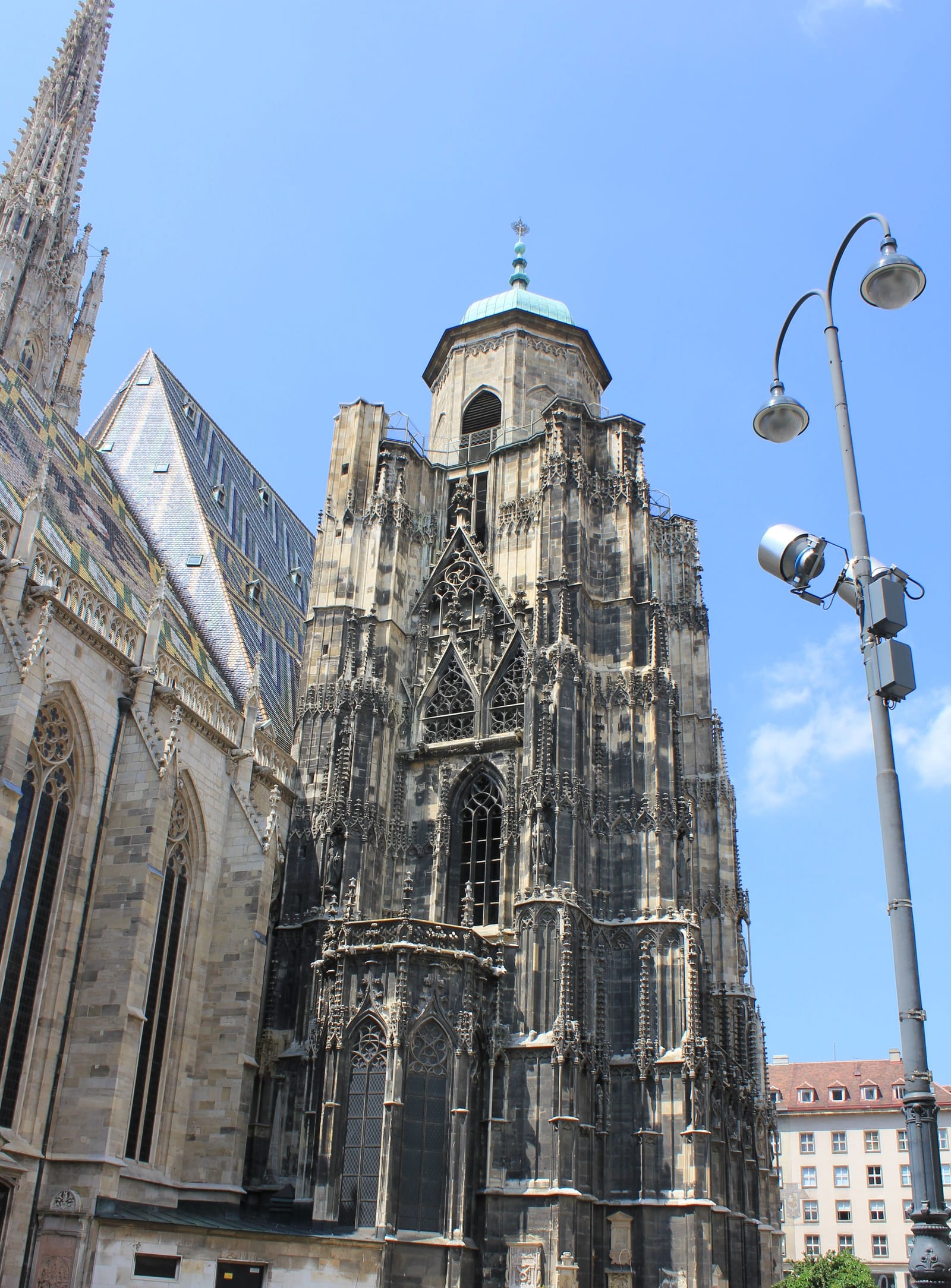
Perituss, CC0, via Wikimedia Commons. Photo: Perituss

Stop 4 of 5 · North Tower, on the north side of the church; the lift to the open platform beside the bell starts from the north aisle, a short walk from the main door
The North Tower and the Pummerin
Begun under Emperor Frederick III, to a design attributed to Hans Puchsbaum; the Renaissance cap by the brothers Hans and Caspar Saphoy; the Pummerin cast in 1951 at Sankt Florian in Upper Austria · Substructure from 1450, foundation stone about 1467, work stopped in 1511; cap 1578; Pummerin hung here in October 1957 · Stone tower stump, 68.3 metres high to the top of its cap; the Pummerin is a bronze bell 314 centimetres across the mouth
Look for
- From the square before you go up: the small Renaissance cap of 1578 sitting on a stone stump that stops at about half the height of the South Tower.
- The double eagle on the very top of the cap, which gave the North Tower its other name, the Eagle Tower.
- The roof beside the platform: over the choir on the north side, the tiles form the arms of the City of Vienna and the Republic of Austria, with the year 1950.
Transcript (2:06)
Up here on the platform of the North Tower you are standing beside the largest bell in Austria, on top of a tower that was never finished.
It was meant to be a twin for the great South Tower. Its substructure was begun under Emperor Frederick the Third in 1450, and the first foundation stone was laid seventeen years later. Then the Reformation and the Ottoman armies advancing on Vienna arrived together, and the city needed its walls far more than a second spire. The last course of stones carries the year 1511. The Viennese tell it differently: the young builder Hans Puchsbaum, they say, sold his soul to the devil to finish the tower in a single year and win his master's daughter, on one condition: that he never speak the name of God or of any saint. The girl was called Maria.
In 1578 the brothers Hans and Caspar Saphoy put the small Renaissance cap on the stump, with the double eagle of the House of Austria on top, which is why this is also called the Adlerturm, the Eagle Tower. It stands 68.3 metres high, about half the height of its neighbour.
Now the bell. The old Pummerin was cast in 1711 from cannon the Ottoman army left behind after the siege of 1683, and it hung in the South Tower until the twelfth of April 1945, when its burning timber frame collapsed and the bell crashed down and shattered. The new Pummerin was a gift from the province of Upper Austria, cast at Sankt Florian, and not at the first try: in October 1950 a beam gave way, the molten bronze ran out and set the spectators' stand on fire. The second pour, on the fifth of September 1951, worked. The bell is 314 centimetres across the mouth, weighs more than twenty tonnes, and is the third largest in western and central Europe.
It came to Vienna on a low-loader in April 1952, through the Soviet zone, where the soldiers waved the convoy through without checking its papers, and a cheering crowd met it on Stephansplatz. It hangs here rather than in the South Tower because the old bell had already strained that slender tower, and the fire had weakened it further.
It rings only on the great feasts and on special occasions, and every New Year's night it is broadcast on radio and television, just before the Blue Danube waltz. Before you go down, look over the edge at the roof beside you: on the north side above the choir, the glazed tiles spell out the arms of the City of Vienna and of the Republic of Austria, with the year 1950.
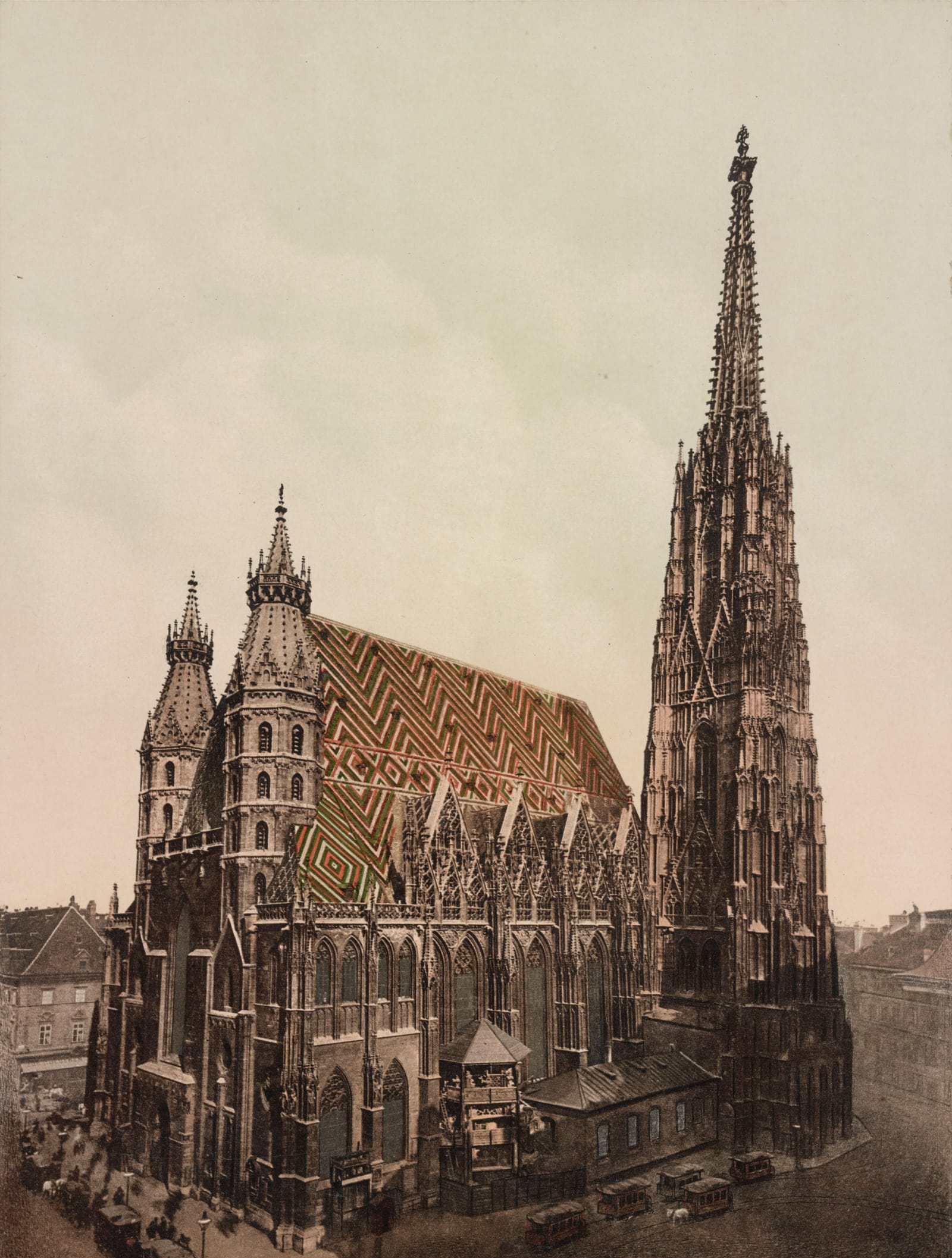
Photoglob Co., publisher, Public domain, via Wikimedia Commons. Photo: Photoglob Co., publisher

Stop 5 of 5 · South side of the cathedral, outside: the tower entrance is reached from Stephansplatz, tucked behind the tower opposite the Curhaus at Stephansplatz 3
The South Tower, 343 steps to the watchmen's room
Founded by Duke Rudolf IV; built above the eaves to Peter von Prachatitz's design and finished under Hans von Prachatitz; the top rebuilt by Friedrich von Schmidt · 1359–1433; the top removed in 1860 by Leopold Ernst and rebuilt in stone 1862–1864 by Friedrich von Schmidt · Limestone tower, 136.4 metres high with its crown; the Türmerstube, the watchmen's room, sits 67 metres up at the top of 343 steps
Look for
- From Stephansplatz before you climb: the double cross and double eagle at the tip, 136.4 metres up, set there on the emperor's birthday in 1864.
- From the Türmerstube: the zigzag tiles of the nave roof below you, and over the choir on the south side the double-headed eagle picked out in tiles with the year 1831.
- The watchmen's room itself, 67 metres up at the top of the 343 steps, where a fire watch was kept from 1534 until the last day of 1955.
Transcript (2:27)
Three hundred and forty-three steps, and you are in the Türmerstube, the watchmen's room, sixty-seven metres above Stephansplatz. It is the highest point of the cathedral open to visitors. Above you the tower carries on for almost seventy metres more, to 136.4 metres at the tip, and only the staff of the cathedral works go further, climbing out at about a hundred and ten metres onto an iron ladder on the outside.
For 421 years someone was on duty in this room. From 1534, five years after the first Ottoman siege, the city kept a fire watchman up here. If he saw a fire, he waved a red flag towards it by day or a red lantern by night, called the alarm down to the streets through a tin speaking-trumpet, and sent a written message down a tube to the tower master below, who alerted the fire guard. The last watchman came down on the thirty-first of December 1955. And in 1529 and again in 1683, with Ottoman armies outside the walls, this tower was the main observation and command post for the defence of the city.
It went up fast at the end. Duke Rudolf the Fourth laid the foundation stone in 1359, but by about 1400 the tower stood only twenty metres high. The remaining hundred metres and more rose in roughly thirty years, to the design of Peter von Prachatitz, and were finished under Hans von Prachatitz in 1433. For six years, until Strasbourg completed its minster tower in 1439, nothing in continental Europe was taller.
The very top is not medieval. French guns damaged the spire in 1809, and a repair between 1839 and 1842 made things worse: the stone ornament was hung on an iron core, the iron rusted, and the rust burst the stones. In 1860 the top was taken down, and Friedrich von Schmidt rebuilt it in stone, the medieval way, between 1862 and 1864. On the eighteenth of August 1864, the emperor's birthday, a new cross and eagle went up. Before that the tip had carried a sun and a crescent moon, which after the siege of 1529 looked uncomfortably Ottoman to the Viennese; it took until 1686 to replace them.
The tower has sunk about thirty centimetres into the ground under its own weight, though that movement stopped long ago, and after about thirty years of restoration it has stood free of scaffolding since the autumn of 2025.
Now look down at the roof. Two hundred and thirty thousand glazed tiles, laid in zigzags over the nave, on a slope that reaches eighty degrees at its steepest, so steep that the rain washes it clean and snow slides off before it can hide the colours. And over the choir, on this south side, the tiles form a double-headed eagle, the arms of the Austrian Empire, with the year 1831.
Independent guide · Chiaro
Point Chiaro at anything at St Stephen's Cathedral.
Seventy-seven figures stand on the nave pillars alone, and 230,000 glazed tiles cover the roof above them. Aim your phone at a saint under a stone canopy, a tombstone set into the outer wall or a gargoyle on a buttress, and Chiaro names it, says who paid for it and when, and keeps going while you still have something to ask.
Before you go
Getting there
Stephansplatz 3, 1010 Wien. Go in by the Riesentor, the main door at the centre of the west front, opposite the stairs down to the U-Bahn; that entrance is step-free. The South Tower has a door of its own outside, on the south side, tucked behind the tower opposite the Curhaus.
Stephansplatz station, on U-Bahn lines U1 and U3, opens onto the square in front of the west front, and buses 1A and 3A stop at Stephansplatz as well. From the airport, the City Airport Train runs to Wien Mitte, where you change to the U3; from the Hauptbahnhof the U1 comes straight here, and from the Westbahnhof the U3.
Tickets and entry
- Walking into the church costs nothing, and its doors stay open until 22.00, from 06.00 on weekdays and Saturdays and from 07.00 on Sundays and holidays. Going further than the entrance area needs the cathedral visit ticket, 8 euros, or 3 for a child up to 14, with no booking. Sightseeing hours are 09.00–11.30 and 13.00–16.30, and on Sundays and holidays only the afternoon slot runs; services and other events can cut into them, so look at the cathedral's calendar for your day.
- Each tower is its own ticket, 8 euros for an adult, and neither needs booking. The North Tower lift runs daily 9.00–19.00, last ride up 18.30, and its door is 56 centimetres wide; the South Tower keeps the same 9.00–19.00 hours with a last climb at 18.15, by stairs only. The All-Inclusive ticket, 29 euros for an adult with one child under 14 free, covers the cathedral visit with a smartphone audio guide, both towers, a catacombs tour and the Dom Museum Wien, and stays valid for a year.
- The catacombs are shown only on a guided tour, 8 euros for adults, which starts at the catacombs stair inside the church several times a day. They are not step-free: 22 steps down and 43 back up.
- Photography and filming are for private use only, and tripods are not allowed. The cathedral asks everyone to dress as suits a church, and men to take off their hats.
The official audio guide
The cathedral's own guides lead a public tour in English at 10.30 and in German at 15.30, Monday to Friday, for 8 euros an adult and 3 a child, starting in front of the Domshop, and no booking is needed. For an independent visit you can rent an audio guide at the ticket counter just inside the main door, and the All-Inclusive ticket includes a digital audio guide for your own smartphone. This page does a different job: it starts outside on the square, follows you up both towers, and prints every recording in full beneath its player.
Official site →Questions
Is there a free St Stephen's Cathedral audio guide?
Yes. Everything on this page is free to play in a phone browser, and two of its stops, the Giant's Door and the view down the nave from the free area inside it, need no ticket either. The cathedral's own audio guide is handed out at the ticket counter just inside the main door, and a digital one comes with its All-Inclusive ticket. For a carving or a gravestone none of them covers, a photo in the Chiaro app will get you its story.
Can I listen to the St Stephen's Cathedral audio guide without a ticket?
For the first two stops, yes. The Giant's Door is out on Stephansplatz, and the view down the nave is heard from the free area just inside it. The pulpit, stop three, is in the part of the nave the cathedral visit ticket covers, and the North and South Towers each have a ticket of their own.
How much is the official St Stephen's Cathedral audio guide?
The cathedral's audio guides are handed out at the ticket counter for independent visits, just inside the main door, so ask there. A digital audio guide for your smartphone is included in the All-Inclusive ticket, 29 euros for an adult. The public tour with a cathedral guide, in English on weekday mornings at 10.30, is 8 euros.
When can I sightsee inside St Stephen's Cathedral?
The church is open every day from early morning until 22.00, but sightseeing is limited to two windows, 09.00–11.30 and 13.00–16.30, except on Sundays and holidays, when only the afternoon one opens. Services and events can restrict it at short notice, and the cathedral's calendar shows them. The first stop on this page, out on Stephansplatz, works whatever is happening inside.
Where is the Fenstergucker in St Stephen's Cathedral?
At the foot of the pulpit stair, on the second pillar of the left-hand row as you come in through the Giant's Door. He leans out of a small stone window under the stair with a pair of compasses in his hand. That part of the nave is on the cathedral visit ticket.
Which tower of St Stephen's Cathedral should I go up?
They are different trips. The South Tower, the Steffl, is 136.4 metres high, and you climb 343 steps to the watchmen's room at 67 metres, the highest point open to visitors. The North Tower, 68.3 metres, has a lift to an open platform beside the Pummerin bell. Each has its own ticket, and neither needs booking.
More audio guides
Made by Chiaro. Not affiliated with St Stephen's Cathedral.