
Vasa Museum · Stockholm · Independent guide
Vasa Museum audio guide,
five stops, free.
One warship, 333 years on the harbour bed, told from her gunports to her keel in this browser tab. Chiaro picks up the rest of her more than 700 carvings from a photo.
Made by Chiaro. Not affiliated with the Vasa Museum.
The Two Rows of Gunports
Vasa Museum, Stockholm
That was the free part
Chiaro narrates any work in the Vasa Museum from a photo.
The five stops · 10 minutes of audio
Five stops, one walk,
in the order you will walk them.
The fault that killed her opens this Vasa Museum audio guide: the two rows of gunports, on the entrance level, then the lion at the bow a short way along. Level five holds two of the ship's three surviving cannons, level six faces the carved stern, and level two puts you under the hull for how she came up and what holds her together now. Lifts serve every floor, and the recordings add up to some ten minutes, so they fit inside the hour the museum itself suggests for a short visit.
The stories come from the museum's own history and research pages and from the ship's English Wikipedia article. She is not going anywhere, but the hall around her is changing as new steel supports go in, so a sign or a barrier there will tell you more than this page can.

Stop 1 of 5 · Ship hall, entrance level (floor 4)
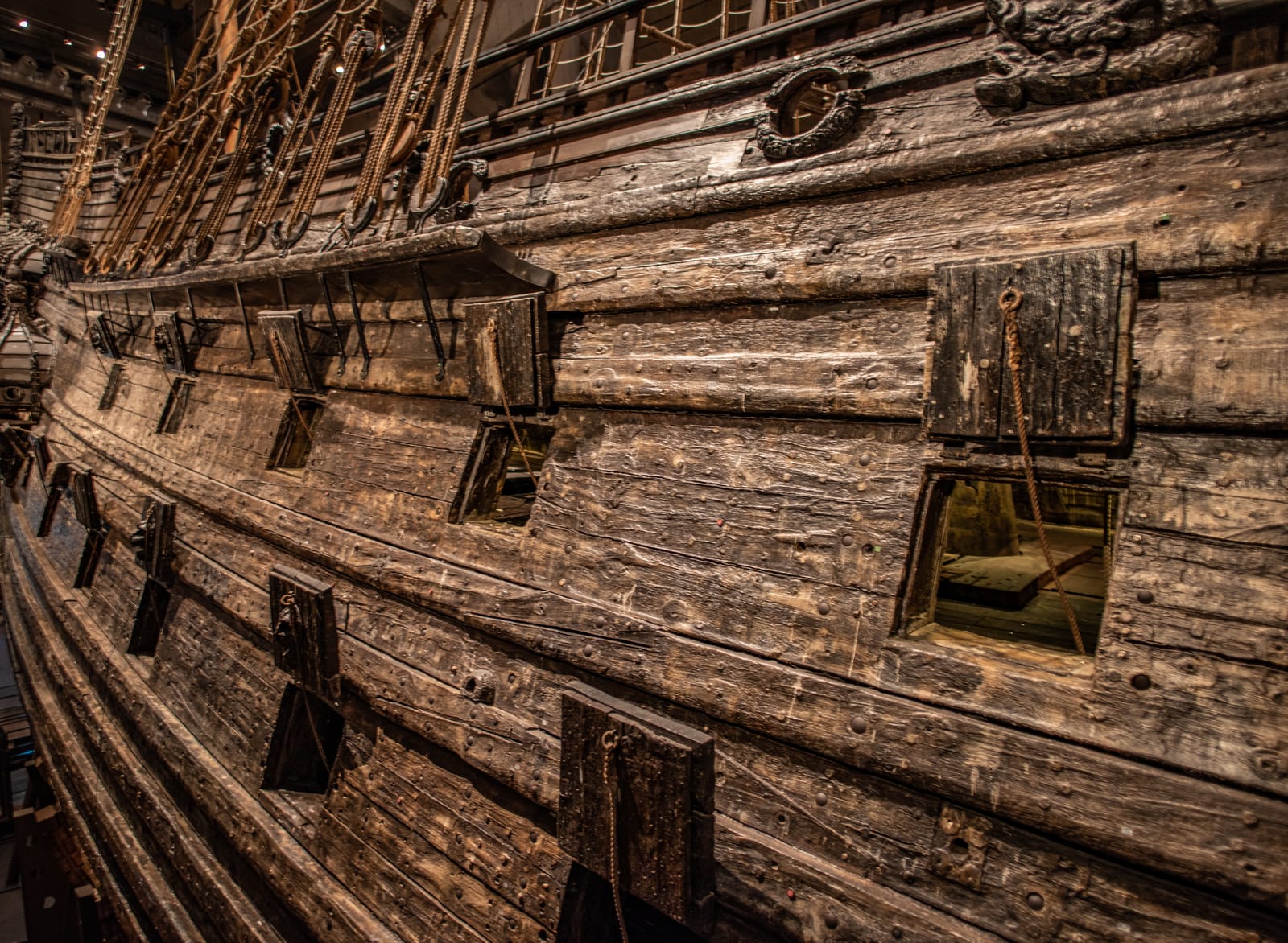
The Two Rows of Gunports
Henrik Hybertsson, master shipwright (died 1627), and the Stockholm navy yard · Built 1626 to 1628 · Oak hull, 69 metres long, 1,200 tonnes when outfitted
Look for
- The two tiers of square ports. On 10 August 1628 the water came in through the lower one, the row nearest the waterline.
- The heavy lids. Divers recovered gunport lids from the sea bed around the wreck in the 1950s.
- How much ship stands above the lower ports compared with what lies beneath them. That proportion is the whole fault.
Transcript (2:07)
Get as close to the hull as you can and look along it, because this wall of old oak is what a diver found with his hands. In early September 1956, Per Edvin Fälting went down in the dark to the floor of Stockholm harbour, feeling his way across the bottom, and walked into a vertical wooden wall. It had a row of square openings in it. Climbing, he found a second. The old records listed only one warship with two gun decks lost near there, so those two rows of holes were how Sweden learned it had found the Vasa.
Those same holes sank her. It was Sunday the 10th of August 1628, and thousands of people were watching, along with several foreign ambassadors. The crew had been allowed to bring their families for the first leg, women and children among them. Four of her ten sails went up. A small gust heeled the ship to port, and she came back, slowly. Then, at the gap in the bluffs at Tegelviken, a stronger gust pushed her much further over, and water poured in through the open gunports of the lower deck. Within minutes she was on the bottom, 32 metres down, with her masts still standing above the surface. She had sailed 1,300 metres. About 30 people died, most of them trapped inside.
Now look up at how much ship rises above those lower ports, and how little sits below them. That is the fault. The upper works are too tall and too heavy for the hull underneath, and the mathematics that could have warned anyone was more than a century away. One expert at the inquest said it best: she did not have enough belly.
Here is the part I find hard to forgive. Before she sailed, her captain had thirty men run back and forth across the upper deck in front of Vice Admiral Klas Fleming. After a few runs she was rolling so badly that the test was stopped, for fear she would capsize at the quay. Fleming was overheard saying, if only His Majesty were at home. He did not tell the king.
The builders at the inquest said she followed the design the king had approved. Her designer, Henrik Hybertsson, had died the year before, so the blame settled on a man who could not answer. His widow, Margareta Nilsdotter, had carried on his contract and business, while his assistant, Hein Jakobsson, supervised the shipwrights. Nobody was punished, and everyone questioned was later promoted. If the ports in front of you had been shut that afternoon, the water could not have come in, and she might have lived long enough to be rebuilt.

Stop 2 of 5 · Ship hall, entrance level (floor 4), at the bow
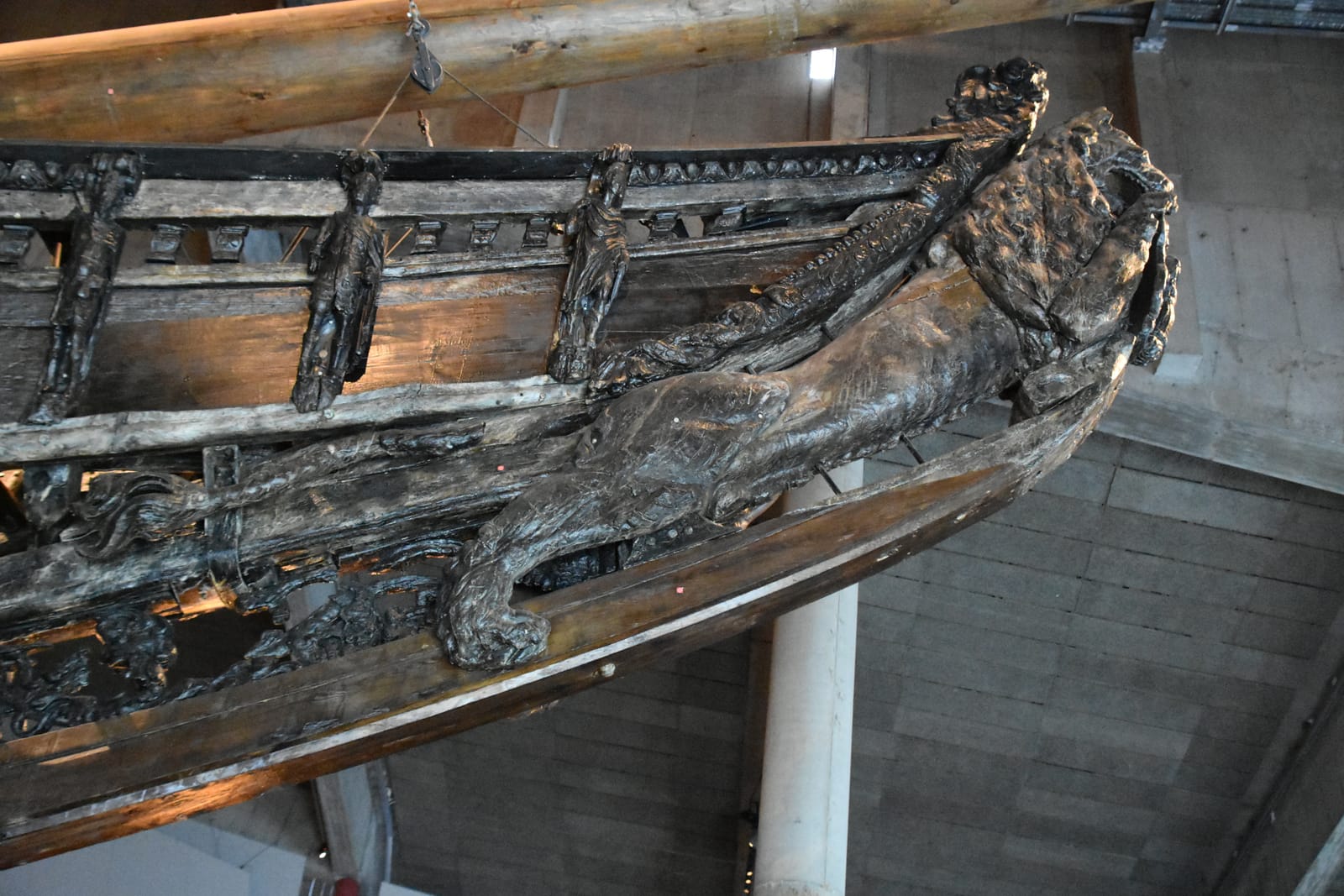
The Lion Figurehead
Vasa's carvers, among them Mårten Redtmer, Johan Thesson and Hans Clausink · 1620s · Carved wood, about 3 metres long
Look for
- The front paws, which hold the coat of arms of the Vasa dynasty.
- The upright figures along the sides of the beakhead. Twenty Roman emperors sat there, a claim about whose heir the king was.
- The dark surface. It comes from time under water and conservation; the beakhead's sides were painted bright red.
Transcript (1:58)
Stand under the bow and look up at the animal leaping off the front of this ship. It is a lion, three metres long, and it was made to be read from across a harbour. In its front paws it holds the coat of arms of the Vasa dynasty, the family of the king who ordered this ship. The so-called Folkunga lion had been a symbol of the Swedish monarchy since the Middle Ages, so nobody on the quay in 1628 had to ask whose animal this was.
Now look at the upright figures lined up behind it, along the sides of the bow. There were twenty, and they were Roman emperors. The lion carried a second meaning as well, as a symbol of the emperor Augustus. So the message of this whole end of the ship is simple. King Gustav Adolf is the heir of Rome, and he is going to build an empire of his own. Sweden at that time was thinly populated and little known, and this is the country introducing itself.
Few people in seventeenth-century Stockholm could read, so the ship did the talking. There were more than 700 sculptures and decorations on board, and the museum's own word for the result is a billboard. I think that is exactly right. Even the jokes had a job. This projecting platform, the beakhead, held the crew's toilets. The view from those toilets was two carved Polish noblemen, with their moustaches, their hair and their knee-length coats, caught in a moment of public shame. Sweden was at war with Poland-Lithuania, and there was a Polish custom that a man who had offended his friends could be sent under a bench or a table to bark off, to confess and ask forgiveness. Those two were doing it permanently, for the courage of the sailors looking at them.
Picture all of this painted, because the sides of the beakhead were bright red and the railings yellow. The dark surface you see today comes from time under water and from conservation.
The bow did not come up with the ship, either. The beakhead had collapsed into the mud beside the wreck. Between 1963 and 1967 divers worked the site they called the Pit and brought the beakhead up along with many of the sculptures, thousands of objects in all, and it was possible to put the ship back together almost completely. So the snarl above your head spent more than three centuries in the mud of Stockholm harbour before it went back on the front of the ship.

Stop 3 of 5 · Battle! exhibition, level 5
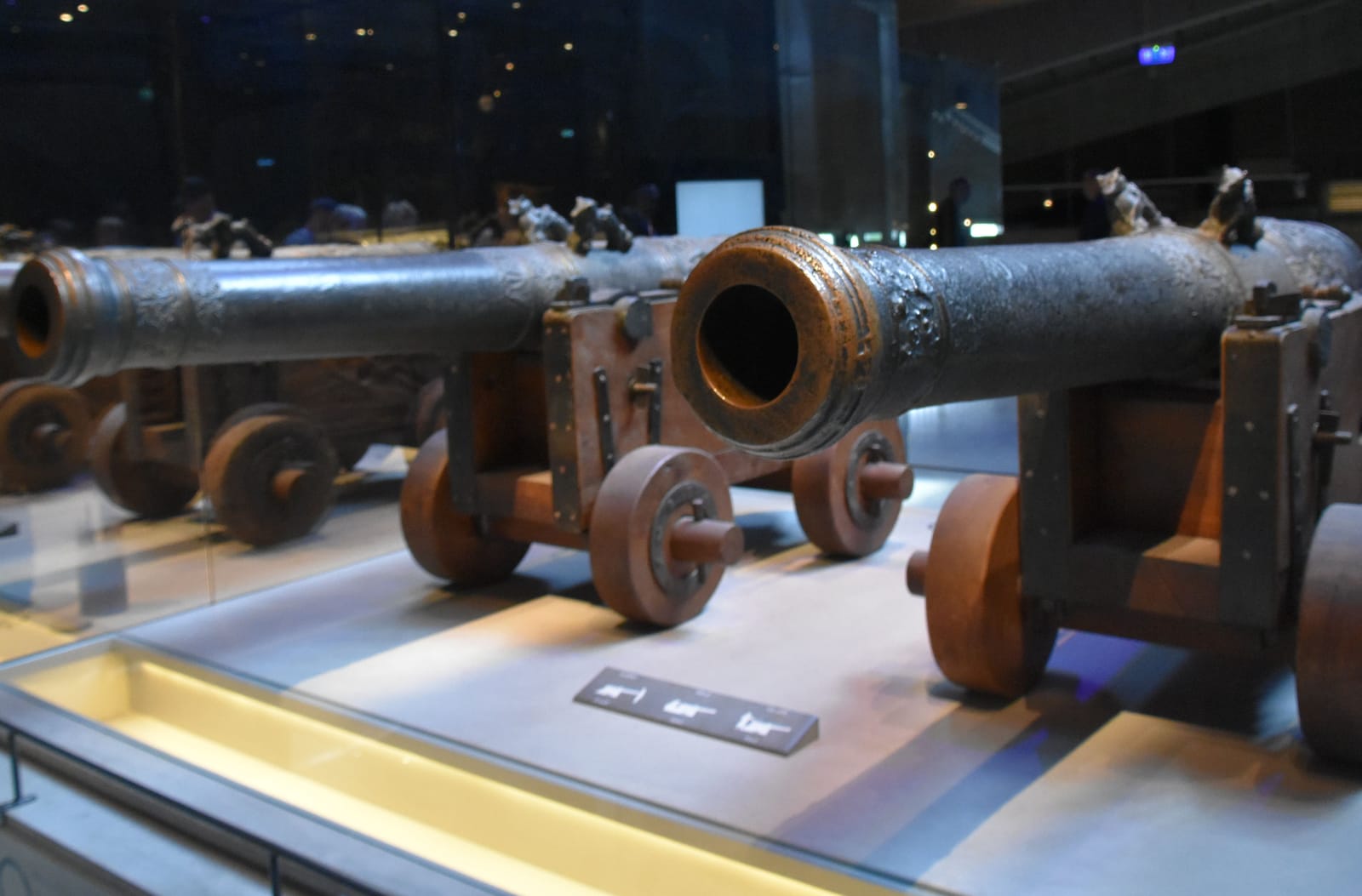
The Bronze 24-Pounders
The royal gun foundry, for the Swedish navy · 1620s · Bronze, firing ten-kilogram round shot; oak carriage with iron fittings, over 300 kg
Look for
- The bore. A ten-kilogram ball left it at close to the speed of sound.
- The four-wheeled carriage. On board, oak and iron carriages of over 300 kg let the crew aim the gun and move it about the deck.
- The weapons you can handle in this exhibition. Feel their weight, and remember they were never used in a fight.
Transcript (2:06)
These two bronze guns are among the rarest things to come off the ship. She carried 64 cannons on the day she sank, and 61 of them were brought up in the seventeenth century. Only three remain today, and two of them are here. They were the most valuable objects on board.
Look into the muzzle. Each of these fired a ball weighing ten kilograms, and the shot left the barrel at close to the speed of sound. Forty-eight guns of this type were her main armament, and a broadside, every gun on one side firing together, threw 250 kilograms. That was around four times as much as a typical Swedish warship of the 1620s, and twice as much as the largest ships in the other navies of northern Europe.
This gun was a new idea. It was developed in 1620 for the army, as mobile siege artillery, and it weighed half as much as the traditional naval 24-pounder. King Gustav Adolf was a keen artillerist. He believed sea battles were going to become duels between guns, while traditional officers still believed in boarding the enemy and taking his ship. Vasa was his argument in oak and bronze, and he ordered more like her. Almost all of those orders were cancelled after he died. There is a small embarrassment here too. When she sailed, eight of her gunports were empty, because the navy yard could build a ship faster than the royal foundry could cast guns for it.
He had his reasons for hurrying. In November 1627, at Oliwa on the Polish coast near Gdańsk, the Polish fleet attacked the end of the Swedish blockade line. The Swedish flagship Tigern was captured after a desperate boarding fight, and the crew of a second ship, Solen, set off their own powder, and the ship disintegrated in a towering explosion. Blowing up a ship rather than letting it be taken was official policy. That is the war these guns were cast for.
They never reached it. Thirty-five years after the sinking, a team led by Albrecht von Treileben and Andreas Peckell came for the guns with a diving bell, then a recently perfected invention, working 32 metres down in black water. They tore up much of the weather deck planking to get at the decks below, and they got almost every gun. The last few waited for the twentieth century: when one was raised on the 5th of September 1958, Swedish Radio carried it live.
Vasa never saw a battle. The one salute on record from her only day at sea was fired as she set off, a few minutes before the water came in.

Stop 4 of 5 · Seen from level 6
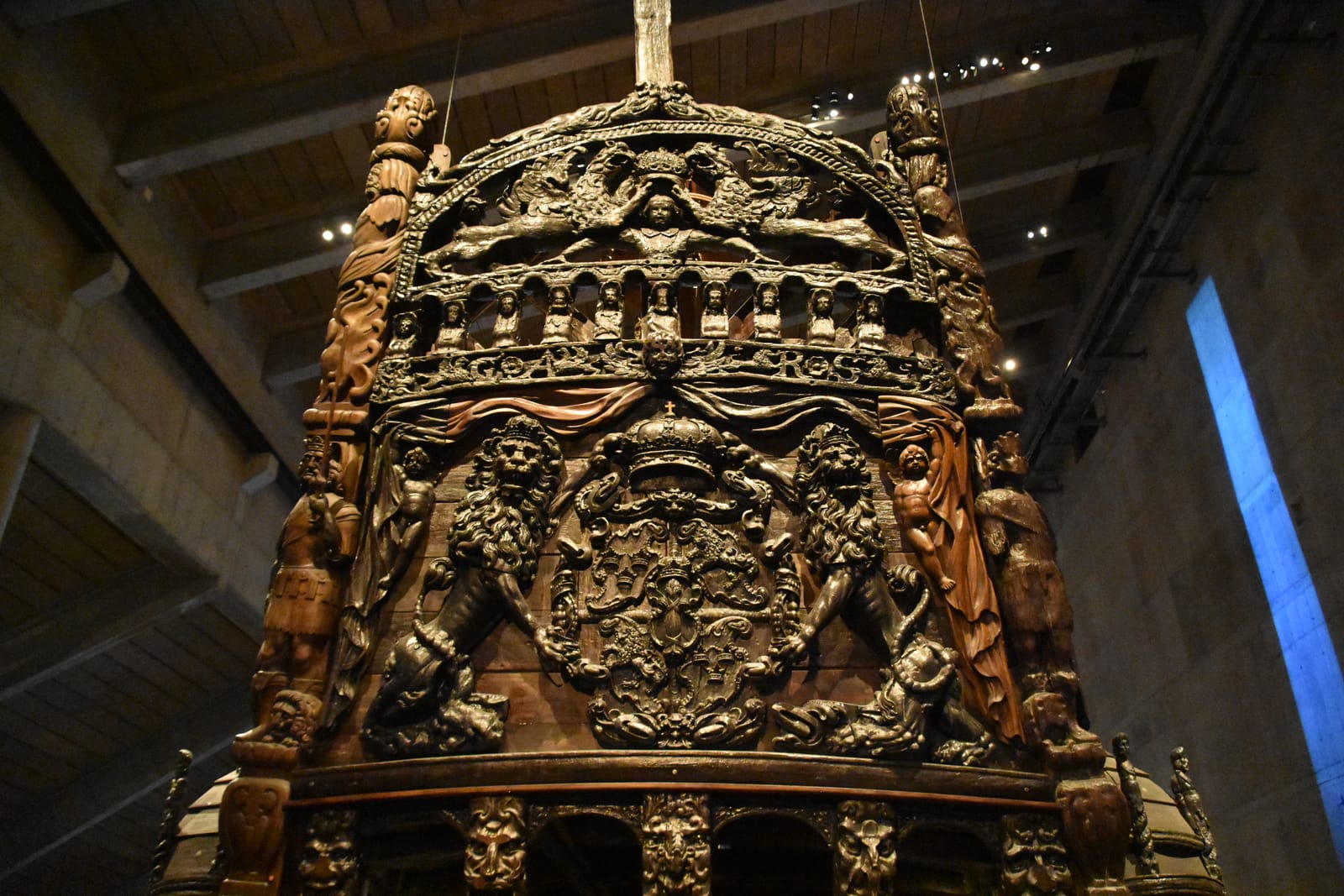
The Sterncastle
Vasa's carvers, among them Mårten Redtmer, Johan Thesson and Hans Clausink · 1620s; upper part raised from the harbour bed in the 1960s · Carved wood, once painted and gilded; the museum counts 460 sculptures and 300 ornaments on the ship
Look for
- The young king at the very top with his arms held out over his people.
- The two angels with a sheaf of wheat between them: the Vasa coat of arms and the source of the ship's name.
- The Swedish coat of arms in the centre, with David, Gideon and two figures of Hercules around the transom.
Transcript (2:03)
From up here you can read the part of the ship her builders cared about most. This is the stern, and it rises like the front of a palace. Start at the very top. The figure holding his arms out over everything below him is King Gustav Adolf as a young man, spreading those arms over his people. He stands at the top of the tallest part of the hull, and that was the idea.
Work your way down. Under him are the Swedish coat of arms and the biblical hero Gideon with his warriors, who beat a large invading army with only 300 men. Further down comes David, who killed Goliath and became a wise king. Swedes knew both stories, and both said the same thing: you can beat a stronger enemy if God is on your side. There are two figures of Hercules in here as well, for strength, bravery, energy and wisdom, in case the Old Testament was not enough.
Now find the two angels holding a sheaf of wheat. That sheaf is the coat of arms of the Vasa dynasty, called a vase, and it is the reason this ship has her name.
This dark brown was never meant to be seen. It comes from time under water and from conservation. Between 1990 and 2002 the conservator and art historian Peter Tångeberg studied how the ship had been painted, and around 1,200 samples of paint were analysed. The answer changes how you see all of this. The stern was bright red. The sculptures were in strong colours with gold leaf used in abundance. About fifteen of the key figures have since been reconstructed in those colours, and I find them a little shocking, more fairground than museum, and they are a plausible picture of how she looked.
The named hands behind this were foreign. Mårten Redtmer, a German and one of the master sculptors of his century, carved several of the most important pieces. The Dutchman Johan Thesson and the German Hans Clausink worked on the ornament too, with an unknown number of assistants. They were making a Swedish king look invincible.
Behind this wall was the great cabin, fitted out like a room in the royal palace, for the king or an admiral. The upper part collapsed into the mud, and divers raised it in the 1960s. Today it is one of the hardest parts of the ship to support, because this wood is badly degraded, and because the sterncastle was fragile even when it was new: a carved wooden palace on a hull that could not carry it.

Stop 5 of 5 · Level 2, below the hull
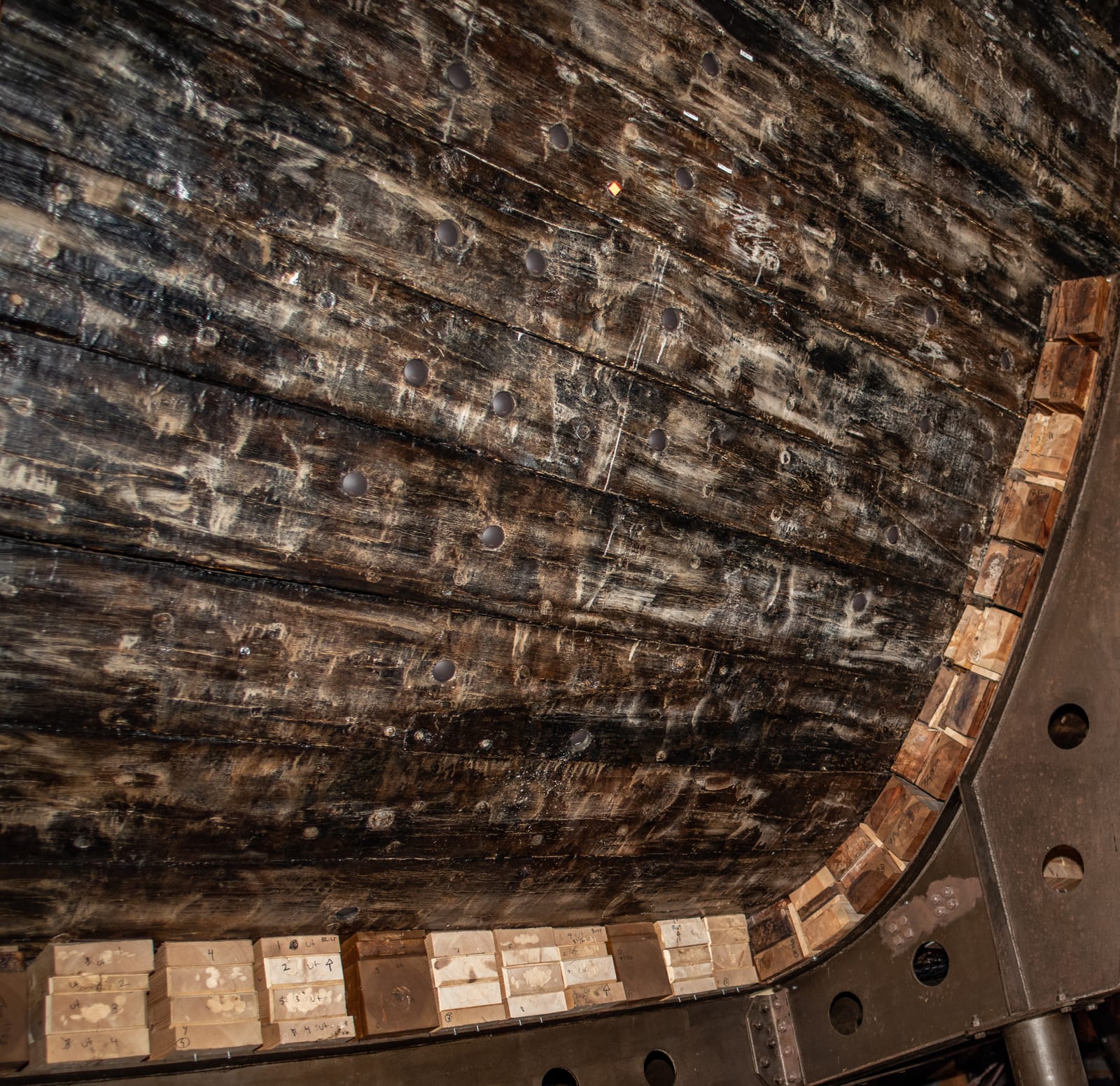
The Hull from Below
Henrik Hybertsson, master shipwright (died 1627), and the Stockholm navy yard · Built 1626 to 1628; raised 1961 · Oak hull on a steel support; 27 new steel cradles due by 2028
Look for
- The round marks in the planking. The bolts that replaced the rusted rivets went into the original holes.
- The steel under the hull. Over the coming years the support is being replaced so the ship can be straightened.
- Any white or yellow flecks on the wood. They are sulphur and iron compounds, and they are what first warned the museum.
Transcript (2:07)
Down here you are looking at the part of her nobody was ever meant to see. Bottom planks, and steel holding them up.
This oak was very nearly furniture. In 1920 two brothers applied to blow up the wrecks along this stretch of Stockholm harbour for their black oak, which was in demand for Art Deco furniture, and the authorities refused. Then, from 1954, a navy fuel engineer called Anders Franzén started dragging the harbour bottom in his spare time, and pulled up, in his own words, rusty iron stoves and ladies' bicycles, Christmas trees and dead cats. On the 25th of August 1956 his home-made coring tool came up with a plug of black oak.
Ideas for raising her poured in, including ping-pong balls and a giant ice cube. The salvage company insisted on a method used since the Middle Ages. Navy divers dug six tunnels under the ship with water jets, steel cables went through them, and she was lifted between two pontoons. At 9:03 on the morning of Monday the 24th of April 1961, the tops of a few timbers broke the surface, live on television.
Then came the mud, and the archaeologists. In five months they took out more than 30,000 objects, and they bought up the old bathtubs of Stockholm's scrap merchants to keep the finds wet. They also found the people. Roughly thirty died on that voyage, and the remains of at least 17 came back with the ship. Only one of the dead is named in the historical record, Captain Hans Jonsson. Researchers have been working with their bones for decades, and in 2023 DNA showed that a skeleton long thought to be a man was a woman. The museum now speaks of them as individuals: a couple who died in each other's arms, a boy with fancy shoes, a woman in a red cap. Many had come aboard for a festive afternoon.
Look at the round marks in the planking. Her iron rivets rusted away on the bottom, so in the 1960s more than 5,000 steel bolts went into the old holes, and those corroded in turn. It took seven years to replace them all, finishing in 2018, and the ship came out about eight tons lighter. She is still not safe. The wood has lost much of its strength, and she leans slightly to port, a little more over time. So 27 new steel cradles and a steel skeleton inside the hull are replacing the old support, due by 2028, her 400th anniversary. The museum's stated goal is a thousand years, for a ship that managed only minutes at sea.
Independent guide · Chiaro
Point Chiaro at any carving on the Vasa.
These stops touch a fraction of her: the museum counts 460 sculptures and 300 ornaments on the ship, and twelve exhibitions around it. Photograph a mermaid on the hull, a sailor's shoe in a case or a block in the rigging, and Chiaro explains its job aboard and who made it, and you can go on asking from the same spot.
Before you go
Getting there
Galärvarvsvägen 14, on the island of Djurgården, Stockholm.
Tram 7 from the city centre to Nordiska museet/Vasamuseet is the route the museum calls easiest. Bus 67 stops there too; buses 69 and 76 stop at Djurgårdsbron. By metro, take the red line to Karlaplan, then walk ten minutes or ride bus 67. Ferries 80 from Nybroplan and 82 from Slussen call at Allmänna gränd, about eight minutes on foot.
Tickets
- Adult tickets are SEK 195 from October to April and SEK 240 from May to September. Anyone 18 or under goes free; children of 12 and under need an adult with them.
- The museum takes cards only. You can always buy on arrival, and a ticket bought in advance gives no priority in the queue. From May to September the wait can reach about 30 minutes, and the museum says afternoons are calmer than mornings and lunchtime.
- Open daily. September to May 10:00 to 17:00, Wednesdays until 20:00; June to August 08:30 to 18:00. Closed 24 and 25 December; 31 December closes at 15:00.
- Large bags and wheeled cases are not allowed, and the building has no luggage storage. The ship needs 18 to 20°C, so bring a sweater.
- New steel supports are being fitted around the hull until 2028. The museum stays open throughout, with a pause in the work over the summer.
The official audio guide
Vasa's official guide deserves a try. You stream it on your own phone or tablet over the free Wi-Fi, in the language you choose from a long list on its website, it runs about 40 minutes, and it is among the things your ticket already includes, like the guided tour of about 25 minutes and the 17-minute film. Bring headphones. Our five stops are shorter and cost nothing at all, ticket or no ticket, so you can hear the whole story on tram 7 before you reach the door.
Official site →Questions
Is there a free Vasa Museum audio guide?
Hear ours at no cost and with no ticket: five recordings, each script printed below its player. The museum's own guide, of about 40 minutes, comes with admission and streams to your phone over its free Wi-Fi.
How much is the official Vasa Museum audio guide?
It has no separate price. The museum lists its audio guides among the things always included in your ticket, and you use your own phone or tablet and your own headphones.
Where is the Vasa ship inside the museum?
She fills the middle of the building, with her hull passing the entrance level, which the museum's map labels floor 4. The lion figurehead is at the bow on that level. The floors run from 2, below the hull, up to 7, with lifts to all of them.
Is the Vasa Museum closed on any day of the week?
No, it opens every day. The exceptions are 24 and 25 December, when it is closed, and 31 December, when it shuts at 15:00. Wednesdays run until 20:00 from September to May.
Is the Vasa the original ship?
Yes. The museum says over 98% of the original structure survives, masts and sails included, though the wood is fragile and is held up by a steel support that is being replaced by 2028. The brightly painted figures around the hall are modern reconstructions, and so is the 1:10 model.
Why did the Vasa sink?
Her upper works were too tall and heavy for the hull beneath them, so a gust on 10 August 1628 pushed her over until water came in through the open lower gunports. She sank within minutes, 1,300 metres into her first voyage, and about 30 people died.
More audio guides
Made by Chiaro. Not affiliated with the Vasa Museum.