
Prague Castle · Prague · Independent guide
Prague Castle audio guide,
five stops, free.
Some 570 metres of courtyards, palaces and a cathedral on one hill, begun around 870: five places along it are narrated here, and Chiaro's camera answers for the rest.
Made by Chiaro. Not affiliated with Prague Castle.
The Gate of the Giants on Hradčany Square
Prague Castle, Prague
That was the free part
Chiaro narrates anything at Prague Castle from a photo.
The five stops · 11 minutes of audio
Five places, one walk,
in the order you will walk them.
A free Prague Castle audio guide you walk yourself, west to east, in the order the hill itself sets: five stops, self-guided, starting before any gate. It opens on Hradčany Square, outside the railings, where the Gate of the Giants needs no ticket at all. From there you go in to St Vitus Cathedral by its west door for Alfons Mucha's window on the north side of the nave, back out to the Third Courtyard for the Golden Gate on the cathedral's south flank, up into the Old Royal Palace for Vladislav Hall, and down past St George's Basilica to Golden Lane on the northern wall, a few steps from the Old Castle Stairs and the way out. Stops two, four and five are on the castle's Main circuit ticket; stops one and three are in the free courtyards and square. Listening takes just under ten minutes in all; on foot you cover the castle's whole length, some 570 metres end to end.
Every date, name and measurement here was checked on 26 September 2026 against the Prague Castle Administration's visitor pages, its Visitor Regulations and price list, and the cathedral chapter's own site, with Wikipedia as the second source behind each one. The castle can shut a building or the whole area at short notice for a state occasion, so look at hrad.cz on the morning you go. If a notice at an information centre says something different from this page, follow the notice, and tell us so we can put this right.
Karelj, Public domain, via Wikimedia Commons. Photo: Karelj

Stop 1 of 5 · Hradčany Square (Hradčanské náměstí), outside the railings of the First Courtyard, facing east; free, before any ticket check
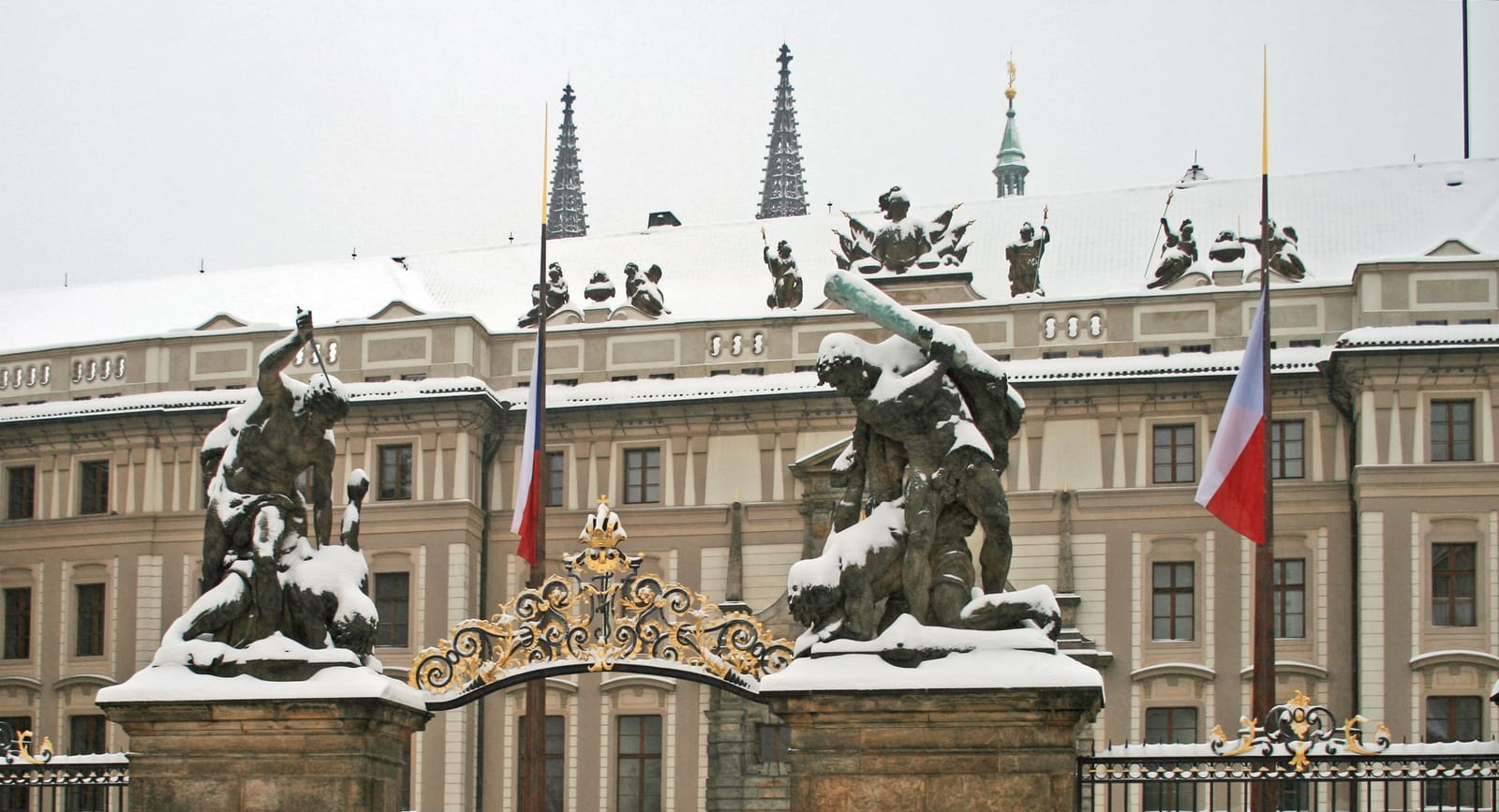
The Gate of the Giants on Hradčany Square
Nicolò Pacassi (1716–1790), architect of the Theresian rebuilding; the giant groups after Ignaz Franz Platzer (1717–1787), in copies by Čeněk Vosmík (1860–1944) and Antonín Procházka (1849–1903); Matthias Gate attributed to Giovanni Maria Filippi · Matthias Gate 1614; First Courtyard and gate 1759–1769; the statue copies early twentieth century · Sandstone groups on sandstone piers with a wrought-iron Rococo grille; the castle behind them runs about 570 m from west to east
Look for
- The two giant groups on the middle piers, one raising a dagger and one a club over an opponent already down. They are early twentieth-century copies by Čeněk Vosmík and Antonín Procházka of the originals from Ignaz Platzer's workshop.
- Matthias Gate at the back of the courtyard, with the date MDCXIV in its inscription panel: it was built as a free-standing triumphal arch, and the eighteenth-century wings you see were wrapped round it.
- The two very tall flagpoles, each a single Moravian fir trunk tapering to about 25 metres, put up in 1925 to Jože Plečnik's design for the new republic.
- The two dark stone spires rising over the palace roof. They belong to St Vitus Cathedral, three courtyards further in, and the second stop is under them.
Transcript (2:07)
Stand in the square with the railings in front of you and look up at the two stone giants on the middle piers. On the left one raises a dagger, on the right one swings a club, and each has an opponent already beaten underneath him. They are the first thing the castle shows you, and they are not subtle about it. What you are looking at are copies: the originals came from the workshop of Ignaz Franz Platzer, and the figures on the piers today were carved at the beginning of the twentieth century by Čeněk Vosmík and Antonín Procházka.
Now look past them, into the courtyard. It is younger than it looks. The whole front you see, three wings round an open court of honour, was built between 1759 and 1769 for Empress Maria Theresa by her architect Nicolò Pacassi. Before that, where you are looking, there was a moat. It separated the castle from this square, and Pacassi had it filled in, the buildings in front of it knocked down, and this grille put across the open side.
The arch at the back of the courtyard is the one thing here older than the empress. Matthias Gate carries a Latin inscription saying that Emperor Matthias had it made in 1614. There is a catch. The panel with his name is stucco, while the rest of the gate is stone, and so historians suspect the gate is some years older, probably ordered by Rudolf the Second before him, with Matthias adding only his name. It is counted as the oldest secular Baroque building in Prague, and it was a free-standing triumphal arch until Pacassi built his wings around it.
The two enormous flagpoles are a third layer again. Each is a single fir trunk from Moravia, tapering to about twenty-five metres, put up in 1925 to a design by the Slovenian architect Jože Plečnik. After 1918 this became the seat of the president of the new Czechoslovak Republic, Tomáš Masaryk, and Plečnik was the architect Masaryk chose to make an imperial castle feel like a republic's.
It still is the president's seat. People here say the Castle, Hrad, and mean the head of state and his staff. And behind this one front the complex runs on for about 570 metres. According to the Guinness Book of Records it is the largest ancient castle in the world, almost seventy thousand square metres, and its history begins around 870 with a single walled church. Look above the palace roof and you can already see where you are going: the two dark spires of St Vitus Cathedral.
Perituss, CC0, via Wikimedia Commons. Photo: Perituss

Stop 2 of 5 · St Vitus Cathedral, north side of the nave, in the New Archbishop's Chapel west of the north entrance, seen from the north aisle; on the Main circuit ticket
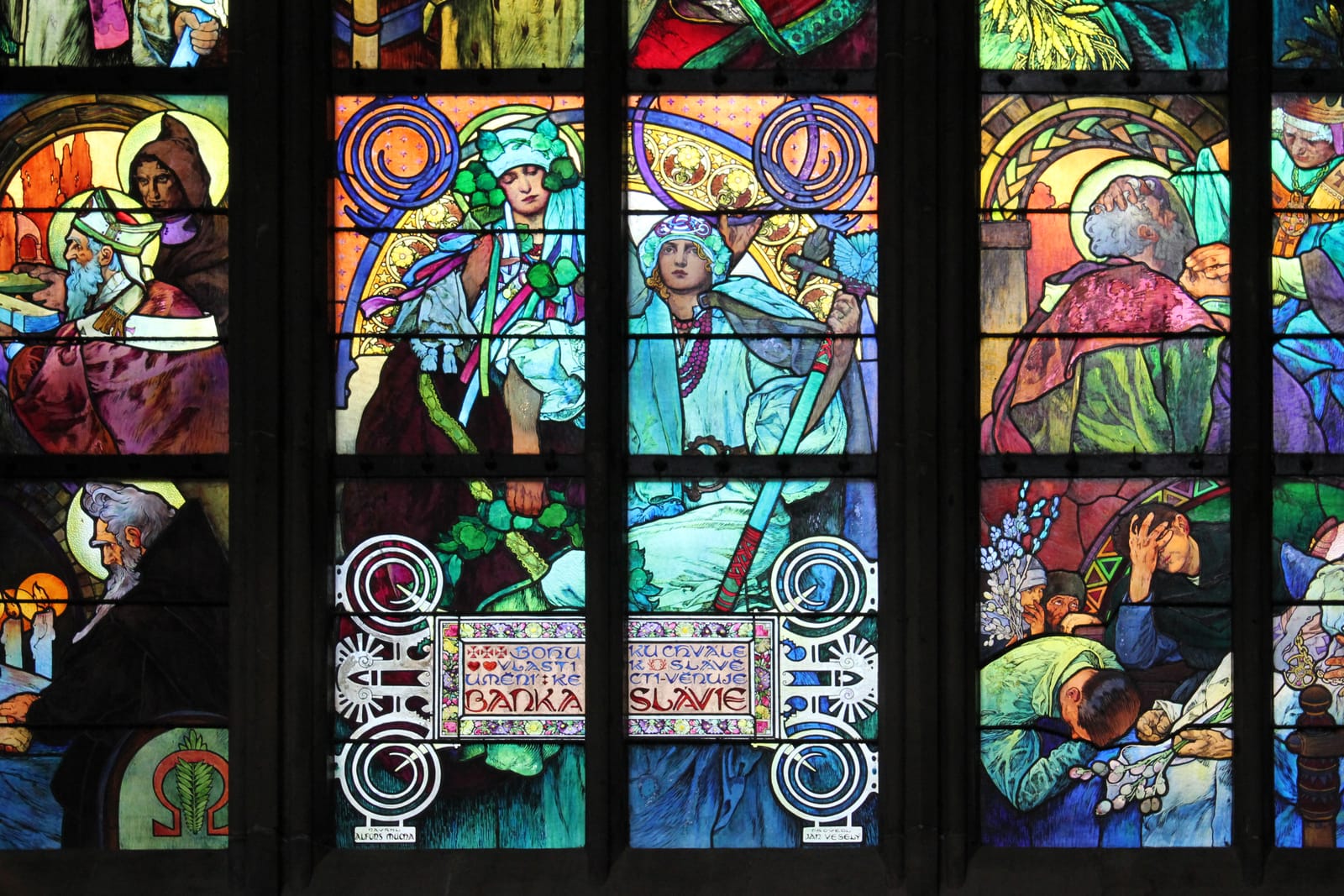
Alfons Mucha's window in St Vitus Cathedral
Designed by Alfons Mucha (1860–1939) and carried out by the glass painter Jan Veselý; given by the Banka Slavie · 1931 · Painted and stained glass in a window of the nave; the cathedral is 124 m long and 33.2 m high to the vault
Look for
- The two small lettered panels at the foot of the central lights. The left one says NAVRHL ALFONS MUCHA, designed by Alfons Mucha; the right one says PROVEDL JAN VESELÝ, carried out by Jan Veselý.
- The dedication across the middle, ending in red capitals: BANKA SLAVIE. A bank paid for this window, and says so in the glass.
- The spirals and circles framing the central figures. They are the poster designer's ornament, carried into a church.
Transcript (2:23)
You are inside the cathedral now, in the part that is least what it seems. Walk up the north side of the nave, on your left as you come in by the west door, and stop at the chapel where the glass suddenly turns into a picture book. That is the New Archbishop's Chapel, and the window is Alfons Mucha's.
First, the building around you. Charles the Fourth began this cathedral in 1344. Work stopped in 1419 when the Hussite Wars broke out, and for centuries the church was a half-finished chancel with a wall across its end. Everything from the west door to about here, the nave you just walked through and the two spires you saw from the square, was built only between 1873 and 1929, to the plans of Josef Kranner, then Josef Mocker, then Kamil Hilbert. The cathedral was consecrated in May 1929, for the thousandth anniversary of the death of Saint Wenceslas. It had taken nearly six hundred years.
When the new nave was finished it needed new windows, and the cathedral's own guide makes a point of it: the most interesting glass here has been in place only a short time. Mucha was one of several Czech artists of the day asked to make them.
Mucha's was completed in 1931. He was in his seventies. He had just spent almost eighteen years on the Slav Epic, and this window is one of the few things he made after it. The man who had become famous in 1896 with a poster of Sarah Bernhardt as the Lady of the Camellias is still recognisable in every inch: the spirals, the circles, the girls with flowers in their hair, the colour laid on in flat bright fields.
Now look at the bottom of the two central lights, because the window tells you exactly who did what. On the left, a small panel: NAVRHL ALFONS MUCHA, designed by Alfons Mucha. On the right: PROVEDL JAN VESELÝ, carried out by Jan Veselý, the glass painter who turned the design into glass. And between them the dedication, in Czech: to the praise of God, to the glory of the homeland, to the honour of art, given by the Banka Slavie. A bank paid for this window and put its name in it, in red capitals, in a cathedral. Years earlier Mucha had designed insurance policies for Slavia, a mutual insurance bank in Prague.
The window shows the patron saints of the land, and a little further east, past the transept, is the one who matters most here: the chapel of Saint Wenceslas, over his grave, its walls set with precious stones. A door in its corner, closed with seven locks, leads up to the Crown Chamber, where the Bohemian coronation jewels are kept. You will not see them. You can see the door.
Richard Mortel from Riyadh, Saudi Arabia, CC BY 2.0, via Wikimedia Commons, cropped. Photo: Richard Mortel from Riyadh, Saudi Arabia
_(25607483824).jpg)
Stop 3 of 5 · Third Courtyard, on the south side of St Vitus Cathedral, facing the porch; the courtyard itself is free
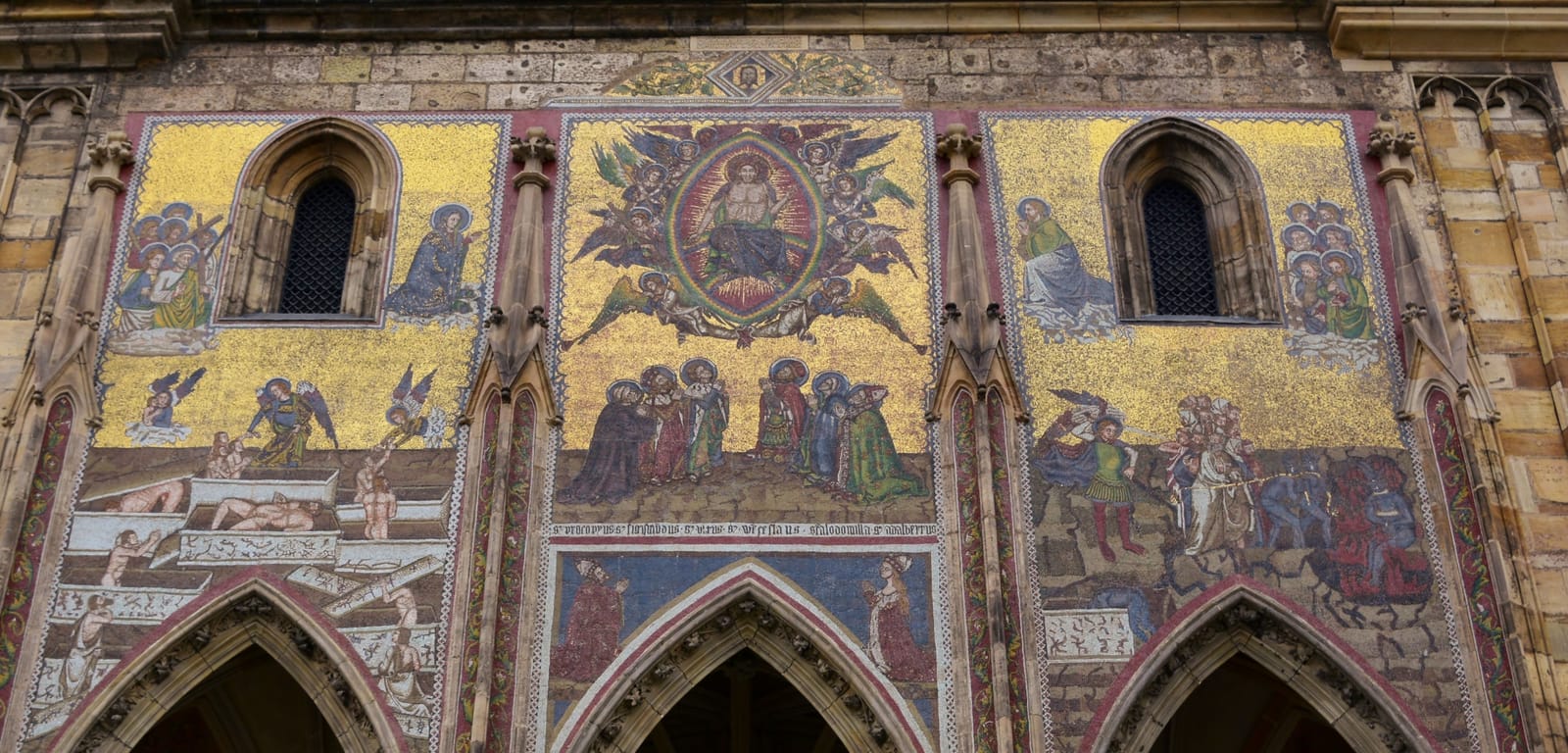
The Golden Gate and its Last Judgement mosaic
Peter Parler's workshop (Parler c.1330–1399) for Emperor Charles IV; the mosaic by unnamed fourteenth-century craftsmen · Porch completed by 1368; mosaic 1370–1372; conserved in 1961 and 2000 · Glass mosaic on a gold ground over a triple-arched stone porch, at the foot of the Great South Tower, about 100 m tall
Look for
- The small panel just above the central arch, under a line of saints' names: Charles IV and his fourth wife, Elizabeth of Pomerania, kneeling.
- The right-hand field, where the archangel Michael's sword drives the damned towards blue devils and the flames.
- The left-hand field, where the dead push up the lids of their tombs and climb out.
- The base of the tall tower to the left of the porch, where a stone tablet of 1394 records how the medieval building was going.
Transcript (2:09)
Out in the Third Courtyard, walk along the south side of the cathedral until the wall turns to gold. Three pointed arches at ground level, and above them a picture made of glass, glittering even on a grey day. This is the Golden Gate, and it is named after exactly what you are looking at: the golden background of the mosaic.
For most of the cathedral's history this, not the west door you used, was the grand way in. The porch was finished by 1368, in Peter Parler's time, and it is through this portal that the kings of Bohemia entered the cathedral to be crowned. The room directly above it is the Crown Chamber, where the coronation jewels are still kept.
The mosaic was made between 1370 and 1372, and it is the Last Judgement, read in three fields. In the middle, Christ sits as judge in an oval of light, surrounded by angels carrying the instruments of the Passion. Below him stand six Czech patron saints, Wenceslas, Adalbert, Vitus, Sigismund, Ludmila and Procopius, and their names run in a line of lettering underneath. Now drop your eyes below that line, to the small panel just over the central arch. Kneeling there, on either side, are Emperor Charles the Fourth, who began this cathedral, and his fourth wife, Elizabeth of Pomerania. The emperor who built the place put himself in the picture on his knees.
Then read the side fields. On the left, the dead are rising, pushing up the lids of their tombs and climbing out, and three angels receive the righteous. On the right, the archangel Michael swings his sword, and the damned are dragged away by blue devils into the fire. Higher up on both sides, the Virgin Mary and John the Baptist plead for mankind, with the apostles ranged beyond the two small windows.
It has survived six and a half centuries out of doors, with serious restorations in 1961 and again in 2000.
Before you move on, look left, at the foot of the great south tower. Charles's first architect, Matthias of Arras, died in 1352; Parler came from Swabia and took over in 1356, when he was only about twenty-three. The lower part of the tower you are looking at was begun by those first builders; above fifty-five metres come a Renaissance gallery and a Baroque dome, and the whole of it rises about a hundred metres. Set into its base is a stone tablet dated 1394, a medieval builders' progress report, still in place.
Richard Mortel from Riyadh, Saudi Arabia, CC BY 2.0, via Wikimedia Commons, cropped. Photo: Richard Mortel from Riyadh, Saudi Arabia
_(25586959334).jpg)
Stop 4 of 5 · Old Royal Palace (building I on the castle map), upper floor, entered from the Third Courtyard; on the Main circuit ticket
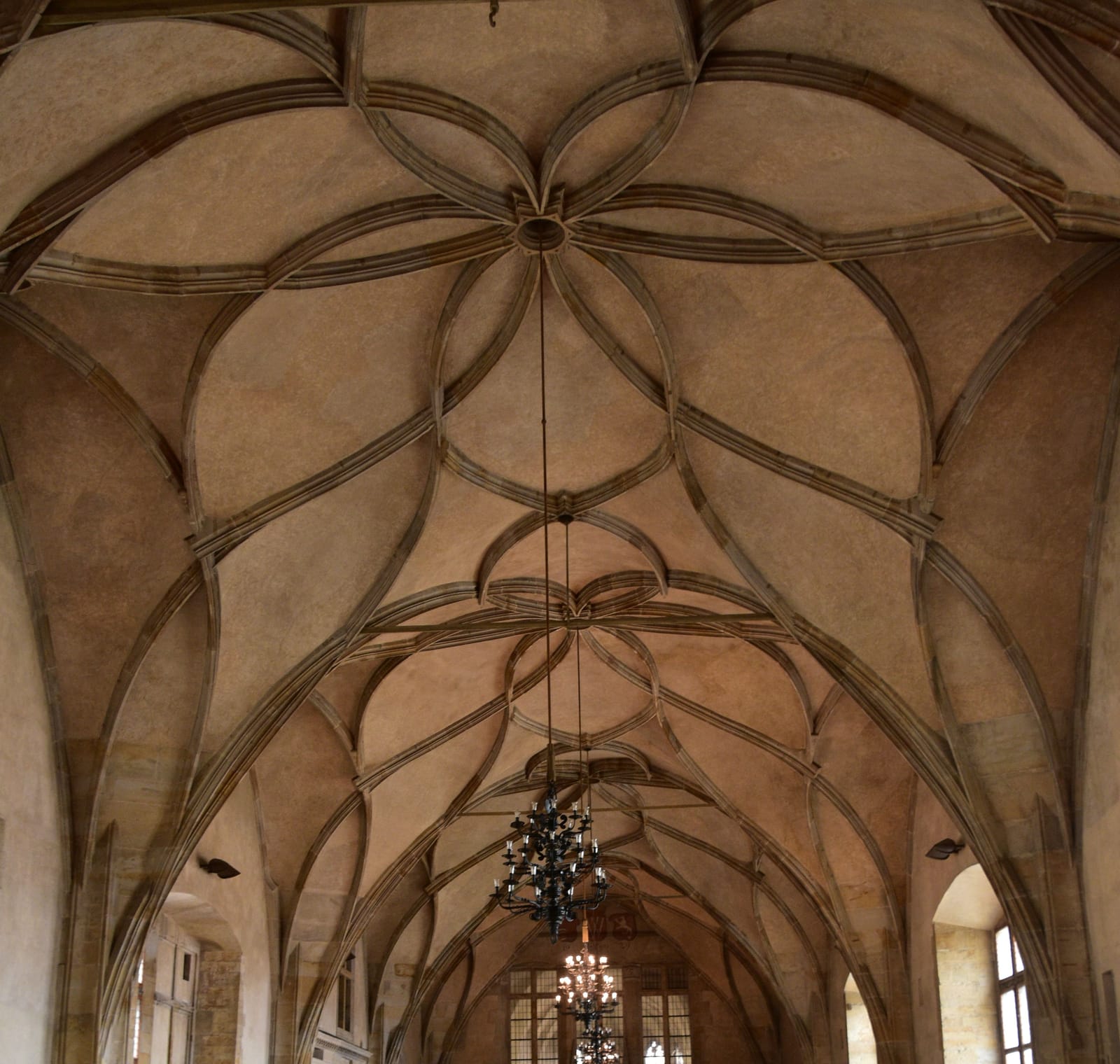
Vladislav Hall in the Old Royal Palace
Benedikt Ried (Rejt) (c.1454–1534) for King Vladislaus II Jagiellon (1456–1516) · 1493–1502 · Sandstone rib vault in five bays over a hall 62 m long, 16 m wide and 13 m high
Look for
- The ribs of the vault, which loop and cross like vines and come straight out of the walls. The hall is sixteen metres wide, and the vault spans all of it without a single column.
- The big rectangular windows. They are Renaissance in a Gothic hall: Ried mixed late Gothic with the style just arriving.
- The portal in the south-west corner of the hall into the Ludwig Wing: its second room is where the governors went out of the window in 1618.
- The gallery on the south wall, with a view down over the Garden on the Ramparts to the city.
Transcript (2:16)
Look up before you do anything else. The ceiling of this hall is a single stone vault sixteen metres across, and there is not one column holding it up. The ribs come straight out of the walls and then loop, cross and curl over your head like vines. Benedikt Ried built it between 1493 and 1502 for King Vladislaus the Second, of the Jagiellon dynasty, and when it was finished it was the largest vaulted secular hall in the world: sixty-two metres long, sixteen wide, thirteen high.
Now look at the windows, because they give Ried away. The vault is late Gothic at its most extravagant. The windows are big, square-headed Renaissance windows, the new style just arriving. He put the two side by side in one room, and you can watch one style handing over to the next.
The hall sits on top of older palaces. You are on the third and highest level. The level beneath is Gothic, from the reign of Charles the Fourth, and below that is a Romanesque palace. When Vladislaus came back to the castle after 1483, it had stood empty for eighty years.
What was it for? Not what people usually think. The Diet of the kingdom did not sit here; it met in the smaller room next door. This hall was for everything that needed space: markets of luxury goods, banquets and coronation feasts, and, famously, tournaments. Knights rode in on horseback, up the Riders' Staircase, which was built for the horses and is your way out. Presidents of the republic have been elected in this room, and it still holds the state's great occasions.
Now find the portal in the south-west corner. It leads into the Ludwig Wing, and in its second room, on the twenty-third of May 1618, Protestant nobles put two royal governors, Jaroslav Bořita of Martinice and Vilém Slavata, and their secretary, Philip Fabricius, out of the window into the castle ditch. All three survived. Catholics said angels had caught them. Protestant pamphlets later said they landed on a dung heap, a story nobody at the time seems to have told. The Thirty Years' War started from that window. The secretary did best of all: the emperor ennobled him as Baron von Hohenfall, which means, more or less, Baron of the High Fall.
One last odd fact, from over your head. When the floors were redone in 2008 and 2009, archaeologists found dried plants packed into the fill of the vaults around 1600, among them the first peanut known in post-Columbian Europe and the first coffee plant in Central Europe.
Jaroslav Krupka, Public domain, via Wikimedia Commons. Photo: Jaroslav Krupka
.jpg)
Stop 5 of 5 · Golden Lane (building V on the castle map), along the northern wall between the White Tower and the Daliborka Tower; on the Main circuit ticket
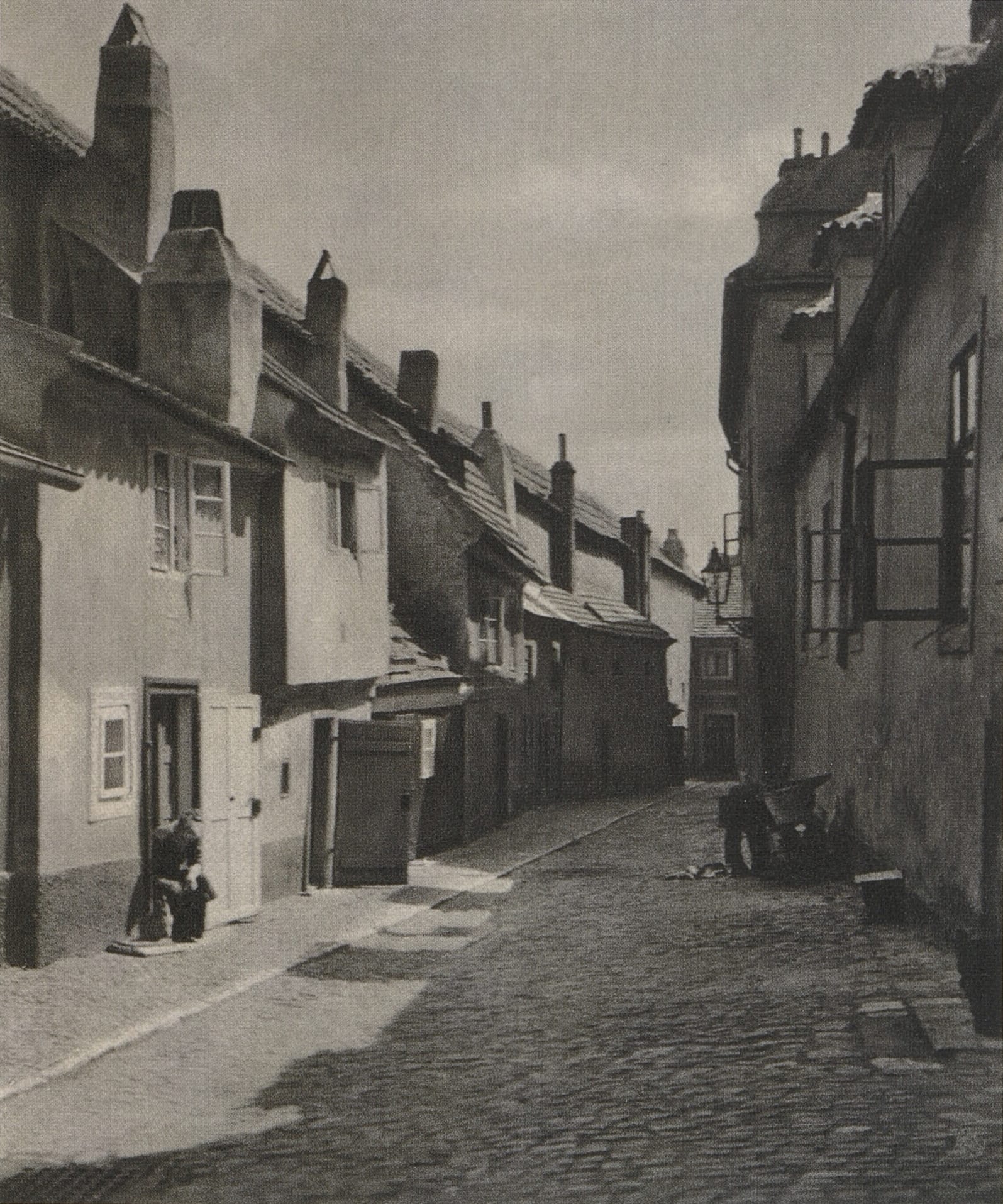
Golden Lane and house No. 22
Castle marksmen and later owners, building into the arches of the northern wall; the present facade colours to designs by Jiří Trnka (1912–1969) in the 1950s · Northern wall at the end of the fifteenth century; houses from 1597; last residents left in 1953; restored 2010–2011 · Small rendered houses built into the arches of the late Gothic northern wall; sixteen houses, nine of them an exhibition
Look for
- The number over the door of No. 22, Kafka's house.
- The chimneys along the roofline, one little stack per house.
- No. 13, the one house that stays inside its arch and does not step out into the lane.
- The round Daliborka Tower at the east end, a cannon tower that was a prison from the day it was built.
Transcript (2:06)
After a cathedral and a royal hall, and the red Baroque front of St George's Basilica that you passed on the way down, this is where the castle's servants lived. Walk slowly down the lane and look at the scale of it: doors you have to stoop for, windows the size of a book, and a chimney for every house.
The houses are built into the castle's northern wall. The wall came at the end of the fifteenth century, and in 1597 the marksmen who guarded the castle gates asked Emperor Rudolf the Second whether they could wall up its arches and make little rooms in them. A decree of the sixteenth of September 1597 said yes. They built at their own expense, then sold and rented to each other, and the rooms grew out into the lane until in places it was less than a metre wide. The additions on the far side were cleared away in 1864. Only one house, No. 13, still keeps to the original rule and stays inside its arch; look for the one that does not step forward.
Nobody agrees where the name comes from. Goldsmiths, say some. Alchemists, says the legend, which is almost certainly only a legend. Or it was a joke, the golden street in the poorest corner of Hradčany. What is certain is that people lived here until the Second World War, and the last residents moved out in 1953. The colours you see date from after that: the facades were painted to designs by Jiří Trnka, the painter and film-maker, in the 1950s.
Now find No. 22, the blue-white house with the number over its door. From November 1916 to March 1917, Franz Kafka came here to write, in a house his sister Ottla had found, and he wrote most of the stories of A Country Doctor in it. A few doors along, No. 14 was the home of Matylda Průšová, a card reader and clairvoyant known as Madame de Thèbes, who died after torture in a Gestapo interrogation. No. 12 belonged to the film historian Josef Kazda, who hid Czechoslovak films here during the occupation so they would not be destroyed.
At the east end stands the round Daliborka Tower, a cannon tower that was a prison from the start. Its first prisoner, in 1498, was the knight Dalibor of Kozojedy, and legend says he learned the violin in his cell; Smetana made an opera of it. Beyond it lies the way out, down the Old Castle Stairs to Malostranská, which is how the castle itself says most people leave.
Independent guide · Chiaro
Point Chiaro at anything at Prague Castle.
Five places narrated, and the hill holds a basilica, a convent, a powder tower, a ball-game hall and gardens besides. Frame a coat of arms over a palace door, a gargoyle on the cathedral or a house sign in Golden Lane, and Chiaro names it, dates it and tells the story behind it, and the conversation runs on through as many follow-ups as the castle gives you.
Before you go
Getting there
Prague Castle, Prague 1 – Hradčany. Start on Hradčany Square (Hradčanské náměstí), in front of the Gate of the Giants: the castle's own directions give the way in from this square as via the Fourth Courtyard, beside it. The courtyards and streets of the castle are free to walk; only the buildings charge.
Tram 22 to Pohořelec, then ten minutes downhill to Hradčany Square; or tram 22 to Malostranské náměstí and up the New Castle Stairs to the square. Tram 22 to the Pražský hrad stop brings you in at the Second Courtyard instead, five minutes from the tram. To leave from Golden Lane, take the Old Castle Stairs down to Malostranská on metro line A (green); Hradčanská, also on line A, is the other metro station nearby.
Tickets and entry
- One Main circuit ticket covers the three ticketed stops here, Mucha's window in St Vitus Cathedral, Vladislav Hall in the Old Royal Palace and Golden Lane, and St George's Basilica, which the walk passes. It was 450 CZK for an adult on the price list in force from March 2024, it stays valid for two days, and each building lets you in once. Buy it at a castle information centre; the official tickets page has the current prices and an online option.
- The cathedral no longer has a free section near the door: since October 2023 the castle has admitted visitors to St Vitus only with a circuit ticket. In the current season it opens only at noon on Sundays; the cathedral's own site has the hours for your date.
- Historic buildings keep summer hours of 9:00 am to 5:00 pm between April and October, and winter hours of 9:00 am to 4:00 pm between November and March; they shut on 24 December. The courtyards themselves are open from 6:00 am to 10:00 pm every day. Police may ask you to go through a security search on the way in.
- Taking photographs inside the buildings needs a photography licence bought on site, with no flash or tripod, and it is not allowed at all in the Picture Gallery, the Powder Tower or the cathedral treasury. The licence rule is for the interiors; the courtyards and the square are open to any camera.
The official audio guide
The castle rents its own audioguide at the Information Centre in the 3rd Courtyard, opposite the cathedral: 96 stops, about three hours of recordings, eight languages in one handset including English, covering the exteriors and the interiors of St Vitus, St George's Basilica and the Old Royal Palace, for 350 CZK a device and a 500 CZK deposit on the current price list. Tours with the castle's own guides cost 250 CZK per person per hour on top of a ticket, with at least four people, and a free app, Prague Castle Archaeological, takes you into the excavations underground. This page does something narrower: five of the castle's places, narrated from the pavement and the nave, readable under each player and free.
Official site →Questions
Is there a free Prague Castle audio guide?
Yes: the five recordings above, from the Gate of the Giants to Golden Lane, every script printed below its player, all of it playing in a phone browser. The castle's own audioguide is a paid rental from the 3rd Courtyard information centre; its free app covers only the archaeology underground.
Can I listen to the Prague Castle audio guide without a ticket?
Two of the five stops need nothing: the Gate of the Giants is on Hradčany Square, and the Golden Gate faces the Third Courtyard, which is free to walk into. Mucha's window, Vladislav Hall and Golden Lane are inside buildings on the Main circuit ticket, so you can play those three recordings anywhere, but to stand in front of what they describe you need that ticket.
How much is the official Prague Castle audio guide?
The castle's price list gives 350 CZK per handset for three hours, plus a deposit of 500 CZK, collected at the Information Centre in the 3rd Courtyard. It has 96 stops in eight languages and is separate from the admission ticket.
Is St Vitus Cathedral free to enter?
Not at present. The castle closed the free part of the cathedral on 25 October 2023 until further notice, and the cathedral can be visited only with a valid circuit ticket. The Golden Gate on its south side, stop three here, is outside and can be seen for nothing.
Where does the Prague Castle walk start, and where does it finish?
It starts on Hradčany Square at the western end, facing the Gate of the Giants and the First Courtyard, before any ticket check. It finishes at Golden Lane on the northern wall at the eastern end, where the Old Castle Stairs lead down to Malostranská metro, which is the way the castle says most visitors leave.
When is Prague Castle closed?
The historic buildings are open daily from 9:00 am, closing at 5:00 pm in the summer season and at 4:00 pm in winter, and they shut on 24 December; the grounds are open 6:00 am to 10:00 pm all year. Holiday hours differ, around Christmas especially, and the castle is also the president's seat, so buildings or the whole area can close for state occasions: check hrad.cz for the day you are going.
More audio guides
Made by Chiaro. Not affiliated with Prague Castle.