
Mont-Saint-Michel · Normandy · Independent guide
Mont-Saint-Michel audio guide,
five stops, free.
A granite rock about 960 metres round, with an abbey church 80 metres long balanced on its summit. The five stops below trace it from the sand to the ramparts; everything else on the rock is for the Chiaro camera.
Made by Chiaro. Not affiliated with Mont-Saint-Michel.
The Mont from the south approach
Mont-Saint-Michel, Le Mont-Saint-Michel
That was the free part
Chiaro narrates anything at Mont-Saint-Michel from a photo.
The five stops · 10 minutes of audio
Five places, one walk,
in the order you will walk them.
From the sand to the spire and back down the walls: that is the line this Mont-Saint-Michel audio guide follows, free and self-guided, with three of its five stops outside the abbey ticket. You start on the south side, before the Porte de l'Avancée, with the whole Mont in view; climb through the village by the Grande Rue to the Barbacane landing of the outer great stair, where the Châtelet guards the abbey gate; go in and out onto the West Terrace on the upper level, then round the cloister at the top of the Merveille; and leave through the northern gardens for the Tour du Nord, at the northern end of the ramparts. The five tracks together last about ten minutes; the Grande Rue climbs some 400 metres from the village gate to the abbey, and the abbey puts its own route inside at 45 minutes to an hour and a half.
Everything a visitor acts on here, hours, prices, the route through the abbey and the way in, was read on 26 September 2026 from abbaye-mont-saint-michel.fr, the abbey's own website, which the Centre des monuments nationaux publishes, as well as from the Mont-Saint-Michel tourist office for the village and the ramparts; the dates, names and measurements are checked against the English and French Wikipedia. Admission is priced by season, with the switch each April and October, so the abbey's page for your dates is the one to trust. And if the abbey's staff at the top of the great stair say otherwise, go with what they say, and send us a line so the page can be put right.
4everyoung2, CC0, via Wikimedia Commons. Photo: 4everyoung2

Stop 1 of 5 · On the approach from the mainland, south of the Mont and outside the Porte de l'Avancée, the first of the village's three gates; free
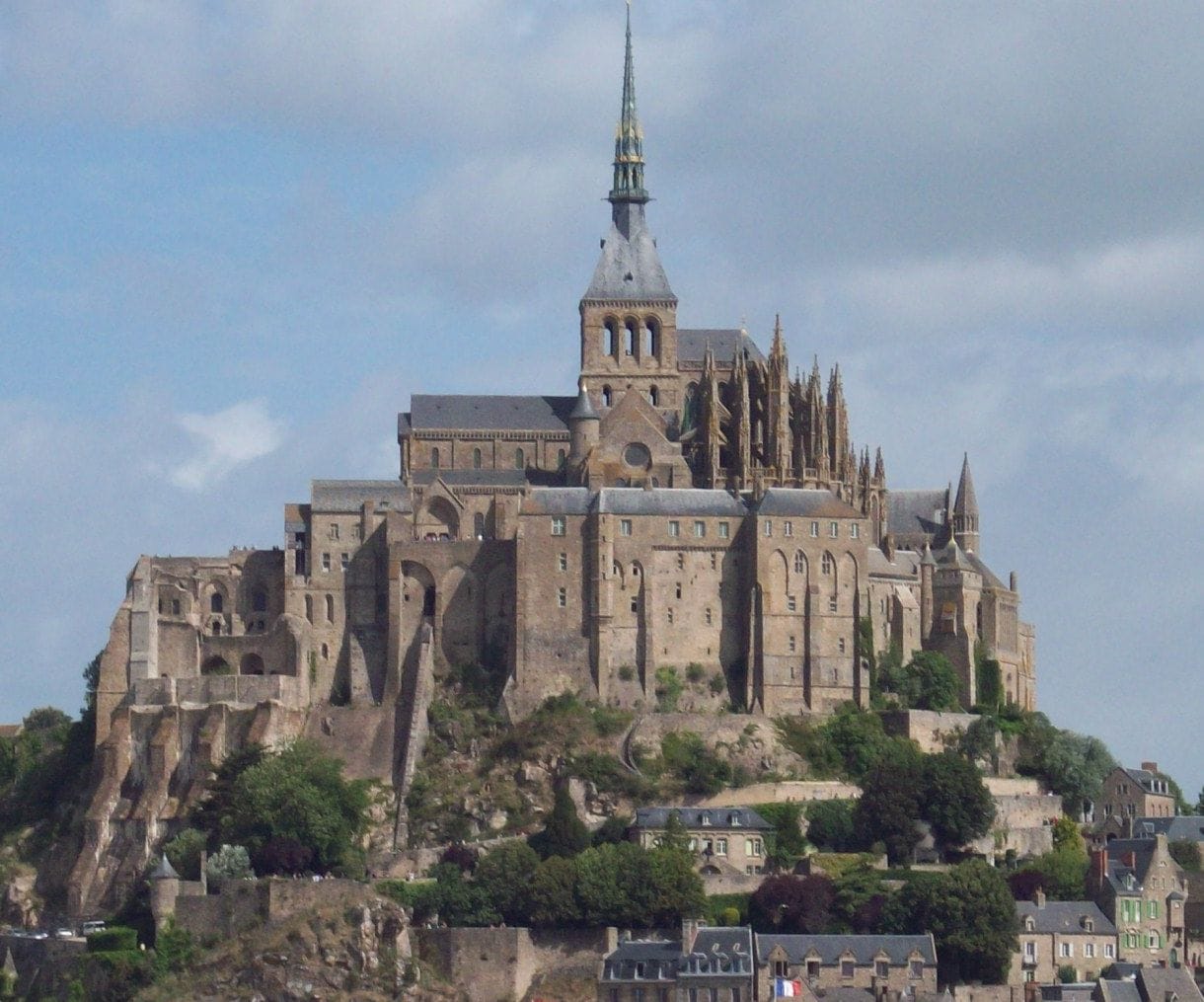
The Mont from the south approach
Benedictine abbots and their master-builders, from the church begun in 1023 to the choir finished in 1523; the town wall under Abbot Robert Jollivet from 1417; bell tower and spire by Victor Petitgrand (1841–1898), statue by Emmanuel Frémiet (1824–1910) · Abbey church begun 1023; ramparts from 1417; spire 1897 · Granite rock about 960 m round, rising to 92 m above sea level; the abbey church on its summit is 80 m long
Look for
- The gilded figure on the very tip of the spire. It is Saint Michael, by the sculptor Emmanuel Frémiet, and he has stood up there since 1897.
- The layers, read from the bottom: rock and trees, then the village inside its wall, then the massive abbey buildings wrapped round the summit, then the church on top. It is the medieval order of the world, built in granite.
- The pinnacles and flying buttresses to the right of the tower. That is the Flamboyant Gothic choir, built after the Romanesque one collapsed in 1421.
Transcript (2:18)
Stand far enough back that the whole thing fits, and it looks like a single building. It is not. What you are looking at is a granite rock about 960 metres round, with a village wrapped around its foot, a wall wrapped around the village, and an abbey wrapped around the summit, each layer resting on the one below.
The rock came first, by about 525 million years. It is leucogranite, magma that cooled underground, and it outlasted the softer stone around it when the sea came in, which is why it stands alone in the bay. People called it Mont Tombe. Then, the story goes, in 708 the archangel Michael appeared three times in a dream to Aubert, bishop of Avranches, and asked for a sanctuary out here. The legend adds that he left the mark of his finger on the bishop's skull, and a skull with just such a scar is still shown in the basilica of Saint-Gervais in Avranches.
Read the Mont from the bottom up and you are reading the Middle Ages' idea of order. At the foot, outside the walls, the fishermen and the farmers. Above them, stores and houses. Above those, the great halls. And at the very top, God, the abbey and the monks. Benedictines arrived in 966, installed by Duke Richard the First of Normandy, and in the eleventh century their builders did something outrageous: they built four crypts around the tip of the rock and set an abbey church 80 metres long on top of them.
Look to the right of the tower, at the thicket of pinnacles and flying buttresses. That is the choir, and it is not the first one. The Romanesque choir collapsed in 1421, and it was rebuilt afterwards in Flamboyant Gothic.
The Hundred Years' War explains the wall in front of you. From 1417 Abbot Robert Jollivet closed the whole lower town inside a continuous crenellated rampart, and you go in through three gates: the Porte de l'Avancée, the Porte du Boulevard, and the Porte du Roy, where the Grande Rue begins. The English laid siege from 1423 and never got in. In the assault of the seventeenth of June 1434 they left two wrought-iron bombards behind on the sand, and the Montois brought them inside as trophies and called them the Michelettes.
Now the top. The spire is younger than it looks. Victor Petitgrand rebuilt the bell tower and raised this neo-Gothic spire between 1892 and 1897, and it is what gives the Mont the pyramid outline everyone draws. The gilded figure on the point is Saint Michael himself, by the sculptor Emmanuel Frémiet, and he has been up there since 1897.
Jorge Láscar from Melbourne, Australia, CC BY 2.0, via Wikimedia Commons. Photo: Jorge Láscar from Melbourne, Australia
_and_Mont_Saint_Michel_Abbey_walls_(32921466455).jpg)
Stop 2 of 5 · Top of the village, on the Barbacane landing of the Grand degré extérieur, facing the Châtelet, with the east end of the Merveille and the Tour des Corbins rising on your right; before the security check, free
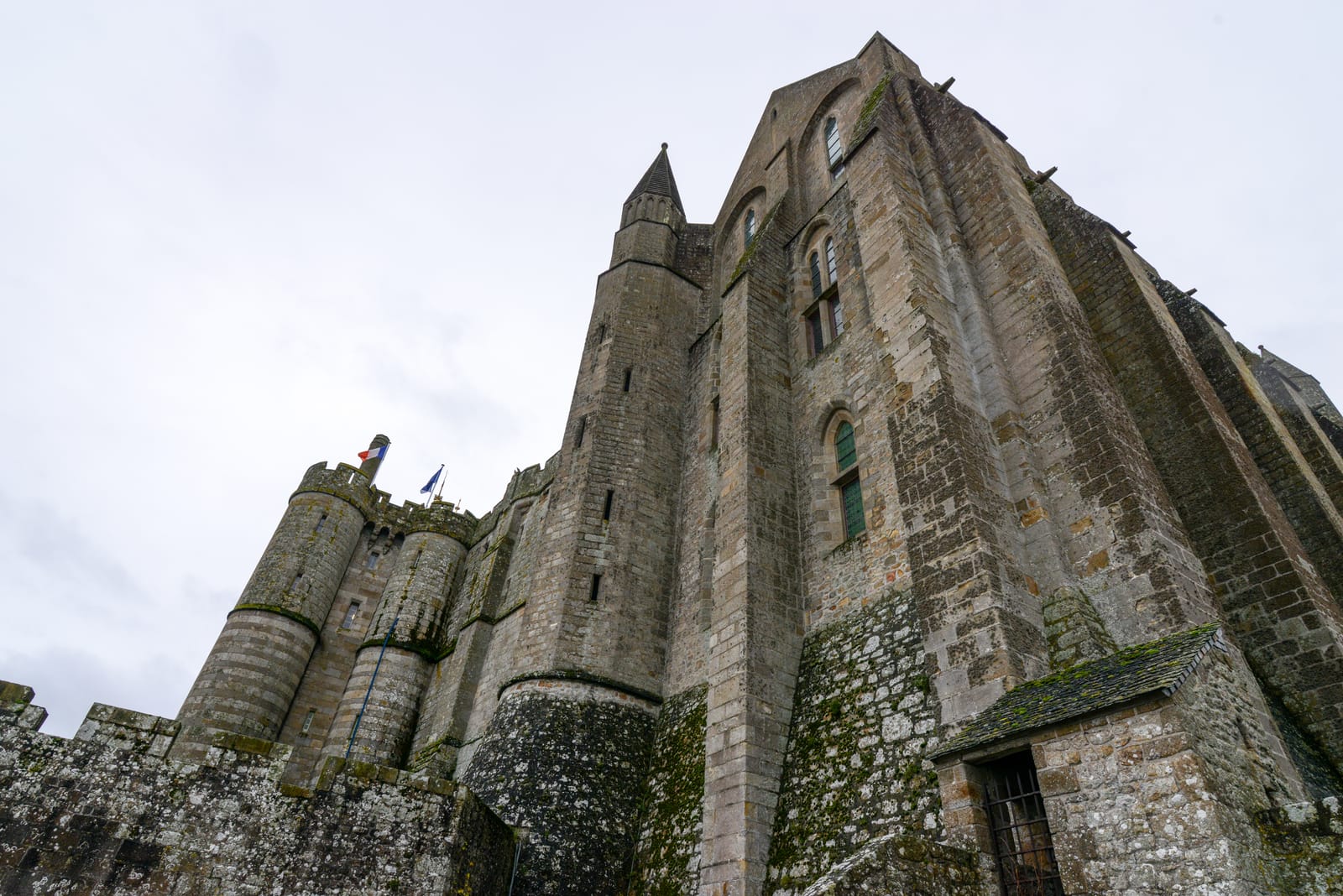
The Châtelet, the abbey's fortified gate
Built for Abbot Pierre Le Roy (abbot 1386–1410); the Merveille behind it built 1211–1228 under Abbots Jordan and Raoul des Îles · Gate of 1257; the two turrets added in 1393 · Granite; two round turrets on corbels over the entrance stair, reached by the Grand degré extérieur, around a hundred steps and 4 m wide
Look for
- The two round turrets of the Châtelet, standing out from the wall on stone brackets, with machicolations at the top. They were stairs as well as defences.
- The Gouffre, the abyss: the very steep stair that vanishes into the dark under the low arch. It leads to the Guard Room, the real entrance to the abbey.
- On your right, the slender Tour des Corbins with its pointed cap, and behind it the buttressed east end of the Merveille.
Transcript (2:01)
You have climbed the Grand degré extérieur, around a hundred steps of it, and this landing, the Barbacane, is the last place to catch your breath before the abbey. Straight ahead, two round turrets stand out from the wall on stone brackets, with the entrance slung between them. This is the Châtelet. The two turrets were added in 1393 to flank a gate of 1257, and together they make one thing clear: the monks inside expected trouble.
The man behind it was Abbot Pierre Le Roy, elected in 1386, and he treated the approach to his abbey as a military problem. He built the square Tour Perrine to house a garrison, the great stair you have just climbed and the Tour Claudine that watches over it, and then this gatehouse straddling the entrance stair, with the barbican in front of it where you are standing. The turrets carry machicolations and merlons at the top, and each one doubles as a staircase.
The stair below you was part of the defence too. It is 4 metres wide, and halfway up it used to be barred by a pivoting door, with a guard posted in a recess you can still find on the left. The Montois have their own name for it: the Monteux.
Now look under the low arch of the Châtelet. A very steep stair runs straight up into the shadow of the vault. It is called the Gouffre, the abyss, and it leads to the Guard Room, the real entrance to the abbey, where pilgrims were once welcomed and where a garrison moved in during the Hundred Years' War.
Turn to your right. The slender tower with the pointed cap is the Tour des Corbins, which has always had the job of protecting this entrance; Pierre Le Roy crowned it with an octagonal top, and inside it is mostly the staircase of the building behind. That building, the vast wall rising beyond it, is the east end of the Merveille, the Marvel, and it exists because of a massacre. In 1204 a Breton army allied to the French king set fire to the village below and slaughtered its people, and the fire spread to the abbey. Philip Augustus, horrified by what his ally had done, gave Abbot Jordan a grant to rebuild in the new Gothic style, and between 1211 and 1228 the monks raised two three-storey buildings on the steepest face of the rock.
Follow the buttresses up that wall. They are evenly spaced and they run all the way to the top, because the upper floors were heavy enough to push the walls outwards, and the builders made every level lighter than the one beneath it.
Pumpdurd, CC0, via Wikimedia Commons. Photo: Pumpdurd

Stop 3 of 5 · Upper level of the abbey, on the West Terrace in front of the church's classical façade, the third point on the abbey's own route
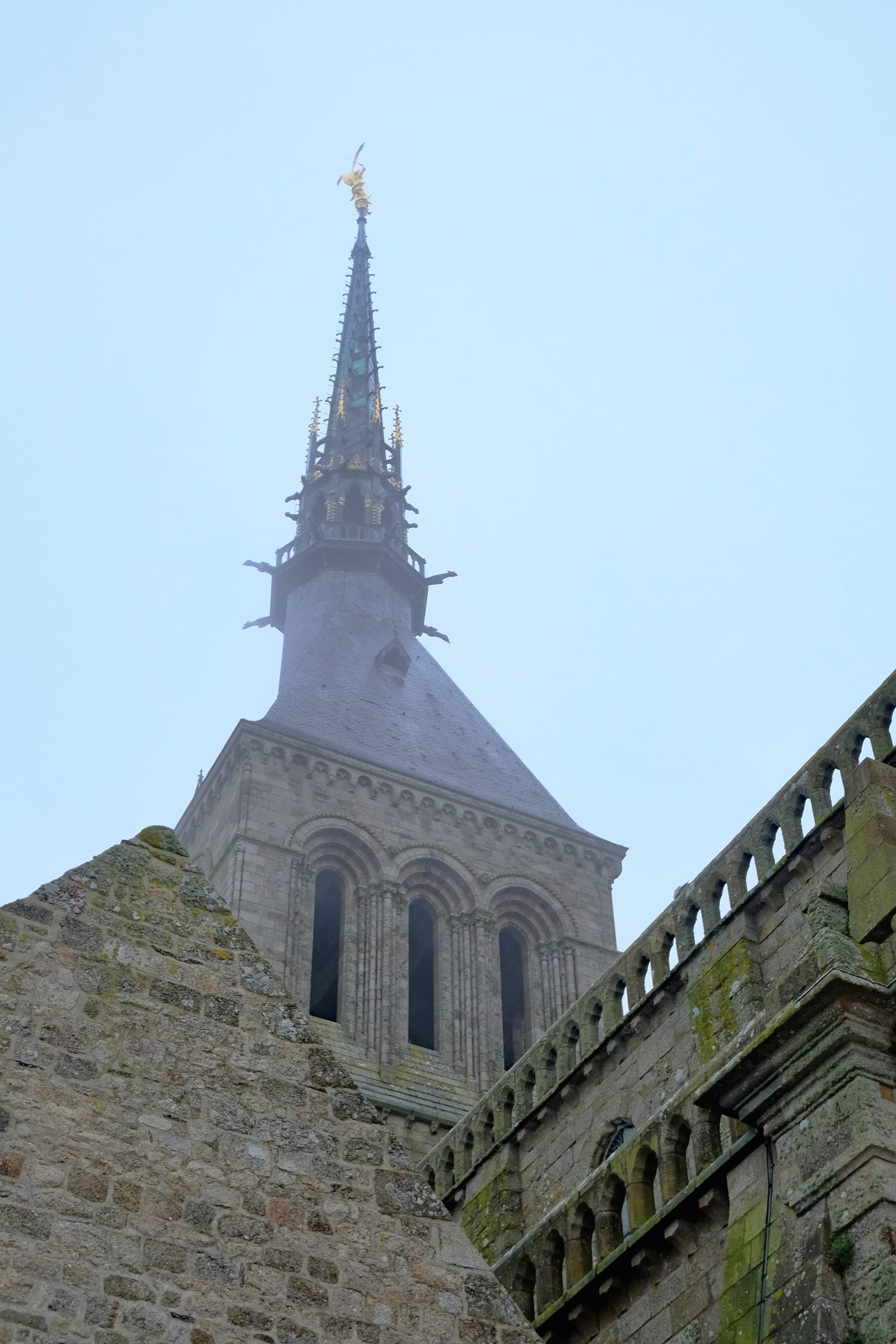
The West Terrace, under the spire of Saint Michael
The terrace covers the church's first three nave bays, taken down after a fire in 1776; classical façade of 1784; bell tower and spire rebuilt 1892–1897 by Victor Petitgrand (1841–1898); statue by Emmanuel Frémiet (1824–1910) · Façade rebuilt 1784; spire 1897 · Granite from the Chausey islands; a spire 40 m tall carrying a gilded copper statue 3.5 m high
Look for
- Tombelaine, the smaller granite islet out in the bay to the north. In good weather the Chausey islands show beyond, where the abbey's granite came from.
- The flat classical façade of 1784 behind you. It closed off the church after the first three bays of the nave were taken down, and you are standing on them.
- Straight up: the spire and Frémiet's gilded Saint Michael, 3.5 metres of beaten copper that looks tiny from here.
- The polders to the west, the squared, dead-flat fields won from the bay and farmed as market gardens.
Transcript (2:00)
Out of the stairs and onto open stone, with the whole bay spread in front of you. This terrace is where the abbey finally lets you see where you are, and it is also a scar.
You are standing on the church. This paving was the original forecourt of the abbey church, plus the first three bays of its nave. After a fire in 1776 those bays were taken down, and the flat classical façade behind you, finished in 1784, closed off what was left. Its foundations went down through Notre-Dame-sous-Terre, the small pre-Romanesque church hidden under your feet, and split it in two. It had been swallowed by later building and forgotten, until Paul Gout found it in 1898, digging under the church floor.
Now the view, and give it time, because it changes while you watch. To the west, the Rock of Cancale and the coast of Brittany; to the east, the cliffs of Normandy. Two granite massifs break the flat: Mont-Dol inland to the west, and out in the bay to the north, the islet of Tombelaine. In good weather you can pick out the Chausey islands, and they are not idle scenery. The granite this abbey is built from came from Chausey. The whole bay covers nearly 500 square kilometres. The dead-straight fields to the west are polders, land won from the bay and now used for market gardening, and the salt-meadow sheep graze below you where the sea comes and goes. Seals and dolphins are regulars out there.
Then turn round and look straight up. This bell tower has burned so often it is almost a tradition: storms and lightning set the abbey on fire a dozen times. In 1794 the top of the tower carried a Chappe optical telegraph, one link in the line between Paris and Brest. What you see now is Victor Petitgrand's work of 1892 to 1897, a neo-Romanesque tower and a neo-Gothic spire 40 metres tall.
On the point is Saint Michael, by Emmanuel Frémiet: plates of rolled, beaten and gilded copper, 3.5 metres tall and 800 kilograms, put up in pieces on the sixth of August 1897. He was restored in 1987 and regilded in 2016, and in March 2016 a helicopter lifted him clean off the spire so that his lightning conductor could be repaired. From this terrace, with nothing but sky behind him, he is the last thing the whole Mont points at.
Van Der Meulen Christofle, CC0, via Wikimedia Commons. Photo: Van Der Meulen Christofle
.jpg)
Stop 4 of 5 · Upper level of the abbey, the cloister, the fifth point on the abbey's own route, reached from the abbey church
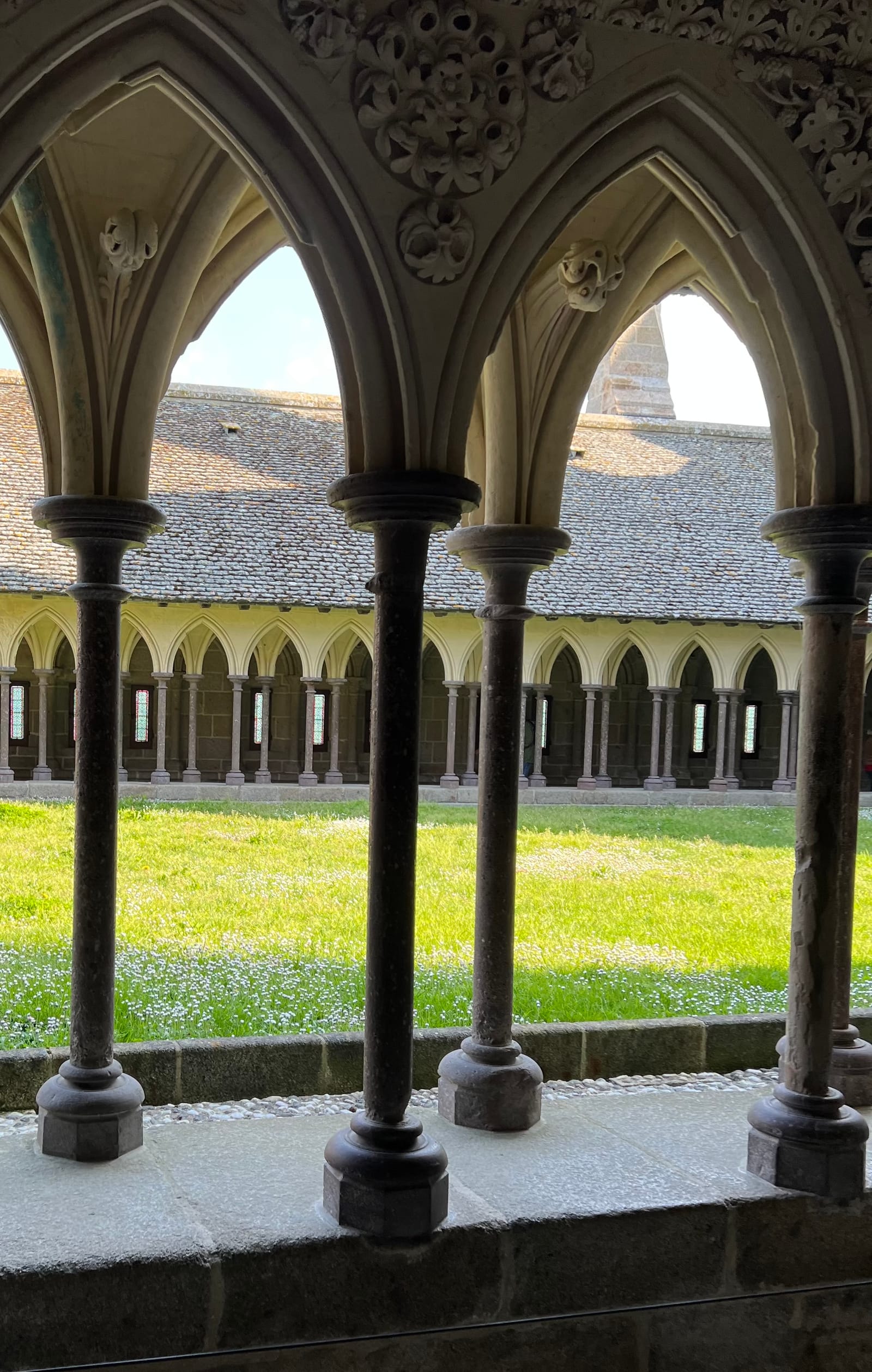
The cloister at the top of the Merveille
Built 1225–1228 under Abbot Raoul des Îles; columns restored under Édouard Corroyer (1835–1904) in the late nineteenth century · 1225–1228 · Caen stone, with a colonnade of 137 columns in staggered rows, now in pudding-stone from La Lucerne-d'Outremer; the floor lies 78.6 m above sea level
Look for
- The two rows of columns, set slightly offset. Walk a few steps and watch them slide past each other.
- The carved spandrels above the arches: plant motifs, and on one of them the abbey's own photographers found a small owl.
- The open bays on the west side, looking onto the sea. They were meant to be doors into a chapter house that was never built.
- The two stone benches of the lavatorium in the south walk, where the monks washed their hands before meals.
Transcript (2:08)
After the weight of everything below, this is the surprise: light, grass, sky, and a roof that seems to float. You are at the top of the Merveille, on the highest floor of a Gothic building standing on the steep north face of the rock, and there is a garden up here.
It was built between 1225 and 1228, under Abbot Raoul des Îles, and its builders had one problem above all others, which was weight. Everything here sits on two storeys of great halls. So the walk around you is roofed on a timber framework rather than stone vaults, and the arcade stands not on a wall but on columns, 137 of them. Look at how they are set. They stand in two rows, slightly offset, grouped in threes like tripods to carry the arches. Walk along one side and watch the rows slide past each other. The abbey's own description is ever-changing perspectives, and it is exactly right.
The columns you see are not the first ones. They were cut from Purbeck marble, a shelly limestone from England, and in the late nineteenth century, when Édouard Corroyer was restoring the abbey, they were replaced in a purple pudding-stone from La Lucerne-d'Outremer, in the Manche. The carving is in Caen stone. Look up at the spandrels between the arches, plant motifs, cleaned and restored in 2017. Somewhere among the leaves the abbey's own photographers found a small owl.
This cloister breaks the rule. In most monasteries the cloister sits in the middle, and every building opens off it. Here it is pushed out to the edge, and its job was spiritual: a garden open to the sky at the top of the mountain, where the monks came to meditate, and walked in procession on feast days. It was a corridor too, between the church, the refectory and the rest of the abbey.
Go to the west side and find the bays that open straight onto the sea. That is not a view anyone planned. The central opening was meant to be the door into a chapter house, in a third block that would have extended the Merveille, and it was never built. From the opening you can still see where its foundations begin.
In the south walk, twin arcades frame the lavatorium, two stone benches where the monks washed their hands before going in to eat, and where the washing of feet was held every Thursday. And under the roof of the north walk, in the prison years, the administration built cells called loges to chain up the prisoners who gave the most trouble, Auguste Blanqui among them. Meditation and punishment, on the same four sides of grass.
Jorge Láscar from Melbourne, Australia, CC BY 2.0, via Wikimedia Commons. Photo: Jorge Láscar from Melbourne, Australia
_of_Mont_Saint_Michel_(32541036080).jpg)
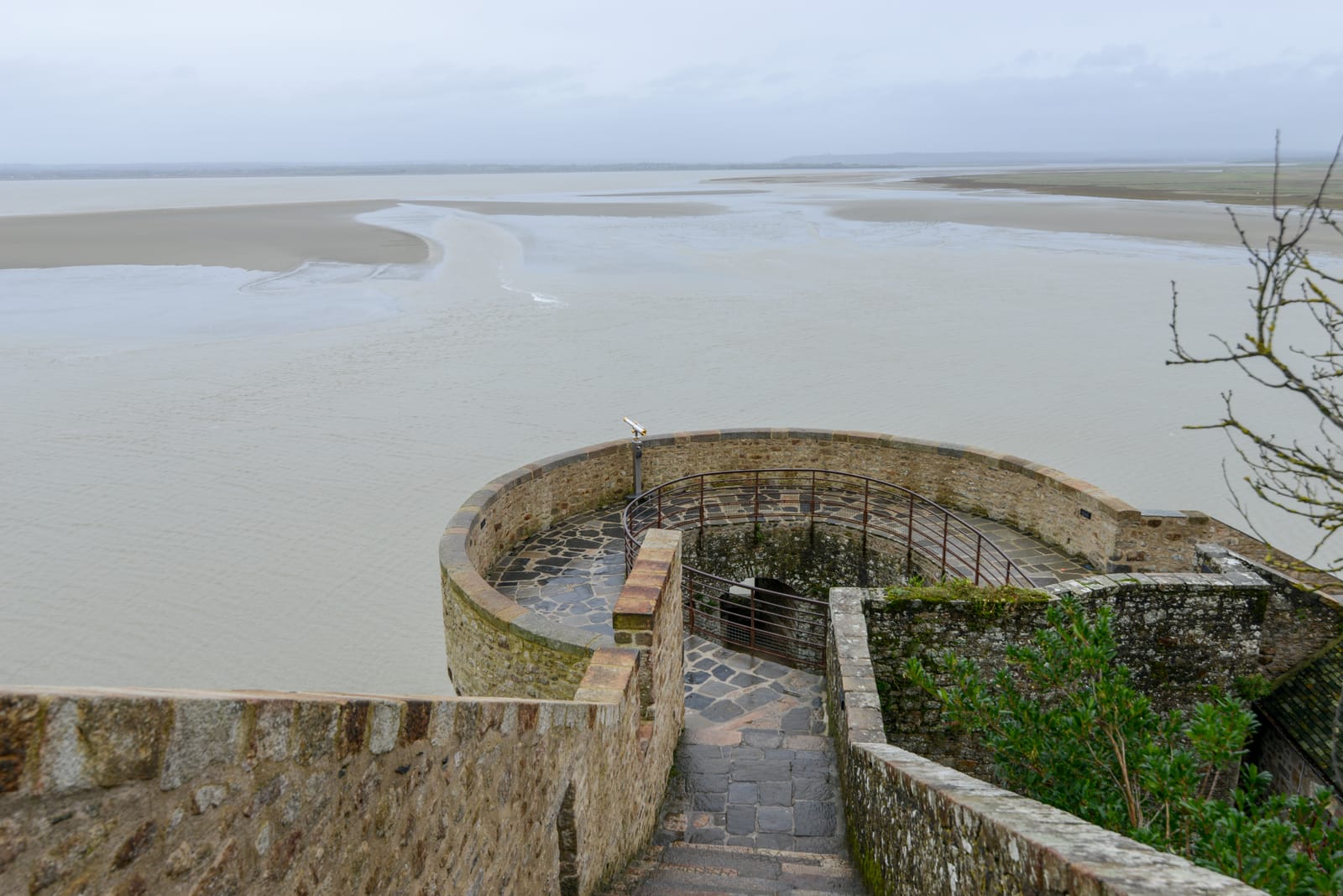
Stop 5 of 5 · The ramparts walk, at the Tour du Nord, the northern end of the town wall; reached after leaving the abbey through the northern gardens, free
The Tour du Nord, on the ramparts
Begun in the mid-thirteenth century; the first town wall completed under Abbot Guillaume du Château (abbot 1299–1314); parapets of the fifteenth century · Begun mid-thirteenth century; first town wall completed about 1311; parapets fifteenth century · Granite; a round tower with a blind parapet on machicolations, over a bay of nearly 500 km² where the sea can pull back up to 15 km
Look for
- Tombelaine, the low granite islet 3 kilometres out to the north. The English held it during the Hundred Years' War.
- The channels and sandbanks the tide leaves behind. When it turns, watch how fast their edges move.
- The machicolations under the parapet: the openings in the overhang through which defenders could drop things on anyone at the foot of the wall.
Transcript (1:57)
The abbey is behind you now, and so is the climb. You came out through the northern gardens, under the north front of the Merveille, the wall with the tall, narrow windows that Victor Hugo called the most beautiful wall in the world, and down onto the ramparts. This round platform is the Tour du Nord, and it is the best free seat on the Mont for the one thing here that never stops moving, which is the sea.
The tower belongs to the first town wall. It was begun in the middle of the thirteenth century, and around 1311 Abbot Guillaume du Château completed a rampart that ran from here to the east end of the parish church of Saint-Pierre; three years later the Mont had its first garrison: one man-at-arms and five servants. Look at the parapet. It is blind, with no openings in its face, and it stands out on machicolations, gaps in the overhang through which the defenders could drop whatever came to hand. The walk beyond, with its seven towers running down to the Tour du Roy by the gate, has its parapets from the fifteenth century, when the English were just across the water.
Just across the water is not a figure of speech. Look north, and the low granite hump 3 kilometres out is Tombelaine. During the Hundred Years' War the English turned it into a stronghold, and ruins from that time are still on it. Today it is a bird reserve, where many birds nest in spring.
Now the flats. The difference between high and low water here is roughly 14 metres, and on the big tides around the spring and autumn equinoxes the sea can pull back as far as 15 kilometres, then return very fast, until it surrounds the rock completely. The wave at the front of it is the tidal bore. The legend says it comes in at the speed of a galloping horse. In fact it averages about 6 kilometres an hour, a brisk walking pace, and the abbey itself strongly advises nobody to go out into the bay alone. Medieval pilgrims had a name for this place, Saint Michael in peril of the sea, and they meant it.
The same sands kept people in. From the Revolution until 1863 the abbey above you was a prison, the Bastille of the Seas, and some 14,000 prisoners passed through it. Nobody needed a higher wall to hold them. The tide and the quicksand did that, and they are still out there, shining, between you and the shore.
Independent guide · Chiaro
Point Chiaro at anything on Mont-Saint-Michel.
A rock with a village, seven towers on its wall, four crypts under one church and an abbey stacked on three levels does not fit into five recordings. Frame a carved spandrel in the cloister, a sculpted sign hanging over the Grande Rue or a sandbank you cannot name from the ramparts, and Chiaro names it, dates it, says which abbot or captain wanted it there, and is still answering when the next question occurs to you on the ramparts.
Before you go
Getting there
Abbaye du Mont-Saint-Michel, 50170 Mont-Saint-Michel, at the top of the village. The shuttle leaves you at the footbridge, about 350 metres from the Mont. Straight ahead is the double gateway into the village and the Grande Rue, about 400 metres from the abbey; to the left is the Fanils gateway and the path along the ramparts, about 520 metres. The abbey entrance is at the top of the Grand degré extérieur.
The nearest station is Pontorson, with a bus on to the Mont; the abbey also lists routes from Paris by TGV to Rennes or Dol-de-Bretagne and from Caen by TER. Keolis Armor runs direct buses from Rennes, several return trips a day that connect with TGVs from Paris, and one return trip from the Esplanade Saint-Vincent in Saint-Malo, whose running days are worth checking in advance. By car, the paid car parks P2 to P13 are on the mainland about 2.5 kilometres out; the parking ticket includes the free shuttle, le Passeur, which leaves every 5 to 15 minutes, or it is at least 40 minutes on foot.
Tickets and entry
- The abbey keeps two sets of hours: 9am to 7pm from 1 May to 31 August, and 9.30am to 6pm from 1 September to 30 April. Last entry is an hour before closing and the last Revelacio tablet goes out an hour and a half before. Its doors stay closed on New Year's Day, on 1 May and on Christmas Day, and on the odd day given over to an event, which the abbey announces at the top of its own website.
- An individual ticket is 16 euros until 30 September 2026 and 13 euros from 1 October 2026 to 31 March 2027, and it covers every room on the route. Under-18s with their families go free, as do 18 to 25-year-olds from the European Union or living in France, and everybody on first Sundays from November through March. You can buy online or at the ticket office just past the security check in the Guard Room.
- The village, the Grande Rue, the ramparts walk and stops 1, 2 and 5 on this page need no ticket, reservation or time slot. The abbey turns away suitcases, large bags and pets, even in a carrier, and has no left-luggage, so leave them behind before the climb.
- There are no ramps or lifts anywhere on the Mont, and the abbey route is steps from end to end; pushchairs have to be folded inside. Some outdoor areas of the abbey may close in bad weather. The abbey strongly advises against going out onto the bay alone.
The official audio guide
The abbey offers four ways in besides this page. A printed visit document in 13 languages, free at the reception desk and at the church door. A commented tour of about 45 minutes by the monument's own staff, in French or English, at no extra charge, booked online or on arrival while places last. The Revelacio augmented-reality tablet, 6 euros on top of the ticket, with a 45-minute Discovery route and a 1 hour 30 Exploration route, against an ID card left at the desk. And a two-hour conference visit with a Centre des monuments nationaux guide, which also opens rooms closed to everyone else, at 24 euros until 30 September 2026 and 20.50 euros from 1 October. This page starts earlier and finishes later than all four: on the sand below the gate, and on the wall walk after the abbey lets you out, in your own browser, with every word of each track written out below it.
Official site →Questions
Is there a free Mont-Saint-Michel audio guide?
Three of its five stops do not even need a ticket: this page streams all five to your phone, from the south approach in the village to the ramparts. Inside the abbey the free help is the monument's own printed visit document, in 13 languages, and a 45-minute commented tour by its staff in French or English. The abbey's own device, the Revelacio tablet, is not free.
Can I listen to the Mont-Saint-Michel audio guide without a ticket?
For three stops out of five, yes. The south approach, the Châtelet seen from the Barbacane landing and the Tour du Nord on the ramparts are all in the village, which is a commune anyone can walk into without a ticket, a reservation or a time limit. The West Terrace and the cloister are inside the abbey and need the standard ticket, which covers every room on the route.
How much is the official Mont-Saint-Michel audio guide?
The abbey's own guide device is the Revelacio augmented-reality tablet, at 6 euros per device on top of the entrance ticket, and you leave an ID card with the desk until it comes back. It has a 45-minute Discovery route, a 1 hour 30 Exploration route and a children's route. The last tablet is handed out an hour and a half before the abbey closes.
When is Mont-Saint-Michel Abbey closed?
On New Year's Day, on 1 May and on Christmas Day, and occasionally for an event such as a festival, which the abbey posts on its own website. Otherwise its doors are open 9am to 7pm from May to August and 9.30am to 6pm from September to April, with last entry an hour before closing. The village itself has no opening hours at all, and the ramparts walk is open to the public.
Where does the Mont-Saint-Michel walk start, and how far is it?
It starts at the foot of the Mont on the south side, before the Porte de l'Avancée, near where the shuttle drops you. From the car parks to the abbey entrance the abbey allows 45 minutes to an hour on foot, and from the village gate it is about 400 metres uphill by the Grande Rue. The abbey's own route inside takes 45 minutes to an hour and a half, and the Tour du Nord is a short walk down the ramparts after the exit.
More audio guides
Made by Chiaro. Not affiliated with Mont-Saint-Michel.